




Abstract
Scavengers are continuously exposed to several health hazards which affect their quality of life. The phenomenon of scavenging in Pakistan is on the rise but literature on scavengers’ health and illness is limited. Hence, this study intends to add to the knowledge by exploring the health status and illness experiences of refugee scavengers using phenomenology approach. Thirty-one adult male Afghan refugee scavengers (with at least 5 years of work experience) were recruited in this qualitative study through purposive sampling. To collect the lived experiences, this study predominantly relied on open-ended, face-to-face, semistructured, and in-depth interviews by using an interview protocol. The qualitative data analyzed with Max van Manen’s hermeneutic phenomenological reflection revealed that all the scavengers were experiencing multiple health problems ranging from minor to chronic illnesses. These health issues were frequent in nature and had affected their overall life mostly daily activities, job, and earnings. The study concludes with the need to increase literacy among scavengers, raise their health awareness and usage of personal protective equipment at work.
Introduction
The growing demand for solid waste management has opened doors for informal waste collection such as scavenging. Informal waste recycling is normally carried out by the poor of developing countries and considered as an important survival strategy and adaptive response (Ezeah et al., 2013; Medina, 2005). The activity of surviving on what others have emitted aside as waste (Sicular, 1992), feeds approximately 15 million people globally (Medina, 2011).
In Pakistan, Afghan refugees constitute a majority of the scavenging population. Afghans took refuge in Pakistan when the Soviet Union invaded Afghanistan in 1979 (Malik et al., 2018). The protracted history of Afghan migration can be divided into five waves. The first wave started during the Soviet–Afghan War between 1980 and 1992. The second wave of the refugee influx took place when mujahideen took over Kabul in 1992, followed by the third wave in 1996 when the Taliban took control of Kabul. The drought and famine-like situation led a mass exodus from Afghanistan during the 1990s which marked the fourth wave. Finally, the U.S.-led invasion in 2001 brought the last wave of refugees to Pakistan (Ali et al., 2019; Khattak, 2003).
Pakistan has generously hosted millions of Afghan refugees during these migration waves. According to a recent estimate, approximately 1.4 million registered Afghan refugees are still residing in Pakistan and roughly two thirds of them live in the urban areas (United Nations High Commissioner for Refugees, 2020). Exile has not been easy for these refugees. Lack of education, skill, and resources as well as the absence of legal documents restricted their access to the formal job sector and left with scarce job opportunities. Thus, forcing them to join scavenging for survival (Masood & Barlow, 2013). Although scavenging generates money for the poorest of society, it is a hazardous activity that jeopardizes the workers’ health.
The ubiquity of solid, industrial, and clinical waste at landfills makes it a hazardous place to work at it. During work, waste workers largely come in contact with human and animal excrement, various pathogens, toxic substances, chemicals, sharp objects, and clinical waste (Athanasiou et al., 2010; Bogale et al., 2014). Regular and protracted exposure to these substances leaves adverse effects on physical and mental health. In the given situation, scavengers are at greatest risk or being affected due to their direct connection with garbage. The conventional way of rummaging waste manually, bear-handed and sometimes bear-footed, make them prone to infections (Awopetu et al., 2014). Moreover, lack of health risk awareness, unsafe working conditions, poor personal hygiene, and absence of personal protective equipment (PPE) and precautionary safety measures further contribute to the occurrence of work-related injuries and diseases (Chandramohan et al., 2010; Jayakrishnan et al., 2013; Majeed et al., 2016; Ohajinwa et al., 2017).
In regard to health hazards, scavengers have been studied in several countries (Heloisa Maciel et al., 2010; Owusu-Sekyere, 2014; Singh & Chokhandre, 2015; Thirarattanasunthon et al., 2012; Wachukwu et al., 2010); the findings reveal a strong connection between the working environment and potential health problems. The most common health problems include accidents, injuries, respiratory disorders, dermatological irritations, musculoskeletal morbidities, gastrointestinal problems, fatigue, headaches, nail infections, and various types of allergies (Asampong et al., 2015; Chokhandre et al., 2017; Nyathi et al., 2019).
There is a growing literature on occupational health and risk of scavenging. However, in Pakistan little is known on the subject. Moreover, studies that explore the subjective illness experiences of scavengers are relatively scarce. The existing knowledge also indicated poor health and risks of communicable diseases among the waste collectors. Batool and Anjum (2016), noted that injuries (79.8%) were the most common among Pakistani scavengers followed by digestive (14.8%), skin (11.2%), and respiratory disorders (8.4%). Similarly, Majeed et al. (2016) and Abdul-Rauf et al. (2013), reported the high prevalence of hepatitis B and C infection. The reviewed studies (Abdul-Rauf et al., 2013; Alam et al., 2011; Batool & Anjum, 2016; Batool et al., 2015; Majeed et al., 2016) presented a general understanding of scavengers’ health through quantitative methods, whereas the detailed description of the health problems and its effects on their lives were mostly missing. Moreover, Afghan refugees generally dominate the scavenging activities in Pakistan (Masood & Barlow, 2013), but they were largely overlooked in the available literature.
The dearth of literature highlights the need for further understanding of the subject. Hence, this study aims to explore, understand, and describe the health status and illness experiences of Afghans scavengers in city Gujrat Pakistan. The findings of this study could be useful in designing policies and plans catering to the scavengers’ and refugees’ health care needs.
Method
For this qualitative inquiry, phenomenology approach was chosen to gain a comprehensive understanding of Afghan scavengers’ lived experiences. Phenomenological research emphasis on lived experiences and their meanings (van Manen, 1990); therefore, it requires a researcher to set aside all personal opinions and produce a rich textual description of a phenomenon as it is experienced by the individuals (Creswell, 2014; Groenewald, 2004). This methodological approach was appropriate as, like the objective of this study, it attempts to explain the subjective experiences of people through their life-world stories (Kafle, 2011).
Participants
A total of 31 Afghan refugee scavengers were recruited from city Gujrat Pakistan via purposive sampling. The sampling technique helped to create a small, homogeneous, and purposeful group of Afghans who all had experienced the phenomenon of scavenging. In this study, the inclusion criteria for participation included (a) Afghan refugee, (b) adult male (as Afghan women are not allowed to work outside the home), (c) full-time scavenger, (d) 5-year work experience or above, and (e) willingness to share experiences. The sample was homogeneous in nature as besides scavenging experiences, the participants had similar characteristics like sex (male), religion (Islam), ethnicity (Pashtun), and nationality (Afghans).
The participants of this study were not selected haphazardly, rather purposefully. The process of selection began with an intention to approach the most appropriate interlocutors based on the inclusion criteria (a–e) and talking to them about the purpose of the study and the significance of their participation. However, despite being a native resident of the research site, recruiting the appropriate informants was challenging. The biggest challenge was to access potential participants. Initially, several unsuccessful attempts were made to locate and persuade the Afghans independently. Subsequently, a few Afghans were approached and convinced for cooperation, which eventually did not work as they were skeptical of the research. Later on, an Afghan refugee, working as a laborer, agreed to introduce us to one of his relatives scavenger, who at the end agreed to participate in the research. Thenceforward, we got to introduce to more potential participants. Moreover, all the willing interviewees were visited personally beforehand to set a convenient time and place of the interview.
This study was carried out in accordance with the ethical codes set by the British Sociological Association (2017), which ensured the consent and confidentiality of the research participants. Before proceeding to the actual interview, as a prerequisite, the participants’ consent to engage in the study was taken. Due to the uncertain and chaotic situation among Afghan refugees, the participants were not willing to sign any document. Moreover, being illiterate, most of them were not able to read the consent form for themselves. Therefore, the informed consent form, addressing the risks and benefits of involvement, confidentiality of the information, and right to withdraw the interview (Escobedo et al., 2007), was read out loud to them and their verbal consent was recorded to ensure voluntary participation. In addition, to protect the anonymity of the participants, their identities were concealed by assigning pseudonyms or aliases (Creswell, 2013). Each participant was allotted a pseudonym, which has been used throughout the article.
Data Collection
To collect the lived experiences of the informants, this study predominantly relied on open-ended, face-to-face, semistructured, and in-depth interviews by using an interview protocol. The interview questions were based on an intensive review of prior literature on scavengers’ health problems (see Table 1). The semistructured nature of the interviews encouraged the interlocutors to express views in their own voice and from their own perspectives (Berg, 2007). To ensure the secrecy of the information, make participants comfortable, responsive, and expressive, and avoid stressing them out, all the interviews were conducted within the four walls of interviewees’ home on their request. All the interviews were conducted in one sitting, and no follow-up interviews were possible to arrange, as being engaged in a full-time job, scavengers always complained about lack of time to spare for further interaction.
List of Interview Questions.
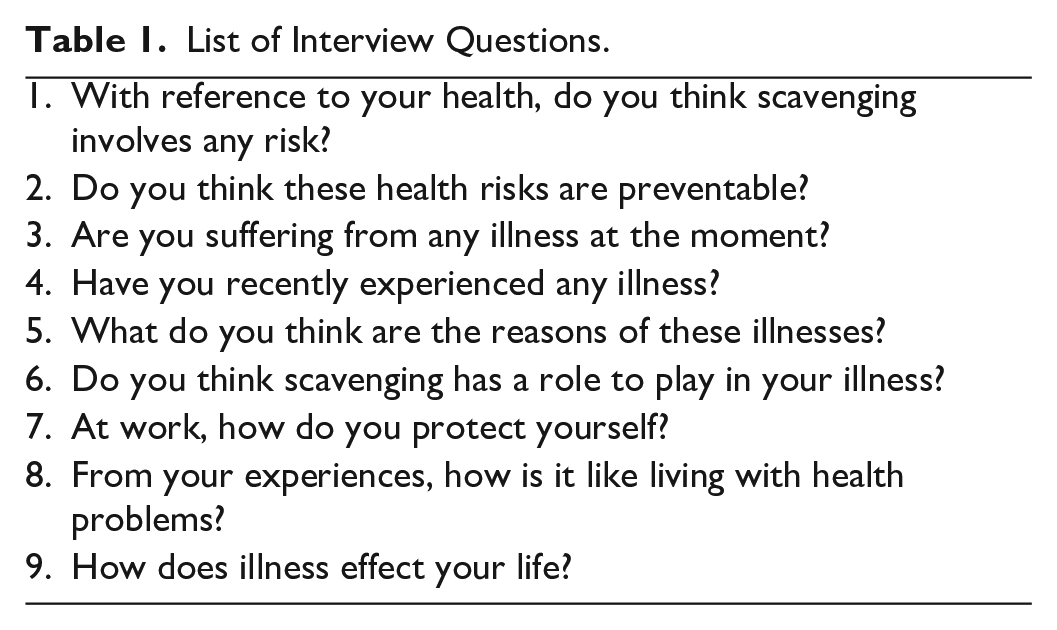
To develop and maintain informants’ interest, the interview commenced with the small talks and basic introductory questions, covering sociodemographic details. The introductory talks subsequently led to the exploration of complex and significant experiences. Hence, interest and confidence level of participants increased as the interviewed proceeded. During the interview, participants were mainly asked about the current and repetitive health problems and how it is living with it. Initially, informants were reluctant to accept that they have any disease or scavenging is a disease-prone profession. Because at the research location, typically the disease is deliberately kept secret from others as disclosing ones’ health problems not only brings disgraces to the person and makes others suspicious about him but also influences the social life of the ill person. The issue of initial disinclination was overcome by winning the informants’ trust and ensuring the confidentiality of their information. Subsequently, it encouraged them to self-report their health problems and illness experiences.
The interviews were audio recorded with the consent of the informants. Each interview lasted for 45–76 min depending on the participants’ ability to focus. During the interview, the participants were encouraged to express their experiences, perspectives, and feelings in detail. Their perspective was accepted and respected by avoiding personal biases and assumptions. Urdu, the national language of Pakistan, was chosen as the medium of communication. The language was prioritized due to the only shared language among the interviewees and the interviewer. Subsequently, the Urdu audio-recorded interviews were transcribed and translated in English for analysis. The data collection continued over the time span of 5 months and ended upon saturation or redundancy point of the data when no new information contributes to the understanding of the topic (Gentles et al., 2015). In this study, the data collection was ceased after 31 in-depth interviews when the participants no longer shared new information about their experiences and their responses got repetitious. A review of the transcribed data helped to ensure the adequacy of the data.
Analysis
Max van Manen’s (1990), hermeneutic phenomenological reflection was used for data analysis. The aim was to grasp the essential meaning of the experienced phenomenon by uncovering its thematic aspects (Kaite et al., 2016).
The analysis procedure started with data reading phase. In an attempt to get familiarized with the data, the transcribed interviews were read and reread meticulously several times for the initial understanding. Reading the data multiple times is highly recommended as each time the reading brings new insights to the data (Smith et al., 1999). Later, the transcripts were reread and all the important, interesting, and repeated phrases revealing the thematic aspects of the phenomenon and answering the research questions were highlighted. These highlighted and meaningful units were then coded or labeled into precise phrases.
In the next step, all the codes derived from data were reviewed to identify whether they can be further grouped under larger units of meaning or particular themes. Subsequently, in the last step, the previously identified themes were reexamined to find links between them and grouped into the superordinate or higher order themes. The superordinate or essential themes summed up the lived experiences of Afghan scavengers. Eventually, the data analysis helped to summarize “what” the individuals have experienced in the phenomenon and “how” they have experienced it (Moustakas, 1994). In this study, NVivo 11, a computer-assisted qualitative data analysis software (CAQDAS), was used to facilitate the process of coding. The purpose of the software was just to manage the coded data and not to analyze it.
Ethical Consideration
The research was conducted in accordance with the ethical standards set by the British Sociological Association and Universiti Kebangsaan Malaysia that ensured consent, confidentiality, and anonymity of the research participants. The study was reviewed and approved by the Faculty of Social Sciences and Humanities, Universiti Kebangsaan Malaysia. Moreover, informed consent was obtained from all the participants for being included in the study. Confidentiality and anonymity were maintained by omitting respondents’ name and personal identification.
Results
Thirty-one male Afghan scavengers, who matched the inclusion criteria, participated in this study. Sociodemographic characteristics reported in Table 2 demonstrates that 18 of the total participants belonged to the age group 20–29 years. The majority (n = 23) never attended school and rest dropped off before completing their primary education. Only two scavengers managed to finish primary school. In terms of work experience, a slight number of participants joined scavenging in their childhood and were still engaged with it. However, most of the scavengers (n = 13) had 6–12 years of work exposure.
Sociodemographic Characteristics of Afghan Scavengers.

The empirical data obtained from 31 Afghan refugee scavengers were systematically analyzed and four essential themes emerged: (a) knowledge and awareness of health risks, (b) personal hygiene as prevention of the risk, (c) physical health problems of scavengers, and (d) living with multiple health problems. Together, these themes helped us in a detailed exploration of scavengers’ health problems and how it is to live with it. The subsequent section will sum up the major findings.
Knowledge and Awareness of Health Risks
The potential health risks of being associated with waste were well known by almost all the participants. They considered the profession a risky one and addressed the higher possibility of getting a disease from the dangerous pathogens it includes. Scavenging was discussed as a disease and injury-prone occupation that affects the daily lives of those who deal with it. Bilal (pseudonym) shared his understanding of the risk as followed:
I know my job is a dangerous one and the variety of germs present in the garbage can make me sick. Placing the recyclable item at home can affect my kids too. But even then, I am bound to continue this work as I do not have any other way of making money.
Only two scavengers opposed the connection between scavenging and illness. They considered illness as inevitable and occur through God’s will. They believed squalor cannot bring a health problem when it is not in fate and no one can prevent it when it has to happen. Essa (pseudonym) shared,
I might get flu, cough, fever or sore throat but I never considered it the outcome of my job. I have been scavenging for the last 20–25 years and I never felt any problem because of my work. . . . when there comes illness from God then nobody can protect me from it. The theories that germs cause health problems is propaganda and meant for terrorizing people from underdeveloped countries. These theories are not true.
Personal Hygiene as Prevention of the Risk
The realization of the potential health risk and the possibility of catching a disease directed the personal hygiene among participants. Despite scavengers’ lower level of formal and religious education, cleanliness was largely stressed by them as a way to diminish the harms. In addition, personal hygiene was linked to the religious obligations of getting rid of impurities and staying clean. Anwar (pseudonym) shared his views:
Cleaning is very important after such activities (scavenging). Every time I bring luggage (retrieved item) back home, I clean my hands before doing anything else. Look, I even have a piece of soap in my pocket which I keep with myself all the time. Whenever I want to clean up outside the house, I use it.
On a similar note, Saeed (pseudonym) stated,
I do not let my clothes become dirty as I have to meet friends outside the house. The friends might say what kind of person I am who knows nothing about personal hygiene, and they might stop seeing me. So, I take care of my cloth and hygiene.
As a part of preventing possible illness, Afghan scavengers also claimed to maintain a distance from everything that could cause harm. The most important was to avoid food items available on streets and dumpsites. Bashir (pseudonym) considered such food as germ-infested and expressed his dislike:
How can I eat food from dumpsites when I am not sure about the condition of the food? It might contain poison or partly eaten by animals. So, consuming such food will surely make me sick.
The excerpt not only reveals the scavengers’ repugnance for the discarded food items but also the knowledge that such edibles are usually rotten and no longer usable, thus it could cause health problems. Nearly all the participants avoided food from waste to stay safe and disease-free.
Despite scavengers’ serious attention to their personal hygiene, a contradiction was observed in their health-related habits especially at work. Dealing with frequent injuries at work carelessly was one of them. Iqbal (pseudonym) revealed,
At work, we all tie wounds with available cloth no matter if it is clean or not. Sometimes we wash the affected area before tying it. People (scavengers) use different ways to stop bleeding, some sprinkle clay on the wound while others pour petrol on it.
Physical Health Problems of Scavengers
As part of the illness experiences, Afghan scavengers spoke about their most recent and repetitive health issues. Each of the participant was suffering from multiple illnesses at the interview. Their self-reported health problems were grouped under three subthemes: injuries and aches, allergies and infections, respiratory and gastrointestinal diseases. The subsequent paragraphs present the detailed description. The following Table 3 presents an overview of all the health problems experienced by the Afghan scavengers.
Health Problems Experienced by the Scavengers.

Injuries and aches
Scavengers discussed injuries and aches as the most common and frequent problems. Regardless of age, back pain was the most prevalent and persistent complaint among them. Apart from back pain, they highly reported multiple joint pain. Most importantly it included wrist, elbow, shoulder, and knee. Heavy lifting and prolonged walks were mentioned as key reasons. Iqbal (pseudonym), who had been in scavenging profession for the last 8 years, shared his experience of pain:
After work my whole body especially the back hurts badly. At night I feel quite tired and when I wake up in the morning, I feel like death would be better than this job. Later when I leave for the work my feet feel as heavy as a mountain. I take very small steps as they (feet) hurt a lot.
Presence of glass and sharp objects at the workplace makes scavenging an injury-prone profession. Almost all the scavengers, except few, admitted that they experience such injuries regularly. Therefore, due to the daily occurrence, the minor injuries were considered a part of the job. However, Sadiq (pseudonym), who had a couple of serious glass injuries, narrated his experience as followed:
Once my coworker and I saw a piece of glass and we both ran to pick it up. While running I got slipped and the targeted glass caused an injury that ended up in nine stitches. Recently, while loading trucking with glass sacks I was hurt again and the cut on my knee was deep enough to get five more stitches.
The excerpt clearly indicates the risk of being repeatedly injured in the workplace and highlights the Sadiq’s experience. Moreover, the scares of deeper cuts on participants’ hands and feet further proved the reoccurrence of such injuries.
Allergies and infections
Eye and skin allergies were also reported by the participants. The occurrence of eye irritation that caused redness, itchiness, burning sensation, swollen eyelids, and watery eyes was associated with the summer season. The participants considered scorching sun and excessive sweating the root cause. Unlike eye inflammation, skin allergies appeared throughout the year and were relatively chronic in nature. The skin disorders were discussed as severe and contagious in nature that caused excessive rash and irresistible itching and took longer to heal. Maqsood (pseudonym) talked about a similar condition:
My entire family and I have the skin allergy for the last five months and it is still there.
Besides allergies, typhoid, dog bite, and hepatitis were experienced by the scavengers. Due to the complex nature, these diseases were reported by only those who had diagnosed it from the doctor. Therefore, the number was relatively small. Dog bite, on leg, was comparatively common among them. Nine of the total participants experienced the dog attack while at work. The dog bite left them with a deeper wound and severe pain that restricted their moment for a while.
Respiratory and gastrointestinal disorders
Toxic gases, air pollution, and incineration at the landfills affect the respiratory health of the waste handlers. Among participants, the respiratory disorders ranged from minor to severe. In the upper respiratory tract, consisting of nose, mouth, and throat, the most frequent problems were common cold and sore throat. The problem was told to occur throughout the year; however, for some, it predominately appeared either in winter or summer. For a significant segment of the participants, runny nose, nasal congestion, and swollen throat normally persisted longer than usual.
Another important problem experienced by the scavengers was the poison from gaseous pollution. Headache, shortness of the breath, and vomiting were discussed as the key symptoms. Scavengers considered gigantic dumpsites as the root cause of the problem. As these places generate heat and stench that makes it difficult to carry out the work. In addition, working under the sun, especially in summer intensifies the problem. Ali (pseudonym) summed up it:
The dumpsites that contain more waste and smell cause shortness of breath and vomiting. When it happens to me, I leave the workplace as soon as possible and find water nearby to drink and freshen up. I also take rest under shade for a while and feel better afterward.
Participants reported fewer cases of lower respiratory tract disorders. Only a small number of them claimed to have sudden or constant chest pain, chest infection pneumonia.
Under the gastrointestinal disorders, a wide range of ailments related to abdominal pain and indigestion were discussed by the informants. These problems were chronic in nature and for some, it had lasted for years. The scavengers shared that they cannot digest the food easily and consequently feel pressure on their abdomen that causes vomiting. Twenty-five-year-old Zafar (pseudonym) shared his digestion disorder:
Whenever I take my meal, I feel a burden on my stomach. I eat less as I cannot digest food properly. Sometimes I even feel vomiting.
As part of impaired digestion, a significant number of the scavengers mentioned having heartburn, a burning sensation around the chest area that usually gets worse during the hot season. Despite having the problem for long enough, the informants denied seeking medical help. Finally, a huge number of participants claimed to have experienced food poisoning. It was associated with indigestion disorders.
Living With Multiple Health Problems
The frequent health problems affected the overall life of the scavengers, most importantly their daily activities, job, and earnings. Although some of the work-related injuries were considered as a routine matter, due to the daily occurrence, and less concern was shown to them. However, these minor problems still posed serious challenges for the scavengers at the workplace and consequently affected productivity. The majority of the informants indicated body aches as the most problematic. Jamal (pseudonym), a 40-year-old man, motioned scavenging as a hard job and shared his experience of how occupational ailments disturbed his work:
I have been experiencing back pain for years now. Recently I experienced a severe back pain episode. I consulted the doctor and he recommended me not to work for a few days. Then I did not go to work for the whole month.
The health condition of some scavengers was worse than the others. Chronic and multiple health problems had disturbed their day-to-day activities especially their job. Ghulam (pseudonym), who was homebound due to multiple health issues, shared his experiences:
Now I cannot go to work because of the illness. I take rest the whole day and night. The medicine provides some relief but the weakness in my body do not let me work. I have recently stopped using the medicines as I cannot afford them.
Apart from scavengers, their families also had to pay a price for their illness, as taking time off from the work made scavengers dependent on their family and consequently disturbed their life. Ghulam, who took time off from his work due to illness, further shared,
Now my sons are going to work. One of them works after school whereas the other has left school and working full time. He used to study in class 5.
Discussion
To the best of our knowledge, it is the first qualitative study that aims to explore the health status and illness experiences of Afghan refugee scavengers in Pakistan. The findings of this study have made a significant contribution by extending new knowledge on an underresearched phenomenon.
The findings of this study demonstrate the scavengers’ knowledge and awareness of potential health risks of being associated with waste. Unlike Nyathi et al. (2019), the health hazards of scavenging were well known by Afghan scavengers. Nearly all of the participants considered illness the outcome of their job. Only two of the scavengers had contradictory views. They opposed the link between scavenging and adverse health effects. They believed uncleanliness cannot bring a health problem when it is not in fate; similarly, PPE cannot protect ones from it.
Scavengers were also well conscious of the fact that dealing with garbage requires them to put extra effort to be clean. Therefore, personal hygiene practices were carried out by participants with an intention to prevent disease and ensure overall health. Nyathi et al. (2019), reported poor personal hygiene among scavengers in Pretoria, whereas Afghan scavengers paid attention to their cleanliness. As part of the daily clean-up, they spoke about the first and foremost activity of washing hands with soap, detergent, or shampoo right after getting back home from work. Aside from cleaning hands, separate outfits for work and normal use were used to maintain personal cleanliness and look presentable after work. However, a contradiction was observed in their overall personal hygiene practices and health-related habits. Scavengers made conscious efforts to look clean and presentable after the work; however, they paid less attention to the injuries and wounds to stay disease-free. Similarly, personal PPE was rarely used as it was believed to cause discomfort and hurdle in scavenging.
Health Belief Model (Rosenstock, 1974), argues that people are likely to adopt preventive care if they perceive themselves at the risk of contracting the particular diseases, perceive their health problem to be severe and afflict them, perceive the benefits of preventive behavior in minimizing the disease threat, and perceive the barriers to be low. However, despite being aware of the disease threat involved in their profession, the Afghan scavengers opted for not to use protective gear. The berries include financial constraint, peer pressure, and inconveniency at work. Scavengers also reported low “self-efficacy” in terms of using PPE.
The participants, being engaged in a low-status job and associated with a socially marginalized segment of the society, maintained their cleanliness in hope to strengthen their social relations and get the social acceptance from people around them, as they knew poor personal hygiene could bring embarrassment and limit their interaction with the peer group. Unlike being watchful and conscious of the physical appearance, the injuries at work were dealt carelessly. As first aid, the wounds and cuts at the workplace were normally tied with a piece of cloth, plastic bag, or paper available at the dumpsites. The practice clearly shows the scavengers’ lack of knowledge of the risk a dirty piece of cloth can pose to their wound. In addition, the absence of personal protective gear was largely noted among scavengers in Pakistan (Batool et al., 2015; Majeed et al., 2016). As part of the unhygienic practices, it was also observed that the sanitary condition of the participants’ houses was poor. As huge piles of the retrieved items were present in the homes and in the absence of the proper kitchen, women were forced to cook next to the heaps of the garbage, which was undoubtedly a hazardous practice.
Suchman (1965), in his model of stages of illness experience and medical care, argued that illness experiences start off with the identification and recognition of bodily symptoms which may include pain, discomfort, uneasiness, or mental disruption. The perception of the symptoms and its interpretation is subjective in nature. Likewise, in this study, the Afghan scavengers defined illness as a hindrance in accomplishing normal social roles. Based on the participants’ subjective interpretation, the findings reported a higher prevalence of health problems which agrees with previous studies (Chokhandre et al., 2017; Nyathi et al., 2019; Owusu-Sekyere, 2014). The findings revealed that irrespective of the age, all the participants of the study were experiencing multiple illnesses. Batool and Anjum (2016), found that injuries were the most common problem among Pakistani scavengers; however, among Afghan scavengers, back pain was the most prevalent. Even the youngest participants (below 20 years) were suffering from chronic backache. As a strenuous physical activity, scavenging requires a great deal of work and effort. Apart from the repetitive bending, pushing, pulling, and heavy lifting at the workplace, the sorting and categorizing the retrieved items at home demand hours of additional labor that puts back at constant strain and adds to the problem. The finding is in accordance with a previous study conducted by Singh and Chokhandre (2015), that developed the link between musculoskeletal disorder and years of work in the profession. In light of the aforementioned study, it was found that even the youngest participants of this study had been into scavenging for roughly 8 to 13 years. Apart from the duration of involvement in scavenging, lack of adequate rest and medication had contributed to it.
Our results show the high prevalence of respiratory and gastrointestinal disorders among participants. Aside from common cold and impaired digestion, poison from gaseous pollution was a significant problem (Ezeah et al., 2013). Headache, shortness of the breath, and vomiting were discussed as the key symptoms. Scavengers considered bigger and fuller dumpsites as the root cause of the problem. They believed, at such places the huge quantity of the waste generates heat and stench that makes the work difficult to carry out. However, for some the long attachment to scavenging had benefited in a way that they were not affected by the fumes anymore. In addition, over the years they had learned the art of tackling the situation by leaving the place as soon as the symptoms appear. On such occasions, fresh cold water and shady places work as an antidote. David Mechanic’s general theory of help-seeking explains the possibility of a person to seek medical help. He believes self-perception and self-definition of the disease are the chief contributors and motivators of health-seeking behavior. Therefore, a disease might be highly dangerous and troublesome to a person, whereas the same disease might not be that severe for the others (Cockerham, 2016). Similarly, in the given scenario, the participants did not consider poison from gaseous pollution as a problem that needs medical care.
This study, like existing literature, supports the possible association between waste exposure and adverse health outcome. It was found that hazardous working environment, adverse living conditions, unhygienic dwellings, the absence of proper kitchen, and usage of waste as fuel provided a fertile breeding ground for most of the health problems among scavengers.
One of the important findings of the study is the scavengers’ subjective experiences of living with multiple diseases. It was found that the repeated health problems affected the overall well-being of the scavengers as well as their livelihood. Majority of the participants preferred scavenging as it brought money home daily; however, taking time off from daily wage job, due to the illness, caused serious financial problems for them. This is consistent with findings of a study conducted in India (Chokhandre et al., 2017), where persistent illness among scavengers not only made them skip work frequently but also increased their health care expenditure, which consequently affected their income. As for daily wage earners, like scavengers, missing work means getting no money for the day. The shortage of money, caused by taking time off from the work, not only delays the treatment but also make the need for loans inevitable. In most cases, the financial constraints forced the Afghan scavengers to overlook their illness and get back to the work again. Joining the work without proper recovery not only affected their productivity but the laborious activities at workplace further triggered the health problems and made their lives even worse.
Although the current inquiry succeeded to achieve its aims, yet the study has some inevitable limitations. First, we only included adult male full-time scavengers as Afghan women were not allowed to scavenge in the research site and children might have not been able to share a true essence of their experiences. Therefore, it restricted the possibility of a heterogeneous sample. Second, the generalization of the findings is another limitation of this study. This qualitative study, purely grounded in the phenomenology approach, intended to understand lived experiences, meanings, and interpretations of Afghan scavengers and not to draw wider explanations (Reeves et al., 2008). The study included a small sample based on purposive and snowball sampling; therefore, no claimed can be made that findings of this study will reflect the experiences of all the Afghan scavengers residing in Gujrat and neighboring cities. Apart from addressing the limitations of this study, the upcoming researches can explore the help-seeking behavior of the Afghan refugee scavengers.
Conclusion
Afghan scavengers, irrespective of their basic knowledge of health risks, experienced multiple work-related illnesses. Unhygienic practices and the absence of preventive health behavior were the real risk factors. The study explored the scavengers’ subjective experiences of living with multiple occupational health problems and its effects on their quality of life. The study highlights the need for education, health awareness campaigns, and provision of personal protective gears. Moreover, it emphasizes the need for free or highly subsidized health care for scavengers in Pakistan.
Footnotes
Acknowledgements
The authors are grateful to the participants for taking their time out and sharing their perspectives and experiences.
Declaration of Conflicting Interests
The author(s) declared no potential conflicts of interest with respect to the research, authorship, and/or publication of this article.
Funding
The author(s) disclosed receipt of the following financial support for the research, authorship, and/or publication of this article: The authors are grateful for the financial support provided by the MPOB-UKM Endowment Grant, code EP-2017-034, for this publication.
