




Abstract
Radon is the leading cause of lung cancer among non-smokers. Exposure in schools may be harmful to schoolchildren and staff. However, states differ considerably in their approaches to mandating radon testing and mitigaiton in schools. In this study, 126 survey responses were received and analyzed from parents of K-12 children in Vermont, USA. Qualitative data were obtained by interviewing two parents for their views and concerns about radon in schools. Our results showed that only 51% of parents believed that radon affects the lungs and only 39% identified it as a carcinogen. 91% believed their children’s schools should act to address elevated radon levels and 87% supported mandated mitigation. These data suggest that there is already overwhelming support for radon regulation in schools among parents of K-12 children. Parents with children in elementary school were significantly more likely to support radon testing, mitigation, and legislation than parents with older children. This suggests that these parents may be strong advocates to encourage legislative action. Parents with more knowledge about radon were significantly more likely to support radon testing in schools. Educating parents about exposure to radon at school and its association with lung cancer could strengthen existing community support for legislation mandating radon testing and mitigation.
Keywords
Introduction
Radon is the leading cause of lung cancer among nonsmokers and is the second leading cause of all lung cancers after smoking (United States Environmental Protection Agency [U.S. EPA], 2017). Radon is a colorless and odorless radioactive gas produced by the decay of uranium in rock and soil. The natural release of radon gas from rock and soil permeates air, groundwater, and surface water (Agency for Toxic Substances and Disease Registry, Division of Toxicology and Human Health Sciences, 2012). The U.S. EPA estimates that radon is responsible for about 21,000 lung cancer–related deaths per year (U.S. EPA, 2017), and residential exposure to radon is positively correlated with lung cancer risk (Darby et al., 2005; Kim et al., 2016; Krewski et al., 2006; Letourneau et al., 1994; Lubin et al., 2004). Although less well-documented, the level of exposure to radon in schools may be harmful to schoolchildren and school staff (Branco et al., 2016).
Based on the National Radon School Survey, the EPA estimates that about 19.3% of U.S. schools have at least one classroom with short-term radon levels at or above 4 pCi/L, the level at which the EPA recommends mitigation to reduce radon levels to a safe range (U.S. EPA, Air and Radiation, 1993). However, 37 states in the United States do not have legislation that mandates monitoring of radon levels in schools. Of the states with radon legislation, only nine have laws requiring testing, whereas four others have legislation describing radon testing as “recommended,” “encouraged,” or “voluntary” (Gordon et al., 2018). In addition, only five of the states that require radon testing also require mitigation if levels are elevated. Vermont has had three radon bills proposed since 1999, but still has no legislation requiring schools to monitor and maintain radon levels within a safe range (Environmental Law Institute, 2013; Vermont General Assembly, 2016, 2018, 2019). Among the states with radon legislation, there is wide variation in the scope and enforceability of the laws (Gordon et al., 2018). A consensus on the important components of successful radon regulation may help facilitate the development and passage of new and effective legislation.
Children exposed to unsafe levels of radon are thought to be particularly vulnerable to an increased risk of developing lung cancer compared with adults due to physiologic differences in the shape, size, and ongoing development of their lungs (Bearer, 1995; Grigg, 2004; Leith Sly & Carpenter, 2012). In addition, children have a faster respiratory rate than adults, which may increase the relative amount of radon their lungs are exposed to (Fleming et al., 2011). The Centers for Disease Control and Prevention (CDC) estimates that the risk of developing lung cancer may be twice as high in children as adults with equivalent levels of exposure to radon (Agency for Toxic Substances and Disease Registry, Environmental Health and Medicine Education, 2013). School employees are at increased risk based on the extent of time spent in schools. Unlike students, faculty and staff spend a substantial number of hours every week for years, or even decades, in buildings that may be contaminated with radon gas.
For more than 20 years, the Vermont Department of Health has provided free radon testing kits to Vermont schools. However, as of 2016, only 73 of 266 total schools in the state (27.4%) had been tested for radon. Of the schools tested, 13.6% of these schools had levels of radon that were above the EPA’s recommended action level for mitigation. Of the schools with radon levels above the EPA standard, 20% elected not to take action to reduce the level of radon (Reddinger, 2016). Although no reasons for failure to mitigate were reported, cost may be a barrier for schools to mitigate elevated radon levels. The cost to mitigate residential elevated radon can vary from US$4,000 to US$75,000 depending on the severity of the problem and the structure of the building (Radon Risk and Public Health in Vermont, 2015). The cost to mitigate elevated radon in schools would likely be comparable. This one-time mitigation cost to a school is less than the total cost of an average school bus which is US$87,000 (Daimler Truck Financial, 2016) and substantially less than the average cost of lung cancer treatment, which is more than US$92,000/patient/year (Mariotto et al., 2011).
Increased knowledge about radon has been previously correlated with an increased likelihood to test for and mitigate elevated radon levels (Wang et al., 1999). This creates a public health incentive to assess parent and guardian knowledge about radon in schools and promote population awareness about the health risks associated with radon exposure, particularly in children. This study aimed to (a) assess parent knowledge of radon and its associated health risks, (b) elicit parent perspectives about radon in schools, and (c) gauge community support for legislation mandating testing for and mitigation of elevated radon levels in Vermont schools.
Method
Participants
Inclusion criteria for both the survey and discussion groups required participants to be a parent or guardian of one or more kindergarten to 12th grade (K-12) children in a Vermont school. Completion of the survey was voluntary, and parents participated with the knowledge that their responses would be anonymously used for research.
Procedure
We created a 29-question survey which was adapted from a prior study about residential radon (Riesenfeld et al., 2007). The survey addressed three main components: (a) parent or guardian awareness of radon and its health effects, (b) parent or guardian awareness of radon in schools, and (c) participant demographics. Likert-like scales were used to assess participant opinions.
Paper surveys and electronic survey links were distributed to family and pediatric medicine clinics across the state, a farmer’s market, and a local grocery store. In addition, online surveys were distributed to parents via social media platforms. Any survey that was not 100% complete was excluded. Because the demographics section was considered optional, surveys with missing demographic information were included in the analysis.
Two Vermont parents participated in a discussion group during which we asked open-ended questions and the conversation was recorded and transcribed.
Data Analysis
LimeSurvey was used in the collection and analysis of the descriptive data. Paper surveys were input manually to the electronic form and were analyzed with the electronic surveys. Data were imported into Statistical Package for the Social Sciences (SPSS) to conduct independent samples t tests to compare level of agreement with several statements about radon testing, mitigation, and regulation among different groups of respondents. A p value of less than .05 was considered statistically significant. Descriptive statistics were also generated using SPSS.
A thematic content analysis of the discussion group manuscript was conducted using the Framework Method in which all meaningful text was assigned a nonpredetermined code. A master list of all codes was maintained, and the codes were organized into a matrix by theme (Gale et al., 2013). A subset of themes was selected to be highlighted in this text.
Human Subjects Approval Statement
This study was reviewed and received an exemption from the local Committee on Human Research in Behavioral and Social Sciences (IRB, CHRBSS B06-194). Under the exemption, formal Institutional Review Board (IRB) Committee review was not required, and the project was approved under an instructor’s assurance. As such, no formal consent was required for participation in the study. Parents and guardians were informed that completion of the survey was voluntary and anonymous prior to their decision to participate.
Results
Surveys were received from 25 school districts throughout Vermont, one from the state of New York, and three from undisclosed locations. Notably, 54% of surveys were distributed within Chittenden County, the most populated region of the state. A total of 171 surveys were received. Of these, 126 were complete and analyzed, whereas 45 were incomplete and excluded from analysis. Of the parents and guardians who completed the survey, 80% were female, 93% were Caucasian, 83% had a college or graduate degree, and 77% were between the ages of 31 and 50; 55% of participants knew whether their own home had been tested for radon.
Survey results revealed that 85% of parents knew that radon is a gas and 68% knew that radon comes from rock. However, as depicted in Figure 1, only 51% knew that radon affects the lungs and only 39% knew that radon can cause cancer. In addition, only 8% of parents felt confident that their children’s school had notified them regarding the school’s radon testing status.

Percentage of parents who correctly identified the following facts about radon.
Regarding perceptions of radon in schools, we found that 82% of parents agreed that their children’s schools should be tested for radon levels, whereas only 2% of parents disagreed with testing for radon levels in schools. Furthermore, 91% of parents believed that schools should take action to address radon levels if they were found to be elevated. Regarding legislation, 83% of Vermont parents were in support of a law requiring testing and disclosure of results of radon levels in schools, and 87% supported a law requiring schools to reduce radon levels if they were elevated. These results are displayed in Figure 2.
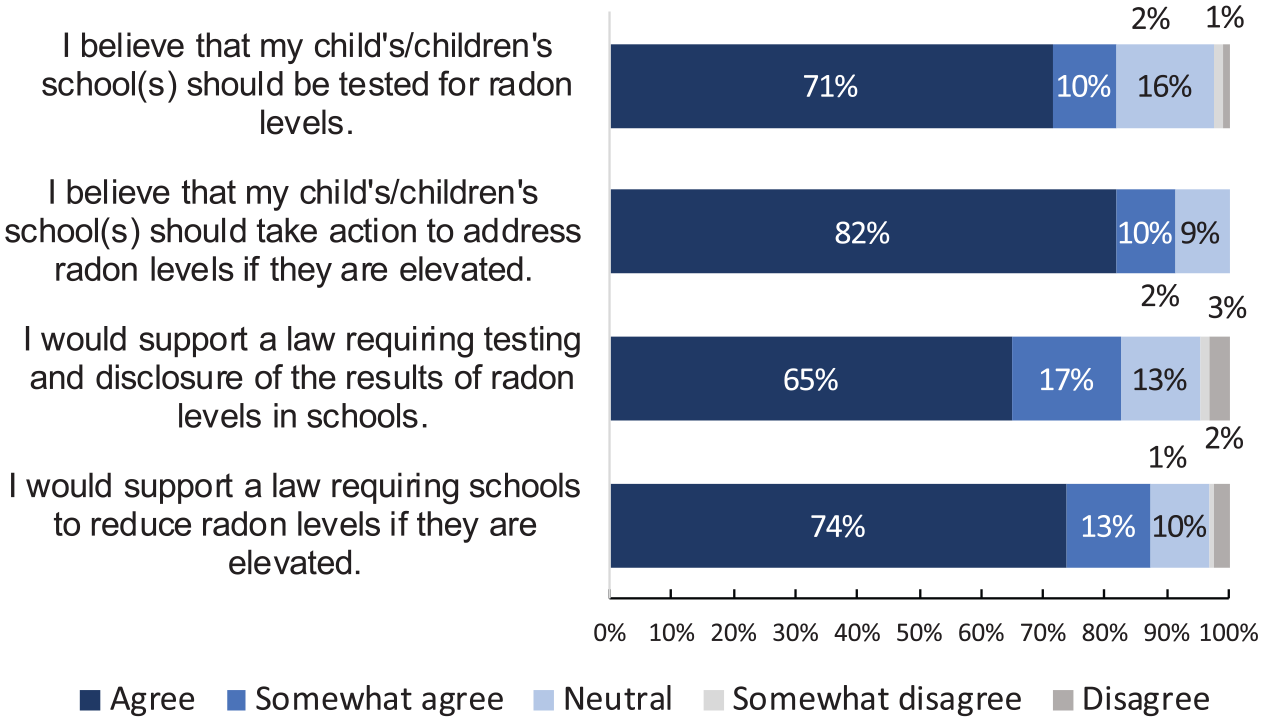
Degree to which parents agree with the following statements regarding radon in schools.
To determine whether knowledge about radon corresponded with views about radon testing in schools, we stratified the responses to knowledge questions (radon is a gas, comes from rock, affects the lungs, and cancer is a risk of long-term exposure) as zero to two correct responses or three to four correct responses. Participants who correctly answered at least three of four knowledge questions about radon were significantly more likely to support testing (p = .037) of elevated radon levels in Vermont schools. Support for mitigating elevated levels did not reach statistical significance. Support for legislation mandating testing and mitigation similarly did not meet statistical significance, but people with more knowledge tended to be more likely to support legislation. These data are displayed in Figure 3.
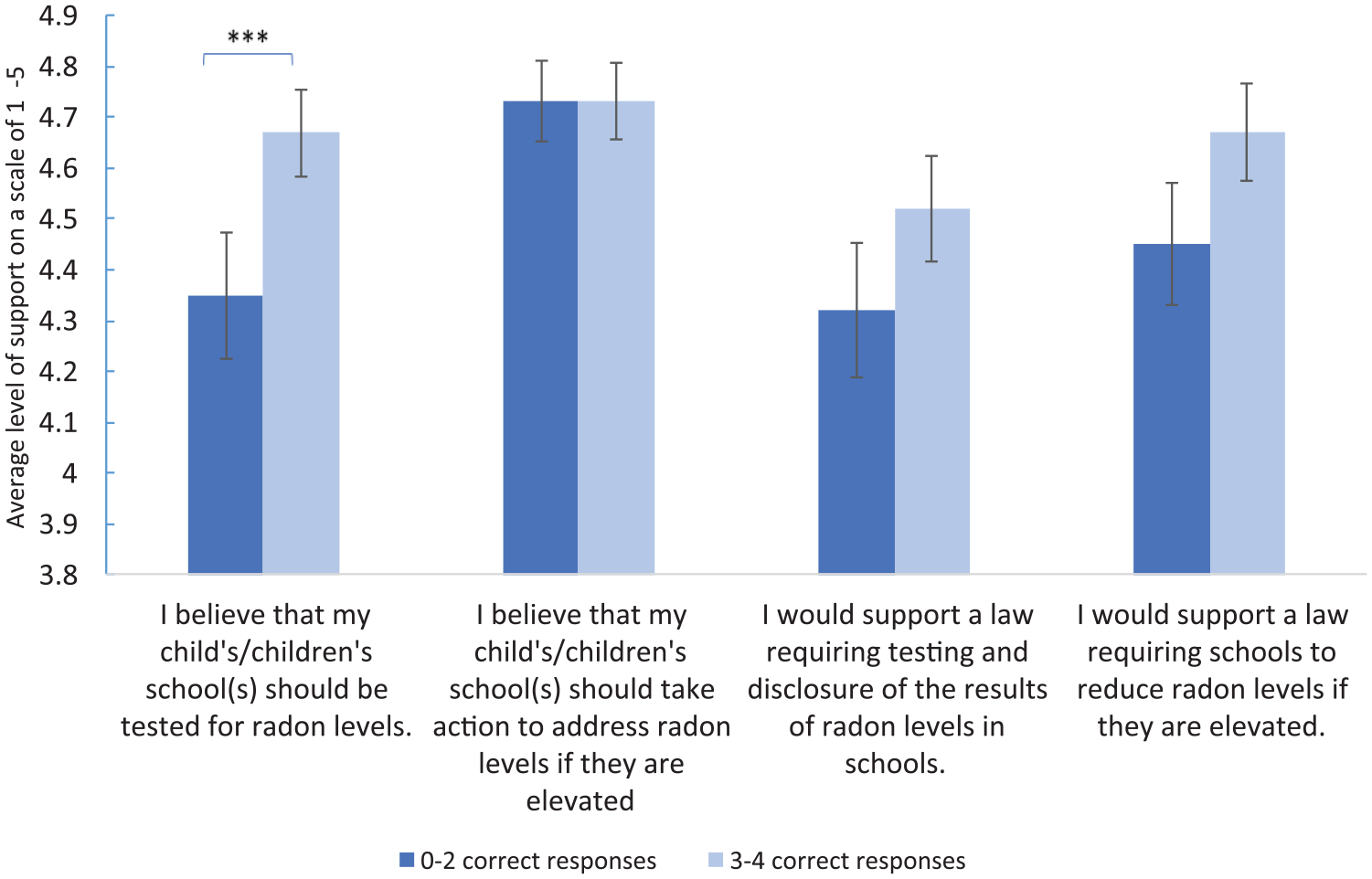
Comparison of radon knowledge and likelihood to support radon testing in schools based on knowledge of radon.
The grade level of the children of participants was also recorded. Sixty percent of participants had children in elementary school, 32% had children in middle school, and 28% had children in high school. Several parents had children in more than one grade level. When stratified by grade level of children, parents of elementary school children were significantly more likely to support radon testing (p = .002), mitigation (p = .012) and legislation mandating testing (p = .011), mitigation (p = .009) than parents without elementary school children. These data are displayed in Figure 4. There were no significant differences in support for radon regulation among parents of middle or high school students.

Comparison of radon knowledge and likelihood to support radon testing in schools based on child’s grade level
There were no significant differences in support for testing, mitigation, or legislation requiring regulation of radon among survey participants based on age, gender, level of education, household income, household radon testing status, or urban versus rural county of residence.
In addition to the survey data, a small group interview was conducted with two community parents. Thematic content analysis of this interview revealed three overarching themes: (a) knowledge and awareness of radon, (b) financial implications for schools and taxpayers, and (c) responsibility for public safety and its precedence.
Discussion
The majority of parents responding to the survey demonstrated a general knowledge and familiarity with radon; however, only half knew that radon affects the lungs. This highlights an important knowledge gap regarding the health-associated consequences of exposure to radon. With their current level of knowledge about radon, most Vermont parents already believe that their children’s schools should be tested for radon and are in favor of a law requiring radon testing and disclosure, particularly parents of elementary school–aged children. In addition, survey participants with more knowledge about radon were significantly more likely to support legislation regarding testing and mitigation of elevated radon levels. It follows then that future public health efforts should focus on increasing parent awareness of the health risks of radon to children in schools. Additional education about the health impacts of radon is likely to strengthen the support of this demographic for new legislation. As one parent commented, “Once the awareness gets out there, I can’t imagine that there’s not going to be a giant flood of support around it.”
The finding that parents of elementary school children were significantly more likely to support radon testing, mitigation, and legislation is interesting and may be related to the particular vulnerability of this population to environmental exposures (Bearer, 1995; Grigg, 2004; Leith Sly & Carpenter, 2012). The duration of potential exposure as young children progress through multiple school systems could also contribute to the increased support of regulation. Knowing that these parents are particularly supportive of radon legislation presents an opportunity to engage this population around the issue of radon regulation in schools, as they may be a powerful demographic to rally community support for proposed legislation.
Only 8% of Vermont parents were confident that their child’s school had informed them about radon levels, pointing to a lack of communication between schools and parents regarding this important health topic. This gap in communication may improve with parent and faculty education about radon and its potential health impact, and certainly with legislation enforcing disclosure of testing results. A website publicly disclosing the results of radon testing, such as the one developed for the new lead testing legislation in Vermont, may help address the issue of disclosure of radon test results to parents (Vermont, 2020; Vermont General Assembly (No. 66), 2019a).
Parents and guardians with more knowledge about radon were significantly more supportive of radon testing in schools. This is consistent with prior studies conducted in homeowners, which established that homeowners who knew the health risks associated with radon were more likely to have their homes tested (Duckworth et al., 2002; Ferng & Lawson, 1996; Ford et al., 1996; Howland, 1996; Neri et al., 2018). Our study builds on this finding by demonstrating that parents with a higher level of education are more supportive of regulating radon in schools in addition to homes. Although we found no significant difference in support for mitigation of elevated radon levels based on participant knowledge of radon, both groups overwhelmingly supported mitigation and there appears to be a ceiling effect in this category, as demonstrated in Figure 3. While support for legislation was not significantly higher among parents with more knowledge about radon, there was still an overwhelming majority of survey participants who supported radon regulation. This finding suggests that parents and guardians are a demographic that could play a pivotal role in supporting legislation to mandate radon testing in schools.
None of the following demographic factors significantly correlated with level of support for radon regulation: level of education, household income, rural versus urban residence, and radon testing status of the home, age, or gender. Prior studies have identified that low education and low income predict decreased knowledge of radon and decreased residential testing and mitigation of elevated radon levels (Ferng & Lawson, 1996; Halpern & Warner, 1994; Wang et al., 1999). We suspect that our relatively small study was not powered to detect small differences in support for radon testing based on income or level of education, or that the difference in support between these groups is less substantial when discussing exposure in schools as opposed to exposure in the home.
The Parent and Guardian Insight
The three predominant themes identified during the discussion group are a clear qualitative reflection of the quantitative data. Despite only 39% of survey participants identifying radon as a carcinogen, 87% support mitigation of elevated school levels. These numbers indicate a majority concern for public safety even in the absence of widespread knowledge. “We put smoke alarms, exit signs, and sprinkler systems . . . in these buildings to protect people . . . and yet we don’t do anything to protect them against a known carcinogen.” These qualitative reports support the quantitative conclusion that more awareness will likely bring about more support for radon regulation.
What This Means for Our Schools
The majority of individuals in the United States attend school for part or all of the K-12 grades. In addition, most school employees including teachers, administrators, counselors, and maintenance workers spend much of their professional lives in the school environment. This represents the two populations which would derive the most benefit from reductions in radon levels in affected schools. Radon is the leading cause of lung cancer among nonsmokers in the United States and exhibits its toxicity in a dose-dependent effect. Therefore, if radon exposure is tested for and minimized in these environments, it could significantly reduce lung cancer–related morbidity and mortality in the school employee and former student populations.
What Can Be Done to Increase Awareness of Radon?
As radon has become a more recognized health concern, several groups across the country have made efforts to increase awareness and decrease exposure to radon. In Montana, it was found that social marketing was an effective strategy to increase awareness of and testing for radon in residential buildings (Larsson, 2014). The U.S. EPA (2007) and other studies (Latour & Henthorne, 2001; Yoder & Murphy, 2012) have similarly supported the effectiveness of social marketing in radon education programs. A community outreach program in Iowa, conducted over 5 years and composed of educational handouts, videos, social media postings, and physician-led educational sessions, also led to a small but significant increase in radon awareness and testing in homes (Bain et al., 2016). It is possible that if similar educational efforts are undertaken among parents targeted at increasing testing in schools, we could similarly see increased radon testing and mitigation.
Targeting teachers and students to help educate voters about the risk of radon in schools could be a particularly effective approach. A group out of Georgia has been developing a curriculum for third- and fifth-grade students with age-appropriate resources including maps and handouts (Foster et al., 2015). Similarly, New Jersey partnered with the Department of Environmental Protection to develop a radon curriculum for teachers at the elementary, middle school, and high school levels in the state (State of New Jersey, Department of Environmental Protection, Radiation Protection Element, 2016). Vermont, Nevada, and Colorado, among other states, have sponsored radon poster contests for middle school students to encourage children to learn more about the health risks of radon (Asperin, 2017; Thompson, 2020). Winning posters were submitted to a national contest aimed at increasing public awareness about radon to increase residential radon testing (Daniels, 2015). Similar programs directed at school children would likely be very effective in increasing public awareness about radon testing and awareness in schools across the nation.
Future Directions
To test the hypothesis that increased knowledge about radon would increase support for radon regulation in schools, a future study could survey parents/guardians before and after receiving education about radon and see how their level of support changed after education. In addition, reaching out to teachers and school staff to learn more about their knowledge of radon and perspectives about radon regulation in schools was beyond the scope of this study, but is an interesting area for future study.
Study Limitations
One limitation of the survey is the predominant recruitment of participants at locations and events near Burlington, Vermont. As a result, there is a disproportionate representation from the most populous county over other, more rural Vermont counties. In addition, the population of survey participants was relatively homogeneous with the majority being white, well-educated, and women above the age of 30. The collection of surveys in doctor’s offices, farmer’s markets, and supermarkets may also have created a selection bias for participants with greater access to health resources. These limitations affect the generalizability of the study conclusions. The cross-sectional study design also prevents us from being able to establish causation between increased knowledge about radon testing and increased support for mitigation. In addition, one survey was included from a parent or guardian from the neighboring state of New York, and the discussion group consisted of only two members, limiting generalizability.
Conclusion
Many Vermont parents of children grades K-12 are unaware that radon is a lung carcinogen and most do not know the radon level or mitigation status of their children’s schools. However, most are in favor of legislation that would require radon testing in schools, disclosure of the results, and mitigation of elevated levels. Parents with elementary school children were significantly more supportive of radon testing, mitigation, and legislation than parents with only children in middle and/or high school. This suggests that parents of younger children may be a particularly important demographic to target when garnering community support for proposed legislative changes. Participants with more knowledge about radon were also significantly more likely to support testing, demonstrating that further education about the dangers of radon is necessary to strengthen existing support.
Footnotes
Declaration of Conflicting Interests
The author(s) declared no potential conflicts of interest with respect to the research, authorship, and/or publication of this article.
Funding
The author(s) received no financial support for the research, authorship, and/or publication of this article.
