




Abstract
This study was performed to determine how senior students rate the importance of each competency of their performance and collect information on the self-perceived confidence levels pertaining to each competency. An anonymous survey was conducted on senior students of 6 consecutive years between 2012 and 2017. Students were asked to rate the importance of each competency and their self-confidences using a 5-point scale. Application of appropriate interpersonal and communication skills was ranked as the most important competency whereas developing a catastrophe preparedness plan for dental practice was ranked as having the lowest importance. Areas reported as weaker should be a warning sign for educators to develop strategies for better delivery and implementation of competencies and students’ performance.
Keywords
Introduction
Nowadays, competency based dental education is a frequently pronounced terminology, familiar to many dental educators. The concept was initially introduced by Chambers as follows: Competencies are skills essential to beginning the practice of dentistry and allied dental practice. Competencies combine appropriate supporting knowledge and professional attitudes, and they are performed reliably in natural settings without assistance (Chambers, 1993). The concept was further described as the necessary skills, understanding and professional values of an individual ready for beginning independent dental, or allied oral health care practice (Boyd et al., 1996). Although some differences were noted in terms of perception of competencies by educators, the methodology has been adopted by many dental schools worldwide for more than two decades. One significant aspect of competency-based education is that learning outcomes and the expectation attained by the end of courses are clearly identified (Licari & Chambers, 2008; Yip & Smales, 2000).
It has been stated that competency documents not only serve as tools to guide educators in the development of a reliable curriculum, but they are also used in accreditation procedures (Dagenais et al., 2003; Whitney et al., 2015).
Competency-based education is currently the preferred method for educating dental students because it is considered as a reliable means of evaluating the learning outcomes and performance of students. It not only provides a good means of assessing the implementation of knowledge and skills but it also clearly outlines what is expected from a dental professional who is expected to serve the community (American Dental Education Association [ADEA], 2011; Cowpe et al., 2010; Dagenais et al., 2003; Whitney et al., 2015).
Yeditepe University Faculty of Dentistry (YUFD) has identified its competencies required for graduation so that the competency document is compatible with the competencies proposed by ADEA as well as Association for Dental Education in Europe (ADEE) (ADEA, 2011; Cowpe et al., 2010). The document consists of 7 major domains as follows: (a) critical thinking, (b) professionalism, (c) communication and interpersonal skills, (d) health promotion, (e) practice management and informatics, (f) patient care, and (g) integration of basic medical sciences. Each major domain has its own sub standards that explain the requirements of the competency more specifically. Overall, there are 59 competencies that define the knowledge and skills expected from a graduate.
One of the effective means of understanding the success of set standards is through surveys performed among students. Feedback received from students prior to graduation will serve as important guides for educators to make necessary amendments. Therefore, this study was performed to understand how senior students rate the importance of each defined competency and collect information on the self-perceived confidence levels prior to graduation. The information was collected from each graduating class of 6 consecutive years from 2012 until 2017. It was further anticipated that the obtained data would help educators understand the differences in terms of student perceptions over time and aid them in improving the curriculum compatible with changing trends and student expectations. To the authors’ knowledge, no study has yet focused on student opinion and feedback regarding dental school competencies in our country and it was expected that the study would serve as a pioneering attempt in that respect.
Aim
The aim of this study was performed to understand how senior students rate the importance of each competency of the Faculty of Dentistry and collect information on the self-perceived confidence levels pertaining to each competency.
Materials and Methods
The research protocol was approved by the Institutional Review Board (IRB) of Yeditepe University, Faculty of Dentistry (YUFD) (No: 185). The anticipated participants were the graduating students of 2012 through 2017.
The Graduating Dental Students Competency Assessment (GDSCA) survey was created according to the existing competency document of YUFD. A paper-based survey which is written on the computer and printed-out was distributed to the graduating classes of 6 consecutive years, 2012 to 2017 after the final exam of the academic year. Prior to the survey, students were informed that there was no obligation for participation and anonymity was confirmed. The students filled out the surveys without any observation of any author or tutor of the faculty in case of objectivity.
The survey included all 59 competencies listed in the competency document of YUFD and students were asked to rate the importance of each competency using a five-point Likert-type’s scale (1 = not at all, 2 = only a little, 3 = somewhat, 4 = almost always, and 5 = very much so) and rate their self-confidence using the same scale. The scaling used by Whitney et al. (2015) was adopted.
SPSS Version 21.0 was used for statistical analysis. Descriptive parameters were calculated for the mean and standard deviation values. One-way analysis of variance (ANOVA) with post hoc Bonferroni adjustment was used to determine cohort effects. The significance level was set at .05.
Results
The number and percentage of participating students are shown in Table 1. A total of 279 students have participated in the study out of 309, giving a response rate of average 90.29%.
Number and Percentage of Students Participating in the Study, Graduation Years From 2012 to 2017.

Table 2 shows the domains of self-perceptions of competency importance and confidence topics and their number of components with the mean and standard deviation through years 2012 to 2017.
The Domains of Competencies and Values of Self-Perceptions of Competency Confidence and Importance.

SD: standard deviation.
Table 3 shows the cohort effect of competencies. Three competencies (3.1, 2.2, and 6.14) showed a cohort effect with regard to importance and 3 competencies (2.3, 6.4, and 3.4) showed a cohort effect regarding confidence (p < .05).
Students’ Self-Perceptions of Yeditepe University, Faculty of Dentistry (YUFD) Competency Importance and Confidence (Perceptions on a Five-Point Scale With Options Ranging From 1 = Not at All to 5 = Very Much So. The Findings That Were Statistically Significant Are Presented) (C value: Cohort Effects Significance Was Evaluated by Chi-Squared Test).
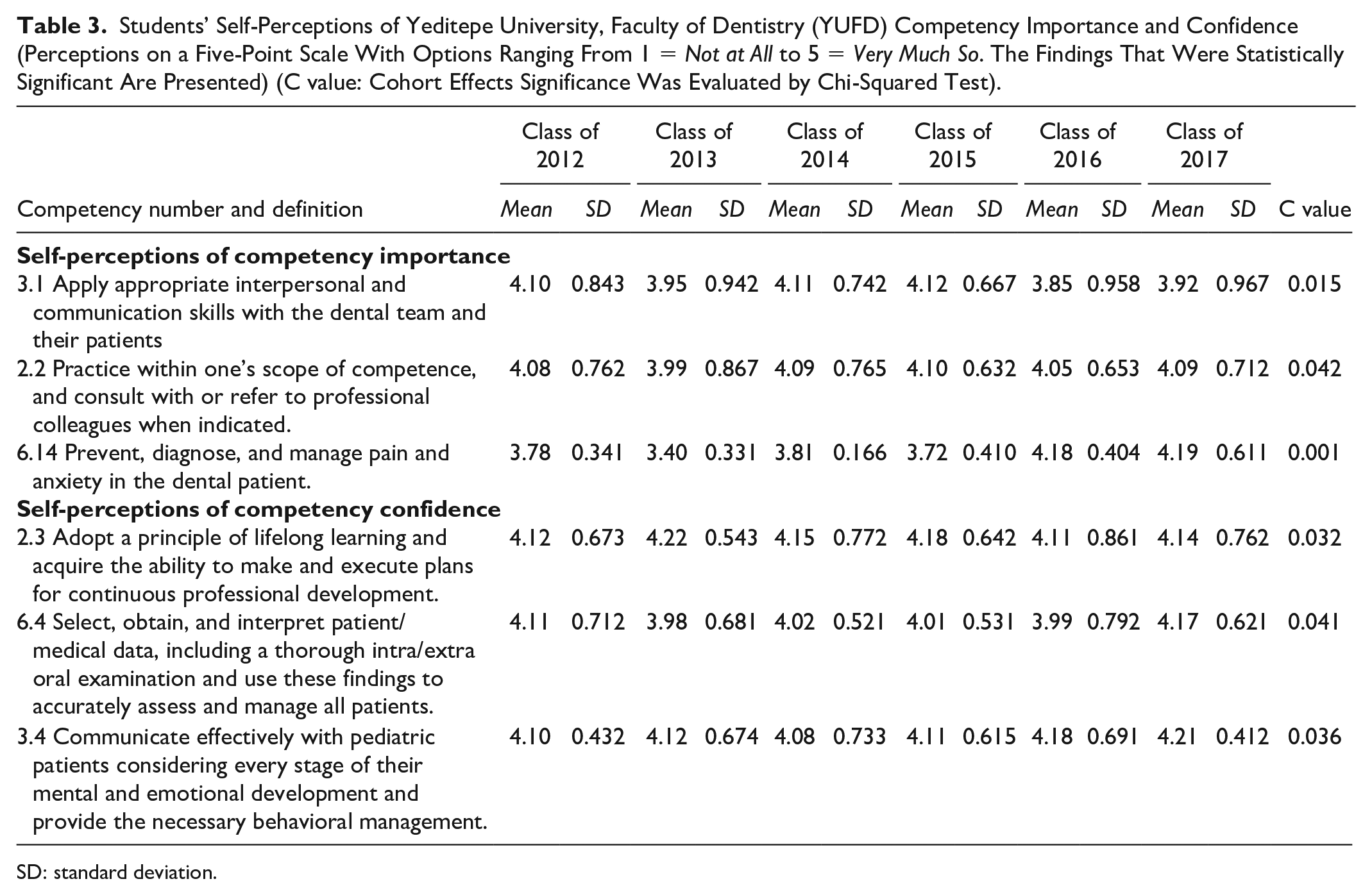
SD: standard deviation.
Table 4 shows the ranking of competencies in terms of importance for all years. Application of appropriate interpersonal and communication skills (3.1) was ranked as the most important competency whereas developing a catastrophe preparedness plan (5.7) was ranked as the one with lowest importance. Nevertheless, even the competency with the lowest importance score was above 4.0.
First Five Competency Importance for All Years Together According to Students’ Highest and Lowest Perceptions.

SD: standard deviation.
Table 5 shows the ranking of competencies in terms of confidence for all years. Adoption of lifelong learning and ability to make continuous professional development (2.3) was ranked as the competency in which students reported the highest confidence whereas having knowledge of the biological processes in the body to a sufficient depth (7.2) was ranked as the one where students felt the least confidence.
First Five Competency Confidence for All Years Together According to Students’ Highest and Lowest Perceptions.

SD: standard deviation.
Discussion
Student/graduate opinions comprise a substantial feedback in continuing revision process of undergraduate dental education program. As educators we have to understand how competent our students/graduates feel on our defined curriculum competencies. Besides self-perceived competency levels, we also wanted to clarify how important was our competencies to our graduates and how important was our competencies for their future work. The participation of students showed an increasing trend and the average response rate was 90.29%, which is higher compared to similar studies. Lower response rates were reported by Whitney et al. (2015), Rafeek et al. (2004) and Honey et al. (2011). In the present study, one reason for the increase in participation may be the continuous emphasis on that fact that completion of the survey would have positive impacts on our education. The reason for the higher response rate may also be related to the mode of delivery of the survey. In the studies by Whitney et al. (2015) and Rafeek et al. (2004), surveys were sent out online or by post. Gerrow et al. (2006) obtained a low response rate and indicated that this result is typical for mailed surveys. On the other hand, the surveys in the present study were completed in the classroom setting, possibly resulting in students to be more enthusiastic to take part.
In our study, students ranked application of interpersonal and communication skills, practicing within one’s scope of competence and consultation with or referral to professional colleagues, evaluation of outcomes of comprehensive dental care, making alternative treatment planning for individual patients by incorporating many parameters and demonstration for effective business, financial management and human resource skills as the top 5 most important competencies. It is noteworthy that students generally ranked competencies related with collaborative, interpersonal and interdisciplinary skills, and comprehensive dental care as important acquisitions. One reason for this may be that Dental Faculty has an integrated clinic that allows the student to evaluate and manage patients with a holistic approach. This facilitates students’ awareness of working in a collaborative attitude and capturing the significance of practicing in an interdisciplinary manner. Similarly, the holistic approach and comprehensive patient management provide the student with the opportunity to follow-up patients and evaluate treatment outcomes. The collaborative dental work also better implements the concept of taking patients individually and drawing a treatment plan including many variables. Koole et al. (2017) reported that differences existed in responses depending on the gender of the dentist. For example; female respondents scored obtaining and recording a complete history; identifying and managing anxiety and abnormal patient behavior; obtaining and interpreting radiography and awareness of own limitations and when to refer as the top important competencies significantly higher compared to males. These responses also show similarity with our study although parameters such as gender or age were not recorded to confirm the anonymity. Our findings also show similarity to the results of Schönwetter et al. (2011) in which interpersonal-communication and basic clinical skills were ranked as the most important competencies.
Business, financial management and human resource skills were also among the most important competencies. Furthermore, a discrepancy existed with respect to this parameter as students also reported it as a competency in which they feel low confidence. This issue was recently taken into consideration and the content of the “Practice management” course was modified. The course includes a wide range of issues related with the functioning of a dental clinic such as financial and legal issues, patient and staff interactions, and so on. It is coordinated by a renowned dentist and another unique aspect is the invitation of leading names in dentistry as guest lecturers. This enables the students to capture key points for successful management of a dental office by firsthand delivery of knowledge by individuals of proven experience and success.
Making clinical decisions taking into consideration clinical expertise, patient values, best research results, systematic reviews and evidence-based dental applications, ability to apply the knowledge and understanding of basic biological, medical, and clinical sciences to every day real life and clinical situations, making suggestions regarding national oral and dental health system and health policies, having knowledge of the science of dental biomaterials and their limitations and developing a catastrophe preparedness plan for the dental practice were the competencies regarded as of lowest importance. Gerrow et al. (2006) reported that managing growth and developmental abnormalities received the lowest score. The authors further indicated that ranking of competency “ evaluation of the literature” was rather disappointing, and this should be an alarming sign for educators to focus more on the delivery of evidence-based dental education. Their results show similarity to ours in which best research results, systematic reviews, and evidence-based dental applications were among the competencies ranked as having relatively lower scores. These results suggest that further attempts should be made to emphasize the significance of evidence-based dentistry and the implementation of evidence-based knowledge into clinical practice. Currently, some departments assign students with different evidence-based topics pertaining to their discipline and ask them to make presentations by further literature search. This type of approach encourages the student to search and better assimilate established information. We anticipate that these attempts will be disseminated further within the dental school. In addition, although evidence-based information is continuously delivered through individual courses, there is not a single course dedicated to evidence-based dentistry only. A collaborative course with the contribution of all clinical departments can be planned to address this issue. One reason for students’ ranking basic medical sciences as of relatively lower importance might be the fact that they do not encounter patients with uncontrolled medical issues at the clinics. Only patients within a specific range of medical scale are admitted, thus students’ experience on the correlation between medical and dental issues is relatively limited. Consequently, they may not have adequate fundamental experience to capture the significance of this competency. Furthermore, correlation of basic and clinical sciences is a topic that has recently been focused on in detail by the educators. Some attempts have been made in that respect such as the participation of clinical faculty in some basic sciences courses to give lectures during which they can assist students in comprehending the clinical relevance of the basic science course they received.
Application of appropriate interpersonal and communication skills with the dental team and their patients (3.1), practicing within one’s scope of competence, and consultation with or referral to professional colleagues when indicated (2.2) and prevention, diagnosis, and management of pain and anxiety (6.14) were these competencies showing a cohort trend in terms of importance. Whitney et al. (2015) only identified one competency displaying a cohort trend in terms of importance, which was “the management of orofacial growth and development abnormalities/minor orthodontics.” On the other hand, adoption of the principle of lifelong learning (2.3), selecting, obtaining, and interpreting patient/medical data, including a thorough intra/extra oral examination and using findings to accurately assess and manage patients (5.4 and 6.4) and communicating effectively with pediatric patients considering every stage of their mental and emotional development and providing the necessary behavioral management (3.4) were competencies with a cohort effect in terms of confidence. Whitney et al. (2015) reported 3 competencies with a cohort effect in terms of confidence one of which was discussion of findings/diagnosis and treatment. This shows similarity with the results of our investigation and implies that all students felt similar confidence when diagnosis and treatment planning is concerned.
Competencies’ Importance
Students ranked application of interpersonal and communication skills (3.1), practicing within one’s scope of competence and consultation with or referral to professional colleagues (2.2), evaluation of outcomes of comprehensive dental care (6.26), making alternative treatment planning for individual patients by incorporating many parameters (6.9) and demonstration for effective business, and financial management and human resource skills (5.4) as the top 5 most important competencies. It is noteworthy that students generally ranked competencies related with collaborative, interpersonal and interdisciplinary skills, and comprehensive dental care as important acquisitions. One reason for this may be that Dental Faculty has an integrated clinic that allows the student to evaluate and manage patients with a holistic approach. This facilitates students’ awareness of working in a collaborative attitude and capturing the significance of practicing in an interdisciplinary manner. Similarly, the holistic approach and comprehensive patient management provide the student with the opportunity to follow-up patients and evaluate treatment outcomes. The collaborative dental work also better implements the concept of taking patients individually and drawing a treatment plan including many variables. Koole et al. (2017) reported that differences existed in responses depending on the gender of the dentist. For example; female respondents scored obtaining and recording a complete history; identifying and managing anxiety and abnormal patient behavior; obtaining and interpreting radiography and awareness of own limitations and when to refer as the top important competencies significantly higher compared to males. These responses also show similarity with our study, although parameters such as gender or age were not recorded to confirm the anonymity. Our findings also show similarity to the results of Schönwetter et al. (2011) in which interpersonal-communication and basic clinical skills were ranked as the most important competencies.
Business, financial management, and human resource skills were also among the most important competencies. Furthermore, a discrepancy existed with respect to this parameter as students also reported it as a competency in which they feel low confidence. This issue was recently taken into consideration and the content of the “Practice management” course was modified. The course includes a wide range of issues related with the functioning of a dental clinic such as financial and legal issues, patient and staff interactions etc. It is coordinated by a renowned dentist and another unique aspect is the invitation of leading names in dentistry as guest lecturers. This enables the students to capture key points for successful management of a dental office by firsthand delivery of knowledge by individuals of proven experience and success.
Making clinical decisions taking into consideration clinical expertise, patient values, best research results, systematic reviews and evidence-based dental applications (6.10), ability to apply the knowledge and understanding of basic biological, medical and clinical sciences to every day real life and clinical situations (7.6), making suggestions regarding national oral and dental health system and health policies (4.6), having knowledge of the science of dental biomaterials and their limitations (7.5), and developing a catastrophe preparedness plan for the dental practice (5.7) were the competencies regarded as of lowest importance. Gerrow et al. (2006) reported that managing growth and developmental abnormalities received the lowest score. The authors further indicated that ranking of competency “ evaluation of the literature” was rather disappointing, and this should be an alarming sign for educators to focus more on the delivery of evidence-based dental education. Their results show similarity to ours in which best research results, systematic reviews, and evidence-based dental applications were among the competencies ranked as having relatively lower scores. These results suggest that further attempts should be made to emphasize the significance of evidence-based dentistry and the implementation of evidence-based knowledge into clinical practice. Currently, some departments assign students with different evidence-based topics pertaining to their discipline and ask them to make presentations by further literature search. This type of approach encourages the student to search and better assimilate established information. We anticipate that these attempts will be disseminated further within the dental school. In addition, although evidence-based information is continuously delivered through individual courses, there is not a single course dedicated to evidence-based dentistry only. A collaborative course with the contribution of all clinical departments can be planned to address this issue. One reason for students’ ranking basic medical sciences as of relatively lower importance might be the fact that they do not encounter patients with uncontrolled medical issues at the clinics. Only patients within a specific range of medical scale are admitted, thus students’ experience on the correlation between medical and dental issues is relatively limited. Consequently, they may not have adequate fundamental experience to capture the significance of this competency. Furthermore, correlation of basic and clinical sciences is a topic that has recently been focused in detail by the educators. Some attempts have been made in that respect such as the participation of clinical faculty in some basic sciences courses to give lectures during which they can assist students in comprehending the clinical relevance of the basic science course they received.
Making suggestions regarding national oral and dental health system and national health policies (4.6) was also regarded as having relatively lower importance. This might be due to the lack of student interaction with related governmental organizations. Future attempts to address this issue might include invitation of individuals associated with such organs to the dental school to deliver information regarding national health policies. Having knowledge of the science of dental biomaterials and their limitations (7.5) was also ranked as of relatively lower importance. The reason for such a consideration might be related with the fact that students select materials under the supervision of instructors, leading them not to have a full comprehension of the significance of this topic. Developing a catastrophe preparedness plan (5.7) was also underscored in terms of importance. Even though this is a very crucial issue, it is a topic that is not directly related with the dental profession itself; thus, students may have ranked it relatively lower and given more priority to professional and scientific competencies. To enhance students’ awareness, regular practices and operations are being carried out where students and staff practice the evacuation plan in the presence of a catastrophic incidence.
Students ranked adoption of lifelong learning and acquisition of the ability to make and execute plans for continuous professional development (2.3) as the competency in which they felt the highest confidence. In the study by Razak et al. (2008), professional development skills were also among the high-ranked competencies, similar to the results of our study. One of the major reasons for this finding might be that students are continuously encouraged to participate in scientific activities during their education, an example of which is the annual International Students Research days where students are assigned with a research topic to present at the annual congress. Meanwhile, periodically organized hands-on courses and seminars might also have contributed to students’ confidence in lifelong professional development.
Selecting, obtaining, and interpreting patient/medical data, including a thorough intra/extra oral examination and using these findings to accurately assess and manage all patients (6.4) was another competency in which students felt confident. It can again be speculated that the integrated clinic is the major contributing factor to this result as students are assigned with patients and complete all procedures in a comprehensive manner. Effective communication with pediatric patients considering every stage of their mental and emotional development and provision of necessary behavioral management (3.4) was also among the top-ranked competencies. Once again, the integrated pediatric clinic provides the students with the opportunity to gain experience by the completion of all dental procedures of the child patient. Keeping and protecting patient records, respect of patient privacy (2.4), and adherence to infection guidelines (6.12) were also ranked as highly important. Joint Commission International (JCI), a renowned organization for hospital quality and management, regularly audits YUFD; thus, the Faculty of Dentistry has very strongly established guidelines and policies for the maintenance of patient service quality on which students continuously receive education. Consequently, topics such as patient privacy, informed consent, and infection control are concepts that are firmly instilled and students’ high level of confidence is clearly reflected in the findings of the present study.
In the study by Honey et al. (2011), final year students were found to be most confident in simpler procedures and procedures in which they had most clinical experience and least confident in more complex procedures in which they were not experienced. Our findings show similarity with their results as students tend to display more confidence in clinical practices where they have adequate experience. Our results are also concurrent with the results of Rafeek et al. (2004) who determined taking an adequate medical history and oral examination among the highly ranked competencies and the report by Razak et al. (2008) where participants ranked treatment planning as one of the topics they felt highly competent.
One of the competencies in which students reported the lowest confidence was effective communication with individuals from diverse populations (3.3). One reason for this result might be the characteristics of our country’s population, which does not have many ethnical varieties. Despite this, attempts are made to evenly distribute patients with different medical conditions so that concept of diversity can be addressed from a different perspective. Prevention, identification, and management of oral trauma, oral diseases, and other disorders (6.3) were also reported as topics with relatively lower confidence. A similar result was reported by Schönwetter et al. (2011).
Lack of adequate knowledge and experience in the diagnosis and correct management of trauma among dental practitioners is actually a well-known and universal problem stated by some authors previously (Cınar et al., 2013; Krastl et al., 2009; Zhao & Gong, 2010). It is therefore not surprising that students report their self-confidence to be relatively lower due to the small possibility of encountering complicated traumatic incidences in their years of education. To compensate this, a multidisciplinary course entitled “Dental Trauma” has been integrated and conducted by the participation of different departments, which deliver the concept from their own perspectives. It is undeniable that reminder courses should be continuously taken following graduation so that knowledge will not be forgotten and dental practitioners will be well-prepared and at least have fundamental knowledge on emergency interventions during traumatic cases.
Demonstration of effective business, financial management, and human resource skills (5.4) was not only ranked as a highly important topic but controversially as one where students felt low confidence. Although the practice management course has been modified to address this issue, lack of experience in a real practice setting might be a reason why students do not feel prepared. Rotation of students in real dental clinics is not a common practice in our country but might be one strategy to enhance students’ self-esteem in practice management by witnessing the real atmosphere and functioning of a dental care delivery unit.
Prevention, diagnosis, and management of pain and anxiety (6.14) as confidence was also reported as relatively lower in terms of confidence. Recently, a multidisciplinary course entitled “Urgent treatment and pain management in dentistry” was implemented and covered emergency treatment approaches as well as topics focusing on the alleviation of pain.” Furthermore, students take rotations at the emergency cubicle at the student clinic to provide first aid for patients presenting with painful and urgent symptoms. Considering the lower result in terms of confidence despite these attempts, it is obvious that further action should be taken to address this important issue as management of pain and anxiety is one of the fundamental responsibilities of the dental practitioner and frequently an ability by which patients judge dentists. Management of orofacial pain was also rated as having relatively low confidence by Schönwetter et al. (2011).
Finally, having knowledge of the biological processes in the body to be able to exploit emerging biological technologies in clinical practice, especially in regenerative medicine (7.2) was a competency scored as relatively low compared to others. Newly emerging information is continuously integrated in the undergraduate curriculum with the efforts of the curriculum management committee, and regenerative procedures constitute a very significant proportion of innovative information implemented in various courses. On the other hand, methodologies such as regenerative procedures are generally delivered theoretically by the inclusion of case presentations during undergraduate years, whereas actual clinical practice is generally a part of post-graduate program. It is therefore expected that students might feel less confident in that respect. Meanwhile, it is also emphasized that challenging cases requiring innovative biological methods should be referred to a specialist who is more intensively involved with these procedures.
This study comprises information gathered from participants extending over a 6-year period and reflects the opinion of a group of individuals receiving dental education from a private institution. Some authors commented that although surveys in dental education are easy and practical means of collecting information, multiple factors might influence findings (Chambers & Licari, 2009). Thus, results of this study should definitely be interpreted with caution and must be regarded as a summary of the views of students in an international dental program over 6 years. It is equally obvious that further contributing studies performed in other dental schools in the country would contribute to making more concrete statements regarding the views of students on the existing dental educational model. It should also be kept in mind that competency-based education is a rather recently established concept in our country and not all dental schools might yet have defined their own competencies for the graduating dentist. Consequently, it may take some time for competency-based dental education to be established before we can draw comparisons between dental schools. Nevertheless, this study highlights the views of the recent graduates of the first private dental school in our country and it is anticipated that it will serve as a guide to other institutions in determining the competencies they wish to implement in their students before graduation.
Conclusion
Within the limitations of this study, it can be concluded that although some discrepancies may exist between importance and confidence ratings from the standpoint of students, they generally appear to feel themselves competent and ready for practice specifically in areas they have gained adequate clinical experiences. Areas reported as relatively weaker should be a warning sign for educators to develop strategies for better delivery and implementation of competencies. It is obvious that in most schools, some types of patients such as trauma or patients with anxiety are not available to students. However, this issue can be compensated by the incorporation of case scenarios and OSCEs into the curriculum to familiarize dental students with as many case variations as possible.
Footnotes
Declaration of Conflicting Interests
The author(s) declared no potential conflicts of interest with respect to the research, authorship, and/or publication of this article.
Funding
The author(s) received no financial support for the research, authorship, and/or publication of this article.
