




Abstract
In China, since the beginning of the 21st century, the study of sports communication has gradually attracted the attention of the academic community, and a number of valuable achievements have emerged. The 2,863 articles that were published by core journals of sport communication from 1982 to 2018 and collected from the CNKI database were chosen as research objects. This article used CitespaceV software to analyze productivity, hot domains, and frontiers in China sport communication research by the methods of bibliometrics method, co-occurrence analysis, and word of frequency analysis. We aimed to grasp the dynamic process of China sport communication research development and provide a valuable reference for its theoretical research and practice. It was shown that first, sport communication researches in China started late but grew fast. Second, the research hotspot of sport communication was related to communication, culture, big data, network, and so on. Third, sport communication research was mainly carried out by universities of sport and communication schools of colleges and universities. Researches were centered around pluralistic, international, and technological aspects with “sport communication” as the focus in drawing experiences from the international sports communication and improve the Chinese sport communication. Rich knowledge and innovative ideas were needed to do the future researches.
Introduction
In the 1930s, with the birth of television, the relationship between sports and the media became increasingly close. Later, with the rise of sports sociology, physical education, mass sports and other disciplines, sports and communication, sports and media gradually entered academic research. At the same time, both communication in sport and communication of sport in China is a rapidly growing and fast-moving interdisciplinary field of study, involving from mostly media sports to holistic sport communication studies, from quantitative studies to multi-channel and multi-method studies, from classic communication studies paradigms to interdisciplinary studies paradigms of humanities and social science as a whole, from studies mainly on text-mediated communication to research on visual-mediated communication, from traditional media studies to new media studies.
Pedersen et al. (2016) acclaimed that the study of sport communication has long been affiliated (and often intertwined) with the academic aspects of sports management. In addition, as with the terms sport management and sport administration, course and degree names in sport communication often make interchangeable use of the terms sport communication, sport journalism, and sports media. However, the term sport communication is a more encompassing title for both this specific field of the sport industry and the associated academic discipline. Moreover, sport communication is the most commonly used term for the field in the discipline of sport management.
The study of sport communication has long been affiliated (and often intertwined) with the academic aspects of sport management and sport administration, course and degree names in sport communication often make interchangeable use of the terms sport communication, sport journalism, and sport media. However, the term sport communication is a more encompassing title for both this specific field of the sport industry and the associated academic discipline. Moreover, sport communication is the most commonly used term for the field in the discipline of sport management. As a field of study, sport communication is built on (and requires) interdisciplinary knowledge, which can be obtained through disciplines and courses including advertising, broadcasting, communication, cinema, electronic media, journalism (including electronic journalism), film, finance, informatics, information services, law, management, marketing, mass communication, media production, public relation, social media, speech, and writing.
Based on the spring up of modern sports communication, professor Xinghua (2005) discussed the basic condition of modern society supporting for sports communication. Under the development of modern sports communication, the combination of modern sports and mass media formed the culture style with the character of mass culture, a kind of visual culture. The sports what was expressed by modern mass media focused on gala of sports and media. Champion it is panegyrized by mass media neglected the public attention, which also influenced the content and forms of sports. The sports expression that coming out experienced certain intensified ceremony. The commercialization of sports communication formed by alliance of sports and mass media which promote the sports development restricted the sports development in certain degree at the same time. During the course of sports globalization, there was deep impression of sports modernization, while media played an important role in sports globalization. Sports communication promoted the communication of world sports and sports communication of different cultures.
The Development and Current Situation of China’s Sports Communication
Sports communication researches in China have been paid more attention in both sports studies and communication studies. To better understand the status, content, and trend of studies on sports communication theory in China, Li Jin-bao (2014) studied the sports communication theory papers which were selected by China Sports Journalism and Communication seminar from 2009 to 2011 and explored communication theory’s status, content, and trend. The result showed that sports communication theory study has greatly developed. The number of research papers has largely increased, and the research content and perspective have become diversified. But most are qualitative research and quantitative research is rare. The main researchers are young and middle aged in sports institutions and their papers’ quality needs to be improved. From the research content aspect, most studies focused on sports communication theory’s history, function, culture, crisis communication, pattern, symbol, and effect. Sports communication theory from its parent disciplines, find research inspiration from sports practice, and borrow research methods from the basic subjects such as sociology.
A recent study by Chen Wei and Qin (2006) involved that sport media was the activity and behavior that takes the sports as communication medium and content. The essence of sport media was communication. Sport was both medium and content of communication. One of the important characters of sport media was the non-verbal symbol as the communication medium.
A significant analysis and discussion on the evolution of sports communication mode in the background of media mergence was presented by Li Ding and Huanyu (2013) who, based on four driving forces of media mergence, that is, technical, economical, political, and social and cultural causes, probed into the special incentives for sports media mergence. They are the needs of sports communication, the audience’s diversified demands, and the self-development of sports media industry. The study took 2012 London Olympic Game as the example to analyze the development and change of sports communication mode from the perspective of process and structure. The relocating of sports disseminators, the reform of sports communication production mode, the creation of sports communication channel, the change of audience’s demands, and the communication effect in the new environment were discussed as well in this study.
Under the development of modern sports communication, the combination of modern sports and mass media formed the culture style with the character of mass culture, a kind of visual culture. The sports what was expressed by modern mass media focused on gala of sports and media. Champion it is panegyrized by mass media neglected the public attention, which also influenced the content and form of sports expression that coming out experienced certain intensified ceremony. The commercialization of sports communication formed by alliance of sports and mass media which promote the sports development restricted the sports development in certain degree at the same time.
With the increase in China’s comprehension national strength and the enhancement of China’s overall competitive sports strength, sport has made a unique contribution to aspects such as shaping national image, boosting national soft power, and enhancing China’s international communication ability. However, problems such as undiversified communication subjects, narrow channels, unbalanced and ambiguous audiences, and so on, which showed up in the process of sports international communication, are quite serious, affecting the range and actual effect of sports international communication to a great extent. In order to remove the obstacles in development, the authors put forward that for Chinese sports international communication, China needs to form multi-subject communication in order to realize extensive communication awareness, to focus on all-media communication in order to highlight the functions of media fusion, to build bridges for domestic and foreign communication via “glocalized” communication, and to further audience segmentation in order to enhance the pertinence of international communication, thus building a balanced, green ecosystem for sports international communication (Xinghua & Zongpei, 2017).
During the course of sports globalization, there was deep impression of sports modernization, while media played an important role in sports globalization. Sports communication promoted the communication of world sports and sports communication of different cultures. If China sports become the main stream of world sports, it must melt into the course of sports globalization. Based on the reform and innovation, sports system with Chinese character should be set up and self-developing mode should be formed.
Material and Methods
The body of the relevant literature grows rapidly. In this article, unless stated otherwise, the literature is reviewed as of July 2018. The China National Knowledge Infrastructure (CNKI) has 2,863 records between 1982 and 2018 based on a topic search of the term “sport communication (tiyuchuanbo)” in titles, abstracts, or indexing terms. The Web of Science has 2,263 records between 2000 and 2018 based on a topic search of the term “sport communication” in titles, abstracts, or indexing terms. Keeping abreast of rapidly evolving literature is critical, not only because new discoveries come from different fields, but because new discoveries can fundamentally change the collective knowledge.
This article analyzed 2,863 journal articles (from CNKI) and proceedings published between 2000 and 2018 in the sport communication studies field around the world through methodologies of literature review, data statistics, and logical analysis.
In this review, we demonstrate a scientometric approach and use CiteSpaceV to delineate the structure and dynamics of the sports communication research. CiteSpaceV is specifically designed to facilitate the detection of emerging trends and abrupt changes in scientific literature (Chaomei et al., 2012). The literature collected by CNKI was quantified by bibliometric method. The statistical analysis was used to analyze the data. The quantitative and qualitative research methods were used to analyze the frequency of the high-frequency keywords collected by the knowledge map. Co-occurring analysis, which comprehensively outlines the dynamic development track of China’s sports communication research from 2000 to 2018, sums up the hot frontier issues of China’s sports communication, and objectively describes the current development of China’s sports communication.
Results
Citespace data collection and analysis were used to address the research. The results of this analysis are discussed in greater detail below.
Each article indexed by the CNKI is assigned one or more subject categories. Figure 1 shows a network of such subject categories after being simplified by Pathfinder network scaling, which retains the most salient connections. The most common category is Chinese culture, which has the largest circle, followed by Big data & Network and Television. Chinese culture has a long history. Sports culture and national traditional sports are the national treasures of China. They play an important role in the formation, evolution, and inheritance of sports communication. Television sports and large-scale sports events are the most popular means of sports communication. It is also the most direct and effective way for us to obtain sports information. In recent years, with the integration of traditional media and new media, as well as the emergence of big data and sports apps, our means of obtaining sports information has become more abundant.
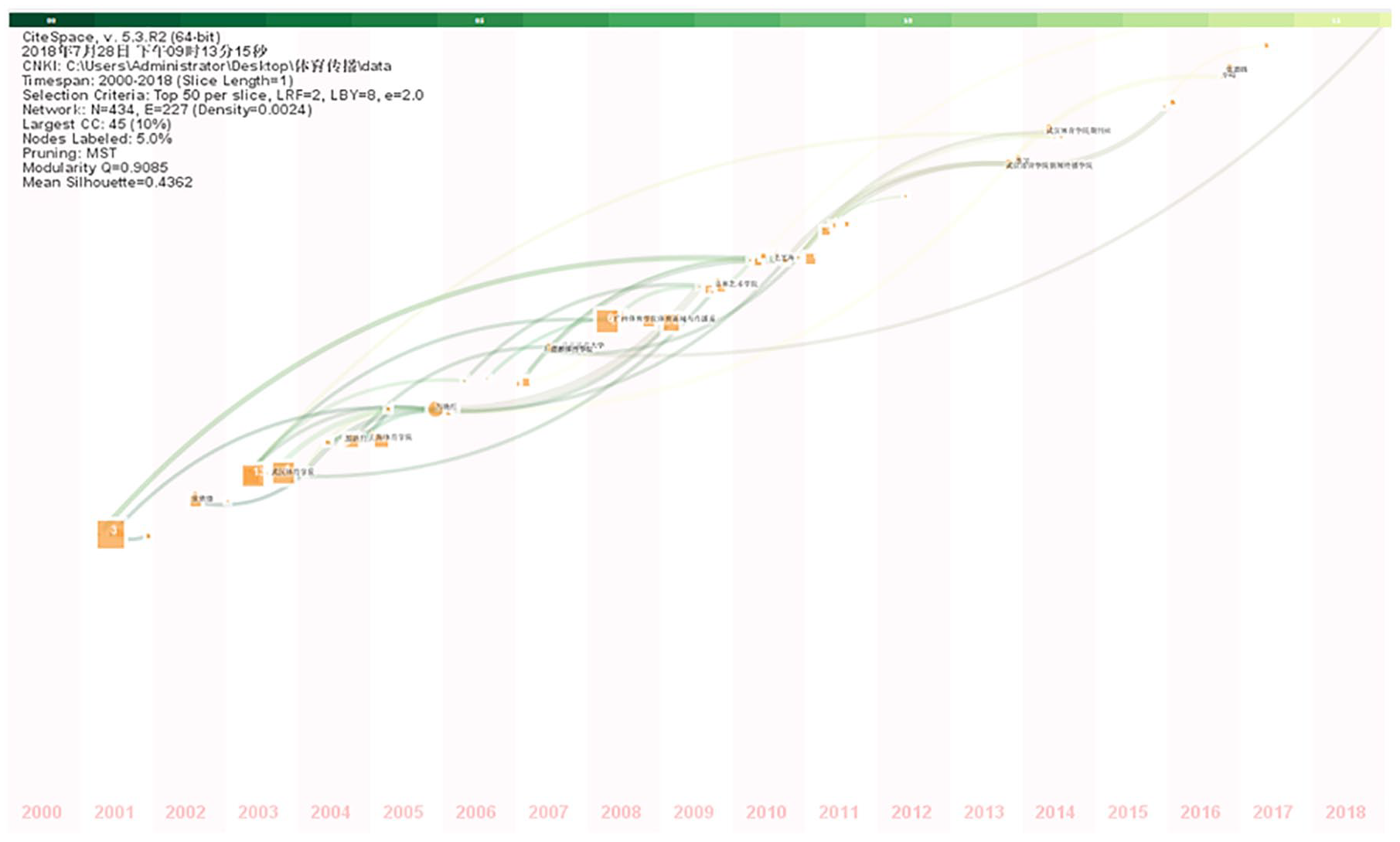
Disciplines involved in sport communication, shown as a Pathfinder network of subject categories.
The topics involved in sports communication can be delineated in terms of the keywords assigned to each article in the dataset. Figure 2 shows a portion of a minimum spanning tree of a network of keywords. Adjacent keywords are often assigned to the same articles. For example, sports news, sports culture, and national traditional sports are close to each other at the top of the figure. Figure 3 shows an overview of a network of co-cited references and burst terms on sports communication. Each cluster involves citing articles as well as cited references. The visualized network also shows highly burst terms found in the titles and abstracts of citing articles to the major clusters. China’s sports communication is spread from single to plural in the means of communication. Wealth and perfection, integration and innovation in the way of communication, and people’s access to sports information are more convenient and proactive.
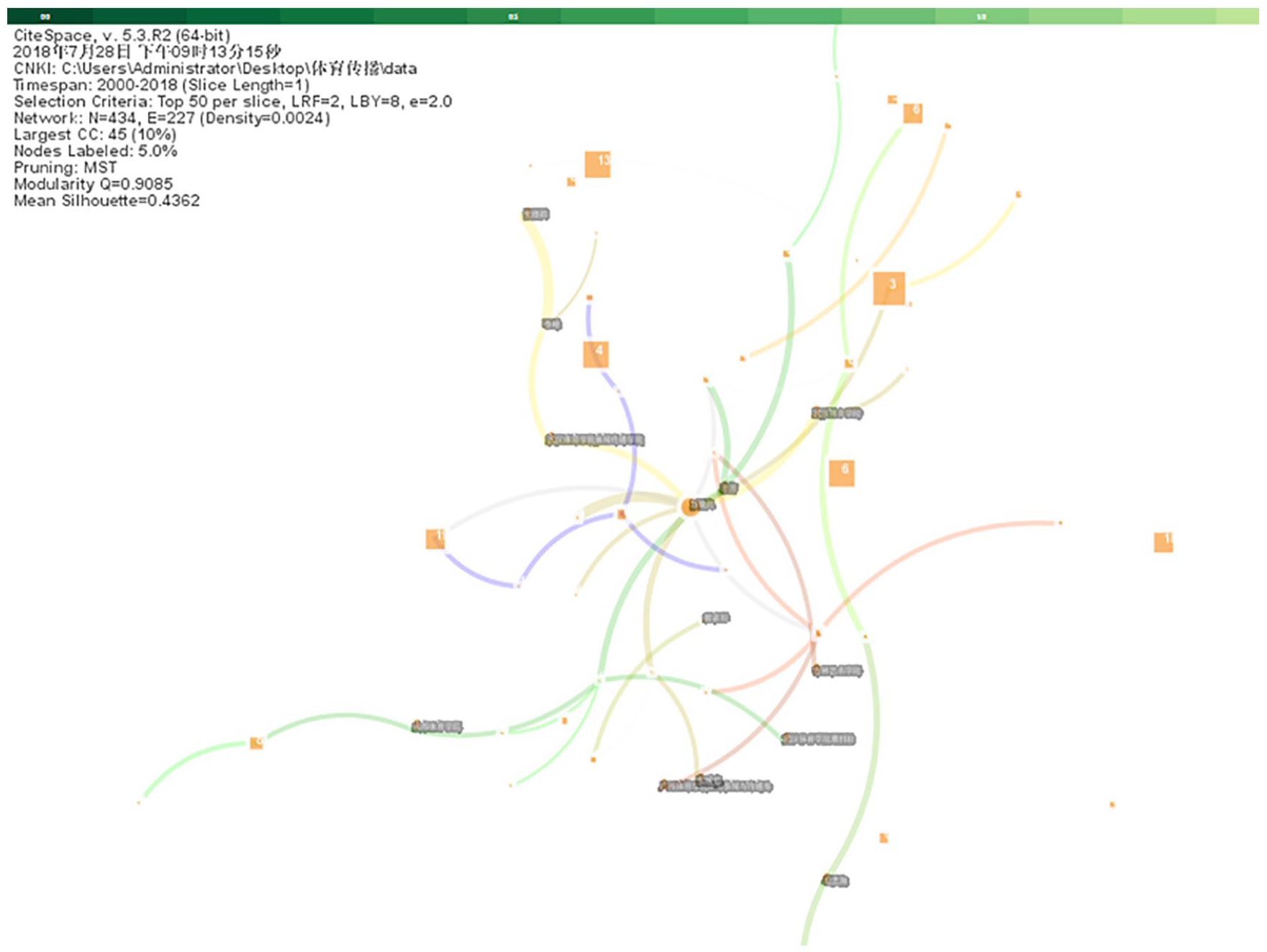
Part of a minimum spanning tree of keywords network based on articles published between 2000 and 2018.

Trajectories of relevant research shown in a hybrid network of co-cited references and burst terms from titles and abstracts.
Analysis of Research Hotspots in Sports Communication Field
Sports Communication in Age of Big Data
The advent of the era of big data has a profound impact on the social and cultural change of mankind. The use of big data technology has expanded the training methods of competitive sports and competition practice, promoted the innovation in research methods of sports science to realize the transformation of research paradigms from “measuring paradigm” to “computing paradigm,” and facilitated the transformation of sports communication mode. Communication and dissemination modes are presenting a diversified development trend, a precise prediction of audience groups has been achieved, and a “We Media” era of sports communication has been created. The era of big data has given birth to complete “module” marketing strategy and maximally promoted the value and technical level of sports industry. Athlete selection, training, competition and other ways of thinking in traditional sports, data safety and sports information intelligence systems, traditional sports research methods, and innovative sports thinking and technology development level of the sports industry are major challenges China’s sports industry is facing in the era of big data. We should solve the problems with the use of the big data in sports athlete selection, training, and competition and build a forward-looking theoretical basis; establish the sports information and intelligence gathering system to adapt to the development of the era of big data and apply them to sports practices; break through the “path dependence” in traditional sports research and adapt to the evolution from “measuring paradigm” to “computing paradigm”; and strengthen the innovation awareness and enhance collaborative innovative research on big data. These are the paths of sports development in China.
In a recent cross-sectional study, Zhang Jiangnan (2014) found that the big data has greatly impacted every field of human beings, bringing great revolution in the new era of information area. Big Data has promoted the integration of the traditional media and the new media in the sports communication. It predicts the future media market, controls the media communication, and quickens the omni-media era of Olympic media communication, providing massive information at the Olympic websites, offering ion great opportunities for sports TV, and supplementing greatly for the sports information communication.
Based on the background of big data, it argues that in the era of big data sports communication platform and channel, diversity, communicator, and audience’s boundaries are fuzzy, and the content of the presentation is fragmentation. It takes London Olympics as an example to locate the bodies of sports communication in the age of big data. It finds that television media’s hegemony status is still hare to shake; broadcast media has a relatively temporal fixed audience; agencies and print media have the source position and their in-depth reports are highlighted; networking has become an important platform for sports communication and information interaction; the new media and mobile media sports communication have become a new mode under the new technical conditions. The development direction of sports communication in the age of big data is that sports communicators should enhance the ability of information analysis and interpretation and make an effective presentation of data; audience should improve their media literacy to rationally choose data; media should create a cross-media integration communication mode to efficiently integrate data; and government and relevant organizations should provide policy and system security to perform their regulatory functions.
The sports communication in the big data era has undergone a fundamental change. The application of new media has promoted the resource acquisition and information mining of big data. In the future, the data will keep increasing and the source and classification will become more complicated. Managing and mining of big data of sports events will be more complicated. Therefore, the application of big data must meet the essential needs of sports communication. It will be possible for sports spectators to write big data news. However, the new media communication of large-scale sports events cannot depend completely on big data. The study by Wang Xiangfei and Qiaoling (2015) offers probably the most comprehensive empirical analysis of major features, influences, application, problems, and prospects of big data in the new media communication in the large-scale sports events. In the future, the data will keep increasing and the source and classification will become more complicated. Managing and mining of the big data of sports events will be more complicated. Therefore, the application of big data must meet the essential needs of the sports communication. It will be possible for the sports spectators to write big data news. However, the new media communication of large-scale sports events cannot depend completely on big data.
Sports Communication Evolution in Age Network
Based on the theory of media forms, Li Hongyi and Du Junkai studied the characteristics of sports communication, audience demands, and cultural expression under the evaluation of media form. Li Hongyi and Junkai (2016) found that the evolution of media forms is driven by the progress of social culture and science and technology and the change in sports media forms has also brought diversified cultural demands and expressions of the audience. In the change from the oral media cultural era to the digital media cultural era, the sports audience has experienced free and equal communication, stratum differentiation, and freedom and equality as the communication characteristics of the We Media era. It characteristics is that paper printed sports media is facing increasingly fierce competition, laying stress on contents and providing in-depth insights is its foundation, and the audience are showing a centralized and elitist trend. Electronic media has brought a new era of sports consumption and created virtual carnivals in the era of consumption while truly reflecting the specific images of sports events. Digital media provides a relatively free and equal platform for public opinions and virtual space for sports carnivals. The emergence of printed sports media has led to the booming of leisure sports culture, and the differences in stratum and gender among the audiences are further highlighted. Electronic sports media boosts the development of the audient culture toward the direction of visualization and universalization and has further deepened the commercialization process of sports. In the context of digital sports media, the audience culture is turning toward the era of complex media culture, virtual carnivals and free expression have become the theme of the audience culture, but the inevitable result of audience differentiation is the cultural expression of the audience in different sports media forms.
With the rapid development of information and communication technology, the internet has gradually spread. At the same time, the internet weaving communication social network and mobile internet gradually developed. Public access to inform channels more and more really broke through the space and time constraints. Under the promotion of the internet and mobile internet technology, a new revolution in human society has begun, it is the “Internet Revolution.” Set off on the internet revolution to promote the original industrial thinking is gradually replaced by the internet thinking. As the starting station of the internet revolution, the mass communication field has also changed greatly under the influence of the internet thinking. To center, heterogeneous, personalized, diversified mode of transmissions is more and more sought after. Through the new media technology, the public can easily connect to the internet, so as to make their own voice, modern society is gradually moving toward a new era of information opening—We Media Era.
We Media Era is a civilian, independent, open type of information dissemination of the times. Since the emergence of the We-Media, the original professional media organizations dominated the pattern of information dissemination. Gradually formed a new pattern of information position in the field of mass communication, nature should conform to the trend of the times, the development of internet thinking under the influence of the new sports communication mode. Sports dissemination of the contents and characteristics of the study, sports broadcasting right and sports media fusion development research, sports of the spread of public opinion and crisis research, sports organization operation, and marketing research have become a hot spot in the research of sports communication field. But the related research in this field is still lack of systematic theoretical research. Sports media in accordance with the order of emergence can be divided into sports print media, sports broadcast media, sports television media, sports network media, and sports mobile media. The emergence of the internet makes the field of mass communication with the traditional media and new media. Media convergence is the trend of the times. Under the impetus of new media technology, the traditional media has developed a new terminal form, such as network TV, mobile station, and so on. Everyone can be the communicator of the message. The transmission of the message also has a previous “one to all” mode of transmission to the “one to one” mode of the transmission. This brings convenience to sports communication while there are many problems. Through the rational integration of all media forms, the media convergence development strategy is more clear. Such an integrated study is necessary at the present stage.
Other authors (Xiaolong & Jianfang, 2017) question the usefulness of such an approach. In their seminal article, Sun Xiaolong and Zha Jianfang explore the structural form, public opinion polarization, and guiding mechanism of network sports information dissemination under the background of media integration using the related theory of communication. Xiaolong and Jianfang (2017) found that the structural form of network sports information dissemination is mainly embodied in the openness of network sports information dissemination, and the bearing form of audience information has given birth to the commercial operation mode of websites. Network sports information dissemination has strong public expression form and shows the characteristics of youthization in communication and structure of audience. It also has intuitive and simple forms of expression and distinctive individual characteristics. Information is easy to be recognized and shows strong communication effect. The main motive force of public polarization caused by sports information dissemination is that the information narrowing phenomenon and subjective comments are likely to further intensify social contradictions. The media theme of network sports information release shifted from the past “power spokesman” to “shady deal revealer,” so negative events are preferred in information release. Through analyzing the phenomenon of public opinion polarization in sports information dissemination, we believe that the guiding mechanism of public opinions should advocate logical persuasion to carry out the typical reports on the sensitive sports events in network communication; actively carry out public opinion analysis and in-depth coverage of the specific events involved in network sports information based on the fact of sports events; give to play the role of “opinion leader” and lead public opinions and investigate the responsibilities of the false events and extreme remarks in the network sports information dissemination process.
Sports Communication Influence on Sport Behavior
As the widest group who touch or use the new media, the college students’ behavior of sports is influenced by new media conveyed information to various degrees. The current teachers are faced with a crucial problem that how to introduce them to have a correct sense of sports and thus do physical exercises actively. A recent study by Yang Shuangyu (2015) involved in new media, sports communication, and sports behavior.
In order to research the university students’ behavior influenced by sports communication in the era of new media and provide new theory evidences for the development of new media and physical education of university. Yang Shuangyu (2015) provides us with a number of important related documents by investigating 600 students from Inner Mongolia University of Science & Technology, Zhengzhou University and Beijing Sport University using questionnaires and then analyzing these results with scientific methods such as mathematical statistics and logic analysis. He found that (a) the media used by college students most frequently is new media, and college students receive sports information through new media more frequently than traditional media; (b) new media can influence college students’ sports concept obviously, and college students’ decision in sports have a positive correlation with the information conveyed by new media. The sports information transmitted in new media can broaden the channel of learning sports knowledge and skills, and excite college students’ interest in learning. (c) Many universities overlook the important role of sports communication transmitted through new media in physical education and cannot combine the physical education courses with new media. (d) The fashion sports information in new media has a positive effect on college students’ sports behavior. Among these, the sports star effect can spur college students on building a correct sense of sport and encourage them to participate in physical exercise actively. But some propaganda of sport star has the information of violence, immoral, or mammonish, which lead to the aggressive behavior of the college students.
The 21st-century modern, media environment has an important impact on the social environment to the youth, has long been the role of the mass media in the development of sports and is becoming more and more obvious, and sports between encryption cut, more and more mass media sports information dissemination is the common needs of the media industry development and the development of sports.In the west, many countries already widely through the mass media to promote the mass sports and the media publicity work put in an important position, the focus of the mass sports activities and future plans, the purpose is to through the mass media sports communication to influence the mass sports activities. Although the mass media sports information communication has attracted the attention of scholars both at home and abroad, it has neglected the influence of media sports information communication on youth sports life. To a more comprehensive understanding of adolescent sport information in mass media contact condition and influence on sports attitude and behavior, for the cultivation of lifelong physical culture consciousness of the mass media to better development and improvement and adolescents to provide reliable basis. Sun Yan (2016) interviewed 460 teenagers from junior high school, high school, and university in Shanghai. The logic analysis and statistics method carries on the analysis and the induction, on adolescent contact mass media sports information on various aspects of the detailed and systematic research and objective describes the youth sports information media reception behavior, consumer behavior and theory initially revealed the influence of mass media dissemination of sports information on youth sports attitude and behavior. It reveals the positive and negative influence of mass media on the sports information communication of teenagers and the countermeasures. In her case study of the influence of sports events of mass media on the sports attitude and sports behavior of young people, Sun Yan (2016) pointed that the individual and social differences of the adolescents lead to the different behaviors of the media sports information. Youth of media sports information, the degree of concern, receive channel and contact time exist certain differences, 93% of young people a day watching sports event information time is less than an hour, only 7% of adolescent students every day to watch more than an hour for sports. The preference, motivation, and limiting factors of the youth receiving sports events are basically the same. In the choice of sports events, basketball (26.9%) and football (18.9%) showed great enthusiasm, watching sports motivation is to enjoy the wonderful sports competitions (38.3%), for personal hobbies (15.3%), rich after-school life (15.2%), limiting him to receive the main factors of sports information for learning pressure is too high does not have the time (63.4%), no interest (28.9%). The status of youth sports participation is not optimistic, there are gender differences in the choice of sports items. 63.2% of young people participate in sports activities every day for no more than half an hour, and 5.7% of young people never participate in sports activities. In the choice of sports, boys are more likely to choose some fighting, interesting string such as basketball, football, and other team sports, whereas girls are more likely to choose badminton and swimming, which are less confrontational sports. Sports media of youth sports life to the positive role at the same time also produced some negative effects, mainly concentrated in the media coverage of match fixing, whistle, stimulants and the use of, distorted their traditional sports ethics (23.3%), the error propagation of sports knowledge lead teenagers to sports knowledge produce incorrect cognitive (12.3%), envy, the pursuit of players in the media rich and fame (10.7%), the worship of sports violence show characters, and to imitate the violence (6.9%). Scores of various dimensions of adolescent physical exercise attitude show that adolescents’ overall scores are higher than the average score, and the average score of boys is higher than that of girls. That the attitudes of youth sports are mostly in the active state, boys are more active than girls’ sports attitude. Have a great influence on the mass media sports communication on youth sports attitude and behavior, teenagers of media sports information more attention, their physical attitude more positive (r = .322, p < .001), youth of media sports information and more attention, their sports behavior more positive (r = .385, p < .001). Teenagers viewing behavior, sports attitude has a significant impact on the sports behavior, sports attitude is viewing behavior influence sports participation behavior of a intermediary variable, on the viewing behavior explain sports behavior is part of the mediating effect.
According to the analysis of the negative influence of China’s sports information dissemination and information dissemination of the mass media have on teenagers, in her analysis of the influence of sports events of mass media on the sports attitude and sports behavior of young people, Sun Yan (2016) put forward several countermeasures: developing the sports information media spread positive impact on young people, to build sports culture quality, enhance the core competitiveness of the media market, the youth sports health communication, to lay the cornerstone of the “health Chinese” strengthen the sports new sports dissemination, promotion of youth sports participation; negative effects contain media on youth sports information, media practitioners of legal regulation and moral self-discipline, through the combination of control technology of purification sports information in mass media content, strengthen the youth media literacy education, implementation of adolescent self control.
Conclusion and Suggestion
This study examined the sport communication field over 37 years from January 1982 to July 2018. CitespaceV helped map the sport communication researchers and their research activity, operationalized through academic publications. The number of literatures on sports communication research in China is fluctuating. The frontier hotspots mainly include sports culture, national traditional sports, sports events, new media, and other fields.
After the 21st century, sports communication science has gradually attracted the attention of academic circles in China. Starting late, the theoretical system is still not perfect, so the core author’s overall volume is low. In the new era, we must vigorously strengthen the discipline team building and talent training of sports communication research, strive to build a talent platform, actively absorb outstanding talents to join the research team, and strengthen the interaction between the industry academic circles and various disciplines, to strengthen the construction of the research team.
The research strength of normal colleges in China’s sports communication development field is better than that of sports and comprehensive colleges. In the future, it is necessary to strengthen inter-institutional exchanges and cooperation, and promote the development of China’s sports communication toward more diversified, enriched, and specialized. To make the core institutions and core journals in the field of sports communication research in China show the trend of “Hundred Flowers Blossom, One Hundred Schools of Contention.”
China’s sports communication research is based on multi-disciplinary research. Its development requires not only acquiring knowledge from its own field but also acquiring knowledge from other disciplines. From the cited literature, sports communication is the product of the interdisciplinary of sport and communication, and its theory is based on the theory of communication. It can be seen that the current research on sports communication in China still lacks the theoretical support of sociology, management, economics, law and other disciplines, and the application of these theories is less. In the future, China’s sports communication research should focus on the unique perspectives of different discipline theories and integrate the mature research results in the field into the process of sports communication development, so that its research presents an interdisciplinary integration and promotes the overall development of sports communication in China.
Footnotes
Declaration of Conflicting Interests
The author(s) declared no potential conflicts of interest with respect to the research, authorship, and/or publication of this article.
Funding
The author(s) received no financial support for the research, authorship, and/or publication of this article.
