



Abstract
The application of natural language processing (NLP) technology in the field of education has attracted considerable attention. This study takes 716 articles from the Web of Science database from 1998 to 2023 as its research sample. Using bibliometrics as the theoretical foundation, and employing methods such as literature review and knowledge mapping analysis, the study utilizes tools like CiteSpace to generate relevant visualizations, analyzing key research themes, frontier developments, and providing future prospects in this domain. The main findings of the study are as follows: First, the number of publications in this field has been increasing annually, forming core publishing journals such as Education and Information Technology, core research teams led by figures like Cucchiarini Catia and Meurers Detmar, and core publishing countries including the United States and China. Second, the field primarily covers five major themes: the educational application of technical tools, the analysis and development of educational content, the application of computational linguistics in education, language acquisition and language learning, and educational assessment and analysis methods. Third, the research in this field exhibits certain developmental phases, progressing through the stages of emergence, exploration, and development. Based on these findings, the following future prospects are proposed: at the theoretical level, deeper application of personalized learning paths, emotional monitoring and learning support, and intelligent generation and optimization of educational content; at the practical level, interdisciplinary collaboration and innovation, educational data mining and analysis, and global perspectives with international cooperation.
Plain language summary
This study explores the use of natural language processing (NLP) technology in education, examining 716 research articles from 1998 to 2023 in the Web of Science database. It uses techniques like literature review, co-occurrence analysis, and knowledge graph analysis, with tools like CiteSpace and VOSviewer, to analyze trends in this field. The research shows a growing interest in NLP in education, as evidenced by an increase in publications. Major journals, research teams, and institutions in the United States and China play key roles in advancing this area. The study identifies five main areas of focus: the use of technical tools in education, content analysis and development, applications of computational linguistics, language acquisition and learning, and evaluation methods. Research in NLP for education has evolved through three stages: early development driven by external factors, an exploratory stage with internal motivations for transformative teaching methods, and a more advanced stage with innovations enhancing the learning experience. Six major trends are highlighted: language learning apps, optimizing educational systems, new educational technologies, data analysis, social-educational relationships, and intelligent educational support. The study suggests deeper interdisciplinary integration, practical applications, user-centered approaches, and the use of emerging technologies to improve education.
Introduction
Natural language processing (NLP) is a technology that utilizes computers to analyze, understand, and process natural language, such as sentiment analysis, topic modeling, machine translation, language modeling, etc. (Smith et al., 2020). It enables interactive communication between human languages and machines, including natural language understanding and natural language generation. With the advancement of computer science, especially the widespread application of artificial intelligence technology and theory, significant progress has been made in the research of NLP technology. From early statistical language models to current large language models, machines can not only understand the surface meanings of text and speech but also grasp contexts, emotions, and metaphors to provide more accurate and efficient “intelligent language services” for humans. For example, machine translation systems employ neural network technology to accurately express semantics and syntax and automatically handle ambiguity, thereby improving translation quality (Z. Xu et al., 2021). Meanwhile, scholars have begun to explore the application of NLP technology in the field of education to enhance learning experiences, improve teaching efficiency, and achieve personalized learning, such as the development of intelligent tutoring systems and automated grading systems (Carmon et al., 2023).
Although NLP technology holds tremendous and new opportunities for application in the field of education, its advancement and improvement in education are still facing significant challenges today, constrained by the cognitive abilities of participants within the educational system (Xue, 2023). This is because NLP technology is a multidisciplinary research field involving linguistics, computer science, and other disciplines, with a high cognitive and application threshold. In view of this, this study aims to systematically organize and analyze literature from the Web of Science database spanning 1998 to 2023. Its goal is to uncover the underlying principles and developmental trends of NLP in education, offering insights and recommendations to policymakers, practitioners, and researchers on advancing the technology’s application in education. In summary, this study mainly addresses the following questions:
RQ1: Analyze the productivity distribution of the application of NLP technology in the field of education from 1998 to 2023 in terms of publication trends, journals, authors, countries, etc.
RQ2: Analyze the core hotspots and research topics of the application of NLP technology in the field of education from 1998 to 2023 through cluster analysis.
RQ3: Analyze the evolutionary logic and stage characteristics of the application of NLP technology in the field of education from 1998 to 2023 through evolution analysis and co-occurrence analysis.
Literature Review
The Current State of Research on the Application of NLP Technology in the Field of Education
NLP technology, as a crucial tool for analyzing, understanding, and processing human language, has gained widespread attention in its application to the education sector. Studies indicate that the exploration of NLP in education can be traced back to the 1940s, initially focusing on automated grammatical analysis and machine translation. The successful development of a machine translation system by IBM’s Georgetown-IBM laboratory in 1954 marked the first entry of NLP technology into the field of education, laying the foundation for subsequent research (Hutchins, 2004).
With the rapid development of computer technology, NLP’s advancement in education has gone through multiple stages. In the 1960s and 1970s, the emergence of computer-assisted language learning systems made language learning more interactive and personalized. For example, the introduction of the PLATO system provided a personalized learning experience, facilitating progress in later research (Anderson, 2003). In the 1980s and 1990s, intelligent educational systems such as Carnegie Mellon University’s “ALBERT” emerged. These systems not only allowed natural language interaction with students but also offered personalized educational support, thus enhancing the learning experience (Somers et al., 2021).
Since the 21st century, with the rise of big data technologies, the application of NLP has become increasingly widespread. Researchers have been able to assess students’ language proficiency and learning needs by analyzing linguistic data, while also providing personalized learning feedback and guidance (Omar et al., 2020). In this context, researchers have also focused on developing NLP tools adapted to different linguistic characteristics to support language education, particularly in applications like automated essay grading, speech recognition for listening and speaking training, significantly enriching the variety of educational tools and improving learning support (Atutxa et al., 2021). In recent years, educational data mining and intelligent education have become research hotspots, with NLP being widely applied to mine educational data, thereby improving educational policies and practices and further enhancing the quality and efficiency of education (Palomino et al., 2019).
In conclusion, the research on NLP technology in the field of education has progressed through several development stages, from early grammatical analysis to intelligent educational systems, personalized learning, and educational data mining. These studies have provided essential support for educational theory and practice, offering key tools to improve the quality and efficiency of education, making education increasingly intelligent and personalized.
The Current State of Research in Bibliometrics
As a discipline that studies the data characteristics and changing patterns of literature and information resources, bibliometrics has attracted widespread attention. Since the term “bibliometrics” was first proposed by the British scholar in 1969, bibliometrics, as an independent discipline, has gradually emerged in the field of scientific quantitative research (Pritchard, 1969). With the gradual improvement of database construction and the establishment of academic journals such as *Scientometrics*, this field has developed vigorously. The establishment of the International Society for Scientometrics and Informetrics (ISSI) in 1987 marked an important step in the institutionalization of bibliometrics as a discipline. In addition, the rapid development of computer technology has facilitated the deep integration of scientific visualization techniques with bibliometrics, making bibliometric analysis more detailed and comprehensive, thereby significantly advancing the field (Börner et al., 2003; van Eck & Waltman, 2010).
In 1987, American computer scientist McCormick Bruce H. first elaborated on the goals and scope of scientific visualization, emphasizing the use of computer graphics to create visual maps that help people understand complex scientific and technological concepts or results (McCormick et al., 1987). In the field of bibliometrics, researchers are no longer confined to conceptual understanding and result presentation but aim to discover patterns, characteristics, relationships, and anomalies through data visualization, thus achieving the goal of “a picture is worth a 1000 words” (Merigó et al., 2015; Van Dam et al., 2000).
With the rise of visualization methods in bibliometric analysis, bibliometrics has entered a more modern and data-driven development phase. In this phase, researchers rely not only on quantitative analysis but also propose innovative methods to evaluate research outcomes. For example, Hirsch (2005) optimized the h-index for assessing individual academic achievements through quantitative analysis. The continued development of computer and network technologies has driven a paradigm shift in bibliometric research. For instance, Amir Hussain used CiteSpace to analyze bibliometric data and utilized Network Workbench to visualize complex networks (Niazi & Hussain, 2011). Shen and Ho (2020) combined bibliometrics with the theory and methods of latent semantic analysis to explore the overall development of technology-enhanced learning in higher education, detailing how information and communication technology applications improve teaching and learning outcomes.
In summary, the importance of NLP technology in the field of education cannot be overstated. Its continuous development and application have profoundly changed the ways of education and learning experiences. By citing cases and examples from previous research, we can see how these technologies, through personalized learning pathways, automated assessment, intelligent tutoring, and real-time feedback, have significantly improved educational outcomes (X. Chen et al., 2024). Teachers are better able to meet students’ needs, and students can more easily obtain personalized learning experiences, resulting in a more flexible and efficient evolution of teaching methods. These advancements bring immense potential and opportunities to the education field, encouraging further exploration of NLP technology applications in this domain.
Previous studies have played a crucial role in revealing the hot topics and frontier developments of NLP technology in the education sector, providing valuable insights into understanding the trends and challenges in this field. These studies not only help us recognize how NLP improves educational outcomes, personalized learning, and teaching methods but also promote deeper discussion and reflection. However, it is essential to acknowledge that existing studies have some limitations, such as the diversity of research methods, insufficient sample sizes, and differences in data sources. These limitations offer room for improvement in future research while helping us gain a more comprehensive understanding of the current status and development trends in this field.
Research Methods and Data
Research Methods
Since bibliometrics emerged as an independent discipline in 1969, it has been widely applied in literature analysis. This research method, which examines and investigates existing literature in a given field through quantitative approaches, makes conclusions more persuasive (Lin & Yu, 2024a; C. Wang et al., 2024). Bibliometrics takes external characteristics of literature as the research unit, such as publication year, author, institution, and journal information, and is based on mathematical, statistical principles, and related empirical laws. It serves as a method to statistically evaluate and predict the development status and trends of a particular field or discipline. In recent years, thanks to advancements in various technological domains (including, but not limited to, computer science, database management, and statistics), the scientific rigor and effectiveness of bibliometric analysis have gained increasing recognition among scholars (Shang et al., 2024). Undoubtedly, bibliometrics has become a powerful discipline for analyzing literature.
This study is grounded in bibliometrics and primarily employs the literature review method and knowledge mapping analysis. We use CiteSpace software to create scientific knowledge maps and conduct co-occurrence analysis, cluster analysis, and timeline analysis. By examining the distribution, quantitative changes, and interactive relationships of the literature, the study aims to identify hot topics and frontier developments of NLP technology in the field of education, helping us visualize the main issues and research trends in this domain.
Data Retrieval
This study selected literature from the Science Citation Index-Expanded (SCIE) and the Social Science Citation Index (SSCI) within the Web of Science Core Collection as the data source for the following reasons: (1) The Web of Science Core Collection is widely accepted by many researchers as a high-quality digital literature resource database and is currently considered the most suitable database for bibliometric analysis. Compared to other databases, Web of Science provides more comprehensive data information (J. Chen et al., 2022), and it offers data formats compatible with various analysis tools (Gaviria-Marin et al., 2019); (2) The application of NLP technology in the field of education is an interdisciplinary research topic involving technical literature from the natural sciences and educational literature from the social sciences. Therefore, it is necessary to select authoritative indexes such as SCIE and SSCI as the data sources for this study. This ensures the high quality and credibility of the literature sources while ensuring comprehensive coverage of data, thereby enhancing the reliability and persuasiveness of bibliometric research (J. Chen et al., 2024; Hwang & Tsai, 2011; C. L. Wang et al., 2022; Yu, Wang et al., 2024).
Once the research data source is determined, a retrieval strategy needs to be established. The selection of the retrieval strategy requires a balance between the breadth and accuracy of coverage, aiming to include all relevant literature while excluding irrelevant ones. Based on multiple relevant literature sources (X. Chen et al., 2022; Ding et al., 2022; Peng et al., 2024), the retrieval strategy selected for this study is as follows: TS = ((“natural language processing” OR “NLP” OR “computational linguistics” OR “text generation” OR “text synthesis” OR “text mining” OR “text analysis” OR “text summarization” OR “information retrieval” OR “information extraction” OR “speech recognition” OR “speech synthesis” OR “sentiment analysis” OR “syntax analysis” OR “syntax analysis” OR “machine translation” OR “word embeddings” OR “dialog systems” OR “ named entity recognition” OR “language processing*” OR “language understanding” OR “NLU” OR “language model” OR “pragmatics”) AND (“education” OR “college*” OR “undergrad*” OR “graduate” OR “postgrad*” OR “K-12” OR “kindergarten*” OR “corporate training*” OR “professional training*” OR “primary school*” OR “middle school*” OR “high school*” OR “elementary school*” OR “teaching” OR “learning”)). The literature retrieval time span was set from 1998 to 2023, with the retrieval deadline being December 31, 2023. The language selected was English, and the document types were set as “Article” or “Review Article.” The Web of Science category selected was “Education Educational Research.” The preliminary retrieval results yielded a total of 987 journal articles (see Figure 1).

Data retrieval, screening, and standardization process.
Literature Screening
The literature obtained through retrieval strategies often contains some documents that appear relevant but are, in fact, unrelated. Therefore, to ensure that the literature included in the analysis is closely aligned with the research topic, it is usually necessary to conduct a literature screening process after completing the initial retrieval.
The literature screening process consists of two steps. First, the issue of duplicate documents is addressed. This step primarily relies on the “Remove Duplicates” function in CiteSpace software, with the screening criterion being the examination of the DOI numbers for all documents. The analysis revealed that there were zero duplicate documents, leaving a sample size of 987 after deletion. Second, the issue of irrelevant topics is addressed. To conduct the manual screening efficiently and scientifically while ensuring the quality of the literature included in the analysis, the screening criteria proposed by C. Wang et al. (2024) and Jing, Wang, Chen, Shen, and Shadiev (2024) were adopted to develop the inclusion criteria, as shown in Tables 1 and 2. Based on these criteria, each document was screened individually, resulting in the deletion of 271 documents that did not align with the topic, leaving a final count of 716 documents for analysis.
Inclusion Criteria.

Top 5 Journals by Publication Volume.

Data Standardization
Nguyen and Hallinger (2020) pointed out that metadata extracted from scientific databases often contains multiple expressions of the same term. If these different expressions of the same data term are not rationalized, bibliometric analysis will yield inaccurate results. Therefore, before conducting data analysis, it is necessary to perform data disambiguation on the metadata set to achieve data standardization.
Data disambiguation processing is primarily completed using CiteSpace software supplemented by manual merging. The process involves uploading the txt data file downloaded from the database to CiteSpace software, identifying problematic data terms, and recording them. Subsequently, following the same semantic meaning, low-frequency keywords are adjusted to synonymous high-frequency keywords, with a priority given to nouns when frequencies are similar, adhering to the standard of manual data cleansing (Strotmann & Zhao, 2012; Van Eck & Waltman, 2011).
This study adopted the data standardization process proposed by Taskin and Al (2019), primarily conducting the following standardization operations. Firstly, corrections and uniformity were applied to the author and source fields in the data. In cases where different authors shared the same name, distinctions were made by adding identifiers. Secondly, an examination was conducted to ascertain whether the journals to which the literature belonged underwent name changes between 1998 and 2023, aiming to avoid any impact of journal name changes on the analysis results. Lastly, standardization was applied to the keyword field by unifying the part of speech and singular/plural forms to reduce meaningless repetition in the knowledge graph.
Distribution of Field Productivity
In bibliometric research, a comprehensive analysis of external characteristics is crucial as it allows us to gain a macro-level understanding of research trends and scholarly contributions within an academic field (Jing, Wang, Chen, Wang, Yu, & Shadiev, 2024). The distribution of productivity not only covers various aspects of academic activities but also reveals interactions and contributions among scholars and countries. To this end, the present study analyzed 716 papers authored by 1,929 researchers from 75 countries and published in 153 different journals. The in-depth analysis of this data lays the foundation for our subsequent discussion. In the following sections, we will explore the development trends of NLP technology in the field of education, focusing on four key dimensions: publication trends, journals, authors, and countries.
Trend of Publications
The annual number of publications in a field and its changes not only reflect the level of prosperity in the research area but also intuitively indicate its macro development trends. The annual number of publications applying NLP technology to the field of education from 1998 to 2023 was analyzed (see Figure 2). Overall, the number of publications in this field showed a significant upward trend. From 1998 to 2005, the annual number of publications was relatively low, reflecting that NLP technology in the field of education had not yet received widespread attention from the academic community due to factors such as technological maturity and academic awareness. From 2006 to 2015, although the annual number of publications fluctuated, there was an overall increasing trend year by year, indicating that NLP technology began to receive more attention in the field of education during this period. From 2016 to 2023, the annual number of publications sharply increased, especially reaching a historical high in 2023, demonstrating unprecedented research and attention to the application of NLP technology in the field of education. This growth trend is closely related to the transformation of educational models in the later stages of the pandemic and the widespread use of artificial intelligence technology in education (Lin & Yu, 2024b; Okoye et al., 2021). In summary, NLP technology has become a hotspot in the research and application of the education field.

Trend of publication volume of relevant literature from 1998 to 2023.
Journals for Publication
Journals serve as the primary vehicle for publishing high-quality papers. Some scholars have pointed out that two key factors in measuring the influence of journals in a specific field are the volume of publications and the number of citations the journal receives in that field. The more papers published in a journal and the more times they are cited, the greater its influence (Dzikowski, 2018). Analysis reveals that the journal with the highest publication volume in this field is Education and Information Technologies, indicating its significant attention to the application of NLP technology in education (see Table 2). The journal with the highest average citations per paper is Computers & Education, reflecting its substantial academic influence and citation value in the research of NLP technology applied in education. However, many of the top-ranking journals in this field are not open access, highlighting the necessity to promote the development of open-access journals to enhance the visibility and impact of research outcomes (C. K. Huang et al., 2020). Further analysis of the research domains to which these journals belong reveals journals focused on education, such as Education and Information Technologies; journals focused on computer science, such as Computers & Education; and journals focused on linguistics, such as Computer Assisted Language Learning. This indicates that the research scope of applying NLP technology in education encompasses multiple disciplines, including education, computer science, and linguistics, reflecting a trend of interdisciplinary research.
Authors for Publication
When a paper involves multiple authors, it usually indicates collaboration among them. By constructing an author collaboration network, we can not only reveal the collaboration patterns among scholars in the field but also gain insights into the level of collaboration among them. Analysis reveals that scholars collaborating on the application of NLP technology to the field of education are primarily linked by institutional affiliations and geographic locations, forming four main research teams (see Figure 3):

Author collaboration network map.
Firstly, Professor Cucchiarini Catia leads a research team focusing on computer-assisted language learning. The team innovatively utilizes automatic speech recognition technology to provide innovative learning methods for second language learners, particularly in speaking and grammar. Their work significantly enhances learning efficiency and experience, particularly contributing to reducing speaking anxiety and enhancing language skills, demonstrating the effectiveness of technology in constructing highly supportive and interactive language learning environments (Cucchiarini et al., 2002, 2009).
Secondly, Professor Meurers Detmar leads a core research team dedicated to applying NLP technology to language education and learning. The team creatively employs NLP tools to optimize language learning and teaching processes, particularly in assessing learners’ language abilities and providing personalized feedback. Their research focuses on developing intelligent educational software to assist learners in better understanding and using the second language, particularly emphasizing the enhancement of grammar, vocabulary, and writing skills (Meurers & Dickinson, 2017; Ziegler et al., 2017).
Thirdly, Professor Chen et al. (2008) leads a research team focused on enhancing electronic learning with NLP technology. The team’s work centers on implementing automatic text summarization in mobile learning environments, studying the effectiveness of group learning in online classrooms, and analyzing academic articles to grasp the core concepts of e-learning. Their research aims to enhance the interactivity, personalization, and efficiency of e-learning while exploring the potential application of technology in language and cultural learning (G. Yang et al., 2013).
Fourthly, the research team led by Professor Zawacki-Richter et al. (2017, 2018), focusing on educational research using text mining tool Leximance. This team’s main work involves analyzing educational literature and data using Leximancer to reveal key trends, topics, and concepts in educational research. This text mining technology also helps the team effectively analyze large amounts of data, thus finding new insights and solutions to complex issues in the field of education.
It is noted that most of these research teams are affiliated with universities and have their own strengths and characteristic research directions. However, from a global perspective, the proportion of collaboration among research scholars is relatively low, with most still maintaining independent research statuses. Through in-depth study of collaboration relationships, it is found that the current collaboration relationships in the application of NLP technology to the field of education belong to the same disciplinary system and internal collaboration within the same university. Interdisciplinary and cross-regional collaboration has not yet reached a mature stage. In the future, it is necessary to strengthen team collaboration to explore more multidimensional collaboration opportunities across disciplines and universities to obtain broader research results (Fan et al., 2015).
Countries of Publication
Countries serve as the solid backbone of academic research, providing crucial support and resources. The number of publications, research output, and influence of countries are essential for evaluating the scientific research system of a field. The relevant information regarding countries where NLP technology is applied in the field of education is tabulated in Table 3. Analysis reveals that the country with the highest publication volume in this field is the United States, followed by China. Their publication volumes far exceed those of other countries, indicating that research activities in the application of NLP technology to education are highly active in these two countries. Scholars from various regions have shown extensive research interests and engagement. The country with the highest average citation per paper is Canada, followed by Germany, reflecting outstanding research achievements in the application of NLP technology to education in these two countries. Furthermore, these achievements are widely cited and recognized in the academic community. Geographically, most of the top 10 countries in terms of publication volume are located in Europe, North America, and Australia, with China being the only exception. Moreover, all except China are developed countries, indicating that the development and deepening of NLP technology in the field of education require a certain economic foundation.
Top 10 Countries by Publication Volume.

Analysis of Hot Topics
Keyword clustering involves analyzing the relationships between keywords and grouping those with strong correlations into different research clusters. This process relies on statistical methods within NLP technologies, such as TF-IDF and co-occurrence networks, combined with similarity calculations and clustering algorithms like K-means, to achieve scientific classification of keywords. The scientific nature of this approach lies in data-driven objective analysis, typically including steps like data preprocessing, keyword extraction, similarity calculation, and cluster generation (Landau & Ster, 2010). When analyzing research hotspots in the application of NLP in education, keyword clustering can reveal differences between various research subjects, modules, and directions. Based on the labels and tag words of the 13 automatically formed research clusters, and in conjunction with the current state of NLP technology application in education, we classified them into five major thematic categories: educational application of technical tools, analysis and development of educational content, application of computational linguistics in education, language acquisition and learning, and educational evaluation and analytical methods (see Figure 4).
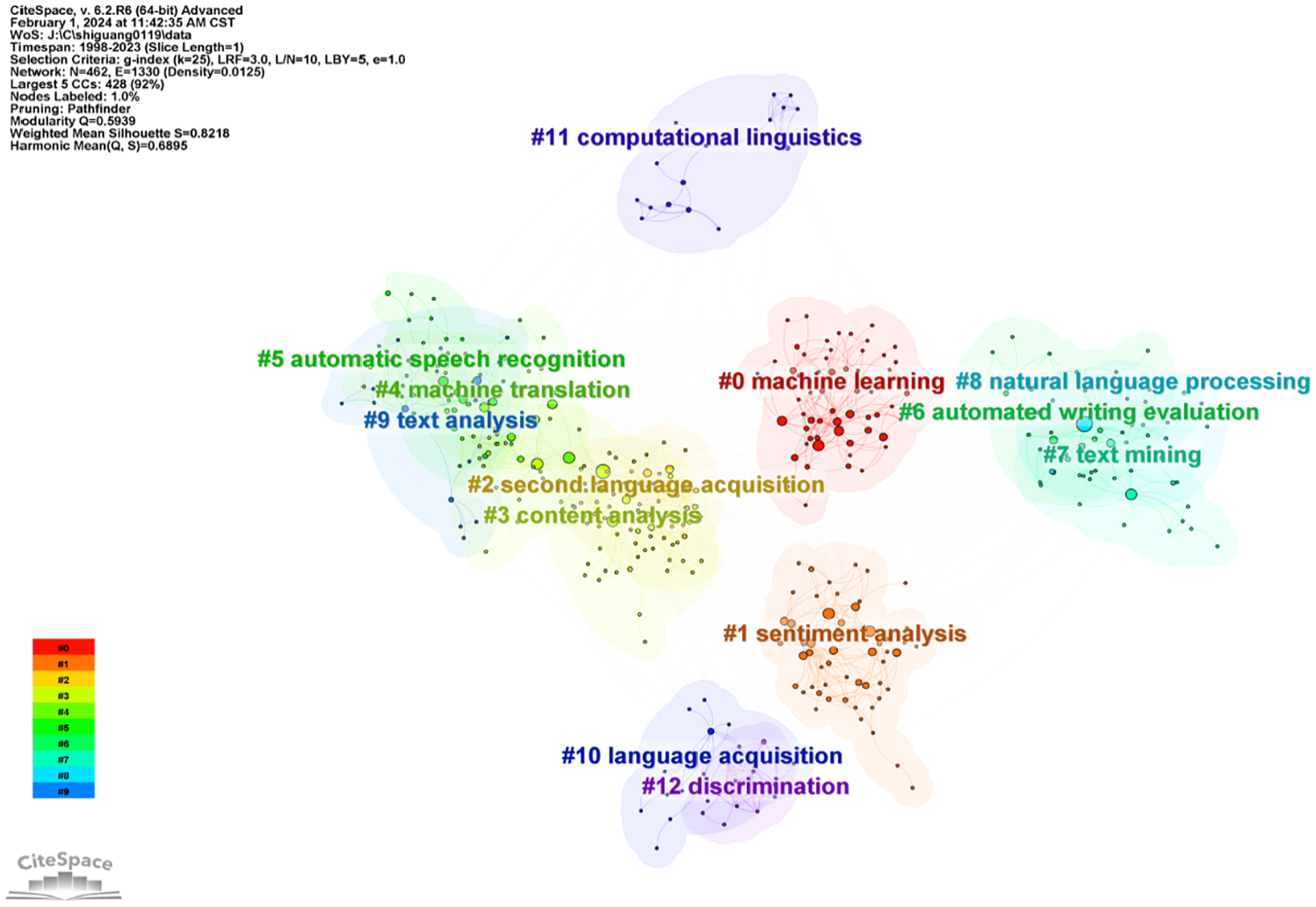
Network graph of keyword clustering.
Educational Application of Technological Tools
The application of NLP technology in the field of education is becoming increasingly widespread, including machine learning, automatic speech recognition, machine translation, and automated writing evaluation. These technologies optimize teaching processes and improve the quality of teaching and learning.
Machine learning analyzes students’ online interactions, assignments, and behavioral patterns, providing educators with insights. For example, Perrotta and Selwyn (2020) use machine learning to track students’ progress and recommend personalized courses and exercises based on students’ learning speed and comprehension. Additionally, machine learning can predict students’ future performance, identifying those who may need extra support.
Automatic speech recognition technology enhances the interactivity of language learning software and improves pronunciation instruction quality. For instance, platforms like Rosetta Stone and Duolingo widely use automatic speech recognition technology to evaluate and improve students’ pronunciation, offering real-time corrections and feedback, enabling students to practice and enhance their pronunciation independently (Loewen et al., 2020).
Machine translation technology promotes the global sharing of educational resources, allowing non-native English-speaking scholars to access international academic results without barriers, thus facilitating cross-cultural academic exchanges. For instance, Google Scholar and other online journal databases integrate machine translation functions, enabling researchers worldwide to understand and utilize research findings in different languages.
Automated writing evaluation tools play a significant role in educational assessment and academic writing guidance. For example, ETS’s e-rater and Vantage Learning’s IntelliMetric systems use NLP technology to automatically score students’ writing, providing feedback on grammar, spelling, content, and style (Weigle, 2013), assisting teachers in managing large student writing assignments and providing guidance.
These technologies also support the learning of students with disabilities. For example, automatic speech recognition technology helps hearing-impaired students better understand classroom content, while automated writing evaluation tools help visually impaired students improve their writing skills through feedback (Mohammdi & Elbourhamy, 2023).
As technology continues to advance and educational demands grow, these technologies will play an increasingly important role in the field of education. They will continue to optimize educational processes, improve teaching and learning quality, and promote the development of personalized and inclusive education. Future education, led by technology, will become more personalized, intelligent, and globalized, offering more opportunities for students and educators (Strycker, 2020; C. Wang et al., 2024). The development of technology will shape the future of education, injecting new vitality and innovation into the educational enterprise.
Analysis and Development of Educational Content
Content analysis and text mining are important applications of NLP technology in the education sector, especially in the development, evaluation, and revision of educational materials. These technologies not only trace the historical development of education but also reveal future trends, providing deep insights into the core of learning materials.
Historical content analysis allows researchers to understand the formation of the education system through the evolution of educational policies and teaching philosophies, uncovering historical trends in educational reform and the influence of socio-cultural factors (Baker et al., 2010). These insights offer valuable references for the continuous evolution and reform of modern education.
Text mining technology plays a significant role in the development of educational materials. By analyzing large amounts of educational text, such as course descriptions, learning objectives, and academic papers, text mining tools can identify key themes and patterns in educational discourse (Freak & Miller, 2017). These insights are crucial for course designers, enabling them to create educational content that better meets learners’ needs. Additionally, text mining technology can evaluate the quality of interaction on online teaching platforms, offering feedback for the improvement of online education.
NLP technology automates the analysis of teaching resources’ readability and complexity. Educational publishers use these technologies to assess the language difficulty of textbooks, ensuring they are suitable for students at specific grade levels (Abeywardena et al., 2013). By comparing different versions of textbooks, publishers can precisely adjust content to align with educational standards and students’ learning needs.
Developers of multilingual educational resources use NLP technology to ensure consistency and accuracy of content across different languages, providing high-quality learning materials for non-native learners.
Content analysis and text mining play key roles in the analysis and development of educational content. The application of these technologies offers more personalized opportunities in education, making educational materials more interactive and flexible. Future educational materials will better adapt to ever-changing educational demands, offering more opportunities and possibilities for students and educators.
Educational Application of Computational Linguistics
The application of NLP technology and computational linguistics in the field of education has become a driving force for educational innovation. Developments in these areas focus not only on language assessment and learning tool development but also on enhancing the intelligence of language learning software. These advancements benefit non-native language learners and play a key role in remote education environments.
Language assessment automation is a core application of NLP in education. For instance, international English proficiency tests like TOEFL and IELTS have begun using NLP technology to automatically score the speaking and writing portions of the exams. NLP technology can analyze test-takers’ language usage, such as grammatical complexity, vocabulary richness, and pronunciation accuracy, providing accurate and consistent scoring (J. Xu et al., 2021). Automated scoring streamlines the assessment process, making large-scale language testing more feasible.
NLP and computational linguistics also focus on the development of learning support tools. For example, learning platforms like Quizlet use NLP technology to create and optimize flashcards, helping students efficiently memorize and learn new vocabulary (Yüksel et al., 2022). These tools analyze users’ learning data to offer personalized review plans and memory curves, thus improving learning efficiency.
The intelligence of language learning software is exemplified in applications like Duolingo, which uses NLP technology to provide an interactive and personalized learning experience (Loewen et al., 2019). Maqsood and colleagues developed an automatic classification model for English readability levels to assist English language learners. The study used evaluation metrics such as accuracy, precision, recall, F1 score, and ROC curve to analyze the performance of five machine learning algorithms—KNN, LR, SVM, NB, and ANN. By comparing the performance of these algorithms, the researchers aimed to identify the most effective method for assessing text readability, thereby improving English learners’ learning efficiency and comprehension abilities (Maqsood et al., 2022).
In remote education environments, NLP technology is crucial. With the rise of online education platforms such as Coursera and edX, intelligent tools are needed to manage and process large volumes of student data and interactions (Ruipérez-Valiente et al., 2020). NLP technology can automatically monitor forum discussions, extract key concepts and questions, and support teachers in providing personalized feedback to students.
Additionally, computational linguistics plays a role in supporting learners with language impairments. For instance, to assist learners with language disabilities, developers have designed applications that utilize NLP technology, such as Speech Buddy, which helps children improve their pronunciation through gamified exercises.
NLP and computational linguistics have become indispensable parts of educational technology. The tools and applications they offer continue to expand the boundaries of education. As technology advances, these tools will play an increasingly important role in providing personalized learning experiences, supporting special educational needs, and extending educational accessibility. This will not only improve the quality of education but also offer more opportunities for students, driving innovation and progress in the field of education.
Language Acquisition and Language Learning
In the field of educational technology, NLP technology significantly impacts language learning and acquisition. By utilizing advanced computational methods, NLP technology transforms language education, particularly in the areas of second language and native language acquisition, providing learners with unprecedented support and convenience.
In the realm of second language acquisition, intelligent educational applications offer users a personalized learning experience. For example, applications like Babbel and Duolingo use NLP technology to analyze users’ language input, providing instant feedback and correction to help users improve their language skills (Perrotta & Selwyn, 2020). These applications identify users’ learning habits and progress, adjusting course difficulty and recommending learning materials accordingly, accelerating the language learning process.
In the field of native language acquisition, NLP technology is used in early education to help children master reading and writing skills. For instance, applications like Readability utilize NLP technology to provide interactive reading materials and assess children’s reading abilities through speech recognition technology, offering personalized feedback to enhance language comprehension and expression (Nahatame, 2021).
During the COVID-19 pandemic, as educational institutions shifted to online learning modes, NLP technology provided crucial support. Platforms like Zoom and Microsoft Teams use real-time translation and captioning tools to make course content more accessible and friendly for non-native language learners (Jing et al., 2023; Omlor et al., 2022; Yu et al., 2023).
Additionally, the development of educational applications is an important direction for NLP technology in language learning. Platforms like Voxy utilize personalized news articles, videos, and dialogs, combining NLP technology to track and analyze learners’ progress and provide tailor-made learning plans, increasing the relevance and interest of learning and improving learning efficiency (Nielson, 2018).
NLP technology’s applications in the field of language learning and acquisition are diverse, including the creation of personalized learning paths, the development of interactive learning materials, and the support of remote teaching. As technology advances, NLP technology will continue to bring profound changes to language education, offering learners a rich, efficient, and personalized learning experience (X. Chen et al., 2023).
Methods of Educational Evaluation and Analysis
Natural language processing (NLP) technology plays a crucial role in educational assessment and analysis methods, including sentiment analysis, text analysis, and research on discrimination issues. The widespread application of these technologies has brought profound changes to the field of education, significantly enhancing understanding of learners’ emotions and needs, while also providing strong support for the evaluation of educational materials and the realization of inclusive education.
Sentiment analysis plays a central role in understanding learner emotions. By analyzing the text of students’ online course forums, feedback, and evaluations, sentiment analysis tools can reveal students’ feelings toward course content, teaching methods, and learning environments. For example, by applying sentiment analysis to students’ online discussions, educators can identify challenges and difficulties students may encounter during the learning process, thus adjusting teaching strategies promptly. Online learning management systems like Moodle integrate sentiment analysis tools to help teachers monitor emotional feedback on courses and optimize teaching content (Fernando, 2020).
Text analysis is crucial for evaluating and improving educational materials. By deeply analyzing the textual content of teaching materials, textbooks, and academic papers, text analysis tools can identify core concepts, knowledge structures, and relationships between concepts. This analysis helps educators and curriculum designers ensure the quality and relevance of educational content, as well as improve teaching effectiveness. For example, Turnitin’s Revision Assistant utilizes text analysis technology to provide students with writing guidance, helping them improve paper structure, argument clarity, and language style.
In promoting inclusive education, NLP technology, especially research on discrimination issues, supports the creation of a non-discriminatory learning environment. By analyzing biases and stereotypes in course content and teaching materials, NLP tools can help educational institutions identify and eliminate potential discriminatory content (M. Liu et al., 2017). Additionally, NLP technology can be used to develop assistive tools that support students with special needs, such as text-to-speech conversion tools for visually impaired students.
NLP technology in sentiment analysis, text analysis, and research on discrimination issues not only deepens understanding of learner needs but also drives continuous improvement in educational content and methods. With the continuous development of NLP technology, the future holds greater potential in educational assessment and analysis methods, providing educators with more precise and personalized support while creating a more inclusive and equitable learning environment for learners.
Analysis of Frontier Evolution
The evolution of research themes is a dynamic and evolving process. By analyzing keyword heat maps and timeline charts, and integrating related research findings, it is evident that the application of NLP technologies in the field of education exhibits a characteristic trend from weak to strong, showing an overall fluctuating growth pattern (see Figures 5 and 6). The research in this field has distinct phases, which can be divided into three stages: from 1998 to 2005, the keywords were relatively independent, marking the first phase (nascent stage); from 2006 to 2015, the keywords became more refined and their relationships gradually tightened, marking the second phase (exploratory stage); from 2016 to 2023, new terms continued to evolve and develop, marking the third phase (development stage).

Network graph of keyword temporal zones.

Network graph of keyword timeline.
Germinal Stage: Exogenous “Driving Force” in the Background, Empowering the Improvement of Teaching and Learning Performance
During the preliminary phase from 1998 to 2005, the application of NLP technology in the field of education began to demonstrate its potential (see Figure 7). The core focus of research during this period was to explore how technological methods could enhance teaching and learning performance. Key research areas included intelligent tutoring systems, automated writing assessment, and speech recognition technology. These early applications reflected the external “driving force” of technology on educational practice.

Network graph of keyword co-occurrence (1998–2005).
Intelligent tutoring systems were a major focus during this period. By simulating human teaching strategies, these systems provided personalized guidance and feedback based on the needs of individual students. Nussbaum et al. (2001) highlighted that early intelligent tutoring systems improved students’ performance in subjects like mathematics and science by offering targeted assessments and solutions. Automated writing assessment systems used NLP technology to provide immediate feedback on grammar, spelling, and content coherence (J. C. Yang et al., 2005). These technologies not only enhanced teachers’ grading efficiency but also improved students’ writing skills. The introduction of speech recognition technology brought new possibilities to language learning, especially for non-native English speakers. O’Hare and McTear (1999) found that students who practiced pronunciation using speech recognition technology significantly improved their speaking skills.
Although the research keywords of this period were relatively independent, these early applications began to reveal the immense potential of NLP technology in education. They played a crucial role in improving teaching and learning efficiency and laid the groundwork for future research and applications.
However, these initial achievements were still limited to specific practical areas and lacked systematic analysis that could translate into measurable outcomes across different educational contexts. Radford et al. (2023) pointed out that while certain technologies performed well in specific environments, empirical validation in broader educational settings was still needed. Moreover, although speech recognition technology improved speaking proficiency, its long-term effects and stability in practical applications were not fully tested. Chen (2022) found that while short-term speech recognition exercises improved pronunciation accuracy, there was limited research on their lasting effects. Therefore, future research needs to incorporate qualitative analysis to explore how these technologies drive educational transformation and provide a solid empirical foundation for wider application. Kirkwood and Price (2014) also emphasized that educational technology must combine qualitative and quantitative analyses to better understand its impact in complex teaching contexts.
Exploratory Stage: Endogenous “Traction Force” in Methodology, Generating Transformative Teaching and Learning Models
During the key exploration phase from 2006 to 2015, NLP technology saw continuous development, with research increasingly focusing on the close integration of technology and educational practice (see Figure 8). The relationships between keywords became more interconnected, reflecting this shift. Research during this period concentrated on areas such as second language learning, text analysis, computer-assisted language learning, automatic speech recognition, and educational data mining. The goal was to enhance learning efficiency, open up personalized learning pathways, and promote interaction and collaboration among learners, marking a transition from technological exploration to deep integration with educational practice.

Network graph of keyword co-occurrence (2006–2015).
In second language learning, automatic speech recognition systems helped learners improve pronunciation and provided real-time feedback, enhancing the interactivity and practicality of language teaching (H. H. J. Chen, 2011). Text analysis and mining technologies enabled teachers and researchers to gain a deeper understanding of the complexity of learning materials and learner outputs, leading to the design of more learner-centered teaching strategies (Jiang & McComas, 2014). Computer-assisted language learning, particularly automated feedback systems, provided learners with immediate, personalized feedback, which improved learning efficiency and motivation (Llorens et al., 2014). Educational data mining and content analysis allowed educators to extract valuable insights from large amounts of educational activities to guide the adjustment and optimization of teaching strategies (Gobert et al., 2015).
During this period, the application of NLP technology sparked significant transformations in the education sector, driving a shift from traditional teaching models to new, personalized, and highly interactive learning models. These technologies not only enhanced the efficiency and quality of teaching and learning, but also introduced new concepts and methods, laying the groundwork for further innovation and development.
Although NLP technology made notable progress during this period, and played a key role in constructing personalized and interactive teaching models, its actual effectiveness and adaptability still require further research. Specifically, how these technologies perform in different teaching environments and the level of acceptance among teachers remain underexplored areas. Assefa (2017) highlighted that educators’ acceptance of technology and the environments in which they work are crucial to the successful implementation of educational technology. Ignoring these factors may result in a disconnect between technology and practice. Therefore, future research should focus more on qualitative analysis of these technologies in real teaching environments to fully understand how they impact learning processes in various contexts, and provide scientific evidence for the effective implementation of technology.
Developmental Stage: Engine-Like Three-Dimensional “Creative Force,” Facilitating Enhanced Teaching and Learning Experience
Since 2016, NLP technology has entered a phase of comprehensive development in the field of education (see Figure 9). During this stage, technological advancements have not only driven improvements in teaching efficiency but also deepened the trend toward personalized and intelligent educational systems, exhibiting characteristics of an “engine-driven multi-dimensional transformative force.”

Network graph of keyword co-occurrence (2016–2023).
Learning analytics has played a pivotal role by analyzing students’ interaction data on learning platforms, such as login frequency and assignment submissions, helping educators understand learning behaviors (Farrell et al., 2022). When combined with machine learning algorithms, learning analytics identifies learning patterns and predicts academic performance, providing teachers with data-supported instructional strategies (Sung et al., 2021). Adaptive learning platforms offer personalized learning paths based on students’ individual needs, significantly enhancing learning efficiency (T. C. Liu, 2022). Emotion analysis, by examining students’ language patterns and interactive behaviors, assesses emotional states, enabling educators to adjust teaching content in real-time to address students’ emotional needs (Feng et al., 2022). Artificial intelligence analyzes teaching resources and student feedback to recommend suitable learning materials, considering students’ learning history and preferences, thereby personalizing the learning process (Jing, Wang, Chen, & Wang, 2024; Page & Gehlbach, 2017; C. Wang et al., 2024). Advancements in machine translation have also facilitated language learning and the global sharing of educational resources (Van Lieshout & Cardoso, 2022). Moreover, the application of big data and large language models has equipped educational research with large-scale data analysis capabilities, uncovering patterns in learning processes and predicting educational trends (Jeon & Lee, 2023).
Overall, from 2016 to 2023, the application of NLP technology in education has significantly optimized teaching and learning methods. Additionally, it has demonstrated widespread influence in various areas, including education management, assessment, and research. However, despite the numerous advantages brought by technological advancements, some limitations and challenges remain. For example, although learning analytics and adaptive learning platforms have shown promise in enhancing personalized learning experiences, their effectiveness in different educational contexts still requires further validation (Panto et al., 2024). Additionally, the practical effectiveness of emotion analysis tools depends on the feedback mechanisms of educators and the acceptance of these tools by students (S. D’Mello et al., 2018). If these factors are not adequately addressed, a disconnect between technology and educational practice may arise. Therefore, future research should focus on how to overcome these limitations to further enhance the practical application of technology in education.
Over the past two decades, the application of NLP technology in the field of education has undergone significant evolution, progressing from simple text processing to complex language understanding and generation. This process not only highlights the leap in technological advancements but also brings profound transformations to the education sector. The three phases—initial exploration during the nascent stage, deep integration during the key exploration phase, and comprehensive innovation during the development phase—reflect the growing fusion between education and technology. Each phase has been accompanied by technological advancements, ranging from text analysis and sentiment analysis to speech recognition and machine translation, and most recently, advanced language understanding and generation technologies like the GPT series. NLP is developing at an unprecedented pace, driving personalized learning and intelligent teaching, particularly in the post-pandemic era where the flexibility and adaptability of education have become more crucial (Jing et al., 2023; Yu, Wang et al., 2024).
Overall, as NLP technology continues to be applied more deeply in the education field, it has greatly enriched the ways educational content is presented and how interactions occur. The advancements in text analysis and speech recognition have laid the foundation for personalized learning and intelligent teaching. Looking ahead, NLP technology will not only improve educational content but also play a key role in more precisely understanding and responding to learners’ needs.
Research Conclusions
Major Publications and Research Forces (RQ1)
The number of publications on the application of NLP in the field of education has shown a significant growth trend from 1998 to 2023, reflecting the continuous expansion of the field and increasing academic attention. From 2020 to 2023, the annual publication count surged sharply, which is closely related to the transformation of educational models and the widespread adoption of artificial intelligence technologies. The high-output journals cover topics such as education, computer science, and linguistics, indicating that research in this field spans multiple disciplines, including education, computer science, and linguistics, showing a trend of interdisciplinary research. A relatively stable group of authors has emerged in this field, with several prominent scholars playing a crucial role in advancing the field. However, collaboration among most authors is not close, primarily occurring within the same academic discipline or institution. Additionally, publication output is mainly concentrated in developed countries, with the United States and China making significant contributions to research in this area. This suggests that economic development and national support for research have been essential in driving advancements in this field. In the context of globalization, enhancing international cooperation is crucial for fully realizing the potential of this technology in the global education sector.
Hot Topics in the Research Field (RQ2)
The research on the application of NLP technology in the field of education covers a wide range, with clearly defined research directions and significant influence. There are five major thematic categories in this field: the educational application of technical tools, the analysis and development of educational content, the application of computational linguistics in education, language acquisition and language learning, and educational assessment and analysis methods. These five categories not only develop independently but also have close connections and intersections, indicating a strong synergy within the field. Among them, the educational application of technical tools focuses on the use of innovative educational technologies, while the analysis and development of educational content centers on the creation and improvement of personalized learning resources. The application of computational linguistics in education explores the use and research of language technologies in educational contexts, language acquisition and language learning delve into the processes and methodologies of language learning, and educational assessment and analysis methods focus on evaluation and data analysis techniques within the education sector. This demonstrates the enormous potential of NLP technology in promoting educational innovation and improving the quality of education. The application of these technologies not only optimizes educational processes but also provides new perspectives and tools for educational research and policy-making.
Frontier Developments in the Research Field (RQ3)
Over the past two decades, the application of NLP technology in the field of education has undergone significant evolution, progressing from simple text processing to complex language understanding and generation. This process not only demonstrates the leap in technological development but also brings profound transformations to the field of education. Research in this domain has gone through three phases: the nascent phase (1998–2005), where external “driving forces” empowered the enhancement of teaching and learning performance; the exploration phase (2006–2015), where methodological “pulling forces” led to the transformation of teaching and learning models; and the development phase (2016–2023), where integrated “creative forces” accelerated the improvement of teaching and learning experiences. These three phases reflect NLP technology’s progression from initial exploration in its nascent stage, through deep integration during the key exploration phase, to comprehensive innovation in the development phase, marking the deepening fusion between education and technology. Each phase has been accompanied by technological advancements, and NLP technology is developing at an unprecedented pace, driving the realization of personalized learning and intelligent teaching in the field of education. As NLP technology continues to deepen its application in education, it has greatly enriched the ways educational content is presented and the modes of interaction. Looking ahead, NLP technology will not only focus on improving educational content but will also play a crucial role in more accurately understanding and responding to learners’ needs.
Future Prospects
Against the backdrop of the continuous development of NLP technology, the research prospects in the field of education are promising, particularly in enhancing learning experiences, personalized learning, and educational assessment. Based on the research conclusions, the future development directions can be anticipated in the following aspects:
Theoretical Aspects
Deep Application of Personalized Learning Pathways
With the advancement of NLP technology, personalized learning pathways will become a key component of educational reform. Future research should focus on developing more precise learning analytics tools to achieve customized learning experiences based on individual student differences. For example, by utilizing NLP and machine learning technologies, analyzing students’ language expression and behavior characteristics can provide tailored learning paths and instructional content. This will further enhance the adaptability and effectiveness of learning resources, helping students improve academic performance (Luckin et al., 2016).
Emotional Monitoring and Learning Support
The application of sentiment analysis technology will provide educators with new insights, enabling them to monitor students’ emotional states in real-time and adjust teaching strategies accordingly. Future research could explore how to integrate sentiment analysis with personalized learning pathways to promote emotional learning and offer more comprehensive learning support, fostering students’ holistic development in emotional, social, and cognitive aspects. For example, by using sentiment analysis to identify students’ emotional fluctuations and adjusting teaching methods based on real-time feedback, it can enhance student engagement and satisfaction (S. K. D’Mello & Graesser, 2014).
Intelligent Generation and Optimization of Educational Content
The generation and analysis of educational content are key frontiers in the application of NLP technology in education. Future research should focus on developing AI-based intelligent content generation tools and exploring how to leverage NLP technology to create high-quality educational resources. These tools can not only generate materials tailored to diverse learning needs but also analyze and optimize existing content, enhancing the usability and effectiveness of educational resources. For example, AI-driven content generation systems can be used to increase student engagement and improve average academic performance (Roll & Wylie, 2016; S. Wang et al., 2024).
Ethical Issues and Policy Research
With the widespread application of NLP technology in education, the field faces new ethical and policy challenges. Future research needs to focus on the ethical issues related to technology use and establish appropriate policy frameworks to ensure student privacy and data security (Selwyn, 2021; Zuboff, 2019). Researchers can actively participate in policy discussions to promote the responsible use of technology in education, for example, by exploring the application of ChatGPT in education and addressing user experience and its ethical implications (Sandu et al., 2024).
Data Privacy and Algorithmic Bias
Although NLP technology brings numerous advantages to education, it also has technical limitations such as data privacy and algorithmic bias. Since NLP systems require large amounts of student data for training and optimization, ensuring the privacy of this data has become a key issue. Additionally, NLP algorithms may exhibit inconsistent performance among certain populations due to imbalances or biases in the training data, potentially leading to unfair learning outcomes. Future research should explore how to better protect student privacy when applying NLP technology and mitigate the impact of algorithmic bias. For example, new encryption algorithms, data anonymization techniques, and more diverse training datasets can be developed to address these challenges (Barocas et al., 2023; Sweeney, 2002).
Practical Aspects
Multidisciplinary Integration and Collaborative Innovation
In the field of education, the application of NLP involves multiple disciplines such as education, computer science, and linguistics. Future research should examine and address complex problems through the lens of interdisciplinary integration, combining the strengths of various research paradigms to break through single-disciplinary boundaries and achieve cross-disciplinary and cross-paradigm development. Exploring how to better promote interdisciplinary research on the application of NLP technology in education is a worthwhile area for further investigation (J. Liu et al., 2020). For example, by establishing closer research collaboration networks, scholars can jointly explore deeper applications of NLP technology in education, driving educational model transformation.
Educational Data Mining and Analysis
Educational data mining will become a key component of future educational technology. By employing text mining techniques, educational institutions can analyze student learning behaviors, notes, and online discussions to deeply explore learning patterns and provide data support for personalized teaching and strategy formulation (Dai et al., 2024). Additionally, sentiment analysis can help institutions better understand students’ emotions and learning experiences, enabling the development of personalized teaching strategies to improve educational outcomes. For example, by leveraging advanced educational data mining techniques and integrating students’ online learning behaviors with personalized learning analytics, student engagement can be enhanced (Mo et al., 2022; Ray & Saeed, 2018; Sweta, 2021; C. Wang et al., 2023).
Global Perspectives and International Cooperation
The global application of NLP technology brings new opportunities for international collaboration in the field of education. Through cross-border cooperation and resource sharing, researchers can gain insights into the diverse educational needs and technological applications of different regions, promoting educational innovation and collaboration on a global scale, ultimately contributing to the formation of a global educational ecosystem (Gleason & Jaramillo Cherrez, 2021). For example, leveraging innovative technologies to foster international cooperation in professional training can enhance the quality of international education for students (Jakubakynov et al., 2024).
Reshaping the Social-Education Relationship
In the future, education will be increasingly integrated into a social framework. NLP technology will support the fusion of online learning platforms and social media, providing students with more opportunities for cross-cultural communication, enhancing their global perspectives and cross-cultural understanding. Additionally, the combination of virtual reality and simulation technologies will not only provide concrete practical scenarios but also simulate real social environments, helping students better understand social roles and professional requirements, thereby promoting their comprehensive skill development (Martin et al., 2018).
Comprehensive Application of Intelligent Tutoring Systems
Intelligent tutoring systems will become essential tools for personalized learning support. These systems can analyze students’ learning performance and needs, providing customized feedback and learning suggestions, while also enhancing students’ understanding and motivation through real-time feedback. For example, researchers have investigated the effects of combining a science competency diagnostic system with a personalized intelligent tutoring module, confirming that intelligent tutoring systems can improve students’ science skills (Zimbardi et al., 2017). Additionally, machine translation technology will play a key role in cross-language education, helping students overcome language barriers and promoting cross-language learning and communication (Pai et al., 2021; Van Lieshout & Cardoso, 2022).
Comprehensive Evaluation of NLP Technology
To evaluate the effectiveness of NLP technology in education, a systematic research approach is required. Future studies can combine both qualitative and quantitative methods for comprehensive assessment. On one hand, experimental design and statistical analysis can be used to evaluate the impact of NLP systems. For example, comparative experiments can be designed to test the differences in learning outcomes between students using and not using NLP technology, quantifying its effects on academic performance, learning efficiency, and engagement (A. Y. Huang et al., 2023). On the other hand, feedback on the user experience with NLP systems can be collected through interviews, questionnaires, and observations from both students and teachers. This will help researchers gain a deeper understanding of the adaptability and practicality of NLP technology in real teaching contexts, enabling further optimization of the design and application scenarios of NLP systems (Lyu et al., 2024).
Footnotes
Acknowledgements
The authors would like to express their sincere gratitude to the reviewers and editor for their valuable suggestions, to Tongji University of Technology for providing places for learning and researching.
Author Contributions
Conceptualization, H.X., W.L.; methodology, H.X.; software, H.X.; writing-original draft preparation, H.X.; writing-review and editing, H.X., W.L.; visualization, H.X.; supervision, W.L.; project administration, W.L. All authors read and approved the final manuscript.
Declaration of Conflicting Interests
The author(s) declared no potential conflicts of interest with respect to the research, authorship, and/or publication of this article.
Funding
The author(s) disclosed receipt of the following financial support for the research, authorship, and/or publication of this article: This research was supported by the Sociology Special Fund of Hunan Women’s University, China (Project No. 2024SHXB016).

Data Availability Statement
The datasets generated during and/or analyzed during the current study are available from the corresponding author on reasonable request.