




Abstract
Communicative approaches have been a dominant paradigm in foreign/second language teaching since the 1980s. However, they are not widely accepted by teachers in many English as a Foreign Language (EFL) contexts. The current study adopted an action research approach to study classroom practice in a Taiwanese EFL secondary school, to identify and solve any problems arising. Three volunteer teachers and their 90 students were involved. The results suggest that the teachers’ limited understanding of the approaches seemed to be a dominant factor and further suggest that some commonly cited obstacles in the implementation of communicative approaches result from the teachers’ lack of understanding. This investigation gained insights into how teachers can learn and can be supported from the five cycles of action research. These experiences may provide a useful reference for practitioners and teacher education/development programmers in a variety of contexts.
Introduction
Globalization has tremendous impacts on language teaching education policy across the world. In the countries where English is taught as a foreign (EFL) or second language (ESL), many policy makers have revised their national curricula to embrace communicative approaches (Littlewood, 2007; Nunan, 2003). Communicative approaches, including communicative language teaching (CLT) and task-based language teaching (TBLT), have been a dominant paradigm in the area of second/foreign language teaching since the 1980s (Kumaravadivelu, 2006). The main principle is to learn communication through communication, where the underlying principle is the importance of interaction to second language acquisition (Richards, 1998). The aim is to develop learners’ communicative competence, which is still the goal of 21st-century second/foreign language pedagogy, according to Savignon (2018).
However, few successful cases of the implementation of communicative approaches have been reported at school level in EFL contexts, such as China, Japan, and Taiwan (Butler, 2011; Carless, 2009; Humphries & Burns, 2015; Nunan, 2003; Ur, 2013) and other parts of Asia (e.g., Vietnam in Newton & Bui, 2017). Traditional pedagogies, such as the grammar-translation and audio-lingual methods, are still dominant in many EFL contexts such as Hong Kong and China (Carless, 2009; Littlewood, 2007; Mangubhai et al., 2007; Paul & Liu, 2018; Richards, 2008), as well as Taiwan (Hsu, 2015; Savignon & Wang, 2003). These pedagogies may contribute to the development of explicit knowledge; however, L2 competence primarily relates to implicit knowledge, as most second language acquisition (SLA) researchers agree (Ellis, 2019).
A number of studies have investigated the practice of communicative approaches in a variety of contexts. Most aimed to identify factors which impede the implementation of these approaches. Yet while these studies make suggestions, they rarely develop these suggestions further. The current study researched into classroom practice, investigating the important issue concerning how teachers can learn and practically adopt an innovative pedagogy. Action research (AR) is suitable for this investigation. Its cyclical nature allows researchers to identify any problems and pursue solutions and thus enable progressive improvements (Burns, 2010). This research project was set up in a Taiwanese secondary school to investigate how a teacher development (TD)/education program can help teachers to adapt the main features of the approaches to their own contexts. It would be one of the few studies in ELT (English language teaching) using AR (Burns, 2005). These experiences may provide a useful reference for practitioners and teacher education/development programmers in a variety of contexts.
Literature Review
In order to inform in the planning of the TD program, it is necessary to examine the main factors which have impeded the implementation of communicative approaches. A number of studies suggest that the low acceptance rate of the communicative approaches by EFL teachers may be attributed to teachers’ lack of understanding and misconceptions, teachers’ beliefs, teacher knowledge, contextual factors, and learner factors. Although they are discussed separately, these factors are interrelated with each other and interact with teachers’ practice (Richards, 2008).
Teacher Factors
Teachers’ lack of understanding of communicative approaches is a common finding among previous studies. Examples include Nunan’s (2003) multiple case studies on seven countries in the Asia-Pacific Region, including Taiwan. He concludes that “most teachers have a poor understanding of the ideas” of CLT (p. 606) and regards this as “a major problem throughout the region” (p. 599). Deng and Carless (2009) also point out that teacher understanding is one of the biggest challenges in the implementation of TBLT in China. Several studies observed that some teachers expressed commitment to the approaches, but apparently reinterpreted them without including the features of CLT or TBLT (Kumaravadivelu, 2006; Littlewood, 2007; Wyatt, 2009).
The variants of CLT models developed by their proponents cause confusion and misunderstanding for practitioners (Butler, 2011; Dörnyei, 2009) and even for teacher educators (Mangubhai et al., 2007). This explains the challenge confronting teachers who wish to apply it to classrooms. TBLT is no better understood by teachers than CLT. Similarly in TBLT, the divergent variations and alternatives may be one of the reasons why it is not always well understood by teachers, as evidenced in Hong Kong and elsewhere (Butler, 2011; Carless, 2009).
Teachers’ beliefs are recognized to have a powerful impact on implementation of an innovation. They can influence greatly their decision to accept a new approach or technique (Borg, 2006). According to Mangubhai et al. (2007), the studies on adoption of CLT in China, Korea, and Vietnam similarly indicate that the lack of enthusiasm for CLT is due to its challenges to traditional cultural beliefs and values. Also, Hu (2002) observes how Chinese traditional teaching has negatively influenced China’s implementation of CLT. The deep-rooted Confucian philosophy influences the view that the teacher is the authority of knowledge, with the obligation to explain and transmit knowledge. Teachers are usually the center of the class. Their main roles are analyzing sentence structure, engaging students in appreciating literature, and mastering grammatical points. In contrast, communicative approaches value learner autonomy and view learners as the center of class. Albeit some studies report rare exceptional instances of teachers in these contexts using communicative approaches freely (Butler, 2011).
With increasing realization of the frequent gap between theory and practice, and the failed uptake by teachers, discussion has shifted to the nature of knowledge derived from teachers’ practice, which is often termed practical knowledge (PK; Elbaz, 1981), knowing-in-action (Schön, 1983), pedagogical content knowledge (PCK; Shulman, 1987), or practitioner knowledge (Richards, 2008). It is such knowledge that teachers base on to make prompt decisions in classrooms (Wallace, 1991). This study uses Richards’s (2008) term: practitioner knowledge with PK and PCK at its core. When expressed (or “espoused”) beliefs are consistent with pedagogical behaviors or there is a synergy between reported beliefs and classroom practice, teacher’s knowledge (including PK, PCK) and beliefs can be described as well developed (Williams & Burden, 1997).
Contextual Factors
Contextual factors may also interact or conflict with these approaches. It is often pointed out that there is little time available for communicative activities in classrooms and for preparation due to excessive curriculum content and limited time (Thomas & Reinders, 2015). Teachers often complete syllabi to tight deadlines; examples include Farrel and Lim’s (2005) study in a primary school in Singapore and Carless’ (2003) study in Chinese primary school contexts.
In addition, national exams can fundamentally influence teachers’ practice in contexts where there is a need or obligation to prepare students to pass a particular standardized exam. Students in many EFL countries have to take entrance exams for going to high school and university (Deng & Carless, 2009; Nunan, 2003), including Taiwan (Liu, 2012). Studies in these contexts observe that teachers’ emphasis is on reading and writing skills, aiming at helping students pass these entrance examinations. Even though the official government rhetoric underlines developing practical communication skills, this is rarely reflected at the classroom level. Due to teachers’ concerns over entrance examinations, they teach for tests at the expense of communicative activities (Ur, 2013).
While the exam patterns do not meet the national guidelines in these aforementioned countries, Hong Kong has developed more task-based examinations. This reform was supposed to create incentives for teachers to utilize communicative approaches. However, many teachers prefer traditional test-preparation techniques to cope with task-based examinations (Carless, 2007). This suggests that there may be more dominant factors than exams themselves. Even in primary schools in China, where there is less pressure from the national exam, TBLT is unpopular (Deng & Carless, 2009).
Textbooks often play a significant role in second or foreign language classrooms (Richards, 1998). In some EFL contexts, teachers are obliged to follow textbooks; Carless (2003) observed that Hong Kong teachers, working to very tight schedules, felt it necessary to complete the textbook as a priority. When the textbooks teachers follow are not communicative-based, time available may become an issue in implementing communicative approaches. In China, English textbooks were based on the centralized curriculum and were merely designed to teach grammar, reading, and writing, with little emphasis on listening and speaking. While commercial textbooks in these countries, from 2000 onward, began to include the principles of TBLT (Nunan, 2003), teachers’ focus remained on reading and writing (Carless, 2007).
Learner Factors
Past studies point out that teachers viewed learners as barriers to the implementation of communicative approaches. These learner factors include low proficiency levels and reluctance to participate. The teachers in Tsui’s (1996) study in Hong Kong and all 18 teachers in Li’s (1998) study in South Korea point out that their learners’ low proficiency level could be a barrier to the implementation of communicative approaches. Carless (2003) questioned this view, suggesting this might be caused by misconceptions about communicative approaches and/or inappropriate selection of tasks. Indeed, tasks and communicative activities can be designed to suit different levels of learners.
As for reluctance to participate, the literature often portrays Chinese EFL learners as reticent and quiet in class (summarized by Xie, 2010). However, Savignon and Wang (2003) find different cases. They asked university students in Taiwan to recall how English was taught when they were in junior and senior high school, and their attitudes and perceptions of instruction at both stages of their school life. The questionnaire showed the students’ positive attitudes toward meaning-based instruction and negative attitudes toward form-focused instruction. Their study asked the students to respond to hypothetical questions, rather than to their real experiences as this study did. Furthermore, few studies consider secondary school students’ views, a research gap I seek to address.
Given that teacher learning involves complex processes and the implementation of communicative approaches may be problematic, it is necessary to set up a TD program to assist teachers with developing and implementing a context-sensitive communicative approach. AR was employed to investigate the ways in which a TD program can help teachers realign their beliefs in the practice of communicative approaches, develop their practitioner knowledge in the approaches, and finally achieve a synergy between their beliefs and practice within their own particular teaching contexts. This can be broken down into three research questions: from the five cycles of AR:
Theoretical Framework
The implementation of communicative approaches involves teachers’ cognition and contextual factors. These factors should be incorporated in establishing a theoretical framework to guide the TD program.
Teacher Learning as a Cognitive Process and Reflective Practice
To address the likelihood of teachers’ lack of understanding of this pedagogy in this research context, the first question needed to be raised is how teachers learn. In the past, learning was viewed as a product of teaching. In this view, teacher education focuses on what teachers need to know and supposes that they learn what they have been taught; however, teachers may not learn new input in this way (Richards, 2008). Instead, teacher learning should be viewed as a cognitive process, personal construction, and reflection on action (Richards & Farrell, 2005). TD programs should encourage and help teachers to explore their beliefs and how these inform their teaching. TD programs should function to assist teachers with assimilating new ideas into their existing personal theory, rather than attempt to transmit information about a new idea and to persuade teachers of its effectiveness (Karavas-Doukas, 1996). Also, teacher learning should be viewed as personal construction; that is, knowledge is actively constructed by learners rather than passively received. In this view, learning can be achieved only by and for oneself (Mann, 2005). A teacher constructing personal knowledge can be assisted with different sources, such as collaboration with colleagues, external experts, and research work (van Schaik et al., 2019).
It has been well recognized that teachers’ beliefs play an active and dynamic role in leading their classroom practice and have a great impact on accepting new knowledge (Borg, 2006). However, it is possible that the extent to which teachers can behave in accordance with their beliefs often depends upon contextual factors beyond their control (Borg, 2006). Therefore, to make reflection critical, it is important for teachers to explore what is underlying their classroom practice (e.g., teachers’ beliefs or assumptions) and its interactions with contexts, and then question, analyze, and examine them critically (Farrell, 2001; Hatton & Smith, 1995; Richards & Farrell, 2005). This distinguishes “critical reflection” from “reflection.”
The Reflective Models
The reflective models also inform the TD program in this study. These models emphasize experiments/experience in developing practitioner knowledge. Dewey (1933) suggests that to acquire knowledge, people not only need to take action but also need to think about, or reflect on that action. Developing Dewey’s concept further, Wallace (1991) illustrates how received knowledge (e.g., theory) and experiential knowledge (derived from practice) interact. He argues that received knowledge can be acquired through experimenting in practice in the context of professional action and, via reflection, become experiential knowledge. This is the fundamental principle of the reflective models, including that of Kolb (1984) and Ur (1996). They argue that the gap between theory and practice could be bridged through repeated interaction between practice and reflection.
Sociocultural Perspectives and Methods for the TD Program
Collaborative approaches to reflection have been preferred to individual ones by many (e.g., Hatton & Smith, 1995; Mann & Walsh, 2013). One way of collaboration is discussion with a colleague who acts as a critical friend. This can promote reflective articulation, enhance understanding of the relationship between their practice and beliefs, and raise awareness about certain issues concerning their practice (Mann & Walsh, 2013).
In addition to group discussion, this TD program selected the ones which can take advantage of collaborative learning, namely, workshops (Richards & Farrell, 2005), peer observation (Richards, 1998; Wallace, 1991), and AR (Burns, 2005, 2010; Hatton & Smith, 1995; Mann, 2005). Observations were not only a tool to collect data in this AR but also a method for teachers’ reflection in this TD program (Brookfield, 1995).
A discussion of conceptualization of teacher learning and factors which may impede the implementation of communicative approaches, the TD program should have functions of providing (a) received knowledge; (b) reflective activities; (c) information about students’ attitudes and perceptions about the teaching, or any issues arising; and (d) examples of ways of applying communicative approaches to the textbook. Workshops offer time and space for these provisions.
Method
Research Context
To meet the Taiwanese developmental needs, the government has kept up with global trends in educational reforms and revised the curriculum frameworks to become communicative-approach based (Ministry of Education, Taiwan, 2001). Following the national curriculum guideline, the textbook has made changes, beginning every lesson with a dialogue and a reading text proceeding to grammar explanation and exercises. However, it does not provide teachers with communicative teaching activities. Still, many Taiwanese junior-high-school English teachers have to work very hard to keep up with the syllabus, in order to prepare students for mid-term and final exams. Multiple choice, cloze testing, sentence transformation and translation have been the most popular modes of tests in Taiwan.
In terms of in-service programs, since 2001, the Compulsory Education Advisory Groups have been organized at local government level. The functions of the groups include organizing regular seminars, setting up online teaching resources, and so on. Highly skilled and experienced teachers have been nominated and appointed as teacher-consultants leading these events.
Participants
Three teachers volunteered, without any financial incentives or certificates: Diana, Wendy, and Ken (all pseudonyms). They were recruited by John, my Master in TESOL course classmate. These four teachers were colleagues in a junior high school in a prosperous city. John played the role of “the critical friend” from an insider perspective in this study (McNiff, 2016). All of them acquired a BA degree in a Taiwanese Normal university, where 4-year preservice teacher training courses were provided. Diana and Ken were also teacher-consultants for the MOE Advisory Team. All were aged from 33 to 38 and their years of teaching ranged from 10 to 14 years. Table 1 summarizes the teacher participants’ attendance in the TD program.
Teachers’ Attendance in the TD Program.

Note. TD = teacher development.
One of each teacher’s Year 8 classes was involved with students aged 14 to 15. With 30 students in each class, 81 student participants (90%) had been learning English for at least 7 years by the time of the data collection. Ethical norms regarding anonymity, respect, confidentiality, and safeguarding were carefully considered and followed (Holliday, 2010).
Method
Based on theories regarding how teacher learning is conceptualized, the theoretical framework of the program is informed by the reflective models, critical reflection, and sociocultural perspectives. Only AR has the capacity to combine all these elements. AR has similar elements to the reflective models, namely, plan, action, observation, and reflection (Burns, 2010). Employing AR is an appropriate approach to investigating how a TD program can assist teachers, since improvements can be made progressively over several reflective cycles (Burns, 2010). However, it has more rigor and leads to more effective outcomes (Wallace, 1991). AR allows researchers to study practice within their own contexts and is collaborative in nature (Burns, 2005).
A typology corresponding to different philosophical and research approaches defines technical, practical, critical AR (Burns, 2005) and participatory action research (PAR) (Kemmis & McTaggart, 2008). This study targets PAR which suggests that AR should treat others as coresearchers rather than merely informants, and thus a critical community is formed (Cain, 2011). The ideal is that the community share “in the way research is conceptualized, practiced, and brought to bear on the life-world. It means ownership—responsible agency in the production of knowledge and the improvement of practice” (McTaggart, 1991: 171)
Data Collection Methods and Procedures
This project was carried out in three phases: Phase 1—preparation stage; Phase 2—main implementation stage with five AR cycles; and Phase 3—final evaluation stage (Burns, 2010; McNiff, 2016). Within the framework of AR, questionnaires, interviews, and observations were employed accordingly for this investigation (Chen, 2016). In Phase 1, to collect baseline information of the teachers’ current levels of knowledge of communicative approaches, a preliminary observation and interview with each teacher were conducted. A questionnaire was distributed to all the student participants to understand their attitudes toward English teaching and learning.
The questionnaire consists of a 5-point Likert-type type scale of 12 items and open-ended questions. The Year 8 students responded to six statements regarding teacher talk and six statements regarding activities. Regarding teacher talk, examples include “I can try to answer my teacher’s questions in English if I feel secure and encouraged to” and “I prefer to be quiet and just listen passively to the teacher.” For activities, examples are “I believe I can learn English well by actively participating in interaction with the teacher or my peer” and “I do not like to talk to my peer in English in class.” For each statement, the respondents were asked to report their level of agreement on a 5-point scale (a = strongly agree, b = agree, c = neutral, d = not agree, e = strongly disagree). Answer “a” was counted as five points, whereas Answer “e” 1 point. A higher score would indicate a more positive attitude toward the instruction and a lower score a more negative attitude. The alpha coefficient is .72 which is within an acceptable range (Pallent, 2007). The open-ended questions in the questionnaire required the students to describe their opinions toward things they like and dislike, and problems they have encountered in English classes.
In Phase 2, each teacher was observed at monthly intervals for 5 months. To trace their knowledge growth, a systematic observation scheme was developed, drawing on literature from second language learning and cognitive psychology. Three key criteria of communicative approaches selected are as follows: (a) whether there is a primary focus on meaning, (b) the extent of interaction and involvement, and (c) whether there is a goal to achieve (specific for evaluating a task). Learner participation in interaction can be facilitated not only by activities which teachers design for communicative purposes but also by teachers’ interaction with their learners in teacher talking time (TTT) (Cullen, 2002; Walsh, 2002). Thus, the first two criteria are applied to observing both teacher talk and pair/group work (Chen, 2014). The lessons were video-recorded and supplemented with the researcher’s field notes.
Post-observation interviews with the teachers were first conducted individually, and then further discussions were carried out in workshops. To collect feedback from students for their teachers, semi-structured interviews with their students followed each observation. Data also include documents from the courses, such as handouts, syllabi, textbooks, and school examination results.
At the end of the program (Phase 3), the second questionnaire was distributed to the same students again to understand whether the students’ attitudes changed over time and to evaluate the intervention from the students’ viewpoints. The first question (Q1) is to ask the students to recall the changes their teachers had made in this semester and to choose from a 5-point type Likert-type scale of preference of the changes. An example (with collected data) is shown in Table 2. Q3 asked the students to tick the appropriate box regarding their progress in seven areas (e.g., listening, grammar); the other four questions were open-ended, for example, Q6. In the first questionnaire you wrote about some things that you like and dislike. Which of these, if any, would you change now?
Diana’s Students’ Attitudes Toward the Changes the Teacher Had Made.

Table 3 illustrates the data collection procedures which involved the teacher participants.
Data Collection Procedures Involving the Teacher Participants.

Analysis
The AR took five cycles, and analysis was started immediately after the data were collected so that propositions and interpretations gleaned from the data could inform later data collection. The interview data and observation data, including field notes which recorded the procedure of pair/group work activities, behaviors of teachers and students, were analyzed with thematic coding. The analysis followed the inductive, bottom-up approach to allow codes and themes to emerge which were allocated to appropriate categories (Robson, 2011). The observation scheme now was logically used as a coding scheme, as illustrated in Figure 1.
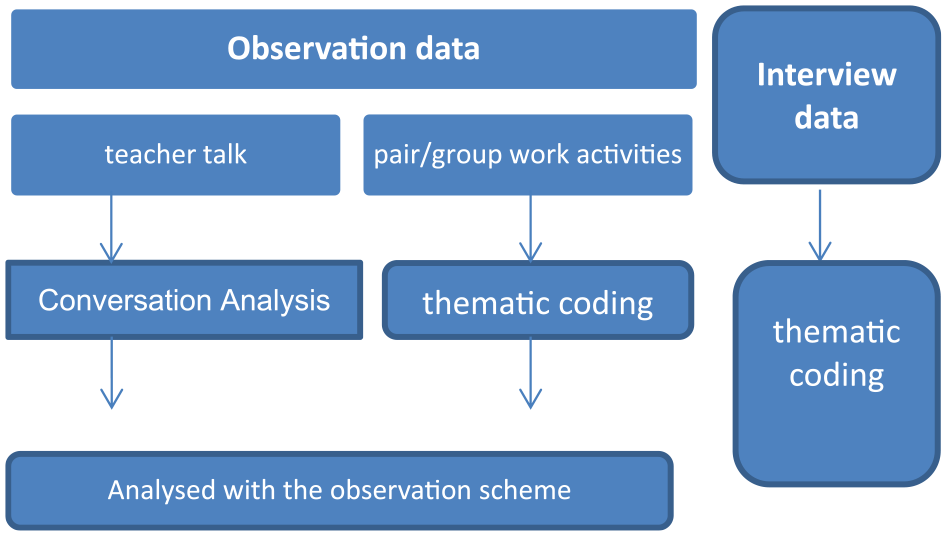
Data analysis framework.
The talks between teachers and students were videoed and later transcribed, and analyzed with Conversation Analysis (CA) (Seedhouse, 2005). From the perspective of CA, types of interactional organization, such as turn-taking and adjacency pairs, should not be viewed in a decontextualized fashion as quantitative data. Instead, they are viewed as normative action templates for reference for the interpretation of interactants’ actions (Seedhouse, 2005). The data generated inductively from the analysis were allocated to the coding scheme to evaluate the extent to which the teachers integrate communicative approaches into their practice.
Results and Discussion
This section reports the teachers’ practitioner knowledge growth in communicative approaches and describes how the TD program helped these teachers develop their practitioner knowledge. Finally, implications are made.
Teachers’ Stated Beliefs and Their Baseline Practitioner Knowledge of the Approaches
The data reveal that there were inconsistencies between the teachers’ reported beliefs and their practice. In the first interview, in answering the most important aspect of English as a subject for junior high school students to learn, Diana responded, “The knowledge that they can use, communication ability, and the knowledge they can apply in real life.” Wendy’s statement was, “Get them interested in English, and acquire basic communication ability and grammar concepts.” Ken gave a concise comment: “The four skills, and the integration of the four skills.” Diana and Wendy highlighted the importance of communication, which is very much in line with communicative approaches. Ken’s response may suggest a neutral stance or a preference for TBLT since only TBLT has the potential to integrate the four skills, namely, listening, speaking, reading, and writing (Ellis, 2003).
Next, those teachers were asked whether they had used CLT or TBLT in their teaching. In Diana’s word, “In the worksheet, I design activities which can help students to apply the target language to their everyday life.” Wendy observed, “I always encourage groups to discuss, using as much English as possible.” Ken stated, “I seldom use TBLT; regarding CLT, there are dialogues between students and the teacher or students and students [in my class].” Diana and Wendy both emphasized putting L2 into real use and Ken identified interactions, and these are at the heart communicative approaches.
However, all the teachers were observed conducting classes of low communicative levels in the preliminary and first observations. For example, some inconsistencies were found in Wendy’s lessons. As an extract shown in Table 4, she was observed constantly asking her students to repeat after her and reminded them of formal features in a warm-up activity.
Extract 1. Wendy’s Warm-Up Activity.

The italics show nonlinguistic behaviors, and the parentheses show the use of the L1, Chinese. [ ] [ ] indicate overlapping between teacher and learner.
Such inconsistencies were also found in Ken’s lesson which aimed to show the students how to introduce themselves. First, students were given worksheets with a set of questions about self; for examples, “Where are you from?,” “When is your birthday?” There was a pattern of fixed sequences: The teacher explained the questions in L1 and the corresponding answers, and then asked the students to repeat after him; next, the students filled in their own answers and finally Ken nominated a student to answer one of the questions. The talks between the teacher and students were virtually discrete questions and answers, with a lack of successive exchanges; there was little focus on meaning. These procedures, more inclined to Littlewood’s (2004) non- or precommunicative language practice, used up the class time.
Similarly, in Diana’s preliminarily observed class, the lesson basically followed the activities in the textbook. Diana asked the students to repeat after her when she read the text. Then she asked some questions based on it. Next, the students listened to the CD and then answered the comprehension questions on the worksheet, answering in Chinese was allowed. Finally, Diana checked their answers by asking volunteers to read them out. After that, she reiterated the key grammatical points.
As in Wendy’s and Ken’s lessons, the questions asked in this lesson were mainly display ones, which refer to questions for eliciting a closed set of predetermined answers. In contrast, referential questions are more effective in eliciting more students’ turns, since they aim for an open-ended set of unpredictable answers which the teacher does not know in advance (Kumaravadivelu, 2003). Also, Diana seldom related these topics to the students’ own experience, for example, by asking them personalized questions. She seldom built on learners’ contributions, but followed closely the textbook’s content.
There were clear cases of lack of understanding of communicative approaches and misconceptions. Obviously, one common misconception among all the teachers was that questioning and answering itself meant communicating. All the teachers expressed positive attitudes toward communicative approaches and claimed they employed them to some extent. However, their practice displayed a very teacher-centered mode and exhibited little communicativeness. This suggests that the issues regarding implementation may be more related to practitioners’ understanding of the approaches than to their beliefs.
Provision in Workshop 1
With the information collected for understanding the teachers’ practice and beliefs, the plan for the first workshop was reviewed with the inclusion of “Explaining im/explicit teaching and learning and their relationship with communicative approaches.” This was inspired by the discussion with John. When I pointed out that none of those teachers’ practice was in line with these approaches, John asked me the reasons for making such a conclusion. I explained and also drew on theories, such as “internal syllabus” to stress that explicit teaching does not necessarily lead to L2 acquisition (Ellis, 1993), which also provides a rationale to employ communicative approaches. However, there was too much to cover in a 90-min session. I had to choose the reflective models, the results of the questionnaire and the definitions of communicative approaches, CLT and TBLT, and examples of their applications, all included in handouts.
In this very first workshop, I learnt that the teachers preferred learning practical examples to theories. Soon after I started introducing the theories, Wendy started, “Will we have theories in every workshop?” These teachers reported that they did not receive effective training in these approaches, either in preservice courses or in-service projects. However, this reminded me that she did mention she was only interested in useful, practical examples.
The handouts also included teacher questioning and the theories of IRF (initiation-response-feedback). I introduced display questions and referential questions. To increase interaction, teachers can ask the right types of questions to trigger meaningful interaction (Kumaravadivelu, 2003). I had designed some activities showing them how to apply communicative approaches to the lesson which they were about to teach. These included a jigsaw activity and a discussion activity. However, I had to leave them for the teachers to read on their own.
The Teachers’ Practitioner Knowledge Development in the First Research Cycle
In this cycle, Diana demonstrated her improvement in her teacher talk. She started the class by asking her students about their recent holiday, as the extract shown in Table 5. As the CA reveals, three main changes made by Diana were employing personalized questions (e.g., Turn 1), referential questions (Turns 3, 7), and utilizing feedback (by repeating students’ words, for example, in Turns 5, 9).
Extract 2. Diana’s Greeting/Warm-Up Activity.

The italics show nonlinguistic behaviors or Chinese was spoken.
One activity in Wendy’s second observed class was to interview their group members about what they did for their families by using “What did you do for your families last week?” All the three teachers designed this activity together (Figure 2). The students were required to fill in what they did and then interview their peers.

The interview activity.
While students were writing, Wendy kept hovering around and reminding students of the grammatical rules and answered students’ questions. It did not seem to me that they were engaged in interaction for the interview. Most of the time, the students lowered their heads; hardly any noise was generated from the 15 pairs. The wrap-up for this activity was that Wendy asked some students questions. In the second interview, Wendy pointed out that she did not observe any student interacting in English, and she thought most of the students did individual work rather than engaged in discussion. It seems odd that the teacher designed a discussion activity, but she did not expect students to discuss.
Similarly, in this cycle, Ken applied this interview activity and adapted my jigsaw activity, his first attempt at group work. The students were not used to group discussion: while some worked on their own to write the answers, others just copied others’ answers. Even when some students were involved in discussion, in most of the cases, L2 was not heard in the process of negotiation for meaning. These features also appeared in Diana’s class where she conducted her first group work (a jigsaw activity). Nonetheless, the students in the interview expressed their liking for this group activity and the opportunities to discuss with peers.
Provision in Workshops 2 and 3
The key points in this workshop were to discuss teachers’ feedback and highlight each teacher’s unique skills in teaching which particularly contribute to developing communicative approaches in the hope to inspire peers’ mutual learning. These objectives were also carried on in the later workshops.
As mentioned previously, Wendy “rejected” the opportunity to learn about theories. This reinforced my decision to utilize their peers’ lessons as models to get to my points. In addition, the relationship among the three teachers was very good, according to my observations. I believed using peers’ strength to generate mutual learning would be a better idea than if I, as an outsider, “teach” them. In Workshop 2, I used Diana’s teacher talk to show how TTT can function to enhance students’ participation and interaction. I began with a brief introduction of this interaction of Diana’s class and presented a short video clip with a full transcription.
Next, we read the transcription as role-play, as Diana suggested; the atmosphere was pleasant. Then I drew their attention to the theories on the handout. Next, we briefly looked at the transcriptions of interesting classroom interactions, such as in Sullivan (2000) and Kumaravadivelu (2003). If the time had been sufficient, I could have let the teachers identify the IRF structure, and the functions of the F-moves in those cases. Most crucially, they could have shared their thoughts and inspired critical reflection. I suggested that they study the turns between the teacher and students in these examples. In the handout, I also shared with the teachers some F-moves, using the textbook content:
To elicit an oral response from the student(s), you can use the following:
Why/Why not?
Wow/Really! (Look at your students and wait for 3–5 seconds) Can/Could you tell me more about it?
Who else . . . . . ? Who else felt wonderful? Who else likes mangoes?
Wait for 5 s. If the student still cannot answer, then provide choices. Or ask other students and go back to the student.
Do you agree/How do you like this story? . . .
In this cycle, I found that the teachers needed to build up both the students’ ability and their habits of using the target language. Therefore, I provided the teachers with practical methods and activities to develop students’ ability to proceed group/pair work. However, due to scarcity of time in the workshop, these were provided in written form for their personal perusal. These examples of communicative activities include crossword as an information gap activity, “Kill the sentence/text” and “Why it surprises me” (Lindstromberg, 2004).
Also, it is necessary to provide students with the language they need in negotiating for meaning. In the handouts, the use of comprehension checks, confirmation checks, and clarification requests were introduced (Long, 1983):
A comprehension check: The speaker’s way of finding whether the interlocutor has understood something.
For example, Do you follow me? . . .
A confirmation check: The speaker’s way of ascertaining whether his or her understanding of the interlocutor’s meaning is correct
For example, Do you mean . . .? . . .
A clarification request: A request made for assistance in understanding something the interlocutor said.
For example, Can you say that again? . . .
I had no ideas as to why it never occurred to these experienced teachers, similar to Carless’ (2002) observation that these kinds of language seemed not to have been taught in his research setting. In addition, teachers should tell their students their expectations for language use at the beginning of an activity. During an activity, students need to be monitored in their use of L1/L2, and “carrots and sticks” can be used to motivate students to use L2 (Carless, 2002).
The Teachers’ Practitioner Knowledge Development by the Third Research Cycle
All the teachers’ practice had shown an influence by Chinese traditional teaching, as Hu (2002) observes. The teachers believed that they were obliged to explain and transmit knowledge. John explained, “teachers often feel they have completed their duty when they explain clearly about the usage of words and grammar in the content of the textbook.” Diana was not observed presenting the reading using the Grammar-Translation method. However, in the third interview, she reflected on how grammar formerly played a part in her teaching. She had felt that her students could not learn if she did not explain the rules first; only such instruction could give her the sense of security.
Diana continued: “I felt a great change of me. In the past, I began teaching a text with grammar rules. Now I start with meanings . . .” In the second observations, Diana already had the concepts of putting new vocabulary into context and learning through using, which are key principles of communicative approaches. For example, to introduce “bank,” she said, “We save money in the bank and you will have more money. So, what is a bank?” She also used pictures in the hope of eliciting students’ talk; as she reflected, “This time I used the word cards because there are pictures being topics for us to talk more.”
The teachers continued making some modifications to communicative approaches, such as improving the quality of feedback and reducing the focus on grammar. In Wendy’s third observed class, there was a discussion of things that the students can do to stay healthy. Wendy gave the students 2 minutes to discuss ways to stay healthy and later asked them to share one of their answers with the class. She not only employed more techniques of F-moves but also extended her waiting time and was more patient to allow students to think of appropriate answers. Furthermore, she did not limit them to standard answers, but encouraged the students to think of as many different answers as possible. Many students wanted to share their ideas of the ways to stay healthy (Figure 3), and appeared to have many ideas, some of which went beyond the textbook.

Wendy’s students enjoying sharing ideas in observation 3.
Even though modifications had been made, the teachers still did not require their students to interact in L2. Their students had few opportunities to practice using L2, to the ways in which language is used in the real world.
Provision in Workshops 4 and 5
To avoid annoying the teachers by pointing out problems face-to-face, I had to develop a strategy to promote teacher learning. I had designed teaching activities to show how communicative approaches applied to their textbook content. From then on, as the first strategy, I put more details into these activities to try and ensure that interaction in L2 did not get overlooked.
However, it seemed difficult for the teachers to recognize the importance of using L2 in language learning. I needed to develop another strategy so I utilized case studies. Two activities from Deng and Carless (2009) were chosen for the discussion, due to contextual similarities with this research context. All the teachers recognized a low communicative activity, and we discussed ways to enhance the communicativeness in Workshop 4. However, no teachers pointed out the key point, which was that there was no new information for the students to communicate. I drew their attention to the authors’ commentary which suggests creating some information gap to push students to interact. Also in this case, the teacher frequently corrected her students’ errors on form when they were giving presentations. I took this opportunity to show them the concept of internal syllabus (Long, 1981).
In the following lessons, all three teachers employed activities with information gap to push students to interact, yet, not always in L2. Wendy conducted a “listen and draw” activity to review the reading, which is a description of the four seasons. For the first step, one student opened the book and read the text to the rest of the group, who were required to listen to the speaker and draw what they have heard. The students were observed using L1 in interaction even for easy phrases for their level, such as for, “draw a tree,” “here.”
The “listen and draw” activity conforms to the three criteria of a task. The information to be transmitted is its meaning rather than form. Only one student holds the information and reads it to his or her group who need to draw what that student tells them to, which allows communication to happen. The goal of the activity is for the drawing to conform to the information communicated. However, the problem of little interaction in L2 was too salient to ignore. As Carless (2002) comments, once the amount of L1 use starts to exceed L2, it becomes a concern.
Dealing With Persistent Neglect of Interaction in L2
When I first addressed this concern with the students in the second interviews, they expressed their willingness to try interaction with peers in English. I reported this promptly to the teachers. However, this information seemed to be neglected, and not taken into their practice. With greater familiarity with the teachers, I felt I could make the point more explicit. Thus, I asked them why they did not require students to interact in L2. Diana admitted that she should have. Wendy stated that she did not view interaction in L2 as necessary. Under this circumstance, a new strategy was developed. I noted down some moments when there were possibilities for students to interact in L2, yet the teachers or students failed to take, and pointed them out to the teachers later. Wendy’s “Listen and Draw” activity was one of the examples. When I reported the scenario to the teachers in Workshop 5, they felt surprised. I continued, “if the students do not use L2, they will forget what they have learnt and be never able to use it.”
The Teachers’ Practitioner Knowledge Development by the End of the Research
As a result, in the final observation, Wendy asked her students to interact in English, and no Chinese was allowed. Diana started to announce the rules for using only L2 for her students. Their students accepted this; Wendy and Diana seemed satisfied.
With the process of AR, Wendy became more open with me. In the last interview, when asked why she did not ask her students to interact in L2, she stated, I didn’t stress it. (pause) No reasons, just forgot. I always want to train their speaking ability. I felt the pressure from time, and I focused on results, and therefore neglected the process. In the long run, it became a teaching habit. Most teachers in Taiwan have the same habit. I really want to say “thank you” to you. (Wendy)
This reflection can be considered to be developing a reflective view of teaching, which is, as Richards and Farrell’s (2005, 37) paraphrase of Dewey’s (1933) idea explains, “to move from a level where they are guided largely by impulse, intuition, or routine to a level where actions are guided by reflection and self-awareness.” Since Wendy’s class had commenced interacting in L2, my final question for her was, “Is it possible to request students to use L2 in interaction in our teaching context?” She replied without hesitation: “Yes. It’s effective and the results are getting better and better.”
Contextual Issue: Textbook and Syllabus
Nunan (2003) concludes that most teachers in Taiwan had a poor understanding of the approach when commercial textbooks started to include principles of TBLT, with the targeting of their market at the public school sector from 2000. The study supports his concern that the teachers were not able to use these materials effectively, before this teacher education program.
All three teachers were unaware of the topical element of the layered syllabi employed by their textbook. Ken asserted, “This textbook is based on grammar,” “the logic of the sequence was awkward,” and “I need to make handouts to fix it” (Interview 3). Wendy commented that this textbook made it difficult for her to design lessons, because “it [the content] is messy” (Interview 3). Wendy provides an example: “in Lesson 9, it appears ‘five straight hours’. It should teach ‘go straight’ first, so students won’t get confused [in the usage of straight] .” She had her own beliefs about the order of presenting form to students, and she believed it should be followed strictly. This view contradicts Long’s (2000) psycholinguistic concept of internal syllabus, or the learners’ own built-in language system. In this view, it is internal syllabus that determines which forms they require and the order in which they acquire them, rather than a predetermined external linguistic system.
Sometimes the teachers were observed to miss the main objective of a lesson. For example, the topic of Lesson 8 is related to the weather and four seasons. The objective set by the textbook compiler is to enable students to talk about the weather and their perception of it to foreigners. A total of 90% of the student participants started studying English before/at age 7, and the weather, four seasons, and 12 months are commonly taught to primary school children. However, in Observation 3, after showing the pictures of the four seasons and 12 months, Ken asked his students to write down the vocabulary on the worksheet. This took one quarter of the class time. The rest of the lesson followed a more discrete-point form instruction, or what Long (2000) calls “focus on forms” (FonFs) instruction, different from FonF, which gives priority to meaning: Ken started with a single topic of vocabulary (e.g., clothing) and subsequently introduced another topic area (e.g., adjectives regarding the weather). This was followed by exercises allowing the students to use the new form, also one category at a time (e.g., Part C. 1. I wear ____ in summer. Part D. 1. You take an umbrella when it is _____). This may imply that Ken believes learning L2 is to accumulate form bit-by-bit and should follow the principle of “from simple to complicated.” This is congruent with a structural syllabus (Ellis, 1993).
This kind of syllabus is the foundation for the Grammar-Translation and Audio-Lingual methods, similar to FonFs (Ellis, 1993). Ellis (1993) observes that such approaches, which isolate linguistic form from their meaning, are the most used syllabi in language teaching. Such a phenomenon was observed in Hsu (2015) in a Taiwanese context and appeared true in this research setting. FonFs differs from FonF, which is one of the methodological principles in TBLT (Ellis, 2010; Long, 2000).
As a teacher educator, I played the role of facilitator to help clarify the concepts of communicative objectives in each class. In addition, I provided the teachers with my lesson plans which included a variety of examples to show how communicative approaches can be applied to their textbook. Rather than just copying them, the teachers often adapted the example activities from our first observations. Initially, the teachers changed them to become less communicative. With the development of their practitioner knowledge, they are more able to appreciate and include communicative elements.
Contextual Issue: Time and School Examination
The teachers all pointed out, either at the first interview or later, that time constraints were an issue. Diana pointed out that time constraints had impacts on her choices of classroom activities. Wendy often claimed that there was not enough time to cover the syllabus. However, the teachers were not observed using their time effectively in class. In the second observed lesson, Diana employed a jigsaw reading activity. When she gave detailed instructions, some students had already started reading. Time which was used in giving such redundant and unnecessarily lengthy instructions makes little contribution to learning (Tomlinson, 2014).
The teachers gradually realized that communicative activities can easily fit into the time available in a lesson, without compromising learning or the teachers’ duty to keep up with the syllabus. Keeping records of a lesson in a written form, such as journal writing or lesson reports, serves as evidence for teachers to reflect on. Lesson reports which record what actually happened during the lesson are suggested to be completed soon after a lesson and made as detailed as possible and be shared with colleagues (Richards & Farrell, 2005). Due to the heavy workload of teachers in Taiwan and the voluntary nature of this study, I video-recorded their lessons and wrote lesson reports and transcripts for the teachers to reflect on later. When the teachers read these reports, they realized that the problems lay in procedures and time management. Reflecting on her class, Wendy expressed regret for using too much time on one procedure. She admitted being “over-ambitious” in asking the students to complete as many as 18 sentences with the same sentence pattern. Ken’s students spent 4 min choosing 16 words to fill in the BINGO grids. Then, I suggested teachers scrutinize their lesson plans for areas of adjustment to find room for communicative activities.
For Ken, time turned out to be a significant issue in terms of preparation for communicative activities. I kept showing the teachers that many communicative activities do not need much time to design (e.g., reasoning, ranking tasks; see Willis & Willis, 2007). However, Ken often missed the workshops. After observing his third lesson, in which hardly any communicative activities were employed, I learnt from him that he had not read my examples sent by email. I also confirmed with him that he had taken considerable time in, for example, collecting the pictures of weather to make the PowerPoint slides. Then I pointed out how some activities which he just did can be made more communicative with less time consumed in preparation. From then on, Ken went back on the track of communicative approaches and seemed to get some confidence back. By the end of this program, his skills had started growing.
Diana, who was fully engaged in this program, listened to my identification of the root problems, such as time management. In Interview 3, she stated that she could finish the syllabus before the mid-term examination without being delayed by the implementation of communicative approaches. The good school examination results confirm her confident statement. This secondary school held three examinations in a semester. For the first school exam, Diana’s class was ranked top of the 26 classes, and the record was kept all through the semester. For the final exam, Diana’s class was again leading the rest of Year 8 classes (M = 82.37 and whole year group’s M = 72.6). The z score (2.51) also shows that the difference among them expanded continuously. Wendy’s class kept making progress, from the 13th place to the 7th. Ken’s class was from the 21st to the 25th place. Diana’s and Wendy’s cases also suggest that the contextual issue of examinations not be a problem.
Learner Factors
In the first interview, when addressing any problems that had occurred when they had implemented CLT in their classrooms, Wendy and Ken asserted that the problems originated from the students. As Wendy pointed out, students “don’t speak . . . are silent, passive, and being passive is the biggest problem.” However, according to my observations, her students were not silent.
Ken had a longer list: “Students don’t speak up; students can’t answer, can’t read, low level, and students can’t understand their teachers.” These echo reasons contributing to the lack of students’ participation given by the teachers’ in Tsui’s (1996) study. Later, Diana also showed her concerns about students of low levels. She worried that the students would not understand if she did not explain word by word. Therefore, her teaching was restricted mainly within the area of the textbook. Meanwhile, she allowed the higher level of students to do anything they liked on their own quietly in the English class.
In Workshop 1, I showed the teachers the results from Questionnaire 1, where it appeared that the learners’ level was not low. A total of 90% of the student participants had learnt English for at least 7 years. In addition, they were willing to undertake communicative activities to learn more, as Table 6 shows the highest responses.
The Highest Responses in Questionnaire 1.

The students’ attitudes were continuously investigated. The data from the three stages point to one main conclusion: while the teachers were modifying their practice toward communicative approaches, their students could perceive those changes in most of the cases and continuously expressed their preference for them. When students perceived that the class had more discussion activities, they claimed, “We learn more through sharing one another’s ideas”; “I like group discussions”; “I like brainstorming with classmates”; “I can learn more and be more interested in English through today’s activities.” When students perceived that their teachers ask more personalized questions, they commented, “This type of question led the lesson more authentic to life”; “These questions are easier to answer”; and “It’s more fun!” (Interview 3). Wendy’s students stated that they liked the “listen and draw” activity and believed that it helped their listening and speaking skills (Interview 4). How the activity can promote speaking puzzled me so they explained: “When we read, we need to make sure we are understood. We need to be careful about the pronunciation and the keywords” (Interview 4). This is exactly conformed to what the interaction hypothesis and the output hypothesis have to say about the function of interaction. Surprisingly, it is expressed by the students themselves.
In answering Q1 in Questionnaire 2, they listed 12 to 19 changes in the three classes. The majority of the Top 5 changes perceived by all three classes are games, group work, and group competition (with assigning score; an example shown in Table 2), all related to the methods to carry out communicative approaches. Also, from the results of Q3, many students expressed that they had made great progress in speaking, for example, more confident in conveying their ideas, asking questions, and taking an active role. Six students in Wendy’s class, four in Diana’s, and two in Ken’s even responded that they had understood grammar better.
Since Observation 3, when Diana and Wendy started to allow the students to share their ideas freely, it surprised them that the students’ responses contained creative ideas and vocabulary not included in the textbook. To quote Diana, I am very surprised to find out that the students’ brains have a lot of things. For example, today when we wrote Dos and Don’ts, the students said something not in the textbook, such as: do not eat junk food, watch too much TV, and be happy. (Diana, Interview 4)
Gradually, when the teachers started employing CLT or tasks, they realized that these approaches are more suitable for a mixed-level class. In Ken’s second observation, he applied a highly communicative activity—“messenger dictation” (Woodward, 2003). He observed the students cooperating and discussing actively with some division of work. In his reflection, This is not the same as I did before, keep letting students repeat after me; they are really “learning.” Letting students repeat after the teacher cannot last long in their memory. The result was students seemed interested, participation increased. (Ken, Interview 3)
Ken also decided that next time he would make some sentences easier for less able students to increase their involvement. These results along with my observation support that the students were more active in engaging in the new activities.
This study finds a similar conclusion to that of Wood (2017) that in a teacher professional development group, seeking, sharing, discussing, and including students’ views on teaching and learning contribute to teacher learning.
Implication
In evaluating and reflecting, in addition to the original plan for the workshops, three ideas developed in the AR cycles may have contributed to address the issues: The input was supplied according to the individual needs, adjustment was made to cater for the teachers’ preferences, and strategies were devised to deal with persistent issues. These are all incidentally involved with practical examples. Hereby, I focus on how examples can be provided to maximize teachers learning a new pedagogy.
First, do not start by explaining theories. Wendy and Ken both stated in the first interviews that their willingness to participate in TD programs depended upon their direct practical relevance to their teaching. Thus, only after showing the teachers practical examples, did I link them to theories. The results show that the teachers were more interested in practical examples; however, they did not reject opportunities to learn how these examples are related to theories. John even became interested to read relevant research papers.
Second, examples should be provided relevant to the teachers’ context. Particularly, in a context where schools need to follow a textbook, examples should show ways of applying the pedagogy to the textbook. Otherwise, it would be ineffective to leave theories to teachers, without also discussing their application, as they would otherwise disregard them as theories irrelevant to their pedagogical praxis (Wallace, 1991). As van Schaik et al. (2019) conclude from their teacher learning groups, one of the key supportive conditions for teacher co-constructing knowledge is its relevance to their teaching practice.
Third, examples should be provided taking the teachers’ current belief and knowledge levels into consideration. This is particularly important to teachers who lack the knowledge of the new pedagogy. The baseline data from observations and interviews suggested that the teachers’ deep-rooted beliefs in the structural syllabus were evident. Therefore, any examples given demonstrated how form-focused instruction can be integrated with communicative activities.
Fourth, the examples provided should be as detailed as possible. This is particularly important to teachers who lack the knowledge of the new pedagogy. As can be seen from the data, even though the teachers adopted my examples, they often overlooked communicative elements.
Finally, utilize teachers’ own cases. In discussions in the workshops, I deliberately pointed out the merits of the teachers’ observed lessons. This study finds that studying the teachers’ own cases served well to raise teachers’ awareness of their practice. Thus, this study suggests that cases from research papers should be used to address negative teaching features, while the teachers’ own cases be selected merely to address good features. Witnessing peers making new attempts may encourage some teachers to make similar ones. Similarly, in Haggarty and Postlethwaite (2003), they found that some teachers were only willing to accept the teacher educators’ introduction of the ideas which had been tested in previous research, as Diana was in this study. Meanwhile, most teachers were willing to try a new idea after it had been tested by their peers, seen frequently in this study. The “local evidence” from their peers’ attempts reassured these teachers of the value of the idea and provided sufficient encouragement for them to try out that approach (Haggarty and Postlethwaite, 2003, p. 440).
This study is a rare case of applying reflective models to learning a new pedagogy. Taking this view, implicit knowledge can be gained through experiments in practice, and reflection on that practice (Wallace, 1991). My study adds that the provision of perceivably practical examples of the pedagogy helps teachers at the starting point. This can be concluded as a more effective way for teacher learning. As Richards (1998) argues, if the examples are designed to follow the principles of an approach, then once teachers adapt them, they are teaching according to this approach.
Conclusion
This study sets out to explore how a TD program could help teachers develop their practitioner knowledge in communicative approaches through AR. This study shows that there was initially little consistency between classroom practice and stated beliefs, which concurs with many studies’ findings (e.g., Wyatt, 2009). The findings are similar to those of some past studies (e.g., Butler, 2011) that some teachers reinterpret communicative approaches another way without the features of CLT or TBLT, as aforementioned. While many studies have pointed out that teachers’ beliefs are the most determinant factors in the implementation of communicative approaches, the data gathered in this study suggest that teachers’ understanding of the approaches is a more dominant factor. This supports and demonstrates the relevance of the findings of a great deal of research which has pointed to practitioners exhibiting a lack of understanding across various contexts (e.g., Butler, 2011; Nunan, 2003).
Furthermore, this study suggests that teachers’ lack of understanding results in some commonly cited obstacles in the implementation of communicative approaches. Commonly cited contextual factors in the past studies, such as syllabi, the textbook, and time constraints, also appeared in this present study. This study gained insights into how teachers can learn and be supported and demonstrates that these factors could be addressed with the help of a teacher educator with expertise in communicative approaches. Also, this study provides counter evidence to viewing EFL learners as passive and impeding the implementation of communicative approaches.
Within the framework of AR, the planned program, the effective reactive adjustments and the strategies developed contributed to the teachers’ knowledge growth. Several suggestions can be made for future TD/TE programs. First, AR has the capacity to deal with the complexity of teacher learning. During the 5-month intervention, many expected and unexpected factors emerged. The nature of AR allowed me to deal with them by reflecting critically on the situational constraints, attempting to understand how these constraints act on people, considering practical potential strategic actions to change the way these constraints limit their action, and observing the consequences of this action systematically. These are similar to Carr and Kemmis’ (1986) description of the procedures of AR.
Second, for teachers to make an attempt to employ a new pedagogy, they first need to understand it, before the mental process—how the new item supports, fits, or competes with their existing belief system—starts. Without understanding, the teacher may wrongly reject it. Ways to encourage their understanding are suggested: starting with examples, experiencing and reflecting with the aid of a collaborative approach. It is evident in this study that the teachers’ practitioner knowledge was developed when they learnt from practical examples and from practicing those examples—another way of connecting theory and practice.
Third, using a collaborative approach rather than a top-down mode contributed significantly to teacher learning. As van Schaik, et al. (2019) observe, teacher learning can be assisted with collaboration with colleagues and external experts, and actively participating in co-constructing knowledge in a teacher learning group. This study witnessed that the teachers benefited from a community of practice where mutual learning frequently happened. This is the benefit that a teacher professional program should offer. This more holistic teacher education mode is recommended for implementing any curriculum innovation and for any teacher professional development programs.
Footnotes
Declaration of Conflicting Interests
The author(s) declared no potential conflicts of interest with respect to the research, authorship, and/or publication of this article.
Funding
The author(s) received no financial support for the research, authorship, and/or publication of this article.
