




Abstract
The aim of the study was to adjust the measurement model of an instrument of sources of Self-efficacy for Mathematics to sample of university students from Northeast of Mexico and the sex measurement invariance. A second-order modeling was performed, which shows convergent and discriminant validity, which corresponds to the original Bandura theory of self-efficacy and contains four factors: experience in mastery, social persuasion, vicarious learning, and physiological state (emotional activation). There was adequate goodness of fit of the model in the confirmatory analysis. The advantages of the use of this instrument are discussed for its simplicity and ease of applications, qualification, and interpretation, to be used by teachers, tutors, and advisors of mathematics.
Introduction
Learning of mathematics is one of the areas that imply greater difficulties for students, and it can be found that from the first years of basic education, many children report that it is not easy for them to carry out the activities that are requested or understand the problems posed by the teachers. This fact agrees with the results reported in PISA regarding the levels of proficiency in mathematics reached by Mexican students at different levels, from elementary to high school. The results from PISA, from the test applied in 2012 (Organisation for Economic Co-Operation and Development [OECD], 2013), suggest a national average of 413 points, below the OECD countries (average of 494) and more than half, around 55%, of 15-year-olds do not reach the basic level of Competence Level II. This low-performance situation in mathematics is implied in a low-efficiency belief scheme that complicates motivating oneself and investing more effort to learn. In the same PISA study, it is reported that about 75% of young Mexicans “predict” that they will have problems with mathematics and almost half of them are already causing an anxiety condition.
The psychosocial factors involved in learning mathematics are especially relevant since they include a similar weight (than the cognitive one) an emotional and motivational aspect, very influential in performance and achievement. This situation has been studied from different perspectives, recognizing in almost all cases its relevance to understanding what happens around the achievements and mastery of the different levels of reasoning. Different theories have been generated to understand these variables, and some authors have considered and studied it as an affective domain in mathematics conformed by beliefs, attitudes, and emotions (Gil et al., 2005; McLeod, 1989).
A perspective with solid theoretical and empirical foundation with scope in its use at the international level is social cognitive theory, from which self-efficacy is derived, as a motivational process (Bandura, 1997) that refers to a construct that allows to know and understand the beliefs that an individual has about their abilities, the author simultaneously takes different sources of information from them, considering in their premises four factors: mastery, vicarious learning, social persuasion, and physiological (emotional) state.
This construct has been tested in different contexts, repeatedly and consistently, finding its constant significant correlation with academic performance and many other human behaviors; this relationship is more or less intense and from participants from different parts of the world, the United States (Usher & Pajares, 2008), Turkey (Özyürek, 2005), Konya (Yurt, 2014), to name a few.
Bandura and Schunk (1981) point out that the beliefs of self-efficacy are given in the context of individuals; they do not exist as an innate interest to engage in some type of activities or experience. Having a goal and establishing some reference standards occurs in an internal comparison process that leads to satisfaction or dissatisfaction and from there to intrinsic interests. When goals are specific and have a level of achievement, they allow to define with greater clarity the standards that are wanted. In this process, the intermediate goals are essential because they allow for reinforcers in the process and guidelines for execution and feedback that, in the process of learning and development of the person, it becomes a mechanism for building their self-efficacy as part of their motivational resources and self-construction, through what he achieves, from what others say, from what he observes and how he feels about it in emotional terms.
Bandura’s theory indicates that beliefs of self-efficacy originate from information obtained from four sources: mastery experience, vicarious learning, social persuasion, and physiological and emotional states (Bandura, 1987).
Experience in Mastery
Master’s experiences refer to the successes that people experience in one or more specific areas. In the school environment, grades and learning are significant achievements for students; these are relevant sources of self-efficacy beliefs. Individuals generate expectations of mastery that can be corroborated or not achieved. Successes determine the effort invested in learning and the persistence to address difficult issues (Bandura, 1977). The experience of success has an effect on the construction of subjective perceptions, as well as satisfaction with the achievement of goals, as mechanisms that affect the self-evaluations of people (Bandura & Cervone, 1983). A history of failure in the field of mathematics seems to be a variable common to many students in schools of different educational levels.
Bandura (1977) points out that as strong self-efficacy beliefs are developed through repeated successes, the impact of occasional failures does not reduce them, but rather they become experiences for persistence. The effect of failure on self-efficacy beliefs is related to the moment in time and patterns of experiences in which it has occurred.
The experiences of success and failure that can start from an early age are associated with self-efficacy beliefs; children who have difficulty achieving the level of performance that most of the children in their group have and show, generally obtain low grades and consistently fail, are not motivated to invest effort and persist less in attaining the desired skill. These individuals tend to give up at the least signs of difficulty, particularly when it represents a degree of public exposure of their low results; some authors call it the failure syndrome; this process is linked to continuous stories of failure or periods of frequent failure (Jere, 1998). Caraway et al. (2003) have observed this type of results in high school students finding a positive and significant correlation between self-efficacy, goal orientation, and a negative and significant association between fear of failure and social desirability. The same was found between the anxiety before the exam and grade average with a negative association.
In an investigation carried out with Spanish university students, the students reported that mathematics is not an area that they reject, but if they feel an experience of failure when they fail to solve a problem, on the contrary, they feel satisfied with themselves if they can achieve the correct answers (Caballero & Blanco, 2007); this situation is complicated for young people who are generally having difficulties and continuously repeat the experience of failure. Bandura (1993) points out that beliefs of low efficacy and failure not only increase with age and compromise academic effort but impact prosocial behavior as well. A history of repeated failures in an adverse social environment does not help to generate and maintain a self-efficacy of context control and its suitability to accomplish the development of the individual, which is of interest to maintain the well-being and security of a society.
Vicarious Experience
The ability to learn through observation generates a broad scenario to acquire knowledge and skills through the influence of modeling. Observing the behavior of other people and the consequences for them generates information that impacts on the beliefs of individuals, including those of oneself (Bandura, 1989).
Observation as an element for the establishment of self-efficacy beliefs, when observing another perform the execution, and if positive results are also shown, the self-efficacy beliefs are influenced. It is also important that the characteristics that can lead to success, such as effort, appear clearly (Bandura, 1977).
This process of vicarious experience is not just about observing a model, but also the type of consequences, the cognitive complexity that it implies, and the characteristics of who is being observed and what is being done. You can model knowledge, skills, and coping strategies, through two processes, predictability and control. The first shows how you can attend to activities that are threatening, reducing stress, and increasing response options; in the case of control modeling, highly effective strategies that can be used are shown (Bandura, 1977).
The characteristics of the model and the type of execution it performs are very relevant if it does not look like the observer it may not affect it; if it is similar and in the process of executing an activity the model fails despite its efforts, this situation does negatively affect motivation. The same happens if someone is very competent; their failure generates the perception of the high complexity of a task and a sense of uncertainty about one’s ability and to experience failure even before trying. In as much, if the observer has different alternatives beforehand, and a model uses a different option to face an activity which it fails, it is relied more on the use of the own options that were thought more efficient.
In the cognitive part, there are four psychological processes that are most studied which affect the observational source and which are involved in the learning processes: attention, retention, production, and motivation. In general, learning by observation will require attention to what is being seen, as well as to the model and the context, that this information may be retained, and that there be a motivation for its similar reproduction or with its variants specific to the individual. Particularly in mathematics, the game of achievement and failure, as well as the characteristics of the models, would have a significant effect on the motivation and beliefs of the ability to be successful in solving problems with the intervention of mathematical reasoning.
Social Persuasion
Social persuasion refers to a type of influence that promotes a change or maintenance in behavior and beliefs and is generated through a verbal exchange or by modeling behaviors (Bandura, 1977). This kind of social process is generated in an area of direct social interaction or through the media and social networks. In the school environment, reinforcing good performance is a form of social persuasion for the belief of self-efficacy.
Social persuasion is a way to promote self-efficacy, and it helps to generate more effort and to sustain it when difficulties arise, especially when it is associated with an improvement of ability. Bandura (1997) points out that this is presented as recognition of achievement and mastery, as well as a feedback process. In the initial writings of Bandura in 1977, he refers to verbal persuasion; although its proposal is broader, he later refers more to the social aspect.
Persuasion as evaluative feedback can have a promoter or weakening effect on self-efficacy. It has been found that if from time to time, people are told that they are showing improvement and that this implies that they are capable people, self-efficacy, and effort increase. The way in which persuasion is provided is relevant, when criticisms are made of the performance and not so much a guide for the improvement of the performance, it has a negative effect on self-efficacy, and produces the opposite effect when it focuses on the forms and orientation of how you can have better results. Also, in the feedback process, attributing to the achievement of skill rather than effort achieves the best results in capacity beliefs (Bandura, 1997).
The knowledge and credibility of those who persuade are very relevant in the process of social persuasion; it must be a person who is recognized as capable or successful in some field by whom he is persuaded, likewise he has to know the context and the circumstances. The form of how the process is carried out is relevant; it cannot generate an expectation of a high level of achievement of a person if the knowledge and mastery of the required skills have not yet been reached, because the persuader would be discredited since in the end failure would be experienced again. In particular, the estimation or measurement of the existence of the skills for a performance is necessary, as they are two different conditions or strategies: When the person has the skills and the mastery, or their level of development falls just a bit short, or when the person has very little or no skill, in the case of those who do not have or very little domain, it is essential to develop competencies. In these cases, even if the same expectations of success are generated as if the person really had the ability, it would result in failure and a significant deterioration in self-efficacy, with a counterproductive effect on motivation and effort.
Physiological State (Emotional)
Physiological and emotional states refer to all physiological and emotional responses that are presented to the individual before the development of an activity, such as anxiety, stress, fatigue, and positive moods, among others. Studies on physiological states and negative emotional conditions related to anxiety about mathematics are consistent and reflect their impact on the level of achievement and also on the quality of life. It is a subject studied in the last decades of the last century, when instruments for its measurement were becoming available around 1970 (Ashcraft & Krause, 2007), the interest, particularly at that time, was identifying its nature, the quality of its measurement, the causal relationship between performance and anxiety. In the first decades of this century, it is still being studied through research about its beginnings in childhood and presence in different school grades and how it has a direct and/or indirect effect between the levels of study and the impact of parents and teachers on this. In fact, several PISA studies (OECD, 2013) retrieve data on this variable.
Negative physiological and emotional states, such as stress and anxiety, begin in many people at an early age from their incorporation into school since preschool, and although it is a topic of controversy, anxiety symptoms have been found in young children, and their prevalence increases with age (Link-Egger & Angold, 2006). From the early school years, some infants report dislike for mathematics, and it is associated with the fact that their parents also dislike them and that in the process of parental help show stress when interacting with this type of content or point to the child that they are not capable of supporting them in that subject; in the words of some specialists, it refers to an intergenerational issue that is perpetuated between parents and children (Maloney et al., 2015).
The repeated failure to solve mathematical problems and class exercises generates low capacity beliefs. Jamerson (2014) has found a consistent relation between anxiety in the face of mathematics and academic self-concept in mathematics (of low ability or self-efficacy). Vlasceanu (2013) has found that stories of failure predispose to a perception of low self-efficacy for mathematics and a high level of stress simply by being exposed to exercises and problems on a sheet of paper; it increases and complicates further when people pay too much attention to their own physiological process, mainly because the nature of this condition extends not only to the class but also to the tasks and exams of mathematics (Hembree, 1990), that is, there are too many stimuli associated with these negative emotional situations (facing mathematics). Ashcraft and Krause (2007) have found unpleasant emotional states and anxiety function as a dual activity that acts simultaneously and demand resources, that is, there is concern for mathematics and also for the same physiological state related to anxiety that it is experienced. This affects the working memory that makes the situation more complicated and competes with the attention to understand the problems and solve the exercises. In this context, the classroom environment contributes to the maintenance of stress or its increase. Turner et al. (2002) conducted a study in nine groups and could distinguish that teachers who focused on students’ learning and maintaining motivation had a lesser avoidance of mathematics in their students, the answers of those who enrolled in these courses varied as to the perspective in performance, that is, the student who achieves the best results from the beginning versus the achievement of mastery with error as part of the learning process.
Measurement of Self-Efficacy
Since 1996, the situation of self-efficacy measurement problems based on Bandura’s (1977, 1997) theory had been analyzed, one of the first discussions on the topic was at one of the annual meetings of the American Educational Research Association held in New York at the Measuring and mismeasuring self-efficacy: dimensions, problems, and misconceptions symposium. In this regard, Usher and Pajares (2008) made a critical review of the state of knowledge of the sources of school self-efficacy, finding that in the measurement part there are a variety of instruments that measure either the four sources of self-efficacy or only some of them. They also observed forms that do not correspond to what is established in the theory and presented test items and inconsistencies with the original theory. They reviewed the quantitative and qualitative measures; the focus of interest in this work is quantitative measurement, which highlights the adaptation of instruments originally designed for more general academic areas specified for mathematics, also scales initially developed for upper level students adjusted for secondary or high school, including some for students with difficulties in learning, others that use the measurement of nearby variables, and others that report studies with instruments that have not yet been previously published.
Some of the instruments that have been used to measure self-efficacy in mathematics for students of different levels was “The Mathematics Self-Efficacy Informative Sources Scales (Mathinform) (Özyürek, 2005)” in which the four sources of self-efficacy are measured, being the one of vicarious experience focused on what they observe about mathematical problem-solving in peers, which is a particularity of this instrument, that it specifies the classmates. Özyürek (2010) makes a revision of the validity and reliability of the scale and finds in an exploratory analysis a structure of three factors and compares it with the original of four factors; finding a better fit of the latter model, however, some of the indices have more appropriate values in the one of three factors, so it is important to continue with the research on the best factorial structure and measurement model of this instrument.
Usher and Pajares (2009) reviewed different measures of self-efficacy information resources in mathematics finding that they had adjustment problems to the Bandura theory from the same process of construction of the test items, or that from a broad perspective they were too general when based on academic self-efficacy, so they developed their own scale with a measurement model ensuring the test items responded to the four factors proposed by Bandura (1977) in high school students. They used a three-phase methodology. The first phase involved a focus group. The second and third phases were quantitative; the version was applied to make some adjustments and perform the exploratory factor analysis (EFA) with the estimation of ML and Promax oblique rotation. Finally, the instrument was applied again to another sample and the confirmatory analysis of the model was carried out. The measurement model that responded to a good fit was maintained, in a version of 24 test items, six for each factor.
Zalazar et al. (2011) tested the instrument of self-efficacy sources of Usher and Pajares (2009) with 163 students from Argentina, using a direct translation procedure to adapt the scale to Spanish. Then, they performed an EFA with a principal components estimation method and Promax oblique rotation. They found that the structure responded to a three-factor model and tested the original model of four findings that three reagents had factor loads lower than the established point and two test items had higher factorial weight in a different one from the original version; the authors discussed the results and concluded on the relevance of performing other tests on the instrument and making other applications with different samples.
These inconclusive results on the psychometric properties of this instrument and the relevance of having a simple scale of easy application, data registration, and interpretation that shows plain and clear data, as well as students’ status in these factors for their use in the interventions of teachers, advisors, and tutors, have motivated the present work. Furthermore, it is necessary to test the measurement model and adjust it for its university implementation, for Mexican students particularly, and by gender due to the consistent reference of variable results for men and women.
It is also important to consider studies that are not consistent with what happens in regard to beliefs about their ability to mathematics between men and women, in which some differences are shown by gender, for example, that female students have higher beliefs of mastery in Spanish than in mathematics and men who consider themselves more capable in mathematics, regardless of their real skills (Usher & Pajares, 2009). Zeldin and Pajares (2000) asked women about their skills for careers related to mathematics; their opinions in this regard were more oriented toward vicarious experience and what they said or heard from others and less on their own mastery. While in another follow-up study, men’s responses were more oriented toward beliefs in their own abilities and achievements (Zeldin et al., 2007). Louis and Mistele (2012) observed that self-efficacy has variations between men and women in each of the subjects. In sciences, they did not find significant differences; in the case of the different areas of mathematics, men felt more capable, except for algebra, in which women surpassed them. Research results have variations regarding the difference generated by students’ gender, which makes the measurement of the invariance in this type of instruments relevant.
The objective of the study was to test the model of measurement of the sources of self-efficacy for mathematics scale to the population of Mexican university students, as well as the measurement of the instrument’s invariance for men and women.
Method
The measurement of the psychometric properties of an instrument refers to different steps when the scale has already been tested in other contexts; it is valuable to go back to it and test it. For this reason, the Argentine version of the original instrument was used since it was translated and had the advantage of the referents of the psychometric properties obtained in the said study.
Participants
For the study, 264 newly admitted students from a Mexican public university responded: 51% females and 49% males.
Instrument
The Scale of Sources of Self-efficacy in Mathematics of Usher and Pajares (2009) was used, translated, and adjusted for the Argentine population by Zalazar et al. (2011). In its original version, it has 24 test items with a distribution of six items per factor, with a 5-point Likert-type response scale in levels of agreement-disagreement, ranging from 1 = total disagreement to 5 = total agreement. The factorial structure of the scale is made up of four factors that correspond to Bandura’s (1977) Self-efficacy theory: (a) experience in mastery, (b) vicarious experience, (c) social persuasion, and (d) physiological states.
The experience in mastery factor refers to the successful performances achieved by a person; in the aspect of mathematics, an example of a test item is, “I do well until the most difficult tasks of mathematics.” In the Argentine version of the scale, one more item was added during the adjustment process, resulting in seven items for this factor.
In the vicarious experience factor, students make judgments of their own abilities by observing others, their classmates, and teachers; how they solve math problems; and how they face difficulties. An example of a test item is “to see my classmates do Math exercises better than I do stimulates me to do better.”
The third source is social or verbal persuasion, which originates from comments on their performance and ability to solve mathematical problems made by parents, teachers, advisors, peers, and other people whom students coexist with and generate these elements of influence. In this process, feedback is involved if it is directed to what the young person cannot do or how he can improve. An example of a test item is “I’ve been praised for my math skills.”
The physiological states factor refers to the activation of biological indicators that reflect an emotional state which renders the individual on alert and can even reach a point of breakdown by anxiety and fear. An example of a test item is “in math classes I feel stressed and nervous.”
Procedure
A review of the terms used in the Argentine version of the instrument was made, and three words were modified adjusting their meaning for the Mexican context, whereas the rest did not require adjustments being applicable in Mexico.
The instrument was applied in classrooms, requesting the informed consent of the students and the permission and support of the teachers. The information was registered, and the database was formed. The analyses were performed using statistical software SPSS and AMOS. EFA was performed, as well as confirmatory analysis for the revision of the invariance by gender.
In EFA, maximum likelihood (ML) and Promax oblique rotation were used for extraction, as was done in the original studies, only that it was considered more appropriate to change the main components to ML.
For the confirmatory analysis and the measurement of the invariance, AMOS of the SPSS was used.
Results
The results are presented in three sections: the EFA, confirmatory factor analysis (FCA), and the measurement of invariance—men and women. In the revision of the vocabulary adjustment and its meaning, few adjustments were made, modifying three words that were not suitable for the Mexican case; in general, the instrument was understandable and maintained its meaning for the university students. It was applied, after corrections, to a group of 20 students, and all expressed to understand the questions, answering the inquiries with clarity.
Exploratory Factor Analysis
When carrying out the exploratory analysis without a set number of factors, a structure of three factors was generated, which was then modeled considering the four dimensions pointed out by the theory and in addition have found a good level of goodness of fit. According to the theoretical self-efficacy model of Bandura (1977), the tetra-dimensional structure was maintained. An extraction method of ML was used, with a Promax rotation (this method is the same one used by the original authors and of the Argentine adaptation). To improve the fit of the model, three vicarious learning test items were eliminated for having low saturation and being loading in several factors. In the physiological (emotional) factor, another test item was eliminated, so 20 reagents remained as shown in Table 1. The model explained 67% of the variance.
Pattern Matrix of the Self-Efficacy Instrument at the End of the EFA.

Note. Extraction method: principal components analysis. EFA = exploratory factor analysis.
Confirmatory Factor Analysis
In the confirmatory analysis, an adequate fit of the model was found, maintaining the four factors indicated in the original versions and the one adapted for the Argentine case, showing consistency with what is indicated in Bandura’s (1977, 1997) Self-efficacy theory.
Six test items were eliminated, so a structure of 14 items was obtained, three in mastery, three in vicarious learning, four in social persuasion, and four in the physiological (emotional) state. The Mardia coefficient is 47.28, which indicates a level of multinormality of the variables involved in the acceptable model, and a rho reliability of .896 (see also reliability by omega model by gender in Table 5).
We ran a second-order model that proved to be convergent between the first-order and the second-order factors (self-efficacy) and discriminant between the factors (see Figure 1) as it has moderate intercorrelations between them.
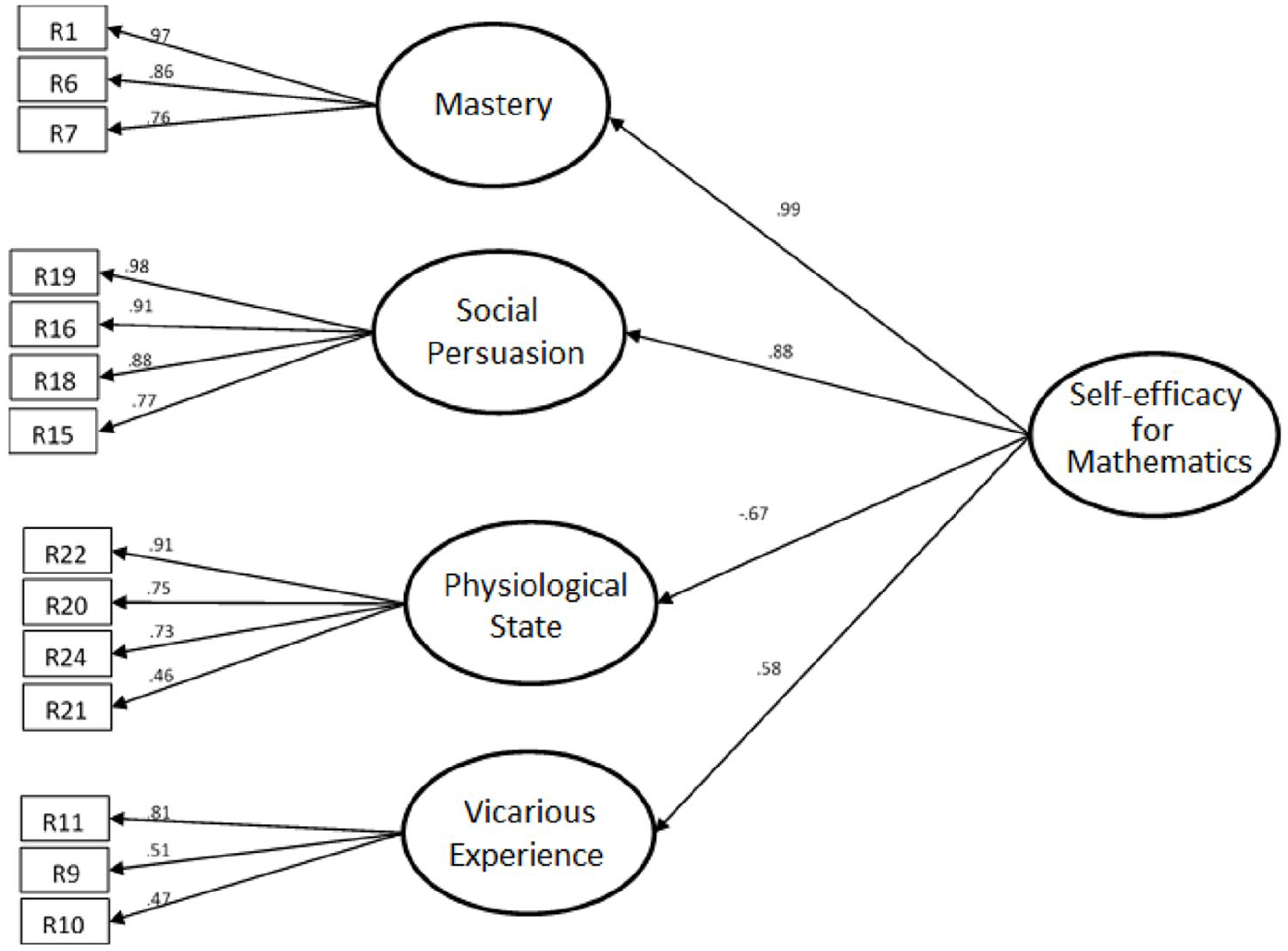
Measurement model for the conformation of the second-order factor “self-efficacy for mathematics.”
The confirmatory model showed adequate goodness of fit indexes (GFIs), χ2 = 318.36, CMIN = 106.79, CMIN/DF = 0 1.54, p = .000, SRMR = .045, GFI = .908, comparative fit index (CFI) = .97, root mean square error of approximation (RMSEA) = .06.
FCA for Modeling by Gender (Males-Females)
FCA was performed for the measurement model for each gender, referring to the factorial structure for men and women, where a similar structure and saturation were observed. As to vicarious learning, it is the factor that has some test items with low factorial weights in both models (see Table 2).
Solutions for Confirmatory Factor Analysis in Both Samples.

F1 = Self-efficacy for mathematics; F2 = Mastery; F3 = Vicarious learning; F4 = Social persuasion; F5 = Physiological state (emotional).
In the mastery factor, half of its test items were also eliminated, and their factorial weights were slightly higher for men. Whereas in social persuasion, they were slightly higher for women, and four of the instrument’s items were put to the test, which is shown in Table 2.
The models fit appropriately in both FCA and CMIN/DF was lower than two, which indicates that there is a good fit of the models, and the RMSEA yielded a maximum value of .06 which is an acceptable value. Overall, the fit, incremental, and parsimony indicators are considered adequate. This is shown in Table 3.
Absolute, Incremental, and Parsimony Indices for the Models Generated in the Confirmatory Factor Analyses for Men and Women.

Note. GFI = goodness of fit index; AGFI = adjusted goodness of fit index; TLI = Tucker–Lewis index; RMSEA = root mean square error approximation; CFI = comparative fit index; AIC = Akaike information criterion.
p < .05.
Measurement of Invariance in the Models
In the invariance analysis with the gender contrast variable, an adequate fit for both genders was found with this structure of 14 items. The Tucker index (coefficient of proportionality) was greater than .95 (Elousua, 2005) which shows a factorial equivalence, although it is very broad (see Table 3).
The configurational invariance shows that the basic measurement models are equivalent, and the factorial weights are similar for men and women. The fit indices are acceptable, as well as their residuals which are less than 1.5, the values of the root mean square (RMSEA) are lower than .040, which is adequate, as well as the rest of the indices considered, and the general fit (GFI) is .913, which is considered good (see Table 4).
Goodness of Fit Indices for Each of the Models Tested in the Measurement of Invariance.

Note. NFI = Bentler–Bonett normed fit index; CFI = comparative fit index; RMSEA = root mean square error approximation; AIC = Akaike information criterion.
p < .05.
The metric invariance is acceptable; there is a GFI of .907, and the RMSEA is .041, which indicates the equivalence of the models. Likewise, there are no increases in the reference values of the Akaike criterion model (AIC = .339) nor of Bentler’s comparative index (CFI = .973). The difference between the nested models between the restricted model and the metric model is .002, which indicates that the factor weights in both samples (male-female) are equivalent (see Table 3). When imposing restrictions on the error variance, the metric invariance, its equivalence is accepted, indicated by the RMSEA which remains very similar (.040), the GFI has a value of .906 and the difference between the CFI is .002, lower than the reference limit of .01 generally used; the AIC is maintained with a difference below 10 points, with respect to the reference model (see Table 4).
Also the metric invariance with respect to the values of the factorial weights and the strong, either independently or in its nesting with the model, observes an adequate fit, the difference between the CFI is around .004 (lower than what is expected as maximum .01; Cheung & Rensvold, 2002), it is considered that there is equivalence in both models, that of factorial weights and intercept values (see Table 4).
The reliability of the instrument was obtained with the omega coefficient, which was higher than 0.85 in all factors, with the exception of the vicarious learning in men. The total reliability is adequate for the applicable instruments for each gender (see Table 5).
Omega Coefficients of the Obtained Factors.

Discussion
In general, the instrument of sources of self-efficacy preserves its structure of four factors, maintaining its consistency with Bandura’s (1977) theory of self-efficacy and with what was reported by the original authors (Usher and Pajares, 2009) and its Argentine adaptation (Zalazar et al., 2011).
The factor that lost more test items and has some with low factorial weight, that is, vicarious learning, requires that the sense and content of those items that were maintained be reviewed and be adapted with greater precision, and that some items be added. Three test items were also eliminated from the mastery factor, but their weights are higher. It requires further testing and increasing in its test items.
It is important to mention that, in the process of conducting the EFA, without restrictions on the number of factors, a three-factor structure is observed, similar to that found in the same scale by Zalazar et al. (2011) in Argentina and in another instrument that measures the same from Özyürek (2010) in Turkey, although it is unknown which items are regrouped and which do not adjust as they are not reported. Given the consistency found at different moments, instruments, and applications with students from different countries, it is important to review this situation in future studies.
Confirmatory factor analyses for each of the genders show models with an adequate level of fit, the same for the case of men and women as it has a similar configurational and metric invariance that complies with the index values that show that they are comparable.
An instrument of this type is valuable for teachers’ work, as it is brief and easy to qualify and interpret and allows for the derivation of some strategies in a timely and simple manner, without having to wait too long after starting the mathematics courses for making some adjustment of teaching-learning designs and strategies that address poor self-efficacy beliefs for this type of course. In this regard, the National Council Teachers of Mathematics (NCTM, n.d.) present a set of principles and quality standards for mathematics in schools, from the first grades to higher education; some are of a general nature applicable at all levels: equity and high student support, high expectations about the learning achievements they will have, with a fundamental premise that should be based on a “high-quality” instruction (referring to what the teacher does) achieves high performances in students, regardless of who or how they are and their origin.
Conclusion
The instrument proved that it is suitable for its application in measuring self-efficacy for mathematics in Mexican university students for both genders. Its psychometric properties have shown an adequate fit in the structure and saturation of the test items, with a theoretical consistency, reliability, and acceptable validity, which show that it is reliable and valid. Its structure is consistent with Bandura’s (1977, 1997) theory of self-efficacy. However, because about one third of the test items were eliminated, it is necessary to continue replicating this type of studies, testing other items that demonstrate their psychometric properties as part of the instrument and that contribute to the measurement of the construct, not only in the university population, but also for the relevance of the topic, for students of different educational levels.
Footnotes
Declaration of Conflicting Interests
The author(s) declared no potential conflicts of interest with respect to the research, authorship, and/or publication of this article.
Funding
The author(s) received no financial support for the research, authorship, and/or publication of this article.
