




Abstract
Humans change places voluntarily or involuntarily because of many factors, such as life struggle, wars, and diseases. The most intense city environments in which these translocations are observed are cities where many native and foreign individuals1 settle with the purposes of job, education, sheltering, and protection. Today, as in many cities of Turkey, it can be observed that the population of neighboring countries’ citizens in Kastamonu is increasing, mostly for educational purposes. The purpose of this study is to determine the effect of cultural differences that especially take place due to migration on the use of public open space. Since squares are the vital points of cities, can be accessed easily by everyone, appeal to everyone, provide opportunity to socializing and they are the democratic environments that symbolize the culture of the city, they were considered to be the public open space which can define the effect of cultural differences in the use of public space the best and in this context Cumhuriyet Square was chosen as the study area which has an important place in the history of the city. In accordance with the aim of the study, the intended use of the square by foreign individuals from different cultures was determined, and therefore, it was aimed to reveal in what way the square was affected by this movement of migration. In the scope of the study, observations were made with area studies, and also 170 questionnaire studies were conducted with the users of the area. As a result of the study, a statistically significant difference was determined between the intended use of the Cumhuriyet Square, which has an important value for the identity of the city, by the local people and foreign individuals. It is required for foreign individuals to socialize with the local people in relation to adopting the space by improving their sense of belonging to prevent the identity of the space to be affected negatively and to create a common value on the emergence of a common culture, and it is considered that the most appropriate place for these values to emerge is squares which are one of the public open spaces.
Highlights
Squares, which are part of public areas, play an important role in establishing the identity of a city.
Cultural diversity leads to variety in the use of squares.
Migration is an important variable in an individual’s sense of belonging.
Cultural differences bring change in spaces, which can sometimes be positive, and sometimes negative.
Introduction
People have a continuous relationship with the environment they live in. In this relationship, people also reshape themselves with various stimuli that come from the environment they live in while sustaining their vital activities. This process of acquiring, interpreting, and formalizing information is an overall behavior system (Aktaş, 2016; Altman & Low, 2012; Gibson, 1966; Ilgın & Hacihasanoglu, 2006; Soğukkuyu & Tunç, 2013; Solak, 2017). There is a strong interaction between the environment and behavior. This interaction is observed sometimes in the smallest environment with a family atmosphere, and sometimes in public areas where members of society coexist. Public areas are places in the urban environment where members of society encounter different experiences and get in touch with each other in safety. Public areas, which are constructs formed by urban mechanisms where all masses are in interaction with each other, are the most important aspects of social and cultural life (Sanders, 2009) and the structure of a society is formed through these areas (Arefi & Meyers, 2003; Erdönmez & Akı, 2005). Squares, which are one of the most important places regarded as public areas, are meeting points where the main streets of cities intersect and intensive activities take place (Lynch, 1981). Squares often represent the values of the society in which they are located (Giddings et al., 2011). These places aim to respond to the wide user profile needs in an urban scale in a totalitarian manner, in interaction and harmony with the whole of the environment and not only in terms of the user–space interaction. Cities expand socially on account of the relationships and flows that occur through these places, and leave a rich imaginative area regarding identity, place, class, and culture. The cultural tracks and marks of the relationships that elapse in these places, which result in a sense of belonging to the time and place, play an important role in the formation of the memories and recollections of cities (Aytaç, 2013; Oğurlu, 2014). Within the temporal dimension, the identity of the space develops (Bilgin, 1996) and the sense of belonging to space by the people strengthens with the phenomenon of appropriation (Hernández et al., 2007; Ilgın & Hacihasanoglu, 2006). These places, which contain different social classes and races, are social areas where differences and divergent dialogues can be understood and resolved, alongside reflecting the identity of a city (Kaymaz, 2013). The features and knowledge of the individuals who make up society affect the communication process. Individuals living in the city differ in terms of their interests, values, beliefs, sense of art, and lifestyles (Soğukkuyu & Tunç, 2013; Wang & Li, 2016). While public areas play an important role in this communication, they also reveal the identity of the city (Erdönmez & Akı, 2005; Özer & Ayten, 2005).
It is observed that due to the rapid changes in the world, population growth is observed to be higher in urban environments and the population diversifies in terms of race. The relocation of people to meet their vital requirements is seen to be continuous from past to present. Migratory events due to various reasons reveal the cultural differences in urban environments (Yenigül, 2005). Culture is learned and transformed for generations, and it contains the beliefs and value system of a society. Culture is defined as the characteristics which are shared and tie people to a society (Bhugra & Becker, 2005). Cultural differences are the differentiation of sharing and characteristics which establish a bond between the individuals and this differentiation may cause changes in spaces and in their usages.
These cultural differences lead to changes in the use of public areas. The old concept of migration is expressed as the spatial mobility of people that occurred throughout history due to various economic and political reasons (Aksoy, 2012; Çakır, 2011; Güler et al., 2015) and a concept which brings socio-cultural and economic interactions and transactions with itself (Cengiz, 2015). Migration significantly impacts the social and spatial structures of the settlements that give and receive migration. Contact and communication between people who are culturally and geographically separated from each other are established with migration. In this context, culture plays an important role in migratory mobility. Cultural differences result in changes in the lives of the societies that give and receive migration. Culture affects our way of life and determines our behavior by transforming the values in our life into shapes in the physical environment (Akıncı et al., 2015). Every cultural extension affects our comprehension and understanding of space, and closely affects our use of space. In the use of space, the physical environment is an environment that conveys the values, judgments, and worldviews of its inhabitants. The architectural language that uses the symbols containing the meanings within draws its strength from tradition and culture (Erdönmez & Akı, 2005). The most important factor that determines cultural interaction is whether immigrants have socio-cultural differences with the inhabitants of the new settlement they migrated to, and the degree of difference if there is any. In cases where socio-cultural differences are explicit, interaction and adaptation are more difficult to occur and sometimes have adverse consequences (Aktaş, 2016; Çakır, 2011; Ilgın & Hacihasanoglu, 2006). The individuals’ failure to familiarize with the place and the community weakens the sense of belonging and also causes the identity of the place to be damaged. The relationship of individuals with places is closely related to their sense of belonging, and identity is seen as the most important factor in this connection (Göregenli & Karakus, 2014).
Today, many cities in Turkey receive intensive immigration from neighboring countries due to reasons such as security issues and the lack of educational opportunities and employment, (Deniz, 2014; Tunç, 2015; Yakar & Temurcin, 2013), and as a result of this, differences in city culture occur even though a great majority of these immigrants are from countries with similar cultures. The areas where these differentiations are seen are public open areas (Van Lieshout & Aarts, 2008). These areas, which are already supposed to serve for the characteristics of various users, have to serve different needs with the change in the profile that occurs within the framework of migration concept (Göregenli & Karakus, 2014).
Kastamonu has been a settlement used by various civilizations for shelter and protection throughout history (Erkan & Yenen, 2010; Özbek & Uluoğlu, 2018) and thus it contains many cultural heritage. The city, which has survived from the Hittites to the present day, has been declared as the Turkish World Culture Capital for the year 2018 due to the historical and cultural values it encompasses. According to the data of Turkish Statistical Institute (TSI) the city population is 233.814 people. In parallel with the establishment of the university, the city started to receive more immigrants. According to the data of TSI, 4,903 foreign people from 56 different countries live in Kastamonu. Foreign population living in Kastamonu constitutes 1.32% of Kastamonu’s population (TSI, 2017). Furthermore, 2,186 students (7.5%) studying in Kastamonu University among 29,138 students came from different countries (Kastamonu University, 2017). It was determined that foreign people living in Kastamonu mostly came from neighboring countries such as Iraq, Afghanistan, Iran, Azerbaijan, Turkmenistan, Uzbekistan, Kazakhstan, and Tajikistan.
One of the most important centers of the city is Cumhuriyet Square. Cumhuriyet Square, which is located in the east of the Karaçomak creek, also known as the Kastamonu streamlet, is a square that was located in the center of the city surrounded by military, administrative, and educational buildings during the process of innovation and westernization in the Ottoman state. When Kastamonu Cumhuriyet Square is examined in terms of its intercity location, topographic structure, relations with the water feature, the intercity spatial perspectives it offers, and its relations with the urban fabric, it can be seen that it bears some resemblances to certain square examples from the Western civilization in the historical process (Sezer, 2010). The square has the feature of being an important space which is imprinted in the minds of local people due to its historical and cultural values (Erkan & Yenen, 2010). At the northeast of the square, there are Military Recruiting Office buildings, there are the Governor’s Office and the Provincial Directorate of Culture building in the southeast, the Kastamonu University Rectorate building, Abdurrahman Paşa High School and Public Education Center buildings in the southwest, and the PTT Headquarters and Ziraat Bank buildings in the northwest. The Governor’s Office, which became a constituent of the administrative center after Ottoman reforms, is an important focal point that is integrated with the Cumhuriyet Square today (Figure 1A). The square is a parade ground that was formed with the establishment of square regulations for the cities in the Republic period (Figure 1B). The city has a significant location in transferring ammunition in the National Struggle period. There is a monument located in the square both for the important role of the city in history and as a symbol of Turkish women, Şehit Şerife Bacı, who martyred while carrying supplies in spite of all the hardships, and today this monument and the square have important places in the formation of the identity of the city. The monument which was erected at the center of the square in 1985 (Figure 1C), surrounded by an amphitheater and an assembly-meeting area, was created in front of it after the landscaping.
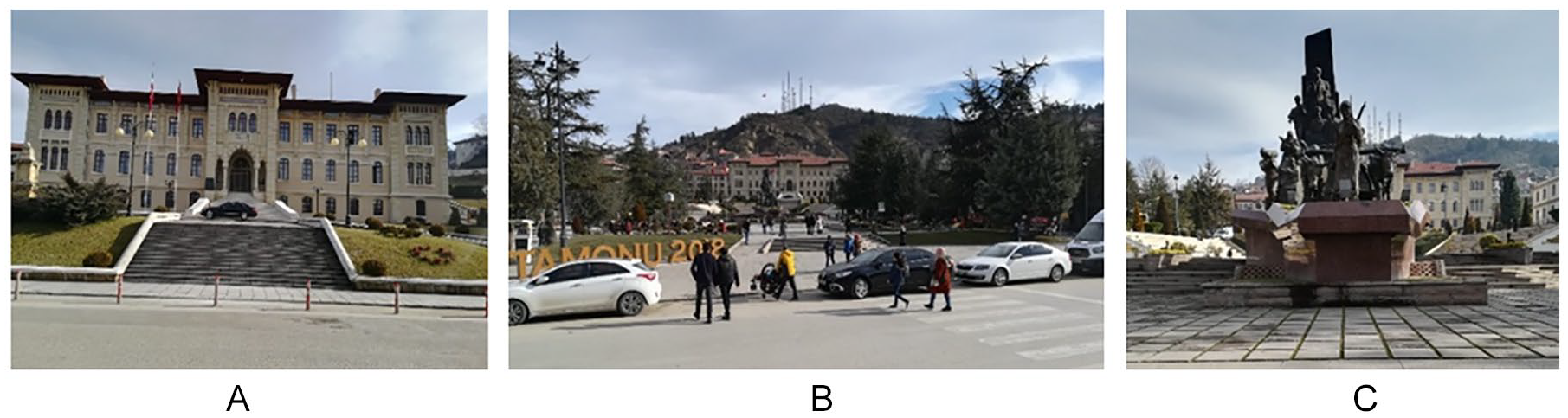
The outlook of the study area: (A) government office, (B) Cumhuriyet Square, and (C) S`erife Bacı Monument.
In this research, it was aimed to determine whether nationality affects the usage of the space by determining the intended use of Cumhuriyet Square which is located in Kastamonu and has an important place in the history of the city by foreign and local individuals and thus to determine whether weakening of the sense of belonging as a result of not being able to establish relationship with the space and the society due to migration damages the identity of the space.
Material and Methods
Within the scope of this study, the intended use of Cumhuriyet Square, which has an important place in the history of Kastamonu and 1 of the 10 squares that are important for Turkey, by foreign individuals who have different cultures was scrutinized; the knowledge about the history of the square was examined to determine the level of knowledge related to the identity features of the study area; and it was tried to determine whether the migration has an effect on the identity of the space by determining whether there is a difference in the use of the space according to the nationality. Research questions related to the study were established as follows:
In accordance with this purpose, face-to-face questionnaire method was conducted with 160 individuals in the study area. The number of questionnaires was determined according to the 10% confidence level (Yazıcıoğlu & Erdoğan, 2004) based on the population of Kastamonu central district (116.737 people) (TSI, 2017) in which Cumhuriyet Square is located. In the questionnaire, there were questions about the socio-cultural characteristics of the participants, their level of knowledge on the history of Cumhuriyet Square, how frequently and for what purpose is the square is used and what kind of usages do they desire in the square. Local and foreign participants were asked questions which were prepared according to the five-point Likert-type scale on the effect of the square to the identity of the city, the effect of used equipment to the identity, and the opportunity of socialization and the sufficiency of square’s current usage. In this way, it was examined whether cultural diversity causes differences in the use of the square and thus in the identity of the square. The results of the study were evaluated with SPSS 22 program, frequency analyses were performed, and whether there is a significant difference between the variables was determined on the 5% significance level with an analysis of variance (ANOVA) test. Furthermore, regression analysis was conducted to determine whether nationality creates a difference in the use of the space.
Results
Within the scope of the study, questions were posed to 170 subjects using a questionnaire, and the intended use of Cumhuriyet Square by local and foreign individuals, their knowledge about the history of the square, and their expectations related to the square were determined. In all, 52% of the participants were local people and 48% of them were foreign individuals. It was determined that 41.5% of the foreign individuals who participated in the study were Afghan, and 23.2% of them were Syrian (Figure 2).

Distribution of questionnaire participants according to countries.
When the socio-demographic features of the participants were examined, it was determined that 57.1% of them were between the age group of 21 and 30, 57.6% of them were studying an undergraduate degree, and 59.4% of them had an income below 165 € (Table 1).
Socio-Demographic Structure of the Participants.

When the duration of time spent in Kastamonu was examined, it was determined that 40.1% of the local people and 76.9% of the foreign individuals were living in the city for approximately 5 years, and 28% of the foreign individuals and 52% of the local people had knowledge about the history of Cumhuriyet Square (Table 1, Figure 3).

Questionnaire on the participants’ level of knowledge about the history of Cumhuriyet Square.
When the square’s frequency and duration of use by the participants were scrutinized, it was determined that 36.6% of the foreign individuals and 30.7% of the local people used the square several times a week, and 40.9% of the local people and 59.7% of the foreign individuals spent approximately half an hour at the square (Table 2).
Square Use Evaluations of Participants.

It was observed that local people and foreign individuals use the square with the purpose of waiting-meeting (48.9%–67.1%), sitting (56.8%–64.6%), and resting (59.1%–42.7%). In all, 45.1% of the foreign individuals and 23.9% of the local people stated that they used the square with the purpose of gathering (Figure 4). When the participants were asked the question for which purposes do they use the square, it was determined that the most preferred usages both for local people and foreign individuals are as follows: sitting, resting, and waiting. While 58.5% of foreign individuals stated that they use the square for gathering, only 17.0% of the local people stated that they use the square for this purpose (Figure 4).

Current usage and preferences.
According to the regression analysis, which was conducted with the purpose of determining whether the usage preference of Cumhuriyet Square show differences between the foreign individuals and local people, it was determined that nationality affected the use on the significance level of 0.05 and the explanation rate of the effect of nationality to the usage preference was 38% (Table 3). According to Table 4, when the current use of the square is examined in terms of the nationality, there is a significant difference between the local people and foreign individuals in terms of sitting, resting, gathering, watching, taking photography, and waiting-meeting activities according to the significance level of 0.05, and it was observed that foreign individuals prefer to use the square for sitting, gathering, watching, and waiting-meeting activities more than the local people. When the preferred activities that should be held in the square were examined in terms of whether there is a difference according to the nationality, a significant difference was observed in the activities of gathering, acquiring knowledge, ceremony area, watching, listening to music, and reading, and it was determined that foreign individuals prefer to use the square for watching and listening to music more than the local people.
Model Summary About the Relationship Between the Way of Using the Square and the Nationality.

Independent variables: (Constant), waiting, resting, ceremony, bicycling, sitting, listening to music, gathering, taking photography, watching, skating, reading a book. b Dependent variable: nationality.
Evaluating the Impact of Nationality on Square Usage Preferences.

Note. Dependent variable: nationality. Independent variable: sitting, rest, meeting, getting, information, ceremony, watching, listening music, reading, taking photo, ride a bike, skating with skate, stand-date.
Bold values represents that Sig.<0.05.
When the opinions of the square’s users were evaluated, it was observed that the local people have different opinions on how the square represents the historical past of the city compared to foreign individuals on the significance level of 0.05. While the local people are irresolute whether the square represents the historical past of the city (M: 3), foreign individuals stated that they believe the square represents the historical past of the city (M: 4). While the local people stated that activities of the foreign individuals in the square affected the identity of the place (M: 4), foreign individuals stated that they did not affect the identity of the square (M: 2). While foreign individuals were irresolute whether the physically challenged individuals can use the square easily (M: 3), the square provides a rather good socializing opportunity (M: 3), and accessories in the square represent the identity of the place (M: 3), local people stated negative opinions about these subjects. Foreign individuals stated that they are not disturbed by the glances (M: 2) or conversations (M: 2) of foreigners in the square and at the same time they are not uncomfortable using the square with other foreign individuals (M: 4). Local people, however, stated that they disagree with foreign individuals and stated that they feel disturbed when foreign individuals use the square. While local people stated that there should be sitting units with cover systems by placing modern accessory elements (M: 4), foreign individuals were irresolute or they stated that they are not necessary. Furthermore, considering the historical past of Cumhuriyet Square, local people stated that bicycling (M: 4) and skating (M: 4) in the square are not appropriate; however, foreign individuals stated the exact opposite (Table 5).
Opinions of the Users of the Area About the Square.

Mean: 1: strongly disagree, 2: disagree, 3: undecided, 4: agree, 5: strongly agree.
According to the variation analysis that was conducted to determine whether the use of Cumhuriyet Square shows differences between foreign individuals and local people, it was determined that the nationality affects the use of the square on the significance level of 0.05, and the explanation rate of the effect of nationality on the use of the square is 38%.
Discussion
Public spaces which are the city’s important areas of usage are places in which the society is together, conflicts are ignored, and everyone is in interaction with each other. Public areas are legible places where people can carry out activities without limitations and have connections with other places in the city (Francis, 2010). Squares which are the important public areas are places where people from all strata living in the city can go to. Sense of belonging to the spaces which have traces of past strengthens the dependence of people to space (Lewicka, 2008). Nevertheless, depending on the historical and cultural features of certain squares, their usage is more limited. The identity of a place is disrupted due to inappropriate usages in terms of the historical and cultural values of the area. The changes in the using the place may cause conflicts between individuals in terms of the sense of belonging. Cumhuriyet Square which has monuments such as Martyr Şerife Bacı, Atatürk, and War of Independence martyrs, which are important symbols of the spirit of national struggle, has a feature of being used as a ceremonial area on important days. Since the square is right in front of the governor’s building, the activities in the square are quite limited and under control.
When the results of the study are examined, it was determined that the level of knowledge of foreign individuals about the history of the square was low (28%). It was observed that while local people use the square for a longer period, foreign individuals use the square for a shorter period. It is considered that the differences in the use of square by the foreign and local individuals also affect the duration of use. While local people stated that they use the square for sitting, resting, and waiting-meeting activities, foreign individuals stated that they use the square for sitting-resting and gathering activities. When it is examined in terms of usage preference, unlike the local people, foreign individuals stated that they use the square for listening to music and gathering activities. When examined accordingly, it is considered that the reason why local people use the square as a gathering place is because one of the important religious building of the city is located in this square and they prefer to use another square which is surrounded by commercial units and for this reason they use the Cumhuriyet Square for sitting and resting purposes. Designing the urban equipment elements as items that attribute to the past in terms of stylistic features contributes to defining the identity of the space (Bayramoğlu & Özdemir, 2012). When examined accordingly, it is considered that the reason why local people want to use the square for sitting activity although they do not prefer this activity is because the sitting elements do not match with the identity of the space and due to the insufficiency of the equipment. The lack of knowledge toward the identity of the space can be indicated as the reason for foreign individuals to be irresolute about whether urban equipment reflect the identity of the space. Although it can be observed that foreign individuals use and would prefer to use the Cumhuriyet Square for gathering purposes more than the local people since it is located at a crucial point and in the center of the city, it is considered that these different ways of usages which are caused by cultural diversity and lack of knowledge on the space would damage the formal usage of the square and thus its identity in time.
When the results of the study are examined, it was observed that the local people use the square as a place for sitting, for resting, and as a ceremonial area, and foreign individuals use the square for sitting-resting, gathering, listening to music, and bicycling. These different ways of usage which are thought to result from cultural differences and the lack of knowledge about the area are thought to disrupt the formal usage of the square and thus its identity in time. This can be understood from foreign individuals since they do not have a sufficient level of knowledge about the features of the square and they are irresolute about the usage and the features of the square. Furthermore, since foreign individuals replied to the question whether the square represents the historical identity of the city as yes it does, it can be concluded that they do not have sufficient knowledge about the city. Hence, although Cumhuriyet Square is one of the squares that has remained from Early Republic period, the history of the city goes back to Hittites and it is stated that the city has experienced its brightest time in Ottoman Period. For this reason, it would not be a realistic approach for the square to represent the identity of the city on its own. Keeping a cultural distance to immigrants and feeling anxious in terms of demography by the immigrant-receiving societies (Tunç, 2015) cause concern in the use of public spaces. Immigrants experience problems in the sense of belonging to the spatial dimension depending on the cultural difference of their new settlement (Tümtaş & Ergun, 2016). Another aspect that is concluded from the results of the study is that although people who have immigrated to Kastamonu came from countries that have similar cultural structures, an intercultural amalgamation did not take place. It can be concluded from the opinion of local people that they do not have positive opinions toward foreign individuals and that they do not want to use public areas with them. Thus, it can be stated that this difference brings along conflicts in the use of the area.
By examining the results of the study, ensuring the common use of this area where people from different cultures gather and not to harm the identity of the area,
It is necessary to place information plates about the history and the identity of the area to the different points of the area.
The main reason of using the space for different purposes is lack of knowledge on the space and the lack of appropriate spaces (skate parks and bicycle tracks) that would meet the demands of bicycle and roller skate users.
It is necessary to give information about the historical and cultural values of the city in the educational institutions,
It is necessary to increase the number of activities that are conducted on the meaning and importance of the square.
Conclusion
As a result of the study, it was determined that Cumhuriyet Square, which has an important value in terms of the identity of the city, is used differently by local people and foreign individuals, and it is considered that this situation negatively affects the square in terms of its cultural identity. Because squares which are public areas and are accessible by people from all strata in the city can only be used in accordance with their identities and by users who have knowledge of the squares. For this reason, it is predicted that aforementioned precautions would have an important effect on the amalgamation of societies with different cultural features, on the increase in the interaction between societies, and on the provision of the adaptation.
Footnotes
Authors’ Note
This study was presented as a verbal statement in 42nd Colloquium of World Urbanism Day that was conducted in IZMIR on November 7 to 9, 2018.
Declaration of Conflicting Interests
The author(s) declared no potential conflicts of interest with respect to the research, authorship, and/or publication of this article.
Funding
The author(s) received no financial support for the research, authorship, and/or publication of this article.
