




Abstract
Despite being the first country in the world to introduce paternity leave in 1978, Finland’s current national leave scheme is complex with regard to incentivizing fathers’ take-up. Taking the unique Finnish leave scheme as a case example, this article examines fathers’ motivations and barriers to leave. Although research on fathers’ take-up of leave in divergent leave policy contexts has increased dramatically, fathers’ motivations and barriers to leave have remained underresearched. The article reports on a survey sample of 852 Finnish fathers of infants who were taking paternity, parental, and other forms of leave, drawn from the Population Register Center. Results show that less than 20% of fathers report taking no leave, with more than 80% taking some form of leave. A multinomial logistic regression analysis indicates that father’s work, partner’s education, and family income, along with father’s wish to take a break from work and wish to facilitate mother’s return to work or studies, are the key characteristics and motivations associated with fathers’ take-up of leave. The most common barriers to fathers’ take-up of leave were related to the family’s economic situation and the father’s job. It is suggested that decreasing maternalism in the leave scheme, by extending investment in fathers’ individual well-paid leave weeks, will also help promote greater gender equality for working parents in Finland following the path of Nordic neighbors.
Introduction
During the last three decades, significant changes in fatherhood have occurred across the developed countries. It has been argued that caring and involved fatherhood has become more widespread and culturally more accepted, or even the norm of male parenting (Doucet, 2006; Miller, 2011; O’Brien & Wall, 2017; Ranson, 2015). The Nordic countries—Finland, Sweden, Norway, Iceland, and Denmark—in which the promotion of gender equality has been on the political agenda for many decades, have often been perceived as trailblazers in encouraging men’s active and caring involvement with their children (Anttonen, Häikiö, & Stefánsson, 2012; Björnberg & Ottesen, 2013; Eydal et al., 2015; Goldscheider, Bernhardt, & Lappegård, 2014; Johansson & Klinth, 2008). The Nordic countries are especially well known for their father-friendly leave policies (Moss & Deven, 2015; O’Brien & Wall, 2017) and have been characterized as the “premier league” in parental leave for fathers, as their leave policies are father-care sensitive and include a high level of compensation for loss of earnings (O’Brien, 2009). The father’s leave quota, based on the use-it-or-lose-it principle, has also often been perceived as a unique feature of Nordic leave policies in international comparisons (Haas & Rostgaard, 2011).
Finland, like its Nordic neighbors, has a long history in trying to encourage fathers to take greater responsibility for childcare from the onset of parenthood (Eydal et al., 2015; Haas & Rostgaard, 2011; Lammi-Taskula, 2017). Finland, along with Norway, was the first country in the world to introduce paternity leave in the late 1970s, and the second country after Sweden to introduce sharable parental leave in the mid-1980s. The current Finnish scheme, introduced in 2013, provides fathers with three alternative leave packages:
“Use it or lose it” paternity leave of 9 weeks, comprising postbirth leave of 3 weeks simultaneously with the mother (henceforth, simultaneous paternity leave) and individual paternity leave of 6 weeks (henceforth, individual paternity leave), both with high compensation for loss of earnings, until the child’s second birthday;
parental leave of 26 weeks, which is a family right and shareable between the parents, with high compensation for loss of income, starts after maternity leave; and
care leave, which can be shared between the parents, up to the child’s third birthday, with flat-rate compensation (The Social Insurance Institution of Finland, 2018).
Although Finnish fathers’ leave entitlements have improved quantitatively on a regular basis, the current policy design differs markedly from those of the other Nordic countries in two respects: The proportion of the father’s individual quota weeks has not increased and a rather inflexible maternalistic design has persisted (Eydal et al., 2015). That is, although, since 2018, Finnish fathers have had the right to take up to 35 weeks leave with high compensation for loss of earnings, only nine of these weeks are individual entitlements and 26 weeks are a family form of leave shareable with the mother (The Social Insurance Institution of Finland, 2018). Thus, the incentives for fathers to take leave equally with mothers have been underwhelming, rendering the Finnish leave scheme unique in the Nordic region.
Fathers’ take-up of leave in Finland has increased annually during the 2000s, although slowly and on a small scale (Salmi, Närvi, & Lammi-Taskula, 2017). Although the majority of fathers, irrespective of socioeconomic background, take simultaneous paternity leave, described by Lammi-Taskula (2006) as “everyman’s mass movement,” for 1 to 3 weeks, less than 10% of all leave (i.e., maternity leave, paternity leave, and parental leave) with high compensation for loss of earnings is currently taken by men (Säkkinen & Kuoppala, 2017). Even more strikingly, only about 5% of all fathers share parental leave with the mother (Lammi-Taskula, 2017; Säkkinen & Kuoppala, 2017). These statistics show that Finland lags far behind its Nordic counterparts Iceland, Norway, and Sweden in fathers’ take-up of leave (Eydal et al., 2015). It has been argued that, in addition to the lack of incentives for fathers to take more leave, the primacy of the mother in early care is supported by the cultural ideals dominant in Finland (Repo, 2010).
The public and political debate on fathers’ leave in Finland has remained lively throughout the 2000s, mainly due to fathers’ low take-up of leave. Much of the debate has revolved around the question of whether Finland should take the path of its Nordic neighbors, Iceland, Norway, and Sweden, by further increasing the father’s individual leave quota. Most attention has been paid to the so-called 6+6+6 model developed by the researchers at the National Institute for Health and Welfare (see Salmi & Lammi-Taskula, 2010). The model, inspired by the Icelandic leave scheme, consists of three periods of 6 months with high compensation for loss of earnings: one for the mother, one sharable between the parents, and one for the father. The model has been defended not only by several nongovernmental family and child organizations, feminist and equality activists, and academics, but also by liberal and left-wing political actors. Due to political disagreements, however, no consensus on a model providing equal length of leave for both parents has yet been reached. The main argument of opponents of the model is twofold: It is too costly and the current model already enables fathers to share postnatal care equally, which the evidence shows is not the case. The most recent attempt to increase fathers’ leave quota collapsed in early 2018. The new Finnish government that took office in June 2019 has a leave scheme reform on its agenda, with a 5+5+5 model as a goal.
During the 2000s, the intensifying debate in Western societies on fathers’ caring roles in family life has been accompanied by a dramatic increase in research on fathers’ early care leave. More specifically, an increasing number of studies have examined fathers’ use of leave entitlements, the factors shaping take-up and the impact of leave use on family relationships, the division of housework, and the care of children (e.g., Buenning, 2015; del Carmen Huerta et al., 2013; Haas & Hwang, 2009; Lammi-Taskula, 2008; Petts, Knoester, & Li, 2018). A particular focus has been on the socioeconomic determinants and patterns of leave use (Brandth & Kvande, 2003; Duvander & Johansson, 2014; Eydal & Gíslason, 2014; Kvande & Brandth, 2017; Lammi-Taskula, 2006, 2008, 2017; Salmi, Lammi-Taskula, & Närvi, 2009; Salmi & Närvi, 2017; Tervola, Duvander, & Mussino, 2017) and its effects on the labor market career of mothers and fathers (Evertsson, 2014; Evertsson & Duvander, 2010), on time use and the division of labor in unpaid work (Almqvist & Duvander, 2014; Duvander, Ferrarini, & Johansson, 2015; Kitterød, 2013), and on the father–child relationship (Arnalds, Eydal, & Gíslason, 2013; Brandth & Kvande, 2018; Duvander & Jans, 2009; Ottesen, 2015; Sarkadi, Kristiansson, Oberklaid, & Bremberg, 2008). The long-term beneficial effects of fathers’ take-up of individual leave found in previous studies include greater gender equality in childcare and domestic work as well as continued paternal engagement in childcare and contact with a child after divorce (Duvander et al., 2019; O’Brien & Wall, 2017). Despite the growing research interest in fathers’ leave, fathers’ motivations and barriers to taking leave have remained rather neglected topics.
Taking the unique and complex Finnish leave scheme as a case example, this article contributes to filling this research gap by exploring (a) individual and family characteristics related to fathers’ take-up of leave and (b) the motivations for and (c) barriers to fathers’ take-up of leave. Theoretically, the article draws on a wide body of research on gendered parenting cultures and practices (e.g., Doucet, 2006; Miller, 2011; Ranson, 2015). Although cultural expectations of involved, intimate, and emotional fatherhood and caring masculinities have broadened, the literature demonstrates the deep-rootedness in the Western societies of gendered parenting roles in contemporary cultural practices, policies, and understandings (e.g., Dermott, 2008; Eerola & Mykkänen, 2015; Fox, 2015; Miller, 2011). Several scholars have argued that parenting ideals are profoundly gendered: Mothers are expected to be the primary caregivers and on call 24/7, whereas fathers are perceived more as mothers’ assistants and primary breadwinners (e.g., Doucet, 2006; Ranson, 2015; Rose, Brady, Yerkes, & Coles, 2014; Vincent & Ball, 2006). Fatherhood is also discretionary in nature: Fathers can, for example, opt out of tasks they feel uncomfortable doing or find too challenging (Rose et al., 2014). Thus, even if fathers have become more involved and “hands-on” with their children over the past few decades, women continue to assume a greater share of parental care and take more parental leave than men (Blum, Koslowski, Macht, & Moss, 2018; Miller, 2011).
The present data comprise survey responses of Finnish fathers of infants (N = 852). During recent years, Finland has attracted global attention as a gender-equality pioneer (European Institute for Gender Equality, 2017) and as having one of the most contented populations in the world (Helliwell, Layard, & Sachs, 2018). Finland, a country with a per capita gross domestic product (GDP) of US$44,000 (2017), has also received praise for its educational system, which includes universal early childhood education and care (ECEC) from the end of the parental leave period (Karila, 2012). With its unique application of the Nordic parental leave scheme, Finland provides an interesting case example enabling a more nuanced picture of the motivations and barriers affecting fathers’ take-up of leave. Multinomial logistic (MNL) regression analysis was performed on survey responses gathered from Finnish fathers of infants in 2016. The study is part of the multidisciplinary research project Finnish Childcare Policies: In/equality in Focus (2015-2021), funded by the Strategic Research Council of the Academy of Finland.
The Finnish Leave Scheme: History and Current Entitlements
Significant steps in the advancement of gender equality in Finland were taken in the 1960s with the introduction of the oral contraception and the right to paid maternity leave. Thus, women were empowered to make their own choices in their work and family lives (Forsberg, 2005; Lammi-Taskula, 2006). Legislation providing for state-subsidized universal day care was passed in the early 1970s, thereby enabling mothers of infants to engage in full-time employment. In connection with this development, paternity leave of 2 weeks was introduced in 1978 (Lammi-Taskula, 2006). Its purpose was to foreground the importance of the father–child relationship and the role of the father in helping and supporting the mother in infant care (Kellokumpu, 2007). The next significant step was taken in 1985, when sharable parental leave with high compensation for loss of earnings for the initial part and a flat-rate care leave payment for the remainder became available for fathers (Duvander & Lammi-Taskula, 2011). In 1991, paternity leave was extended to 3 weeks.
It has been argued that the aim of encouraging parents to share early care more equally through the introduction of individual paternity leave entitlements has been at the core of Finnish family policies throughout the 2000s (Lammi-Taskula, 2017; Salmi et al., 2017). The first attempt in the new millennium to enhance the role of fathers in early care took place in 2003, when a 2-week “father’s bonus” for fathers taking parental leave was introduced. The aim of the reform was to increase fathers’ take-up of sharable parental leave, and thus the bonus was granted to all fathers who took at least 2 weeks of parental leave (Kellokumpu, 2007). In 2010, the number of bonus weeks was increased to 4. Although these reforms increased the length of fathers’ individual leave, permission for fathers to take parental leave continued to be required from the mother.
The current Finnish leave scheme introduced in 2013 (Salmi et al., 2017) comprises three types of leave with high compensation for loss of earnings (Table 1). An expectant mother can start maternity leave from 5 to 8 weeks before her due date, after which it continues for the next 18 weeks. Thereafter, sharable parental leave of 26 weeks is available. Paternity leave comprises simultaneous paternity leave of 3 weeks and, subsequently, individual paternity leave of 6 weeks. If a father does not take simultaneous leave, he can take all 9 weeks of his paternity leave between the end of the parental leave period and the child’s second birthday. Paid compensation for maternity, parental, and paternity leave is on average 70% of earned income. Parents who have not been employed or have very low annual earnings receive a minimum flat-rate allowance (€593 per month in 2017, which is about 16% of the median salary). In total, leave with high compensation for loss of earnings covers the period from the last month of pregnancy to approximately 10 months after childbirth. Age of a child at the end of leave with high compensation for loss of earnings is dependent on two decisions made by the family: (a) the point at which the mother begins maternity leave and (b) when and to what extent the father takes up individual paternity leave.
Family Leave Scheme and ECEC in Finland (2016).
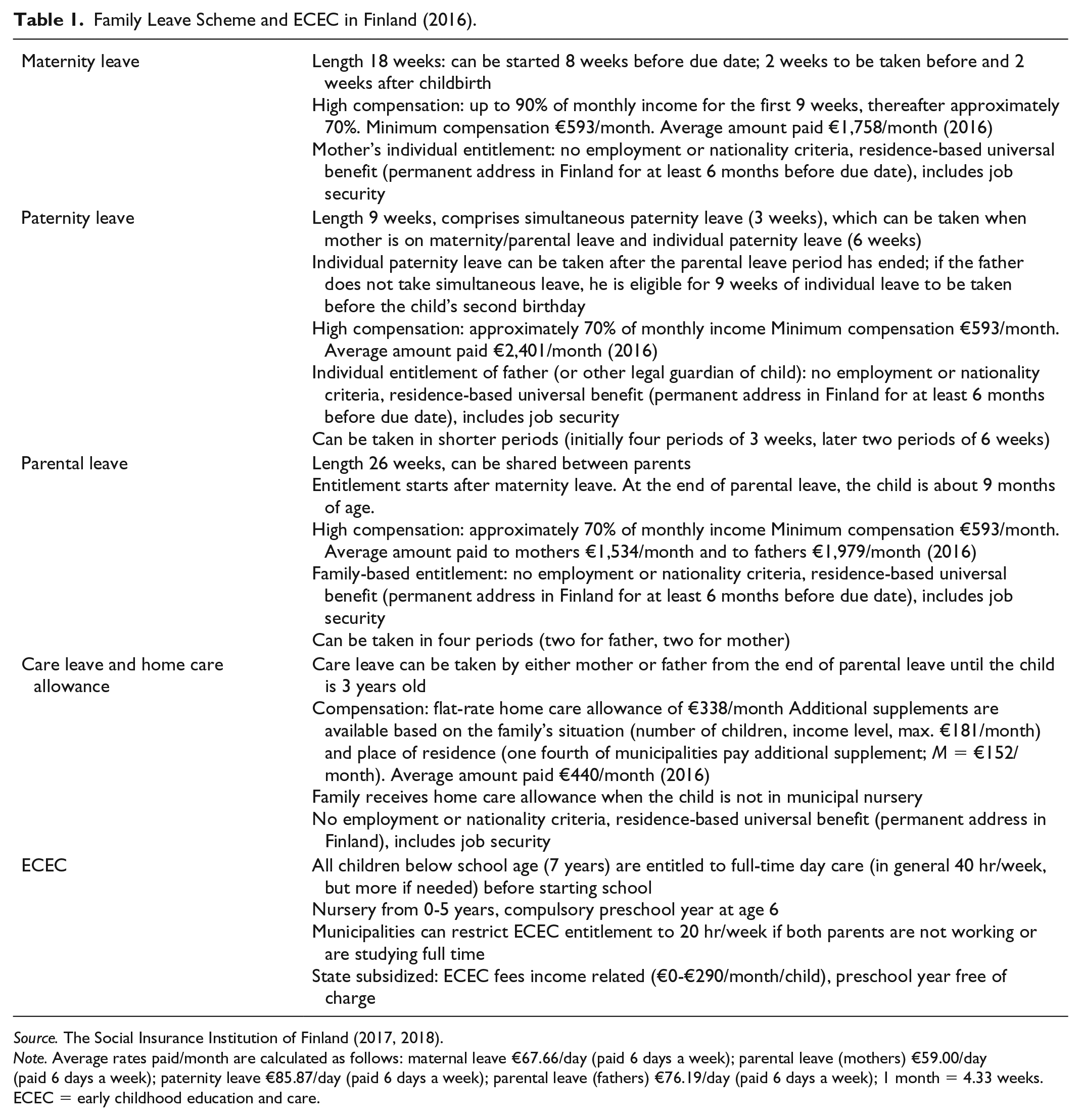
Note. Average rates paid/month are calculated as follows: maternal leave €67.66/day (paid 6 days a week); parental leave (mothers) €59.00/day (paid 6 days a week); paternity leave €85.87/day (paid 6 days a week); parental leave (fathers) €76.19/day (paid 6 days a week); 1 month = 4.33 weeks. ECEC = early childhood education and care.
After the aforementioned leaves, parents can choose between flat-rate care leave and state-subsidized ECEC (Table 1). Care leave can be taken until the child is 3 years old. A flat-rate allowance is paid during care leave, with additions for siblings and a means-tested supplement for low-income families. Although the entitlement to state-subsidized ECEC begins immediately after the end of parental leave, most infants less than 1 year old are taken care at home by a parent on care leave. In fact, less than 1% of children attend formal ECEC immediately after the end of parental leave (Säkkinen & Kuoppala, 2017). At age 2, 54% of children participate in ECEC and, thus, cared for outside the home (Säkkinen & Kuoppala, 2017).
All leave entitlements included in the Finnish leave scheme are universal benefits based on residence (Salmi et al., 2017). Although most parents of infants meet this condition, the criterion could restrict access to leave, especially for immigrant parents. As the leave entitlements are universal benefits, they are not tied to any employment criteria. That is, the leaves are available to parents regardless of their labor market position, and thus, students and unemployed parents, among others, are also eligible for leave. All the leaves also include job security, that is, the right to return to the same job, in case the parent has a valid employment contract.
In international comparisons, Finland is often perceived as one of the Nordic “premier league” countries regarding fathers’ leave. However, significant intra-Nordic differences between fathers’ entitlements exist, especially in the length of individual paternity leave and flexibility in take-up (Eydal et al., 2015). In comparison with that of Sweden (14.3 weeks), Iceland (13 weeks), Norway (10 weeks), and Denmark (2 weeks), Finland’s paternity leave entitlement of 9 weeks is around the Nordic mean. In flexibility of take-up, the Finnish variant (like the Danish one) is more restricted than the Swedish, Norwegian, or Icelandic variants (Eydal et al., 2015). For example, in Finland, parents’ simultaneous leave is restricted to 3 weeks, and there are also restrictions on part-time leave.
Fathers’ Take-Up of Leave and Related Motivations and Barriers
According to the latest (2015) statistics on Finnish fathers’ take-up of leave (Salmi et al., 2017), 80% of fathers take simultaneous paternity leave from 2 to 3 weeks while the mother is on maternity leave. The proportion has remained at same level over the past two decades, and it has, thus, been argued that simultaneous leave has become the norm for the Finnish fathers (Eerola & Mykkänen, 2015; Lammi-Taskula, 2017). Individual paternity leave is also taken by 50% of Finnish fathers. The proportion of fathers taking individual paternity leave has thus risen significantly since the father’s quota was introduced. Sharable parental leave, however, is predominantly taken up by mothers. In total, fathers’ take-up of all leave with high compensation for loss of earnings was only 9.7% in 2015 (Salmi et al., 2017). In Nordic comparison, Finland thus lags far behind Norway (19.8% of all leave with high compensation for loss of earnings), Sweden (25.1%), and Iceland (28.4%; Eydal et al., 2015). Mothers also dominate in the take-up of flat-rate care leave. Although the care leave is taken in almost all Finnish families after the maternity, parental, and paternity leave periods (e.g., in 2015, care leave was taken up in 89% of the families entitled to it), it is taken by the mother in 97% of cases (Salmi et al., 2017). Due to the continuing predominance of women in early care, the participation in the labor force of women aged 25 to 34 years has remained far behind that of men throughout the 2000s, although this gender difference is not present in any of the other age groups in Finland (Statistics Finland, 2014, 2016).
Previous research has shown some general international trends in fathers’ take-up of leave in countries with leave entitlements for fathers. Positive associations with fathers’ take-up of leave have been found for fathers with an academic education, a middle-class background, a permanent work contract, fixed working hours, a job in the public sector, and being a member of an ethnic majority (Duvander & Johansson, 2014; Organisation for Economic Co-operation and Development, 2017; Reimer, 2017; Stefansen & Farstad, 2008; Whitehouse, Diamond, & Baird, 2007). In Finland, although simultaneous paternity leave is taken by most fathers irrespective of their socioeconomic background, individual paternity leave, parental leave, and care leave are more often taken up by fathers with a high education, high level of family income, and a white-collar occupation. The mother’s socioeconomic position is also relevant for the father’s take-up of individual paternity leave, parental leave, and care leave, as these types of leave are more often taken by Finnish men with highly educated spouses who have a reasonably good position in the labor market (Lammi-Taskula, 2017; Salmi et al., 2009). First-time fathers and men above 30 years are also more likely to take up these types of leave than the fathers of several children or fathers in their twenties (Lammi-Taskula, Salmi, & Närvi, 2017). Fathers with an immigrant background take up all types of leave considerably less often than their native Finnish counterparts (Tervola et al., 2017).
Although fathers’ motivations for taking up leave have been little researched, some previous work has been done in the Finnish context. The results have shown that the most popular motivations of Finnish fathers, regardless of the type of leave taken, are the father’s wish to get to know the new baby and the ideology of shared parenting (Lammi-Taskula et al., 2017; Salmi et al., 2009). Differences have also been reported: Fathers taking simultaneous or individual paternity leave also expressed a wish to help their partner in childcare as a third main motivation for their leave, as fathers taking parental or care leave more often justified their leave by a preference for home care rather than institutional day care. Variation in motivation has also been found by father’s education: High-educated fathers emphasized parenting as a shared responsibility and accentuated their desire to spend time with the baby more than less educated fathers, who, in turn, stressed the importance of helping the mother. Perceiving leave as an opportunity to help the mother was more often reported by fathers in families with more than one child (Lammi-Taskula et al., 2017; Salmi et al., 2009).
Recent research suggests that barriers to fathers’ take up of leave continue to exist, even when individual leave with high compensation for loss of earnings is available. These obstacles can be practical, such as financial or work related, or related to power structures, traditions, and values (Duvander & Johansson, 2014; Koslowski & Kadar-Satat, 2019). This is also the case in Finland, where approximately 20% of fathers do not take up any form of leave. According to previous studies conducted in Finland (Lammi-Taskula et al., 2017; Närvi, 2018; Salmi et al., 2009), the main reasons for not taking any leave are related to the father’s work situation, the family’s economic situation, and gender role attitudes. For example, the insecurity of working life seems to play a role in fathers’ take-up of leave, as men who had experienced unemployment or risk of dismissal before childbirth took leave less often than those whose position in the labor market was more secure. Take-up is also less common among entrepreneurs and those in managerial positions (Lammi-Taskula et al., 2017). The family’s finances was especially highlighted as a barrier among fathers with a lower level of education, who perceived the family’s economic situation as an obstacle to taking leave more often than those with higher level of education. Gender roles and gender ideology seem, however, to be even more relevant obstacles than family income: Irrespective of income level, a father is less likely to take leave if he believes family breadwinning is mainly his responsibility (Salmi et al., 2009).
The Present Study
This study aims to extend current understanding of fathers’ leave by focusing on the motivations and barriers affecting fathers’ take-up of leave by using Finland as an example of a Nordic leave scheme. Taking the present Finnish leave scheme (see Table 1) as the model, we focus on four types of fathers differentiated by their take-up and length of leave: fathers taking no leave, fathers taking only simultaneous paternity leave, fathers taking some individual paternity leave in addition to simultaneous paternity leave, and fathers sharing care responsibilities with the mother by taking parental and/or childcare leave in addition to simultaneous and individual paternity leave. First, we examine how fathers’ individual and family characteristics are associated with their take-up of leave. We then scrutinize the role of different motivations and barriers to fathers’ take-up and length of leave. The research questions were as follows:
Based on the literature review, we expected employed fathers with a university education, in regular daytime work, and living with a university-educated partner to take more individual leave than other fathers (Lammi-Taskula, 2017; Salmi et al., 2009). We also expected a father’s personal desire to take care of his child to be associated with longer leave (Lammi-Taskula et al., 2017; Salmi et al., 2009). Finally, we assumed that fathers would report financial and work-related reasons as the key barriers to taking leave (Lammi-Taskula et al., 2017; Salmi et al., 2009).
Method
Participants and Procedure
This article is part of the multidisciplinary research project Finnish Childcare Policies: In/equality in Focus (2015-2021). Aim of the project is to examine the potential sources of inequality in Finnish childcare policies and consider how they could be overcome. The project has been approved by the Ethical Committee of the University of Jyväskylä, Finland. The present case study analyzes cross-sectional data gathered for the project in 10 Finnish municipalities via an online and postal survey in 2016. The survey focus was on families’ decisions about childcare and early childhood education. Take-up of leave formed just one section of the survey. The survey was targeted to parents of children born between October 1, 2014, and September 30, 2015. Information about the children and their parents’ contact information were obtained from the Population Register Center. All the parents were their children’s legal guardians. At the time of data collection, the children varied in ages from 8 to 22 months. The survey was sent to 14,612 parents (7,645 mothers and 6,967 fathers) of 7,649 children and was answered by at least one parent or guardian of 2,081 children, yielding a response rate of 27.2% for the original sample of children. Responses were received from 2,696 parents, yielding response rate of 18.5% for the parent sample. Mothers’ and fathers’ response rates were 24.1% and 12.2%, respectively.
For this article, the responses of the male parents or guardians (N = 852) were analyzed. On the issue of leave take-up, fathers taking parental and/or care leave (total leave length more than 10 weeks) were overrepresented in our data (19%) when compared with the corresponding proportion (less than 5%) for the whole country (Salmi et al., 2017). Respondents’ level of education was also substantially higher than the national average, as approximately half of them held a university degree (compared with the national mean of 13%; Hietamäki et al., 2017). In their work–life situation, the responding fathers were representative of fathers in the general population. With two exceptions, all responders were biological fathers living with the target child and his or her mother at the time of the survey.
The municipalities in which the data were gathered differed in population, demographics, and key economic aspects. Four of the municipalities represented the larger Finnish cities, with populations ranging from 100,000 to 650,000. In these municipalities, the invitation to participate was sent to all parents with children born between October 1, 2014, and September 30, 2015, and resident in selected postal code areas. Two municipalities were middle-sized provincial towns with populations between 20,000 and 100,000, whereas the remaining four municipalities had populations of less than 20,000. In these six smaller municipalities, the parents of all children born between October 1, 2014, and September 30, 2015, were invited to participate in the survey.
The parents were invited to participate in the online survey via ordinary mail. The survey was available in five languages (Finnish, Swedish, English, Russian, and Somali). The invitation letter was sent in the recipients’ native language, information on which was obtained from the Population Register Center. The study aims and procedures and relevant research ethical considerations were explained in the letter. Reminders were not sent to parents who had completed the questionnaire. Otherwise up to two reminders were sent, the second of which also included a printout of the questionnaire and a return envelope.
Measures and Variables
Take-up of father’s leave
Fathers were classified into four mutually exclusive leave categories based on information about the total length of leave taken. Given that the leave categories available to them direct fathers’ use of leave in fundamental ways (Moss & Deven, 2015; O’Brien & Wall, 2017), the present category cutoffs were determined in accordance with the Finnish leave scheme (see Table 1): 1 = no leave, 2 = simultaneous paternity leave only (total leave length 1-3 weeks maximum), 3 = individual paternity leave (including take-up of 1-6 weeks of individual paternity leave in addition to simultaneous paternity leave; total leave length 4-9 weeks maximum), and 4 = parental and/or childcare leave (including take-up of the whole paternity leave entitlement and at least 1 week of parental and/or childcare leave; total leave length 10 weeks or more).
Individual and family characteristics
The following father’s individual characteristics were examined: age in years, level of education (0 = other, 1 = university education), employment situation when the 1-year-old child was born (0 = not in employment, 1 = in employment), working time pattern (0 = other, 1 = regular daytime, that is approximately 8 hr between 8 a.m. and 5 p.m.), position in work–life (1 = self-employed, 2 = manager, 3 = other; in the analyses, other position in work–life served as a reference group), 1 member of an ethnic minority (0 = no, 1 = yes 2 ), and self-reported health (1 = very poor to 5 = very good).
Characteristics related to family were measured with the following variables: number of children (0 = one, 1 = two or more), child’s health (reported by the father; 1 = very poor to 5 = very good), partner’s level of education (0 = other, 1 = university education), self-reported satisfaction with couple relationship (1 = very dissatisfied to 4 = very satisfied), satisfaction with parenting (1 = very dissatisfied to 4 = very satisfied), and monthly family income (1 = less than €500 pcm [per calendar month] to 5 = €3,001-€4,000 pcm to 10 = more than €8,000 pcm).
Motivations and barriers to taking up leave
Only fathers who had taken leave for at least 1 week were asked for their motivations for doing so, using statements on motivations and barriers from the Parental Leave Survey by the Finnish National Institute for Health and Welfare (Salmi & Närvi, 2017). Six motivations were presented, from which the father could choose up to three. The motivations were (0 = no, 1 = yes) as follows: Father wanted to take care of child; father wanted to take a break from work; father wanted to make mother’s return to work possible; father wanted to make mother’s studies possible; father had become unemployed; mother wanted father to take leave.
Fathers who did not take any leave were asked about the barriers for not taking leave. Eleven barriers were presented, from which the fathers were asked to choose up to three. The barriers were (0 = no, 1 = yes) as follows: Parents did not know about fathers’ leave possibilities, father did not think leave was necessary, father is not in working life, mother has no job, father’s employer does not see leave as possible, father is too busy at work, insecurity of father’s job, not possible in family’s economic situation, father thinks childcare is mother’s responsibility, mother does not want father to take leave.
Analytic Strategy
All analyses were conducted using SPSS 24 software. Descriptive statistics were computed for all study variables.
The associations of individual and family characteristics with fathers’ take-up of leave were examined using MNL regression analysis. Fathers’ take-up of leave (no leave, simultaneous paternity leave, individual paternity leave, parental and/or childcare leave) was the dependent variable with individual and family characteristics as the independent variables. Each leave category was, in turn, used as a reference category for comparisons with all the other leave categories. In the “Results” section, regression coefficients of MNL analysis are presented as odds ratios (ORs). The interpretation of ORs differs slightly for categorical and continuous independent variables. For the categorical independent variables (e.g., level of education: 0 = other, 1 = university education), an OR greater than 1 indicates that fathers with “other” level of education (i.e., independent variable value of 0) are more likely to be in the leave category of interest than those with a university education (i.e., independent variable value of 1). The latter are more likely to be in the reference category. An OR smaller than 1 indicates the reverse: Fathers with the level of education value of 0 are more likely to be in the reference category than the fathers with a university education, who, in turn, are more likely to be in the leave category of interest. For a continuous independent variable, an OR greater than 1 indicates that the higher the value of the independent variable, the greater the likelihood of the father being in the leave category of interest. The interpretation of an OR smaller than 1 is the reverse: The higher the value of a continuous independent variable, the greater the likelihood of the father being in the reference category. The statistical significance of the ORs was determined by computing 95% confidence intervals (CIs) for each OR. The OR was statistically significant if the 95% CI did not include the value 1. A nonsignificant OR indicates that the likelihood of being in a leave category does not depend on the value of the predictor.
Our second aim was to examine whether different motivational factors for taking up leave are related to fathers’ length of leave. As the dependent variable (fathers’ length of leave) contained three categories (simultaneous paternity leave, individual paternity leave, parental and/or childcare leave), MNL regression analysis was used. The category “no leave” was omitted from the analysis, as the non–leave-taking fathers did not respond to the motivational statements related to the take-up of leave. Again, each leave category was used in turn as a reference category for comparisons with the other two leave categories. The motivation variables formed the main independent variables. However, the motivation variable “father had become unemployed” had to be excluded from the analysis due to the low number of fathers (n = 13) in this situation. Furthermore, the individual and family characteristics found to be statistically significant in the analysis pertaining to Research Question 1 were used here as control variables. The results are presented as ORs and their 95% CIs. Finally, the potential reasons for fathers not taking any leave were examined using percentages, as the number of fathers not taking leave was relatively small.
Results
Fathers’ Take-Up of Leave and Individual and Family Characteristics
Descriptive statistics for the fathers’ take-up of leave in relation to individual and family characteristics are shown in Table 2. The fathers were rather evenly split across the four categories of leave type and length. A little below one fifth of fathers had taken no leave, and thus more than four fifths had taken some leave. Approximately 30% of fathers had taken simultaneous paternity leave (total leave 1-3 weeks), and around 30% had also taken individual paternity leave (total leave 4-9 weeks). Parental and/or care leave (total leave 10 weeks or more) had been taken by around 20% of the fathers.
Descriptive Statistics for the Study Variables.

Note. Number of fathers (N) are presented for all variables, percentages (%) are presented for categorical variables, and Ms and SDs are presented for continuous variables. N is the number of nonmissing cases for each variable.
Fathers’ mean age was slightly above 35 years. Approximately half of them held a university degree. The vast majority were in employment at the time of childbirth, and almost three quarters of the fathers were working regular daytime hours. Less than 10% were self-employed or held a managerial position; the remainder were ordinary employees. Approximately 8% of the fathers described themselves as members of an ethnic minority. Most of the fathers assessed their health as good.
Almost half of the fathers had two or more children and slightly more than half had one. The majority of fathers rated the health of their 1-year-old child as very good. More than half of the fathers had a partner with a university education. The fathers reported relatively high satisfaction with their couple relationship and own parenting. Median self-reported monthly family income before taxes was €4,001 to €5,000 pcm.
Individual and Family Characteristics Associated With Take-Up of Leave
Our first aim was to examine the relationship between fathers’ take-up of leave and its potential predictors. The MNL regression analysis indicated that a father’s job-related individual characteristics were statistically significantly associated with his take-up of leave (Table 3). Fathers in employment when their 1-year-old child was born were more likely to take leave than unemployed fathers. However, being employed was not related to type or length of leave. Fathers’ working time patterns showed a similar effect, as fathers working regular daytime hours were more likely to have taken either simultaneous paternity leave (total leave 1-3 weeks) or individual paternity leave (total leave 4-9 weeks) than no leave at all. Being in a managerial position or self-employed was associated with shorter leave periods or no leave at all. Of the other individual characteristics, fathers’ ethnic background was related to take-up of leave, although the result was statistically significant in only one comparison: A father who was a member of an ethnic minority was more likely to take no leave at all than take individual paternity leave. Fathers’ age, level of education, and health were all unrelated to take-up of leave.
Associations of Individual and Family Characteristics With Take-Up of Father’s Leave Examined by Multinomial Logistic Regression Analysis (N = 744-851).
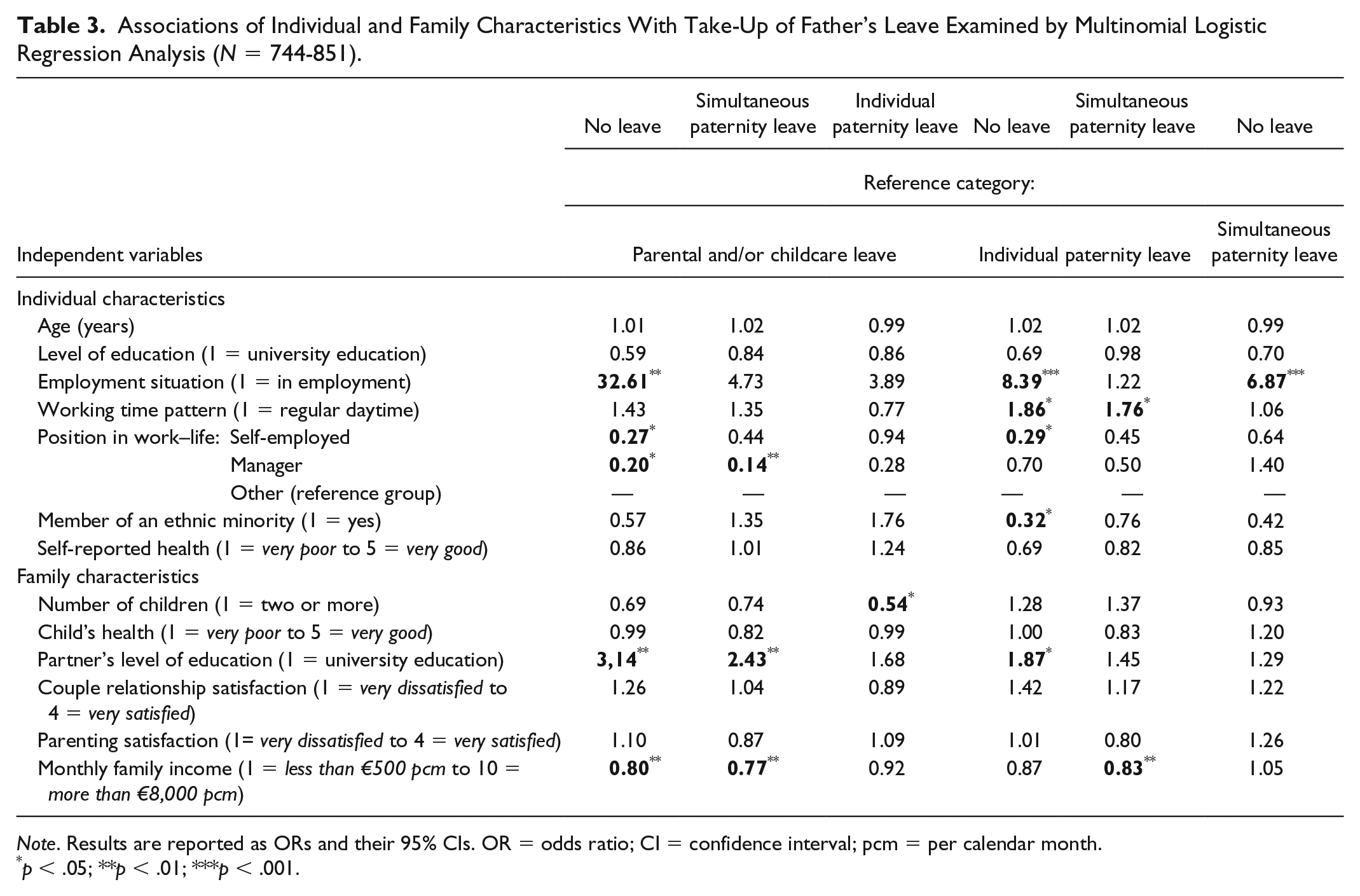
Note. Results are reported as ORs and their 95% CIs. OR = odds ratio; CI = confidence interval; pcm = per calendar month.
p < .05; **p < .01; ***p < .001.
Of the family-related characteristics, partner’s level of education and family income were associated with fathers’ take-up of leave. If the mother had a university education, the father was more likely to take parental and/or care leave, or individual paternity leave, than no leave at all. If the mother did not have a university education, the father was more likely to take simultaneous paternity leave but not parental and/or care leave. Higher family income was associated with no leave at all or simultaneous paternity leave, but not individual paternity leave, parental leave, or care leave. Number of children had also some predictive power: Fathers with only one child were more likely to take parental and/or care leave than individual paternity leave than fathers with two or more children. Number of children was not associated with simultaneous paternity leave or taking no leave at all. Child’s health and father’s satisfaction with couple relationship and own parenting were not associated with take-up of father’s leave.
Motivations and Barriers to Take-Up of Leave
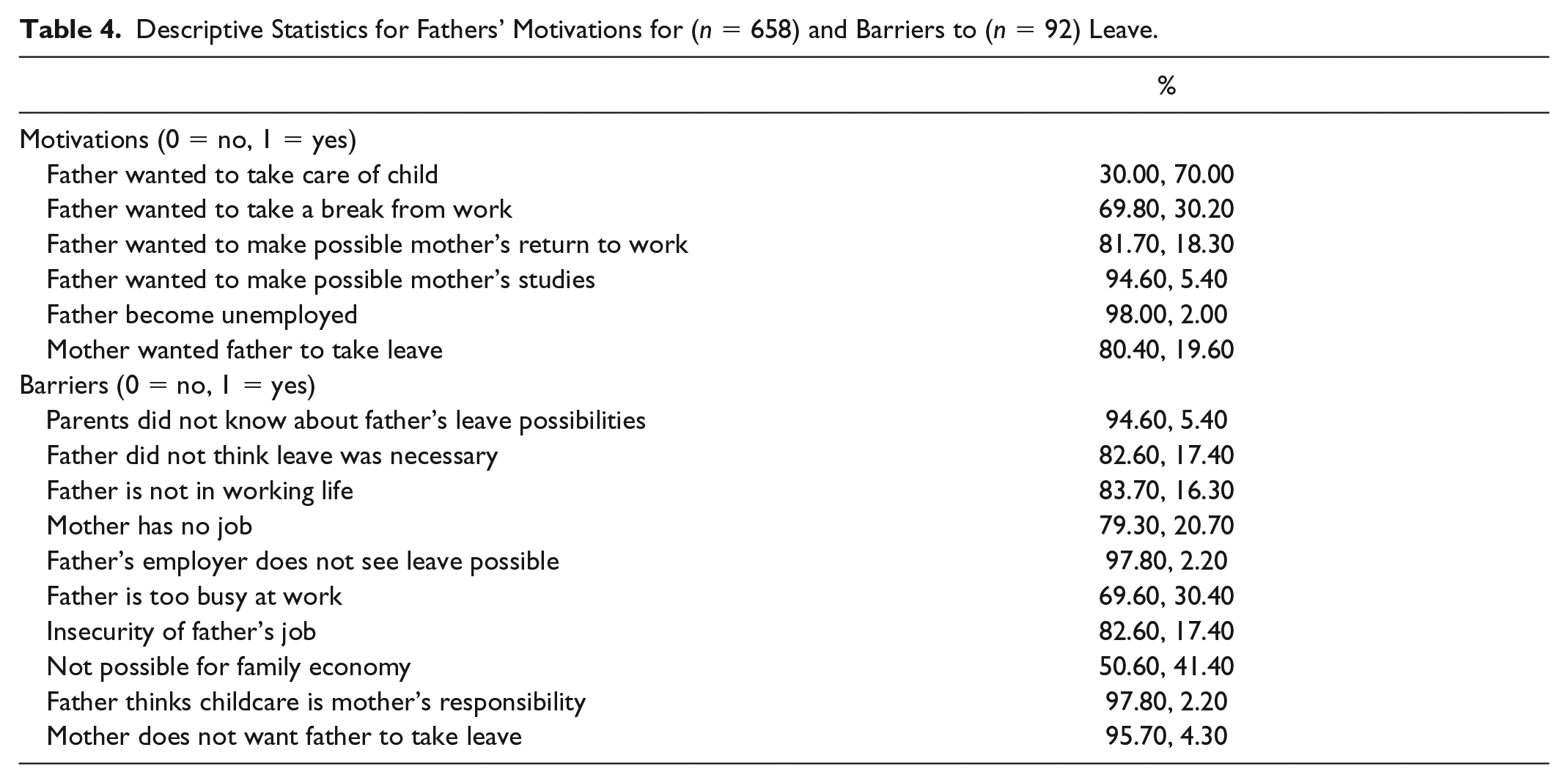
Our second aim was to examine the motivations for fathers’ take-up of leave. Fathers’ motivations for taking leave are given in Table 4. The most common motivation, selected by more than two thirds of fathers, was the father’s personal desire to take care of the child. A significant proportion of fathers also selected the wish to take a break from work, the mother’s wish that the father take leave, and the father’s desire to facilitate the mother’s return to work. Only a few fathers mentioned unemployment or facilitating the mother’s studies as motivations for taking up leave.
Descriptive Statistics for Fathers’ Motivations for (n = 658) and Barriers to (n = 92) Leave.
The relationship between length of father’s leave and fathers’ motivations for taking leave was studied using MNL regression. The individual and family characteristics found to be statistically significant predictors of take-up and length of leave in answering Research Question 1 (see Table 3) were adjusted for in this analysis. The detailed results are presented in Table 5. Three motivations were associated with length of leave. These were the father’s wish to take a break from work and to enable the mother’s return to work or studies. All three motivations were associated with longer leave. The other two motivations—father wanting to take care of the child and mother wanting the father to take leave—were not associated with length of leave. The motivational variable “father became unemployed” was excluded from the analysis due to the low number of fathers (n = 13) in this situation after childbirth.
Associations of Motivational Characteristics With the Type and Length of Leave Examined by Multinomial Logistic Regression Analysis (N = 658).

Note. Results are reported as ORs and their 95% CIs. OR = odds ratio; CI = confidence interval; pcm = per calendar month.
p < .05; **p < .01; ***p < .001.
Only individual and family characteristics that were statistically significant predictors in Research Question 1 are adjusted for in this analysis.
Our third aim was to examine fathers’ barriers to taking leave. The barriers preventing fathers from taking their leave are presented in Table 4. The barriers showed considerable variation. The most frequently mentioned barrier, selected by approximately 40% of the fathers, was the family’s economic situation. Slightly below one third of the fathers reported the barrier of being too busy at work. Substantially less reported barriers were the mother having no job to return to, father’s job insecurity, father’s perception of leave as unnecessary, and not being in working life. The remaining barriers (i.e., not knowing about fathers’ leave entitlements, father thinks childcare is the mother’s responsibility, mother does not want the father to take leave, and father’s employer does not see leave as possible) were only occasionally selected.
Discussion and Conclusion
In this article, individual and family characteristics associated with fathers’ take-up of leave and leave length, and the motivations and barriers they reported for taking up leave were studied within the Finnish leave scheme. First, the variables related to work were significant predictors of fathers’ take-up of leave. The results for individual and family characteristics revealed that the father’s employment situation, working time pattern and occupational status, mother’s level of education, and family income were all associated with length of father’s leave. Recent studies have found similar links between fathers’ take-up of leave and occupational status (e.g., Lammi-Taskula, 2017; Lammi-Taskula et al., 2017; Reimer, 2017). The results were mainly in line with our prediction, which was based on the literature review (Lammi-Taskula, 2017; Salmi et al., 2009). However, contrary to our expectations, fathers’ education was not associated with take-up of leave. Second, when motivational factors were added into the analysis, the associations of most of the individual and family characteristics with leave take-up diminished or vanished entirely. Specifically, the father’s wish to take a break from work and to facilitate the mother’s return to work or studies became the main predictors of fathers’ take-up of leave. Again, contrary to our expectations, fathers’ personal desire to take care of their child was not associated with longer leave (Lammi-Taskula et al., 2017; Salmi et al., 2009). Third, although the barriers preventing fathers from taking leave were diverse, the most common seemed to be related to the family’s economic situation (father’s leave not possible owing to the family’s economic situation) and father’s work (father is too busy at work). This finding supports our prediction based on the literature review (Lammi-Taskula et al., 2017; Salmi et al., 2009). Although only descriptive statistics of the barriers can be presented owing to the low number of fathers taking no leave, the results suggest that significant barriers to fathers’ leave remain even in situations where individual leave with high compensation for loss of earnings is available.
The results of our analyses endorse the current consensus on the gendered nature of contemporary parenting. In our sample, fathers’ relatively low take-up of individual paternity leave (approximately 30%) and of parental and/or childcare leave (approximately 19%) and the proportion of fathers not taking leave at all (approximately 19%) support previous evidence on fathers’ family roles as mothers’ assistants, secondary caregivers, and primary breadwinners (Doucet, 2006; Ranson, 2015; Rose et al., 2014; Vincent & Ball, 2006). The above percentages also indicate the selective and discretionary character of father involvement, as approximately half of the fathers did not utilize their individual paternity leave entitlement (see also Rose et al., 2014). On a positive note, our results also highlight the trend toward caring and emotional fatherhood (Dermott, 2008; Doucet, 2006; Ranson, 2015): Fathers’ personal desire to take care of their child was by far the most common motivation for taking up leave.
Our results and those of other recent studies (Lammi-Taskula et al., 2017; Salmi et al., 2017; Tervola et al., 2017) draw attention both to the complexities of the Finnish leave scheme and to the existence of various gendered assumptions restricting fathers’ take-up of leave in Finland. First, in international comparisons (see Blum et al., 2018), the Finnish leave scheme, comprising several different categories of leave—maternity leave, (two types) paternity leave, sharable parental leave, and care leave—can be perceived as overcomplex and difficult to understand. The use of fathers’ leave is also strictly regulated and lacks the flexibility needed to accommodate the diversity that exists in family situations and care arrangements. In addition, as the popularity of the 3-week simultaneous paternity leave entitlement shows, the leave design lacks clear incentives for fathers to take other forms of leave. Second, sharable parental leave is often culturally understood as an extension of maternity leave, which further reduces fathers’ take-up. Our results also show that the two most common barriers to leave mentioned by fathers reflect their roles as breadwinners, indicating that the father is culturally understood as the primary provider. These gendered ways of understanding family-related leave and parenthood constitute major obstacles—in addition to the leave scheme itself—for more gender equality in the take-up of leave.
We explored the motivations and barriers to leave through precoded response options in line with previous studies on Finnish fathers’ take-up of leave (Lammi-Taskula, 2006; Lammi-Taskula et al., 2017; Närvi, 2018; Salmi et al., 2009). However, leave schemes and cultural contexts have been shown to direct fathers’ use of leave in fundamental ways (Moss & Deven, 2015; O’Brien & Wall, 2017; Tervola et al., 2017). Thus, the present findings on fathers’ motivations and barriers may not be wholly generalizable to other leave schemes or contexts. We suggest that more research internationally should be focused on fathers’ motivations and barriers to understand more clearly (a) why some fathers take leave—and others do not—in different leave schemes and (b) the different roles that motivations and barriers in different leave schemes play in fathers’ take-up of leave. It would also be important to develop a standardized questionnaire that would facilitate comparative studies on the motivations and barriers to the take-up of leave between different leave schemes. To obtain a more nuanced picture of fathers’ motivations and barriers to taking up leave in different leave schemes, qualitative and mixed-method studies focusing on fathers’ decision making on their use of leave are also needed.
Our empirical analysis was based on cross-sectional survey data obtained from 852 Finnish fathers of infants. Although the present study gave much needed insight into the paternity leave literature, especially from viewpoint of fathers’ motivations and barriers to taking leave, two data-related limitations should be considered in any attempt to generalize our findings. First, due to the cross-sectional nature of the data, the present study offers only a snapshot of the issues related to the take-up of leave by fathers. The present data form the first wave of a longitudinal survey on the childcare and early childhood education decisions of Finnish families with infants. The second wave of the survey will be completed in 2019, when the children are from 4 to 5 years old. This longitudinal survey will allow us to focus on predictive relationships such as the outcomes of the involvement in childcare of leave-taker fathers. Second, although our sample of fathers was large enough for detecting the effects of background characteristics and motives on the take-up and length of leave, the survey response rate was only 12.2%. Thus, highly educated fathers from the larger Finnish cities were overrepresented in our sample. In addition, our data included more fathers (19%) who took parental and/or care leave than Finnish fathers in general. For example, these characteristics may explain the unexpected lack of an association between level of education and the take-up or length of leave. Furthermore, the results are not generalizable to fathers with a lower level of education or to fathers living in Finnish rural areas. These limitations indicate that, to confirm our results in Finland and to assess their applicability elsewhere, studies with more diverse samples are needed.
Fathers’ use of leave has been a hotly debated topic in the Finnish public and political arena throughout the 2000s. Despite a general consensus on the importance of the father’s role in early care, political agreement on a more father-inclusive leave scheme has not been reached. International evidence, however, shows that the most effective way to increase fathers’ take-up of leave is to extend their individual share of leave with high compensation for loss of earnings. Thus, if an increase in fathers’ take-up of leave is a societal goal, Finland should follow the path of its Nordic neighbors, Iceland, Norway, and Sweden, by extending fathers’ individual leave. Furthermore, to overcome the possible barriers to leave, the Finnish scheme also requires greater flexibility in take-up. Providing fathers with more extensive and flexible leave entitlements would also send a strong societal signal about the importance of the father’s role in early care, which, in turn, would encourage men to make more extensive use of early care leave.
Footnotes
Declaration of Conflicting Interests
The author(s) declared no potential conflicts of interest with respect to the research, authorship, and/or publication of this article.
Funding
The author(s) disclosed receipt of the following financial support for the research, authorship, and/or publication of this article: This study was funded by the Strategic Research Council of the Academy of Finland (SA314317).
