




Abstract
The importance and interest in individual cultural values have been increased considerably in recent years. Cultural values have been examined as the antecedent to many consumer behaviors and attitudes. The individual cultural values of consumers are shaping attitude and behavior and how that influence consumer animosity is less studied in the literature. To address the research gap, the current study proposes a theoretically and empirically tested framework based on value–attitude–behavior (VAB) model. This study aims to investigate the role of individual cultural values on consumer animosity in the context of 2018 China–United States (U.S.) trade war. The study also examines the relationship between consumer animosity and reluctance to buy (RTB) U.S. products by Chinese consumers. The hypothesized model is tested in China in the context of the ongoing political conflict initiated by United States over Donald Trump’s administration’s tariffs policy targeting China. A convenience sample of Chinese consumers (n = 303) yielded a total of the questionnaire. The results point to a positive and significant relationship between collectivism, masculinity, uncertainty avoidance, and consumer animosity and a negative relationship between power distance and consumer animosity. Moreover, result shows an insignificant association between long-term orientation and consumer animosity. Finally, the result of this study shows a positive relationship between consumer animosity and RTB U.S. products. The theoretical and practical implications of the proposed study are also discussed.
Introduction
To capitalize on the challenges and opportunities that are emerging for marketers as globalization expands, managers must develop sustainable strategies to respond and adapt to market changes. Klein, Ettenson, and Morris (1998) initiated the study of consumer animosity, developing a model for animosity and defining animosity as “antipathy related to previous or ongoing political, military, economic, or diplomatic events” (p. 90). Since the publication of that seminal study, animosity has been investigated in the context of product evaluation, reluctance to buy (RTB), consumer ethnocentrism, and product choice (Ettenson & Gabrielle Klein, 2005; Kalliny & LeMaster, 2005; Klein, 2002; Klein et al., 1998). However, there have been few studies that have determined predictors to consumer animosity. Among these, for instance, Bahaee and Pisani (2009) mentioned the role of sociodemographic antecedents in predicting consumer animosity. Shoham, Davidow, Klein, and Ruvio (2006) proposed that sociophycological antecedents are key factors for the prediction of consumer animosity. Similarly, economic factors play an important role in predicting consumer animosity (Barrera, Caples, & Tein, 2001; Huang, Phau, & Lin, 2010; Klein & Ettensoe, 1999).
As a result of the globalization of markets and the diversification of consumer segments, interest in the influence of culture on consumer attitude and behavior has considerably increased (Conner, Reardon, Miller, Salciuviene, & Auruskeviciene, 2017). Culture has been investigated in depth in the marketing and business literature (Samuel Craig & Douglas, 2006; Warner-Søderholm, 2012). Awareness of the importance of individual cultural values has been growing in recent years, and cultural values are being examined as antecedents to consumer behaviors and attitudes (Conner et al., 2017; Gürhan-Canli & Maheswaran, 2000; Sharma, 2011; Yoo & Donthu, 2005; Yoo & Shin, 2017; Yoon, 2009). Consumers’ individual cultural values shape their attitudes and behaviors, but how they influence consumer animosity is less studied (Han, 2017).
The importance of cultural values as antecedents indicates the need to explore their role in predicting consumer animosity. This study focuses on the role of individual Chinese consumers’ cultural values as antecedents to their consumer animosity toward the United States, in relation to the recent trade war between the two countries.
This article proposes and tests a theoretical model to expand our understanding of consumer animosity and its antecedents. In addition, it examines consumer animosity among Chinese consumers and their attitudes toward American products. We thus contribute to the existing consumer animosity literature in the following ways: the understanding of the effect of individual cultural values in creating consumer attitudes and behaviors in relation to an animosity-evoking country is developed. Hofstede’s (1980, 2001) five cultural dimensions, namely collectivism, masculinity, uncertainty avoidance, power distance, and long-term orientation, are used to describe Chinese consumers’ cultural values at an individual level. This study contributes to the literature on consumer animosity by incorporating its cultural antecedents. The animosity construct of Chinese consumers toward the United States is tested in the context of the hostility between the two nations, related to the 2018 China–U.S. trade war. This study provides insight that can be used by managers responsible for international marketing; they can examine ways that the negative impacts of such anger could be countered. Global marketers can adapt to accommodate consumer animosity, depending on the cultural values of those individuals who identify with a certain country. Managers can use these insights to reduce RTB products from the country that is the target of animosity by focusing on those individuals who have favorable individual cultural values.
Context of Chinese Consumers’ Animosity Toward the United States
The contemporary relationship of the United States with China has developed into an interesting topic. This relationship has been tense, with a few open conflicts, most strikingly in the Korean War and the Vietnam War, and their positions remained in conflict, for example, concerning territorial questions regarded islands in the South China Sea. The U.S. Council on Foreign Relations made the following assessment. ‘Since 1949, U.S.–China relations have evolved from tense standoffs to a complex mix of intensifying diplomacy, growing international rivalry, and increasingly intertwined economies.’ 1 The bilateral relationship between China and the United States is the world’s most important and vital. On March 22, 2018, the administration of U.S. President Donald Trump initiated a trade war against China by imposing tariffs on at a total of US$50 billion worth of Chinese imports. 2 China retaliated in early April by imposing tariffs on U.S. imports, prompting concerns of a trade war between the world’s two largest national economies. 3 The United States imposed more tariffs on Chinese imports at various points in 2018, and each time, China retaliated with tariffs on equal values of U.S. imports. 4 China accused the United States of trade bullying. 5 The trade war between the two countries is still ongoing, and it has had implications for Chinese consumers: the prices of imported products from the United States have significantly escalated. Li, He, and Lin (2018) concluded that “China will lose more than the US in comparing the effects under mutual trade war.” Previous studies have indicated that past and current political disagreements between countries, including trade wars, likely prompt consumer animosity (Huang et al., 2010; Maher & Mady, 2010).
Individual Cultural Values
In this article, we investigate individual cultural values in relation to the consumer animosity of Chinese consumers. Cultural values are shared values and norms that individuals partake in, along with the personal beliefs that they develop based on their unique individual experiences (Sharma, 2010). Yoo and Donthu (2005, p. 10) define personal cultural orientation, which they use interchangeably with personal cultural values, and we term here individual cultural values, as “an individual’s values that can be found across countries or cultures . . . it is a result of personal learning through interactions with social environments such as family, workplace, community, host country, and media.” The literature suggests that individual cultural values are not inherited but learned from the environment, and cultural values continue to change when an individual is exposed to a new setting (Yoo & Donthu, 2005). Hofstede’s (1980, 2001) delineation of the cultural dimensions of national culture is widely used to assess national culture in country samples. Hofstede (1980) collected his data by randomly surveying 70,000 IBM employees in 67 countries. The concept of national culture has proven useful in the study of countries and nationalities. However, it has been noted that not all individuals in one country display the typical cultural values (Bond, 2002; Schwartz & Bilsky, 1990). Business researchers and managers may deal with individual consumers, so it is more appropriate to use a reflection of culture at the individual level (Kamakura & Mazzon, 1991; Kamakura & Novak, 1992; Yoo, Donthu, & Lenartowicz, 2011). We have used Hofstede’s (1980, 2001) five cultural dimensions to describe the cultural values held at the individual level. This article describes individuals’ cultural values using Hofstede’s five dimensions of national culture. In this way, it becomes possible to describe a person as displaying lower power distance, high collectivism, weak uncertainty avoidance, high masculinity, and short-term orientation.
Consumer Animosity
Klein et al. (1998, p. 90) pioneered the study of consumer animosity, defining it as “antipathy related to previous or ongoing political, military, economic, or diplomatic events.” Similarly, Averill (2012) stated that animosity is an extreme feeling of dislike or anger in relation to past or ongoing disputes between nations or people, which can take military, political, or economic dimensions in an international setting. Huang et al. (2010) defined consumer animosity as sensitivity to perceived threat, and Abraham and Reitman (2018, p. 412) defined it as a “hostile attitude aimed at national out-groups.” A number of studies have been performed on consumer animosity, of which some have replicated Klein et al. (1998), and others have extended the model by investigating its predictors, intervening variables, contextual variables, and outcome (Abraham & Reitman, 2018; Huang et al., 2010; Klein & Ettensoe, 1999; Maher & Mady, 2010; Riefler & Diamantopoulos, 2007; Shoham et al., 2006; Wang, He, & Li, 2013). This study contributes to the cultural antecedents of consumer animosity.
Value–Attitude–Behavior (VAB) Model
The VAB model, used in marketing studies, states that values (V) affect the attitudes (A) of consumers, which in turn drive their behavioral responses (B) (Homer & Kahle, 1988; Kahle, 1983). That is, there is a flow of personal values to attitudes to behavioral responses. This model is suitable for this article. First, this model has been used widely in previous studies of consumer behavior to create a theoretical framework (Homer & Kahle, 1988; Lotz, Shim, & Gehrt, 2003; Teck Weng & Cyril de Run, 2013). Second, because individual cultural values are so important in the consumer behavioral response, the VAB model provides a parsimonious, organized way to examine the effects of values on attitudes and behaviors. Jung et al. (2002) define consumer animosity as an attitude toward a country. We use the VAB model to investigate the effects of the five dimensions of cultural values determined by Hofstede (2001), operationalized at the individual level (Yoo et al., 2011), on attitudes of consumer animosity and the effect of animosity on RTB products (behavioral response) from an offending country. In Figure 1, the research model for the study is exhibited.

Research model based on value–attitude–behavior (VAB) Model.
Collectivism and Consumer Animosity
In individualistic societies, “the ties between individuals are loose: everyone is expected to look after him/herself and his or her immediate family only,” and by contrast, individuals from collectivistic societies “from birth onwards are integrated into strong, cohesive in-groups, which throughout people’s lifetime continue to protect them in exchange for unquestioning loyalty” (Hofstede, 2001, p. 225). Similarly, collectivistic cultures emphasize group values and collective behavior, because the group to which a person belongs is considered more important than private life. Subsequently, Individuals with collectivistic behavior are more willing to maintain integrity and comply with in-group authorities (Triandis, 1989). Likewise, individuals with collectivistic values exhibit a strong propensity to keep to group norms (Gupta & Panda, 2003). The literature on culture suggests that individualistic cultures and consumers are less prone to out-group bias (Hui, 1988; Triandis, McCusker, & Hui, 1990). According to Abraham and Reitman (2018), “animosity is a hostile attitude aimed at national out-groups.” Therefore, consumers from collectivist cultures may more easily develop a hostile attitude toward national out-groups. In addition, collectivist consumers may perceive their identity as merged with their national identity (Conner et al., 2017), and consumer animosity is anger toward a country in response to a threat to the national image (Huang et al., 2010). As they may perceive themselves as protecting their nation’s identity from outside threats, collectivist consumers can be expected to harbor more animosity. Similarly, Han (2017) suggests that Korean consumers with collectivist values exhibit a high level of consumer animosity toward Japan. Thus, it is likely that Chinese consumers, who have high collectivist values, have developed a high degree of animosity toward the United States in the Context of trade war. Therefore, the literature prompts us to adopt the following hypothesis:
Masculinity and Consumer Animosity
Masculinity as a national cultural value is defined as “the extent to which the dominant values in society are ‘masculine,’ that is, assertiveness, aggressiveness, competitiveness, the acquisition of money and things, and not caring for others, the quality of life, or people” (Hofstede, 2001, p. 297). Similarly, Leung, Bond, Carment, Krishnan, and Liebrand (1990) find that consumers with high masculinity are confrontational, preferring threats, blame, and accusation to emerge victorious from a dispute. Likewise, masculine individuals are not ready for conversation as between equals, whereas consumers who score high on the femininity index tend to be more harmonious, like mediating and negotiating, and avoid violent procedures. Leung (1987) signifies an expression of insistence, self-confidence, hostility, aggression, and desire (Schwartz & Rubel-Lifschitz, 2009).
Consumer animosity can be understood as anger and hostility toward a target country that has its roots in past or current political disagreement between two countries (Huang et al., 2010; Maher & Mady, 2010). As a result of the ongoing political discord between China and the United States, masculine Chinese consumers are likely to harbor more hostility toward China’s opponent. This study proposes the following hypothesis:
Uncertainty Avoidance and Consumer Animosity
Uncertainty avoidance dimension is defined as ‘the extent to which an individual ‘feels threatened by uncertain or unknown situations” (Hofstede, 2001, p. 161). Similarly, individuals with higher uncertainty avoidance are active, emotional, and security seekers; they also tend to accept uncertainty without much discomfort and show greater tolerance for opinions and behaviors different from their own, whereas individuals with lower uncertainty avoidance values are contemplative, less emotional, and risk takers; and they have a greater need to control the environment, events, and situations in their personal lives (Sharma, 2010; Yoo & Donthu, 2005). As a result of this, people with their origins in a culture of uncertainty avoidance are prone to in-group favoritism (Fischer & Derham, 2016). According to Wu and Srite (2015), individuals who express a higher level of uncertainty avoidance respond by becoming more oriented toward self-protection when they encounter with problems and challenges. Furthermore, consumers with high uncertainty avoidance depend on emotional and sentimental cues, such as individual attachment to their country (Conner et al., 2017). Therefore, it is likely that consumers with a strong value of uncertainty avoidance have a high degree of consumer animosity. Thus, the following hypothesis was adopted:
Power Distance and Consumer Animosity
Power distance is defined as pertaining “to general human inequality in areas such as prestige, wealth, power, social status, and the class system, people of large power distance assume that less powerful people should expect and accept that power is distributed unequally” (Hofstede, 2001, p. 98). In cultures with high power distance, the members of a society expect and accept that power is not distributed evenly (Hofstede, 2001). Similarly, individuals with high power distance are more likely to “accept a power hierarchy, tight control, vertical top-down communication, and even discrimination based on age, gender, hometown, family, social class, school, education level, or job positions” (Yoo & Donthu, 2005). According to Wu and Srite (2015), those with high power-distance values have “tolerance in accepting inequalities in power, they are less likely to feel the unfairness and be miserable about the situation.” According to Bochner and Hesketh (1994), individuals with high power-distance values are fearful of powerful people and reluctant to disagree with them. We predict that high power-distance consumers in an importing country are likely to be unwilling to disagree with the exporting country (the United States). It is likely that individuals with high power-distance values of the importing country will not believe that exporting country acted wrongly and should be criticized for its trade practices with the importing entity. This study assumes that consumers with high power-distance values are less likely to be responsive to considerations of inequality and so are less likely to harbor anger toward the United States. Therefore, it is likely that individuals with high power-distance values are likely to harbor less animosity toward the United States. Hence, this study proposes the following hypothesis:
Long-Term Orientation and Consumer Animosity
The long-term orientation is defined as “the fostering of virtues oriented toward future rewards, in particular, perseverance, and thrift” (Hofstede, 2001, p. 359).
Consumer Animosity and RTB American Products
Klein et al. (1998) investigated Chinese consumer animosity, determining that it related positively to the RTB Japanese products. Even though many years have passed since the occurrence of Nanjing Massacre, some Chinese are still unwilling to purchase Japanese products. A large body of research has also found a positive relationship between consumer animosity and RTB products from the country against which the animosity is felt (Abraham & Reitman, 2018;
Research Methodology
A survey was used to test the proposed research model. This survey forecasts certain behaviors and the link between constructs (Newsted, Huff, & Munro, 1998; Pitafi, Liu, & Cai, 2018). This study measured the effects of individual cultural values (collectivism, masculinity, uncertainty avoidance, power distance, and long-term orientations) as antecedents to consumer animosity. This section explains the data collection procedure, the sample, and the measures employed.
Data Collection Procedure
The sampled population was consumers from China. We collected the data through an online questionnaire survey from July 2018 to August 2018. The respondents were university students in China. A pilot study was initially conducted with 23 students to determine the levels of animosity harbored toward the United States. For the purposes of data collection, the authors were assisted by university instructors, who shared the survey link among their students. Students were guaranteed the secrecy of their personal information. The total sample size was n = 303 (64% male, 65% 21- to 30-year olds, 60% completed 16 years of education). Demographic information is presented in Table 1. According to Hofstede’s national cultural dimensions, China’s scores on the cultural dimensions for collectivism, masculinity, power distance, uncertainty avoidance, and long-term orientation were 91, 66, 80, 40, and 118, respectively. Thus, China was found to be a high power-distance and highly collectivist society. Table 3 shows the mean scores and standard deviations for the constructs. As shown in Table 3, the mean score for power distance was 2.01, and the mean score for collectivism was 3.33. In this study, the score for power distance differed from the score for China reported by Hofstede. This indicates that cultural values of consumers are varying as a result of rapid economic development and globalization (Han, 2017).
Demographic Information of the Sample.

Measures
In total, this study included seven constructs: collectivism, masculinity, uncertainty avoidance, power distance, long-term orientation, consumer animosity, and RTB. The three demographic variables measured were age, gender, and years of education. All scales used in this study were adopted from previous studies that have been well recognized in their particular area. All the measures (except long-term orientation) were scored on a 5-point Likert-type-type scale ranging from (1) strongly disagree to (5) strongly agree. Many researchers have also suggested that a 5-point Likert-type scale is easier to understand than a 7-point scale (Cheng & Chen, 2015; Dawes, 2008; Pitafi, Kanwal, Ali, Khan, & Ameen, 2018). For the long-term orientations construct, respondents chose their agreement with each question on a 5-point Likert scale anchored at (1) not at all important and (5) extremely important. The details of measurement items are as follows.
Individual cultural values
The individual cultural values scale, CVSCALE, published by Yoo et al. (2011) and Yoo and Shin (2017), was used to measure individual cultural values. The CVSCALE was established to measure Hofstede’s (1980, 2001) five cultural dimensions at the individual level. Hofstede’s original scale measured cultural values at the country level, so when Hofstede’s scale is used to understand individuals, the ecological fallacy is committed. For this reason, the CVSCALE was developed to measure cultural values at the individual level. This scale confirms psychometric properties in terms of reliability and validity, with cross-sample and cross-national generalizability (Yoo and Shin, 2017). CVSCALE is most useful in predicting consumer behavior (Yoo et al., 2011). We were concerned about the homogeneity of respondents’ background by collecting data from university students. We think the bias has reduced causing sample heterogeneity in terms of age, gender, educational experience, and cultural difference (Yoon, 2009). Also, given that in today’s world, general mobility of individuals within a country and worldwide communication channels, the members of a country may possess cultural inequivalency. The CVSCALE consists of 26 items in five dimensions. Two items used to measure the collectivism dimension, “Group success is more important than individual success,” and “Group loyalty should be encouraged even if individual goals suffer,” one item to measure the masculinity dimension, “Men usually solve problems with logical analysis; women usually solve problems with intuition,” one item to measure uncertainty avoidance, “Instructions for operations are important,” one item to measure power distance, “People in higher positions should not delegate important tasks to people in lower positions,” and one item to measure long-term orientation, “Going on resolutely in spite of opposition (persistence),” had poor loadings and were dropped from the instrument used in the study. Counting the remaining items, for collectivism, we used four items; for masculinity, we used three items; for uncertainty avoidance, we used four questions items; for power distance, we used four questions items; and for long-term orientation, we used five questions items. Details for these items are given in Table 2.
Measure of Constructs.

Consumer animosity
The original animosity scale had nine items (Klein, 2002; Klein et al., 1998), with six first-order items related to war and economic animosity. The remaining three are second order and related to general animosity. In the pilot study, Chinese consumers gave contrasting opinions in relation to the first-order constructs of animosity. However, their opinions were consistent with regard to the second-order constructs of animosity. This study adapted the three-item scale published by Klein (2002) to measure consumer animosity. This study adapted this scale for use in China to measure animosity against the United States in the context of the ongoing political conflict initiated by the United States against China regarding tariff policy. Details of these items are given in Table 2.
RTB foreign products
We used a three-item scale developed by Huang et al. (2010) to measure RTB U.S. products. The items are given in Table 2.
Data Analysis
Structural equation modeling with AMOS (version 24.0) software was used to test the measurement model and the structural model. For this study, the parameters were estimated using the maximum likelihood method.
Measurement Model
Due to the nature of the data, we tested for common method bias (Podsakoff, MacKenzie, & Podsakoff, 2012). In the literature, various procedures are reported that ensure the common bias issue. First, Harman’s one-factor method was performed on all the items for all the constructs. As a result, 13 factors were created with eigenvalues >1.0 that accounted for 91.86% of the variance. The first factor was kept to only 28.70% of the difference or less than 50%. Second, a common latent factor procedure was utilized to examine the validity of the data (Podsakoff, MacKenzie, Lee, & Podsakoff, 2003; Podsakoff et al., 2012). These results confirm that this study was not influenced by common method bias. Table 3 also shows an inter-correlation among all the variables (r < 0.9), as proposed by Pavlou and El Sawy (2006). All these results taken together reconfirm that common method bias did not seriously affect the outcomes.
Means, Standard Deviation, and Correlations.

Note. The mean is assessed based on average factor scores; standard deviation (SD) and correlations are from the second-order CFA output. The diagonal elements are the square root of the AVE. CFA = confirmatory factor analysis; AVE = average variance extracted.
In this study, we also employed several techniques of data analysis to check our questionnaire for reliability and validity. For this purpose, validity, reliability, average shared variance, and maximum shared variance tests were conducted. Item loadings were higher than the standard value of 0.60 (Fornell & Larcker, 1981). To verify convergent validity, Cronbach’s alpha, composite reliability, and average variance extracted (AVE) were investigated. The findings shown in Table 4 indicate that the results for Cronbach’s alpha ranged from 0.90 to 0.96, above the standard value of 0.70 (Hinkin, 1998). The results for composite reliability ranged from 0.93 to 0.97 and were above the standard value of 0.70 (Nunnally, 1978). The AVE values ranged from 0.71 to 0.92, greater than the 0.50 standard value (Bagozzi & Yi, 1988) and greater than the maximum shared variance.
Results of Confirmatory Factor Analysis.
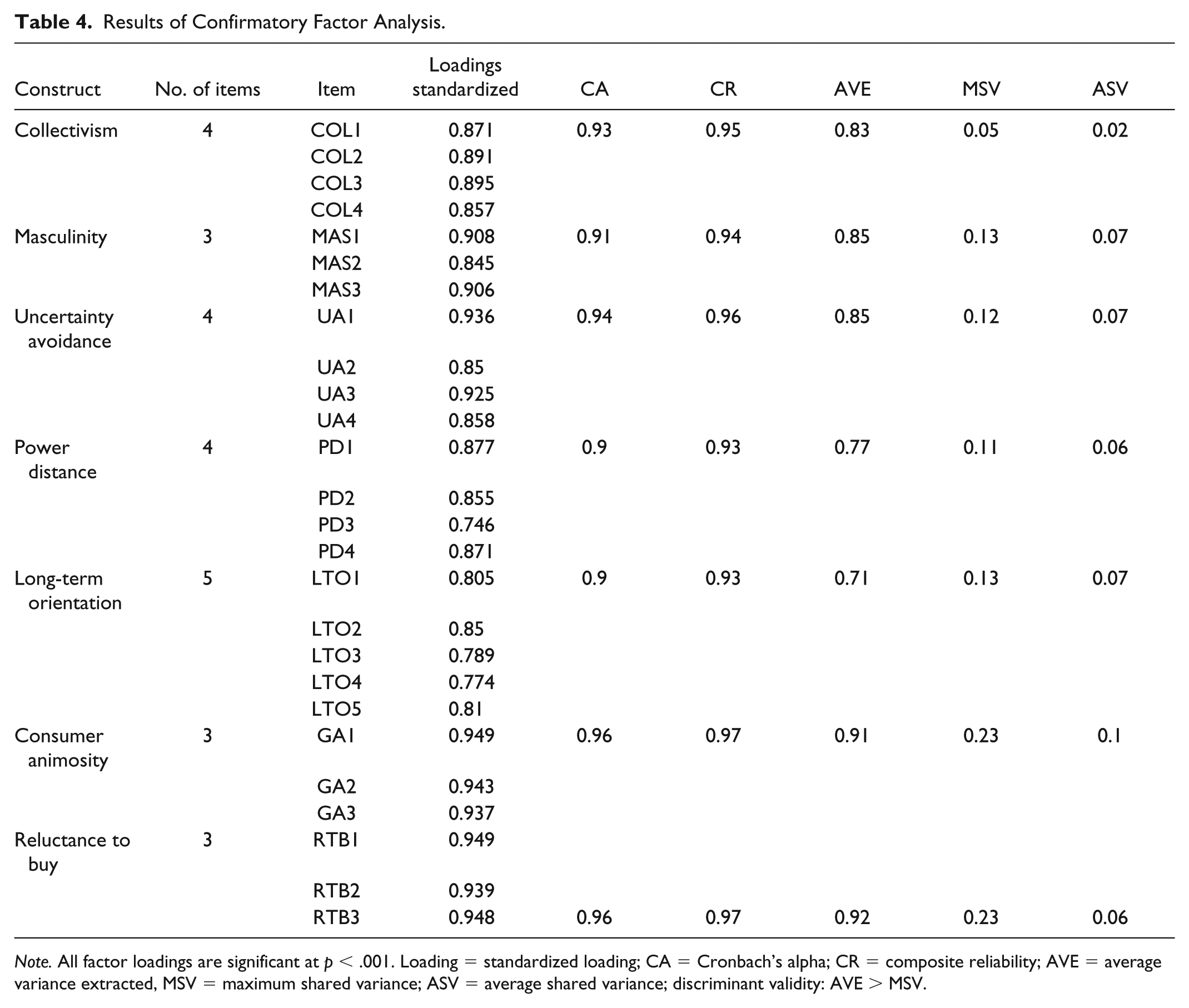
Note. All factor loadings are significant at p < .001. Loading = standardized loading; CA = Cronbach’s alpha; CR = composite reliability; AVE = average variance extracted, MSV = maximum shared variance; ASV = average shared variance; discriminant validity: AVE > MSV.
Furthermore, all values for the AVE were less than the maximum shared variance. This indicates that the measurement model had a suitable convergent validity. Furthermore, Table 3 shows that the square roots of the AVEs for all variables were greater than the correlations among constructs, which validated the discriminant validity of the research model. These findings suggested a good discriminant validity for the data set. Thus, the measurement model possessed acceptable convergent and discriminant validity and reliability.
Confirmatory factor analysis was conducted by the software AMOS (24). The measurement model included seven latent factors. The factor loadings for all items among the latent variables were above 0.7, 0.74 to 0.94, and they were reliable (p < .001). Table 3 displays the results of the factor loadings. All the loadings were greater than the threshold level of 0.4. (J. F. Hair, Black, Babin, Anderson, & Tatham, 2010). All other item loadings were in the range 0.74 to 0.94. Table 3 indicates that all items were loaded on their constructs.
The fit of the full measurement model was analyzed to validate the relationship among all variables and goodness-of-fit measures, as suggested by Hair, Black, Babin, Anderson, and Tatham (1998;
Structural Model
Structural equation modeling was carried out to examine the effects of individual cultural values on consumer animosity toward the United States and the effects of Chinese consumer animosity on RTB U.S. products. The structural model was analyzed by AMOS software. The results of structural model are shown in Figure 2. The results are within the accepted values, and the overall fit indices for the structural model are acceptable, χ2/df = 1.624, RMSEA = 0.045, NFI = 0.937, CFI = 0.975, incremental fit index (IFI) = 0.975, and Tucker–Lewis index (TLI) = 0.971. Thus, this model had a satisfactory fit to the data. We proceeded to calculate the coefficient paths. Our findings indicated that collectivism, masculinity, uncertainty avoidance, and power distance all had significant effects on consumer animosity (β = 0.153, p < .01; β = .192, p < .01; β = .211, p < .001, and β = −0.214, p < .001, respectively), so H1, H2, H3, and H4 were supported. However, long-term orientation shows a nonsignificant relationship with consumer animosity (β = −0.008, p > .05), so H5 was not supported. Last, consumer animosity exhibited a positive relationship with RTB U.S. products (β = .498, p < .001), so H6 was supported. The results of all the analyses are given in Table 5.

Results of structural model.
Results of Structural Equation Modeling.

Note. Goodness-of-fit statistics: chi-square/df = 1.624 at p < .01, RMSEA = 0.045, CFI = 0.975, IFI = 0.975, TLI = 0.971. RMSEA = root mean square error approximation; CFI = comparative fit index; IFI = incremental fit index; TLI = Tucker–Lewis index.
Discussions
Key Findings
This study investigated the effects of individual cultural values on consumer animosity and the relationship between consumer animosity and RTB U.S. products among Chinese consumers. Empirical work has already established some antecedents of consumer animosity (Bahaee & Pisani, 2009; Barrera et al., 2001; Huang et al., 2010; Klein & Ettensoe, 1999; Shoham et al., 2006). This study examined individual cultural values as antecedents to consumer animosity and the impact of consumer animosity among Chinese consumers toward the products of the United States. In addition to consumer collectivism, our results suggest that values of masculinity, uncertainty avoidance, and power distance in an individual consumer predicts that individual’s consumer animosity in the context of the 2018 trade war between China and the United States. This study fills a gap in the literature in its illustration of the role of individual cultural values as antecedents to consumer animosity. This study brought practical insights into consumer animosity literature, in relation to individual cultural values as antecedents. Collectivism, masculinity, uncertainty avoidance, and power distance had a significant relationship with consumer animosity, in accordance with our arguments. Chinese consumers who reported values of collectivist, masculine, and uncertainty avoidance expressed a high degree of animosity toward the United States. Likewise, those with high values of power distance harbored a low degree of animosity toward the United States.
Theoretical Implications
Theoretically, the results of this study contribute to the consumer animosity literature in numerous ways. First, this was the first study to investigate the relationships among all five Hofstede cultural dimensions at the individual level to consumer animosity. Consistent with previous research, we found that individual cultural values can predict consumer behavior (Yoo & Donthu, 2005; Yoo & Shin, 2017).
Second, while past studies have emphasized sociodemographic (Bahaee & Pisani, 2009), sociophycological (Shoham et al., 2006), and economic (Barrera et al., 2001; Huang et al., 2010; Klein & Ettensoe, 1999) antecedents of consumer animosity, this study contributes to cultural antecedents.
Third, the results of this article extended the use of VAB theory (Homer & Kahle, 1988; Kahle, 1983) in the consumer animosity literature by investigating the role of individual cultural values on consumer animosity and consider the impact of consumer animosity on RTB U.S. products among Chinese consumers.
Fourth, in addition to consumer collectivism/individualism (Han, 2017), our findings provide evidence that consumers’ values of masculinity, uncertainty avoidance, and power distance predict consumer animosity in the context of a trade war between China and the United States.
Fifth, the relationship between long-term orientation and consumer animosity was found to be nonsignificant. A possible justification for this unexpected result may be found in the specific characteristics of our participants, who were generally young, male, educated Chinese consumers. As shown in Table 1, almost 64% of respondents were males, 65% of respondents were of 21 to 30 year, and 60% of respondents had a master’s degree. This type of Chinese consumer may be less motivated by values of either short-term or long-term orientation.
Finally, consistent with previous research on consumer animosity and RTB products from the country that is the object of the animosity (Abraham & Reitman, 2018; Fernández-Ferrín et al., 2015; Peng Cui et al., 2012; Podoshen, 2009; Rose et al., 2009; Wang et al., 2013), the relationship between consumer animosity and RTB U.S. products appeared to be significant. The consumer animosity of Chinese consumers toward the United States increased the RTB U.S. products.
Practical Implications
This study suggested that international marketers must consider the role of consumer animosity in the RTB products from an offending country, not only in reference to consumers with collectivistic or individualistic values (Han, 2017) but also regarding consumers with values of the masculine, uncertainty avoidance, and power distance orientations.
In addition, firms should not target consumers who hold animosity toward the sourcing country of the product. They should not concentrate their marketing and promotion campaigns on consumers with values of high collectivism, high masculine, high uncertainty avoidance, and low power-distance orientations rather than the reverse. Long-term orientation consumers do not appear to have a significant relationship with consumer animosity.
Furthermore, “globalness” of buyers is recognized; this article confirms past findings on differing consumer behavior and it proposes that when consumer segmentation is performed, consideration should be taken for the differences among consumers in the international context (Conner et al., 2017). Marketing should therefore vary according to the particular differences in cultural values among consumers in the country where sales are hoped to be made.
Limitations and Directions for Future Research
Some limitations that the study suffers under should be discussed, as well as indications for possible directions of future research.
First, the findings of this research are generalized from a sample of participants who were largely young, educated Chinese, so the findings should be generalized to young and educated consumers, not to the entire population of Chinese consumers. This suggests that future study could more diversified occupational contexts, beyond student populations.
Second, this study only examined five Hofstede cultural dimensions (Hofstede, 2001) measured at individual level, so adding other dimensions (for instance, GLOBE study’s dimension) measured at individual level would be a valuable service that future research could contribute.
Third, this study was limited to only one kind of consumer animosity. Future work might explore the effects of individual cultural values on other kinds of animosity (Riefler & Diamantopoulos, 2007).
Fourth, in this study, we investigated the effects of consumer animosity on RTB in a very general product category, namely, U.S. products. Conducting nearly the same study with specific product categories such as U.S. fast foods or U.S. apparel would be valuable. Future research should consider examining the generalizability of our findings by performing the same research on other countries and non-East Asian countries in particular.
Fifth, our respondents were Chinese consumers. A complementary future examination of U.S. respondents to test their animosity toward Chinese products in this trade war would be interesting. A comparative study between consumers in both countries could help contextualize the data and deepen our understanding.
Finally, the timeframe of this research study was a limitation. Prior studies have indicated that consumer animosity can be situational (Jung et al., 2002). The recent political discord over tariff policies might have provoked animosity among Chinese consumers.
Footnotes
Acknowledgements
The first author (K.L.) is grateful to University of Science and Technology of China (USTC) authorities for the scholarship award and financial support during Ph.D. research studies at the University of Science and Technology of China, China.
Declaration of Conflicting Interests
The author(s) declared no potential conflicts of interest with respect to the research, authorship, and/or publication of this article.
Funding
The author(s) received no financial support for the research, authorship, and/or publication of this article.
