




Abstract
This study explores the work perspective of two individuals who self-identify as religious and are employed in non-religious work responsibilities. Drawing on the perceptions and experiences of a Muslim and a Christian, this narrative study examines how religion affects intentions, perceptions, and work behavior. The procedure for implementing small-scale personalized narrative research consists of studying individuals through the collection of their lived stories. Using two interviews with a series of open-ended questions, two male participants disclose how their religion intersects with their working lives. With a focus on diversity and inclusion in the workplace, this study distinguishes religion as an important workplace issue. The narratives demonstrate how two people of faith negotiate their beliefs alongside their work life. With an expectation that employers understand and accommodate the religious identities and beliefs of their employees and perhaps even profit from those beliefs, the implications of this study are important for perceiving how religion and work can integrate productively.
Introduction: Religion and Work
This study explores the work perspectives of two individuals who self-identify as religious and are employed in non-religious work responsibilities. Both participants live and work in two different but similar commonwealth nations.
As commonwealth nations, Canada and Australia have much in common, as well as some notable differences. Although there is a vast physical distance that separates the two nations with unique psychological temperaments between the two, both countries share particular characteristics. Both have a comparable geography with related patterns of demographic and economic development. Both are equally stable and prosperous Commonwealth countries with open markets with a high level of personal freedom, composed of a strong civil society (McLean, 2013). Canada and Australia are Western democratic states with a prominent middle power foreign policy tradition and limited industrial capacity (Blaxland, 2013). The two countries share a related philosophy of life, work, culture, religious diversity, and liberal values.
In Canada and Australia, religion is a fundamental core characteristic of many peoples’ identity—providing a guide for behavior at home, in society, and in the workplace. Comparable with numerous Western societies, Canada and Australia have experienced an upsurge of religious identities and behaviors lived out within society and the workplace. This increase has transpired primarily through the migration and settlement of religious identities (see Kaufmann, 2010).
With these realities in mind, the main purpose of this study was to investigate how religion influences the work intentions and behaviors of two religious people of two significant faiths, Christianity and Islam. Such an investigation is timely because employers, managers, and companies are required to negotiate the ways that different religions, such as Christians and Muslims, are permitted to draw on their religion to guide and inform their work lives and practices.
The importance that work has on our lives is obvious. When meeting someone for the first time we inevitably ask, “What do you do?” If employed, one will likely discuss their work. However, ask a religious person, “Who are you?” and the answer will often comprise their religion and how it provides purpose and meaning in life and affects everything they do (see Tanenbaum, 2013, p. 3).
Therefore, it is of no surprise to propose that religion shapes opportunities at work and provides motivation for people to earn a living (Donkin, 2010). This is set to intensify as many Western societies depend on immigration to increase their citizenry and workforce (Pew Research Center, 2015). The higher fertility rates of religious immigrants and the greater volume of their religious youth are projected to increase in the West (Kaufman, 2010). This is significant because immigration typically increases ones’ religious commitment, for as Granberg-Michaelson (2015) confirms, “the process of migration typically increases the intensity of religious faith—whatever its form—of those persons crossing borders of nations and cultures. The process of global migration is fueling fresh spiritual vitality in both North America and Europe.” Furthermore, most religiously devoted people expect to live out their fundamental beliefs in all aspects of their lives (Connor, 2009a, 2009b; Kaufmann, 2010; Massey & Higgins, 2010). Consequently, the expectation that religion will become an ever-increasing work issue in Western culture is reasonable and foreseeable.
Although there is already a wide body of research with respect to religion and society, the question of how religion directly or indirectly influences work perceptions and behavior has not been a topic of focused research. While workplace culture is a well-studied topic of investigation (Morgan, 2006), “religious issues seem to fall outside the concept of culture and are consequently less explored” (Askeland & Døhlie, 2015, p. 262). This is regrettable because religious identities are increasing in the West and this is occuring even in secular European nations, and with the solidification of the “religious right” in the United States, there has been a “reassertion of religious national identity which has added to a sense that religion in general has emerged as a political force. . . around the world” (Kaufmann, 2010; van Arragon, 2015, p. 1). In Canada, the number of citizens who belong to a religious tradition is also increasing at a steady rate and this includes the religions of Islam, Hinduism, Sikhism, Buddhism, Judaism, while two thirds of Canadians identify as Catholic or Protestant (Pew Research Center, Religion and Public Life, 2015).
These cultural realities are important because according to research by Alanezi and Sherkat (2008), religious beliefs govern how people perceive and practice their work, and with the graying of the workforce, that is, those in the middle and later stages of life, the blending of religion and work behavior is progressively intertwined (Bennet, cited in Canas & Sondak, 2008).
As Western culture undergoes a “religious awakening” due largely to the migration of religious identities (see Anderson, 2016; Kaufman, 2010), new and important conversations have begun to emerge in respect to how religion and work could or should cooperate. Such conversations are timely because the focus has frequently been about race, gender, disability, and sexual orientation, which, although important and necessary, have often been at the detriment of understanding how religious doctrines, commands, and practices influence the behavior of people in the workplace (see Tanenbaum, 2013). Substantive work conducted by the Tanenbaum Survey and Sikkink (2000, p. 18, 2018, p. 8) longitudinal research predicts a “continuing presence of religiously informed behaviour in the workplace, where religious graduates are more ‘likely to seek a job that fulfills a religious calling.’”
A “secularization” of culture—perceived or actual—is understood by some individuals as a threat to the freedom of religious identities and perspectives in the public marketplace and this has fueled an offensive attitude by those who suggest that religious beliefs should not be included in all domains of public life, including the secular workplace. Threats to eliminate religion in the public space has increased religious zeal and renewed the convictions of the religious (see Kaufmann, 2010). In other words, modernity has not led to a walling of faith in the workplace; rather renewed efforts have arisen from people of faith to take a decisive stand in the secular workplace, and this has been particularly evident when moral or ethical issues have been at stake (Dik, Eldridge, Steger, & Duffy, 2012; Sikkink, 2000).
Comparable with Western culture, the workplace today consists of many types of people and is particularly diverse in terms of its religious identities (Mor Barak, 2005). Consequently, religion is a significant feature of the workplace simply because religion itself is a living modern day phenomenon (Hicks, 2003; Kaufmann, 2010). As such, religion is less of a private matter isolated from the workplace and better understood as a public issue, one that will ultimately affect everyone (Askeland & Døhlie, 2015).
Assuming that the workplace is not a formal religious 1 institution such as a church, mosque, Synagogue, or any other religious establishment, religion in the workplace is both flourishing and constrained. 2 It is flourishing mainly through the higher birthrates of religious identites (see Kaufmann, 2010) and constrained because of its perceived irrelevancy in secular Western society (see Widdowson, 2010). Consequently, discussions, both for and against, remain attentive to the value of including religion in the secular workplace. One argument is that religion and the modern secular workplace should have no association, while others contend that religion has a natural and important inclusion in the workplace simply due to the West’s commitment to cultural diversity and pluralism, together with the importance the West has placed on the concept of hospitality and inclusion (Henderson, 2001) which has been supported through anti-discrimination laws. Therefore, the reality that religion is a public issue and influences the workplace in a variety of ways today should be significant to everybody, as ultimately it will affect everyone. 3 For these reasons and more, it is justifiable to suggest that an investigation into the association that religion has on work practice is a timely and worthy modern workplace issue.
Religion Influences Work
What is work? Reskin (2000) suggests that work can be “the exertion of effort toward some end, activities oriented toward producing goods and services for one’s own use or for pay, or unpaid productive work, such as that done in the home and volunteer work” (p. 3261). Whereas religion is similar to a “reality interpreter” which defines us, even separates us, “revealing who we are and who we are not. . .so that we can have relationships of meaning and substance” (Westerhoff, p. 55). However, a particular religious worldview is not always the same for all believers and it does not have to account for everything one chooses to do in life, including one’s work.
However, for many people, religion is an important guide for judging right and wrong behavior in the workplace. In the midst of notorious work scandals, 4 which continue to shake the confidence of employees and raise concerns about the ethical underpinnings of the business world at large, religious people often find sanctuary in their faith at work. This is not to say that non-religious people cannot be ethical in the workplace without religion; however, sometimes the culture of certain types of work might encourage employees to lie or cheat to make a profit. In response, a religious worldview can inspire in people a behavior that adopts a different behavior, ethic, and overall outcome.
Interest in spirituality and religion in the workplace is a relatively new area of inquiry (Benefiel, Fry, & Geigle, 2014); however, religion as a workplace issue is beginning to appeal to the research interests of numerous academics (Healy & Link, 2012; Hugman, 2010). One outcome has been a mindfulness among researchers that religious people do have their own ideas about work. Religion makes epistemological and metaphysical claims that spill over into the workplace. Religion regulates a sense of duty, honor, loyalty, and sentiment in life including how one should behave while at work.
Religion is one aspect of “social capital” that may influence earnings, and religious affiliation is important when members of the group have shared values, “such that they place greater emphasis on education, the virtue of work, or honesty and other personal characteristics that are rewarded in the labour market” (Grant & Rosenstock, 2011). Consequently, religion or the supernatural is a “powerful source and shaper of values and, consequently, a motivator and obligatory for calculating social action even at cost to self” (Anderson, 2016, p. 389).
Sociological research by Sikkink (2000) found that conservative evangelicals are more likely to perceive work as unethical when money, profits, or power is placed ahead of people and family needs. Similar results by Roels (1997) showed that conservative evangelicals take a grand metanarrative approach to their work life, with an overarching religious story that gives context, meaning, and purpose to their lives. Consequently, they tend to express their faith in an overt way at work (see also Sikkink, 2000). This contrasts with mainline Protestants who apparently tend to stay quiet about their faith at work (Hart, 1992; Sikkink, 2000).
On occasion, the ethical principles held by the religious are misaligned with the values adopted by the workplace or employer. For example, workers have cited religious reasons for declining to fill out prescriptions for morning-after pills, refusing to work on videogame software that is perceived too violent, while flight attendants have declined to serve alcohol to passengers, all in compliance with religious convictions (see Puglisi, 2016). Workers often request religious accommodations at work such as setting time aside to pray, meditating, or engaging in religious observances or requesting special provisions for religious dietary needs, allowing religious decorations in an individual’s workspace, and being absent from work during certain religious holidays. These types of work requests continue to endure (Hastings, 2008) and a lack of religious accommodation may be perceived as insensitive at best and discriminatory at worst.
Although “religious” and “secular” are often unhelpful categories as there is considerable diversity within each notion, they do provide some useful classification. The modern workplace, it appears, has begun to reimagine itself as a place that can provide its workers with reasonable religions accommodations in a thoughtful and sensitive way. Of course, religious employees still have a duty to fulfill the specific obligations inherent to their work post, and managers can appreciate that the main purpose of work is not freedom of religious expression. However, having the freedom to express one’s religion at work is an important human right and it would appear that the workplace could become a hospitable place for the expression and inclusion of one’s religion (Pearson, 2014). Consequently, there is anticipation that employers will accommodate the religion of their employers (Cañamares, 2015).
However, it is also unclear how and to what degree one’s religion can be exercised in the workplace. A recent study of almost 600 working adults in a variety of industries, such as education and finance-related jobs, revealed that simply experiencing the freedom to discuss openly one’s religion in the workplace did facilitate solutions to many work-related problems (see Lyons, Wessel, Ghumman, Ryan, & Kim 2014). The freedom to include one’s religious viewpoint in conversations at work resulted in happier employees and a higher score for job satisfaction compared with those employees who did not experience such freedoms. Those who experienced a safe environment to disclose their faith at work showed greater job happiness and perceived well-being (Lyons et al., 2014).
Although religious behavior and viewpoints can result in conflict at work, religion can also inspire positive virtues to emerge in the workplace. For example, religion can positively influence a worker’s loyalty, morale, and communication (Askeland & Døhlie, 2015). Nevertheless, during the last 12 years, religious discrimination complaints in the workplace have increased by over 69% (see Borstorff, Cunningham, & Clark, 2012; Pledger, 2011; Schaeffer & Mattis, 2012). Grievances run the gamut from “proselytizing” to “failing to accommodate religious beliefs” in the workplace (Canas & Sondak, 2008, p. 143). With increasing requests for religious accommodation, the Equal Employment Opportunity Commission (EEOC) experienced a rise of over 3,721 religious discrimination grievances in 2013 5 —an increase from 1,709 grievances way back in 1997 (Wright, 2014).
The 2013 Tanenbaum Survey of American Workers and Religion revealed that 50% of workers held the view that Muslims experienced discrimination at work, while 50% of non-Christians believed that employers ignored their religious beliefs. In addition, 48% of White evangelical Christians reported religious discrimination and nearly six in 10 atheists agreed that people look down on their beliefs (see Tanenbaum, 2013).
Young religious immigrants to Western cultures report a persistent lack of interest and resistance from employers towards their spiritual beliefs and religious observances. For example, in early 2001, about thirty Muslims, recent immigrants from Somalia, “resigned from their jobs at a chicken processing plant near Atlanta because their employer would not allow them five-minute breaks for prayer” (Hicks, 2003, p.82. The Tanenbaum survey also showed that many work places are slow to include religious freedom and expression in their diversity and inclusion initiatives (Tanenbaum, 2013). With greater religious diversity in the workplace, it is only a matter of time before employers are legally required to integrate the religion of their employees with their work obligations (Chang, 2016). Although one could uncover other examples of work and religion in tension, many workplaces have also embraced religion as a business strategy by publicly declaring their allegiance for religious accommodation (Canas & Sondak, 2008).
Religion and Work Calling
Religious people sometimes refer to work as a “calling.” Although the term “calling” is often associated with a vocation, the idea of a vocation is different to a “calling” as it is minus a “perceived summons from an external source” (Dik et al., 2012, p. 244). A “calling” denotes destiny and sacredness, and for many religious people, work provides a place to exercise their God-given talents and gifts. Martin (2017) notes that a “calling” to work can be understood as simply a desire to bring joy, peace, and patience to the workplace rather than engage in protests or actions against a perceived injustice. Dik et al.’s (2012) research established that the more the religious, which in the study referred to as weekly church attendance, the likelihood that the person would experience their work as a “calling” incresed. Although protests and resistance to injustice in the workplace might indeed be an important feature of work “calling” for the religious, the association of “calling” and religion is obvious, as noted by the sociologist Max Weber in the early 20th century. This association concerned Weber (1904/1930) who suggested that the concept of “calling” “prowls about in our lives like the ghost of dead religious beliefs” (p. 182).
Two Religious Narratives of Work
This section addresses two religious narratives of faith and work. Comparable with Christianity, Islam is a complete way of life and gives broad and specific guidance for behavior. In Islam, work must represent the religion it advocates (Kamri, Ramlan, & Ibrahim, 2014) and an Islamic work ethic teaches the social aspect of the workplace, which includes emphasizing values such as preserving human respectability, prioritizing work commitment, and diligence (Fatima, 2011). Idleness or squandering of time in pursuit of unproductive work is the manifestation of lack of faith and belief. Moreover, Islam views commercial activity as not only divine but also a necessary pragmatic aspect of human life, a source of social gratification and psychological pleasure (Aldulaimi, 2016; Azharsyah & Azzah, 2017).
One way that a person seeks God’s ways is through their business affairs. If it is evident that their work behavior is with integrity and honesty, their actions are highly praised. Ali (2001) notes that work is considered a “virtue in light of man’s needs, individually and socially” (p. 576). Moreover, work provides independence and self-respect and requires one to engage in ethical work and commitment (Ali, 2001). Work is a right, a duty, and an obligation, and has practical benefits such as increased sustenance for the individual and a healthier prosperous society (Aldulaimi, 2016). The earnings gained from paid work is through lawful and ethical means and is an achievement of man’s ultimate objective but not an end in itself. No worker should wrong any individual and the exploitation of employees in the name of competition is not permissible (Ali, 2001).
There is an expectation of a just wage as being the right of an employee and one is obligated to provide the employer with their best in the workplace, which also pertains to organizational conduct and interactions (Aldulaimi, 2016) such as conflict resolution and management, organizational cohesion, cooperation, and loyalty.
For devoted Christians, 6 there are two main options of thought concerning work. One is that work is a curse. This view has its origins in the Greek world, where manual work was considered a curse. Aristotle (1925) said that to be unemployed was a good fortune because it allowed a person to participate in the life of contemplation. Over time, the Church began to be heavily influenced by Greek thought in their theology and the view of work as a curse. The other perspectiveis that work is good because God is a worker and the Christian bears God’s image. However, the whole of humanity is morally infected; therefore, the process of work is distorted, and fragmented. This idea is grounded in the Genesis story in the Bible where Adam and Eve are depicted as workers in the Garden of Eden but then disobey God, and as a result, God curses their work by producing “thorns and thistles.” Therefore, although work itself is good, it is the process of work which is damaged, cursed and distorted.
A Christian worldview gives emphasis to the social issues of the workplace, stressing the importance of restoring the process of work. Restoration could involve bringing peace, joy, truth, human respectability, commitment, justice, and diligence to the workplace (Martin, 2017). This would include all types of work—assuming the work is ethical, because work brings glory to God. Therefore, for the Christian believer, work has intrinsic value with a prevailing meta-story. Work is never just a means to an end (Brimlow, 2002); however, because the process of work now experiences decay and corruption, this must not be overlooked, but rather addressed and ultimately restored.
Methodology: Narrative Inquiry
This study utilized narrative inquiry to uncover the stories of two working people of faith. Narrative researchers position individual stories within “participants’ personal experiences (their jobs, their homes), their culture (racial or ethnic), and their historical contexts (time and place)” (Creswell, 2007, p. 56). Narrative is used within the context of a mode of inquiry in qualitative research (Chase, 2005), with a specific focus on the stories offered by individuals (Polkinghorne, 1995). Narratives offer increased comprehension, interest, and engagement. Nonexperts get most of their information about religion from the media, which can often turn out to be an imprecise and uninformed source.
The two main questions that guided this study were “What do you do” and “Who are you?” Four essential features were necessary for verification as a religious identity. 7 The person must possess a committed belief in a deity. They must be a frequent attendant at their place of worship. They must have the belief that a relation to a deity is a core part of their basic sense of worth. Finally, they must reflect daily on their relationship with the deity. The two participants who volunteered for this study fulfilled these four criteria. In addition, a work criterion for participation in the study consisted of fulfilling a conventional definition of work as “activities that are paid are work” (Eichler & Matthews, 2004, p. 5). The two participants satisfied this criterion.
The process for implementing narrative research entails “focusing on one or two individuals, gathering data through the collection of their lived experiences, reporting these experiences, and ordering the meaning of those experiences” (Creswell, 2007, p. 54). In terms of religion and work, Chase (2005) recommends that researchers use typical reasons for a narrative study, such as how individuals are enabled and constrained by social resources. This narrative study evokes a specific contextual focus involving religious people sharing their faith perspectives in relation to their work. The narratives are guided through testimonies (Beverly, 2004), and this type of lived experience research is to question what something is really like for the individual (van Manen, 1990).
The researcher prepared an email requesting participation in the research project and this was sent to a variety of work places. Two volunteers from two different places of work identified themselves as religious and expressed a desire to take part in the study. The interviews addressed the lived experience of work and the impact of their religion, as they perceived it. Two interviews were conducted with each participant on different occasions in a distinct non-academic setting and separate from the workplace of each participant. The interviews were each approximately 1 hr 30 min in duration.
The interviews were audio recorded and later transcribed by the researcher for analysis with thematic statements isolated as aspects of the phenomenon it described. With the data acquired, the researcher applied what van Manen (1997) describes as the “selective” or “highlighting approach.” This approach requires the researcher to listen and judiciously read a text or recording several times. During the listening or reading phase, the researcher asks what statements or phrases in the data seem particularly essential or revealing about the phenomenon or experience being described (van Manen, 1997). The researcher then circles, underlines, and highlights the statements and phrases. This method describes how the analysis of this research was conducted.
The Participant Profiles
Participant 1
Heywood; religion: Protestant Christian; work: school teacher, metal worker, administrator (data entry)
Heywood (BEd) is a 59-year-old male who currently lives and works as a government employee for an engineering management unit in Maitland, NSW, Australia. He holds an official job description of Configuration Document Control Administrator. Heywood is married with three children.
Before 2009, Heywood worked as a metalworker, then a schoolteacher, clerk, a drawings office manager for a jury office, and finally an administrative position working in data entry. Heywood notes that the Drawings Office Manager job was eventually outsourced to a private contractor. From 2009, Heywood comprised data entry for a large and growing distribution center. He is a current elder in a local Christian church and self-identifies as a practicing protestant Christian of the Baptist tradition.
Participant 2
Jamil; religion: Islam; work: non-violence counselor
Jamil is a 44-year-old practicing traditional Sunnite (orthodox) Muslim who understands his religion as a core fundamental feature of life. Based in Richmond, BC, Canada, Jamil’s (BA) work is that of a family counselor and mediator. He is married with two children and his expertise includes collaborative communication, non-violent approaches to conflict, and interests-based family mediation. As a certified Family Relations Mediator with “Family Mediation Canada,” Jamil helps individuals and families to “move beyond positional arguments and conflicts to unveil common goals and aspirations for both the family unit and each individual within that unit.”
Jamil brings an approach to anger management that is, according to him, “culturally informed and a necessity for today’s increasingly diverse Metro-Vancouver.” In counseling men, Jamil’s approach has been to facilitate a process for his clients to gain self-knowledge, thereby “addressing anger and aggression at its root while avoiding superficial changes in behavior,” which, he notes, “tends to be short-lived.”
Results: Insights and Reflections
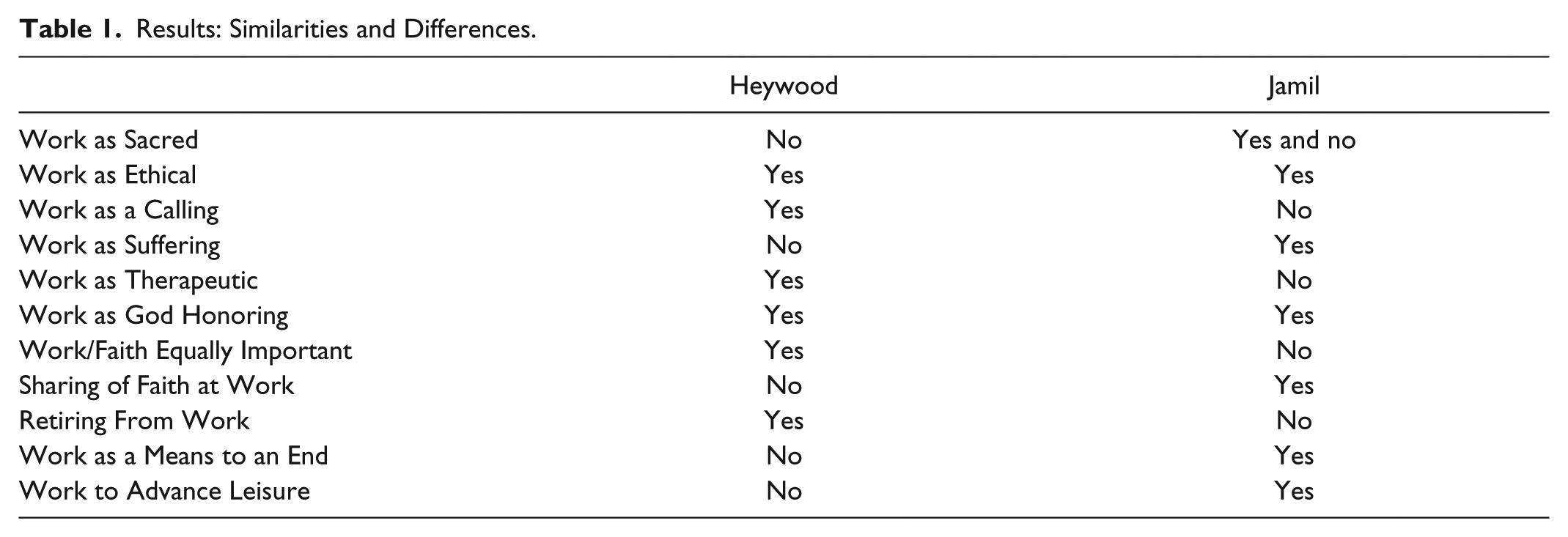
Narrative inquiry was chosen as the most advantageous methodology to direct this type of personal and lived experience research because it can create a construction of the self as an active agent, which I believed was essential for a narrative investigation into how religion affects an individual’s perceptions and meanings of work life. The results highlight the personal meanings of a work life, and how one’s work relates (or not) to one’s religion. Narrative inquiry can open a metaphorical window into multiple identities and, in this study, one’s work identity and religious identity (Riessman, 2008). Table 1 summarizes the key themes derived from the participant’s identity and understandings about the relationship between their work and religion.
Results: Similarities and Differences.
Jamil: Work and Religion
Jamil believes that work itself is not a religious or holy activity. He explains, “Work is never seen as holy or an act of worship in and of itself.” As a practicing Muslim, Jamil suggests that it the process, intentions, or how one does their work which is far more important because how one does their work can advance an ethical work environment, which is important for Jamil. For example, he describes “a principled work commitment,” which harvests from a “sacred obligation to carry out personal ethics such as honesty and truthfulness.” Religious Islamic teachings entail ethical work behavior and at all times. Jamil notes that men in particular have a responsibility to their families to work but not any type of work is acceptable, rather “it must always be ethical.” He argues, “I would never accept working for an immoral or unethical workplace such as gambling, because unethical work is prohibited in Islam.”
In regard to work and the notion of work as cursed as described in the story of Adam and Eve in the Bible, this story is also important in Islam. Jamil maintains the story is repeatedly “brought up in the Qur’an, not only to inform mankind of their origin but also to exhort them to work hard in this world in desiring the next final world.” Contrasting with a Christian understanding where God works, God is holy, and therefore, as image bearers, one can engage in Holy work similar to God. Jamil explains how this is different for the Muslim. God forgives Adam and Eve, but they are also exiled from the Garden for a time where they are sent to earth to work, and this is where toil and trouble accompany them. Therefore, work is never holy but rather they are expected to work with good intention and integrity. For the Muslim, the work itself takes lesser importance than how they do their work. Jamil explains further, It is rather the way in which one works that can be seen as praiseworthy or blameworthy. For example, working with integrity, honesty and diligence is praiseworthy while cheating, lying and doing work haphazardly would be considered blameworthy, perhaps even sinful.
Religious faith offers Jamil a “deep sense of meaning,” and consequently, he is committed to preserving a transparency and openness for sharing his faith with others at work. This is because, as he suggests, “my faith is alive in me, and whoever cares to listen to me, I will share it with them.” He considers the sharing of faith important because as a family counselor, the ultimate goal of work is to help others pursue and discover an “ultimate meaning in life.” As a counselor, Jamil’s efforts entail working closely alongside people, and he reveals that many people “do not know what it means to have ultimate meaning in life.” As a therapist and Muslim, he recognizes that without ultimate purpose and meaning in life, “the logical conclusion is to drown oneself in alcohol and drugs.” Jamil’s faith directly influences the importance he has for “establishing a positive and straightforward client-patient relationship.” As he notes, “this is why I always try to seek out connection and compassion first, for myself and others at work—be it with clients or colleagues.” Jamil is adamant that “this does not entail being liberal with morals and principles” but it does mean “connection before correction.”
Jamil considers the lengthy and unpredictable work hours he must endure as a family counselor and the effect this can have on his family. Longer days at work also incurs absence as a father and husband, and this is problematic given his Islamic beliefs about the importance of nurturing the family. Although Jamil admits that at times longer work hours is necessary, as a Muslim he also understands that “I must try and work smart which does not necessarily mean longer.” He explains that the teachings about work in the Quran including how one should do their work are best summed up as “work smart and also with integrity.”
Jamil believes that work does not offer him meaning in life, but rather work provides him an opportunity to “live life ethically and work nobly as a person of deep faith.” He suggests that living an honorable life is like “living out a little piece of paradise on this earth.” Although work is not holy or sacred, it is really the intention behind work that is most important. Therefore, he declares, “My faith does not allow me to be a workaholic.” Consequently, as a faithful Muslim, Jamil highlights the importance of leisure time away from work and preserving this as a Muslim is paramount. As he says, “Leisure is paramount in Islam because leisure is where poetry is written, and quality time with children can occur.” If work reduces leisure or interferes with his creativity, Jamil suggests that he is no different to a “rat in a circle.” Therefore, there is a determination to find ways to increase leisure and family time without scarifying work commitments. As he maintains, “it would be a shameful and sinful decision for me to work a 12-15 hours a day and neglect my family.”
In regard to work values, Jamil is adamant that he would only pursue ethical work that compares favorably with his faith. He explains, “I would not work for a tobacco factory, a brewery or building software for casinos.” These are unethical work environments. Moreover, Jamil is prepared to take an active moral stand against unethical practices in the workplace. The moral stand would not be due to “personal dislike” as he notes, but rather a faith-based awareness and commitment to a belief that “faith places certain limitations upon me—there is no blessing in work when it is not honorable, so everything I do at work brings me closer to God or it does not.” Jamil understands that all work has its challenges; however, as he admits, “I do not have control over what happens to me but I do control how I respond to it—I must respond with dignity and never with rebellion.”
As a Muslim, Jamil believes any response to difficult workplace issues should be always carried out with “dignity, gratitude and patience,” for example, responding to difficult clients and colleagues with an understanding that “goes beyond the visual or current circumstances.” As Jamil clarifies, “I would not judge people as lazy because they have not been successful; I understand the limitations of life to be associated with larger historical process such as systemic injustice.” As a person of faith, Jamil questions the aspirations of “success” or “happiness” as a goal that any work should require of its employees, instead, Jamil understands that although work can be meaningful, it can involve personal suffering. He expounds, As a Muslim, work success is not even a concept in Islam, however, suffering is inherent in Islam and so this would mean that at work I am prepared to suffer which might occasionally consist of working longer hours on the job.
Jamil offers a direct example of how his faith tradition of reconciliation and his work as a family counselor overlap: A client came in and shared what a difficult marriage she was in and went into detail about how her husband was mistreating her. In the language of Nonviolent Communication, we would say that she was making an enemy image of her husband with her indictments and blame. I knew she had a significant role to play in her marital challenges but all I did was listen to her and when she was through, I reflected back what I understood from her. In doing so, I was able to remain true to my religious teachings of helping couples reconcile as I hold a moral/religious stance that reconciling is generally better than divorce. Since morals without wisdom borders insanity for me, I made the conscious effort to withhold my judgment of the woman as she was in a very difficult place, emotionally. Islam’s spiritual path (Sufism) teaches that having morals need not entail being moralistic and that the essence of wisdom is the process of interacting with the world in a way that is true to both compassion for one’s fellow children of Adam, as well as congruence for the moral/spiritual teachings found in the Islamic tradition.
Another illustration of how work and religion intersect is demonstrated by the interactions between Jamil and a work colleague: . . . a colleague of mine disclosed that she was still mourning the loss of her spouse to an overdose-related death many years ago. Our conversation went into the topic of meaning and she shared that she felt life and its happening had no meaning at all. I sensed that she was most certainly not an Abrahamic monotheist like myself so I abstained from preaching to her. However, I was able to interact with her and invite her to explore meaning in a way that she had never done prior to that day. I asked her to pause and reflect on the tragedies that befall all of us on God’s green earth and ask herself “might there still be meaning to all this even if, especially if, we are unable to discern the wisdom ourselves?” This shook her a little because it shattered her foundational belief that everything that happens in life can be rationally understood somehow by human beings if they just apply the appropriate worldly knowledge.
Jamil notes that this entire exchange aligns with the Qur’anic message found in numerous chapters where God speaks to humankind. As explanation Jamie quotes a verse, “Does man think he was created in vain? Verily to God is his return and God will hold him accountable for all his actions?” Consequently, for Jamil, simply working hard is no guarantee for acquiring a good and well-lived life full of meaning and purpose. As he declares, “In life there are no guarantees—rather there are hardships that are also blessings.” In fact, for Jamil, a deep appreciation of life would not be possible without some suffering. He submits that compassion and empathy are advanced when suffering transpires. Jamil explains, “Work may entail suffering and I would be prepared to suffer at work but respond well and learn from it.” His prime motivation to accept suffering at work with dignity stems from the fact that he has been given an example to live by, for example, “the prophets who also suffered.”
Consequently, Jamil is prepared to work hard and endure the consequences, although he maintains “I do not welcome suffering.” Due to his faith, Jamil believes “suffering is never in vain at work” because “all things, one day, will be accounted for and this is known by any person of faith.” Suffering in this life includes work; it is always for a higher purpose. This knowledge grants Jamil the clarity and endurance to tolerate any hardship. In the midst of suffering, he has hope because in the end, “justice will always be served.”
For Jamil, the Islamic work ethic is “an honest work ethic.” Consequently, there is no neutrality at work—“one either does good at work or they do bad.” He recites an Islamic saying taken from the Hadith 8 and expressed in the following way, “Teach me to do everything with excellence, honesty and vigor.” As a counselor and person of faith, Jamil is motivated to work ethically with endurance and resilience.
For Jamil, work is secular; however, he does acknowledge, “I can bring the sacred into it.” There could indeed be a holy side to work; nevertheless, “this will come about through my approach to work.” In this way, it may be possible for the workplace to undergo transformation from the secular to the sacred but only by way of doing ethical and honest work. Another transformation from the secular to the sacred occurs through the ritual of prayer. As Jamil states, “When I do my daily office prayers, my office does become sacred.”
Although the workplace itself is secular, as a person of deep faith, Jamil understands his identity at work is not secular but religious. He states, “I am a Muslim at all times, even at my work.” Moreover, he does not perceive the workplace as inhospitable to his faith; subsequently, he is prepared to share his faith at work, especially “when it could help someone experience their life as valuable and meaningful.” Jamil acknowledges sharing his faith at work, which “has caused some discomfort with my work colleagues”; nonetheless, he also suggests the discomfort has been the result of “unwarranted fear.” As he clarifies, “Some people are afraid that the building might be coming down (inferring terrorism), however, for most people at work, he suggests, ‘realize who I am and appreciate me being open about it.’”
With respect to retirement from official salaried work, Jamil suggests that in Islam, “there is no such concept because retirement is a secular notion.” As he stresses, “The point in Islam is that work is a means to an end. Work is a means to leisure, and the fruits of labor will go towards family.” In that sense, work gives Jamil “some spontaneity to my life.” Ultimately, the purpose of work is to advance leisure, pleasure, and creativity—three important teachings in Islam.
For Jamil, work encompasses “everything that is important to me.” His faith provides a grand narrative that prescribes his behavior at work as a counselor. As Jamil explains, “Work involves my prayer life, my life of faith and my family life—they are not isolated.” Although he ultimately works to provide for his family, his work ethic stems largely from a larger goal to “seek God’s bounty, while my traditions and the ancients teach me how to work well.”
Heywood: Work and Religion
As a full-time working person, Heywood understands his faith in dualistic terms—work is secular and religion is sacred—however, faith has priority while work does not. He explains, “My faith is more important than any work, because work is secular, and faith surpasses any occupation.” Nevertheless, Heywood restrains from sharing his faith while at work. Rather than being recognized as a “person of faith,” he believes that the pressure to assimilate and be known as “an efficient employee” is greater. Consequently, Heywood declares, “I am unlikely to disclose my religious identity at work.” He acknowledges that faith and work have their own domains.
In regard to work motivation, Heywood reflects back to his early years as a younger person. He recalls a school report in which the teacher described him as “unexceptional,” which for Heywood, “unexceptional was probably quite accurate because the teachers were well aware of my overachieving family and they used this as a standard for me.” He considers this report to be an unfair judgment on his character, but admits that such evaluations were a direct cause of “my low self-esteem and disheartenment.” He explains, “I had yet to become my own person and it only happened when faith entered my life during my late teenage years.”
It was after securing a job in the steel industry that Heywood began to consider how faith and work could integrate. As he explains, “My faith became so much stronger there and it was reinforced through this type of work.” In fact, it was while working in the steel industry, where Heywood encountered employees who “reminded me of my pre-faith days, similar to the way I had been before becoming a person of faith.” He perceived a lack of purpose and meaning in their lives, and this challenged him to look deeper into his faith. Heywood admits that faith in God helped to recover his low self-concept, because, as he submits, “it offered me a new way to think about myself.” According to Heywood, an identity crisis had transpired as he tried to navigate the stormy years of adolescence, unsuccessfully comparing himself with his hardworking and “larger than life parental figure of my overachieving father.” Since becoming a person of faith, Heywood’s focus at work turned to helping others similar to himself, which involved helping them find meaning and purpose in life. This was important because these people, he maintains, “were a bit like I was and the workplace offered me that opportunity to help others see themselves differently.”
In regard to being “called” to a particular type of work, Heywood maintains that God opened doors and guided the type of job he would ultimately choose. This motivated him to “see how I could make the workplace more Godly.” For Heywood, making the workplace more Godly occurred when “everything in the workplace was orderly and accounted for.” He believes that order and precision in the workplace is important because God is an orderly and logical God and the workplace should reflect God’s image. Heywood admits that this is not always easy to maintain. He explains, “I believe that God should be seen in the details of my work especially when faced with randomness and mess.” He admits that mess and disorder is common at work, and so, Heywood is active every day to maintain order at work. When he encounters chaos, Heywood’s first line of action is to “remedy the problem as God would because I have a higher source of strength to draw from, so I can keep my cool and begin restoring.” To do this effectively, Heywood is prepared to devote as many hours as needed even working outside of regular work periods. However, because the motivation to make the workplace reflect the nature of God is paramount, Heywood is always prepared to work outside regular hours, because as he submits, “I work with enthusiasm and order because the workplace should always reflect God’s orderly nature.” Consequently, he is often at work early on Saturday mornings organizing the workplace and “maintaining a functional office for the coming week.” Heywood’s commitment for generating order through chaos at work offers him spiritual peace, knowing that God’s orderly design is reflected in an organized workplace. Heywood admits this goal increases his motivation to work as a “good steward with God’s resources,” and this is especially important because he knows through experience that “work resources could be misused, and so I am careful to preserve that too.”
As a religious person, Heywood is sensitive to the problems created through unethical work practices and so he is unwilling to engage in any unethical negotiations at work. He explains, “I will not overlook unethical work conduct, even when my coworkers expect it from me.” Because his religious beliefs entail ethical work, Heywood is prepared to maintain a workplace that denies his work colleagues from pursuing any immoral behavior. He explains, I have said no to my coworkers on many occasions because I did not believe their requests were ethical. My aim is to bring order at work by keeping to the rules and this means sometimes denying people their requests.
Heywood’s goal is to uphold a pattern of work conduct that simply honors God. This requires him to remember God’s restoration in his personal life. As a schoolteacher, Heywood’s faith had been tested after suffering from a mental breakdown. He remembers this producing “an existential crisis to occur in my life.” The work he did as a schoolteacher presented him with especially difficult challenges, because as he declares, I believed God had called me to become a teacher; God had sanctioned this work. Having a mental breakdown cast doubts on my calling to be a teacher and I needed confirmation. I thought, maybe I had been mistaken about this calling. This experience really affected my relationship with God and overall my self-worth suffered greatly.
Eventually, it was through his faith that Heywood found hope once again for work. He recalls that his relationship with God improved after he recommitted himself to what he believed was a calling to become a schoolteacher. Work as a schoolteacher was God-intended, despite the suffering that would follow. Heywood explains, “it was one particular day while I was on playground duty, when I heard one of the students talk about me. This school student described me as cool and this changed everything for me.” This spontaneous and trivial remark from a student in the playground was a confirmation to Heywood that he had been divinely called to be a schoolteacher.
With a renewed sense of work calling to teach children and a deeper understanding of his identity as a person of faith, Heywood continues to value and respect his religious identity at work. His religion provides him with additional incentive to work efficiently and ethically. In addition, when his work leaders show themselves to be people of integrity and wisdom, his commitment to honor their decisions and guidance increases. As he confirms, When my leaders at work show themselves to be knowledgeable and wise, two important values I believe reflect my Christian faith; I make additional efforts to emulate their character and please them as leaders.
Discussion
This timely focus on work and religion has led to some significant insights in understanding how religion guides two individuals for living a good, productive, and honorable work life. Jamil and Heywood both have well-established religious beliefs that provide significance and meaning to their work. This is not unusual for the religiously devoted, 9 as religion guides a persons’ values, ethical convictions, character, and leadership expectations, and confirms their identity, influencing their work behavior and motivation (see Benefiel et al., 2014). Consequently, Jamil and Heywood are not satisfied keeping their religion separate from their work life, but, like many religious people, expect to include religious understandings and values into their places of work.
The two participants confirm how religion can influence work intentions and practice. This is significant because people of faith could be significant allies for helping managers and other employees to advance productive, ethical, and orderly work environments. At the very least, religious people in the workforce have an important role in helping to generate benevolent and virtuous organizations.
Both Jamil and Heywood live and work according to a grand narrative of God’s presence in their lives. As they engage in so-called “secular work,” both participants think about, make sense of, practice, and resolve work problems in conjunction with how they understand God and the teachings of their religion. They have a comprehensive perspective of life that influences how they perceive their work and this keeps them centered on what is most important.
The work experience of Jamil and Heywood offers important insights for the modern day workplace. Taken together, their religion influences how they work, that is, their work behavior, and their commitment to work. The two individuals present similar obligations to include religious understandings and values to direct, inform, and answer difficult questions, while benevolent guidance is offered to their colleagues concerning life issues.
Jamil and Heywood’s grand narrative perspective of God’s presence in their lives and work supports Sikkink’s (2000) research, which suggests religion informs people in substantial ways that often oversee their work behavior and expectations. Jamil and Heywood believe that to overlook the importance of religion at work is to call into question who they are as devoted religious people.
In the workplace, Jamil and Heywood expect virtuous behavior from themselves and from their colleagues. Although both experience the intersection of their faith and work in different ways, the concern they have with engaging in and upholding ethical work practice, they largely agree. They also agree that their work is secular, although for Jamil, work undergoes transformation to the sacred when prayer transpires and Heywood is certain that one can be called to a particular type of work, and in that sense, the work then becomes sacred. However, this does not mean that work will be easy or even enjoyable. Jamil anticipates grief to occur at work because his religion teaches him that life will always entail some suffering; however, his faith remains robust and his work commitments endure.
Moreover, as a practicing Muslim, Jamil acknowledges that suffering at work is an opportunity to understand higher truths in life that would otherwise have been absent. While suffering is also an expectation encoded within the Christian narrative, Heywood’s anguish may cause him to question if work is perceived by him as a calling. This is where the secular and sacred divide makes sense for Heywood. Suffering in the secular is tolerable as it is without God compared to suffering in the sacred, which is with God, something for which Heywood may find difficult to explain if he believes God has really called him to a particular type of work.
When work is not perceived as sacred or a calling, there is a tendency to experience faith and work in dualistic terms. Although this can change—as previously noted, Jamil spoke of how his office is transformed from the secular to the sacred during prayer time—a transformation from the secular to the sacred is suggestive of a postmodern perspective of faith and work. For example, Askeland and Døhlie (2015) suggest that accepting prayers to God is an activity typically influenced by postmodern thinking, because religion is considered an “important empowering resource at anytime and anywhere” (p. 267) and is not confined to a church, synagogue, or mosque. Moreover, a postmodern perspective of work and religion “identifies the workplace more broadly and does not think of religion in terms of being true or false, attractive or repulsive, but rather as an important contextual factor for understanding how we work and how we should work” (Askeland & Døhlie, 2015, p. 268). As such, a postmodern religious perspective identifies religion just like any other workplace issue.
Nevertheless, both participants typically agree that there is sacred and secular division of religion and work. Research by Sikkink (2000) further suggests that this is characteristic of people representing liberal mainline thought who are more willing to accept a secular and sacred separation. This is in contrast with conservative religious thought, where people tend to make no secular and sacred divide and are motivated to incorporate their faith at work to ultimately transform the workplace. Heywood could be described as a liberal mainline religious identity, because he works comfortably within a secular environment and is unlikely to reveal his religious distinctiveness at work, although his behavior at work may ultimately reveal his religious identity and beliefs.
Heywood and Jamil do not experience their work as holy or sacred, and religion does not directly govern the workplace or restrict the type of work they do (unless it is unethical or immoral work); however, religion does influence how they practice their work. Displaying virtuous work behavior is paramount for both religious identities. This compares favorably with Nadesan’s (1999) research who revealed that religious people in particular are frequently in conflict with the social, legal, and perceived unethical foundations of business, law, and public and nonprofit administration.
This study suggests that virtuous work behavior is important for two religious people who represent the Abrahamic faiths. Sharing their religion with other colleagues (Jamil) or changing the workplace to reflect their beliefs (Jamil and Heywood) is necessary for these two religious identities. Martin’s (2017) research suggests that ignoring the behavior of religious employees is to the detriment of employers because if ignored, then work assumes a subsidiary role to people with religious ideals and religion takes on a higher responsibility for maintaining order. This is because God is their ultimate authority, and not bosses, managers, or employers—an important detail because this awareness guides their human action, their intentions, and who they perceive as an authority (Graham, Haidt, & Nosek, 2009).
The findings of this research contribute knowledge to the following three areas: The first is to encourage managers and coworkers to increase their understanding of how religion can affect people’s behavior and intentions in the workplace. The second is to highlight the importance of advancing the religious literacy of managers and coworkers in the workplace. This is especially vital as globalization has created greater links and migration between societies of different faiths and cultures; consequently, ignorance of religion in the workplace can lead to dangerous misunderstandings. The third is to support and offer knowledge and insight to the progress and development of policies created for religious accommodation in the workplace. 10
It is further suggested that the workplace should have an official policy regarding religious diversity. This would include matters such as the use of office/work space for religious practice, religious employee networks, food, dress, and holidays. The religious diversity policy could be communicated to employees and the public (e.g., through an employee guidebook, information packets, etc.). Finally, it would be necessary for employers to know the general religious demographics of their employees.
An example of a religious diversity policy that has worked well for one enterprise is the policy developed by the cosmetics company L’Oréal. In their article, titled “L’Oréal Masters Multiculturalism,” Hong and Doz (2013) describe how the French cosmetics company L’Oréal has fashioned a diversity policy that includes cultural and religious employees as vital partners in their management. The employees are required to share their knowledge about products and cultures and to teach employees and employers how to work well together.
Multicultural and religious executives are asked to play a critical role in product development. The unique aspect of this strategy is that L’Oréal recruits and builds teams around individual managers, who then gain experience and familiarity with the norms and behaviors of diverse cultural and religious ways of doing business. A team consists of three or four people, two of whom may be multicultural and/or religious. This strategy has been associated with the success L’Oréal has experienced in emerging and diverse markets.
The strategy that L’Oréal has adopted for religious and cultural diversity in the work place provides an important message for other multinational and local companies, workplaces, and institutions. Working in multicultural and multi-religious cultures, L’Oréal is an example of how a company can utilize the skills, insights, deep knowledge, and perspectives of both multicultural and religious employees and managers, and do so by placing them not at the periphery but at the center of knowledge-based work interactions concerning brands, regions, cultures, and functions (Hong & Doz, 2013).
Conclusion
This narrative inquiry investigated how the religion of two people influence work behavior and intentions. When drawing on their responses, it was apparent that both individuals experience their work as a good in their lives, but more importantly, at work, they anticipate representing themselves as their religion teaches—as virtuous people of faith. They perceive their work behavior as analogous to living a reputable and honorable life as prescribed by their religion.
The implication for this narrative inquiry is to promote an understanding for how religious people perceive and practice their work. Although there are only two narratives to contemplate, their experiences could also be the experience of other religious working people. Small scale narrative inquiry is undoubtedly one meaningful way to better understand the nuances essential to how religious people perceive and experience their work life. Employees and employers would do well to consider the religious perspectives of their employees, and how they can influence their work practice and intentions. This will move the modern workplace away from a position that frequently perceives religion as a misnomer to be kept private and instead a topic of public interest, importance, and concern.
With the influx of world religions, the coalescence of New Age traditions, and a heightened desire of religious adherants to apply their faith at work all combine to make the workplace a more important context for spiritual expression, exploration, and potential conflict (Hicks, 2003, p. 36). In the end, although ongoing conflicts associated with religion and work may continue, it takes knowledge, emotional maturity, ego-strength, and diplomatic sophistication on both sides of the secular and the sacred divide to think outside of one’s own perspective and work toward understanding how others utilize their abilities, talents, and religion to make sense of their work.
Footnotes
Author’s Note
This preliminary study is part of a larger research project focused on the diverse perspectives of workers in full-time employment.
Declaration of Conflicting Interests
The author(s) declared no potential conflicts of interest with respect to the research, authorship, and/or publication of this article.
Funding
The author(s) received no financial support for the research, authorship, and/or publication of this article.
