




Abstract
This study seeks to identify the level of general competency of technical and vocational education and training (TVET) lecturers of construction technology civil engineering (CTCE) of vocational college using the standard model of competency requirement based on grade of lecturer and years of teaching experience. The data were analyzed using the SPSS Version 20.0 software, which involved descriptive statistical method, mean, and standard deviation. Data collection for the assessment phase involves construction technology lecturers from 45 vocational colleges in all the states in Peninsular Malaysia. The respondents of the study were 304 lecturers who taught CTCE courses in vocational colleges from 14 states, namely Johor, Sarawak, and Federal Territory (Kuala Lumpur and Labuan). Finding shows that the professional general competency level of TVET CTCE vocational college lecturers based on years of teaching experience is high with satisfactory interpretation. It also shows that the level of professional competency of TVET CTCE lecturer of vocational college based on grade of the post is high, whereas the level of entrepreneurship skill competency as a whole is at moderate level. There was a slight decrease in the proficiency level profile of the CTCE lecturer who had more than 15 years of experience compared with those with teaching experience of 15 years or less. There found positive relationships between the dimensions of professionalism and the generic skills. The findings of the study will help the Ministry of Education in particular public or private institutions of higher learning in preparing TVET lecturers to become specialized, highly skilled, competent, and efficient in civil engineering courses in the attempt to strengthen the teaching profession, especially in technical and vocational education, which is in line with the aspirations of the 21st-century education.
Keywords
Background of the Study
The process of creating improvements in the field of education including the technical and vocational education and training (TVET) field requires qualified, competent, and efficient instructors to carry out the responsibilities. Based on these requirements, one of the important aspects in the transformation of vocational education is the level of the instructors’ competency in TVET’s general skills. This is because competency demonstrates the teaching profession specification, including the organization’s competency in which educators are able to successfully organize teaching activities (Marinković, 2011). As defined by Saedah and Ibrahim (2012), competency is one’s ability to achieve interactive goals, in a specific social context, using the accepted means and yielding positive results by giving significant elements to others. Efficiency of competency may be defined as the ability of a person to produce a result that has been mutually agreed upon through the prescribed terms of measurement. The specific definition of competency is a measure that has been set to teach in mastering the various levels of competencies required to meet the aspirations of students and society. There are enough reasons to believe that competency means competence, proficiency, skillful, and skill (Daud Ibrahim, 2003; Roberts et al., 2015; Saedah, 2008; Saedah and Ibrahim, 2012) as a combination of the aspects of knowledge, skills, and personal characteristics that must be owned and practiced for the performance of job or position. The basic principle of competency model is that the performance of a civil service officer will increase if he or she has all the competencies required to carry out the duties and responsibilities of the position he or she holds. Specializing in particular field and the frequency in performing a task will enable the officer to perform his or her duties effectively and excellently.
Frank et al. (2010) identified knowledge, skills, values, and attitudes as basic competencies, which are the elements of professionalism and generic skills required by a lecturer or an instructor in TVET or any other organization. Saedah and Ibrahim (2012) have more clarification of these skills: (a) Knowledge: The ability of an officer to continuously improve knowledge to improve his or her own performance; (b) Skills: Ability to use and practice the skills in acquiring knowledge and skills acquired to perform tasks excellently to achieve organizational objectives; and (c) Personal Attributes: Personal values and behavior that need to be addressed and practiced by public service officers.
Although basic competencies are essential for all teachers, professional competencies make them specialized in certain areas. Professional competency is based on several domains, performance and dimension in a particular context (Snell et al., 2006), which is dynamic, following changes from time to time, closely related to experience and tasks given. Jacobs (2016) has strong evidence that qualifications do not guarantee the development of occupational competence among students. In their studies, Saedah and Ibrahim (2012) have clearly differentiated the competencies. They compared competency to iceberg where the skills and knowledge lie at the end of iceberg and are above the water level. Personal characteristics are located beneath the water level and not easily known. Even though skills and knowledge are necessary to carry out certain task, it does not differentiate performance yield. Behavioral elements determined by personal characteristics, which are hidden features is an important factor that will distinguish between high performance and average performance employees. In other words, knowledge and skills are an easy-to-understand and recognized component of competency, whereas personal characteristics are tough and difficult to recognize supporting component, but are an important factor in creating excellent officers who have the necessary knowledge and skills. There are two types of competencies based on the Iceberg Competency Model: (a) generic competencies: it is the knowledge, skills, and personal qualities and behaviors that every member must possess in a particular service and (b) functional competencies: it is knowledge, specific personal characteristics to carry out the duties and responsibilities of a post and a group of posts.
Likewise, Marinković (2011) has also tried to find the overall teachers’ competencies as the indicators of the quality of education. From his findings, the following competencies were identified: (a) organizational competency: the ability of teachers to successfully organize students’ educational activities; (b) deductive competency: the ability of a teacher to transfer knowledge to students in a way that will make them interested in the learning process; (c) pedagogical thinking: a teacher’s reflective ability related to his or her own related activities and any planned activities; (d) creative cognitive competency: the ability of a teacher to organize a learning process with an understanding of the students, to coordinate the teaching objectives with students’ cognitive abilities; (e) psychological competency: this competency allows the teacher to respect the unique personality of a student in the teaching process; (f) assessment competency: the ability of teachers to look objectively at learning and students’ learning process, their own work, peer professional work, positive and negative aspects of the overall education system; (g) advisory competencies: the ability of the teacher as a reference personnel; (h) professional development competency: the ability of a teacher to develop professional skills, knowledge, and the overall competency of his or her career; and (i) Competency of course is content taught for self-directed practice purposes. From the findings of Marinković (2011), it can be concluded that competencies can be categorized into two; basic competency and specialized or professional competency. Both of these competencies touched on the specification of the teaching profession and the specification of the competency in the subject matter being taught. Whether it is basic or professional, competency is an efficiency to do the right thing at the right time in the right way in complex situations by properly using and integrating internal and external resources.
In the field of TVET, Brock (2011) terms competency as professionalism that demonstrates personal thinking and attitude, whereas Moustafa Wahba (2013) had a broad definition; competency is an individual’s readiness to use, apply, and demonstrate the relevant mastery, knowledge, skills, and attitudes required to implement duties and responsibilities that can be measured by certain accepted standards at certain levels. This efficiency affects individual job responsibilities and performance at work and is divided into two categories, namely, technical and behavior. Moustafa Wahba (2013) lists five main aspects of competency definition: (a) any task or job can be effective and sufficiently described in the terms of the worker’s success in executing work; (b) all duties have direct implications related to employee’s diligence, knowledge, skills, and attitudes to properly carry out the duties; (c) an assessment is made on how the individual actually works; (d) an individual is said to be incompetent, if they cannot use proper knowledge and skills in the workplace although they have much knowledge; and (e) the assessment must be objective by implementing it according to the definition of the standard level of competency. Based on the observation of the definition of competency by Wahba (2013), it can be concluded that competency is a more formal ability, an objective process, evaluates performance clearly, knows what is being assessed and how it is assessed. It is a slightly different approach than most of the previous practices of performance evaluation used in the industry.
From overall discussion, it can be summed up that whether it is TVET or general education, competency is a person’s professional thinking or attitude that demonstrates once knowledge and qualifications to meet the future needs in providing excellent human capital and to continuously preserve the excellence of educational institution. Nor Hayati Ramlan (2011) has a study in Malaysia on generic skills and professional competencies in TVET in which she used four dimensions as professional competencies: professional ethics, professional character, potential, and practice of professional learning community. These dimensions are used in this study as they are very specific and most importantly constituted in Malaysian perspective.
On the contrary, generic skills, known as soft skills, are skills other than nonacademic skills, and they include a wide range of learning domains, which cover aspects of personality and group work. There are three types of skills, which are communication skills, critical problem-solving skills, and teamwork skills (Ahmad, 2011; Rahim, 2005; Razali, 2006). According to Nor Hayati Ramlan (2011) there are several types of generic skills including thinking skills such as problem-solving techniques, learning strategy skills such as mnemonic designs to help remember something, and meta-cognitive skills such as observing and reviewing problem-solving techniques or mnemonic creation techniques. Generic skills also include critical thinking skills and creative skills, learning skills, technology skills in teaching and learning processes, and skills in assessing and evaluating learning. The generic skills required by the construction technology lecturer are the basic skills required to perform tasks in related field, namely, information communication skills, problem-solving skills, decision-making skills, leadership skills, group work skills, interpersonal skills, and management skills.
In Malaysia, TVET lecturers’ competencies in terms of their professionalism, qualifications, and generic skills have become an issue in teacher training in this country. Educational institutions are always competitive. This is due to the competition, which existed in the education field in the era of globalization. The power of TVET’s educators is essential as they are the mediators who are responsible for direct interaction with students. They need to have a general level of competency or a clear established generic knowledge and skills. They must be prepared to encounter and accept various changes in instructional practices. As stated by Othman and Yaakub (2010), the process of transformation and restructuring of TVET’s system has shown the implementation of various changes and created new paradigms. There are critical dimensions that need immediate action and long-term planning in meeting these objectives (PPPM, 2013-2025). One of these critical elements is hiring a well-trained lecturer from outside market as teaching staff at vocational college. Among the skills needed by TVET construction technology civil engineering (CTCE) lecturers are general competencies. This includes their generic professional competency and skills. Therefore, a certain standard should be established as a guideline for specific competencies, general competencies, and TVET educator skills to ensure that the teaching process is of high standard (Kagaari, 2007; Mahadzir, 2014; Nooraini, Kamaruddin, & Ibrahim, 2010). The competency standard of vocational college lecturer either specific or general must be of excellent level. This is because the competency standards comprises of a set of tasks that integrate the aspects of knowledge, skills, and values in using specific tools, materials, and techniques to accomplish job-related tasks.
It is expected that in 2020 all teachers need to have at least a first-degree qualification before they can join teaching profession to ensure that they meet the required criteria before leaving the training institution (Hassan, Razzaly, & Alias, 2012; Khalil, 2016). There is a need to develop a policy by identifying TVET lecturer’s qualification standards in conjunction with the transformation of Malaysia’s vocational education system. Hassan et al. (2012) also emphasize the need to strengthen the accreditation program skills to enable new TVET lecturer’s model to meet high quality standards and teacher’s market needs. This statement is in line with Bauer (2007) and Mahazani (2011), who suggest that the number of literary studies on TVET’s competencies is still low, thus the theoretical and empirical competency profiles of TVET lecturers are still unsatisfactory. Hence, this study aims at inquiring TVET lecturers specialized in Civil Engineering Construction Technology (CTCE) general competency level in the areas of professionalism, which is considered the core competency for graduates (Fosen, 2015; Larkin, Binder, Houry, & Adams, 2002) and generic skills in line with 2020 vision of Malaysia. The following objectives have been formulated to achieve the aim.
Research Objectives
This study was carried out to achieve the following objectives:
i. To identify the level of professionalism of TVET lecturers (CTCE) in vocational college based on grade of post and year of teaching experience;
ii. To identify the level of generic skills competency of TVET lecturer (CTCE) in vocational college based on the grade and year of teaching experience;
iii. To test the model of structural equation and directly see the relationship between the dimension and subdimension of standard competency model, which corresponds to and suitable for TVET lecturer (technology construction, civil engineering) of vocational college, Ministry of Education, Malaysia.
Method
Research Design
This descriptive study was implemented to explore the views of population of vocational colleges in particular to the CTCE lecturers on the level of general competency, that is, professionalism and generic skills. According to Chua (2006), a descriptive study is appropriate to see the progress of an event or change. Therefore, quantitative methods using survey had been used to collect data to explain the existence of a variable.
Population and Sampling
Selection of participants is based on purposive sampling. A total of 304 participants were chosen from CTCE course lecturers from 45 vocational colleges throughout Malaysia. Furthermore, for the purpose of determining the sample size of the study, Sekaran’s (2000, 2003) opinion has been taken into account where he has suggested that sample size between 30 and 500 is sufficient to conduct a survey and to gain accurate information. This opinion is also agreed by Satzinger, Jackson, and Burd (2007) that a small sample size is sufficient if the objectives of the study are clear and limited.
Instruments and its Validity and Reliability
This study used a questionnaire as an instrument, developed by Nor Hayati Ramlan (2017) through Delphi 3 cycles technique. This instrument is used because of its high validity and reliability due to its construction based on the views of nine TVET specialists of CTCE course. This questionnaire contains 366 items as follows: Part II related to general competency, that is, Part A: Professionalism Dimensions: To measure professionalism dimension of TVET CTCE lecturers, the areas of professional ethics, professional character, potential, practice professional learning community, and entrepreneurship quality have been explored (Nor Hayati Ramlan, 2017). Part B: Generic Skill Dimensions. To measure generic skills of TVET CTCE lecturers, the information of their communicative, collaborative, problem-solving, decision-making, interpersonal, and entrepreneurship skills has constituted (Nor Hayati Ramlan, 2017). Whereas Part III relates to special competency, which is much more technical, that is, Part A: Technical Skills for Construction Technology and Part B: Technical Pedagogy Skills. In addition, special competency level has been tested using the Likert-type scale of 5 points as follows:1 = very weak, 2 = weak, 3 = good, 4 = excellent, 5 = very excellent. This instrument has also undergone pilot studies with a Cronbach’s alpha reliability score of .90. A total of nine experts in the related field have been referred to for instrument validity.
Data Analysis
Data were analyzed using Statistical Packages for Social Sciences (SPSS Version 21), which involved descriptive statistics (Creswell, 2008; Nik Mustafa, 2016; Parmjit et al., 2012; Rosnah, 2013) related to years of teaching experience based on mean score and standard deviation. In addition, 5-point Likert-type scale, 5 = very excellent (SC), 4 = excellent (C), 3 = good (B), 2 = weak (L), and 1 = very weak (SL), has also been used. For the purposes of describing the competency level of the CTCE lecturer, the researchers have used interpretations of mean value modified from Nunally (1978) and Rosnah’s (2013) works. Interpretation of mean score at each level of this variable was obtained by finding the highest and lowest scores’ difference. Mean score = 1.00-2.33, low competency level (less satisfactory); mean score = 2.34-3.66, moderate competency (moderate satisfaction); The findings show that the level of competency of generic skills for DG 48 grade lecturers is high with satisfactory interpretation of communication and mean value = 3.67-5.00, high level of competency (satisfactory).
Findings
The findings of the study refer to the four (4) subdimensions of the CTCE lecturer professionalism. Details of the level of lecturer’s professionalism competency according to grade of teaching and years of teaching experience are as follows:
i. Identify the level of professionalism of TVET lecturer (CTCE), vocational college, based on grade level and years of teaching experience.
The level of professionalism of CTCE lecturers based on the grade of posts for four (4) subdimensions is presented in Table 1.
Professionalism Competency Level, CTCE Lecturer, Vocational College, Based on Grade of Post.

Note. Min score: 1-2.33 = low, 2.34-3.66 = moderate, 3.67-5.00 = high. DG34-DG48: salary scale for civil servants in Malaysia. CTCE = construction technology civil engineering.
Table 1 displays the standard mean and standard deviation of general competency level based on the dimension of professionalism according to the grade of post. There is a high level of professionalism competency among all grades DG36, DG41, DG44, and DG48 lecturers with satisfactory interpretation of overall mean value of more than 3.67.
The level of competency of TVET grade DG 34 lecturers is high for all subdimensions, that is, professional ethics, mean score = 4.18 (SD = 0.56), mean score = 4.05 (SD = 0.56), mean value = 3.86 (SD = 0.58) and professional learning community practice mean value = 3.97 (SD = 0.54). For Grade DG 41, the level of competency is high for all subdimensions, that is, professional ethics, with mean score of 4.16 (SD = 0.48), mean value = 4.15 (SD = 0.48), mean value = 3.98 (SD = 0.61) and Community Learning Practice Professional with min score of 4.05 (SD = 0.52). Meanwhile, for lecturers with DG 44 level, the level of competency is high for all subdimensions, that is, professional ethics, with mean score of 4.22 (SD = 0.49), mean value of 4.19 (SD = 0.48), mean value = 4.06 (SD = 0.51); professional learning community mean value = 4.12 (SD = 0.47). The level of competency of DG 48 grade lecturers is high for all subdimensions, that is, professional ethics, mean score = 4.40 (SD = 0.48); professional character, mean value = 4.34 (SD = 0.44); potential, mean value = 4.12 (SD = 0.60); and professional learning community practice, mean value = 4.22 (SD = 0.52).
As a conclusion from the findings shown in Table 1, it can be summarized that the level of competency of general professionalism lecturer CTCE vocational college based on the grade of post is of high level with satisfactory interpretation, satisfactory referring to the mean value of all subdimensions, that is professional ethics, 4.22 (SD = 0.50); professional character, 4.18 (SD = 0.49); potential, 4.02 (SD = 0.56); and practice of professional learning community, 4.09 (SD = 0.51). Table 2 is a comparative analysis of the level of professionalism of CTCE lecturer, vocational college, based on years of teaching experience. Details are as follows.
Professionalism Level, CTCE Lecturer, Vocational College Based on Year of Teaching Experience.

Note. Min score: 1-2.33 = low, 2.34-3.66 = moderate, 3.67-5.00 = high. CTCE = construction technology civil engineering.
Table 2 displays the standard mean and standard deviation levels of general competency, the dimension of professionalism by years of teaching experience. It was found that the level of professionalism competency of all lecturers was at a high level (satisfactory interpretation) with a mean score of 3.86 (SD = 0.59) to 4.40 (SD = 0.49) as a whole.
The results of the study found that the level of general competency of professional vocational lecture dimension (CTCE) of the vocational college based on years of teaching experience was also at a high level with satisfactory interpretation with a mean score of 4.02 (SD = 0.57) to 4.22 (SD = 0.50) as a whole. The level of competency of TVET lecturer with teaching experience of 5 years and below (≤ 5 years) is high for all subdimensions, that is, professional ethics, with mean score of 4.16 (SD = 0.49), professional character mean value = 4.14 (SD = 0.50), potential mean value = 3.98 (SD = 0.62), and professional learning community practice with mean score of 4.05 (SD = 0.53). For TVET lecturers with 5 to 10 years of teaching experience (5 < year ≤ 10), the level of competency is high for all subdimensions, that is, professional ethics, with mean score of 4.22 (SD = 0.49), professional character mean value = 4.19 (SD = 0.48), potential mean score = 4.06 (SD = 0.51), and professional learning community mean value of 4.12 (SD = 0.48). Meanwhile, for lecturers who have more than 10 years to 15 years, a total experience of 10 years, the level of competency is high for all subdimensions, that is, professional ethics, mean score = 4.40 (SD = 0.49), professional character mean value = 4.34 (SD = 0.44), potential mean value = 4.12 (SD = 0.60), and professional learning community practice mean value = 4.22 (SD = 0.53). For TVET lecturers who have more than 15 years of experience, the level of competency is high for all subdimensions, that is, professional ethics with mean score = 4.18 (SD = 0.57), professional character mean value = 4.05 (SD = 0.56), potential = 3.86 (SD = 0.59), and professional learning community practice mean value of 3.97 (SD = 0.55).
As a conclusion from the findings shown in Table 2, it can be concluded that the professional general competency level of TVET CTCE vocational college lecturers based on years of teaching experience is high with satisfactory interpretation. Satisfactory refers to the mean value of all subdimensions, that is, professional ethics, 4.22 (SD = 0.50); professional character, 4.18 (SD = 0.50); potential, 4.02 (SD = 0.57); and professional pursuit community, 4.10 (SD = 0.51).
The findings below are related to the degree of generic skill competency of CTCE lecturer. The details of the analysis according to the grade of teaching and years of teaching experience are as follows:
ii. Identify the competency level of TVET generic skill (CTCE), vocational college, based on grade level and years of teaching experience.
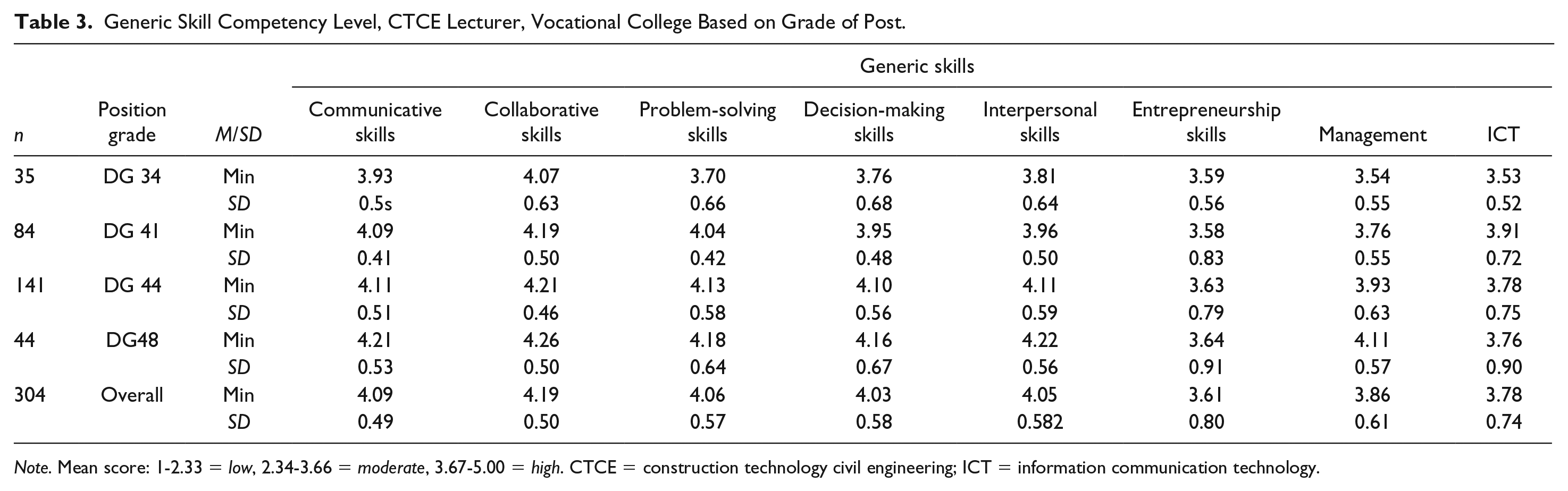
Table 3 shows the standard mean and standard deviation of the general competency level, generic skill dimensions according to the grade of the lecturer’s post. Generally, generic skill competency level is high with mean value 3.61 (SD = 0.80) to 4.19 (SD = 0.50).
Generic Skill Competency Level, CTCE Lecturer, Vocational College Based on Grade of Post.
Note. Mean score: 1-2.33 = low, 2.34-3.66 = moderate, 3.67-5.00 = high. CTCE = construction technology civil engineering; ICT = information communication technology.
The results show that the level of competency of generic skills for DG 34 lecturers is high with satisfactory interpretation of communication skills, minimum value = 3.93 (SD = 0.56), group work skills, mean score = 4.07 (SD = 0.63), problem-solving skills, mean score = 3.70 (SD = 0.66), decision-making skills, mean score = 3.76 (SD = 0.68), and interpersonal skills, entrepreneurship skill mean score = 3.81 (SD = 0.64). Although the level of competency is moderate, moderate interpretation is satisfactory in entrepreneurship skills with mean score of 3.61 (SD = 0.80); management skills, mean score = 3.86 (SD = 0.61); and ICT skills, mean = 3.78 (SD = 0.74).
The results showed that the level of competency of generic skills for DG 41 grade lecturers was high with satisfactory interpretation of communication skills = 4.09 (SD = 0.41); working skills in the group, mean score = 4.19 (SD = 0.50); problem-solving skills, with mean score = 4.04 (SD = 0.42); decision-making skills, with mean score = 3.95 (SD = 0.48); interpersonal skills, mean score = 3.96 (SD = 0.50); ICT, with mean 3.91 (SD = 0.72). Although the level of competency is moderate, moderate interpretation is moderate satisfactory in entrepreneurship skills with a mean value of 3.58 (SD = 0.83).
The findings show that the level of competency of generic skills for DG 44 grade lecturers is high with satisfactory interpretation of communication skills, 4.11 (SD = 0.51); working skills in the group, mean score = 4.21 (SD = 0.46). Problem-solving skills, mean score = 4.13 (SD = 0.58); decision-making skills, mean score = 4.10 (SD = 0.56); interpersonal skills, mean score = 4.11 (SD = 0.59); ICT skills, mean = 3.78 (SD = 0.75). Although the level of competency is moderate, moderate interpretation is moderate satisfactory in entrepreneurship skill with mean value of 3.63 (SD = 0.79).
The findings show that the level of competency of generic skills for DG 48 grade lecturers is high with satisfactory interpretation of communication skills (M = 4.21, SD = 0.53); working skills in the group (M = 4.26, SD = 0.50) ; Problem-solving skills (M = 4.18, SD = 0.64); decision-making skills (M = 4.16, SD = 0.67); interpersonal skills (M = 4.22, SD = 0.56); ICT skills (M = 3.76, SD = 0.90), while entrepreneurial skills are at moderate level of competency with mean value of 3.64 (SD = 0.91).
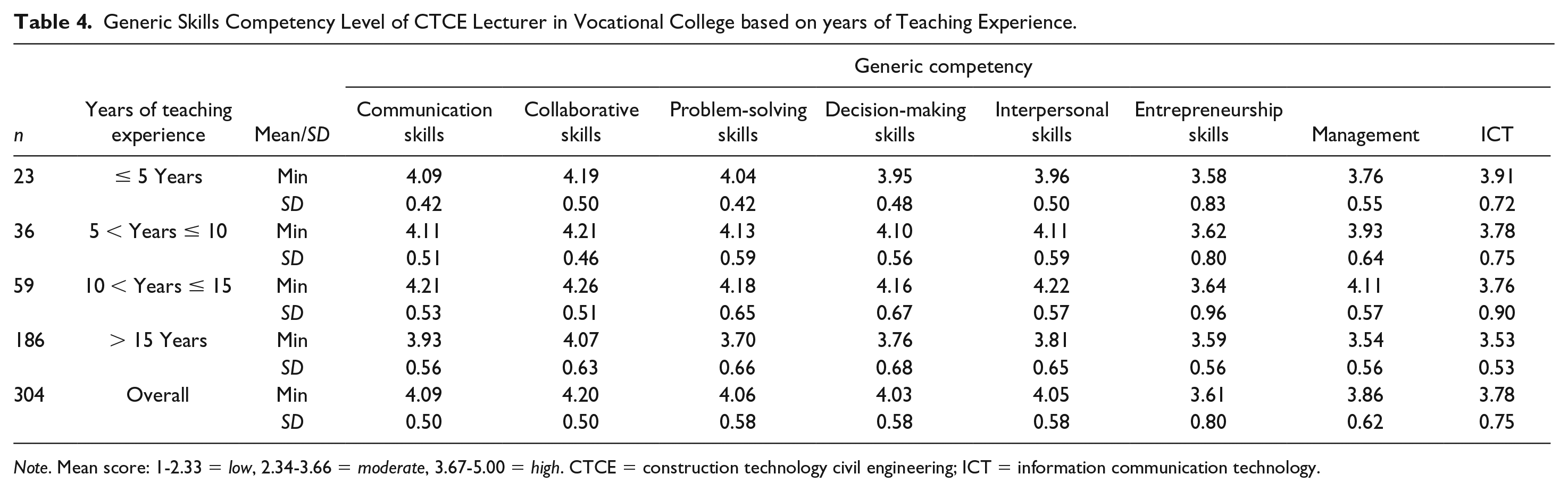
Referring to Table 4, the findings show that entrepreneurial skills are at a moderate level of competency for all levels of teaching experience of lecturers with a mean score of 3.61 (SD = 0.80) as a whole. In addition, the findings show that competency level of lecturers with over 15 years of teaching are of moderate level with satisfactory moderate interpretation of entrepreneurship skills, management skills, and ICT skills with mean values from 3.53 (SD = 053) to 3.59 (SD = 0.56).
Generic Skills Competency Level of CTCE Lecturer in Vocational College based on years of Teaching Experience.
Note. Mean score: 1-2.33 = low, 2.34-3.66 = moderate, 3.67-5.00 = high. CTCE = construction technology civil engineering; ICT = information communication technology.
The findings show that the level of competency for PLTV lecturer (construction technology) with 5 years of experience and undergraduates is high in communication skills, with mean score 4.09 (SD = 0.42); group work skills, mean score = 4.19 (SD = 0.42); decision-making skills, mean score = 3.95 (SD = 0.48); interpersonal skills, mean score = 3.96 (SD = 0.50); management skills, mean score = 3.76 (SD = 0.55); and ICT skills, mean score = 3.91 (SD = 0.72). However, only of moderate competency in entrepreneurship skill with mean value = 3.58 (SD = 0.83).
Based on the findings shown in Table 3, it can be summarized that the level of professional competency of TVET CTCE lecturer of vocational college based on grade of the post is high with satisfactory interpretation; satisfactory referring to the mean value of all subdimensions, that is, communication skills, 4.09 (SD = 0.49, 0.50), problem-solving skills, 4.06 (SD = 0.57), decision-making skills, 4.03 (SD = 0.58), interpersonal skills, 4.05 (0.58), management skills, 3.86; ICT skills 3.78 (SD = 0.74). Whereas the level of entrepreneurship skill competency as a whole is at moderate level, satisfactory moderate interpretation with a mean value of 3.61 (SD = 0.80).
From Table 4, the findings show that the level of generic competency for CTCE lecturers with teaching experience exceeding 5 to 10 years, is at high level in communication skills with mean score of 4.11 (SD = 0.51), working in group skills with mean score of 4.13 (SD = 0.59), decision-making skills, mean score of 4.10 (SD = 0.56), interpersonal skills, mean score of 4.11 (SD = 0.59), management skills, mean = 3.93 (SD = 0.64) and ICT skills, mean score = 3.78 (SD = 0.75). However, entrepreneurship skill is only of moderate competency level, with mean value of 3.62 (SD = 0.80). Table 4 shows the descriptive analysis of mean score and standard deviation based on years of teaching experience.
The findings show that the level of competency of the CTCE lecturer with years of experience of more than 10 to 15 years is high in communication skills, mean score = 4.21 (SD = 0.53), group work skills, mean score = 4.26 (SD = 0.51 (SD = 0.65), interpersonal skills, mean score = 4.22 (SD = 0.57), management skills, mean score = 4.11 (SD = 0.57), and ICT skills, mean score = 3.76 (SD = 0.90). But only of moderate competency level for entrepreneurship skill with mean score of 3.64 (SD = 0.96).
Finally, the findings show that the level of competency for the CTCE lecturer with more than 15 years of experience is high in communication skills, mean score = 3.03 (SD = 06), working skills in the group, mean score = 4.07 (SD = 0.63), problem-solving skills, mean score = 3.70 (SD = 0.66), decision-making skills, mean score = 3.76 (SD = 0.68) and interpersonal skills, mean score = 3.81 (SD = 0.65). However, the findings shows a moderate level of competency in entrepreneurship skill with mean score of 3.59 (SD = 0.56), management skills, mean score = 3.54 (SD = 0.56) and ICT skills, mean score = 3.53 (SD = 0.53).
Based on the findings shown in Table 4, it can be concluded that the level of general professional competency of TVET CTCE lecturer of vocational college based on the years of teaching experience is of high level with satisfactory interpretation by referring to the mean value of all subdimensions, that is, communication skills, 4.09 (SD = 0.50); skills, 4.06 (SD = 0.50); problem-solving skills, 4.06 (SD = 0.58); decision-making skills, 4.03 (SD = 0.58); interpersonal skills, 4.05 (0.58); and ICT skills, 3.78 (SD = 0.75). Whereas the level of entrepreneurship skill competency as a whole is at moderate level of competency, interpretation of satisfactory moderate with a mean value of 3.61 (SD = 0.80).
Overall, the findings show that the level of competency of entrepreneurship skill is of moderate level in terms of grade of post and years of teaching experience.
iii. Structural equation model of general competency (professionalism and generic skill)
The researcher also used SEM (structural equation modeling) analysis using AMOS (analysis of moment structure) software to test the model of structural equation and directly see the influence of moderation between the dimension and subdimension of standard competency model, which corresponds to and suitable for TVET lecturer (technology construction, civil engineering) of vocational college, Ministry of Education, Malaysia. The simplest method of influence between the dimensions and subdivisions of TVET’s technical competency standards (construction technology, civil engineering) of the vocational college is the method of Ping (1995) and Nik Mustafa (2016).
An analysis of each dimension and subdimension is performed to compare the chi-square, probability, goodness of fit index (GFI), adjusted goodness of fit index (AGFI), comparative fit index (CFI), Tucker–Lewis index (TLI), root mean square error approximation (RMSEA), and CMIN/DF values of the proposed original dimension and subdimension of CTCE lecturer’s standard competency model, as well as its modified model. This is carried out to achieve model fit (Nik Mustafa, 2016; Ping, 1995) to be used in designing this standard model.
The general competency domains of TPKA lecturer competency standards comprised of professionalism and generic skills dimensions. Figure 1 and Table 5 show professionalism model and chi-square, probability, GFI, AGFI, CFI, TLI, RMSEA, and CMINDF values.

Structural equation modeling of general competency: Professionalism dimension, standard competency model of TPKA lecturers.
Maximum Likelihood Estimates Regression Weights for Regression Model Variable of Stuctural Equation Model With Regard to Professionalism Dimension.

significant confidence level p < .05.
The following Table 5 illustrates Maximum Likelihood Estimates Regression Weights For Regression Model Variable of Stuctural Equation Model with regards to Professionalism Dimension;
Based on Table 5, the critical value (CR) of the regression between professionals latent variable with all the four indicator variables, that is, professional ethics (PROETHIC), personality (PERSONAL), potential (POTENTIAL), and professional learning community practice (PLC). This finding shows that all four indicator variables are predictor variables that are significant for professionalism latent variable at p < .05. Based on Table 5, a sum of .825 or 82.5% variance in the PROETHIC variable (professional ethics) can be predicted by the model. For variable PERSONAL (personality) with .890 (89.0%) variance can be predicted by the model. On the contrary, a total of .867 (86.7%) variances in POTENTIAL (potential) can be predicted by the model. For variable PLC (professional learning community practice) about .924 (92.4%) can be predicted by the model. Therefore, the overall variance predicted by the model is between .825 (82.5%) and .924 (92.4%). Meanwhile, the unexplained variance value (variance error) in this model ranges from 7.6% to 17.5%.
Table 6 is the Overall Measurement Model Fit Structural Equation Modeling Assessment for Confirmatory Test Model of Professional Dimension.
Overall Measurement Model Fit Structural Equation Modeling for Confirmatory Test Model, Professional Dimension.

Note. GFI = goodness of fit index; CFI = confirmatory fit index; AGFI = adjusted goodness of fit index; RMSEA: root mean square error of approximation; TLI = Tucker–Lewis index.
Significance *** at 0.05 level.
Based on Table 6 above, the chi-square test result shows a value of 47.692 with probability p = .000. This shows that the dimensions in the model are significant, but not a good fit. The GFI value = .921, AGFI = .605, CFI = .956, TLI = .867, RMSEA = .275, CMINDF = 23.981. By referring to the significant value of the loading factor, there is no probability value greater than 0.05. This means that the items contained in the dimensions studied are acceptable. The model is reestimated and shown in Figure 2.

Modified structure equation model of general competency: Professionalism dimension, standard model of TVET (CTCE) lecturer’s competency (CTCE).
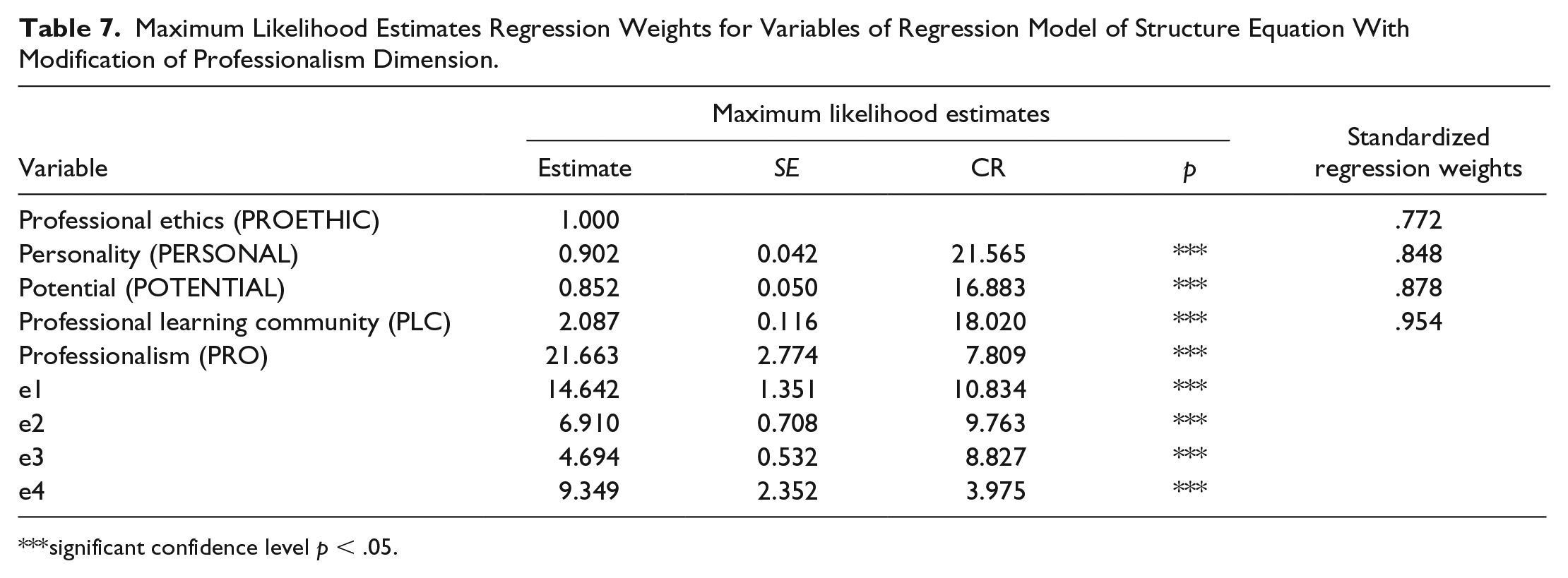
In Table 7 describes the analysis of maximum likelihood estimates regression weights for variables of regression model of structural equation with modified model of professionalism dimension.
Maximum Likelihood Estimates Regression Weights for Variables of Regression Model of Structure Equation With Modification of Professionalism Dimension.
significant confidence level p < .05.
Table 8 illustrates the analysis of the overall measurement model fit SEM for modified model of confirmatory test for professionalism dimension.
Assessment of Overall Measurement Model Fit Structural Equation Modeling for Modified Model of Confirmatory Test for the Dimension of Professionalism.

Note. GFI = goodness of fit index; CFI = confirmatory fit index; AGFI = adjusted goodness of fit index; RMSEA: root mean square error of approximation; TLI = Tucker–Lewis index.
Significant *** at level 0.05.
By referring to Figure 2 and Tables 8 and 9, the chi-square value for modified model is 1.288, which is of good fit with probability, p = 268. This shows that the dimensions of the model are significant *** at 0.01 good fit level. After the modified model is undertaken, the model shows good fit value with GFI = .998, AGFI = .605, CFI = .956, TLI = .999, RMSEA = .027, CMINDF = 1.228. This shows that the subdimension tested are well received (Bentler, 1993; Bollen, 1993; Nik Mustafa, 2016)
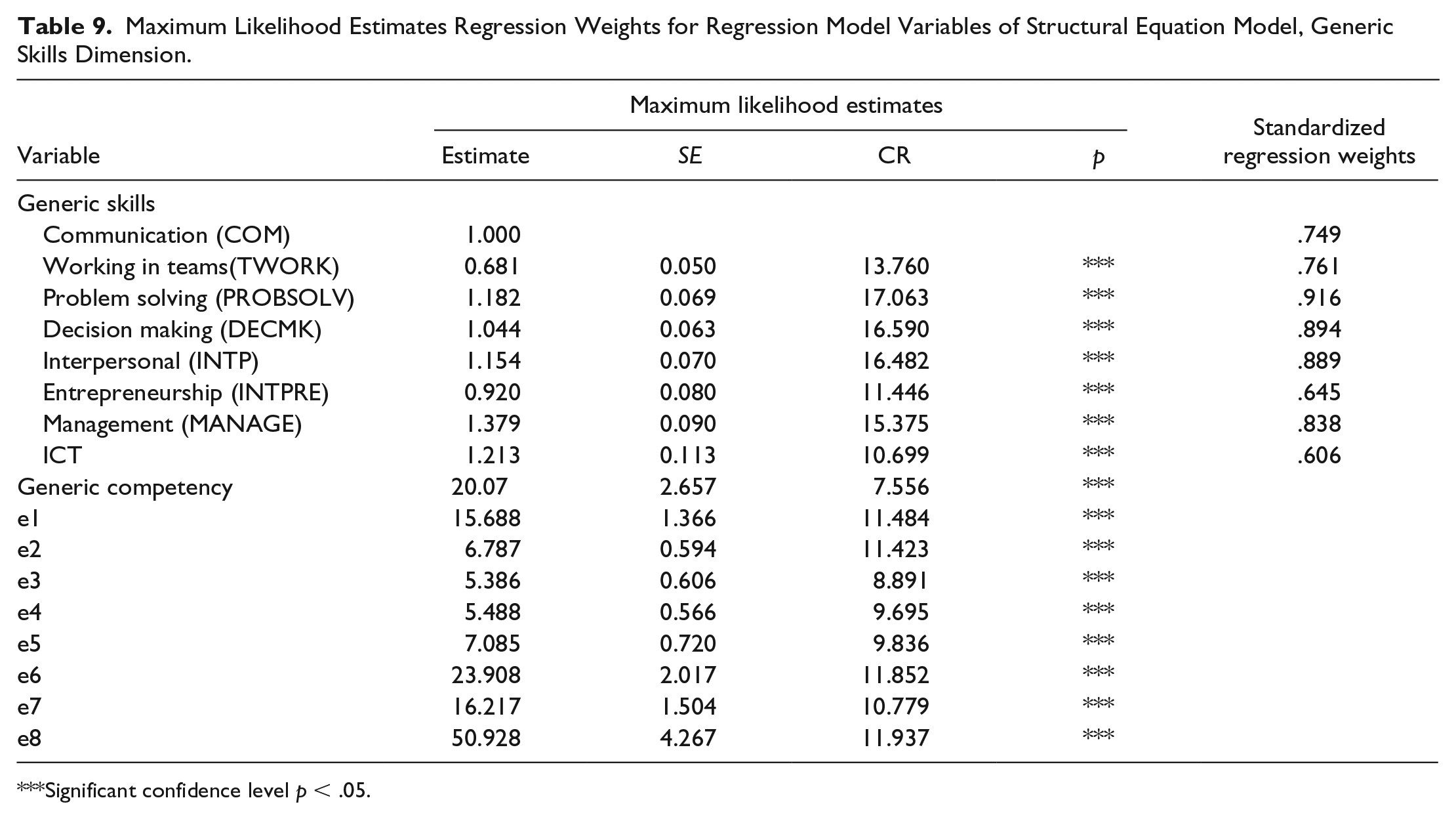
Maximum Likelihood Estimates Regression Weights for Regression Model Variables of Structural Equation Model, Generic Skills Dimension.
Significant confidence level p < .05.
Figure 3 and Table 9 show generic skill model and values of chi-square, probability, GFI, AGFI, CFI, TLI, RMSEA, and CMINDF.

Structural equation model, general competency: Generic skill dimension of standard model of TVET (CTCE) lecturer’s competency (CTCE).
Based on Table 9, the critical value (CR) for the regression between generic skill latent variables with all eight indicator variables, namely, communication skills, working in group skill, problem-solving skills, decision-making skills, interpersonel skills, entrepreneurship skills, management skills and ICT skills is beyond the range of ±1.96. This finding shows that the eight indicator variables are predictor variables, which is significant for the generic skill latent variable at p < .05.
Based on Table 9, about .749 or 74.9% variance in COM variables (communication skills) can be predicted by the model. For TWORK variable (working skills in the group) about .761 (76.1%) variance can be predicted by the model. Meanwhile, about .916 (91.6%) variance in PROBSOLV (problem-solving skills) can be predicted by the model. For variable DECMK (decision-making skills), .894 (89.4%) can be predicted by model. For INTP variable (interpersonel skills) .889 (88.9%) variants can be predicted by the model, whereas .645 (64.5%) variance in INTPRE (entrepreneurship skills) can be predicted by the model. For the MANAGE variable, about .838 (83.8%) variance can be predicted by the model, whereas by .606 (60.6%) the variance in ICT (ICT skills) can be predicted in the model. Therefore, the overall value of the variance predicted by the model is between .606 (60.6%) and .916 (91.6%). While the unexplained variance value (variance error) in this model ranges from 8.4% to 39.4%.
Table 10 illustrates the analysis of the overall measurement model of fit SEM for the confirmative test model, generic skill dimension.
Overall Measurement Model of Fit Structural Equation Modeling for Confirmatory Test Model of Generic Skill Dimension.

Note. GFI = goodness of fit index; CFI = confirmatory fit index; AGFI = adjusted goodness of fit index; RMSEA: root mean square error of approximation; TLI = Tucker–Lewis index.
Significant *** at 0.05.
By referring to Table 10, chi-square test results show a value of 106.367 with probability p = .000. This shows that the dimensions in the model are significant by having a good fit with GFI = .914, AGFI = .844, CFI = .954, TLI = .935, RMSEA = .089, CMINDF = 4.988. By referring to the significant value of the loading factor, there is no probability value greater than 0.05. This shows that the subdimensional tested are well received (Bentler, 1993; Bollen & Long, 1993; Nik Mustafa, 2016).
Figure 4 as well as Tables 11 and 12 show the general competency model and values of chi-square, probability, GFI, AGFI, CFI, TLI, RMSEA, and CMINDF.

Structural equation modeling, general competency (Kemahiran Generik) domain, standard model of TVET (CTCE) lecturers’ competency (Kompetensi Profesionalisme).
Maximum Likelihood Estimates Regression Weights Bagi Variable Model Regresi Structural Equation Modeling, Genaral Competency Domain, l Standard Model of TVET (CTCE) Lecturers’ Competency (Construction Technology).

Note. TVET = technical and vocational education and training; CTCE = construction technology civil engineering.
Significant at confidence level p < .05.
Analysis of the Overall Measurement Model Fit Structural Equation Modeling Model for the General Competency Confirmatory Model; Competency Standard of TPKA Lecturer Model.

Note. GFI = goodness of fit index; CFI = confirmatory fit index; AGFI = adjusted goodness of fit index; RMSEA: root mean square error of approximation; TLI = Tucker–Lewis index.
Significant *** as at level 0.05.
Based on Table 11, the critical value (CR) of the regression between the general skills variable and all 12 indicator variables, namely, communication skills, group work skills, problem solving skills, decision-making skills, inpreferonal skills, entrepreneurship skills, management skills, ICT, professional ethics (ETK), Sahsiah (SAH), potential (POT), and professional learning community practices (KPPs) are outside ± 1.96. This finding shows that all 12 indicators are predictor variables, which are significant to the generic skill latent variable at p < .05.
Based on Table 11, about .753 or 75.3% variance in KOM variables (communication skills) can be predicted by the model. For BDK variable (working in group) about .768 (76.8%) variance can be predicted by the model. Meanwhile, .913 (91.3%) variance in PM (problem-solving skills) can be predicted by the model. For variable MK (decision-making skills) about .887 (88.7%) can be predicted by the model. For INTP variable (interpersonal skills) about .882 (88.2%) variants can be predicted by the model, whereas .645 (64.5%) variance in KUSH (entrepreneurship skills) can be predicted by the model. For the PGR variable, .850 (85.0%) variance can be predicted by the model, whereas for ICT (ICT skills) .615 (61.5%) variance can be predicted in the model. A total of .774 (77.4%) variance in the ETK variable (professional ethics) can be predicted by the model. For variable SAH (Sahsiah) about .854 (85.4%) variance can be predicted by model. Meanwhile, a total of 888 (88.8%) variances in Pot (Potential) can be predicted by the model. For variable KPP (professional learning community practice) a total of 9.91 (94.1%) can be predicted by model. Therefore, the overall variance predicted by the model is between .615 (61.5%) and .941 (94.1%), whereas the unexplained variance value (variance error) in this model is between 5.9% and 38.5%.
Table 12 illustratesan analysis of the overall measurement model fit SEM model for the general competency confirmatory model; competency standard of CTCE lecturer model.
By referring to Table 12, chi-square test results show a value of 255,911 with the probability of p = .000. It shows the dimensions in the model are significant with good fit with GFI = .863, AGFI = .821, CFI = .939, TLI = .922, RMSEA = .084, CMIN / DF = 4.921. Referring to the significant value of the loading factor, there is no probability value greater than 0.05. This shows that the subdimensional tested are well received (Bentler, 1993; Bollen, 1993; Nik Mustafa, 2016).
Discussion
Based on the analysis, the researchers have formed a radar graph (Spider Web Chart) using Microsoft Office Excel 2007 software to see the full profile of the proficiency level of the CTCE lecturer’s general level. Radar Graph 1 shows the level of general competency based on salary grade levels for teachers or lecturers (DG34-DG48 while lower grade means lower salary), the level of competency of construction technology lecturer DG 48 (44 students) in all subdimensions is at a high level compared with lecturers other grades. This finding is in line with the theory of teacher or educator development (Berliner, 2005; Fuller, 1969; Hapidah Mohamed, 2001; Ngadiman, 2011; Nik Mustafa, 2016), which states that there are five phases of skill, expertise, the educator is proportional to the length of teaching experience.
From Graph Radar 1, it was found that the degree of competency level of DG34 grade students (35 students) and DG41 (84 students) was not much different. Grade DG34 lecturer are construction technology lecturer who are diploma holder and most of them are skilled and have extensive experience with the construction technology workshop, whereas DG41 grade lecturers have bachelor’s degree and on the average are still new and have less theoretical and practical experience in construction technology. However, the findings shows that the level of general competency of the DG44 grade (141 lecturers) level is more consistent compared with the general competency level of the DG34 and DG41 grade lecturers in relation to all subdimensions of general competency.

Generic skills competency level of construction technology lecturer based on grade of post.
As stated in the Iceberg Competency Model, generic competencies are the knowledge, skills, and personal characteristics and behaviors that every member needs in a service. From the mean score and standard deviation of descriptive analysis, it is found that the general competency level of DG36, DG44, and DG48 grade lecturers is more consistent than DG41 grade lecturers. Overall, the findings show that the level of competency among DG48 lecturers is highest and dominant in each subdivision of the standard competency tested. Below are the details of the Radar Graph 2 (Spider Web Chart) of Microsoft Office Excel 2007 software to view the full profile of the proficiency level of the CTCE lecturer based on years of teaching experience.

Generic skills competency level of construction technology lecturer based on years of teaching experience.
By referring to the above Radar Graph 2, the findings showed that there was a slight decrease in the proficiency level profile of the CTCE lecturer who had more than 15 years of experience (186 people), compared with those with teaching experience of 15 years or less. However, even though it shows a particular pattern, but the general competency level is still of moderate satisfying level. This finding is consistent with the findings of Huberman’s (1989) and Nik Mustafa’s (2016) that educators’ motivation and commitment are increasingly proportionate with the duration of teaching experience, increase up to the 18th year at the initial stage and subsequently decreasing linearly starting from the 19th year to 45th year of teaching. In addition, the results of the study show that the construction technology lecturer with over 10 years of experience up to 15 years of teaching experience (59 people) has the highest general competency level compared with others. This finding is consistent with Rauner (2007) who states that the development of occupational competence occurs in a process of reflective practical experience. But it also overrides the level of competency of lecturers with over 15 years of experience. This is followed by the competency level of lecturers teaching over 5 to 10 years (36 people). The findings showed a higher level of competency level as compared with lecturers with the experience of teaching for 10 years and below.
In the analysis, the researcher also uses the structural equation model to show the relationship between the dimensions. The confirmatory test is used to examine the relationship between domains, dimensions, and subdimensions of competency standard of TVET lecturer (CTCE). The dimensions and subdimensions of the general competency domain and general competencies have been tested using this alphanumeric test. CFI and GFI values are used to measure the feasibility of the model. In this study, the researcher has designed the model and there are several modes of competency domain, dimension, and subdimension of competency standard of TVET lecturer (CTCE). This is done to see more clearly the level of relationship between the items being built.
By referring to the structural equation model of general competency domain, as a whole, the findings show a positive relationship between the dimension of professionalism and the generic skills dimensions that there of 0.85. Chi-square test results show a value of 255,911 with the probability of p = .000. It shows dimensions in the model are significant and have good relationship; GFI value = .863, AGFI = .821, CFI = .939, TLI = .922, RMSEA = .084, CMINDF = 4.921. Based on the significant value of the loading factor, there is no probability value greater than 0.05. Overall, the values shown describe the structural equation model of the general competency domain of TVET lecturer competency standard model (CTCE) with the tested subdimension well accepted (Bentler, 1993; Bollen, 1993; Nik Mustafa, 2016; Nooraini, Kamaruddin, & Ibrahim, 2016).
Concluding Remarks
Overall, the findings show the level of general competency of vocational college CTCE lecturer. The study provides empirical evidence and confirms the suitability of general skills competency level of TVET CTCE lecturers, which can be used as a measurement of the competency level of CTCE lecturer at vocational colleges. It is highly desirable for TVET lecturers to equip themselves with soft skills, so that they are more competitive. The general skills competency standards can be used as a benchmark for vocational college and the technical and vocational education division (BPTV) of the Ministry of Education to enhance the competency level of PLTV lecturers. The findings of this study are in line with the focus of the Malaysia Education Blueprint (PPPM 2013-2025), which is to reduce the competitiveness gap among TVET lecturers in general and specifically in the CTCE Scheme. This also refers to the benchmark of professionalism and generic skills of the second wave of 2016-2020. The findings also provide input to BPTV in developing a continuous professional development module (PPB) and in terms of professional ethics, personality, potential, and practice of professional learning communities. In addition, the findings of this study provide information on training and PPB on generic skills, which includes eight subdimensions as a catalyst for the teaching of lectures on TVET CTCE vocational college. The findings of this study can also be used by the University, Teacher Education Institute who conducts studies or training in providing BPTV lecturer and meets the criteria of the quality required. The cultivation of the elements of general and specific competency, knowledge, skills, and achievement in the field of TVET is highly relevant to the formation of human capital in achieving the status of a developed nation in the 21st century.
Footnotes
Declaration of Conflicting Interests
The author(s) declared no potential conflicts of interest with respect to the research, authorship, and/or publication of this article.
Funding
The author(s) received no financial support for the research, authorship, and/or publication of this article.
