




Abstract
Identifying psychological factors related to smoking habits is important to enact effective personalized treatment. We examined the relationship between the Big Five personality traits and smoking using a large and representative Japanese sample (n = 4,563 [2,462 women]; Mage = 53.48 years, SD = 12.87, ranging from 23 to 79 years). The results of multinomial logistic regression analysis showed that current smokers were higher in Extraversion and lower in Conscientiousness than never smokers. Extraversion was the strongest personality trait differentiating current smokers from never smokers, especially in the younger age group. Former smokers scored significantly higher than current smokers on Conscientiousness, suggesting that Conscientiousness is associated with smoking cessation.
Keywords
Although tobacco smoking is declining in many countries, there is a need to reduce it further (World Health Organization [WHO], 2013). Not only smoking but also exposure to passive smoking causes health problems such as ischemic heart disease, sudden infant death syndrome, lung cancer, and breast cancer (California Air Resources Board, 2005; IARC Working Group on the Evaluation of Carcinogenic Risks to Humans, 2004). In Japan, as the Ministry of Health, Labour and Welfare (2017) is discussing regulating smoking in public places, there has been great interest in smoking cessation. Identifying the psychological factors related to smoking is important to enacting effective personalized treatment. This study examined the relationships between smoking habits and the Big Five personality traits in a representative Japanese sample.
The Big Five or the Five Factor Model has become a widely accepted model of personality traits, and there is good evidence of its cross-cultural generalizability (John, Naumann, & Soto, 2008; Oshio, Abe, Cutrone, & Gosling, 2014).
The five personality traits are Extraversion (e.g., proneness to be lively, cheerful, and sociable), Agreeableness (e.g., trust, compassion, and modesty toward other people), Conscientiousness (e.g., organization, punctuality, and purposefulness), Neuroticism (e.g., tendency to be anxious, easily depressed, and irritable), and Openness (e.g., curiosity, originality, and artistry) (John & Srivastava, 1999; McCrae, 2002).
Some studies have shown relationships between smoking habits and the Big Five personality traits. Eysenck (1980) argued that individuals with high Extraversion smoke to seek stimulation, whereas individuals with high Neuroticism smoke to reduce tension and anxiety. In studies on health risk behaviors, there is consistent evidence that low Conscientiousness is related to poor health habits, including smoking (Booth-Kewley & Vickers, 1994; Lemos-Giráldez & Fidalgo-Aliste, 1997; Vollrath, Knoch, & Cassano, 1999). Gilbert (1995) proposed the Situation-Trait-Adaptive-Response model of smoking and showed that Extraversion, Neuroticism, and Psychoticism (now considered to include low Conscientiousness and low Agreeableness) were positively related to smoking. However, the effect of Extraversion, which is generally regarded as a socially positive trait, was either very small or had no effect in more recent studies, perhaps because of changes over time in the social acceptance of smoking. Subsequently, Malouff, Thorsteinsson, and Schutte (2006) conducted a meta-analysis of the relationships between the Big Five and smoking and revealed that smokers tended to be more neurotic and less agreeable and conscientious. Although another meta-analysis conducted by Hakulinen et al. (2015) showed a significant effect of Extraversion on smoking, the effect size was very small. More recently, in one of two samples examined by Sallis, Smith, and Munafò (2018), the effect of Extraversion was not only significant, but also very weak. In an integrative data analysis of 15 international longitudinal studies, Graham et al. (2017) also found similar results.
Although the association between Extraversion and smoking was not significant in the meta-analytic study by Malouff et al. (2006), the researchers found that in non-English-speaking countries (Japan and Spain), there was a significant positive effect of Extraversion on smoking. Yoshimura (2000) investigated the relationships between smoking and the Big Five personality traits with a Japanese sample and showed that both male and female smokers were more extraverted, whereas female smokers were less agreeable. However, because the smoking rate in Japan has been decreasing recently (Organisation for Economic Co-operation and Development [OECD], 2015), we may expect that the association between Extraversion and smoking has changed in recent years. Although the influence of personality on smoking is usually weak (Terracciano & Costa, 2004), it is important because smoking kills nearly 6 million people each year; more than 5 million people die from direct smoking, and more than 600,000 who die are nonsmokers exposed to secondhand smoke (WHO, 2015). Continuous monitoring of the personality traits associated with smoking is essential to address this major public health threat.
The purpose of this study was to examine the relationship between smoking and personality traits using a relatively large and representative Japanese sample. Research from the United States and Europe is most prevalent in the literature, and studies conducted in East Asian countries are relatively scarce. Although the sample used in the previous study by Yoshimura (2000) was Japanese, the sample size was relatively small and was collected in only one prefecture located in a rural area, which may have produced biased results. In addition, we also examined differences between current smokers and former smokers. Smoking cessation programs are not equally effective for all smokers (Hughes, 2011). Thus, they are likely to require personal, tailored interventions that consider individual factors such as personality traits. Terracciano and Costa (2004) found that current smokers scored significantly higher than never smokers on Neuroticism and significantly lower on Agreeableness and Conscientiousness. Moreover, former smokers had intermediate scores on these factors, with significant differences from other groups in Neuroticism and Conscientiousness.
To summarize, the present study examined differences in the Big Five personality traits among former smokers, current smokers, and persons who have never smoked. Based on previous findings, we expected that current smokers would be more neurotic and less agreeable and conscientious than never smokers. In addition, we expected former smokers to have intermediate levels of these traits. We also explored whether the effect of Extraversion on smoking exists in Japan.
In addition, previous studies have found effects of gender, age, and education on smoking behavior, and that these moderated the relationship between personality and smoking (e.g., Bogg & Roberts, 2004; Hakulinen et al., 2015; Hampson, Goldberg, Vogt, & Dubanoski, 2006; Hiscock, Bauld, Amos, Fidler, & Munafò, 2012; Yoshimura, 2000), although the direction of these effects was inconsistent. Thus, we included these factors in the analytic model and conducted an exploratory analysis of these effects.
Method
Participants
The data used for this study were from the Preference Parameters Study of Osaka University, conducted in 2012. This survey used multistage stratified probability sampling and included a nationally representative sample of adults in Japan. The response rate was 93.9%, and the sample consisted of 4,563 participants (2,462 women). The mean age of participants was the 53.48 years (SD = 12.87) and ranged from 23 to 79 years.
Materials
Smoking was measured as frequency of smoking as follows: 1 = “never smoked,” 2 = “hardly smoke,” 3 = “occasionally smoke,” 4 = “I smoke approximately 1 to 5 cigarettes a day,” 5 = “I smoke approximately 6 to 10 cigarettes a day,” 6 = “I smoke approximately 11 to 20 cigarettes a day,” 7 = “I smoke approximately 21 to 30 cigarettes a day,” 8 = “I smoke approximately 31 to 40 cigarettes a day,” 9 = “I smoke 41 cigarettes or more a day,” or 10 = “I used to smoke, but I quit.” In line with Terracciano and Costa (2004), participants were divided into three groups based on smoking frequency. “Never smokers” (n = 2,559, 56.08%) included those who had never smoked. “Former smokers” (n = 980, 21.48%) were those who had quit smoking. On average, former smokers started smoking at age 21.45 (SD = 12.35), smoked for 22.16 years (SD = 12.95), and quit 13.79 years ago (SD = 11.68). “Current smokers” (n = 1,024, 22.44%) were those who reported smoking at the time of the survey. On average, current smokers started smoking at age 23.10 (SD = 15.32) and had smoked for 30.78 years (SD = 11.65).
Personality traits were measured using the Japanese version of the Ten-Item Personality Inventory (TIPI-J; Oshio, Abe, & Cutrone, 2012). The original version of the TIPI (Gosling, Rentfrow, & Swann, 2003) is by far the most widely used of the very brief scales (Oshio et al., 2014). In this inventory, two items assess each of the Big Five dimensions. For each dimension, one item is positively keyed, and the other item is negatively keyed. Items are rated on a 7-point Likert-type scale from 1 (disagree strongly) to 7 (agree strongly). Previous research has indicated that the TIPI-J demonstrated sufficient 2-week test–retest reliability (r = .64-.84; Oshio et al., 2012). The scale provides an adequate representation of the Big Five dimensions of personality and correlates sufficiently well with other Big Five scales (Oshio, Abe, Cutrone, & Gosling, 2013; Oshio et al., 2014)
In addition, the demographic measures in this survey included gender, age, and education. Gender was coded as women = 0.5 and men = −0.5. Education was categorized for each participant as junior high graduate, high school graduate, or college graduate. From this variable, we created dummy variables for each of the three categories, such that a value of “1” was given for the education level indicated by the participant and a value of “0” was given for the other levels of education.
Analytic Plan
This study was not preregistered. We conducted a multinomial logistic regression analysis using current smokers as the reference group to clarify the differences between current smokers and those who have never smoked, as well as the differences between current smokers and those who had quit smoking. We controlled for gender, age (standardized), and education and simultaneously entered each standardized personality trait, the interaction between each trait and gender, the interaction between each trait and age, and the interaction between each trait and education in the model.
Results
Gender, Age, and Education Differences in the Three Smoking Groups
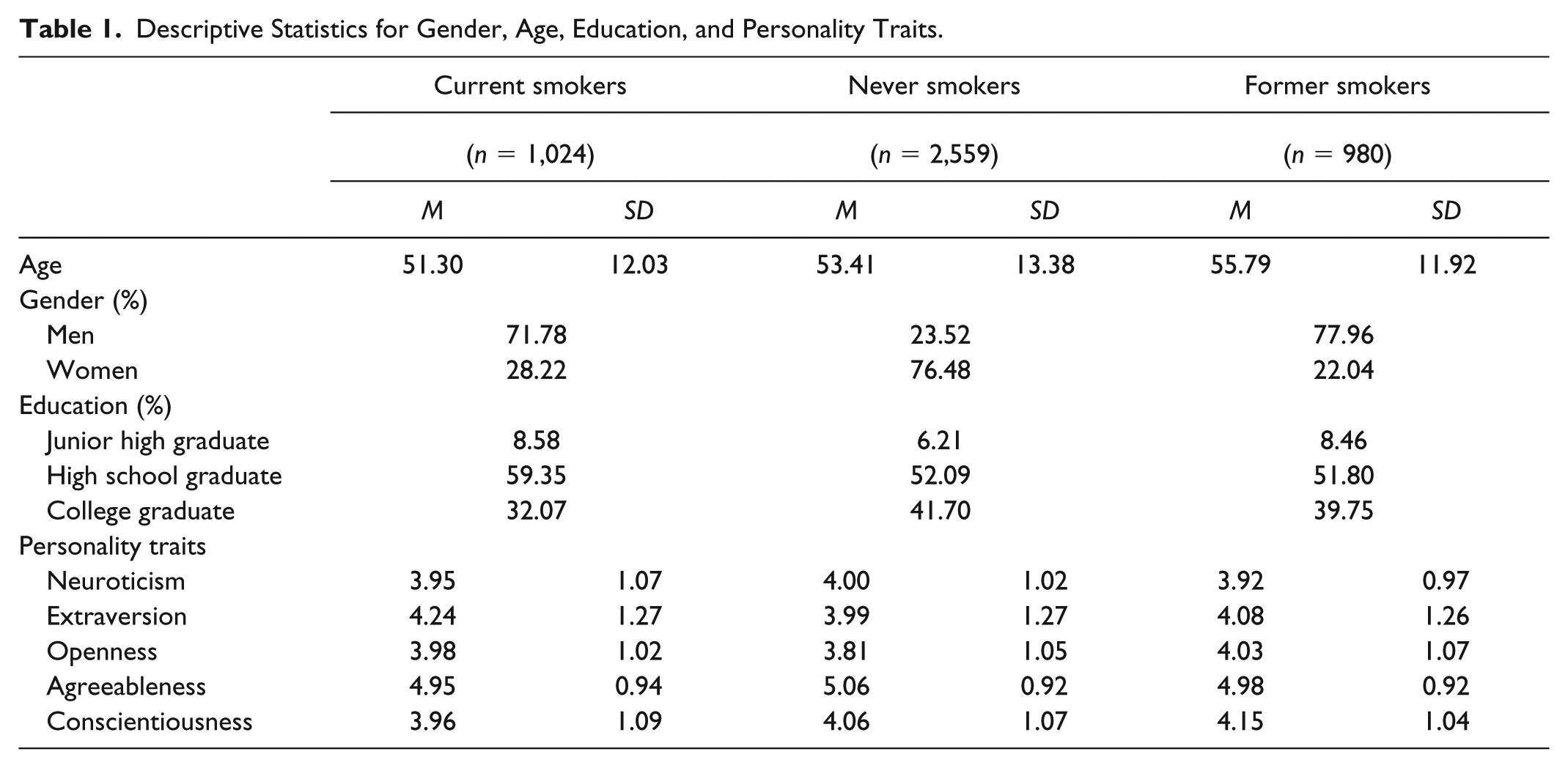
Gender differences were found in the three groups, χ2(2) = 1,197.10, p < .001. More women were never smokers (23.52% men vs. 76.48% women), whereas more men were former smokers (77.96% men vs. 22.04% women) and current smokers (71.78% men vs. 28.22% women). The groups differed in age, F(2, 4560) = 30.85, p < .001. Former smokers (M = 55.79, SD = 11.92) were older than never smokers (M = 53.41, SD = 13.38), who were older than current smokers (M = 51.30, SD = 12.03).
Education differences were also found in the three groups, χ2(4) = 32.32, p < .001. More college graduates were never smokers than current smokers (41.70% vs. 32.07%), whereas more high school graduates were current smokers than never smokers (59.35% vs. 52.09%).
Table 1 shows descriptive statistics for gender, age, education, and each of the personality traits.
Descriptive Statistics for Gender, Age, Education, and Personality Traits.
Multinomial Logistic Regression Analysis
The results of the multinomial logistic regression analysis are provided in Table 2. As the interactions between traits and education did not contribute to a significant increase in R2, we excluded them from the model. In addition, the higher order interaction did not contribute to a significant increase in R2.
OR, 95% CI, and p Values of Multinomial Logistic Regression Analysis.

Note. Nagelkerke R2 = .30. OR = odds ratio; CI = confidence interval.
Odds ratios (ORs) indicate an increased likelihood of membership in each specific category given a one-point increase in the predictor relative to the reference group (current smokers). Lower scores on Extraversion (OR = .66, 95% confidence interval [CI] = [.60, .73], p < .001) and higher scores on Conscientiousness (OR = 1.23, 95% CI = [1.09, 1.39], p < .001) predicted being a never smoker. In addition, the interaction term between Agreeableness and gender was significant (OR = 1.47, 95% CI = [1.18, 1.83], p < .001). Lower scores on Agreeableness predicted being a never smoker only for men (OR = 0.78, 95% CI = [0.67, 0.90], p < .001). Moreover, significant interactions between age and Extraversion (OR = 1.24, 95% CI = [1.11, 1.39], p < .001), Openness (OR = .85, 95% CI = [.75, .96], p = .010), and Conscientiousness (OR = 1.19, 95% CI = [1.04, 1.36], p = .012) were found. The association with Extraversion was found to be stronger for those who were younger (i.e., 1 SD below the mean; OR = .56, 95% CI = [.49, .64], p < .001) than older (i.e., 1 SD above the mean; OR = .77, 95% CI = [.66, .89], p < .001). Higher scores on Openness predicted being a never smoker only for younger individuals (OR = 1.17, 95% CI = [1.02, 1.34], p = .025), and the association with Conscientiousness was significant only for older individuals (OR = 1.46, 95% CI = [1.21, 1.75], p < .001).
Higher scores on Conscientiousness predicted being a former smoker (OR = 1.17, 95% CI = [1.01, 1.35], p = .034). In addition, a significant interaction was found between Extraversion and age (OR = .88, 95% CI = [.78, 1.00], p = .049), where lower scores on Extraversion predicted being a former smoker only in the older age group (OR =.823, 95% CI = [.689, .985], p = .033).
Discussion
The results for Extraversion and Conscientiousness were consistent with the meta-analysis conducted by Malouff et al. (2006). Using an abbreviated measure of the Big Five, the present study replicated the findings of previous studies. Moreover, in agreement with Terracciano and Costa (2004), participants scoring high on Conscientiousness were significantly more likely to be former smokers, suggesting that Conscientiousness is associated with smoking cessation. This result is consistent with previous studies on health risk behaviors (Booth-Kewley & Vickers, 1994; Lemos-Giráldez & Fidalgo-Aliste, 1997; Vollrath et al., 1999). High Conscientiousness represents self-control and planning ability, which might lead to smoking cessation, considering that this ability is associated with a healthy lifestyle.
The results of this study showed that Extraversion was the strongest personality trait differentiating current smokers and never smokers, especially in younger age groups. In addition, the findings indicated that among those who were older, participants scoring low on Extraversion were significantly more likely to be former smokers.
Smoking as a social activity might influence this difference in effects by age. That is, at younger ages, in which the prevalence of starting smoking has been decreasing, individuals with lower Extraversion might have less opportunity to associate with smokers because of their smaller social networks (Selden & Goodie, 2018). This might mean that the less extraverted people are, the less likely they are to become smokers. As a result, the effect of extraversion could be stronger at a younger age. By contrast, at older ages, in which the prevalence of starting smoking was relatively high, extraverted people might have some difficulty in stopping smoking because doing so would mean they must leave their smokers’ social network, which makes the effect of extraversion on continuing smoking stronger.
Based on these results, interventions for individuals with low Conscientiousness might need many sessions or greater intensity, and interventions for individuals with high Extraversion might need an approach that considers their social network of smokers.
Male participants scoring low on Agreeableness were significantly more likely to have never smoked, which is inconsistent with the meta-analysis results (Malouff et al., 2006). Smoking is generally more prevalent among men than women, and this gender gap is particularly large in Japan (OECD, 2015). Thus, for men, the social pressure against starting smoking might be weak. East Asian culture, including that in Japan, is more interdependent than Western culture (Markus & Kitayama, 1991). High Agreeableness and Extraversion in male Japanese smokers may represent the importance of human relationships in smoking initiation in Japan.
The effect of Neuroticism on smoking was not significant, which is inconsistent with previous studies. It could be that cultural factors contributed to the different findings. For instance, Malouff et al. (2006) found that non-English-speaking countries (Japan and Spain) showed a significantly lower effect of Neuroticism on smoking than did Canada and the United States. Smoking is more socially acceptable in Japan and Spain, and the presence of a higher proportion of smokers may inhibit the effects of negative traits, such as Neuroticism.
Openness among younger participants was a significant predictor of smoking, which is also inconsistent with previous studies. The participants in previous studies were older than in the present study, which might explain why the effects of Openness were not found. Smoking is legally prohibited to those under the age of 20 years in Japan, so smoking might be seen as new and fascinating to younger people with high Openness. However, as people get older, smoking is no longer a “new” habit, which might be why the effect of Openness occurs only in younger individuals.
The results of this study are limited in that the very short scale used to measure the Big Five traits might not have sufficiently represented the facets relevant to smoking behavior, which could cause problems with validity; moreover, the findings cannot explain the causal relationships between the Big Five personality traits and smoking. We should further investigate these relationships with longitudinal data. In addition, this study did not investigate the etiology of the associations between personality traits and smoking behaviors. As we can expect that these associations stem from both genetic and environmental factors, future research should examine this etiology using a behavioral genetics approach. Moreover, smoking could possibly affect the level of personality traits. For instance, smoking areas in Japan are generally limited, making it inevitable that people approach each other. The frequent opportunities for talking with other smokers might draw out smokers’ extraverted and agreeable personality traits. Longitudinal research is necessary to examine this hypothesis.
Footnotes
Declaration of Conflicting Interests
The author(s) declared no potential conflicts of interest with respect to the research, authorship, and/or publication of this article.
Funding
The author(s) received no financial support for the research, authorship, and/or publication of this article.
