




Abstract
Hazelnut is an important nut food that was widely consumed throughout prehistory. Archaeologists frequently find the charred plant macrofossils of Corylus at archaeological sites throughout Eurasia. We present new records of charred Siberian hazelnut (Corylus heterophylla) that were recovered from the Beiniu site (109.32°E, 34.46°N) in Shaanxi Province, North West China, that are directly dated around 5,400 cal. yr BP. They are basic evidence that we use to reconstruct the early history of hazelnut use in the northern part of China. Our findings in China are much less abundant than the hazelnut remains recovered at archaeological sites in Europe and North America. We suggest that the hazelnuts deposited in the cultural layer of Beiniu site were not intentionally used as a fuel but rather were first broken and then consumed as food before their eventual charring in a refuse pit. These discoveries also contribute to our understanding of risk mitigation strategies in food production by ancient farmers in China.
Introduction
Archaeobotanists have long argued that hazelnut (Corylus spp.) is an important nut food partly because of its abundance and rich nutritional content (Alphan, Pala, Açkurt, & Yilmaz, 1997; Zohary & Hopf, 2012). Hazelnuts are by weight more than 60% fat (predominantly oleic acid), 15% protein, and 17% carbohydrate, and contain many other essential vitamins and minerals (U.S. Department of Agriculture, 2009). Moreover, the unique flavor of hazelnuts has made it famous in the modern food industry (Boccacci & Botta, 2009). Hazel trees are highly adaptable and widely distributed throughout the temperate regions of Europe, Asia, and North America (Erdogan & Mehlenbacher, 2002). The ubiquity and nutritional value of hazelnuts have inspired many anthropologists and archaeologists to reconstruct the early history of hazelnut use and processing (e.g., Cunningham, 2011; López-Dóriga, 2013).
The genus Corylus, a small deciduous shrub or small tree, which consists of nearly 20 species, belongs to the tribe Coryleae of the family Betulaceae (Zohary & Hopf, 2012). Because hazelnut pericarps are easily lignified, archaeologists often find large quantities of charred hazelnuts (Corylus avellana) at archaeological sites throughout Europe from Mesolithic period to Bronze Age (Fairbairn, Kulakoglu, & Atici, 2014; Holst, 2010; Kubiak-Martens, 1999; Mithen, Finlay, Carruthers, Carter, & Ashmore, 2001; Peña-Chocarro et al., 2005; Regnell, 2012; Zvelebil, 1994). In North America, archaeologists have also recovered abundant hazelnut remains that show the long-term use of these nuts for various types of pre-Columbian cuisine (Corylus cornuta var. californica) by indigenous during the pre-Columbian period (Fine, Misiewicz, Chavez, & Cuthrell, 2013).
Although evidence for hazelnuts is common in Eurasia and North America, archaeologists working in China have only recovered hazelnuts from 13 Neolithic sites (see Table 1 and Figure 1). Perhaps the best collection of hazelnut shells comes from the large Neolithic village of Banpo (~6,000 cal. BP). Research there suggests that hazelnuts were an important nut food (Shi, 1963). Furthermore, based on pollen analyses in North China, hazel trees were abundant in natural vegetation during the mid–late Holocene (e.g., Jiang, Yang, & Cheng, 2014; Zhou et al., 2014). Despite these promising lines of evidence, no systematic analysis of hazelnut macrobotanical remains has yet been done in China.
Archaeobotanical Findings of Corylus in the Neolithic China.


The locations of the archaeological sites where ancient hazelnut shells were recovered in the northern part of China.
During the last few decades, many archaeobotanical studies have examined the origin of cereal cultivation in the Neolithic China (e.g., Lu et al., 2009; Zhao, 2011), leaving hazelnut overlooked. According to historical records, hazelnut was a valued nut food by the ancient Chinese. For example, Chinese literature sources, including the Shi Jing and the Zuo Zhuan, recorded that hazelnuts were not only used as conventional foods but also served as a luxury ritual offering to the ancestors in the northern part of China during the late Bronze Age (Anderson, 1988; Wang, 2007). Systematic investigation of charred hazelnut remains discovered from the archaeological sites is necessary to reconstruct the history of hazelnut use in China.
Here, we present a brief discussion of new archaeobotanical records of hazelnut discovered from the Beiniu site in the Wei river basin, Shaanxi Province, North West China, that has been directly radiocarbon dated to around 5,400 cal. yr BP. These new data can help us better understand the long-term interaction between early food producers and hazelnuts in the Neolithic China (Figure 1).
Archaeological Background
The Beiniu site (109.32°E, 34.46°N), covering an area of 200,000 m², is located in the Lintong County of Shaanxi Province, near the southern bank of the Wei River (Sun et al., 2006; Figure 1). The region is characterized by a typical temperate monsoonal climate covered by deciduous broad-leaved forest. The salvage excavation of Beiniu site was conducted by the Shaanxi Provincial Institute of Archaeology and reported in 2006. The excavations produced a number of archaeological finds, including houses, pits and kiln, crushed red painted and gray pottery containers, stone and bone tools, as well as pottery ornaments (Sun et al., 2006). Most of the archaeological findings showed that the Beiniu site was related to the Miaodigou culture (5,600-4,900 BP) in the Wei River basin during the middle period of Holocene.
The western part of the Beiniu site is occupied by a modern village. The southern and northern parts of the site have been destroyed. Only the eastern part is left with a natural ravine, about 100 m wide and 5 m deep contained ancient cultural remains. We selected off a 3-m profile with continuous cultural sediment layers in the eastern portion of the Beiniu site for charcoal and archaeobotanical studies to expand our current understanding of the paleoenvironment and subsistence economy in this area during the Neolithic (Sun et al., 2016; Yang et al., 2016). Thirteen floatation samples (about 40 L in each sample) were collected from the loess section (Yang et al., 2016). According to the color and lithologic features of that section, eight layers were observed (Figure 2):
0~10 cm: modern cultivation layer, containing grassroots;
10~50 cm: yellowish unconsolidated loess;
50~70 cm: blackish cultural layer, containing many charcoal fragments and pottery pieces;
70~100 cm: brownish cultural layer, containing a few charcoal fragments and pottery pieces;
100~200 cm: blackish cultural layer;
200~210 cm: brownish cultural layer;
210~280 cm: blackish cultural layer;
280~300 cm: yellowish unconsolidated loess (Sun et al., 2016).

(a) and (b) Profile of the Beiniu loess section and slice sampling for charred plant remains (photographed by Dr. Xinying Zhou) (redrawn after Yang et al., 2016); ancient hazelnut specimens found in slice sample (BN-11) of the Beiniu loess section (red arrow).
Based on the study of the ancient wood charcoal discovered from the loess sections in the eastern part of the Beiniu site, 15 different plants were identified (Sun et al., 2016). Quercus sp. and Pinus sp. are the highest in abundance, while Cyclobalanopsis sp., Platycarya sp., and Zelkova sp. are lower in abundance. Castanopsis sp., Cyclobalanopsis sp., also appear in the charcoal assemblages. In addition, charred millet (Setaria italica and Panicum miliaceum) and rice (Oryza sativa) seeds were also unearthed from those cultural layers (Yang et al., 2016). Previous radiocarbon dating information showed that the sediment of the Beiniu loess section was deposited between 6,400 and 4,100 cal. yr BP (Sun et al., 2016; Yang et al., 2016) (see Figure 2 and Table 2). However, there are two substantially older dates that overlie two younger dates.
Radiocarbon Dating Information of Beiniu Loess Section.

Materials and Methods
Fragments of charred hazelnut shells were collected from the soil sample No. BN-11 by water floatation (Figure 2). One of them is well preserved, while the others are small fragments with less morphological characters (Figures 3 and 4). To determine the real ages of the hazelnut specimens, a small chip of hazelnut specimen was sent to Beta Analytic, Inc., Miami, Florida, USA, for radiocarbon dating and then calibrated using the IntCal 13 calibration curve (Reimer et al., 2013) and OxCal v4.3.2 (http://c14.arch.ox.ac.uk/oxcal.html).

The charred hazelnut shells recovered from the Beiniu site; Scale bar of a = 1.5 mm; Scale bar of b, c, d = 1.0 mm, photographed by Dr. Pengfei Sheng.
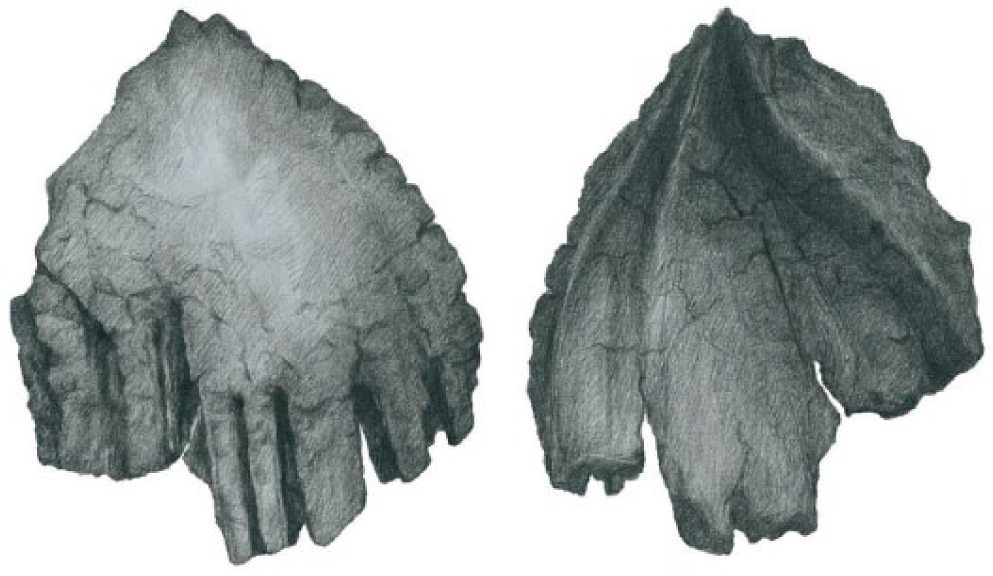
Line drawing of the well-preserved charred hazelnut shell (prepared by Ms. Yumeng Qu).
Morphological and anatomical characters of the ancient hazelnut samples were observed under a Nikon SMZ1000 stereomicroscope in the Institute of Vertebrate Paleontology and Paleoanthropology, Chinese Academy of Sciences (CAS), Beijing. For comparative studies, different types of hazelnuts were obtained from the Peking (PE) Herbarium, Institute of Botany, Chinese Academy of Sciences. Plant nomenclature follows the revised English version of Flora of China (http://www.efloras.org/flora_page.aspx?flora_id=2). The botanical terms used in the description are from the published reference works of Fairbairn et al. (2014). As there are only two species of hazelnut which have natural distributions around the Beiniu site nowadays, the Siberian hazelnut (C. heterophylla) and Manchurian hazelnut (Corylus mandshurica), shells of above two modern hazelnuts (C. heterophylla, n = 30; C. mandshurica, n = 30) were selected for morphometric measurement. We measured the inclined angle between the plane of the vertex, the epicarp, and the thickness of pericarp.
The Siberian hazelnut (C. heterophylla) and Manchurian hazelnut (C. mandshurica) share similar an ecotope (Huo, Ma, Li, Zhao, & Wang, 2016; Li & Skvortsov, 1999). However, there are several differences between their morphology. The Siberian hazelnut is a little compressed in shape with a thicker pericarp 1.35 to 3.21 mm (2.00 ± 0.44 mm), while its apex is blunt, and tapered into a dull tip (Figure 5). On the contrary, the shell of Manchurian hazelnut is conical in shape with a relative thin nutshell 0.82 to 1.48 mm (1.18 ± 0.17 mm), while its apex tapers into a pointed tip (Figure 6). Accordingly, the hazelnut specimens recovered from the Beiniu site are more similar to C. heterophylla. The measurement of the two modern hazelnut species is summarized in Supplementary Table 1 and plotted in Figure 7. The angle between the plane of the vertex of C. mandshurica ranges from 32° and 53° (43° ± 4.85°, n = 30), while the one in C. heterophylla is 5° to 28° (17° ± 7.16°, n = 30).

Shell of the modern Siberian hazelnut (Corylus heterophylla); scale bar = 3 mm, photographed by Dr. Zhenwei Qiu.

Shell of the modern Manchurian hazelnut (Corylus mandshurica); scale bar = 3 mm, photographed by Dr. Pengfei Sheng.

The angle between the plane of the vertex and epicarp, as well as the thickness of the pericarp of the modern Siberian hazelnut (Corylus heterophylla), Manchurian hazelnut (Corylus mandshurica), and ancient hazelnuts recovered from the Beiniu site.
Results
Radiocarbon Dating
The Accelerator Mass Spectrometry (AMS) date for charred hazelnut shell unearthed from the Beiniu site is shown in Table 2. The date was determined to range from about 5,500 to 5,300 cal. yr BP, which fits well with the estimated age of the cultural layers.
Measurements and Identification
In total, four charred hazelnut macrofossils were discovered from the soil sample of BN-11. One of the four specimens is a well-preserved charred hazelnut with a dark black and deformed rough outer surface. Transversal and longitudinal fissures appear on the surfaces of the perianth. Many parallels and longitudinal voids are left by vascular bundles in the nutshell. Several fissures appear on the inner pericarp, which are rough and discontinuous at the edges. The profile of the nutshell sample shows that the pericarp has been slightly laterally compressed and tapers to a blunt end at the top. Several fissures also appear in profile. In addition, there are some voids left by the vascular veins across the perianth in the other three hazelnut fragments.
The angle between the plane of the vertex and epicarp of the one well-preserved hazelnut shell discovered at the Beiniu site is 18° and the pericarp is 1.82 mm thick. The other three fragments are 1.84, 1.95, and 1.98 mm thick, respectively (Figure 7). Based on the evidence of shape, thickness, and angle, we tentatively identify our four ancient fragments of nutshell as Siberian hazelnut (C. heterophylla).
Discussion and Conclusion
The charred hazelnut specimens found at the Beiniu site provide direct evidence for the use of C. heterophylla by the ancient peoples in the northern part of China approximately 5,400 cal. yr BP. Siberian hazelnuts are rich in fat and have a robust and intense hazelnut taste, providing a nutrient rich mix of carbohydrates, soluble protein, and vitamins (Tian et al., 2012). Even until, C. heterophylla are often regarded as one of the most important hazelnut species frequently found in the northern part of China (Zhang et al., 2005). The discovery of the charred shell fragments in the Beiniu site indicates that the indigenous people in North China used Siberian hazelnut since the middle period of Neolithic.
Scholars have recently suggested that the fire alteration marks on carbonized modern hazelnut specimens (C. avellana) can be used to understand the taphonomy of charred hazelnuts at ancient sites and reveal more information regarding the use and processing methods of hazelnuts by ancient peoples (López-Dóriga, 2013). Due to the small number of hazelnuts discovered at the Beiniu site, our default assumption was that these hazelnuts are incidental—In other words, when ancient humans collected hazel woods and branches as fuel, they incidentally burned, broke, and deposited hazelnuts at the archaeological site. However, according to recent studies of the charcoal wood at the Beiniu site, they found no evidence of Corylus wood (Sun et al., 2016), indicating that these hazelnuts were most likely intentionally brought to the site.
According to recent experimental work, if the nutshell was charred before the outer shell is broken, then the surface of charred shell fragments would be smooth (López-Dóriga, 2013). Our specimens instead do not have a smooth surface, indicating that they were first broken, and likely consumed, and then burned as fuel. The outer skin of the pericarp of the well-preserved hazelnut recovered from the Beiniu site is rough and deformed. The others are attached to the inner woody part of the nutshell with a number of transversal and longitudinal fissures. Moreover, there are also several transversal and longitudinal deep cracks across the inner wooden pericarp. The edge surfaces of nutshell fragments are also relatively rough and discontinuous. The existence of these fissures and the rough surface of the pericarp suggests that the hazelnut was broken before it was charred. One possible scenario is that people collected hazelnut and crushed them food, then discard the shell into the kitchen midden, and then burned the midden. Regardless, given these lines of evidence, we do not believe that the Siberian hazelnuts were incidentally included in wood collected for fuel.
Over the past several decades, archaeologists have found 13 sites with hazelnuts in the northern part of China that range from the early Neolithic to Bronze Age. It indicates that ancient peoples in this region were quite knowledgeable about the value of hazelnuts. In addition, various edible nut remains, such as acorn (Quercus and Cyclobalanopsis), water chestnut (Trapa sp.), walnut (Juglans mandshurica), have also been uncovered from a number of sites in the northern part of China (e.g., Dong, 1995; Hosoya, 2011; Kong & Du, 1985; Liu & Kong, 2007; Liu et al., 2014; L. Liu et al., 2010; Yang et al., 2009; Zhao & Zhang, 2009). It is reasonable to believe that Neolithic people acquired various nut resources in this area. In consideration of the archaeological hazelnut remains in China were small in terms of the number recovered, it suggests that hazelnuts were only a supplementary food for ancient peoples.
Based on extant studies, mixed rice and millet faming appeared around the Beiniu site in the Wei river basin since the middle period of the Holocene (He et al., 2017). Besides, dry-land agricultural economy in this area was vulnerable to the fluctuating monsoonal climate during the mid–late Holocene (Zhou et al., 2011). Our findings suggested that hazelnut foods played an important role in the diet of Beiniu peoples during seasonal food shortage, even famine. All the hazelnut remains discovered in the northern part of China show that early farmers had continuously collected and made use of hazelnuts as a kind of risk management approach, even under the wide acceptance of millet agriculture during the middle and late periods of Holocene.
Supplemental Material
Supplementary – Supplemental material for Archaeobotanical Evidence of Hazelnut (Corylus heterophylla, Betulaceae) Exploitation in the Neolithic Northern China
Supplemental material, Supplementary for Archaeobotanical Evidence of Hazelnut (Corylus heterophylla, Betulaceae) Exploitation in the Neolithic Northern China by Pengfei Sheng, Xue Shang, Xinying Zhou and Hongen Jiang in SAGE Open
Footnotes
Acknowledgements
The authors are grateful to the NSFC (41672171, 41371003, 41471167) and China Postdoctoral Science Foundation Grant (2018M641902) for financial support National Natural Science Fundation of China (NSFC). We are also thankful to Dr. Zhenwei Qiu in National Museum of China for providing related pictures of modern hazelnut specimens, Ms. Yumeng Qu in Renmin University for line drawing, and Dr. Michael Storozum in Fudan University for English correction.
Declaration of Conflicting Interests
The author(s) declared no potential conflicts of interest with respect to the research, authorship, and/or publication of this article.
Funding
The author(s) disclosed receipt of the following financial support for the research, authorship, and/or publication of this article: This research was funded by the National Natural Science Foundation of China (No. 41672171, 41371003, 41471167) and China Postdoctoral Science Foundation Grant (No. 2018M641902).
Supplemental Material
Supplemental material for this article is available online.

Author Biographies
References
Supplementary Material
Please find the following supplemental material available below.
For Open Access articles published under a Creative Commons License, all supplemental material carries the same license as the article it is associated with.
For non-Open Access articles published, all supplemental material carries a non-exclusive license, and permission requests for re-use of supplemental material or any part of supplemental material shall be sent directly to the copyright owner as specified in the copyright notice associated with the article.
