




Abstract
Addressing an underresearched aspect of narcissism, this study investigated subclinical “grandiose” and “vulnerable” narcissism within the context of domestic violence. Common triggers evoking narcissistic rage and differences in narcissistic injury response were explored. Qualitative semi-structured interviews with seven participants who reported being in a relationship with a narcissistic partner were thematically analyzed. Three overarching themes emerged: (a) overt and covert expressions of abuse, (b) challenge to self-perceived authority, and (c) fear of abandonment. Findings suggest both grandiose and vulnerable narcissists’ reactions to narcissistic injury are most likely covertly and overtly aggressive and violent; however, the underlying motives for the behavior differed. For grandiose narcissists, violence was commonly triggered by threats to self-esteem, whereas vulnerable narcissists commonly experienced significant injury and rage from fear of abandonment. It is argued that attempts to regulate and restore self-esteem for the two subtypes of narcissistic presentation will differ, thus providing further support for theoretical distinctions between grandiose and vulnerable narcissists in intimate relationships. It is concluded that popular images of the narcissist are overly simplistic as the personality trait is more complex than the grandiose type typically presented. This study contributes new understanding to the nature of narcissism in domestic violence. Limitations and suggestions for future research are discussed.
Introduction
The psychopathology of narcissism has been widely researched (Larson, Vaughn, Salas-Wright, & Delisi, 2015; Miller, Widiger, & Campbell, 2010; Ronningstam, 2005), with the extreme and unhealthy forms of narcissism considered a personality disorder (narcissistic personality disorder [NPD]; American Psychiatric Association [APA], 2013). Although clinical and empirical research consistently identifies two types of narcissistic characters, namely, grandiose and vulnerable narcissism, the Diagnostic and Statistical Manual of Mental Disorders (5th ed.; DSM-5; APA, 2013) criteria of NPD emphasize the grandiose character at the expense of vulnerable content. In these criteria, narcissistic pathology is represented as grandiose, arrogant, entitled, envious, and exploitative. The vulnerable personality, on the contrary, is observed as overtly presenting with shyness, hypersensitivity, and inhibition, while harboring feelings of covert grandiosity and entitled expectations (Levy, 2012). It is noteworthy that many traits descriptive of NPD diagnosis exist among the general population, wherein individuals exhibit narcissistic traits reflective of both adaptive and maladaptive characteristics (i.e., subclinical narcissism). In the empirical literature, dominant assessments of subclinical narcissism are based on the NPD description, with more than 75% of research only capturing grandiose elements of narcissism (Cain, Pincus, & Ansell, 2008). The present study investigates perceptions of grandiose and vulnerable narcissism through a qualitative analysis of underlying responses to narcissistic injury in intimate relationships. The focus is specifically on individuals with subclinical narcissistic personality styles, in contrast to actual NPD.
Background
Subclinical Narcissism and Its Relationship With Violence
One of the more frequently studied consequential interpersonal behaviors of narcissism is the perpetration of aggression following ego threats (Twenge & Campbell, 2003). Theories have postulated the concept of “narcissistic injury” in explaining how narcissistic self-preoccupation can fuel a vicious cycle of intense anger, violence, and vindictiveness when self-esteem is challenged (Freud, 1914/1957; Kohut, 1977). Logan (2009) proposed that when the potential of a threat (real or imagined) is perceived by the narcissist, intolerable emotions in the form of shame, humiliation, and anger are evoked, followed either instantly or later by a self-righteous defensive response intended to attack or eliminate the source of threat to restore self-esteem.
Accordingly, the reaction and intense anger in response to perceived interpersonal slights and injury will inevitably result in a phenomenon referred to as “narcissistic rage” (Krizan & Johar, 2015). Narcissistic rage is thought to be instigated by underlying feelings of shame and inferiority experienced as extremely severe, culminating in intense anger at the perceived sources of shame. These intolerable emotions, if prolonged, may result in chronic rage reactions, which further aggravate existing feelings of guilt and shame, in turn fueling anger and ultimately creating a self-perpetuating “shame-rage spiral” (Krizan & Johar, 2015). Although such behavior captures narcissistic rage as a state of explosive anger, narcissists may also respond to provocations and insults in a passive–aggressive manner (Miller et al., 2010; Roark, 2012). Such behavior may involve narcissists holding grudges against those who are perceived to have wronged them, carefully planning plots for revenge to reassert domination and control, and thus repair damage done to self-esteem (Roark, 2012).
A number of studies on basic personality traits have predicted narcissistic traits that predispose certain individuals to criminal behavior (Blinkhorn, Lyons, & Almond, 2016; Campbell & Foster, 2002; Hepper, Hart, Meek, Cisek, & Sedikides, 2014; Miller & Campbell, 2008). For instance, Hepper et al. (2014) investigated the role of narcissism (both NPD and subclinical narcissism) by comparing levels in young prison offenders with those without a criminal record. In short, results showed that while prison participants had significantly higher levels of narcissism than the control group, this finding was significantly mediated by levels of trait narcissism rather than clinical NPD symptoms. It was found that narcissistic entitlement and the ensuing lack of empathy were the main predictors of offending behavior. The authors concluded that the findings might be symptomatic of the blurred boundary between pathological and subclinical narcissism, in that pathological narcissism, instead of being a qualitatively distinct construct, may simply reflect the extreme end of a single dimension, with entitlement and lack of empathy being the most maladaptive components.
Subclinical Narcissism and Its Relationship With Domestic Violence
The empirical research on trait narcissism casts a negative light on narcissistic individuals in intimate relationships (Miller et al., 2010). In such relationships, narcissism has been associated with conflict and hostility (Moeller, Crocker, & Bushman, 2009), low commitment and infidelity (Campbell, Foster, & Finkel, 2002; McNulty & Widman, 2014), vengeful-seeking behavior (Brown, 2004), maladaptive jealousy (Chin, Atkinson, Raheb, Harris, & Vernon, 2017), a game-playing and exploitative approach to romantic relationships (Campbell et al., 2002), and an accepting attitude toward domestic violence (Blinkhorn et al., 2016). Domestic violence encompasses physical, verbal, and psychological forms of abusive behavior; thus, any pattern of controlling, coercive, or threatening behavior intended to punish, harm, or frighten an intimate partner is considered illegal (Legislation.gov.uk, 2015). Narcissism has been linked to the perpetration of psychological abuse (Gormley & Lopez, 2010), verbal abuse (Caiozzo, Houston, & Grych, 2016; Lamkin, Lavner, & Shaffer, 2017), and sexual and physical abuse (Blinkhorn, Lyons, & Almond, 2015; Carton & Egan, 2017; Keiller, 2010; Ryan, Weikel, & Sprechini, 2008; Southard, 2010). It is noteworthy that although these maladaptive behaviors can also be applied to nonnarcissistic relationships, it is arguable that, in the case of narcissists, they may well be more prevalent (Fields, 2012; Peterson & DeHart, 2014).
A related line of research points to the conclusion that narcissists view interpersonal relationships in the service of self-esteem regulation, power, and control (Besser & Priel, 2010; Campbell et al., 2002). Alarmingly, these relationship-threatening behaviors may reflect, in part, strategic attempts at manipulating and undermining intimate partners to reexert and reestablish a sense of power and control (Filippini, 2005; Määttä, Uusiautti, & Määttä, 2012; Peterson & DeHart, 2014; Tortoriello, Hart, Richardson, & Tullett, 2017). Although romantic partners are often viewed as “objects” for self-enhancement and self-aggrandizement for narcissistic individuals (Foster & Campbell, 2005; Rhodewalt & Eddings, 2002), the often complex and tragic outcome of entering a relationship with a narcissist is that the narcissist may initially come across as charming, seductive, and exciting during the early stages of the relationship, but the dark and toxic characteristics associated with the trait only become apparent over time (Moeller et al., 2009).
Grandiose Versus Vulnerable Narcissism in Intimate Relationships
The majority of studies on narcissism and domestic violence have been dominated by the grandiose component (i.e., the Narcissistic Personality Inventory or the Entitlement/Exploitativeness subcomponent) as the main assessment of narcissism (Blinkhorn et al., 2015; Caiozzo et al., 2016; Carton & Egan, 2017; Fields, 2012; Gormley & Lopez, 2010; Keller et al., 2014; Lamkin et al., 2017; Peterson & DeHart, 2014; Robins, Tracy, & Shaver, 2001; Ryan et al., 2008; Southard, 2010). These studies arguably fail to consider the complex and multidimensional construct of the personality trait. Indeed, while all narcissists are likely to display similar behaviors, they are not all the same. Rinker (2009) argued it is necessary that grandiose and vulnerable narcissism are differentiated, as violence against a partner, controlling behaviors, and psychological abuse are mediated by the two subtypes of narcissistic presentation.
Interpersonally, both grandiose and vulnerable narcissists display cold, domineering, and vindictive characteristics, but the underlying motive for these interpersonal behaviors can diverge based on the predominant subtype. For instance, Dickinson and Pincus (2003) found that grandiose narcissists are associated with less interpersonal distress, higher self-esteem, and a secure/dismissive attachment style as compared with vulnerable narcissists. On the contrary, it was found that vulnerable narcissists appeared to exhibit an anxious/fearful attachment style, high interpersonal distress, and low self-esteem. As a result of these interpersonal difficulties, Dickinson and Pincus (2003) asserted that vulnerable narcissists are likely to promote social withdrawal and avoidance of intimate relationships, given their fear of disappointments and self-esteem threat.
Similarly, other research has found that vulnerable narcissism has been associated with a possessive love style characterized by dependency and interpersonal fearfulness (Rohmann, Herner, Bierhoff, & Neumann, 2012), whereas grandiose narcissism was associated with attachment avoidance and independent self-construal. Besser and Priel (2010) compared the two subtypes in relation to emotional reactions to threatening scenarios involving achievement failure and interpersonal rejection. Although both forms of narcissism required external validation, vulnerable narcissists were particularly concerned with the approval of others as evidenced by heightened sensitivity toward the interpersonal rejection scenario, whereas grandiose narcissists were particularly vulnerable to threats concerning achievement and competition failure but were less concerned regarding domains requiring the approval of others. Although caution must be exercised when interpreting these findings as they are based on imaginary responses to threats and may not capture and elicit uncontrolled acts of anger as would be representative of real-life experiences (Holtzman, Vazire, & Mehl, 2010). The divergent nomological networks associated with grandiose and vulnerable narcissism suggest that the two subtypes differ in domains in which self-esteem is built and maintained.
Although subclinical narcissism has received growing interest in the empirical literature, the overreliance of quantitative methods measuring grandiosity has led to a paucity of research investigating the multidimensional conceptualization of narcissism and the underlying motives underpinning grandiose and vulnerable narcissists’ relationship-threatening behavior. The present study begins to address this shortcoming through a qualitative analysis of how grandiose and vulnerable narcissistic individuals are perceived to differ in their responses to injury and self-esteem regulation in domestically abusive relationships. These concepts will be explored through the use of informant narratives, that is, the romantic partners of narcissistic individuals. In so doing, this study intends to expand the nomological networks associated with grandiose and vulnerable features of subclinical narcissism and aims to offer a more nuanced and in-depth insight into how narcissistic individuals are perceived through the lived experiences of their romantic partners.
On the basis of existing empirical research and theoretical distinctions between grandiosity and vulnerability, it was surmised that different triggers or intent for similar abusive behavior would be identified, and that there would be differences in how grandiose and vulnerable narcissists attempt to regulate and restore self-esteem following narcissistic injury. Violence is expected for both grandiose and vulnerable narcissists in their responses to injury; however, in the grandiose narcissist, such violence may be means to the end of ego promotion and enlargement, whereas in the vulnerable narcissist, the violence is a protection from personal vulnerability.
Method
Sampling and Participants
Given the nature of the research, a purposive sampling strategy was adopted. This involved specifically selecting participants based on their relevance to the research topic (Silverman, 2010). The inclusion criteria required participants to perceive themselves to have been in a relationship with a narcissist and also be above 18 years old. There were no criteria for gender. Seven participants (six females and one male) took part in this study. Seven participants proved sufficient to reach “data saturation,” that is, when the number of interviews conducted generates repetition of ideas and themes, and collection of any new data tends to, therefore, be redundant of data already collected (Saunders et al., 2018).
The majority of participants were accessed through a private Facebook group (“NARH—Narcissism Abuse & Recovery Hotline”). At the time of recruitment, the group contained 1,990 members and considered active with daily posts. The administrator of the group was asked to forward a recruitment email as an approach to recruit participants, inviting members to contact the researcher directly if they were interested in taking part. Subsequently, those who were interested in taking part directly contacted the researcher voluntarily, and no one was coerced into taking part in the study. Other participants showed interest through word of mouth about the research project and approached the researcher as self-perceived victims of narcissistic partners.
Design
A qualitative approach was chosen for this project as such an approach allows sensitive exploration of a difficult topic in a way that a quantitative approach would not. While quantitative studies seek broader numerically based data for generalization to a wider population (Wilson & MacLean, 2011), a qualitative design offers an in-depth approach to the research question to understand it more thoroughly, and to analyze concepts in more detail (Ritchie & Lewis, 2003). Semi-structured interviews were chosen to gain in-depth knowledge of the participant’s experiences of their encounters with a narcissistic partner. Semi-structured interviews provide flexibility and allow participants to elaborate and elicit accounts of their experiences (Gough & Lyons, 2016).
The interview schedule (see the appendix) contained broad, open-ended questions centered on how participants perceived narcissistic traits in their partners and their recollections regarding the abuse they were subjected to. The interview questions emerged from theoretical concepts and empirical research in the literature review. Although a deductive approach has been taken, the interview allowed for flexibility and openness for alternative themes and concepts to emerge throughout the interview process, which might not fit within the theoretical approach, but were, nevertheless, worthwhile to discuss. Additional prompt questions were asked in instances where elaboration and clarification were desired for both the participant and the researcher. Throughout the interview process, the researcher allowed for openness and nondirective questions as a way to encourage the participants to expand their responses and individual experiences. At times, the researcher asked more specific questions based on the nature of the interview; however, this acted as a prompt to reinforce communication and to avoid any prejudgments or influence on the part of the researcher (Camic, Rhodes, & Yardley, 2003).
Data Collection and Procedure
Four interviews were conducted online (using Skype) and three interviews were conducted face-to-face in the city center at a place and time of convenience for each participant. Prior to the interview, all participants were provided with an information sheet followed by a consent form. The participants were also informed that the interview would be recorded from start to end on a voice-recording app. Each interview lasted approximately 45 min, ranging from 20 to 76 min. All interviews were transcribed verbatim. Bracketing was used to minimize research bias as much as possible. Bracketing is a conscious effort to avoid idiosyncrasies and personal bias throughout the research, thereby consistently interpreting what is truly articulated in the data to most accurately reflect participants’ subjective accounts. A step-by-step analysis process was documented and supported with relevant data extracts for further illustration of the approach to interpretation. The data set and the illustrative quotes were discussed within the research team before final representation of themes to further eliminate interpretation bias and to ensure intercoder reliability.
Given the sensitive nature of this research topic, a conscious effort was made to ensure a safe atmosphere where participants had the freedom to share their experiences without feeling uncomfortable or judged. All participants were informed that they could withdraw from the study at any time, and that their names would be replaced with a pseudonym for anonymity purposes. Participants were also fully aware of information which the researcher may not be able to hold in confidence, such as disclosures containing potentially serious risk (to either the participant or someone else) or information that would entail a future risk or act of criminal activity. At the end of the interview process, each participant was thanked for their participation and was provided with a debrief sheet detailing the rationale of the study followed by a list of contact details for agencies providing emotional support, in case participants had experienced any sort of discomfort followed by taking part in this study.
Data Analysis
Prior to conducting the interviews, the researcher decided not to provide explicit guidance regarding the definition of narcissism as to avoid influencing participants’ understanding of narcissism. This strategy was used on the basis that it would potentially offer a more accurate glimpse into how others conceive of the construct of narcissism (also suggested by other research; Miller et al., 2011). Once interviews were conducted, it was possible to predict what type of narcissist the participant’s partner was through the use of the first interview question, for example, “How would you describe a narcissistic person?” followed by a thorough analysis of trait descriptions and theoretical distinctions between the two subtypes of narcissism. As a result, four participants had partners who displayed grandiose characteristics and three victims had partners who exhibited vulnerable traits.
The data were analyzed using thematic analysis based on the guidelines provided by Braun and Clarke (2006). These guidelines contain a six-phase step at conducting thematic analysis: familiarization with the data, generating initial codes, searching for themes, reviewing themes, defining themes, and finally, producing the results. To perform thematic analysis, the transcripts were read several times to facilitate familiarity with the data. This was followed by annotations and highlighting to identify initial codes that were of relevance to the key issues and concepts raised in the literature review. After the coding process, the data were thoroughly analyzed in a search for recurrent underlying patterns or themes that captured meaningful and important information in addressing the research aims of this project. As this study has a specific research question, themes and patterns within the data were identified using a deductive (theory-driven) approach. Braun and Clarke (2006) note that a deductive approach is more analyst driven, as it is closely related to the researcher’s theoretical interest and research topic.
The codes and development of themes were analyzed at a latent level of interpretation, as this type of analysis goes beyond surface-level interpretations and identifies underlying patterns and meanings, which are theorized as underpinning what is truly articulated in the data set (Braun & Clarke, 2006). The stages following these steps required a recursive process where subthemes were reviewed and refined to ensure an accurate representation of analysis had been produced between the participants’ accounts and the thematic description of data. Finally, a thematic map was constructed to further enable visualization between the subthemes, which were generated from the coding process and main overarching themes.
Results
Thematic Analysis
Three overarching themes emerged from the interview transcripts concerning the participants’ subjective accounts of their intimate relationships with narcissistic partners. These themes are (a) overt and covert expressions of abuse, (b) challenge to self-perceived authority, and (c) fear of abandonment. The first theme captures the variety of abuse and hostility reported by the participants in their victimization of domestic violence. The second and third themes encapsulate the underlying motives driving aggressive outbursts for the grandiose narcissist and for the vulnerable narcissist, respectively (see Figure 1). The following section presents each theme with accompanying data narratives, before proceeding with a discussion of how the data findings relate and differ from existing literature on narcissism in domestic violence.
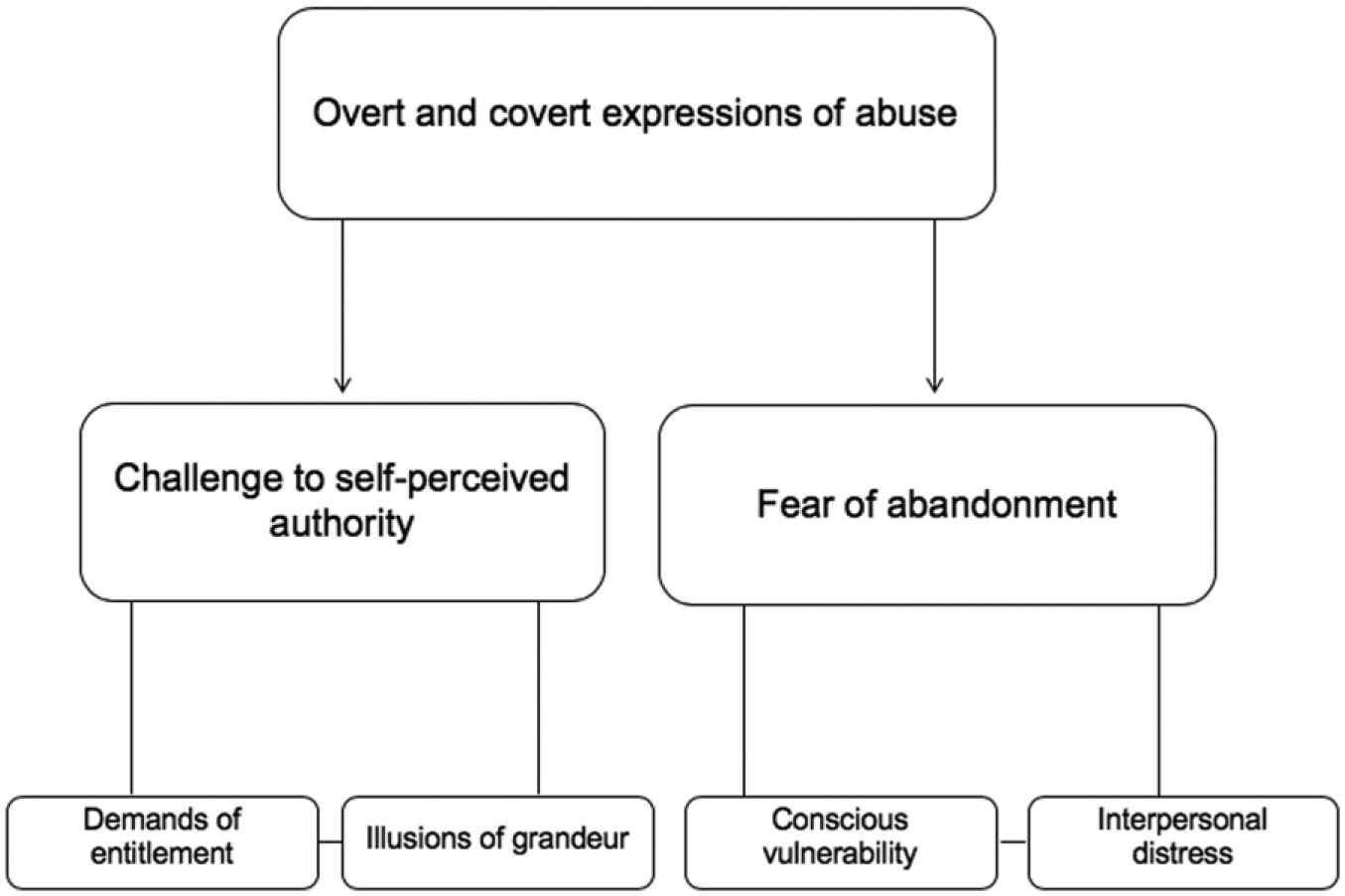
Thematic Map.
Overt and Covert Expressions of Abuse
This theme concerned the common and frequent expressions of narcissistic rage in intimate relationships. The narcissists described in this sample were perceived to be in a constant state of rage, which appeared to be manifested outwardly in the form of verbal and physical abuse, and inwardly in terms of more subtle and repressed anger, pernicious psychological manipulation, and passive–aggressive behavior. The harm enacted to participants was perceived to be instigated of feelings of control, dominance, and power on part of their narcissistic partners. At times, the rage was experienced as unpredictable, frightening, and occurring without apparent provocations: . . . he was always mad for no reason. He was always physically abusive when we argued. One time he sat on top of me and head-butted me on the nose because he saw a text I sent to a friend that he was “mentally ill.” I cried and panicked but he said it was my fault and later on showed remorse and started playing the victim. (Sarah—grandiose partner)
Although physical assault was a common theme underpinning victimization of violent behavior, many participants experienced the psychological abuse as more damaging, with violent threats, coercive control, and the systematic attempts to menace and invalidate their perceived reality (i.e., “gas-lighting”) as being significant factors in their mental health.
A glaringly example of “gas-lighting” was conveyed by Elisabeth, who suffered prolonged psychological abuse during her relationship: He would tell me what the reality was and he justified it so well and he was so convinced in his arguments that I would sort of accept his reality as my own . . . I felt like I was part of his reality to the point where I didn’t even have my own thoughts anymore. (Elisabeth—vulnerable partner)
Similarly remarked by another victim of severe psychological torment, In the end the rage was huge, violent, scary and lots of threats of killing me and my children. I mean he threatened to burn me and my children alive. (Jessica—grandiose partner)
The interpersonally exploitative and devious nature of their relationships was described by participants as both swift and vicious, as well as slow and insidious. Participants conveyed sentiments that the attachment they formed with their narcissistic partners left them with feelings of worthlessness, confusion, anxiety, posttraumatic stress and suicidal ideation as a result of the tormenting behaviors, blame-shifting tendencies, and the disavowal of the ramifications following the maltreatment they were sustained to.
Challenge to Self-Perceived Authority
This theme illustrated the common underlying trigger that evoked rage in narcissistic partners who displayed grandiose characteristics. During thematic coding, several elements of grandiose personalities emerged, such as overt expressions of arrogance, self-absorption, and exhibition of superiority in attitude and behavior without any need for its justification. These defining characteristics appeared to be underpinned by inflated demands of entitlement and illusions of grandeur. Analysis showed that rage associated with grandiosely narcissistic partners appeared to be commonly provoked by confrontation or perceived threats to their self-worth (exemplified in the data excerpts below): The minute I stood up against him or he felt he was losing control he would get aggressive and violent . . . once we were arguing and he knew he was losing the argument so he grabbed the iron, held it two inches from my face and said “I will burn you and nobody will ever look at you again.” (Jessica—grandiose partner)
And, Once I said something and she got offended and said “well normally I would just get up and punch you in the face.” (Lydia—grandiose partner)
Narcissistically grandiose partners were narrated to make hostile outbursts through a justification underpinned by feelings of entitlement for being “special” and “superior.” Deviant patterns of behavior manifested in continual attempts to reassert dominance and control in interpersonal contexts. Susan describes, He didn’t like to be argued with, I should have just listened to him you know and have him taking over complete control. (Susan—grandiose partner)
Infuriation precipitated by ego threats stemming from unmet expectations was described by most participants. In responses to narcissistic injury, perceptions of grandiose narcissists suggest that restoration of self-esteem is maintained through engaging in self-regulatory behaviors to undermine and derogate partners, often quite overtly, as a way to defend themselves against slightest injury and ego-threatening contexts. It is apparent in the data that there is a dissonance between narcissists’ expectations of intimate relationships (i.e., self-enhancement by means of admiring attention) and their tendency to fluctuate with hostility when their selves have been threatened. Paradoxically, it appears grandiose narcissists use self-defeating strategies in interpersonal relationships, essentially undermining the self they are trying to build and maintain.
Fear of Abandonment
The common underlying trigger that fueled narcissistic rage in individuals who exhibited vulnerable characteristics was the fear of being abandoned (i.e., losing narcissistic supply). Vulnerable characteristics were apparent in the interview narratives, with features of hypersensitivity, insecurity, jealousy, paranoia, control, and an exploitative interpersonal style being common of narcissistic partners as recalled by the participants. Vulnerably narcissistic partners were perceived to regularly become enraged at the slightest fear of rejection or abandonment, underpinned by defenses against conscious vulnerability and interpersonal distress: Just the idea, the prospect of us breaking up freaked him out so much that I sort of had to take it back in a way you know because it seemed to utterly destroy him. (Elisabeth—vulnerable partner)
Similarly as described by another victim, Well the fact that me and him were on the verge of breaking up for such a long time and never actually broke up says a lot about how he didn’t want me to ever leave him . . . (Rebecca—vulnerable partner)
Participants conveyed that they gradually cut people out of their lives and became isolated as they struggled to leave their long-term relationships. The data also show that vulnerable narcissists were perceived to manipulate in ways to inspire more sympathy, power, and control from their partners and to keep them in a heightened state of codependent anxiety. The quote below provides an example of how the “victim card” is exploited in an attempt to maintain control: He would never admit that “I never want to lose you” but I think he was so afraid of losing me that he turned into the victim just to keep me. (Danielle—vulnerable partner)
In the case of vulnerable narcissists as described in this sample, responses to narcissistic injury and underlying triggers of rage, mostly sulky passive–aggressive behavior, stemmed from fears of losing external validation in the service of self-esteem regulation. This fearful attachment style was evidenced across the narratives and is indicative of vulnerable narcissists’ covert entitled expectations of partners to satisfy their needs while fearing they will fail to do so. Participants’ perceptions of the covert and manipulative tactics inflicted upon them in the attempt for control and isolation suggests that vulnerable narcissists engage in self-regulatory behaviors intended to defend their vulnerability.
Discussion
The findings of this study support previous empirical research establishing a clear link between subclinical narcissism and criminal behavior (Blinkhorn et al., 2016; Campbell & Foster, 2002; Hepper et al., 2014; Larson et al., 2015; Miller & Campbell, 2008) and concepts relating to threaten egotism and narcissistic injury (Freud, 1914/1957; Kohut, 1977; Logan, 2009; Twenge & Campbell, 2003). From the participants’ accounts, narcissists in this sample were perceived to exhibit a pervasive pattern of defensive responses to sources of ego threats and injury accompanied by violent outbursts. Such findings provide further support to the notion that narcissistic injury is not necessarily symptomatic of narcissism as a full-fledged personality disorder. In this study, narcissistic partners were described as experiencing chronic rage reactions in both overt and covert forms, adding further credence to the existence of explosive and passive–aggressive types of rage identified in previous research (Krizan & Johar, 2015; Miller et al., 2010; Roark, 2012). Interestingly, the literature has repeatedly noted that angry outbursts are almost intrinsic to the narcissistic personality. Despite this, the DSM-5 does not specifically refer to this core feature in its nine criteria (APA, 2013).
The significant distress and pain experienced by participants shed light on the dysfunctional context narcissists create through their interpersonal hostility, resulting in a lack of empathy and callous exploitation of others (Blinkhorn et al., 2016; Brown, 2004; Campbell et al., 2002; Filippini, 2005; Foster & Campbell, 2005; Määttä et al., 2012; Miller et al., 2010; Moeller et al., 2009; Peterson & DeHart, 2014; Rhodewalt & Eddings, 2002; Tortoriello et al., 2017). Interestingly, an intriguing pattern emerged throughout the interview narratives, suggesting that the entitled expectations and exploitative motivations driving behavior and the attempt to regulate self-esteem appear to diverge for the two subtypes of narcissistic presentation. In terms of the overt presentation of the grandiose narcissistic subtype, participants shared experiences of being subjected to hostile outbursts when demands of entitlement, admiration, and perceived authority were not met. These tendencies reflective of the grandiose type are consistent with both theory and research (Besser & Priel, 2010; Campbell et al., 2002; Dickinson & Pincus, 2003; McNulty & Widman, 2014; Rohmann et al., 2012). The data demonstrated that grandiose narcissists were perceived to show little interpersonal distress, coupled with an inability to endure committed long-term relationships, suggesting that partners serve as narcissistic supply. Participants reported feeling deceived as their whole relationship appeared to be an illusion, much like the identity portrayed by the narcissist.
Contrary to long-standing preconceived notions of the stereotypical grandiose narcissist, the vulnerable subtype is arguably the lesser seen and understood image of narcissism in interpersonal contexts, given its overt presentation of shyness, constraint, and emotional sensitivity. These reticent behaviors intrinsic to the overt presentation of the vulnerable narcissist were highlighted in the participants’ accounts indicating that they would not necessarily label their partners as narcissists because their behavior did not fully match the extant findings or literature regarding narcissism. In line with previous research, vulnerable narcissists appeared to display high levels of interpersonal distress, emotional sensitivity, and extreme reliance on their partners to modulate self-esteem (Besser & Priel, 2010; Dickinson & Pincus, 2003). Yet, in previous research, vulnerable narcissists are believed to be prone to avoiding relationships, and this avoidance serves to sustain elevated self-esteem against conscious awareness of chronic disappointments and self-esteem threat (Dickinson & Pincus, 2003). In this study, however, results provide new insights into how vulnerable narcissists are perceived to maintain their intimate relationships, and, more importantly, identify the underlying dynamics driving their relationship-threatening behaviors. Indeed, it is suggested here that, at the crux of vulnerable narcissism is the profound fear of abandonment, which appears to reside at the core of the narcissists’ maltreatment and interpersonal exploitation of intimate partners in attempts to defend self-conscious states of vulnerability and underlying narcissistic needs.
The results of this study provide further support for the theoretical distinction between grandiose and vulnerable subtypes of narcissistic character styles in the context of intimate relationships. Despite the evidence for a theoretical distinction, it is important to acknowledge that expressions of grandiose and vulnerable subtypes do overlap. The findings of this study showed that vulnerable narcissists, like grandiose narcissists, display domineering and vindictive interpersonal behaviors. These may be underpinned by high levels of interpersonal exploitation and entitlement across both subtypes, which is a core feature of the narcissistic personality. In support of this argument, Pincus and Lukowitsky (2010) contend that expressions of grandiosity and vulnerability may each be either overtly or covertly displayed, and, therefore, these character styles may appropriately be considered as states operating dialectically and reciprocally. Nevertheless, the distinctive expressions of narcissistic grandiosity and vulnerability in domestic violence will arguably provide insight into the motives and behaviors that initially gave rise to them. The current findings present a more individualized and complex image of the narcissist than what has been previously understood. Through qualitative real-life narratives, these findings add understanding to the nature of narcissists’ relationship-threatening behaviors, embrace the diversity and complexity of the narcissistic personality styles, and identify divergent self-regulatory behaviors underpinning responses to narcissistic injury.
Limitations and Future Directions
In terms of participant bias, the narratives developed throughout the interview process suggest that participants took an interest in being members of groups (i.e., recovery from “narcissistic abuse”), and sharing their stories while adapting to a particular vocabulary, which is driven and influenced by the language used in pop-psychology and self-help books. In terms of the authenticity of the data, it can be argued that participants’ recollections of their past relationships may have been somewhat restructured and rephrased through repeated telling in self-help groups. If this was indeed the case, this may affect the validity of the results as participants would be more likely to speak the language used in these groups rather than using their own voice. Data transcripts from the participants who had been with a vulnerable narcissist appear to have a more idiosyncratic style with less psychologized language in their recollections. This could be the result of there being a paucity of literature concerning the vulnerable narcissist in domestic violence, meaning that participants were unable to find a label or cause for the behavior of their partners and were “working this out” through the dialogue in their interviews. It may also be evidence that individuals were using their own language to describe their experiences, and not the language and labels they had read about in literature and pop-psychology books.
It is recommended that future research incorporates data obtained from narcissists’ own accounts in intimate relationships to more accurately distinguish how grandiose and vulnerable narcissists differ in their responses to injury. Such research would complement that research related here and also allow for comparison and further granularity with regard to distinguishing and understanding the different types of narcissistic rage and their impacts. Elucidating characteristics and triggers to aggressive outbursts in grandiose and vulnerable narcissism can aid clinicians to develop appropriate courses of intervention to reduce potentially criminal behavior according to the type of narcissist. Furthermore, in light of research suggesting that manifestations of narcissism in females and males tend to differ (Morf & Rhodewalt, 2001; Ryan et al., 2008), it is recommended here that future research should explore female narcissists and their responses to narcissistic injury in intimate relationships to achieve a more complete image of the role of narcissism in domestic violence.
Current findings also support theoretical contentions that narcissism is not necessarily grounded in the perceptible grandiosity as suggested by the DSM-5 (Reynolds & Lejuez, 2012). In considering recommendations for practice, more caution and clarity should be placed on the DSM-5 criteria pertaining the diagnosis of NPD. In particular, an emphasis on the interpersonal features and self-regulation behaviours which underlie vulnerable narcissistic themes. It is noteworthy that earlier versions of NPD criteria (e.g. DSM-III and DSM-III-R) acknowledged vulnerable aspects of narcissism, such as shameful reactivity or humiliation in response to narcissistic injury. Vulnerable themes have been eliminated from subsequent versions of the DSM-5 criteria to increase its grandiose emphasis (Cain et al., 2008), and in turn, are only included in the self and interpersonal portion of the diagnosis (Criteria A), as opposed to the actual trait perspective (Criteria B; American Psychiatric Association, 2013). Failing to capture the complex and multidimensional aspects of narcissism may impede clinical recognition of patients who present narcissistic vulnerability (Pincus & Lukowitsky, 2010), along with the related self-regulation behaviours that drive narcissistic pathology. Vulnerable presentation in narcissistic patients may also be easily misdiagnosed as other personality disorders, such as borderline personality disorder (BPD; Ronningstam, 2011). Fear of abandonment, for instance, is a central marker for BPD (American Psychological Association, 2013). Future research should identify meaningful deviations in the interpersonal problems experienced by these individuals, and dismantle underlying causes to fears of abandonment.
Footnotes
Appendix
Declaration of Conflicting Interests
The author(s) declared no potential conflicts of interest with respect to the research, authorship, and/or publication of this article.
Funding
The author(s) received no financial support for the research, authorship, and/or publication of this article.