




Abstract
First-year undergraduates’ expectations and experience of university and student engagement variables were investigated to determine how these perceptions influence their student identity and overall course satisfaction. Data collected from 554 first-year undergraduates at a large private university were analyzed. Participants were given the adapted version of the Melbourne Centre for the Study of Higher Education Survey to self-report their learning experience and engagement in the university community. The results showed that, in general, the students’ reasons of pursuing tertiary education were to open the door to career opportunities and skill development. Moreover, students’ views on their learning and university engagement were at the moderate level. In relation to student identity and overall student satisfaction, it is encouraging to state that their perceptions of studentship and course satisfaction were rather positive. After controlling for demographics, student engagement appeared to explain more variance in student identity, whereas students’ expectations and experience explained greater variance in students’ overall course satisfaction. Implications for practice, limitations, and recommendation of this study are addressed.
Introduction
First-year experience (FYE) at university has become a major topic since the past decade as it plays an important role in shaping students’ attitudes toward higher education in subsequent years (Baik, Naylor, & Arkoudis, 2015; Tinto, 1993; Upcraft, Gardner, & Barefoot, 2005). There is increasing evidence that university transitions can be a stressful and daunting fight for first-year students (James, Krause, & Jennings, 2010; Wintre & Yaffe, 2000). Failure to handle such transition adequately can result in significant distress and increased attrition rates, so universities are under increasing pressure to retain and graduate more students (Smith & Hopkins, 2005). Malaysia has the aspiration to become an international and regional education hub in Southeast Asia, and as seen in the recent Malaysia Education Blueprint (2015-2025) for higher education, it seeks to create a higher education system that ranks among the world’s leading education systems which would then enable Malaysia to compete in the global economy (Ministry of Education, 2015).
In the face of difficult economic circumstances, a wide range of quality tertiary qualifications at affordable prices is the unique selling point of education in Malaysia among Asian countries (Alexandra, 2017). In addition, international students have permission to work under extremely lenient conditions. It was therefore no surprise that Malaysia is currently ranked as the 11th most preferred education destination in the world (Alexandra, 2017). To ensure the quality of every academic program in both public and private education institutions, the Malaysian Qualification Agency (MQA), under the purview of the Ministry of Higher Education (MOHE), is established to regulate the higher education sector in Malaysia. Malaysia’s first rating system, SETARA (Malaysia’s Rating System for Higher Education Institutions), has also been implemented since 2009 to assess the quality of undergraduate teaching and learning in higher education institutions (HEIs). Subsequently, another rating system, My QUEST (Malaysian Quality Evaluation System for Private Colleges) was introduced in 2011 to evaluate the current performance of private colleges in Malaysia in the areas of programs, students, resources, governance, and graduates. These rating systems thus provide useful guidelines for the selection of institution and programs of study offered by various HEIs in Malaysia (Alexandra, 2017).
Malaysia has positioned itself as an international and regional education hub and correspondingly has experienced an increasing influx of international students with the rapid growth of tertiary colleges and universities in Malaysia (Ministry of Education, 2015). The “massification” of higher education due to the increasing number of local and international students, the impact of online technologies on education, and the increasing importance of quality assurance have resulted in changes to the higher education landscape (Alexandra, 2017; Awang, Kutty, & Ahmad, 2014; Latifah & Mansor, 2007). These developments and changes require empirical investigation into the academic, psychological, and social experiences of first-year students, which may have an impact on student identity and satisfaction in Malaysian HEIs (Hendel, 2007; Normala & Dileep, 2012). This research aims to fill the gap in the literature by investigating the impact of freshmen’s expectations, experiences of university, and engagements on student identity and overall course satisfaction in a private university in Malaysia, specifically UCSI University.
UCSI University shares the aspiration and takes up the challenge and responsibility of making Malaysia the regional hub of higher education. It is nationally renowned for its high-quality teaching, research, and innovation. In the 2018 QS World University Rankings, the UCSI University is the only Malaysian private university in the top 500 worldwide, as well as Asia’s fastest rising university (Hazlina, 2018). Anchored on a 30-year track record, the university affirms its commitment to quality education, and the university has retained its “Tier 5” or “Excellent” status in SETARA (2017) rating. As a rite of passage for freshmen to be inducted into the university, a 2-day orientation program that comprises a series of briefings and fun games is held before the start of their academic journey. Freshmen get to meet and interact with their academic advisors and lecturers during these 2 days. There also are senior–junior sessions where the new students can meet the seniors in their respective program, so that they can get an idea of what to expect and what to aspire to on a guided basis. To enhance the student experience at UCSI, the new students can engage in peer-assisted learning on the industry, community engagement, and extracurricular activities during their studies.
Literature Review
Globally, student attrition is a serious problem for universities and colleges and these institutions usually lose the greatest number of students during the freshmen year. For example, Rausch and Hamilton (2006) reported that 30% of the 22 million students in American universities dropped out after the freshmen year. In a meta-analysis, O’Neill, Wallstedt, Eika, and Hartvigsen (2011) found an average student attrition rate of 11.1% from the tertiary institutions. A similar trend has been noted in Asia. In an open and distance learning institution in Malaysia, the student attrition rate was 21.5% (Latifah & Mansor, 2007). Govindarajo and Kumar (2012) reported that the student attrition rate for a private university was 14% in just 6 months. Although these studies conclude that the student attrition rate stays remarkably constant over time, the relatively high attrition rate is a cause of concern for universities and colleges.
Johnston (1997) identified academic performance, finances, health, full-time employment, change of institutions, lack of interest, and family responsibilities as correlates of attrition among Scottish students. Yorke and Longden (2008) argued that financial hardship is a significant factor affecting student retention and persistence to completion. Aside from financial hardship, other reasons reported include perceived racism and discrimination among African American undergraduates (Brown, Morning, & Watkins, 2005) and lack of academic preparation among U.S. undergraduates (Veenstra, 2009). For Australian universities, Willcoxson, Cotter, and Joy (2011) related that attrition was affected by insufficient financial aid, increased competition, and the inability to adapt to university study. From the perspective of Malaysian undergraduates, Normala and Dileep (2012) identified increased competition, ranking of universities, unattractive scholarship offers, negative perception of homegrown program awards, inadequate academic standing and stature of Malaysian lecturers, personal financial problems, examination pass rates, insufficient campus entertainment, tuition fees increase, inconvenience of public transportation, and language difficulties as statistical risk factors. All studies referenced above shed light on the importance of investigating students’ expectations and experiences of studying and their engagement at university.
Student Expectations and Experiences of Studying at University
Taking on the new role of university or college student often brings many new challenges concerning social and academic adjustment. Prior studies have found that if the first year goes well, attrition is less of an issue (Govindarajo & Kumar, 2012; Latifah & Mansor, 2007; O’Neill et al., 2011; Rausch & Hamilton, 2006). Much of the previous literature conveyed that learning at university is likely to be very different from learning at school, and many students harbor unrealistic expectations of themselves and of their universities prior to arriving at university (Crisp et al., 2009; Kandinko & Mawer, 2013; Lowe & Cook, 2003; Murtagh, 2010; Smith & Hopkins, 2005). While new students are rather confident about their academic capabilities, they always identify that there are disparities between their expectations of class sizes, service delivery, staff availability, and workload, and the reality. Such a mismatch leads them to experience academic struggles in higher education, where the emphasis is on independent learning (Crisp et al., 2009; Lowe & Cook, 2003; Murtagh, 2010). Yorke and Longden (2008) similarly mentioned that students are much more unlikely to continue their studies into a second year when their social and academic expectations are not met.
Numerous studies have repeatedly emphasized that contacts between university staff and students are vital for students’ success in university (James et al., 2010; Johnston, 1997; Wilcox, Winn, & Fyvie-Gauld, 2005). First-year students often expect the same kind of “teaching” at university, which they had experienced at school, where the lecturer will spoon-feed them (Smith & Hopkins, 2005). As noted by Lowe and Cook (2003), two fifths of students had expected lecturers to be more compassionate and supportive, and one third had thought that lecturers would be more caring and enthusiastic. However, the budget crises in the higher education sector has resulted in many universities putting greater reliance on large-group lectures rather than small-group learning classes (Baik et al., 2015), especially for the first- and second-year introductory courses. And for many students, attending larger lecture-type classes seems to be unrewarding or ineffective as they get by with less individual attention from the teaching staff (Kandinko & Mawer, 2013). Moreover, some students tend to think that it is the lecturer’s responsibility to ensure that students learn, whereas lecturers tend to think that students should truly take responsibility for their learning (Johnston, 1997). As a result, some students found themselves demotivated to keep up or felt too overwhelmed to seek for help in front of many of their peers who were listening (Lowe & Cook, 2003). These obstacles are likely to make it harder for students to adjust well during their transition to higher education.
Jacobs and Newstead (2000) investigated and tracked undergraduate student motivation and posited two types of students—one motivated by the subject of their study and the other by the acquisition of more general experiences and skills. They indicated that some aspects of student motivation deteriorated across the duration of the degree although some acquired skills may increase in the final year. Baik et al. (2015) stated that motivation and the ability to cope with university studies remains problematic for about a third of Australian university students in their first year. Yusoff’s (2013) study of pass–fail outcomes and psychological health of first-year medical students at a university in Malaysia revealed that psychological stress is a motivating factor for failure. While Yusoff’s (2013) sample was small, it opened up an area of investigation pertaining to the first-year student experience, coping strategies, and their impact on academic achievement. The findings of these various studies imply that further investigation into student motivation, resilience, and persistence could yield valuable insights for strategies of encouraging student retention and persistence to completion.
The significance of teaching and learning strategies to the FYE is examined in Schrader and Brown’s (2008) quantitative study that scrutinized an intervention program developed for first-year university students to facilitate their transition to tertiary education. While Schrader and Brown (2008) were careful to disclaim the generalizability of their data due to their small sample, they indicated that students who underwent the FYE course experience more gains over time when compared with students who did not take the FYE seminar. Lifton, Cohen, and Schlesinger (2007) conducted a 4-year longitudinal study to examine the efforts made to raise the level of persistence to graduate among business students. Their findings identified that a curriculum link between the FYE seminar and a course in their discipline would consolidate the students’ persistence and retention. Larmar and Ingamells (2010) reported on a range of effective school-based university orientation and engagement activities that effectively engaged first-year Human Service and Social Network students at Griffith University at institutional, academic, and peer levels. While Larmar and Ingamells’s (2010) study had obvious policy implications at national levels, Lifton et al.’s (2007) work underscored the importance of integrating academic objectives and outcomes with the socialization objectives and outcomes for better student adjustment in the first year.
Student Engagement
Student engagement is defined as positive behavior or a positive state of mind at school that leads to being physically involved, cognitively vigilant, and emotionally connected to studies (Parsons & Taylor, 2011). According to Jennifer, Phyllis, and Alison (2004), student engagement contains two types of elements: The first is the quantity and quality of student involvement in educational purposeful activities, and the second is how the institution utilizes its resources in creating an environment that is full of learning opportunities to nurture more involved students. When the students are not engaged, there will be negative behavioral and psychological consequences, such as low academic achievement, isolation, and high dropout rates (Jennifer et al., 2004).
Baik et al. (2015) found a larger proportion of students reporting a lack of social and academic connection to their institution of higher learning, with about a third of students having a difficult time adjusting to the social atmosphere at university. They suggested a possible continuing trend of disengagement arising from advancements in online learning. Buote et al. (2007) examined the relationship between new friendships and the process of adjustment to university life for first-year students in six Canadian universities. The results of the study indicated a positive relationship between the two—the more successful the new friendship, the better the process of adjustment to the university environment. They also showed a statistically significant relationship between the success of new relationships and the students’ academic adjustment and attachment to the university. Wintre and Yaffe’s (2000) study corroborated the importance of students’ strong affective ties to significant people for their process of adjustment to university life. Rayle and Chung’s (2007) study of gender and student adjustment to the college environment revealed that female students experienced higher levels of support from family and friends and less academic stress. The study also indicated that college friends’ social support was a key factor in predicting academic stress levels. Awang et al.’s (2014) small qualitative exploration of perceived social support and well-being for first-year students at a Malaysian university also found positive relationships between students and their peers and parents and their adjustment to university life.
The impact of social media and networking during the first year is investigated by Nalbone et al. (2015) and West, Moore, and Barry (2015). Nalbone et al. (2015) indicated in their study of the use of social network sites to assist student transition that students connected to a university-established virtual network and community experienced a smoother transition to university life. West et al. (2015) reported in their findings that using Twitter as a teaching tool enabled students to feel more connected to their classmates, the professors, and to members of the professional community. While Baik et al. (2015) suggested a correlation between the rise of online learning and student disengagement, Nalbone et al. (2015) and West et al.’s (2015) studies argued that the increasing presence of online learning and social media as a stable form of communication within universities could be put to effective use to develop more student engagement by the institutions of higher learning.
Nevertheless, Crisp et al. (2009) found in their study that 70% of students studied alongside their working life. Longden (2006) also found that over 40% of their sample of first-year students held some kind of job to cover at least part of their living or study expenses. It appears that while attendance at lectures may have a positive impact on students’ academic performance (Crisp et al., 2009), there is anecdotal evidence suggesting that working students are much more likely to become detached from the classes (Field, 2012). This may exacerbate student disengagement in the areas of academic, social, or extracurricular activities, and eventually they tend to have an apathetic attitude toward their universities (Lowe & Cook, 2003). Moreover, Baik et al.’s (2015) longitudinal FYE study of students in Australian universities indicated that while there has been a positive trend over 20 years of reduction in the numbers of students considering deferment or premature termination of studies, there has also been a rise in the number of students who identify emotional well-being as a reason for deferment (Krause, Hartley, James, & McInnis, 2005). The findings of the above studies supported the need for a consistent and comprehensive study of student engagement and social interaction in the future to encourage positive student experience and retention.
Of all the studies discussed above, only the national studies conducted by James et al. (2010), Krause et al. (2005), Baik et al. (2015), Yorke and Longden (2008), and Larmar and Ingamells (2010) yield findings with stronger implications for national and institutional policy making and implementation. The educational landscapes featured in much of the literature about the FYE pertain to Australia, the United Kingdom, and the United States. Examinations of the FYE in Malaysian tertiary education have been sparse and limited in scale. Furthermore, there has been no study conducted to examine first-year students’ expectations, experience, and engagement in multiple dimensions in Malaysian HEIs, the findings of which may have implications for Malaysian national and institutional policy and practice.
Method
Participants
Data were collected from students enrolled in a large private university in Malaysia. Of the 600 questionnaires sent out, a total of 554 students provided usable surveys with 35.7% males and 64.3% females. Their ages ranged from 18 to 29 years, with a mean age of 20.43 years (SD = 1.50). There were 82.3% Chinese, 3.6% Malay, 5.4% Indian, and 8.7% Others. A delineation of the participants in each academic discipline is as follows: 22% were from Applied Science, 56.3% from Business and Information Sciences, 3.6% from Hospitality and Tourism Management, 4.7% from Medicine and Health Sciences, 0.4% from Social Sciences and Liberal Arts and Creative Arts and Design, and 12.6% from Music disciplines. Seventy-eighty percent were Malaysians and the remaining were international students. In terms of financing university education, 46% of students seek parents’ help to fund their studies and the remainder relied on savings (15.1%), scholarship (15%), loans (12.3%), part-time jobs (9.2%), spouses (1.3%), and full-time jobs (1.1%). From the total sample, 174 students had either part-time or full-time jobs, while going to university, for the following reasons: to gain work experience (70.2%), to be financially independent (67.8%), for necessities (62.1%), to improve employability (58.6%), for savings (57.4%), for extra expenses (56.3%), to support family (51.7%), and to pay off loans (42.6%). A total of 178 students have thought of deferment for the following reasons: physical health (33.7%), thought they might fail (30.4%), financial reasons (29.2%), emotional health (27%), family commitment (25.8%), the university wasn’t what they expected it to be (24.7%), job commitment (23.7%), to find a new job (23.5%), and changing courses (22.5%).
Procedure
Trained research assistants distributed the questionnaires to students prior to the start of class. Earlier, institutional review board approval was obtained. Participants first read and signed an informed consent and questionnaires were administered. Completed questionnaires were collected in sealed envelopes.
Materials
The following measures were contained in a 122-item questionnaire. The questionnaire was adapted from Baik et al.’s (2015) measure of first-year university experience validated with Australian college population. We altered some items to make the items more relevant to the context of the university. The first section of the questionnaire summarized commencing students’ expectations and experiences of university. The data captured within the section included reasons for attending university, purpose of university education, adjustment to university education, curriculum perception, teaching perception, availability of online technologies, and university strain. The second part of the survey explored commencing students’ perception of their engagement in six dimensions: engagement with the university, classroom engagement, learning engagement, academic staff engagement, peer engagement, and beyond classroom engagement. The frequency of university engagement and frequency of technology usage were also explored in the second part. The third part of the survey involved student identity and overall course satisfaction. Students were asked to complete the questionnaire with answer options ranging from strongly disagree to strongly agree to rate how much the term is true for them, or never to regularly, to reflect frequency of behaviors/thoughts. Demographic information on the participants such as age, gender, ethnicity, academic discipline, nationality, financing university education, paid job involvement, and thought to defer were captured.
Statistical Analyses
Data were analyzed with SPSS for Windows Statistical Package. Descriptive statistics were used to summarize the participant’s data and the answer of the inventory and the scale. For better presentation of descriptive statistics, the original 5-point Likert-type scale response was changed to a 3-point format (strongly disagree and disagree were combined, as were agree and strongly agree; Sara & Bettina, 2013). The items were then added up and averaged by the number of items in each factor to produce sum scores. We then performed simple correlations between all variables, with particular interest in the relationships between university expectations and experience, student engagement, student identity, and overall course satisfaction. We next performed regression analyses. To do so, we used hierarchical multiple regression to determine the extent to which different forms of university expectations and experience, as well as student engagement, predicted student identity and overall course satisfaction. All results were set at .05 significance level (Creswell & Plano Clark, 2011).
Results
Students’ Expectations and Experiences of University
Reasons for attending university
A total of 84.2% of students said that improving job prospects was the biggest reason for attending university. Students also were motivated to attend university for both developing their talents and receiving specific training. However, meeting parents’ expectations has a lesser impact on students’ decision to attend university.
Purpose of university education
A total of 78.7% reported that they are clear about the reasons they came to university. Only 4.3% indicated that they do not know the type of occupation that they wanted to do or the reasons for coming to the university.
Adjustment to university education
A total of 53.5% of students perceived that the subjects at the university clearly build on their studies at school, although 43.4% agreed the standard of work expected at university is much higher than they expected. A total of 47.6% of students acknowledged that their parents have little understanding about what they are doing at the university.
Curriculum and teaching perception
In terms of curriculum perception, the results were mixed. About 70% of students felt that their curriculum sets a good base for their future studies; 65.7% indicated that the curriculum prepared them well for future career prospects. However, 62.9% and 54.9% of students doubted whether there was sufficient exposure to the latest research and university research from their curricula. On the contrary, the responses were generally favorable on teaching perception. Students perceived that the lecturers were providing good explanation, good quality of teaching, and were approachable, enthusiastic, and making continuous improvements on their teaching quality.
Availability of online technologies
In the area of student perception relating to the availability of online technology, 61.7% of students indicated there was access to study resources online and 60.7% acknowledged that most administrative tasks can be done online. However, 33.2% of students refuted there is good Wi-Fi access on campus. Dissatisfaction with the Wi-Fi access somehow overlapped with the study pressures in which some students need to spend more time on campus to access online educational resources (23.4%). One tenth of the students disagreed that guidance on how to use technology through academic or online support was sufficient.
University strain
A total of 44.2% of student agreed or strongly agreed that they felt overwhelmed frequently and they were finding it stressful to manage their studies given other commitments, and 44.8% indicated that their workload was too heavy (Table 1).
Proportion for Students’ Expectations and Experiences of University Scale Items.

Student Engagement
Engagement with the university, classroom engagement, learning engagement, academic staff engagement, peer engagement, and engagement beyond classroom
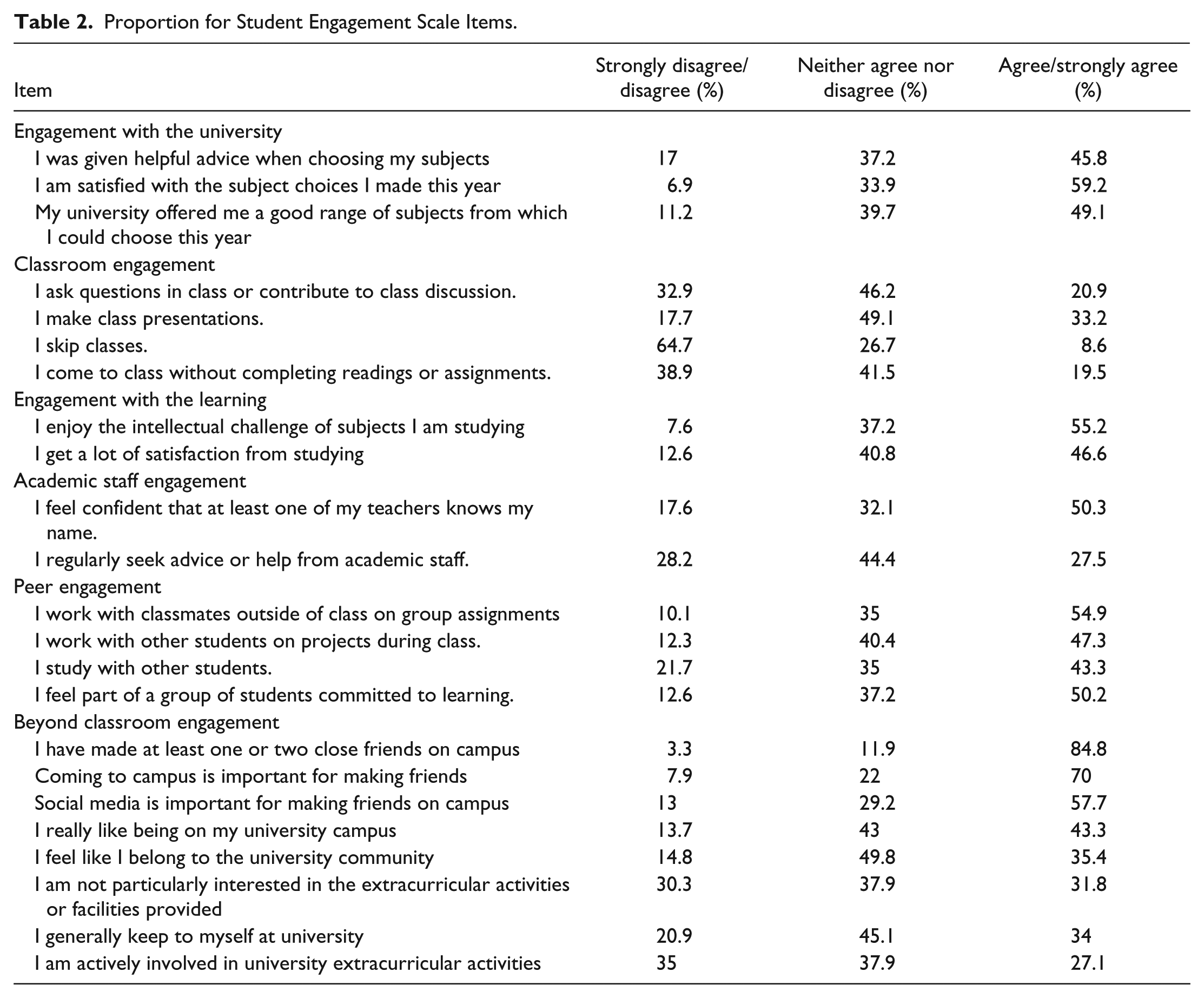
In the area of university engagement, students’ perceptions were somewhat positive: 59.2% of students perceived that they felt satisfied in the choice of subjects, 49.1% reported that the university offered a good range of subjects, and 45.8% indicated that they were readily able to get the advice they need. The level of engagement with peers was somewhat higher than with the classroom and academic staff. About half of students reported that they have worked with classmates outside of class (54.9%) and felt themselves being part of a study group (50.2%). On items measuring learning engagement, 55.2% agreed that their subjects of study in the degree program were intellectually stimulating and 46.6% perceived a lot of satisfaction from their studies. As for engagement beyond the classroom, 70% of students agreed that coming to campus is important for making friends, with 57.7% reporting that social media is for that purpose, and 84.8% indicated that they have made at least one or two close friends on campus (Table 2).
Proportion for Student Engagement Scale Items.
Frequency of university engagement
A total of 61.4% of students spent 5 days in a week on campus while 20.6% indicated 4 days per week; 48.4% reported that the total course contact hours per week is 16 to 20 hr, which is equivalent to four to five subjects in a semester. However, most students spent lesser hours on own study and e-learning in a week (Table 3).
Proportion for Frequency of University Engagement Scale Items.

Frequency of technology usage
On measures relating to the frequency of technology usage, 17% of students used online learning management systems on daily basis. Internet-based resources and social networking technologies also appeared to be popular study tools among students. On the contrary, lecture recordings and online discussion groups were less used (Table 4).
Proportion for Frequency of Technology Usage Scale Items.

Student Identity and Overall Course Satisfaction
Student identity
In terms of student identity, the results were promising: 57.5% liked being a university student, 52% felt excited to get in to university, and 44.8% felt they were a good fit with the university.
Overall course satisfaction
Items focusing on overall course experience indicated that the majority of students reported that they were enjoying their studies and find it intellectually stimulating, and 54.9% agreed that they were satisfied with their experience so far at university (Table 5).
Proportion for Student Identity and Overall Course Satisfaction Scale Items.

Correlation Analysis
The intercorrelations among the variables are shown in Table 6. These provide the basis for the following hierarchical multiple regression analyses.
Intercorrelations Among Variables.
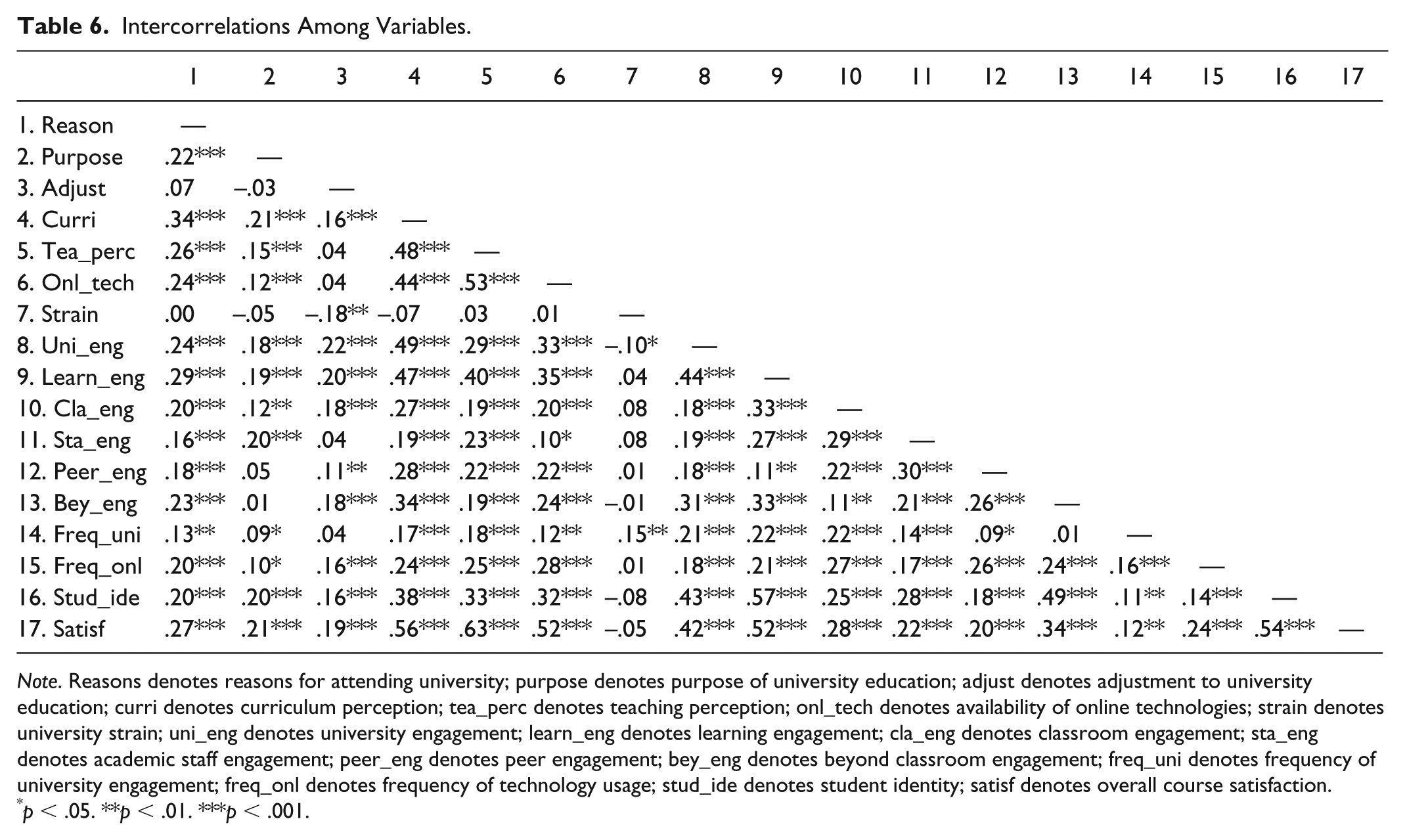
Note. Reasons denotes reasons for attending university; purpose denotes purpose of university education; adjust denotes adjustment to university education; curri denotes curriculum perception; tea_perc denotes teaching perception; onl_tech denotes availability of online technologies; strain denotes university strain; uni_eng denotes university engagement; learn_eng denotes learning engagement; cla_eng denotes classroom engagement; sta_eng denotes academic staff engagement; peer_eng denotes peer engagement; bey_eng denotes beyond classroom engagement; freq_uni denotes frequency of university engagement; freq_onl denotes frequency of technology usage; stud_ide denotes student identity; satisf denotes overall course satisfaction.
p < .05. **p < .01. ***p < .001.
Hierarchical Multiple Regression
Data were further analyzed by performing two separate hierarchical regressions for student identity and overall course satisfaction. Three blocks were entered sequentially in the regression equations during the analyses. The demographic variables were entered in the first step of the equation. All categorical variables were dummy coded before entering into the equations. Student expectations and experiences of university were added in the second step. The third predictor block was composed of student engagement variables. These variables were entered after the university expectations and experience on the basis of the presumed temporal sequence of occurrence of the events.
As can be seen in Table 7, none of the demographic variables made a significant contribution to the prediction of student identity, accounting only for 3% of variance. The second step accounted for an additional 22% of variance. Results demonstrated that students with high sense of purpose, better adjustment to university education, positive feelings about curriculum and teaching quality, and perceived availability of higher online technology were likely to have higher student identity. To our surprise, when student engagement variables were entered in the third block, only the purpose of university education remained to be a significant predictor. University engagement, learning engagement, classroom engagement, and beyond classroom engagement were found significantly and positively linked to student identity. Beyond classroom engagement thus emerged as a stronger unique predictor of student identity. An additional 25% of the variance in student identity was explained.
Hierarchical Multiple Regression Analyses for Predicting Student Identity and Overall Course Satisfaction.

Note. 1 indicates the reference group. AS = academic discipline; Freq = frequency.
However, ethnicity and paid job were found significant in predicting overall course satisfaction. Being Malay and nonworking students were more satisfied in their overall courses. The demographics block explained 4% of the variance. Adding the second block of predictors to the regression equation found that purpose of university education, adjustment to university education, curriculum perception, teaching perception, and availability of online technologies cumulatively made a significant contribution to the predictability of overall course satisfaction. An additional 51% of variance was added to the equation. Paid job remained to be a significant predictor, but not for ethnicity. The third block of predictors added another 4% to the variance and a total of 59% of the variance was accounted for. Only learning engagement and beyond classroom engagement significantly predicted reports of overall course satisfaction.
Discussion
The goal of this study was to come to an understanding about first-year undergraduates’ perceptions of their university expectations, experience, and engagement, and their influences on student identity and overall course satisfaction. Preliminary analyses showed that students in this study perceive that university education can open career opportunities, so they reported a significant sense of purpose to enroll in higher studies. Findings further suggested that students perceive their high schools had prepared them with adequate skills that assisted them to integrate positively into the university culture, which was in line with Johnston’s (1997) study. When describing university experience, quality of teaching, as an integral part of their course, was a factor as many gave a positive impression of the university, where lecturers were seen as very helpful and supportive. Besides lecturers, the quality of education needs to also be supported by information communication technology services (Nalbone et al., 2015; West et al., 2015). While students were generally satisfied with the availability of online technologies, some expressed frustration trying to access Wi-Fi services and Integrated Information System (IIS).
In terms of student engagement, students spent more hours on classroom learning and less hours on self-learning or e-learning. The students also demonstrated a lack of interest in classroom engagement, such as asking questions, but tended to focus more on developing networks of friends in study and outside study, supporting Buote et al.’s (2007) notion that young adults value much on friendships and peer companion. However, there were concerns that the lecture material was not as research-based as they had expected, so greater attention should be paid to close the gap between academic research and teaching materials. In addition, students often do experience financial difficulties during their degree course, so most students do some form of paid work while at university (Willcoxson et al., 2011). It is therefore not surprising that one in three students in this study combined paid work with their studies. Among working students, there were also greater concerns about the maintenance of good grades due to long working hours. It was also evident that students in general were having a strong sense of identity to be a university student and were satisfied with their courses.
Subsequent analyses found that purpose of university education, adjustment to university education, curriculum perception, teaching perception, and online technology availability to be positively related to student identity. It appears that increased feelings of sense of purpose, better adjustment to university education, curriculum perception, teaching quality, and availability of higher online technology were necessary conditions for fostering positive student identity. This can potentially lead students to adopt a deep approach to learning and trying to understand the course material (Upcraft et al., 2005; Yorke & Longden, 2008). Interestingly, the association between university experience and student identity is minimal at best, partially because the effects from these variables are concealed when student engagement variables are taken into account; only the purpose of university education remained to be a significant predictor. University engagement, learning engagement, classroom engagement, and beyond classroom engagement appear to be better predictors of student identity. These findings support prior studies that posited that student engagement is a key factor for better university transition (Jennifer et al., 2004; Parsons & Taylor, 2011; Veenstra, 2009). As is evident from the psychological literature, identity is a mental construct that is socially constructed (Abrams, 1999). This implies identity is not something that we find, it is something we build every day. With different aspects of engagement in life, they likely shape people’s cognitive schemata and behavioral scripts that allow people to change what they are aiming to become (Elliot, 2001). Further research is needed to gain additional insight into this matter and validate these results.
On the contrary, university expectations and experience appeared to be predicted more as a unique variance of overall course satisfaction compared with student engagement. Again, purpose of university education, adjustment to university education, curriculum perception, teaching perception, and availability of online technologies were predicted for overall course satisfaction. These results so far endorse the findings of the majority of studies on university experience and student satisfaction, showing the positive relationship to be a reliable one (Hendel, 2007; Larmar & Ingamells, 2010; Lifton et al., 2007; Wilcox et al., 2005). Learning engagement and beyond classroom engagement also affected their satisfaction. Furthermore, focusing on background characteristics does little to advance understanding of the reasons why students with part-time or full-time employment might withdraw. It was clear that working students tended to score lower on the overall course satisfaction (Crisp et al., 2009; Longden, 2006).
The findings offer important implications. First, the study adds to the body of knowledge about the factors that motivate first-year undergraduates’ student identity and overall course satisfaction. This research functions as a pilot study of a larger scale study of HEIs in Malaysia, and the results of this study can inform and guide a larger study in the future. Second, our findings set out practical advices that university and colleges could take to help first-year undergraduates chart a successful pathway from school to higher education. Specifically, universities and colleges should focus more on engagement factors such as peer-mentoring and staff–student interaction opportunities when considering student identity interventions. A need for better academic preparation, aided by appropriate practicalities, linked to good delivery, assessment, and facilities, is obvious to increase the overall actual experience of new undergraduates and help sustaining their satisfaction on overall courses.
Nevertheless, there are a number of limitations to consider when interpreting these findings. First, the nature of the data was cross-sectional, thus causality claims must be equivocal. A longitudinal research design may more effectively explore the effect of continued experiences and engagement in university. Second, future research should use both subjective and objective measures of first-year university experience to isolate the social desirability bias on present findings. Furthermore, the results, based on a sample of freshmen from a private university, although large and relatively diverse, were not representative of the Malaysian population. Studies with subjects from other universities are required to strengthen the external validity of the results of the present study. Despite inherent drawbacks, this study nevertheless provides a great deal of information about first-year undergraduates’ experience and engagement. Findings can thus help to inform decision making and create policies that are well suited to the needs of students. Taking an ever wider view, it is hoped that this article successfully sheds light for some understanding on factors relating to first-year undergraduates’ identity and overall satisfaction at university, and researchers in the future will be more apt to consider the importance of university experience and engagement from a variety of perspectives.
Footnotes
Declaration of Conflicting Interests
The author(s) declared no potential conflicts of interest with respect to the research, authorship, and/or publication of this article.
Funding
The author(s) disclosed receipt of the following financial support for the research, authorship, and/or publication of this article: This work was approved by UCSI University in Malaysia (Proj-In-FOSSLA-002), however, there is no any financial support from the university. All costs are borne by the authors.