




Abstract
China–Pakistan Economic Corridor (CPEC) has got a vital position in the perspectives of economic growth and sustainable development of China and Pakistan. Viewing these prospects, the Chinese organizations are taking interest to deal with Pakistani organizations for the reinforcement of the mergers and acquisitions (M&As) deals. But, soft issues (SIs), such as, differences in organizational and national cultures, leadership styles, and human resource (HR) practices, may arise between Sino–Pak business entities which may hamper the successful dealings of M&As. This research investigates the effects of SIs on knowledge and technology sharing and transfer (KTST) and firm performance (FP), leading to industry performance (IP), and KTST effect on FP. Drawing on social exchange theory, psychological contract development and maintenance (PCDM) is investigated as a moderator in this study. The convenience sampling technique and administrative survey approach are applied for data collection. The 550 questionnaires were distributed among the Chinese and Pakistani workers. However, only 435 respondents gave proper feedback. Partial least square, structural equation modeling (PLS-SEM), a statistical model through smart PLS-3 is applied to analyze the data. The results elucidate the negative impacts of SIs on KTST and FP while KTST affects positively on FP and FP positively affects IP. The PCDM significantly moderates the effects of SIs on KTST and FP. If the Chinese organizations concentrate upon PCDM, the SIs would be resolved. The productive deals of M&As would be helpful in underpinning the exclusive growth of CPEC projects. The implications and limitations are discussed at the end of this study.
Keywords
Introduction
The key intentions of organizations’ marriages are increasing in market share, profitability, performance, innovative knowledge, technologies, and competitive advantage. However, the previous studies corroborate the failure of these marriages in achieving the desired objectives. As per previous studies, the failure rate of organizational marriages fluctuates from 60% to 80% (Bari, Fanchen, & Baloch, 2016; Gunkel, Schlaegel, Rossteutscher, & Wolff, 2015; Weber & Tarba, 2010). The scholars highlight multiple reasons behind the failure/underperformance of mergers and acquisition (hereinafter M&As) strategies. According to the study of literature, M&As failures are associated with two kinds of issues: “hard issues” and “Soft Issues” (SIs). The hard issues consist of financial, legal, and marketing problems during M&As deals, whereas SIs comprise human resource (HR), national and organizational culture, and leadership styles problems (Bari et al., 2016). In the 20th century, M&As’ consultants and academic researchers were more concerned about hard issues than SIs (Sciriha & Debono, 2018). Scholars agreed that hard issues play a more significant role in the failure of M&As strategies. However, in the last decades of the 20th century, scholars and consultants changed their views regarding the reasons for M&As’ failures/underperformance by giving the importance to SIs. While entering into the 21st century, scholars have convinced that SIs play equally and sometimes more significant role in the achievement of M&As goals (Weber & Tarba, 2010).
The SIs become more significant when cross-border and cross-culture M&As deals are performed. M&As deals at the national level only create the problem of organizational culture clashes. However, a cross-border M&As deal creates not only corporate culture conflicts but also national culture clashes. Likewise, HR practices and leadership styles also clatter under the shadow of corporate and national mismanaged cultures. The scholars debate that culture leaves impacts passively during and after M&As deals, and it is the responsibility of leadership and the role of HR practices to manage the organizational culture accordingly (Dixon, 2005). The SIs are subjective which are convertible in accordance with every latest approach to reinforce M&As deal. The ineffective management of SIs may create problems in the executing M&As transactions. Conceptualizing with the knowledge sharing and social exchange theories, innovative technology, and the knowledge sharing process are highly dependant upon the mutual understanding and trust among the organizations (acquirer and acquiree) at strategic and operational levels. Ahammad, Tarba, Liu, and Glaister (2016) also substantiate the positive association between knowledge transfer and cross-border acquisition performance and a negative effect of contradicted organizational culture on cross-border M&As’ performance. The presence of SIs affects negatively on the transfer of innovative technology and diversified knowledge during and post-M&As deals (Aguilera & Dencker, 2004; Sarala & Vaara, 2010; Sarala, Junni, Cooper, & Tarba, 2016).
Due to the poor management of SIs during M&A deals with the afterward impacts, there is not only decrease in the incubated organization performance but also a negative effect upon the innovative technology and knowledge sharing practices. Through the lens of relationalism and structuralism paradigms, the negative or underperformance of the firms is observed which leads to a decrease in the relevant industry performance (IP). Based on the psychological contract (PC) theory, positive perception and mutual trust development among employees and top-level management may help to moderate the effects of SIs on knowledge and technology sharing and transfer (KTST) practices, firm performance (FP) leading to relevant IP (Conway & Coyle-Shapiro, 2012; Ejimonyeabala, 2014). The positive relational signals can develop mutual trust and long-term relations among employer and employees during and post-M&A deals.
China–Pakistan Economic Corridor (CPEC) is a gigantic and long-run economic project between China and Pakistan with the worth of US$54 to US$62 billion (Siddiqui, 2017). The CPEC would be supportive to flourish the economic progress of manifold domains of Pakistan such as road infrastructure and network, railways, energy pipelines, information technology, development of Gwadar seaport, and industrial growth (special industrial zones). The CPEC has been opening new horizons of business opportunities for Chinese organizations in Pakistan and vice versa. China has been emerging as superpower economically in the world. Chinese organizations have emerged in the international business markets with their cost-cutting strategies, innovative technologies, and advanced supply chain systems. Comparatively, most of the Pakistani organizations lack such exclusive business practices. The Chinese organizations have a vibrant, competitive edge as compared with the Pakistani organizations by these resourceful factors. On the basis of the technological advancement and strong financial position, China is a dominant strategic partner with good business practices to initiate M&As deals in Pakistan for Chinese business organizations.
China and Pakistan are bonded with everlasting friendship as neighboring states. Their testified diplomatic, political, and economic relations have completed seven decades successfully, and CPEC is a clear evidence of the said relationship. However, business to business and individual-level relations are at initial stages. China and Pakistan have visible social, cultural, and religious differences. These differences also depict in organizational culture and their business practices in both countries. In case Chinese organizations perform M&As deals in Pakistan, they may face SIs such as differences in national and organizational culture, languages, folkloric values, HR practices, and leadership styles. The global knowledge, innovative technologies, local culture, and local business practices are equally important for the success of cross-border M&As deals. The failure of M&As deals between Chinese and Pakistani organizations may also affect the objectives of CPEC (industrial performance of Pakistan).
The key objectives of the present study are as follows: first, to highlight the most common and expected SIs during M&As transactions among Sino–Pak organizations; second, as per literature, to measure the effects of the four most common SIs (such as national and organizational cultural differences, human resource management (HRM) practice differences, and different leadership styles) on KTST in cross-border M&As Sino–Pak business organizations deals; third, to investigate the effects of SIs and KTST practices upon FP, leading to IP; finally, based on relational signaling theory, to determine the effectiveness of psychological contract development and maintenance (PCDM) to overcome the SIs during cross-border M&As deals among Sino–Pak business organizations. To achieve these objectives, the present study has raised the following research questions.
For empirical investigation, the data are collected from those individuals (Chinese and Pakistani) who have at least 2 years joint working experience in Pakistan or China.
Literature Review
China Pakistan Economic Corridor
CPEC is a socioeconomic project signed in 2014 between “National Reforms and Development Commission of China” and “Ministry of Planning, Reforms, And Development of Pakistan.” The initial scope of the CPEC project was 47 agreements with US$46 billion investment by the Chinese government for 15 years (Abid & Ashfaq, 2016). The main projects and memorandum of understanding (MOUs) signed under the umbrella of CPEC are regarding roads development, energy projects, education, telecommunication, law and security, dry ports and seaports development, cotton industry, agriculture sector, technical skills exchange, energy pipelines, special economic zones (SEZs), and Chinese organizations’ investment in Pakistan (Chaudhri, 2017; Tong, 2015). China is a fast-growing economy, and Chinese investors and entrepreneurs are searching for new markets to expand their businesses and control their cost of production. Recent evidence of such Chinese entrepreneurs’ investment activities can be observed in African countries (Leavy, 2018).
Since 2014, both nations have achieved many milestones under the CPEC project. Currently, many Chinese organizations have established their businesses in Pakistan. In the future, considerable investment is anticipated from China in different sectors of Pakistan. Strong equity position of Chinese organizations and destabilized economic condition of Pakistan are providing the opportunities of M&As to Chinese organizations in Pakistan. Development of SEZs in Pakistan are arrangements to facilitate foreign investors in Pakistan (Makhdoom, Shah, & Sami, 2017). Sino–Pak has strong diplomatic, political, and economic relationships. However, both nations have a significantly different culture, ethnicities, religious practices, languages, food, and so on. Business organizations’ practices and cultures are designed and developed in the light of national culture and indigenous social values. The leadership of business organizations also consider the national culture, social values, and local individuals’ psychology while espousing leadership style and HR practices.
M&As deals of Chinese organizations in Pakistan may suffer because of cultural and ethnic differences at national and organizational levels between both nations. In literature, differences in culture, HR practices, and leadership styles are considered most common SIs during and post-M&As stages (Giffords & Dina, 2003; Weber & Tarba, 2010; J. Zhang et al., 2014). These SIs are considerably observed while studying many Pakistani students and businessmen in China. In an intercultural comparison study, Su (2017) explained that language difference is an excellent barrier to Pakistani students during the adaption of socio-cultural values of China. As per national culture theory, if Chinese organizations and their HR join Pakistani business environment, they can also face these kinds of cultural, social, and psychological issues. Ali, Ullah, Ahmad, Sadiq, and Siyal (2017) also described that people to people contact could improve through language learning, secure visa services, security, civic engagement, cultural exchange programs, and academic conferences between China and Pakistan. Social impact assessment regarding CPEC scholars explained that ethnic benefits and religious believes are severe risks at the macro level, while language, culture, and community benefits are high-level risks at the micro level (R. Zhang & Shi, 2016).
Soft Issues, Knowledge &Technology Sharing &Transfer, and Firm Performance
The SIs are denoted as national and organizational culture dissimilarities, divergence in HR practices, the difference in leadership styles, and social differences such as food, language, social values, and living style (Bari et al., 2016; Cartwright, Cooper, Cartwright, & Cooper, 1995; Nur, 2012). Since the 1980s, after emergence the concept of strategic HRM, the focus of scholars and consultants have been equally divided on hard issues and SIs (Gomes, Angwin, Peter, & Mellahi, 2012; Pikula, 1999).
Dixon (2005) described that culture is a soft notion and organizations should use culture-related surveys and multiple assessment tools to measure and manage the cultural clashes (Dixon, 2005; Walter & Walter, 2017). A practical approach to managing cultural issues is to develop a set of cultural features for all, such as customer-focused, innovative, conclusive, team-based, and respectful (Dixon, 2005). Giffords and Dina (2003) and Sciriha and Debono (2018) agreed that hard issues such as staff compensation during M&As deals are easy to measure than SIs such as organizational culture and human relations. However, they accept the effective role of SIs in M&As deals. Scholars explained that treatment of organizational culture is different at post-mergers than post-acquisitions deals. In acquisitions, usually, target organization changes its culture; however, in mergers, a combination of good cultural fit is required (Nur, 2012). With a good cultural fit, a new organization can perform better. Bresman, Birkinshaw, and Nobel (2010) and Weber, Shenkar, and Raveh (1996) presented a different view: they said, in cross-border M&As, cultural dissimilarities between two organizations are positively associated with the cooperation of top management, because employees are psychologically prepared for such types of changes and stress. Effective management of cultural differences, adaptation, and understanding can also help in KTST (Nur, 2012).
Walter and Walter (2017) pointed out that managers involved in M&As deals are identified by different cultural factors such as ethnicity, native language, and nationality. Although national and organizational cultural differences are a vital reason behind integration hitches, however, overemphasizing on the cultural differences as a reason for M&As failure by the managers should be noticed (Walter & Walter, 2017). Managers with special skills such as target organization language and culture understanding should be deployed in cross-border M&As deals. Hofstede, Hofstede, and Minkov (2010) explained that cross-border M&As have two-fold cultural differences (national and organizational); this double layer of culture may complicate integration of knowledge pools. However, any hard or soft critical reaction/s at incubated entity can create mutual irrelevancy, uncertainty, communication, and social clashes.
Along with cultural differences, contradictions in HRM policies and practices between two organizations also affect employees regarding KTST practices and FP at the post-M&As stage. A common culture can be created with justice in HRM practices of two cultures at a post-M&As stage such as reward management, training and development, workplace environment, and health security programs (Bansal, 2016; Sciriha & Debono, 2018). Discrimination among employees by HRM can create stress, uncertainty, and anxiety among employees at post-M&As stage (Napier, 1989; Weber & Tarba, 2010). Changes like salaries and benefits, job description, assignments, transfers to new places and jobs, and redesigning career paths can develop more worries among employees. However, supportive HR practices can develop a positive perception of M&As deals among employees (Buiter & Rotterdam, 2013). Drawing on social exchange theory (SET), when employees have a liberty to speak about organizational changes and HR practices are applied in justified and fair manners, reciprocally, employees are motivated to share knowledge and perform their jobs at their utmost level (Buiter & Rotterdam, 2013; Cook, Cheshire, Rice, & Nakagawa, 2013).
Variant leadership styles during and post cross-border M&A deals are also considered the significant SIs. The organizational and national cultures shape leadership styles. A leader with effective communication and justified strategy can win the trust, motivation, and loyalty and reduce stress and uncertainty among employees (Bari et al., 2016; Weber, Rachmann-Moore, & Tarba, 2012). Buiter and Rotterdam (2013) concluded that leaders serve as a focal person who manages the changes and convinces the subordinates for changes. Thus, a leader should be open, visible, transparent, and acknowledge the mistakes. The organization needs to develop an excellent cultural fit at the post-M&As stage; leaders need to change their styles as per new organizational and national cultures and environment of the organization. Rigid with parent organization leadership style and national culture, leaders promote demotivation, stress, and negative behavioral intentions (J. Zhang et al., 2014), which demotivates the employees to perform and share knowledge and technology at the post-M&A stage.
Knowledge &Technology Sharing &Transfer, and Firm Performance
As per SET, mutual trust and support are mandatory for KTST at the individual as well as organizational level (Emerson, 1976). The organizations keep objective to increase repositories of innovative knowledge and technology through M&As deals (Sarala et al., 2016). In the case of an acquisition, an acquirer ensures to grasp the explicit and tacit knowledge from the acquiree. Up to the extent of explicit knowledge, an acquirer may be successful. However, tacit knowledge which is the key to radical innovation is not easy as an explicit one. The SIs during M&As deals can stop employees from sharing their tacit knowledge. Nur (2012) referred to Weber et al. (1996) and explained that during international M&As, top management expects and is ready to adopt cultural and organizational structural changes by considering the domestic environment. Cross-border M&As deals can get better success through strategic management approaches with positive attitudes and enthusiastic behaviors. Cross-cultural understanding and adaptation by top managers positively support the KTST through effective communication strategy, informal meetings, and get-togethers (Nur, 2012). Cross-border M&As deals face two layers of cultural differences (national and organizational) which make the process of KTST more complicated (Hofstede et al., 2010). Junni, Sarala, Tarba, and Weber (2015) explained some managerial recommendations in their study regarding KTST. Key recommendations are as follows:

The KTST behaviors at post-M&As stage increase mutual trust, motivation, and teamwork among employees and they increase FP (Zhou & Li, 2012). Drawn on the theory of innovation, the KTST practices are a great source of innovation which also impact on the FP positively (Brueller, Carmeli, & Markman, 2018). Therefore, it is proposed that
Soft Issues, Firm Performance, and Industry Performance
Drawing on affective events theory (AET), scholars endorsed that SIs have a negative relationship with employees’ output and FP (Kim & Brymer, 2011; Lok & Crawford, 2004). Kedia and Reddy (2016) highlighted the importance of language in the success of cross-border acquisitions deals. Kedia and Reddy analyzed 1,120 U.S. deals in 33 target countries from 2007 to 2012 and concluded that linguistic distance has explanatory importance in post-acquisition performance. Bari et al. (2016) investigated the effects of effective communication strategy and coping programs on post-M&A performance and explained that an effective and open communication system significantly motivates the employees to increase the FP.
A firm stands as a unit of an industry. When the units of the industry increase their performance in a competitive environment, the performance of the industry increases. The same case happens at post-M&As, with the change of ownership and leadership, a local acquired firm changes its patterns of working as per the practices of foreign acquirer firm. A firm with innovative knowledge and technology creates a significant effect on cross-border targeted firm knowledge repository (Sun, 2018). A firm with innovative business practices leads other organizations in the industry with innovative knowledge and technology. Knowledge spillover can happen during instrumental guanxi/social network development (Bari & Fanchen, 2017). The employees of knowledge and technology-intensive firms may also leak/share some advance knowledge with competitors in the industry. With reference to relationalism and competitive advantage theory (Omerzel & Gulev, 2011), a firm with advanced knowledge and technology induces other firms of the same industry to compete and improve their performance within the industry (Hou, Yang, Yao, & Mckelvey, 2015). It means, some firms with innovative knowledge and technology are essential to the performance of the industry. Therefore, it is proposed that
Psychological Contract Development and Maintenance
A PC is the interaction between “expectations” and “offers” among employees and the organization (Ejimonyeabala, 2014). Rousseau (1989) defined the PC as an employee’s belief about the reciprocal obligations between the employer and the employee. The key elements of the PC include beliefs or perceptions, implicit, perceived agreement, an exchange, ongoing, and evolving. A PC theory confirms that the development of a PC may start from the initial recruitment interviews, documented HR policies, organizational management practices, and performance appraisal derived from firm representatives such as supervisors, strategic management, and HR staff (Restubog, Bordia, Tang, & Krebs, 2010). Robinson and Rousseau (1994) categorized the PC into three types. A transactional PC refers to specific types of exchanges, which include a limited range of behaviors for a certain period. A relational PC is based on loyalty and sustainability in the long run. Under the relational PC, employees perform their duties more than their legal bindings. A balanced PC comprises promises and obligations settled down by both sides interactively (Manxhari, 2015).
Drawn on PC theory, negative effects of SIs on KTST and FP can be moderated through successful PCDM during and post-M&As stage. Based on relational signaling theory and organizational justice theory, the leadership of both organizations can design certain policies and activities such as informal get-togethers and mutual cultural learning sessions to promote PCDM of both sides teams during and post-M&As deals (Six, 2007). A PCDM among employees and the employer of diversified culture (cross-border) can moderate the effects of SIs on employees’ behaviors and motivate them for mutual KTST (Yuseph, 2012). The motivated employees not only increase the FP (Bergamin & Braun, 2018) but also affect overall relevant IP. Thus, it is proposed that
Study Framework
In Figure 1, by considering the AET (Sinkovics, Zagelmeyer, & Kusstatscher, 2011), this study explains the negative relationship between SIs and KTST, and FP. In the second order, drawn on SET (Cook et al., 2013), the present study proposes PCDM as a moderator between SIs and KTST, and FP.
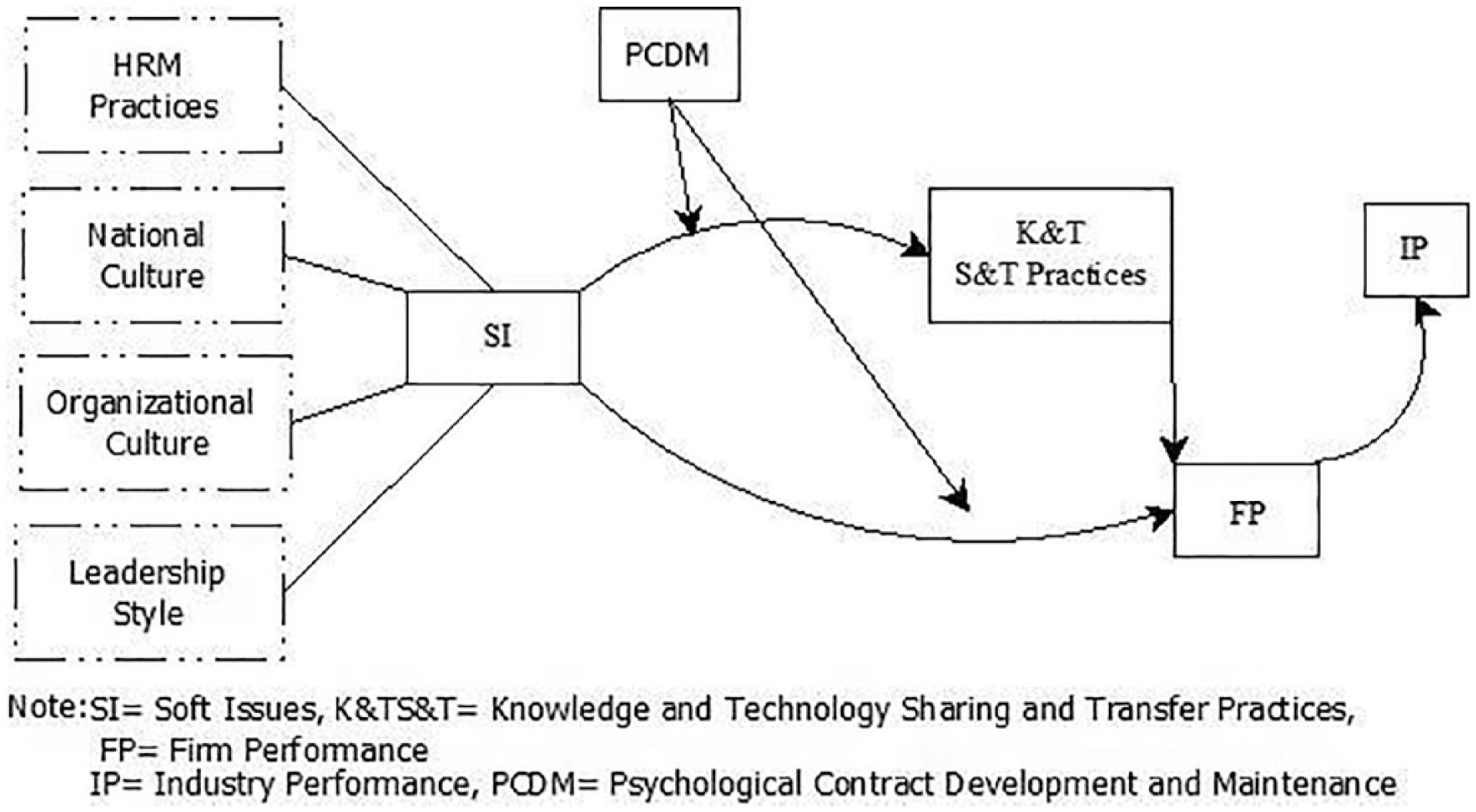
Study framework.
Research Methodology
Sampling Strategy and Context
Numerous opportunities of M&As deals between Sino–Pak organizations of different industries already availed and more are expected in the near future. The last couple of years, many Chinese investors and workers are living and working in Pakistan. Similarly, many Pakistani workers are working under the supervision of Chinese leadership in Pakistan and China. Thus, all those Chinese and Pakistani employers and employees are invited to participate as a respondent in the present study who have at least 2 years joint working experience in Pakistan or in China. It was very difficult to approach Chinese workers in Pakistan due to security and language issues. Therefore, in this cross-sectional study, “convenience sampling technique,” administrative survey approach with the bilingual questionnaire (English and Chinese), is used. All constructs are evaluated with 5-point Likert-type scale with a questionnaire developed from literature with some changes as per present study goals and context.
A total number of 550 questionnaires were distributed to employees and employers within different cities of Pakistan and through email to China. With two to three reminders and personal visits, 451 questionnaires were received back within a period of 3 months. Among 451, 16 questionnaires were ignored due to incomplete/improper responses. Therefore, the total useable response was 79% (435).
Measurement of Variables
Soft Issues
Multiple SIs can occur during and post M&As deals. However, after reviewing the literature, four types of SIs are selected to investigate.
HRM practices difference
Employees used their parent organization HRM practices. Post organizational changes, employees need to follow new HRM practices which may not attract them and decrease their motivation level. Two items are adopted from Datta (1991) to measure the perception of employees regarding the difference in HRM practices, that is, “Time period over which the reward and evaluation process focused (short-run vs. long-run performance).” Participants were asked to indicate the extent of perceived differences on a Likert-type scale (1 = very similar, 5 = very different).
National culture difference
National values, traditions, and behaviors affect the psychology of citizens. Learnings from prior national culture may create resistance during the adoption of another culture. To measure the differences in national culture, two items are adopted from Rottig, Schappert, and Starkman (2017), that is, “Individualists or Collectivists.” Participants were requested to indicate the extent of perceived differences on a Likert-type scale (1 = very similar, 5 = very different).
Organizational culture difference
Every organization has its own specific values and believes which may differ from other organizations whether within a country or cross-border. Two items adopted from Veiga, Lubatkin, Calori, and Very (2000) are used to measure the perception of respondents regarding organizational culture difference, that is, “Encourages cooperation more than the competition.” Participants were asked to indicate the extent of perceived differences on a Likert-type scale (5 = very important and 1 = extremely not important).
Leadership style difference
Leaders of every organization lead and supervise their subordinates as per previous organization’s culture and practices. Leadership strategies may differ from one to another organization to achieve the strategic and operational goals. Two items adopted from Datta (1991) are used to measure the perception of respondents regarding leadership/management style difference with a Likert-type scale (1 = very similar, 5 = very different), that is, “Emphasis on adaption to changing circumstances without too much concern for past practice.” Participants were asked to indicate the extent of perceived differences in leadership styles between the acquiree and acquirer firms.
Knowledge and Technology Sharing and Transfer
KTST helps not only the personal growth of employees but also provides a great competitive advantage to the organization. However, SIs during and post-M&As may demotivate employees and employer to share innovative knowledge and technology. To measure the respondents’ perception regarding KTST, six items adopted from Collins and Smith (2006) are used at Likert-type scale (1 = strongly not agrees, 5 = strongly agreed), that is, “Employees at this company are proficient at combining and exchanging ideas to solve problems or to create opportunities.”
Firm Performance
The financial and non-financial performance determines the future success of a firm. To evaluate the current perception of respondents regarding FP, four items adapted from a previous study (Lichtenthaler, 2009) are used, that is, “Attaining market share.” All items are measured with a Likert-type scale (1 = strongly not agrees, 5 = strongly agreed).
Industry Performance
FP indicators relatively affect/predict the IP. How cross-border post-M&As FP (with innovative knowledge and technology) affect the overall performance of the industry? To evaluate the perception of respondents regarding the relative performance of the industry, a new scale comprising four items was designed, that is, “International organizations in my industry introduced better business practices.” All items are measured with a Likert-type scale (1 = strongly not agrees, 5 = strongly agreed).
Psychological Contract Development and Maintenance
Mutual trust, rationality, and signals of long-term commitments by the organization side motivate the employees for performing their role in the FP. To evaluate the perception of respondents regarding PCDM, a six-item scale based on relational signaling theory (Six, 2007; Suazo, Martínez, & Sandoval, 2009) and organizational justice theory (Colquitt, 2012) was adopted, that is, “Transparent and open procedure of appraisal, rewards, and promotions.” All items are measured with a Likert-type scale (1 = strongly not agrees, 5 = strongly agreed).
Statistical Model
Structural equation modeling (SEM) is one of the most suitable statistical models for perception-based data analyses. The SEM is equally supportive to univariate, bivariate, and multivariate research models. While applying multivariate analysis, following points are necessary: (a) composite variables, (b) measurement scales, (c) coding, (d) measurement, and (e) data distributions (Hair, Hult, Ringle, & Sarstedt, 2016). The SEM is equally supportive in theory confirmation and theory exploration (Hair et al., 2016). The SEM has two types: covariance-based (CB-SEM) and variance-based structural equation modeling (PLS-SEM). CB-SEM is applied for theory confirmation/rejection, and PLS-SEM is used for theory development (Bari et al., 2016; Hair et al., 2016).
The PLS-SEM has two prominent advantages related to data features. First, traditionally, multivariate technique strictly demands of normal data distribution; however, PLS-SEM is very flexible and provides very robust model estimations with data that have normal as well as skewness or kurtosis (Hair et al., 2016). Second, in general, PLS-SEM algorithm demands metric data on an interval scale or ratio for the measurement/assessment model indicators. However, PLS-SEM technique is also equally supportive to ordinal scales (J. F. J. Hair, Hult, Ringle, & Sarstedt, 2014; Hair et al., 2016). Smart PLS-3 software is used for data analyses in the present study. Smart PLS is very user-friendly and provides results in detail.
Pilot Study
Before completion of the complete process of data collection, the reliability and validity of the survey instrument were verified through a pilot study. Feedback of 25 respondents was analyzed through smart PLS-SEM-3 software. Four questions (two from SIs [national culture and HR practices], one from KTST and one from PCDM) were deleted from the survey instruments due to lower outer loading values (OLV). Some word modifications and changes were also accounted for suggested by the respondents to improve the instrument. The Cronbach’s alpha values of the variables are as follows: SIs .895, KTST .809, FP .867, IP .864, and PCDM .881.
Results and Analysis
The Smart PLS software performs PLS-SEM based multivariate model analyses with the two-stage approach: first, an assessment of reflective measurement model (outer model) and, second, an estimation of a structural model (inner model) and hypotheses confirmation (Sarstedt, Ringle, Smith, Reams, & Hair, 2014).
Model Measurement (Stage 1)
The model contains 19 reflective indicators of five variables (Table 1). All indicators’ reliability values (outer loadings) are equal to/higher than the threshold level of .70 (Hair et al., 2016). Internal consistency reliability of the model is evaluated through composite reliability (CR) and Cronbach’s alpha. The values of CR between .6 and .7 are acceptable, .70 and .95 are good, and value exceeding .95 is considered problematic (Bari & Fanchen, 2017). All values of CR are good and greater than .70. Cronbach’s alpha is a substitute approach of CR to check the internal consistency reliability of the model. All values of Cronbach’s alpha are higher than the threshold level of .70 (Bari et al., 2016). Convergent validity is determined through average variance extracted (AVE). AVE explains the degree to which a construct converges with its indicators by clarifying the items’ variance (Hair, Ringle, & Sarstedt, 2013). All variables’ values of AVE are higher than the threshold level of .50. The above-mentioned indicators confirm that construct reliability and validity of the model have been established (Bari & Fanchen, 2017; Lin, Su, & Higgins, 2016).
Model Assessment (Direct Model).

Note. CR = composite reliability; AVE = average variance extracted; OLVs = outer loading values.
Discriminant validity of the present study model is measured by two approaches: Fornell–Larcker criterion and Heterotrait–Monotrait ratio (HTMT). The square roots of AVE in each dependent variable fix the discriminant validity, provided that if this value is greater than the correlation values other than all remaining dependent variables (Bari & Fanchen, 2017; Fornell & Larcker, 1981). The scholars suggest HTMT ratio, a stricter criterion, to determine the discriminant validity. A threshold recommended by statisticians for HTMT ratios is 0.90 and preferably acceptable is 0.85 (Hair et al., 2016). Table 2 explained that both approaches confirm the discriminant validity of the study model.
Discriminant Validity.

Note. FP = firm performance; IP = industry performance; KTST = knowledge and technology sharing and transfer; SIs = soft issues.
Variance inflation factor (VIF) explains the collinearity issues (if any) and robustness of the data. The results explain that inner VIF values of constructs SIs, KTST, FP, and IP are 1.026, 1.028, 1.002, and 1.005, respectively. Scholars recommend that VIF values less than 5 is acceptable (Bari et al., 2016; Hair et al., 2016).
The coefficient of determination (R2) value of each endogenous construct is a level of the variance explained in each endogenous construct and predictive accurateness of the study model. Traditionally, threshold levels recommended by scholars are as follows: R2 values ≥ .75 are substantial, ≥.50 are moderate, and ≥.25 are weak models (Bari & Fanchen, 2017). The R2 values of all three endogenous constructs depict KTST (.225), FP (.497), and IP (.568) moderate strength of the model. The blindfolding approach is applied through smart PLS with omission distance 7 to estimate the cross-validated redundancy (Q2). The Q2 values greater than zero of any endogenous construct depicts that projected relevance of the paths is acceptable (Bari & Fanchen, 2017; Lin et al., 2016). The Q2 values of endogenous variables are KTST (0.011), FP (0.333), and IP (0.378), which are acceptable. The standardized root mean square residual (SRMR) is defined as “the difference between observed correlation and the model implied correlation matrix” (Hair et al., 2016). In the present study, the SRMR value is 0.078 which confirms the model fit as threshold level is 0.082 (Bari et al., 2016).
Model Estimation (Stage 2)
Table 3 explains the hypotheses results (direct relationship) of the present study. The results confirm the direct significant negative relationship between SIs and KTST with β value −.158 and p value .001 at .05 level of significance; thus, H1 is accepted. The SIs also have a direct significant negative relationship between SIs and FP with β value −.073 and p value .004 at .05 level of significance; therefore, H2 is accepted. The KTST has a direct significant positive effect on FP with β value of .690 and p value .000; therefore, H3 is accepted. The FP also has a direct significant positive effect on IP with β value of .754 and p value .000; therefore, H4 is also accepted.
Hypotheses Verification (Direct Relationship).

Note. SIs = soft issues; KTST = knowledge and technology sharing and transfer; FP = firm performance; IP = industry performance.
Level of significance of all hypotheses is .05.
Moderation Analysis
For a reflective measurement model, Smart-PLS recommends a two-stage approach for moderation analysis, that is, model measurement and model estimation (interaction term, level of significance, and f2 effect size). In moderation analysis, all basic criteria (construct reliability and validity) and indicators of model assessment such as out loading values, CR, Cronbach’s alpha, rho_A, and AVE have been found correct and above the threshold levels (Hair et al., 2016). Table 4 explains the details of model assessment indicators.
Model Assessment (Moderation).

Note. CR = composite reliability; AVE = average variance extracted; OLVs = outer loading values.
The discriminant validity with moderation effect (PCDM) through two approaches (Fornell–Larcker criterion and HTMT ratios) have also been confirmed (Table 5).
Discriminant Validity.

Note. Common measurement model evaluation standards do not apply when using the two-stage approach as the interaction term is measured with a single item. Therefore, the interaction term does not have to be assessed in the measurement model evaluation step (Hair, Hult, Ringle, & Sarstedt, 2016). FP = firm performance; IP = industry performance; KTST = knowledge and technology sharing and transfer; PCDM = psychological contract development and maintenance; SIs = soft issues.
The inner VIF values of all constructs are significantly less than 5 (Table 6). It confirms that there is no issue of collinearity in the data. The R2 values of dependent variables post moderation are KTST (.534), FP (.760), and IP (.568). It indicates that model strength has been improved.
Collinearity Statistics (Inner-VIF Values).
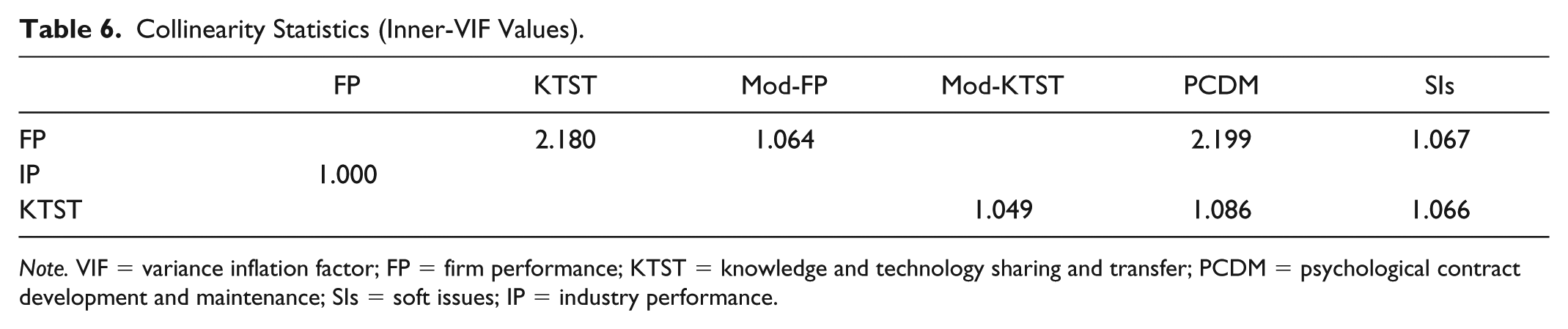
Note. VIF = variance inflation factor; FP = firm performance; KTST = knowledge and technology sharing and transfer; PCDM = psychological contract development and maintenance; SIs = soft issues; IP = industry performance.
Model Estimation, Moderation (Stage 2)
Table 7 explains the results of moderation. The interaction term SIs × PCDM has a significant effect on KTST and FP; therefore, H5a and H5b are accepted. The next step is the evaluation of moderation analysis with the size of moderation. In this model, PCDM moderates two dependent variables, that is, KTST and FP. In case of moderation effect of PCDM on KTST, the interaction term has a negative effect on KTST (−0.074), whereas the simple effect of SIs on KTST is −0.012 (Table 7). Together, these outcomes indicate that the association between SIs and KTST is −0.012 during the average level of PCDM. For the strong level of PCDM (e.g., PCDM is increased by one standard deviation unit), the association between SIs and KTST decreases by the size of the interaction term (–0.012 − 0.074 = −0.086). On the contrary, at a lower level of PCDM (e.g., PCDM is decreased by one standard deviation point), the association between SIs and KTST develops (−0.012 + 0.074 = 0.062). In case of the moderation effect of PCDM on FP, the interaction term has a positive effect on FP (0.040), whereas the simple effect of SIs on FP is 0.006. Together, these outcomes propose that the association between SIs and FP is 0.006 for the average level of PCDM. For the strong level of PCDM (e.g., PCDM is increased by one standard deviation unit), the association between SIs and FP decreases by the size of the interaction term (0.006 − 0.040 = −0.034). On the contrary, at a lower level of PCDM (e.g., PCDM is decreased by one standard deviation point), the association between SIs and FP develops (0.006 + 0.040 = 0.046).
Hypotheses Verification (Moderation Effect).

Note. SIs = soft issues; PCDM = psychological contract development and maintenance; KTST = knowledge and technology sharing and transfer; FP = firm performance.
A further check to confirm the significant effect of a moderator is f2 effect size. There is no general agreement regarding the significance level of f2 effect size. Cohen (1988) proposed that f2 values 0.35, 0.15, and 0.02 indicate large, medium, and small effect size (Hair et al., 2016). On the contrary, some scholars recommended that average effect size in moderation test is 0.009 (Aguinis, Beaty, Boik, & Pierce, 2005). Kenny (2015) suggests large, medium, and small f2 effect size as 0.025, 0.01, and 0.005 respectively. By considering Kenny, Table 7 presents medium f2 effect size for both hypotheses (H5a and H5b).
Discussion
The idea of this study is to highlight the SIs that are occurring and expected to occur in the near future when Chinese firms acquire some Pakistani firms. Second, how SIs affect KTST practices and FP leading to IP during and post-M&As. The critical literature review and empirical investigations of the present study enlighten the important insights.
Although Sino–Pak national and diplomatic relations are spread over seven decades, in last three decades, Pakistan has become a big market for Chinese products. However, Chinese and Pakistani traders/businessmen still feel many socio-cultural clashes. The present study also focuses on these socio-cultural and business practice clashes with the name of SIs. During literature review and personal observations on Sino–Pak cultures and business practices, the authors found four (national culture, organizational culture, HR practices, and leadership style) most significant SIs during and post-M&As deals (Bari et al., 2016; Cartwright et al., 1995; Nur, 2012). The results of the present empirical study also confirm that KTST has a strong association with FP (Figure 2). Based on PC theory, the present study proposed PCDM as a solution to overcome the SIs’ effects on KTST practices and FP. The results confirm that PCDM significantly moderates the negative effects of SIs on KTST and FP (Figure 3), which are also aligned with several other studies in the literature (Abdullah, Hamzah, Arshad, Isa, & Ghani, 2011; Bari & Fanchen, 2017; Salazar-fierro & Bayardo, 2015).

Model assessment.

Moderation analysis.
The CPEC is a game-changer project in the economic, political, defense, and geographical perspectives for both nations. The success of CPEC seriously depends on mutual coordination and joint and interdependent economic interests of Sino–Pak. The successful M&As deals and joint ventures among Sino–Pak business organizations can create the interdependency and strong bond of socio-economic relations. However, this achievement highly depends on the effective solution of SIs.
China and Pakistan have very close relations at the state level. However, organizational and individual-level relationship between Sino–Pak is weak. The key reasons behind this weak relationship are national and organizational culture distance, different languages, food, and social values and norms, and a big difference in religious believes. Second, since 1980, after the takeoff of the Chinese economy, the young Chinese (less than 30 years) have set their benchmark to Western countries in perspective, social values, studies, traveling, family emigration, and life career (Faure & Fang, 2008; Tian, 2000). Therefore, the young generation of China which is also a major part of the Chinese working class has no clear and sufficient information about South Asian countries’ culture such as Pakistan, India, and Bangladesh. This unfamiliarity can develop serious SIs during interaction between Sino–Pak firms and individuals.
During the discussion with respondents, data analysis, and personal observations by the authors, several dissimilarities are also found regarding national and organizational cultures, HRM practices, and leadership styles. First, Pakistani culture is dominated by religious (Islamic) values, whereas more than 88% of Chinese have no practical religion (Yang, 2010). Chinese as a nation believe in the social/secular system and have the negligible importance of religion in their lives (Yang, 2010). Therefore, the leadership of both sides should seriously consider and respect the beliefs of both nations at the individual level. Second, Sino–Pak has different languages and food habits. The mutual languages learning and food habits make the working environment friendly and more supportive. The opportunities of languages learning and food awareness of opponents can enhance the success of M&As deals. Social gatherings also do impact positively on KTST behaviors of employees. Third, the Chinese organization’s culture is more time focused, disciplined, and transactional than Pakistani organizational culture. Therefore, the Chinese firms should consider the working style and culture of Pakistani organizations, and it will help to improve the harmony among workers and performance of the organization.
Fourth, HRM practices vary from organization to organization and culture to culture. In the case of cross-border M&As, the variation becomes more serious. The acquirer consideration of acquiree HRM policies/practices such as recruitment and selection, training and development, and performance and compensation helps him to tackle the potential clashes regarding HRM practices. Fifth, another significant issue during and post-M&As deals is how the leadership of the acquirer firm deals with acquiree’s employees. The employees of every organization are used to a particular leadership style, that is, individualistic or collectivistic, autocratic, or democratic approaches. The post-acquisition leadership can better motivate employees by observing the acquiree leadership behavior and previous nature and level of the PC.
The organizational changes in the result of M&As deals usually disturb the PC between employees and preceding management which affect the relationship between upcoming management and the employees. The present study proposed PCDM as a moderator based on relational signaling and organizational justice theories. This study proves that equal opportunities of informal meetings with senior management, transparent and open appraisal procedure, equal relational behavior at workplace, confirmed positive signals from organization, mutual respect to social and cultural values, and admiration to employees’ previous knowledge significantly moderate the effects of SIs on KTST practices and FP leading to IP. Thus, the success of M&As deals in Pakistan highly depends on Chinese organizations’ management style, and formation, development, and maintenance of PC with Pakistani employees. The other name of CPEC is the development of infrastructure for the growth of economic activities and social relations among nations. The M&As deals serve both purposes: growth of economic indicators and social ties. Therefore, the failure of M&As deals between Sino–Pak organizations will be equal to the failure of CPEC.
Theoretical Implications
Principally, the present study has substantiated the theories, namely, AET, SET, and PC, in the scenario of M&As deals which is directly linked with CPEC. Based on AET, the results confirm that the changes during cross-border M&As deals develop SIs which hurt the employees’ emotions and performance. Drawn on SET, the employees decrease the KTST practices and FP in the presence of SIs. This study theoretically implies the PCDM as a remedy to control SIs. With the support of relational signaling theory and organizational justice theories, the present study theoretically contributed that a consistent PCDM can significantly resolve/decrease the SIs at post M&As stage, motivating the employees to expedite the KTST practices and FP. The present study also strengthens the paradigms of relationalism and structuralism as results confirm that FP positively affects IP.
Managerial Implications
The results of this research project provide a clear line of action to Sino–Pak business organizations. It is expected that in most of the M&As deals, Chinese organizations would act as acquirer or dominant merger partner. Therefore, the leadership of Chinese organizations should employ those managers who have the experience of cross-border M&As deals. Second, the managers with a good understanding of the national and organizational culture, religious, and social values of Pakistan, they may play a more effective role in controlling the SIs. The language is also a significant barrier among Sino–Pak people; miscommunication and misunderstanding may create serious issues during and post-M&As deals. These hurdles may be removed by hiring those people who have a good understanding of Sino–Pak cultures and business practices. The most suitable option is the students who have studied in China and now have been doing jobs in Chinese organizations in China. The Pakistani professionals who have already worked in Chinese organizations are also a good choice. Third, at the post-M&As stage, language learning and cultural exchange social activities may improve the compatibility of employees and acceleration of KTST practices, such as short-term students and professional scholarship for language and culture learning.
Limitations and Future Research Directions
This research project has some limitations. First is the outcomes of this research project derived from perception which is based on the cross-sectional data. A longitudinal study or time lag data may depict different results. Second, several SIs may develop during cross-border M&As deals among Sino–Pak organizations. However, this study focuses upon only four key SIs (clashes in national culture, organizational culture, HR practices, and leadership style). For future studies, more SIs may be added to investigate their effects upon KTST and FP. Third, a few M&As deals are practiced among Sino–Pak organizations. Therefore, the present study collected the data from different industries’ workers without focusing upon a specific sector or M&As deals. In the future, data collection from the experienced employees of M&As deals or particular industry may detect different results. The present study investigated the collective impact of SIs on KTST practices and FP leading to IP. In future studies, the individual impact of SIs on FP may be examined.
Conclusion
The CPEC is a game changer for Sino–Pak nations. Currently, Chinese organizations are investing in Pakistan, and many more Chinese organizations may invest directly or in the shape of M&As deals with Pakistani organizations. However, as per cross-cultural theory (Hofstede, 1983) and AET, SIs may develop and affect the FP and KTST practices. The present study investigates the effect of SIs on KTST and FP leading to IP based on data collected from Sino–Pak employees who have been working in Pakistan or China for 2 years. The results corroborate the significant negative effect of SIs on KTST and FP. The present study proposed the PCDM as a moderator. The results verified that PCDM may moderate the adverse effects of SIs upon KTST and FP leading to IP. However, the PSDM process is required consistently forever.
Footnotes
Acknowledgements
This research paper is completed under the research project of HEC, Reference no. 21-1807/SRGP/R&D/HEC/2017.
Declaration of Conflicting Interests
The author(s) declared no potential conflicts of interest with respect to the research, authorship, and/or publication of this article.
Funding
The author(s) received no financial support for the research, authorship, and/or publication of this article.
