




Abstract
The purpose of this study was to investigate the effect of the “knowledge of cognition” and “regulation of cognition,” which are processes of the metacognitive strategy for improving learners’ writing skills. The working group for the present study, in which a sequential explanatory design was employed, included 44 pupils (21 control, 23 experimental) at a private secondary school. The pupils in the experimental group were instructed in metacognitive strategy-based writing practices, whereas the pupils in the control group were instructed in traditional writing practices. The results revealed that it is necessary to effectively use the metacognitive strategy in learning and teaching to improve writing skills. Further experimental research is recommended to determine, using various scales, whether the metacognitive strategy influences writing skills.
Introduction
Writing is one of the basic skills used and fostered in educating students. In this respect, it can be employed both as a means of learning and of persuading others (Graham, Gillespie, & McKeown, 2013). A text may need rewriting again and again to reach the intended writing level (Kellogg, 2008). This indicates that writing is a cognitive and metacognitive process (Flower & Hayes, 1984; Graham & Perin, 2007). Research on writing shows that using the metacognitive strategy develops the quality of writing because it encompasses planning, drafting, monitoring, and evaluating processes in pre-, during-, and post-writing (Andrade, 1999; Schraw, 1998; Todd, 2002; Zimmerman, 1995). Learners experiencing these processes not only have the chance to employ self-regulation for writing skills but they can also improve their writing skills by composing a well-structured text on the desired level.
Learners need to ameliorate their writing skills at the beginning of their academic life to ensure their future success. For this reason, they should be taught the contextual, structural, and educational principles (Sever, 2011) of writing in a strategy-focused way, taking into account learners’ writing skills and proficiencies. Recent research has shown that learners who use the metacognitive strategy in writing focus more on linguistic elements, content, knowledge of task requirements, the personal learning process, text, accuracy, and discourse features (Magogwe, 2013; Mekala, Shabitha, & Ponmani, 2016). This proves the necessity of variables such as selecting, organizing, and connecting information (Hayes & Flower, 1980). Therefore, these variables should be prioritized in improving writing skills.
Activities including self-planning, self-monitoring, self-regulation, which are included in the metacognitive strategy, may contribute to secondary education pupils’ creating a quality text (Harris, Santangelo, & Graham, 2010) because these activities may help learners develop and regulate awareness of linguistic and cognitive levels for writing. Recent research has remarked on the effectiveness of this condition (Guo & Huang, 2018; Liberty & Conderman, 2018; Samanian & Roohani, 2018; Siamak & Mona, 2018). Taking these factors into consideration, this study focused on a group of pupils who were instructed using the metacognitive strategy to determine whether effective writing skills appeared, and subsequently, the effectiveness of this strategy-based practice was tested.
Improving Writing Skills
Writing is a complex process as it is one of the necessary skills to generate the symbols and signs required to express our emotions and thoughts. It is also a problem-solving activity (Hayes & Flower, 1980), in which we can communicate what we hear, think, envision, and experience (Göçer, 2008; Ramet, 2007; Sever, 2011), as well as our nature (Özdemir & Binyazar, 1979). Moreover, writing includes cognitive and physical processes, and thus, it takes time to develop (Güneş, 2007). It is the process of putting information restructured in the brain into writing (Öz & Çelik, 2007). It also involves high-level processing, in which emotions and thoughts are transferred, revised, organized, and evaluated (Gözüküçük, 2016), and the well-ordered performance of emotions, thoughts, views, and dreams in a dynamic and eye-catching way (Kavcar, Oğuzkan, & Hasırcı, 2016). And so, writing is not dependent on ability alone; rather, it is a metacognitive process requiring being aesthetic, legible, and fluent in the affective aspect (Zimmerman & Kitsantas, 2007); self-motivation and readiness in pre- and post-writing in the psychological aspect; and gathering information on a specific area and arranging, organizing, and evaluating this information by considering grammatical rules in the cognitive aspect. Furthermore, it is kinesthetic since it depends on the speed of writing, holding the pencil, and motor movements, and it requires the overall process to be self-regulated (Brown & Hood, 1989; Flavell, 1976; Flower & Hayes, 1984; Flower, 1998; Güleryüz, 2001; Haven, 2015; Sundem, 2007).
Improving writing is contingent on knowledge and skill along with technical and strategy-based practices (Deane et al., 2008). Therefore, individuals must first have comprehensive knowledge so that they can use effective and fluent language in the writing process (McCutchen, 2000) because the accumulation of knowledge plays a key role in creating and enhancing writing (Kellogg, 1996; Saddler & Graham, 2007). Second, apart from the accumulation of knowledge, the individual must have the ability to write to produce writing in an effective format (Cindy, Monroe, & Troia, 2007). Individuals with a low level of writing ability focus mostly on spelling, punctuation, and grammar, while individuals with a high level of writing ability are more concerned with the organizational, stylistic, and contextual aspects of writing (Schoonen & de Glopper, 1996). Thus, writing ability is very important in the writing process. Last, besides all these variables, individuals require certain strategies in planning, designing, organizing, revising, and evaluating writing.
Although there are several strategies, such as cognitive and affective self-regulation and concentrating on fostering the writing process (Schunk, 2003; Sexton, Harris, & Graham, 1998), the metacognitive strategy is one of the most effective strategies (Flavell, 2004) because it reveals types of cognitive awareness, such as learning about learning and thinking about thinking (Lu & Liu, 2011; Ruan, 2005; Yanyan, 2010). The metacognitive strategy, therefore, involves restructuring cognition (Schmidt, 2001). In particular, it is a process in which individuals create a strategy for what they know, as well as how and why they will use it (Tapinta, 2006). Moreover, awareness of the metacognitive strategy helps learners have knowledge of the quality and structure of literary types (Harris et al., 2010). Hence, learners are supposed to understand the different writing practices that depend on their purpose and topic, the organizational, stylistic, contextual, and linguistic elements, as well as be able to practice and evaluate the overall process, all of which can be ameliorated by understanding the positive effects of cognitive psychology on improving writing skills (Johns, 1990).
The literature review found many studies on writing skills and the metacognitive strategy, which should help learners develop (a) metacognitive awareness and positive attitudes towards writing; (b) the ability to focus on planning, organizing, drafting, revising, and evaluating the steps of the writing process; (c) the skill to eliminate deficiencies in writing; (d) the ability to attain higher-order thinking capacity; and (e) the aptitude for concentrating on writing more (Aliyu, Fung, Abdullah, & Hoon, 2016; Karahroudi & Reddy, 2014; Kim, 2016; Lu, 2006; Mekala et al., 2016; Yanyan, 2010; Zimmerman & Bandura, 1994). These studies showed that learners become aware of their self-efficacy in writing through the metacognitive strategy and regulate their self-efficacy levels accordingly. Hence, it is clear that this strategy has an important effect on learners’ writing and thinking skills.
Metacognitive Strategy and Metacognitive Strategy-Based Writing Instruction Process
Since metacognitive thinking is a process that reveals how cognition should be controlled and monitored (Pintrich, 1999), it constitutes a significant part of learning. The metacognitive strategy developed based on cognitive knowledge and skills creates an awareness of learning as a prerequisite for planning, monitoring, controlling, evaluating, and self-regulating the learning process (Roeschl-Heils, Schneider, & van Kraayenoord, 2003). However, the metacognitive strategy constructs many relationships depending on the purpose of learning to learn (Pressley, 2002). Thus, learners should use the metacognitive strategy to self-regulate and self-control (Perfect & Schwartz, 2002). As writing skills also constitute an important aspect of learning and teaching, they should be improved through metacognitive strategy-based writing instruction. In the current instruction, though, since learners showed higher-order thinking types such as awareness, motivation, organization, and evaluation (Hayes & Flower, 1980; Schraw, 1998), stylistic, contextual, and educational attributes of writing could be effectively fostered on the desired level.
Based on theoretical definitions, the metacognitive strategy has two sides, namely, knowledge of cognition and regulation of cognition. Knowledge of cognition provides awareness of how the individual can acquire its four subdimensions: (a) declarative knowledge, which reflects the individual’s beliefs, self-concept, and self-efficacy; (b) task knowledge, which means one’s understanding of the theme, purpose, structure, and organization of writing; (c) procedural knowledge, which denotes the methodological knowledge related to how the individual will compose the writing plan, draft, revise, and organize; and (d) conditional knowledge, which refers to how and when the individual performs varying processes of writing. Regulation of cognition, however, contributes to the learner’s writing process with its aspects of self-planning and drafting, self-monitoring, self-evaluation, and revision (Flavell, 1979; Harris et al., 2010). Hence, all these processes will be tested in relation to writing skills.
During metacognitive strategy-based writing instruction, learners are helped to realize their cognitive and affective proficiency related to beliefs and attitudes toward writing skills as the first step of knowledge of cognition. In this way, learners become aware of their performance level before starting to write. As the second step, learners are provided information about contextual attributes of writing, including that it must have a purpose and a certain layout. Thus, learners understand that a topic, purpose, and particular layout are essential when writing. As the third step, learners acquire information on how the stylistic attributes of writing, such as planning, drafting, revision, and organizing, are to be structured. Last, learners are taught that they should use all this information when writing depending on the time and place. And so, whole knowledge of cognition develops learners’ awareness of writing. During regulation of the cognition process, though, learners put all their awareness into practice by planning and drafting, monitoring, evaluating, and revising processes in pre-, during-, and post-writing (Flavell, 1979; Harris et al., 2010).
The research problem of the present study focused on the relationship between the metacognitive strategy and writing skills. This study is novel in that no national research has been conducted on the effect of the metacognitive strategy on writing skills, although there have been many studies on the relationship between this strategy and writing skills (Karahroudi & Reddy, 2014; Lv & Chen, 2010; Maftoon, Birjandi, & Farahian, 2014; Magogwe, 2013; Mekala et al., 2016). While a great deal of research on the relationship between metacognitive strategy and reading/listening skills or self-esteem have been undertaken (Ateş, 2013; Akın & Çeçen, 2014; Çer & Şahin, 2016; Çer & Şahin, 2017; Kana, 2014; Karabay, 2015), writing skills have been left out. This has prevented the metacognitive strategy from being effectively used in improving writing skills. Thus, by examining the metacognitive strategy, the goal of this article was to make significant contributions to improving writing skills.
Purpose of the Study
The general purpose of the present study was to examine the effect of the metacognitive strategy on improving learners’ writing skills. This might help them both improve their general writing skills and develop their awareness of how to express their ideas and opinions in writing. In particular, the goal was for learners to have the knowledge and skills related to what they should focus on in pre-, during-, and post-writing; how they should organize the text and their knowledge; and what sort of planning, practice, and arrangement are crucial in the writing process. In this context, the following research questions were proposed:
Method
The mixed method, which includes both qualitative and quantitative research designs, was employed for the present study. This method was chosen because it considers the notion that it is possible to eliminate and compensate for all biases and deficiencies of each data set by aggregating both qualitative and quantitative data. Therefore, including qualitative and quantitative data in the research process may systematically provide consistency in the results (Creswell & Plano Clark, 2011).
Research Design
The pre-test/post-test quasi-experimental research design with control and experimental groups was employed in the present study. All pupils were first asked to write a composition in the pre- and post-tests. They then filled in the “Personal Information Form” and “The Writing Self-Efficacy Scale” (WSES). Next, “The Written Expression Evaluation Scale” (WEES) was employed during the pre- and post-tests to evaluate the pupils’ compositions. The students in the experimental group were instructed in “Metacognitive Strategy-Based Written Expression Skills,” whereas the control group was only instructed in classical written expression skills.
Participants
In this research, the students’ grade level, gender, and age were controlled, and their scores obtained from the WSES and WEES were considered during the pre-test. The matching method was used to construct the experimental and control groups. The control and experimental groups established for this research were formed by pairing 5-A and 5-B students who were going to a private school in the first semester of 2017-2018. Pre-test results obtained from the scales were used to form the control and experimental groups. To determine whether the groups were equal to each other, a paired samples t-test was performed.
As shown in Table 1, as a result of the paired samples t-test, a significant difference was found between the scores obtained from the two scales in the first group consisting of 21 individuals and the pre-test results of the second group consisting of 23 individuals. Thus, the control and experimental groups were generated as follows:
The Paired Samples t-Test.

p < .001.
Experimental group
In this group, the metacognitive strategy was used in the training of written expression skills. It included 23 (12 girls and 11 boys) out of 29 students in the 5-A class at a private school in the first semester of 2017-2018.
Control group
In this group, writing instruction was given using free writing activities. It included 21 (11 girls and 10 boys) out of 27 students in the 5-B class at a private school during the first semester of 2017-2018.
The pupils in the experimental group were instructed in metacognitive strategy-based writing practices, while the control group practiced writing by traditional writing strategies. The researcher intervened in both groups to control the variables of instruction. To ensure the reliability and validity of the study, the researcher did not inform the students to which group they belonged.
Data Collection Process
Quantitative data collection process and tools
The quantitative data were collected by the WEES and WSES, “Classical Writing Instruction” (Free Writing), and “Metacognitive Strategy-Based Written Expression Skills” Instruction.
WSES
The scale consists of 10 items and measures how confidant the participants are of their writing skills. In that regard, the scale includes items for the content, organization, paragraphs, word selection, sentence fluency, and harmony for the evaluation of writing. Plus, the scale grades participants’ confidence level from 0 to 100 as follows: 0 to 30 = “cannot do it,” 31 to 70 = “sure I can do it,” and 71 to 100 = “completely sure I can do it” in relation to participants’ writing skills self-efficacy. The higher the score, the better the students believe their writing skills to be. This scale has been theoretically proven to measure self-efficacy in writing skills better than traditional scales (Pajares, Hartley, & Valiante, 2001). The validity and reliability of the adaptation of the scale for the Turkish language was performed by Demir (2014). The Cronbach’s Alpha internal consistency coefficient, which was calculated to determine the reliability of the scale, was found to be .88 for the overall scale, and 0.80 and 0.84 for the subscales, respectively. The test–retest reliability coefficient for the overall scale was 0.90. Based on these findings, the scores obtained from the Turkish adaptation of the scale may be said to be valid and reliable.
WEES
Although there are several instruments for the evaluation of writing skills (Daly & Miller, 1975; Kieft, Rijlaarsdam, & Van den Bergh, 2006), the WEES developed by Sever (2011) was used in this study. It was chosen both because its validity was ensured, and it aims to evaluate learners’ written expression skills in terms of their stylistic, contextual, and language and expression aspects. The stylistic subdimension of the scale notes the rules to be obeyed while writing. For instance, its goal is to determine how well learners follow the stylistic aspects, such as aligning the lines, leaving proper spaces between the title and the first sentence, and writing letters accurately, correctly, and legibly. The contextual subdimension evaluates what level learners are on, for example, in terms of excluding irrelevant thoughts, explaining the theme by dividing the writing into paragraphs, and expressing emotions and thoughts in a fluent and engrossing way. Last, the language and expression subdimension aims to evaluate learners’ ability to spell words correctly, use words and sentences properly, and obey punctuation rules. The stylistic subdimension of the scale consists of 14 items, the contextual subdimension consists of 10 items, and the language and expression subdimension consists of 14 items. Experts in Turkish Language Education or Turkish Language and Literature score the items on the scale from 0 to 2, 0 to 3, 0 to 4, or 0 to 5 depending on the score intervals. The scores range from 0 to 30 in the stylistic, 0 to 35 in the contextual, and 0 to 35 in the language and expression subdimensions. As the scores increase, the skills learners need to have are supposed to increase as well. The reliability of this scale was found to be 0.83 for KR-20.
Writing assignment
All pupils were asked to write about a topic of their choice during the pre-test. During post-test, the experimental group was asked to write about a topic based on the metacognitive strategy. This method was preferred to reveal the effect of the knowledge of cognition and the regulation of cognition sides of the metacognitive strategy on writing skills. The control group was told that they could write about anything with the instructions given by the researcher to lead them to write something appropriate to the context of free writing. All pupils wrote compositions in about one class hour during the pre- and post-tests, and all compositions were collected by the researcher.
Implementation of metacognitive strategy-based writing instruction
The groups were given different instructions. First, the pupils in the experimental group were instructed in improving writing skills through the metacognitive strategy, including the knowledge of cognition and regulation of cognition aspects (Flavell, 1979; Lv & Chen, 2010), for 18 hr over 5 weeks. The pupils in the control group were instructed in traditional writing skills for the same duration.
Knowledge of cognition
In the 1st week, the attitudes and beliefs of the pupils in the experimental group toward writing were determined to reveal their awareness of the knowledge of cognition. For such a determination, the WSES developed by Shell, Murphy, and Bruning (1989) was used. In the 2nd week, the pupils were instructed in declarative knowledge, procedural knowledge, and conditional knowledge in the context of the knowledge of cognition. In line with this purpose, the researcher first helped them develop their awareness of declarative knowledge by informing them about how the theme, purpose, structure, and layout of writing should be considered when producing any composition. Second, the pupils were informed about the revision and organization of writing as part of procedural knowledge. Finally, they were instructed in how and when they should perform these processes in the context of conditional knowledge. In other words, for the first 2 weeks of instruction, priority was given to developing the pupils’ awareness of knowledge of cognition.
Regulation of cognition
Beginning from the 3rd week, the pupils in the experimental group were instructed in the regulation of cognition, which encompasses planning and drafting, monitoring, revising, and editing. Thus, in the 3rd week, the pupils were first asked to concentrate on ideas and messages to be considered before starting to write, and they were informed about how to plan their writing. The pupils were then able to start writing with a set plan. Then, the researcher asked the students to write a first draft accordingly. In the 4th week, the pupils were informed in the monitoring process about grasping the text fully; determining whether a change in the text was needed, as well as being aware of problems in the text; realizing linguistic and contextual errors; re-writing challenging parts to eliminate semantic ambiguity; and if there was information missing that could help strengthen the text, they were asked to make the necessary revisions. As the ongoing evaluation of learning or strategy use, monitoring is one of the higher-order thinking processes, which regulates the learning process (Schraw & Dennison, 1994). In the final week, the researcher informed the pupils about evaluating and revising what they wrote. In that regard, the researcher asked the pupils to restructure the hypothesized microstructure of their writing, to evaluate the quality and the content of the text, and to give positive and negative emotional feedback on the comprehensive content of the text and revise it accordingly. However, the pupils in the control group were given classical writing instruction, during which no strategies were implemented.
Classical writing expression skills education (free writing)
The pupils in the control group were instructed in free writing. Free writing means transferring emotions, ideas, and imagination into writing, independent of any strategies or the teacher (Ünsal, 2008). This kind of writing requires students to write compositions on two or more given topics. Describing people or things, narrating an event, discussing the cause and effect relationship between actions, expressing opinions about a given topic, and writing a letter, short story, play, memoir, poem, and so on are common in this kind of writing (Göçer, 2014). The pupils in the control group were instructed in no strategies other than the activities used in free writing. Thus, the researcher merely gave the pupils instructions on what they should write about. Hence, in the 1st week, the pupils were asked to write a composition about topics based on the love of nature and animals: “Why are we supposed to protect trees?” and “How should we treat animals?” In the 2nd week, the researcher asked the pupils to write on the question, “How do you imagine yourself in the future?” In the next week, they engaged in free writing without any instructions given. In the 4th week, they were directed to write a letter to their best friends. In the final week, they were asked to compose a memoir of an interesting past event.
Qualitative data collection process and instruments
The qualitative data were obtained from focus group discussions with both groups. Focus group discussions entail using the effect of group dynamic to gather profound information and generate ideas in structured or nonstructured discussions and interviews between the leader and a small group (Bowling, 2009). This type of discussion is performed to reveal interests, perspectives, perceptions, experiences, tendencies, emotions, and thoughts, as well as the attitudes and habits of the participants in relation to a certain topic (Krueger, 1994). What matters in focus group discussions is creating an environment that will allow participants to express their opinions freely (Kitzinger, 1995).
The topics to be discussed was planned in advance before the focus group discussions. For this reason, the researcher prepared questions to reveal what they thought of pre-, during- and post-writing with metacognitive strategy-based and free writing instructions. After the researcher prepared the structured-interview questions, the pupils were asked the following questions suggested by Krueger (1994).
Classic and Metacognitive Strategy-Based Writing Instruction With Their Expected Learning Outcome (Wischgoll, 2016).

The researcher stressed that the questions should be open-ended, directive, and interrogative during focus group discussions. Second, the participants were determined: Nine out of 23 pupils in the experimental, and seven out of 21 pupils in the control group took part in the focus group discussions. In each group, 14 pupils did not want to participate in the discussions. The proper participant number for focus group discussions, according to Edmunds (2000), is 8 to 10. Third, the focus group discussions with each group lasted 90 to 100 min, with a 10-min break. All discussions were audio- and video-recorded with the pupils’ permission.
Kitzinger’s (1995) model was employed both for the control and the experimental group separately during the focus group discussions. The researcher first prepared name tags for each pupil. Then, he carefully created “U” shaped seating for the class to ensure an effective interaction environment between him and the pupils. Next, the researcher placed two recording devices to capture the pupils’ voices and images. Fourth, the researcher placed a “Do not disturb” warning sign on the door. Then, the researcher told the pupils to sit in the free seats. Finally, he repeated a few times during the discussion that anything they said would remain anonymous.
Data Analysis
Quantitative data analysis
In the present study, the WSES was performed first with the pupils in both groups to determine their self-efficacy levels during the pre-test and post-test. At the end of 5 weeks, it was expected that the pupils’ self-efficacy in writing should have improved. Next, the WEES was employed to test the efficiency of metacognitive strategy-based instruction during the pre-test and post-test. The researcher gave the participants different code numbers before evaluating their compositions, which were rated by two different researchers. The inter-rater reliability was calculated using intra-class correlation coefficient (Carrasco & Jover, 2003). As a result of these calculations, the intra-class correlation coefficient (inter-rater agreement) for the pre-test was found to be .90 for stylistic structure, .83 for contextual structure, and .93 for language and expression. For the post-test, it was .91 for stylistic structure, .86 for contextual structure, and .93 for language and expression. Statistical analyses were conducted by calculating the means the participants received from each rater.
After preparing the data for statistical analysis, extreme and missing values were specified. Next, descriptive statistics was used to determine the general qualities of the control and experimental groups. Mean, standard deviation, frequency, and percentages were all calculated, and these values were analyzed within the scope of the research problems. An independent samples t-test was performed to determine whether there was a significant difference among the pre-test and post-test scores before and after the procedure. In addition, two-way ANCOVA was performed to determine the effect of both scales on both pre-test and post-test scores before and after the procedure. Last, simple and multivariate linear regression was used in the analysis of the relationship between the pre-test and post-test scores of both scales. Multivariate regression analysis enables the prediction of the dependent variable, depending on two or more independent variables interrelated to the dependent variable. This sort of analysis helps interpret the relationship between the dependent and the independent variable (Büyüköztürk, 2017). The quantitative data analysis was performed with SPSS 23.
Questions for the Focus Group Discussions.
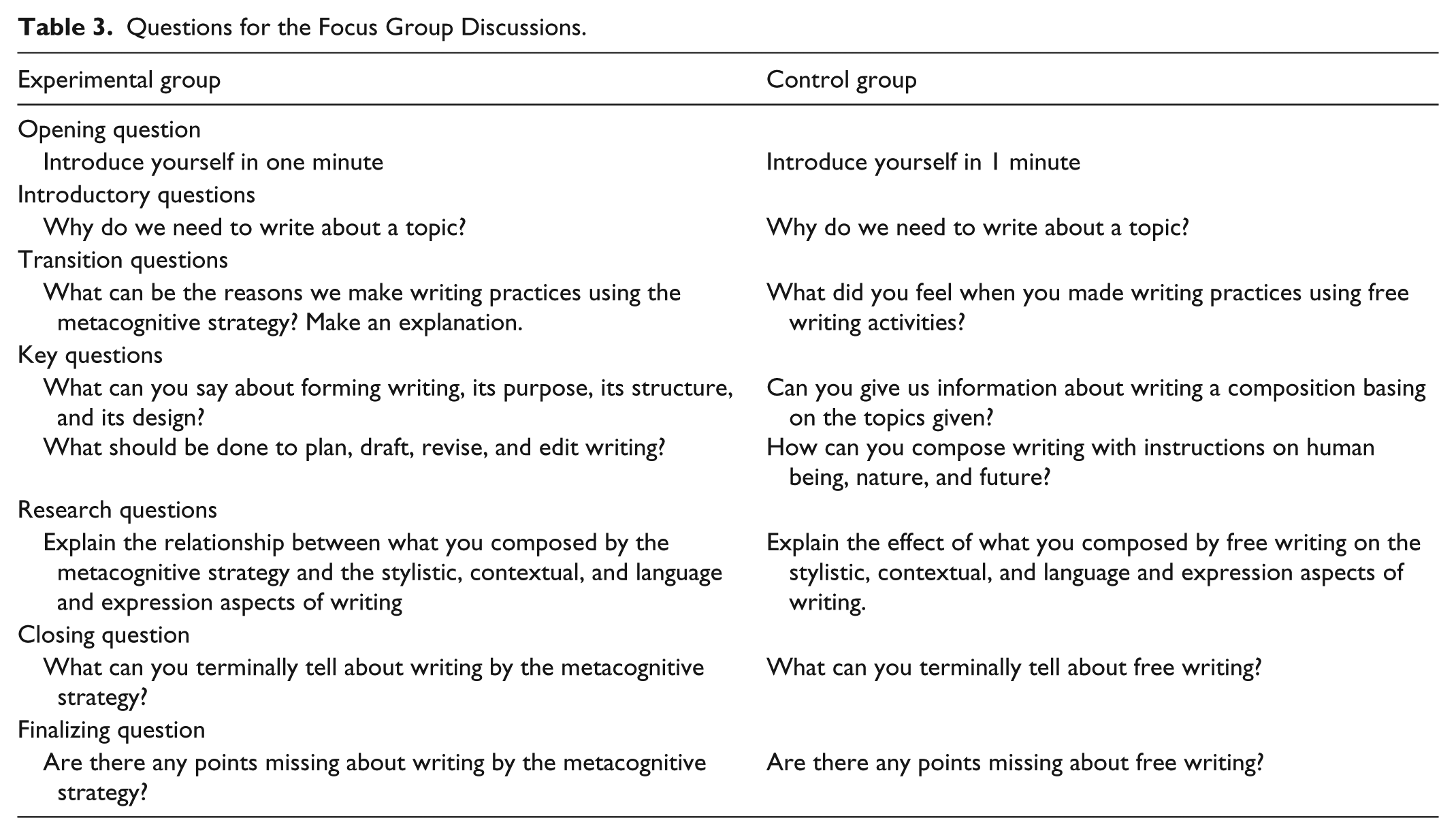
Qualitative data analysis
Content analysis was employed in analyzing the data collected through focus group discussions in the present study. It is one of the most effective techniques for analyzing qualitative data from focus group discussions (Kitzinger & Farquhar, 1999). The aim of content analysis is to gather similar data within the context of certain concepts and themes (McMillan & Schumacher, 2014). Moreover, content analysis, in its most basic definition, is the process of systematically summarizing and reporting written data and the themes within the data (Cohen, Manion, & Morrison, 2007).
Content analysis has four steps, namely, coding data, locating categories and themes, organizing data and themes, and identifying and interpreting findings (Denzin & Lincoln, 2005). The data collected in the present study, including the information from video and audio recordings, were saved in Microsoft Word under the names of the formerly coded students. The process was independently conducted by two researchers at different times and in different places. What the pupils in the experimental group knew about regulation of cognition and knowledge of cognition of the metacognitive strategy and what the pupils in the control group knew about free writing were extracted and classified in a Microsoft Excel page. Subsequently, the gathered codes were re-coded by another researcher to ensure reliability, and then the codes were compared. The validity and reliability of the codes were calculated by the formula of (Agreement/Disagreement) × 100 (Miles & Huberman, 2014), and the reliability of the codes were found to be 90%. Next, the researchers performed open, axial, and selective coding (Punch, 2005) while creating categories and themes from the data of both groups. By gathering raw data with open coding, similar data could be classified and categorized. The interconnections of the categories created by open coding were revealed through axial coding, and therefore, the subthemes were determined. The main themes were obtained by selective coding to integrate and collect the relationship found by axial coding. Next, the coders reexamined the codes to create categories, main themes, and subthemes. Some of the inconsistent codes were re-coded. After these procedures, the findings obtained from the focus group discussions by content analysis were revealed.
Validity and Reliability
Validity and reliability of the quantitative data
In quantitative research, while selection and maturation, instrumentation, subject background, experimental mortality, pre-test effect, statistical regression, interaction effect, and effect of expectation affect internal validity, sample effect, reaction effect, and interaction effect of experimental arrangements affect external validity (Karasar, 2014). With these considerations in mind, the control and experimental groups were created by matching 5-A and 5-B students who were going to a private school in the first semester of 2017-2018. The participants with similar backgrounds among fifth-grade pupils were objectively and randomly assigned into groups. The research was conducted in two distinct categories, namely, experimental and control. No other researcher took part in the process of data collection; the researcher collected all data on his own to ensure consistency. The experimental mortality effect was not observed since 44 pupils remained in the research up to the end. To prevent the pupils from being acquainted with the two different scales, which were performed twice, and to eliminate the effect on post-test scores, a 5-week period elapsed, and multivariate covariance analysis was performed. One- and two-way extreme values were excluded by controlling for them with statistical procedures. The pupils were not informed about the experimental conditions to prevent differences caused by their expectations.
Validity and reliability of the qualitative data
Examining validity and reliability is one of the best ways of ascertaining problems emerging in the research process (Daymon & Holloway, 2003; Silverman, 2001). Accordingly, cogency (internal validity), transmissibility (external validity), coherence (internal validity), and confirmability (external validity) were examined to ensure validity and reliability. Long-term interaction, participant confirmation, variation, and expertization were employed to increase the cogency of the data (Holloway & Wheeler, 1996). For a 5-week research period, an environment of trust produced through interaction and communication was provided with the goal of increasing the cogency of the data. The researcher ensured additional data coherence by obtaining pupils’ opinions and transferring the data obtained by focus group discussions into digital media. All the data garnered from the WSES, WEES, and focus group discussions were compared to increase the cogency of the research. Furthermore, the entire research process was assessed by another expert who was expected to give feedback about everything, including the data collected, recording the findings, analyses of the results, and so on. The most significant variables to ensure transmissibility are detailed description and sample selection. Detailed description means faithfully and objectively transferring the raw data to the reader based on the generated concepts and themes (McMillan & Schumacher, 2014). Hence, every step of the research process was presented in detail for the reader to ensure all components were understandable. Therefore, the researcher included direct citations in the “Results” section. In addition, the researcher employed voluntary and purposive sampling in the study because some of the pupils in both groups did not want to participate in the discussions. The researcher chose the most suitable pupils for the discussion by negotiating with all the students who volunteered.
The findings were directly presented to the reader with no generalizations or interpretations to ensure coherence. In addition, the codes obtained were re-rated by another researcher using Miles and Huberman’s (2014) reliability formula. To guarantee the confirmability of the data, the “Method” and “Results” sections contain minute descriptions, and the raw data and codes were kept by the researcher within the scope of the research process.
Results
Quantitative Results
This section includes the results obtained through basic and advanced statistical analyses to determine whether there was a change in the writing skills of both groups, one of which was instructed in metacognitive strategy-based written expression skills and the other engaged in free writing.
Data Preparation for Analysis
The effects of missing and extreme values were first examined to ensure the data would be used effectively. Hence, since deletion, one of the ways of eliminating missing values, causes sample loss, low reliability, and bias (Cumming, 2013), mean score assignment for each item was preferred. It is also necessary to find the extreme values caused by the researcher’s data entry errors (Tabachnick & Fidell, 2013). Therefore, unidirectional extreme values were converted into Z scores for all scores and were examined through box plot (Büyüköztürk, 2017). In addition, the fact that the number of participants was under 100 (n < 100) made it compulsory to take the Z scores interval as ± 2.5 (Mertler & Vannatta, 2004). As a consequence, unidirectional extreme values were observed both in the box plot and in the Z scores interval. It was realized that the univariate outliers were caused by the researcher’s errors while entering the data in SPSS 23, and they were all corrected. Multidirectional extreme values were controlled by Mahalanobis distance on the p < .001 significance level; however, no extreme values were found. After all, the expected values of the chi-squared table on the 3 degrees of freedom were 16.27 for the .001 significance level. Since all values of Mahalanobis distance were lower than the so-called value, it was extrapolated that no extreme values existed. Third, before conducting uni- and multivariate analyses, multicollinearity and singularity were examined. Multicollinearity appears when there is a high degree of correlation (r = .7 and higher) among variables (Pallant, 2016). As a result of the analyses, a high correlation (r = .7 and higher) was observed in the contextual (.59), stylistic (.63), and language and expression (.79) variables of the WEES. Therefore, the language and expression variable, which had a high correlation, was removed from the analysis. In addition, by performing linearity diagnostics as part of multiple regression procedure, vague problems of multicollinearity on the correlation matrix were detected. Accordingly, tolerance values for each independent variable were .89 for contextual structure, .68 for language and expression, and .62 for self-efficacy. These values were also supported by all variance inflation factor (VIF) values (contextual 1.123, language and expression 1.468, and self-efficacy 1.612), which are supposed to be lower than 10. Last, skewness and kurtosis values for each variable were examined for normality of the data to be used, because if skewness and kurtosis are between ± 2, distribution is regarded as normal (Tabachnick & Fidell, 2013). As a result of the normality test, skewness and kurtosis values were found to be between ± 1, and the variables were distributed normally. Levene’s test to control for homogeneity of variances and Box’s M test for equality of covariances were also used. As a result of Levene’s test, all variables were found to meet assumptions of homogeneity (p > .005). Box’s M test showed the homogeneity of covariances. After all these procedures, parametrical tests were employed in the present study since normality and homogeneity were ensured.
Table 4 displays independent samples t-test results for the pupils’ pre-test writing self-efficacy, stylistic structure, contextual structure, and language and expression scores. As a result of the independent samples t-test, no significant difference was found between the pre-test scores of the control and experimental groups in self-efficacy scores, t(42) = .30, p > .05. In addition, tests were conducted to determine whether there was a significant difference between the pre-test mean and standard deviations of both groups in stylistic structure, contextual structure, and language and expression. The analyses revealed no significant differences among stylistic structure, t(42) = .27, p > .05; contextual structure, t(42) = .07, p > .05; and language and expression, t(42) = .32, p > .05, scores of both groups.
Results of Independent Samples t-Test for WSES and WEES pretest scores.
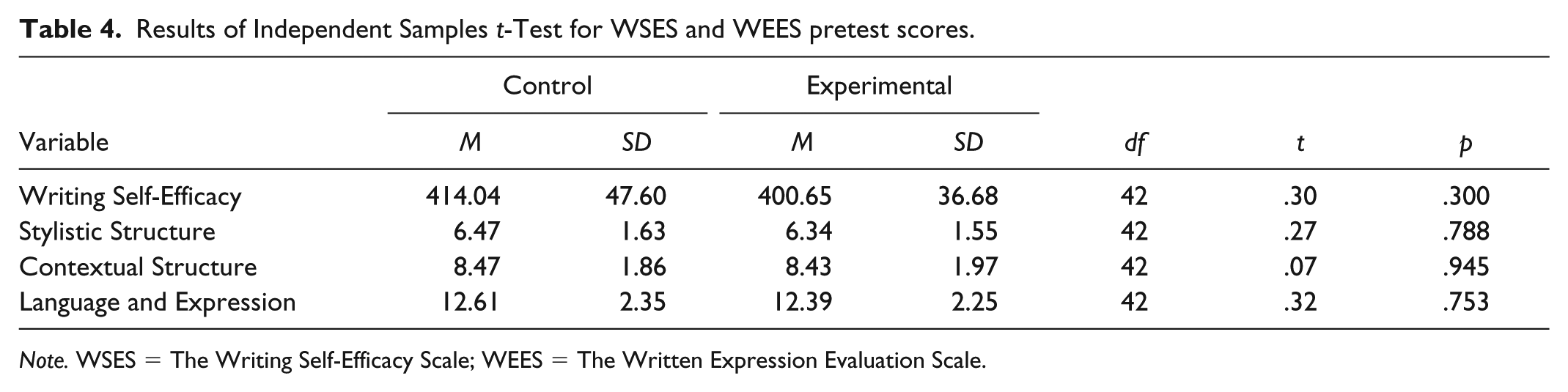
Note. WSES = The Writing Self-Efficacy Scale; WEES = The Written Expression Evaluation Scale.
Table 5 displays the two-way ANCOVA results of the efficiency of the instruction given for writing skills improvement using the metacognitive strategy. After the instruction, the independent variables in this practice were specified as the post-test scores of both scales. The pre-test scores of the scales, which were given before starting the instruction, were taken as covariants. No significant difference was found among the post-test scores of the WSES, F(1, 40) = 90.08, p < .05, partial eta squared = .69, and the WEES, F(1, 40) = 151.59, p < .05, partial eta squared = .79. As revealed by the effect size, a strong correlation was found among the scores of both scales before and after the procedure. In other words, metacognitive strategy use helped the pupils in the experimental group improve in their writing skills compared with those in the control group, which was instructed in traditional writing.
Results of Two-Way ANCOVA.

Note. ANCOVA = analysis of covariance; WEES = The Written Expression Evaluation Scale; WSES = The Writing Self-Efficacy Scale.
p < .001.
As seen in Table 6, the pupils’ self-efficacy levels had a significant effect on writing skills, F(1, 42) = 35.39, p < .001. According to this model, the pupils’ writing self-efficacy levels denote % 33.1 of the variance in writing skill, R = .576, R2 = .331. It can be seen in Table 6 that self-efficacy for writing generally affects writing achievement level, and a multiple regression analysis was performed to see which one of the subdimensions of writing defined writing achievement.
Simple Linear Regression Analysis for the Prediction of Achievement in Writing.

p < .001.
As seen in Table 7, there was a significant effect between the pupils’ writing achievement levels and contextual and stylistic structure, which are two components of the WEES, F(2, 40) = 39.77, p < .001. According to this model, the contextual (32%) and stylistic (26%) aspects of writing denote 58% of the variance (R = .762, R2 = .580), that is, the Beta value of the contextual aspect (β = .564, p < .001) was higher than that of the stylistic aspect (β = .511, p < .001).
Multi-Linear Regression Analysis for the Prediction of Achievement in Writing.

p < .001.
Qualitative Findings
This section includes findings of the focus group discussions collected through content analysis.
Findings for the experimental group
On analyzing the focus group discussions for the effect of metacognitive strategy instruction, the pupils’ views were collected under three subthemes and one main theme, which are displayed in Table 8.
Categories, Subthemes, and Main Theme for Writing Skills.

As seen in Table 8, the pupils in the experimental group had the same opinions on subtheme planning and drafting, monitoring, evaluating, and editing under the main theme of self-regulating. The pupils’ expressions of their awareness of the subthemes are as follows: Determining the aim of writing, generating ideas for the text content, determining what to write about, making writing stylistically suitable, revealing the gist, specifying a strategy for the sort of writing, determining how much time and knowledge is required, checking spelling and punctuation, writing neatly, noticing if there are irrelevant ideas, checking how the writing looks on paper, controlling how emotions and ideas are conveyed, realizing if words suitable to the topic/audience are used, revising the text for grammatical errors, re-arranging the parts of the text to improve the flow, applying changes to the writing in line with emotional reactions, evaluating the writing as a whole, and not ignoring the quality of the writing.
Following are some of the examples of the pupils’ views on developing awareness of the writing process: I do not just start writing. First, I choose the topic I will write about, and I ask myself about the purpose of writing. We should not start writing without a chosen topic and purpose. (E3) I think about the topics which are already on my mind when the teacher tells us to write. If I have memoirs, I want to write about them. I revise and edit the parts I am not satisfied with after finishing. (E5) I always look at the style of the paper while writing. I care about not using incorrect words. (E2)
Findings for the control group
On analyzing the focus group discussions for the effect of classical instruction (free writing), the pupils’ views were collected under two subthemes and one main theme, which are displayed in Table 9.
Categories, Subthemes, and Main Theme for Writing Skill.

As seen in Table 9, the pupils in the control group had similar opinions on both the main theme of inadequacy in the writing process and the subthemes of what to do in pre-, during-, and post-writing. The pupils’ ideas about why they lacked awareness of the subthemes are as follows: Not being able to find what to write about, desire to stop writing immediately, not knowing how to keep writing, not having a clear message, losing too much time before being able to start writing, not having an idea of what to write about concerning the given topic, not checking the text when finished, not stating a judgment about the writing, not assessing the content, and not knowing how to edit writing.
Here are some examples of pupils’ perspectives on their inadequacies in the control group: Our instructor gave us the topics before starting to write. He provided no extra information . . . I am writing what comes to my mind. (C2) I constantly pause while writing. I am thinking about what to write. I sometimes dislike what I write and re-write. I do not know how to conclude writing. (C3). . . . I ignore punctuation marks and accurate writing. When I return to check, I forget what I have written. I keep writing not to forget. (C5)
Discussion
Developing the experimental group pupils’ awareness of their knowledge of cognition in pre-, during-, and post-writing through the metacognitive strategy helped them engage in regulation of cognition when writing. More specifically, understanding about what sorts of attitudes and beliefs they had about writing and instructing them accordingly made a positive contribution to their self-efficacy. According to Bandura’s (1986) social cognitive theory, developing learners’ self-efficacy, attitudes, and beliefs is a good predictor of their academic achievement and motivations. In that regard, beginning writing after determining the pupils’ affective and cognitive knowledge in the process of knowledge of cognition and developing them within the process helped the students be aware of their self-efficacy and be prepared for the contextual, stylistic, and language and expression attributes of writing. It is clear that the self-efficacy levels of the pupils in the control group generally had an impact on their writing achievement (p = .00 < .05), F(1, 40) = 90.08, p < .05, with partial eta square (=.69) and the self-efficacy levels of the pupils accounting for 35.7% of the variance in writing success (R = .676, R2 = .357). This fact can be seen in the category of “specifying a strategy for the sort of writing.” However, the pupils in the control group displayed no improvement in awareness of the quality of their writing in the categories of “not having an idea of what to write with the given topic, not knowing how to keep writing, not assessing the content, and not knowing how to edit writing.” It is necessary, in every way, to evaluate and enhance learners’ attitudes and beliefs toward writing. Their writing must have a specific topic and purpose, and they must also understand how and when to perform these procedures about topic and purpose before engaging in regulation of cognition (Karahroudi & Reddy, 2014; Kim, 2016; Mekala et al., 2016).
The aim of the present study was to help the pupils in the control group improve their contextual, stylistic, and language and expression writing skills through planning and revising, monitoring, evaluating, and editing processes, which were performed using the regulation of cognition step of the metacognitive strategy. In addition, in line with the responses by the experimental group pupils, comparing the categories “determining the aim of writing, generating ideas for the text content, determining what to write about, making writing stylistically suitable, revealing the gist, specifying a strategy for the sort of writing, checking spelling and punctuation, revising the text for grammatical errors, noticing if there are irrelevant ideas, checking how the writing looks on paper, and controlling how emotions and ideas are conveyed,” which are related to contextual, stylistic, and language and expression processes of writing, with the control group categories “not being able to find what to write about, not checking the text when finished, not assessing the content, not knowing how to edit writing,” which appeared through free writing, the metacognitive strategy may be said to be more effective in the writing process. Although the control group was instructed in free writing, the pupils in this group did not display a significant improvement in writing skills since they had no instruction based on improvement in contextual, stylistic, and language and expression aspects of writing. Thus, we can conclude that writing skills should be improved using the metacognitive strategy processes.
This conclusion is supported by examples of the control group pupils’ texts and responses. In particular, two pupils in the control group (appendix) were observed not to plan and revise, monitor, evaluate, or edit in pre-, during-, and post-writing. Their issues can also be seen in the contextual, stylistic, and language and expression structures of their texts. The first pupil (C7) did not end writing with a full stop, capitalize, know simple and compound words, distinguish the connective and suffix “de,” include personal endings, spell correctly, make grammatically correct sentences, or punctuate correctly. In terms of the contextual structure, the pupil was not able to write what he or she wished to express reasonably or able to convey his or her emotions and thoughts smoothly and fluently. For the stylistic structure, the pupil did not write an even line or properly align the text, start writing in paragraph form, leave equal spaces between the lines, or write letters properly, correctly, cleanly, or legibly. All these problems were also observed in the other pupil’s (C12) text. Consequently, it is clear that the pupils in the control group were not able to plan, revise, and monitor, and thus not able to evaluate and edit their writing. These factors reveal that free writing instruction did not help to significantly improve the pupils’ writing skills.
The reason why the pupils in the control group did not improve their writing skills was that they were only exposed to writing-related activities through topics and instructions. Thus, they did not develop awareness of the contextual, stylistic, and language and expression structures of writing. This fact also prevented them from displaying what they could do in the writing process. Second, no strategies to improve students’ writing skills were available to the control group (Göçer, 2014). As a result, they were unable to properly form and structure the text, as well as analyze, evaluate, and interpret the events/actions and, most importantly, engage in self-regulation. Furthermore, the fact that the pupils in the control group did not plan to enhance the contextual, stylistic, and language and expression structures, or implement drafting, organizing, or revising the text as part of the editing process meant that their writing skills did not improve.
The present study aimed to show the efficiency of the processes of planning and revising, monitoring, evaluating, and editing performed in the pre-, during-, and post-writing steps of the metacognitive strategy. By examining the text of two pupils (appendix) from the experimental group in terms of contextual, stylistic, and language and expression factors, it is clear they engaged in self-regulation as part of the writing process. For example, the first pupil (E2) was observed to present opinions and actions in an orderly manner, to compose interrelated sentences, not to include irrelevant opinions, not to create contradictions, and to express emotions and thoughts in a smooth and engrossing way. In terms of stylistic structure, the student was seen to write and align lines neatly, leave equal spaces between the lines, to write letters correctly and legibly, and leave equal spaces between words. For the language and expression aspect, the pupil was successful at making short and simple sentences, avoiding repeating words, choosing suitable words, writing words correctly, making grammatically correct sentences, punctuating properly, and establishing reasonable connections between words and sentences. All these specifications can also be seen in the second pupil’s text (E10). The texts were observed to be revised and edited given the evaluations and corrections on the paper. This may prove the positive effect of regulation of cognition on writing skills in the experimental group.
As the experimental group pupils were instructed in regulation of cognition and knowledge of cognition, this process helped them enhance their skills in terms of the contextual, stylistic, and language and expression structures of writing. In other words, the pupils exposed to the metacognitive strategy ameliorated their writing ability through self-regulation. Hence, the results of the present study are also supported by studies emphasizing the effects of the metacognitive strategy on writing skills (Devine, 1993; Karahroudi & Reddy, 2014; Lu, 2006; Yanyan, 2010; Zimmerman & Bandura, 1994). Moreover, the pupils in the experimental group developed strategies related to what they know and how they know it, as well as why and when they should use pieces of information, with the aid of learning about learning and thinking about thinking (Flavell, 2004; Harris et al., 2010; Tapinta, 2006), because the metacognitive strategy develops learners’ experiences, skills, and perceptions about their ability to handle contextual, stylistic, and language and expression structures (Lu & Liu, 2011; Yanyan, 2010).
Therefore, it seems that the metacognitive strategy improves writing ability, which is revealed not only by this study but also by other research on the metacognitive strategy (Aliyu et al., 2016; Lv & Chen, 2010; Maftoon et al., 2014; Magogwe, 2013; Mekala et al., 2016; Zu-Feng, Hui-Fang, & Briody, 2012). First, a study performed in China with 86 vocational high school students found that students’ writing skills were improved through the use of the metacognitive strategy (Lv & Chen, 2010). In addition, in a study in Iran with 59 foreign language department students, the metacognitive strategy was discovered to positively affect students’ achievement in writing (Maftoon et al., 2014). Research conducted with 152 students ranging in age from 18 to 22 in Taiwan showed that those with a high level of English proficiency were better at operating metacognition in planning and revising, whereas students with low proficiency focused on the stylistic structure of writing (Zu-Feng et al., 2012). Also, in a study in Botswana, 30 undergraduates were observed to advance their writing skills, from grammar to the communicative aspect, through the metacognitive strategy (Magogwe, 2013). Research conducted in India with 27 students showed that the metacognitive strategy was quite effective in improving the contextual attributes of writing (Mekala et al., 2016). In addition, a study in Malaysia with 18 students ranging in age from 24 to 38 found that students who developed metacognitive awareness were more likely to attain higher levels of achievement in writing (Aliyu et al., 2016).
The first limitation of the present study was that only the WEES and WSES were employed in both groups. It is recommended that various scales be used in further studies. Second, since there were no follow-up studies for the instruction for the experimental group, it is unknown how long the pupils’ improvement in writing skills might last. Thus, the research process should also be supported by follow-up studies. Last, the pupils’ socioeconomic conditions were not taken into consideration. Therefore, such additional conditions should be included in the research to determine whether they affect writing skills.
In short, the present study revealed that the metacognitive strategy should be used to effectively improve writing skills in the teaching/learning process because it emphasizes that the text should be restructured through planning and revising, monitoring, evaluating, and editing, instead of having students write compositions with only topics and simple instructions. Thus, the results of the present study suggest that further qualitative and quantitative research should be done using various scales to do a more comprehensive job of determining the impact of the metacognitive strategy on writing skills.
Footnotes
Appendix
Authors’ Note
The summary of the article is published in “The 9th International Turkish Language Education-Teaching Conference” proceedings book with Hatice Turhan Agrelim, Turkey. Hatice Turhan Agrelim is not included in the article because she is not actively contribute to the article process.
Declaration of Conflicting Interests
The author(s) declared no potential conflicts of interest with respect to the research, authorship, and/or publication of this article.
Funding
The author(s) received no financial support for the research, authorship, and/or publication of this article.
