




Abstract
Exhibiting evidence of the applicability of scales developed in one society to other societies is a critical issue in establishing the general models of consumer behavior. This study investigates the measurement model of adolescent influence tactics with their parents in family vacation decision making in 19 societies. By conducting a series of exploratory and confirmatory factor analyses, adolescent influence behavior emerges in a refined and validated model of four subscales indicating its construct equivalence across societies. Procrustes rotation assessing the similarity of each society’s factor structure reveals a substantial degree of metric equivalence. Moreover, the original measures of influence tactics were relatively free from cross-cultural response bias, achieving the necessary degree of scalar equivalence. Our findings not only furnish future empirical research with cross-societal evidence of the generalized model of measuring adolescent influence behaviors but also highlight the participative role that adolescents play in family vacation decisions.
Keywords
Introduction
Adolescents’ role and participation in family decisions regarding tourism or leisure products has recently been an emerging topic of tourism research (cf. Nanda, Hu, & Bai, 2007). However, despite the various approaches to studying the behavior of adolescents who focus on their relative influence (Kozak & Karadag, 2012), possession of power (Liang, 2013), or dominance in relation to other members in family travel decisions (Nanda et al., 2007; Therkelsen, 2010), little attention has been paid to how adolescents use influence tactics with parents to achieve their goals in these decision-making processes (Palan & Wilkes, 1997). Such tactics have stimulated research interest in interpersonal issues within tourism management (e.g., Su, 2010; Su, Lorgnier, Yang, & Oh, 2015; Su, Yang, Badaoui, & Cho, 2014). Based on categories identified by Palan and Wilkes (1997), a measurement model for adolescent influence tactics has been developed and applied in cross-societal research on family purchase decisions in Asia (Su, 2011; Su & Wang, 2010). However, researchers have failed to examine the model’s comparability and applicability across other societal contexts. The lack of evidence of cross-cultural measurement equivalence equivocates conclusions and casts doubt on theories of adolescents’ influence behavior. There is a call for a more comprehensive survey, covering a sufficient number of societies that are diverse in cultural and societal features, to clarify the equivalence of measurement of adolescent influence tactics with their parents. The main purpose of this study, therefore, was to develop a commonly accepted scale of adolescent behavior that is comparable across societies by investigating the measurement model of adolescent influence tactics with parents in the process of family travel decision making in 19 societies.
In this study, we start by providing an overview of the major findings from the current literature on adolescent influence tactics in family decisions. We also suggest a major concern for a required level of equivalence of measurement model of adolescent influence tactics in cross-societal studies. We go on to review current controversies around approaches to examine measurement equivalence in studies based on multiple sample groups and demonstrate the need for an examination of equivalence of measurement model of adolescent influence tactics, which this research seeks to meet. We then set out our research method, data analysis, and results before concluding with the implications of our work and suggestions for future research.
Literature Review
Adolescent Influence Tactics in Use
Traditional views of influence tactics used in family purchase decisions regarding tourism products lack comprehensiveness and thus need revision. One study focuses on the mere bases of power rather than the actual use of power to influence the target family member (cf. Liang, 2013). Other research on decision-making strategies is rooted in patterns of family interactions in which conflict resolution emerges during the process of decision making (e.g., Therkelsen, 2010). However, this approach confounds the influence tactics used by individual members, with modes of conflict resolution arising within a family (e.g., Kang & Hsu, 2004; Lee & Collins, 2000; Zhao, Xu, Wang, Jiang, & Zhang, 2015). We argue that influence tactics used in interactions within the family should be considered as the means by which power is used by an individual member to achieve his or her goal. Palan and Wilkes (1997) propose a taxonomy of adolescent influence tactics with parents that demonstrates a general umbrella covering (a) bargaining tactics—creating agreement between children and parents based on mutual benefit; (b) persuasion tactics—convincing parents to resolve decision conflict in the children’s favor; (c) emotional tactics—using emotion directly or indirectly when attempting to influence others; and (d) requesting tactics—simply asking for a particular item to be purchased. Previous research, adopting Palan and Wilkes’s (1997) taxonomy, suggests that in Asian societies, adolescents’ choice of influence tactics with their parents is explained by cultural values and substantially predicts their influence over family purchase decisions (Su, 2011; Su & Wang, 2010). The resultant findings, however, should be interpreted with caution because they lack psychometric evidence to support the cross-societal generalizability of the measurement model. To adequately advance surveys on adolescent influence behavior in family travel decisions in various cross-societal contexts, a psychometrically sound measurement scale should be ensured beforehand.
Measurement Equivalence Across Societies
Ensuring measurement equivalence is strongly emphasized in cross-societal studies as there is a need for a commonly accepted factor structure in every society prior to examining further relationships (Davidov, Meuleman, Cieciuch, Schmidt, & Billiet, 2014; House, Dorfman, Javidan, Hanges, & de Luque, 2014; Karam et al., 2013; Steenkamp & Baumgartner, 1998; Usunier & Lee, 2013; van de Vijver & Tanzer, 2004). In accordance with this requirement, the measurement models applied to various societies in such studies are expected to yield equivalent representations of the same construct (Hair, Black, Babin, & Anderson, 2010). Typically, issues of measurement equivalence in cross-societal surveys are addressed at four sequential levels, from basic to advanced, demonstrating (a) construct equivalence—the same factor structure across societies; (b) metric equivalence—the identical factor loadings between the items and the factor across societies; (c) scalar equivalence—unbiased items across societies; and (d) full equivalence—the equal reliability of the factor structure measured across societies. For analyses of relationships using data represented in an interval scale, achieving the level of metric equivalence is considered to be a sufficient measurement equivalence because the scale has equal intervals across societies. This enables the assessment to lead to statistically meaningful results (Hair et al., 2010; House et al., 2014). In essence, the focused level of measurement equivalence in a study depends on the measurement scale used to reflect its corresponding construct (Steenkamp & Baumgartner, 1998). From a practical perspective, it is strategically wise to pursue construct and metric equivalence. This allows for refining and cross-validating measures in an interval scale as a qualified measuring instrument for further analyses of relationships among constructs (House et al., 2014).
Approaches to Assess Measurement Equivalence
Multigroup confirmatory factor analysis (MG-CFA) has been widely used to assess measurement equivalence at all four levels across situations in which it is to be applied (Hair et al., 2010; Karam et al., 2013; Zumbo, Sireci, & Hambleton, 2003). Compared with exploratory factor analysis (EFA)-based methods, MG-CFA produces more estimates from which researchers can judge whether the factor structure is acceptable at all four levels of equivalence. Still, there are limitations in the application of MG-CFA in cross-societal research. The major concern is that CFA-based methods allow items to load only on their intended factor rather than on minor factors. MG-CFA’s premise of a pure structure is substantially different from empirical conditions. As mentioned above, the focus of cross-validating interval-scaled measures can be construct and metric equivalence. Given that psychometric measures are typically interval-scaled, to be adapted for examining construct and metric equivalence in analyses of dependence relationships in cross-societal contexts, a strategy of multigroup exploratory factor analysis (MG-EFA) has been advocated (Barrett, 1986; Zumbo et al., 2003) and applied in recent global research (House et al., 2014). Unlike typical EFA methods, which are more inductively conducted, the MG-EFA approach pertains to a “quasi-confirmatory approach” that relies less on strictly defined factor structures. We are convinced that MG-EFA is adequate for testing construct and metric equivalence across societies (House et al., 2014). Although MG-EFA does not address scalar equivalence directly, we are able to address the issue indirectly by examining the occurrence of cross-cultural response bias in behavior measured across multiple societies (Fischer, 2004; House et al., 2014; Karam et al., 2013).
Method
Sample and Procedures
There is no commonly accepted age range for adolescence in the related research. To define comparable subsamples, we followed Beatty and Talpade’s (1994) design, which defines an adolescent as any person between ages 16 and 19 (Su, 2011; Su & Wang, 2010). We obtained 4,712 usable responses from adolescents at the campuses of senior high schools (i.e., the 10th to 12th grade of the U.S. system) in 19 societies as part of the Commonwealth Research Program (CRP, http://battle7447.wixsite.com/crp-taiwan): China (n = 201), France (n = 426), Great Britain (n = 90), India (n = 204), Indonesia (n = 605), Iran (n = 217), Italy (n = 203), Japan (n = 262), Lithuania (n = 205), Nigeria (n = 65), Poland (n = 221), Portugal (n = 200), Slovakia (n = 200), South Africa (n = 161), South Korea (n = 268), Taiwan (n = 571), Tunisia (n = 223), Turkey (n = 196), and the United States (n = 194). The different-sized samples among these societies were acceptable to our country-level analyses (Bond et al., 2004; Smith, Peterson, & Schwartz, 2002). Our sampling frame limits the age range of participants (M = 16.56, SD = 1.19) and thus avoids experiencing variation explained by age-related transitions in decision-making competence during adolescence (Mann, Harmoni, & Power, 1989). Collaborators in each of the 19 societies approached suitable respondents during a regular class period in school and conducted the formal survey by class between 2015 and 2017. The participants were asked to think of a joint decision on a family vacation made during the past year in which they were involved and to report how they influenced their cohabiting parent(s) in the decision making.
Overall, the majority of the participating adolescents were female (63.3%), 16 to 17 years old (61.4%), currently living with both parents (80.9%), from a double-income family (56.9%), with a head of household who was no younger than 35 years old (90.9%), and from a family in which the youngest child was 0 to 17 year(s) old (56.3%). The majority of the vacation cases were domestic (70.6%), with an average duration of 6.93 days (SD = 5.35).
Measures
The measurement of adolescents’ use of influence tactics was adapted from previous studies (Su, 2011; Su & Wang, 2010; see Table 1). The measurement scale was developed with reference to the ideas in Palan and Wilkes’s (1997) study. The subscales included bargaining tactics (four items), persuasion tactics (eight items), emotional tactics (five items), and request tactics (four items), with a scale ranging from 1 (never) to 7 (always). The participants were asked to describe how much they had relied on each tactic category with their parent(s) in their selected case of a family vacation decision. From the original survey questionnaire organized in English, our bilingual researchers used standard back-translation procedures to develop the survey questionnaire in each of the official languages of the participating societies. To reduce our need for translation equivalence tests, there were two exceptions in which we used nonofficial languages in the survey due to concerns of colonialism or education policies: India (English) and Tunisia (French). For respondents from India and Tunisia, these nonofficial languages were commonly used in their respective societies.
Promax-Rotated Pattern Matrices: Full (Model I) and Reduced (Model II) Sets of Influence Tactics Items (N = 4,712).
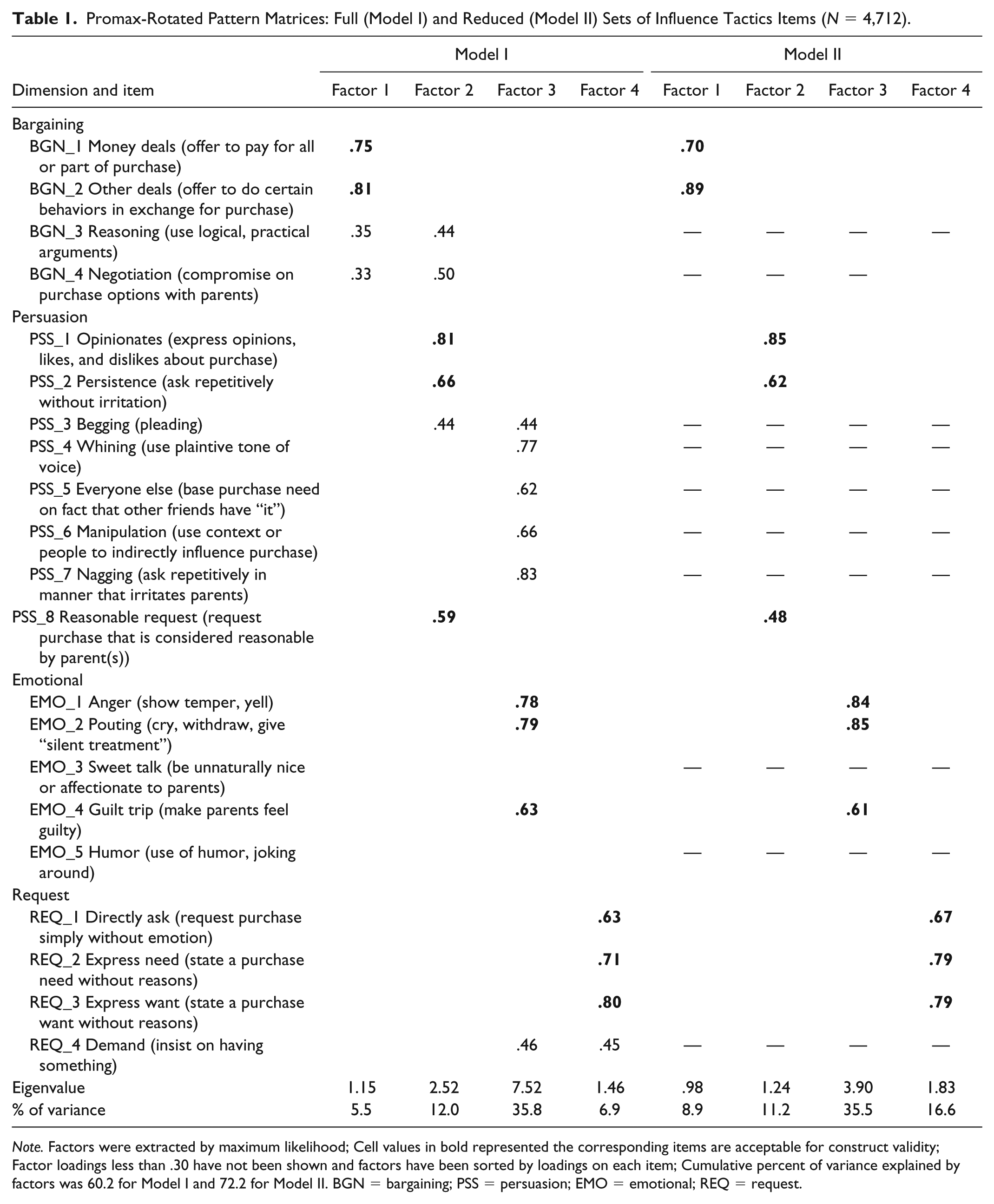
Note. Factors were extracted by maximum likelihood; Cell values in bold represented the corresponding items are acceptable for construct validity; Factor loadings less than .30 have not been shown and factors have been sorted by loadings on each item; Cumulative percent of variance explained by factors was 60.2 for Model I and 72.2 for Model II. BGN = bargaining; PSS = persuasion; EMO = emotional; REQ = request.
Analysis
Following the practice of House et al. (2014), we chose the MG-EFA approach to discover the common underlying structure of adolescent influence tactics across the 19 societies. We used IBM SPSS Statistics for Windows, Version 20.0, to conduct a series of EFAs to refine and validate the scale of adolescent influence tactics and examine whether it was construct-equivalent across societies. We also used AMOS (Version 7.0) to perform a CFA based on an overall sample to assess the degree to which each of the measures reflected the intended dimension. For the test of the metric equivalence of the scale, we used Orthosim 2.1 to perform Procrustes rotation to evaluate the fit indices representing the congruence between the factor pattern matrices derived from the overall sample and each society.
Results
Refinement and Validation of Measures
We factor analyzed the items of influence tactics with Promax rotation in a specified four-factor model (Hair et al., 2010; see Table 1). The results of the first round of analysis (Model I), which explained 60.2% of the variance, showed that two items of bargaining tactics (i.e., BGN_3 and BGN_4), five items of persuasion tactics (i.e., PSS_3, PSS_4, PSS_5, PSS_6, and PSS_7), two items of emotional tactics (i.e., EMO_3 and EMO_5), and one item of request tactics (i.e., REQ_4) failed to load strongly on the intended dimensions and weakly on other dimensions at the same time. We therefore deleted these and then reanalyzed the remaining items. A refined model ultimately emerged (Model II), as suggested by previous research (Su, 2011; Su & Wang, 2010), containing 11 statements on a scale of influence tactics that represented the four categories of adolescent influence behavior. The total variance explained by these statements was 72.2% and thus was acceptable (Hair et al., 2010). All of the factor loadings, ranging from .48 to .89, were not only positive and quite high on the intended dimensions but also weakly loaded on other factors, and thus simultaneously demonstrated convergent and discriminant validity (Venkatesh, Kohli, & Zaltman, 1995). The final alpha values of all dimensions, ranging from .72 to .81, demonstrated the acceptable reliability of these scales (Hair et al., 2010).
To ensure construct validity of the measurement under more conservative tests, Model II was analyzed using CFA. Results showed that the model had values of goodness of fit index (GFI) >.90, adjusted goodness of fit index (AGFI) >.90, comparative fit index (CFI) >.92, and root mean square error of approximation (RMSEA) <.07, suggesting a satisfactory fit (Hair et al., 2010). The standardized factor loadings on the hypothesized latent variables ranged from .65 to .88 with p < .001, providing evidence of convergent validity (Garbarino & Johnson, 1999). In addition, the confidence intervals around the correlations between any two latent variables did not include 1, demonstrating discriminant validity (Anderson & Gerbing, 1988).
Construct Equivalence
Having refined the measurement model of adolescent influence tactics, we then repeated the analysis using data from each of the 19 societies separately (Fu et al., 2004; House et al., 2014). Table 2 shows that the percentage of variance explained for all the societies exceeded the acceptable level of 60% (Hair et al., 2010). For the majority of societies, over 90% of their items met the required level of construct validity. We also checked the reliability of the four subscales within each society separately. The majority of the alpha values were above the acceptable level of .60 or .70 (Fu et al., 2004; Hair et al., 2010), and the average alpha values of the subscales across societies were .74 for bargaining tactics, .68 for persuasion tactics, .80 for emotional tactics, and .78 for request tactics. In summary, we were able to identify the same factor structure within the majority of societies, and the construct equivalence of our influence tactics scale was substantially supported.
Measurement Equivalence Results for Adolescent Influence Tactics Subscales (N = 4,712).
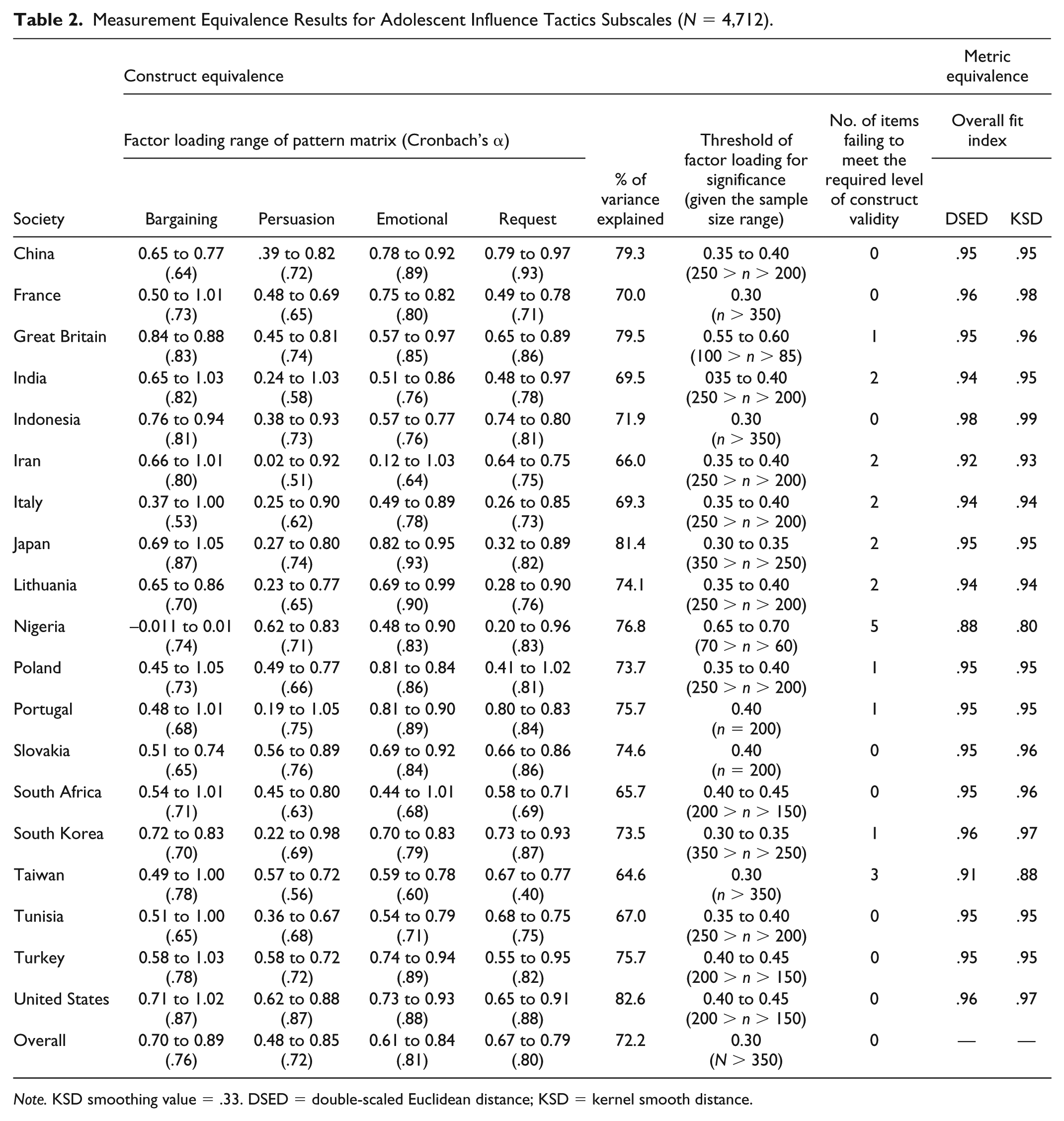
Note. KSD smoothing value = .33. DSED = double-scaled Euclidean distance; KSD = kernel smooth distance.
Metric Equivalence
To test the metric equivalence of the adolescent influence tactics subscales, we next performed Procrustes rotation to compare the matrix of factor loadings of each society with its counterpart of the overall sample. This approach was used to examine whether the degree of connection between each item and its corresponding factor was identical across societies (House et al., 2014; van de Vijver & Leung, 1997). Table 2 shows that the overall double-scaled Euclidean distance (DSED) similarity coefficient and the overall kernel smooth distance (KSD) similarity coefficient of all the societies were above the acceptable level of .80, suggesting that our influence tactics scale exhibited strong metric equivalence across societies (Barrett, 1986; House et al., 2014).
Cross-Cultural Response Bias
Finally, to test whether our influence tactics scale was subject to cultural response pattern bias, we used a within-subject standardization procedure to remove potential cultural response patterns from the data (Fischer, 2004). Results of correlation analyses showed that all subscales of adolescent influence tactics correlated highly with their within-subject standardized versions (rbargaining = .73; rpersuasion = .55; remotional = .68; rrequest = .65) at the p < .001 level, demonstrating that our original measures of influence tactics were relatively free from cross-cultural response bias (House et al., 2014) and thus to a degree met the necessary degree of scalar equivalence (Karam et al., 2013).
Discussion and Conclusion
Summary
By adopting a multistaged process, we have demonstrated that the quaternion model of adolescents’ influence behaviors with their parents was found across 19 societies throughout the world, suggesting that this construct does not only exist in Asian contexts (Su, 2011; Su & Wang, 2010). We have also provided an 11-item scale to measure an adolescent’s influence tactics as reflected in Palan and Wilkes’s (1997) four dimensions of adolescent influence tactics. The scale generally exhibited satisfactory levels of cross-national internal consistency of the four dimensions and met the required levels of convergent and divergent validity of the measurements. Regardless of the high diversity in language and ethnicity of the surveyed societies, the 11-item four-dimensional scale consistently achieved satisfactory psychometric comparability of construct and metric equivalence across nations and cultures. In addition, we have shown that our measures were relatively free from the effects of cultural response bias, suggesting that, in general, there was no evidence of severe response styles in any society (Usunier & Lee, 2013). To sum up, all the evidence supports the speculation that the application of the proposed scale in cross-national studies is meaningful and extensive. The findings of the present study may be of interest to researchers using the scale of adolescent influence tactics to examine adolescents’ influence behavior with their parents across societies.
Contribution to Scholarship
This article attempted to advocate greater interest in cross-validation of measures by proposing a sequential procedure elaborating on how to test measurement equivalence within the integrative framework. Our results improve on previous research in four ways. First, this study built on literatures by developing and then testing a theoretical model of measurement of adolescent influence tactics with parents. Results of the study would be used as evidence for revising or expanding theories of adolescent influence tactics. Second, the 19 participating societies in the study represented a wide range of cultural and societal characteristics. Therefore, our findings are more generalizable than previous discovery which has often derived from a single or few cultural or societal context(s) (Steenkamp & Baumgartner, 1998; Su & Wang, 2010). Third, we integrated the MG-EFA approach with an assessment of cross-cultural response bias that may assist other researchers to examine measurement equivalence in their research with multiple groups. Thus, this study substantially contributes to the literature in that it builds on the Palan and Wilkes (1997) taxonomy and profitably applies a series of analyses to shed light on underlying rationales to be associated with the measure of validation of adolescent influence tactics. These rationales are difficult to disentangle in cross-cultural contexts (Su, 2011; Su & Wang, 2010). Fourth, our process of validation screened out 10 items failing to reflect adolescent influence tactics used in the 19 societies. These deleted items of influential behavior also establish evidence for the boundary of the measurement model in cross-cultural applications.
Although our results suggest that the original scores obtained by validated scale are generally comparable across 19 societies, there are few issues which compel researcher to apply the cross-validated scale with caution. First, when compared with the other societies surveyed, Nigeria is feeble in construct equivalence, with five items violating the construct validity of the refined model. This may be due to an important variation between Nigeria’s sample and the overall sample in terms of how adolescent influence tactics are conceptualized and measured. A further potential complication is that not all relevant behaviors or facets associated with the construct of influence tactics are covered and properly sampled in Nigeria (cf. van de Vijver & Tanzer, 2004), resulting in confusing dimensions of adolescent influence tactics somewhat to the respondents. An in-depth examination of violating items revealed somewhat distinct patterns for the four subscales in Nigeria. In sum, the statements “money deals (offer to pay for all or part of purchase)” (BGN_1), “reasonable request (request purchase that is considered reasonable by parent(s))” (PSS_8), and “anger (show temper, yell)” (EMO_1) appear to reflect none of adolescents’ influence tactics in Nigeria. In contrast, the statement “other deals (offer to do certain behaviors in exchange for purchase)” (BGN_2) is perceived as a behavior of emotionality rather than bargaining, whereas the statement “ask directly (request purchase simply without emotion)”(REQ_1) is perceived as a behavior of bargaining rather than request.
Another issue for discussion derived from our findings regarding adolescents’ use of persuasion. It demonstrates minor response bias across societies due to a lower but acceptable correlation coefficient between the original score and the standardized score. This overall difference might be caused by factors related to reflecting bias of cultures. For example, respondents of some societies may tend to change their opinions as a result of taking part in the survey itself. Similarly, respondents of some societies may likely answer questions with ratings of social desirability, extremity, or acquiescence, rather than truthful replies (cf. Fischer, 2004). Moreover, Palan and Wilkes’s (1997) view of the persuasion concept was based on reasoning and feelings. Persuasion, as measured based on the refined model in this study, was focused on the former, suggesting that responses of reasoning items are likely cross-culturally biased.
Limitations and Directions for Future Research
There are limitations to the current study. Advanced endeavors will be required in the future to overcome them. First, we followed quantitative research approach to assess measurement equivalence and cultural differences on scaling items. Because constraints on quantitative approach have been previously recognized, future research in a qualitative approach may facilitate a further in-depth analysis of adolescent influence tactics used in family decisions and a better understanding of how cultural and societal features shape the use of these tactics. In addition, we did not investigate the predictive properties and correlates of the measurement model of influence tactics with outcome measures. Future research conducted across more culturally varied contexts is required to further examine the criterion-related validity of the model with global evidence.
As we have established first evidence for cross-societal applicability of the refined scale of adolescent influence tactics with parents, future research is required to investigate associations of the model with antecedents and outcomes. Studying the effect of cultural and societal features on adolescents’ use of influence tactics with parents will enable a deeper understanding of the underpinning mechanisms through which we can better compare and explain the observed difference on the use of influence tactics between societies. A rewarding research direction is to adopt a society-level approach to demonstrate each dimension of adolescent influence tactics that captures adolescents’ collective strategic thoughts of a society on a variety of influence behaviors they use with parents in family vacation decisions. Future analyses in society-level approach are expected to provide strong evidence which connects adolescents’ use of influence tactics with society’s cultural values and socioeconomic characteristics. This goal can be achieved only by investigating sufficient number of societies which are diverse in cultural, socioeconomic, and geographic settings (cf. Bond et al., 2004; Leung & Bond, 1989).
Moreover, for marketers, the relative equivalence of the influence tactics used by adolescents implies that the model and scale developed in a given society may be largely transferable across the 19 societies studied and that, in turn, marketing and sales techniques capitalizing on these influence tactics may be used with limited adaptations across these markets. Following our cross-validated model and scale of adolescent influence tactics with parents, future research is required to further segment international tourist market of family products according to adolescents’ participative role of societies and decisions, respectively (Decrop & Snelders, 2005).
Footnotes
Declaration of Conflicting Interests
The author(s) declared no potential conflicts of interest with respect to the research, authorship, and/or publication of this article.
Funding
The author(s) disclosed receipt of the following financial support for the research and/or authorship of this article: This article is based on the first author’s project grant of the Ministry of Science and Technology, Taiwan for the Commonwealth Research Program (MOST 105-2410-H-030-069).
