




Abstract
This study sought to provide an understanding of the sources of work intensification and its effects on assistant principals in Turkey, and the coping strategies they use. The participants of this qualitative study were a sample of 18 assistant principals. The current qualitative study was based on semi-structured interviews. Data analysis was performed through descriptive and content analysis. This study revealed that assistant principals had work intensification related to heavy paperwork, a variety of administrative affairs, a variety of tasks, school size, and lack of experience. Assistant principals’ work intensification caused negative psychological and physical health, work-family conflict, limited social relationships, and a decrease in professional commitment. Assistant principals spent time with their families, engaged in task sharing, received support from colleagues, took part in various social events, planned work habits and managed priorities to reduce the negative effects of work intensification.
Keywords
Introduction
Research indicates that critical issues related to assistant principals have not been adequately studied in the field of educational management, and that individuals holding such positions have been “forgotten” as leaders (Cranston et al., 2004). Since the last decade has witnessed a surprising number of studies examining assistant principals in different countries, assistant principals have newly become “remembered leaders” (Arar, 2014; Armstrong, 2009, 2015; Bukoski et al., 2015; Darmody & Smyth, 2016; Demirbilek & Bakioğlu, 2019; Kwan, 2019; Leithwood & Azah, 2014; Oplatka & Tamir, 2009; Searby et al., 2017; Tahir et al., 2019). National literature related to assistant principals remains limited (Bellibaş & Gümüş, 2019; Kaya et al., 2016; Polat, 2010). Despite these advances, studies on assistant principals in different countries still do not receive sufficient attention. Assistant principals play a critical role in the regular execution of all activities related to education and training and in achieving strategic goals (e.g., Barnett et al., 2012; Celikten, 2001; Garrett, 1999; Glanz, 1994; Hausman et al., 2002; Hughes, 1999; Timperley, 2005). Examining the responsibilities of assistant principals to increase their performance in educational outcomes will make important contributions to the field of educational leadership and management (Tahir et al., 2019). Therefore, the current study examined the effects of work intensification, one of the main obstacles to assistant principals’ effective performance (Brauckmann & Schwarz, 2015; Leithwood & Azah, 2014; Oplatka, 2017b; Starr & White, 2008; Tahir et al., 2019), as well as their methods of managing such work intensification.
Study Background
Expectations for education and schools are increasing day by day due to public reforms focusing on student performance and educator accountability (Arar, 2014; Brauckmann & Schwarz, 2015). In Turkey, the Ministry of National Education (MoNE) established new policies in 2018 to improve the quality of education, within the framework of the “2023 Vision” charter. Two of the goals outlined in this document focus their attention on school administrators. The first details expectations for data-based management in schools. The second aims to improve the professional development and personal rights of school employees (Ministry of National Education [MoNE], 2018). As a result of these policies, expectations for all school stakeholders have increased. It seems impossible for school principals alone to shoulder the burden of realizing these increasing expectations. Assistant principals take administrative responsibilities in different fields and carry out education and training activities effectively in schools (Cranston et al., 2004). In recent years, the responsibilities of these assistant principals have increased, both in their duties and the high expectations placed on them that heighten the pressure that they feel in their workplaces (e.g., Barnett et al., 2012; Leithwood & Azah, 2014). In Turkey, increasing exam-centered education adds to the expectations of academic success—expectations that are often aimed at managers (Büyüköztürk, 2016; Gümüş et al., 2021; Yılmaz & Bülbül, 2017). In this regard, planning, monitoring, and following studies focusing on exams and academic success increase the burden of assistant principals. In Turkey, assistant principals also have to deal with tasks beyond their legally assigned duties and areas of responsibility (Beycioğlu & Şahin, 2016; Egitimciler Birligi Sendikası [Egitim Bir Sen], 2019; Official Gazette, 2014; Türk Eğitim Derneği [TED], 2014). Adding to this pressure, school principals assign assistant principals to solve students’ and parents’ problems. Assistant principals’ increasing work intensification and psychological pressures result directly from these changing expectations (Demirbilek & Bakioğlu, 2019; Köse, 2018).
The current study makes key contributions to solving these problems encountered by assistant principals and school management. (i) The most important contribution of this study is illuminating how the unwanted effects of work intensity arising from these demands are dealt with in organizations where excessive workload, emotional and physical job challenges, and work-home conflict are seen as risk factors (Bakker & Demerouti, 2017) for work efficiency. This contribution may reveal hidden aspects of the work intensification of assistant principals, which we see as a harbinger of future management crises. (ii) There are a limited number of studies in the national literature on the problems faced by assistant principals (e.g., Demirbilek & Bakioğlu, 2019; Köse, 2018), to which the present study will make a critical contribution. (iii) In centralized education systems, revealing the problems faced by assistant principals in their professions may provide important contributions to nations with similar management styles, because the behavior of school administrators varies according to social, cultural, and political context (Hallinger, 2018). (iv) When working conditions are improved by reducing the workload of assistant principals, better quality support can be provided for both student learning and school administration. In addition, assistant principals have a strong potential to become school principals in the future. If assistant principals experience increasing burnout and leave the profession as a result, they will not have the opportunity to further influence schools and educational systems as full principals (Oplatka & Tamir, 2009). Thus, determining the sources of, effects of, and strategies to cope with work intensification, which has an important impact on assistant principals, may offer important implications to increase student learning and academic success. Therefore, this research aims to display the opinions of assistant principals about work intensification based on their own personal experiences. The results of this study provide useful findings for policymakers and practitioners to design programs and interventions to improve the conditions of assistant principals. Based on this exigency, the study aimed to answer the following research questions:
(i) What are the sources of work intensification of assistant principals?
(ii) How does work intensification affect assistant principals?
(iii) Which methods do assistant principals use to cope with work intensification?
What is work intensification?
Work intensification refers to the insufficiency of mental and physical capacity related to work done during working hours. In other words, it is associated with employees’ mental and physical effort during certain working hours (Green, 2004). Work intensification arises due to the fact that employees are held responsible for a greater workload than they can accomplish during working hours (Kelliher & Anderson, 2010), as well as due to the decrease in resting time as a result of extended working hours (Lu, 2009). A possible cause of this phenomenon is that work intensification is seen as an organizational tool that can increase the productivity of employees (Brown, 2012; Green, 2001). Similarly, the literature emphasizes different factors that cause work intensification. With the acceleration of organizational change globally in the 1990s (Zeytinoglu et al., 2007), increasing stakeholder expectations (Ogbonna & Harris, 2004; Turkoglu & Cansoy, 2020) and the emergence of economic and technological changes (Paskvan et al., 2016) in turn increased work intensification. However, work intensification that is applied to increase productivity actually creates negative effects on employee welfare and job satisfaction (Paskvan et al., 2016), and can cause different occupational medical conditions—both physical and psychological (Krause et al., 2005).
Causes and consequences of work intensification of assistant principals
Assistant principals oversee and execute many activities in schools, such as coordination and governance, general administrative affairs, human relations management, creating a disciplined environment, managing relations with the external environment, conducting quality studies, working with teachers, and developing school strategies (Barnett et al., 2012; Celikten, 2001; Garrett, 1999; Glanz, 1994; Hausman et al., 2002; Hughes, 1999; Timperley, 2005). They must cope with teachers with low motivation, a variety of difficult and time-consuming tasks, and high academic success expectations from their environment (Barnett et al., 2012). Besides, they spend a great deal of time reading and responding to email, attending many meetings (Leithwood & Azah, 2014), and dealing with disciplinary problems at school (Kennedy et al., 2017; Oplatka & Tamir, 2009; Williams et al., 2020). Assistant principals may also work to generate funding for their institutions (Gryna, 2004). Their workload is comprised of many duties and responsibilities that combine to create an effective school environment (Leithwood & Azah, 2014).
The roles of an assistant principal become uncertain as these individuals contend with duties and responsibilities that are not fully defined in law or policy (Armstrong, 2015; Bukoski et al., 2015; Cranston et al., 2004; Grimmett & Echols, 2000; Kwan, 2019; Marshall & Hooley, 2006). This uncertainty increases work intensification and pressure for assistant principals. Indeed, the fact that assistant principals need training on time management, maintaining work/life balance, special education, teaching leadership and creating a school culture (Allen & Weaver, 2014; Cranston et al., 2004) shows that they have difficulty coping with work intensification.
Increasing work intensification has serious negative effects on employees’ health (Fairris & Brenner, 2001) and increases their fatigue and stress (Boxall & Macky, 2014; Green, 2001). Accordingly, work intensification negatively affects the work-life balance of employees. Similar results are found in educational institutions. Assistant principals encounter different physical and psychological problems depending on their work intensification (Barnett et al., 2012; Demirbilek & Bakioğlu, 2019; Leithwood & Azah, 2014; Marshall & Hooley, 2006). Examples of these ill effects include stress (Barnett et al., 2012; Marshall & Hooley, 2006), increasing emotional exhaustion (Celik, 2013), decreases in job performance (Cranston et al., 2004; Glanz, 1994), and business/family conflict (Demirbilek & Bakioğlu, 2019). All of these problems can cause assistant principals to quit. Assistant principals have stated that they resigned due to the problems they experienced: for example, heavy paperwork and work intensification. The imbalance between work and family and feelings of exhaustion due to work intensification are also among the important factors contributing to such resignations (Demirbilek & Bakioğlu, 2019). In this context, it is understood that assistant principals struggle with the pressures arising from work intensification.
Assistant principals in the Turkish Education System
The Turkish educational system is centralized; thus, school administrators are appointed by central administration. School management has yet to become a profession in Turkey; however, the principle of “teaching is essential in school management” has been adopted nationally (Cemaloğlu, 2005). Therefore, becoming an assistant principal requires some general and special conditions, provided that a candidate has at least 2 years of teaching experience. There is no special pre-service training program for assistant principals in Turkey. Teachers who have at least 2 years of teaching experience who wish to pursue a principal position must take both written and oral exams. Based on the results of these exams, assistant principals are selected and recruited (Beycioğlu & Şahin, 2016; Official Gazette, 2018).
Assistant principals in Turkey have duties and responsibilities determined by legal frameworks (Beycioğlu & Şahin, 2016; Eğitim-Bir-Sen, 2019; Official Gazette, 2014; Türk Eğitim Derneği [TED], 2014). Assistant principals are expected to take over the responsibilities of the school principal when necessary, and to fulfill their duties in cooperation with other assistant principals (MoNE, 2018). However, these responsibilities are based on bureaucratic jobs, also known as administrative affairs (Balıkçı, 2016). The Ministry expects such bureaucratic issues to be dealt with according to a school development model and a data-based management approach (MoNE, 2018). Increasing the motivation and professional development of school principals is among the goals outlined by the MoNE (Directorate of Strategy and Budget [DSB], 11th Development Plan, p. 127).
Method
This qualitative study adopted a phenomenological design. Qualitative research uncovers human experiences through words, pictures, images, and documents. The purpose of such research is to reach more detailed, explanatory, and holistic interpretations and meanings of a subject (Christensen et al., 2015; Patton, 1987). The phenomenological design aims to deduce and make sense of participants’ experiences on a subject (Creswell, 2016). This research examined the work intensification experiences of assistant principals, their reflections on work intensification’s impact on their lives, and the strategies that they used to cope with work intensification-related problems.
Participants
The sample consisted of 18 assistant principals (15 males, three females) working in a major city in south-central Turkey during the 2017–2018 academic year. Sixteen of the participants held a bachelor’s degree, while two of them held a master’s degree. Their teaching experience ranged from 5 to 23 years, while their management experience ranged from 2 to 14 years. The majority of the participants worked in primary and middle schools.
In a qualitative study, it is important to recruit participants who have similar characteristics related to the subject under examination, in order to reach as nuanced and complete an explanation as possible of the phenomenon (Creswell, 2016; Marshall & Rossman, 2010; Patton, 1987). Therefore, preliminary interviews were conducted to determine whether the assistant principals had experienced work intensification or not. Accordingly, 34 assistant principals were interviewed. The preliminary interviews showed that some of the assistant principals did not experience work intensification or voice any concerns or complaints due to work intensification. Those assistant principals (N = 16) were not included in the study. Consequently, we chose the study participants (N = 18) among the assistant principals who expressed high levels of work intensification. During this selection process, we also aimed to determine how work intensification affected assistant principals. These assistant principals considered their job to be very stressful, using specific expressions such as “time pressure,” “workload,” “having jobs,” “thinking volume,” “unhappiness,” “parents’ pressure in school,” and “facing work intensification.” Thus, as referenced in the literature review, we believe that assistant principals who held management and leadership responsibilities at higher-than-typical levels would be more likely to voice their concerns and share their feelings on this issue. This type of participant selection is somewhat subjective, which is a limitation (Oplatka, 2017a, 2017b). Thus, this selection process caused us to exclude 16 participants who said that they were very happy with their jobs, and that they generally did not feel concerns about work conditions such as paperwork, time pressure, or turnover.
As shown in Tables 1 and 2, participants worked in schools where the number of students ranged between 160 and 1,613 (M = 562.78). Two schools had 100 to 200 students, 10 schools had 200 to 500 students, and six schools had more than 500 students. Descriptive and content analyses were used to analyze the data.
Participants Included in the Study.

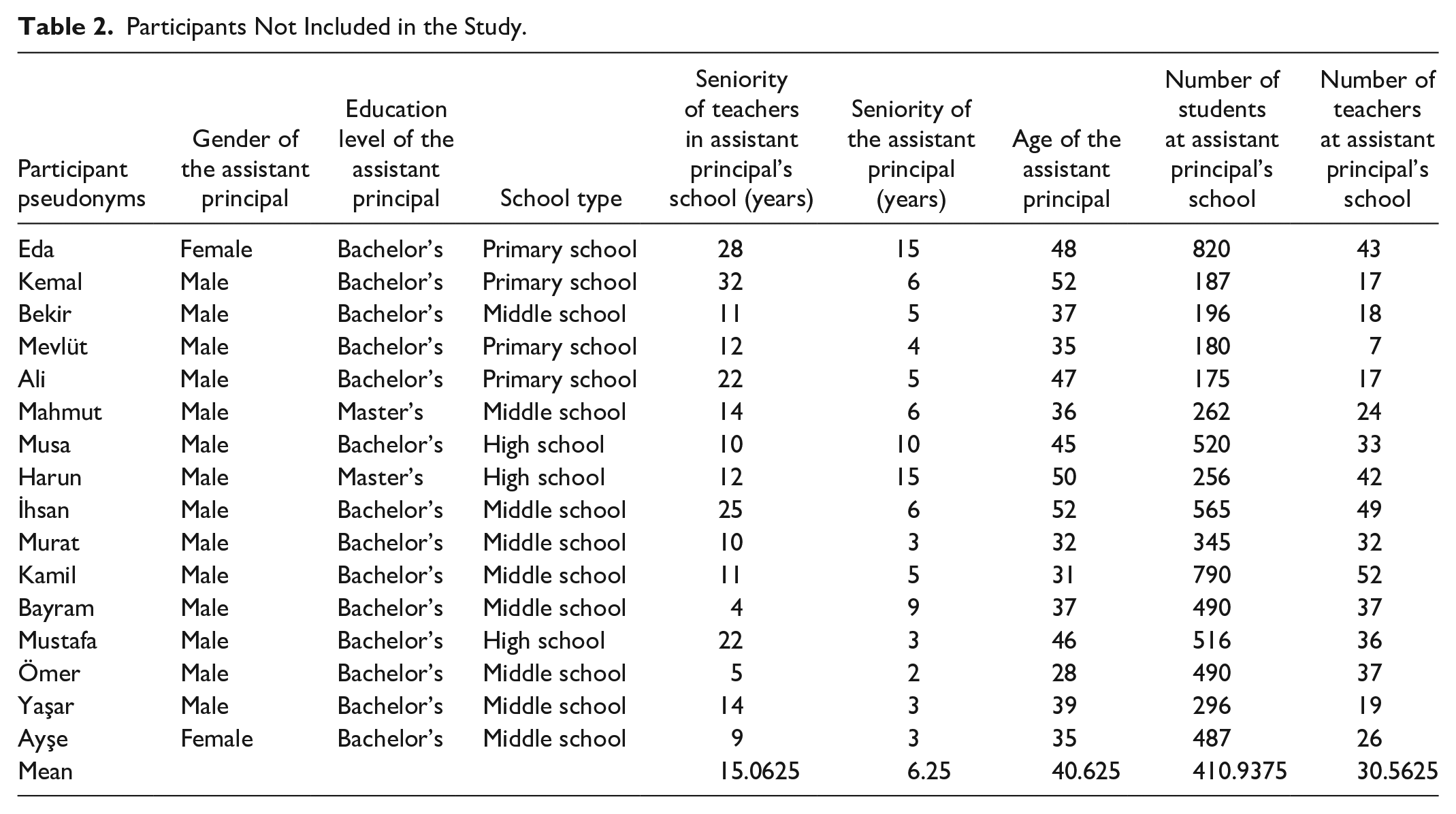
Participants Not Included in the Study.
As seen in Table 1, the participants’ ages ranged from 29 to 44 (M = 36.06). Three of the assistant principals were identified as female, while the remaining 15 were identified as male. Two of the assistant principals had postgraduate education, and the remaining 16 had bachelor’s degrees. The number of students in these assistant principals’ schools ranged from 160 to 1613 (M = 562.78). The seniority of the assistant principals ranged from 2 to 14 years (M = 5.61), while teachers’ seniority ranged from 5 to 23 years (M = 12.11).
Table 2 shows that non-participants’ ages ranged from 28 to 52. In this sample, two assistant principals were identified as female, while the remaining 14 were male. Two assistant principals had postgraduate education, while the remaining 14 had bachelor’s degrees. The number of students in these principals’ schools ranged from 175 to 820 (M = 410.9375). The seniority of these assistant principals ranged from 2 to 15 years (M = 6.25), while the teachers’ seniority ranged from 4 to 32 years (M = 15.0625).
The participants who reported high levels of work intensification (Table 1) were less experienced than those who did not, had more students in their schools (by about 150 students on average), and were younger. Most of the assistant principals in the study sample worked at elementary and middle schools. Elementary and middle schools have large amounts of paperwork, and middle schools also experience great intensity as students have to prepare for high school entrance exams. These participants’ backgrounds and their schools’ characteristics might be related to the differences in how they experience and cope with work intensification.
Data Analysis
A semi-structured interview form was used to collect data for this study. The form was prepared with the help of two academics (field experts), two participants who could contribute to the research, and a language expert. It consisted of a total of 12 questions related to sources of work intensification (four questions), the effects of work intensification (five questions), and methods for coping with work intensification (three questions). Yıldırım and Şimşek (2011) advocate that the opinions of the participants about the research should be handled in a meaningful and understandable way in descriptive analysis. In the current study, such opinions have been presented in the findings and interpretations section. Direct quotation was used to state the opinions of the participants in their own words. According to Krippendorff (2004), content analysis aims to uncover new meanings by creating different and meaningful texts based on existing data. In this study, the results of the content analysis are accordingly presented with the themes, categories, and sub-categories reached by the researchers (Table 2). The opinions of the participants were coded with pseudonyms to protect their identities and ensure confidentiality Strategies specified by Merriam (2015) were also employed to ensure the validity and reliability of the research. Member checking, ensuring sufficient participation to reach a certain satisfaction level in the data, providing external supervision based on the opinions of different researchers, and reflecting different opinions within the research are among these strategies.
Findings and Interpretations
There were three themes, three categories, and 16 sub-categories generated during analysis of the data for this research (Table 3). These themes include the work intensification of assistant principals, the negative effects of work intensification on assistant principals, and the methods used by assistant principals to cope with work intensification.
Themes and Categories Emerging From the Research.
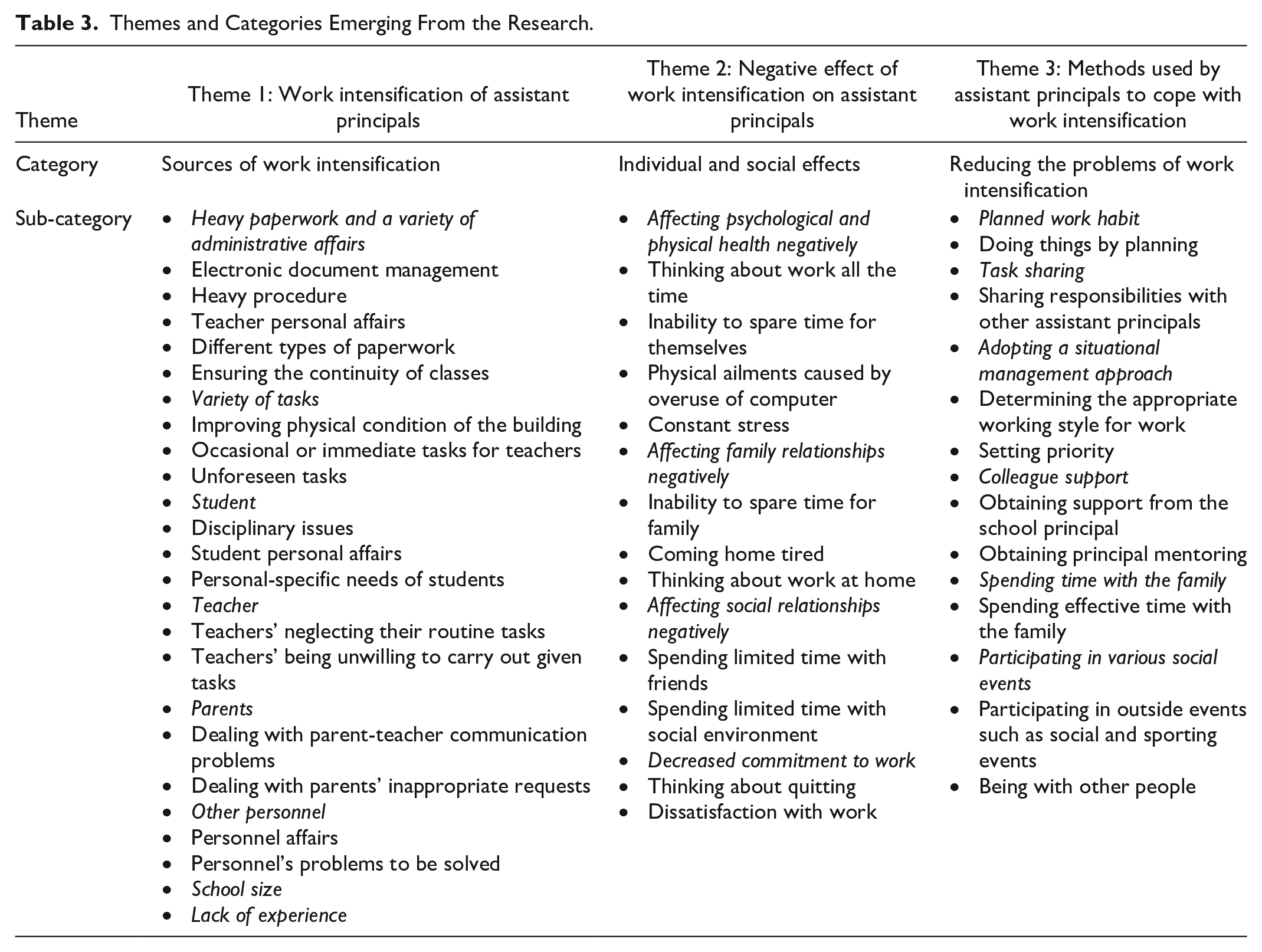
Table 3 displays how participants expressed different and detailed opinions about work intensification. Problem sources are presented as a whole, alongside their effects and methods of solution.
Theme 1: Sources of Work Intensification for Assistant Principals
According to participants, sources of work intensification included paperwork and administrative affairs, being responsible for many tasks, school size, lack of experience, and factors related to students, teachers, and parents.
Variety of paperwork and administrative affairs
Participants indicated paperwork and other administrative tasks as the main reason for their work intensification. Paperwork includes official affairs and various forms of correspondence that must be completed within a certain timeframe. These affairs include recording the activities at the school, responding to documents delivered by the DMS (Document Management System), and following and completing the processes related to the personal rights of teachers in the school. It is understood that the participants had to deal with heavy paperwork and procedures. Zeki, with 2 years of experience as an AP (assistant principal), explained the work intensification of paperwork and other administrative affairs as follows: “We spend most of our time on arranging the documents in administrative affairs, checking whether the documents are delivered on time, calculating additional courses, and for parent meetings. These tasks take up most of our time.”
According to participants, DMSs cause work intensification. These applications transfer documents to the electronic environment. However, according to Hüseyin, with 14 years of experience as an AP, checking them constantly also takes up a large proportion of participants’ time. He expressed his complaints as follows: “Now all transactions are carried out in the system called DMS. All documents from national education are entered in the system. We constantly check the system throughout the day. A malfunction in the system causes delays in the work that needs to be done that day.”
Finding substitutes for teachers who are absent, monitoring school-wide competitions, and some occasional or immediate administrative tasks also increase the work intensification of assistant principals. On the other hand, as can be seen from the opinions of Mehmet, with 5 years of experience as an AP, although assistant principals want to monitor and enrich education and training, they cannot spare enough time for the development of students because of mounting administrative affairs and paperwork. Mehmet pointed out this contradictory situation and said: “Strategy refers to accounting and accountancy, official paperwork. . . Contrary to popular belief, we spend less time dealing with students.”
Participants had to deal more intensely with some routine (daily) tasks at certain times of the school day. The main feature of these routine tasks was that they occurred during certain periods. Hasan, with 5 years of experience as an AP, said: “We are busy at the beginning of the period. Sometimes we need to work overtime or stay at the school at weekends.” Acar, with 6 years of experience as an AP, expressed this pattern as follows: “We have to work extra at certain times.”
Being responsible for many jobs
The participants had to deal with many other tasks and responsibilities besides paperwork. While monitoring and responding to the school’s physical structure, they may also need to deal with teachers’ work or intervene in unexpected and immediate events. For example, Betül, with 5 years of experience as an AP, stated: “We must eliminate all kinds of problems that teachers have about school, equipment, and students. We also have sudden (unexpected)tasks such as roof leaks of upstairs classes on rainy days, and boiler breakdown.”
Participants warned that it was necessary to allocate spare time to cope with infrastructure-related problems. As with other work, the time devoted to these tasks and contingencies can be a source of work intensification. The work intensification of assistant principals increases as they must deal with many issues related to school management, such as administration, budget, and physical conditions of the building. Kerim, with 2 years of experience as an AP, expressed this situation as follows: “If I need to give an example from our school, we may have problems with internet speed, especially since we are in a deficient infrastructure.”
School size
Participants (e.g., Ahmet, Mehmet, Zeki, and Hüseyin) stated that their work intensification increases directly with school size. Both the volume of correspondence and intensity of experiences related to their work can cause work intensification as a result of school scale. Their opinions showed that they have a wide variety of jobs, which cause work intensification for various reasons. Work intensification can occur both naturally (e.g., due to the number of students or amount of paperwork) and unexpectedly (e.g., due to student quarrels, parent complaints, etc.).
Some participants indicated the number of students in their school as a source of work intensification. Each increase in the number of students also increases work intensification. Participants pointed out that they felt helpless from time to time as a result of a high student-to-faculty ratio. Ahmet, with 11 years of experience as an AP, said: “We have a lot of students, which means a lot of work intensification, so sometimes we have to work extra.. . . It is difficult for such a large institution to deal with personnel in terms of both serving staff and security officers. There are 1216 students, and about 700 people go down the stairs at the same time. Someone gets stuck with another. Heads colliding accidentally from one to the other, etc., then the parent comes, what did you do to my child? we are dealing with them. [. . .] Because the school is big, sometimes problems may arise among children during the break time or while playing in the garden. In such cases, parents sometimes talk about not paying attention to their children, which can create extra difficulties for us.” Similarly, Hatice, with 3 years of experience as an AP, said: “We devote most of our time to correspondence. Jobs that take our most time are administrative correspondence, problematic student follow-up and absenteeism, and parent meetings.” Participant Abdullah, with 5 years of experience as an AP, emphasized that the negative aspects of this situation should also be taken into account, explaining: “The crowding of the school also affects us negatively. We have many students and teachers. As an elementary school it is especially so. The negativities of this also happen. The most important problem that increases the workload is the population of our school and the high number of staff.”
Being inexperienced
Participants with fewer years of experience emphasized the importance of being a professional assistant principal. They gave examples of the problems posed by on-the-job learning through trial and error. Participant Ferhat, with 2 years of experience as an AP, and who described himself as inexperienced, said: “In particular, I did not have information about other tender jobs, or financial affairs other than the teaching profession, and we did not receive any training on this. We have difficulties in this regard; our knowledge is insufficient. Financial affairs are not what a principal from teaching can do. It would be nice to have a professional management system. Just as there are chief physicians in hospitals, it should be the same as if we had a hospital manager; the director of the hospital deals with the financial affairs, the responsibilities of the building, and the chief physician only deals with the doctors. I think it should be the same for us.” Another participant with little experience, Zeki, with 2 years of experience as an AP, made similar points: “The biggest challenge I face while doing my job is people, because we may come across many people who do not want to understand even though we try to explain something to them. Sometimes teachers insist on not doing something when we ask for something, and they force us by not understanding and giving feedback. For example, projects need to be done on TUBITAK (The Scientific and Technological Research Council of Turkey), but some teachers do not want to understand this situation and do not want to do projects. They make us have difficulties with their opposition on this issue. In such cases, we have difficulties in getting them to do business and following their business.”
Student-related factors
Some participants emphasized disciplinary problems and conflicts between students as key factors contributing to work intensification. Students project their problems they cannot solve themselves onto the assistant principals. In addition, some interpersonal issues between students can turn into major disciplinary problems. Dealing with student aggression takes a lot of time. Hatice, with 3 years of experience as an AP, explained that this situation was exhausting them: “Student affairs take much of my time. There are problems between students as well as discipline problems. The most time-consuming issue is that they constantly fight and complain about each other.” The need to respond to students’ personal needs may also cause work intensification. Kerim, with 2 years of experience as an AP, and who worked at a school where students were transported from neighboring villages/districts by bus, said: “Many of our students come from neighboring villages/districts. Sometimes our students have to wait for the school bus in cold weather or do not come to school due to late buses or being stranded.” These statements show that principals must provide students with assistance to cope with many problems—a responsibility that eats up time and resources.
Teacher-related factors
Some participants complained that they had difficulty motivating teachers to do tasks related to their duties. For example, if teachers do not gather the relevant information about students and deliver it to the administration, the assistant principal’s daily workload increases. This situation was explained by Abdullah, with 5 years of experience as an AP: “Teachers do not give support for reducing work intensification. Instead, they decrease it because I check class registers and personally call teachers who did not sign and fill them. Considering that our school has 28 branches, this is a very intense process for me.” On the other hand, there are also immediate tasks that teachers need to finish on time that they then forward to the assistant principals. However, these tasks, which are time-sensitive, are sometimes left incomplete. In this context, teachers increase the work intensification of assistant principals and make their jobs more difficult. The opinions that the participants make evident are related to a communication problem between school administrators, where teachers are sometimes insensitive to the messages received from their administration. Zeki, with 2 years of experience as an AP, addressed this issue as follows: “Some issues take up a lot of time such as collecting information about the number of students, their parents’ profession, and telephone numbers.”
Parent-related factors
Some parents trespass on assistant principals’ time and sap their energy. When they meet with dissatisfied parents, these assistant principals spend most of their time persuading them. Parents often complain about teachers they are not satisfied with or have problems with. This situation was underlined by Acar, with 6 years of experience as an AP, as follows: “The biggest challenge we face when performing our job is parent complaints. Parents prefer the way of complaining to us instead of communicating with the teachers and solving the problems.” Some parents also make requests that are incompatible with regulations. Thus, they may make daily work difficult, as Acar explained: “Parents request things that are not in the regulations or that we cannot do from teachers or the school administration.”
Theme 2: Negative Effects of Work Intensification on Assistant Principals
This theme explains how work intensification harms assistant principals in the realms of psychological and physical health, family relations, social environment, and commitment to work.
Affecting psychological and physical health negatively
Most participants stated that work intensification negatively affects their physical and psychological health. Especially, the time spent on computers causes health problems. For example, Mehmet, with 5 years of experience as an AP, said: “Of course work intensification has physical and mental effects. Health problems can be experienced due to work intensification.” Participants believe that the work intensification negatively affects their psychology, in addition to causing physical problems. Thinking about and monitoring work all the time, as well as not making time for themselves causes stress over time. Hüseyin, with 14 years of experience as an AP, described this burnout as follows: “Of course we may have trouble. I get bored and stressed when there is work intensification. Sometimes this situation can be reflected on teachers. Sometimes I feel tired of meeting the requirements of teachers, students and parents.” According to the participants’ reflections, the pressure created by work intensification decreases the quality of their administrative work. Moreover, the resulting stress can also cause negative impacts outside of school.
Negatively affecting family relationships
The consensus is that work intensification harms family life. Participants detailed the impact of work intensity on family life as follows: inability to spare time for family, coming home tired, thinking about work at home, and taking care of work from home. These situations make both participants and their families unhappy. The participants expressed a feeling of being stuck between work and family, with the two in tension. One participant, Zeki, with 2 years of experience as an AP, said: “The work intensification affects us. Sometimes we may not be able to spend time on our family and friends. Even when we are with our family, we are criticized for thinking about school or work-related issues, because although your body is here, your mind or soul is not here. They say: Your mind is somewhere else, what are you thinking about? You are not here!”
Negatively affecting social relationships
According to participants, work intensification negatively affects their social relations as well. Due to work intensification, they may experience problems such as allocating limited time to their friends and feeling unable to help their friends sufficiently. Participants pay attention to the social environment and see it as a source of morale in doing their work. Bilgehan, with 3 years of experience as am AP, pointed out this situation and explained: “. . .My work intensification also affects the relationship with my colleagues. We cannot find time to chat, drink, or eat together in school.”
Decreased commitment to work
All participants (except Alper, Emre, Berna, and Acar) think that work intensification has negative effects on their profession. This effect reduces participants’ commitment to work, and it may even result in quitting. They assert two reasons for these negative thoughts, with the first being superiors’ negative attitudes. Bilgehan, with 3 years of experience as an AP, expressed her boredom as follows: “I have been thinking seriously about quitting recently. We already have work intensification . . . Our superiors never find solutions; instead, they ask us to find all solutions. They never help.” The second reason for this phenomenon is love of the teaching profession and the idea that they could be happier while teaching (instead of working in a school administrative role). Therefore, the participants consider quitting. Hasan’s thoughts, with 5 years of experience as an AP, echoed Bilgehan’s on this matter: “I thought about quitting many times. I always thought of starting teaching in such situations. The most important reason for this is that I like to communicate with students.” The bureaucratic work outlined in the first theme underlines both of these factors. The constant correspondence, the routine day-to-day work, and the repeated problems that assistant professors experience cause dissatisfaction over time.
In this theme, work intensification negatively affects assistant principals at various levels. The negative effects can directly affect their performance and cause some assistant principals to quit over time.
Theme 3: Methods Used by Assistant Principals to Cope With Work Intensification
This theme identifies how assistant principals balance the issues that occur in the first and second themes and reduce their negative effects. Participants follow different methods to cope with work intensification: planned work habits, work based on task distribution, adopting a situational approach, giving importance to teamwork, spending time with family, and participating in various social activities. Participants found it appropriate to internalize methods of coping with work intensification throughout their lives. However, there are three prominent methods: planned work, principal, and family. The environment is the main factor in the effectiveness of coping methods for work intensification.
Planned work habits
All except three participants (Hüseyin, Zafer, and Abdullah) agreed that planned work is a key measure in preventing work intensification. This majority deemed it necessary to do the tasks that they planned. Planned work can both decrease the work intensification of the participants and enable the work to be done more easily. Ferhat, with 2 years of experience as an AP, said: “Do not postpone today’s work until tomorrow . . . When you make the plans a week in advance, there is no jam.” The vast majority of the study participants adopted planned work as an individual and professional approach.
Task sharing
Another noteworthy point is that assistant principals consider task sharing as a method that can reduce bureaucratic work intensification and ease their workload. This can be seen as both a quantitative and psychological contributing factor in reducing work intensification. Task sharing is a reflection of the planned work and serves as a precaution to eliminate confusion in the work done. Bilgehan, with 3 years of experience as an AP, explained what he did to make things easier: “We perform our profession by sharing responsibilities with other assistant principals and this is good for reducing our work intensification.”
Adopting a situational management approach
The participants explained that it would be more appropriate to work according to the procedure of the task required. According to some participants (Hüseyin, Zafer, and Abdullah), their job requirements are not presented to them in a certain order on a daily basis; moreover, their job duties may also include different and unpredicted situations. Some of the participants assert that it is critical to take into account these features when working. Therefore, they find it appropriate to indicate and account for different ways of working. The opinions expressed at this point suggest the situational management approach. Hüseyin, with 14 years of experience as an AP, said: “It is difficult to determine a plan, a program, or a strategy since things are done indiscriminately.” Their experiences of coping with work intensity paved the way for participants to develop different methods. Such situations bring a balance to the personal and professional life of assistant principals.
Colleague support
Participants consider their colleagues’ contributions when coping with work intensification. However, the remarkable point here is that all participants regard school principals as colleagues. They receive support from school principals in two ways. First, they receive support from school principals in the realm of human values such as morale, motivation, and encouragement when doing their work. Second, they receive assistance from principals in the technical realization of their work. This contributes to both the comprehension of the work and the positive progress of communication between the principals. Hatice, with 3 years of experience as an AP, explained: “Our school principal is a quiet, understanding, moderate, and calm person. He can show his attitude very clearly. He/she supports me in any case.”
Teachers contribute as much as the school principal in this respect. The majority of the participants stated that teachers contribute to reducing their work intensification. Depending on the attitudes of teachers, teamwork at school can be considered an effective method to cope with work intensification. Cüneyt, with 7 years of experience as an AP, explained: “. . . Teachers sometimes help to reduce our work intensification.” It is important that assistant principals use human-centered solutions because they work mainly with other people in their day-to-day duties, through managing school personnel and addressing student and parent concerns. This situation underlines the importance of considering the environment to address the needs of assistant principals.
Spending time with the family
Participants considered family as a vital factor for coping with work intensification. According to the opinions of the participants, they process negative feelings from their job with the help of their family. All participants displayed this view. The more participants spend time with their families and the more they do things with them, the more relaxed and able to focus on their work they feel. The aforementioned issues reveal not only the nature of the work but also the importance of a healthy and supportive private life for assistant principals to do their duty. Bilgehan, with 3 years of experience as an AP, highlighted the importance of family as follows: “The only thing I do to relieve myself is to look after my child. Spending time with my daughter is like a therapy. I forget all the problems or feelings of fatigue when I go home and hug her.”
Participating in various social events
Participants’ opinions show that assistant principals must get used to the demands of their work over time, but that they also must develop various methods to cope with it. Some participants highlighted the importance of time spent with their friends and engaging in various out-of-school activities, though not as much as those with family, to overcome the problems of work intensification. It is important to note that these different types of activities can enter the life of assistant principals despite work intensification. This situation is thought to support the planned work that the participants stated as the first method for coping with this phenomenon. This situation also shows that assistant principals must foster a healthy in-school work environment as well as a healthy out-of-school (both physical and social) environment. Cüneyt, with 7 years of experience as an AP, drew attention to different activities with friends: “I play with my friends on football turf pitches to reduce the negative effects of my work intensification. I do research on issues related to my branch and follow the innovations. Also, I go on nature trips.”
Discussion
Limitations
Some key limitations should be taken into account when interpreting and applying the results of this study. First, study participants consisted of assistant principals working near the city center for two reasons: reaching participants easily and examining more crowded schools with higher work intensification. In this respect, assistant principals working at schools with a low number of students in rural areas were excluded from the study sample. Also, the study lacked data triangulation due to the limited time available and obstacles to permission processes. The participants in this study were selected from among the assistant principals who were thought to experience work intensity and the negative consequences of this phenomenon. In this respect, this situation should be taken into consideration while evaluating the results and should be addressed without generalizing these findings to all schools.
Future Directions
In this research, assistant principals stated that they devoted their time to different tasks and dealt with complex problems, which put intense pressure on them. In this context, depending on the observations and perceptions of the assistant principals, the factors that increase work intensity and the specific tasks on which they spend more time should be examined using quantitative methods to provide more insights into their impact. As a result of such studies, measures can be taken to decrease the work intensity in this profession. In addition, future studies may focus on organizational and individual variables that reduce the motivation of assistant principals.
Sources of Work Intensification
The most important factor that increases the work intensification of assistant principals is the excess of administrative paperwork. On the other hand, the necessity of using the DMS to transfer and monitor documents increases work intensification even more. The heavy paperwork and associated procedures can be considered a result of the bureaucratic structure of educational administration (Buluç, 2009; Sunderman et al., 2010). In this context, bureaucratic practices are factors that increase work intensification. Hence, bureaucracy can be both supportive and challenging (Omeroglu, 2006; Yılmaz & Beycioğlu, 2017). School administrators have to spend more time on tasks outside of direct educational observation and management in a challenging bureaucratic structure (Kotnis, 2004). It can be claimed that bureaucracy played a challenging role in the schools where the present study was conducted.
The increased administrative paperwork and other expected duties of assistant principals can be associated with recent changes in education (Arar, 2014; Brauckmann & Schwarz, 2015; Oplatka, 2017a). Considering Turkey’s 2023 Vision, new targets related to education quality have been set and expectations have increased in schools. In the 2023 Vision, two issues related to school administrators cause work intensity and offer solutions. The first problem is the workload on school administrators caused by the management style of schools. This workload is defined as bureaucratic, and a data-based management is recommended for schools. In addition, the implementation of a school development model for each school, the establishment of an information system, and the creation of a system for interaction with the environment are among other solution suggestions. In order to solve this problem, it is recommended that the professional development of teachers and school administrators be carried out with postgraduate education under the leadership of the Council for Higher Education (CoHE) or non-governmental organizations (MoNE, 2018). On the other hand, as the education system becomes more exam-oriented (Büyüköztürk, 2016; Yılmaz & Bülbül, 2017), it increases community expectations for schools. Thus, the emerging policies increase the work intensification pressure on schools and their management.
Students and parents are the other work intensification-related sources most frequently cited by principals. Assistant principals try to solve the discipline problems that students have with each other and with teachers, devoting a large amount of time to their efforts. They also have to respond to parents’ complaints and requests, which may at times be unreasonable and time-consuming. These tasks can at times disrupt the daily school flow. In addition to their daily routine work, assistant principals allocate time for these contingencies and emergent tasks. These findings confirm various studies that affirm the varying nature of educational leadership work (e.g., Barnett et al., 2012; Kennedy et al., 2017; Leithwood & Azah, 2014; Williams et al., 2020). Also, effective leadership is important for positive organizational outcomes (Abbas, Saud et al., 2020).
These statements demonstrate that assistant principals’ workloads involve many different tasks in the school, such as coordination, supervising general management affairs, managing human relations, and creating a positive school climate. In addition, they try to cope with many elements and responsibilities outside of their assigned duties. In this context, it can be stated that assistant principals experience an intense role ambiguity. Such a situation may make the position of assistant principal, which plays an important role in improving the quality of education, ineffective (Celikten, 2001). Additionally, assistant principals whose work intensification increases may have negative attitudes toward their profession and increased desires to quit (Demirbilek & Bakioğlu, 2019). Thus, practical measures should be taken to reduce their work intensification.
Negative Effects of Work Intensification
Work intensification has clear negative effects on assistant principals, including poor physical and psychological health outcomes, negative effects on family and social relationships, and decreased job satisfaction. Due to work intensification, assistant principals mostly do a desk job, which can cause physical ailments. Studies support these findings. Working long hours causes low back pain and other occupational diseases (Fein et al., 2017; Krause et al., 2005; Wang et al., 2018). Moreover, the efforts to complete work during the day creates pressure to finish tasks on time. These pressures may lead to psychological problems such as tension, stress, and anxiety (Barnett et al., 2012; Demirbilek & Bakioğlu, 2019; Leithwood & Azah, 2014; Marshall & Hooley, 2006). Work intensification was found to cause stress in studies conducted in different fields (Beck, 2018; Boxall & Macky, 2014; Currie & Eveline, 2011; de la Fuente et al., 2020; Fein et al., 2017; White & Bray, 2003). The change that comes with technology forces many institutions to be more effective (Taşçı & Titrek, 2019). Similarly, due to the development of information and communication technologies (Abbas, Eliyana et al., 2020), the expectation of completing tasks within a short timeframe creates stress in employees (Chesley, 2014; Currie & Eveline, 2011). In a nutshell, the stress caused by work intensification leads to decreases in the quality of administrative duties. Moreover, the resulting stress not only affects the work in school negatively but also brings consequences that affect health and private life.
Another negative effect of work intensification is that assistant principals cannot allocate sufficient or dedicated time to their families. This can weaken family relationships. Previous studies advocate that work intensification negatively affects work-family balance (Boxall & Macky, 2014; Currie & Eveline, 2011; Fein et al., 2017; Green, 2001). The same holds true for social relationships. Assistant principals spend limited time with their friends due to their busy schedules. Research has shown that work intensification causes diminished free time for social life (Fein et al., 2017; Kelliher & Anderson, 2010). Another problem related to work intensification is decreased commitment to work and career dissatisfaction. Although work intensification is expected to contribute to an increase in productivity in many institutions, it actually results in dissatisfaction with work (Brown, 2012; Kelliher & Anderson, 2010; Wang et al., 2018; Zeytinoglu et al., 2007). As a result, assistant principals experience emotional problems and consider quitting their jobs. Studies conducted in different fields have demonstrated that work intensification has serious consequences that can ultimately lead to job resignation and career changes (Demirbilek & Bakioğlu, 2019; Karakuş, 2011). Based on these results, work intensification yielded no increase in the performance of assistant principals, who play a key role in the regular execution of all activities related to education and training in the school and in the realization of strategic goals. Consequently, dissatisfaction with work and thoughts of quitting may have negative consequences in terms of student learning, stakeholders’ expectations, and the ultimate success of the 2023 Educational Vision.
Coping Strategies for Work Intensification
The assistant principals involved in the present study stated that they created plans to manage their work intensity, distributed duties among administrators in their schools, and received support from their school principals. However, it seems that assistant principals usually finish their work in order of priority, rather than behaving in a planned way to manage their work intensification. In other words, they complete their tasks according to order of importance and priority. Various studies support this result (Leithwood & Azah, 2014). In line with these findings, the fact that school principals also often complete their work according to order of priority (Allison, 1997; Demirkasımoğu, 2015; Koşar et al., 2013; Leithwood & Azah, 2014; Oplatka, 2017b) indicates that school leaders also follow similar strategies for managing work intensification. Therefore, it can be stated that participants plan their work intensification in the midst of their workflow, and that they largely do not employ work intensification management techniques (e.g., time and meeting management). Their emphasis on situational business management provides evidence for this claim. This finding can be considered a negative factor in terms of the development of teaching quality in school. This is because the ability of assistant principals to manage their work intensification is critical, so that they can focus their energies on improving the quality of teaching in schools. Administrators who can manage their work intensification well are able to plan and execute more effective studies for student learning (Grissom et al., 2015). The fact that the assistant principals in the present study did not manage their school tasks according to a strategic framework and did not consider time management may be strengthening their perceptions of work intensification.
Assistant principals explained that their school principals helped them overcome the pressure and tension arising from work intensification. They consulted their school principals about the issues they could not overcome and received emotional and guiding support, thus decreasing their work tensions and improving their overall outlook. That is, emotional help given by school principals, suggestions to do their job effectively, and encouraging approaches can be effective tools for reducing tension caused by work intensification. These important roles of school principals have been emphasized by previous studies (Searby et al., 2017; Tahir et al., 2019). On the other hand, when school principals put pressure on assistant principals instead of helping them think through their issues, assistant principals generally felt discouraged and considered quitting (Demirbilek & Bakioğlu, 2019). From this point of view, it can be interpreted that school principals should create a supportive environment for their junior colleagues.
Our study showed that some of the assistant principals who had a high number of students in the school or who were in the first few years of their profession had more difficulty in managing their work, and consequently felt greater pressure. Moreover, as the size of the school increases, the qualified learning of students declines and schools experience greater disciplinary problems (Barker & Gump, 1964; Chen & Vazsonyi, 2013; Fowler & Walberg, 1991). In addition, the experiences of school administrators are important in fostering high student performance in the school (Clark et al., 2009), and experience is also an important determining factor in the resilience of school administrators (Lazaridou & Beka, 2015). As a matter of fact, the experiences of school administrators, paired with the environment and conditions in which they work, serve as important factors shaping management behavior and results (Hallinger, 2018). School leadership in Turkey is not a profession. For this reason, only teaching experience is required for the selection and appointment of assistant principals. Many problems arise due to this situation, because it is a great weakness not to have any previous experience with school management. In this regard, reforming the training and selection of assistant principals and developing appointment policies are critical. In addition, inexperienced assistant principals may be assigned primarily to smaller schools to prevent work intensification and burnout.
The most common methods used by the assistant principals to reduce the pressure, tensions, and stress created by work intensification are spending quality time with family and participating in social activities with friends. Participants in this study struggled to cope with the stress that work intensification caused by trying to establish a balance between work-life-family. These findings are consistent with the literature (Allison, 1997; Cranston, 2007; Leithwood & Azah, 2014). Identifying the threats and precautionary factors is crucial to minimize stress (Ye et al., 2020). In this regard, it can be underscored that family and the social environment have an active role in helping assistant principals to assure work-life balance and reduce stress.
Consistent with the findings in this study, in studies conducted in different countries, vice principals experienced different problems due to work intensification. In a study conducted in Malaysia, assistant principals stated that they felt unhappy and emotionally worn out because of the tasks they had to complete in a short time, as well as due to the problems of school stakeholders (Tahir et al., 2019). Another study conducted in Canada found that assistant principals had to come to school instead of staying at home when they had ailments due to work related illnesses (Leithwood & Azah, 2014). A study conducted in different school types in South Texas (USA) revealed that assistant principals dealt with excessive workload and experienced problems in task management. Also, these professionals resolved conflicts with parents and students, in addition to addressing curriculum and instruction issues. As a result, such work intensification caused pressure and stress (Barnett et al., 2012). We think that the reasons and sources of work intensity in different countries are similar. This may be related to the similarities in the functioning of administrative processes at school and the buffer behaviors of vice principals in their duties. The findings of the present study showed that assistant principals play a supplementary role for school principals in human relations and the completion of administrative tasks at school. In a nutshell, even as countries and contexts change, the buffer role of vice principals remains.
Practical Implications
Expectations of school administrators have increased in the last decade due to political initiatives and social changes. In this context, it may be recommended that policy makers and practitioners take targeted measures to reduce the work intensification of assistant principals by considering their increasing responsibilities. Especially with the introduction of the electronic DMS, compounding administrative paperwork increases their work intensification. In this respect, the efficiency of these systems and their effectiveness in accomplishing educational outcomes should be re-evaluated, and thus bureaucratic procedures that reduce productivity can be reduced. In addition, it was observed that assistant principals were engaged in many tasks outside of their assigned duties, and consequently experienced role ambiguity. Therefore, especially in schools with a high number of students, it may be beneficial to separate educational and other tasks at school and assign them to different assistant principals to reduce this work intensification. Additionally, administrative activities can be strengthened by establishing a mid-level management system (such as coordinatorships and broadly competent branch offices). Thus, it is possible to prevent assistant principals from dealing with irrelevant duties and tasks. In addition, assistant principals in the present study did not follow a systematic method to manage their responsibilities. As a result, they had difficulty managing their work, and their work intensification increased over time. To address this issue, assistant principals could be provided with in-service training on managing their business effectively (through time management, etc.). Moreover, developing a special pre-service training program for assistant principals can increase their repertoire of skills and their power to cope with such problems. Finally, school principals played an important role in reducing assistant principals’ work intensification-related pressure. To prevent burnout and foster a healthy working environment, it should be ensured that principals maintain this role effectively in schools. However, due to the current gaps in this field, it is recommended that researchers continue to examine the variables that affect the work intensification of assistant principals, using different qualitative methods.
Conclusions
This study examined the causes of work intensification for assistant principals, the effects of work intensification on their lives, and the methods that they use cope with work intensification. In addition to their routine tasks, assistant principals have to deal with a wide range of different duties and responsibilities. As a result, the problems they experience due to work intensity have become clearer. In this regard, decision makers should take steps to enable assistant principals to perform their primary duties effectively and clarify their roles.
This study showed that assistant principals’ practices were not directly aimed at improving student learning, and thus their performance in this realm was inadequate. Considering the debates in the literature on sharing leadership in schools and improving the quality of student learning, it is vital to pave the way for assistant principals to display more effective behavioral patterns. In addition, it seems crucial that the social, emotional, and physical problems faced by assistant principals should be taken into consideration. This can help assistant principals do their job effectively. Also, factors such as school size, seniority, and managerial experience should be taken into account in the selection and appointment of assistant principals.
Footnotes
Declaration of Conflicting Interests
The author(s) declared no potential conflicts of interest with respect to the research, authorship, and/or publication of this article.
Funding
The author(s) received no financial support for the research, authorship, and/or publication of this article.
