




Abstract
This article investigates the problem of style stability and variation over time and presents the results of analysis of style evolution of American romantic poet H.W. Longfellow. The feature set includes 29 morphological and syntactic characteristics. The method of multivariate discriminant analysis is used. The study showed significant style changes over time and made it possible to single out the major tendencies of style evolution: the poet in his mature verses returns to the characteristics of his early lyrics. Besides, comparison of the variable and stable characteristics demonstrated that the initial part of the line is connected with style evolution, whereas the end of the line (which is the rhymed position) is less variable over time. The results may be useful for authorship attribution and manuscript dating research.
Keywords
Introduction
Research of individual style evolution is becoming one of the rapidly developing domains of stylometry. Quite a number of studies have revealed systematic changes in the syntactic, morphological, lexical, and other features of texts written by the same author at different periods of his life (Goldfield & Hoover, 2008; Juola, 2006; Stamou, 2008). This investigation of the development of style is often referred to as diachronic style analysis or stylochronometry (Forsyth, 1999), whose aim is to establish linguistic properties, which undergo changes over time and to discover factors influencing such style alterations. Detection of style variation patterns will certainly contribute to text attribution techniques, enhance the precision of research in dating texts, form the basis for the periodization of authors’ creative activity and, in general, will help to carry out more precise classifications of individual styles.
Besides general theoretical issues of variance over time of rhythmic, syntactic, and thematic style features (Can & Patton, 2004; Jackson, 2002; Laffal, 1997; Pennebaker & Stone, 2003), study of style development has provided data for a number of important applied studies, such as establishing the order of the creation of Euripides’s tragedies (Devine & Stephens, 1981), differentiating between Plato’s early and late dialogues with the consequent dating of some disputed texts (Brandwood, 1990; Temple, 1982), attributing texts by Yeats to one of the periods of his life (Forsyth, 1999; Jaynes, 1980), and types of semantic and thematic shifts in the vocabulary of Frost’s poems (Whissel, 1999).
Giving credit for the achieved results, we feel that still much remains to be done in this field. Further research of style variation, among other issues, may help estimate the relative contribution of different linguistic levels to the variability and stability of style, style contiguity, the speed of changes of different groups of characteristics, patterns of style evolution, to investigate the influence of style variation on text attribution and to reveal individual and universal tendencies in style evolution.
The aim of this article is to address some of the above-mentioned issues of style variation in verse. For this purpose, analysis of style evolution of the American romantic poet H.W. Longfellow was carried out. Longfellow was among the authors who laid the foundation of the American romanticism in the 19th century and influenced the further development of literature.
Data Sources
Different research objectives in stylochronometry suggests the use of corpora that include texts of various genres—from drama and tragedies to popular songs (Whissel, 1996) and email letters (Koppel & Schler, 2003). In most cases, the corpora only included texts written in prose.
We consider that verse presents at least the same, if not an even bigger interest for such research due to the peculiarities of its organization. Indeed, verse text, in contrast to prose, possesses a more complex structure: Unlike prose, which may be subdivided into fragments according to the understanding of the reader, verse imposes on the reader a preset fragmentation of text into similar portions (lines). In syllabo-tonic versification, systematic repetition of these similar parts creates a certain rhythmic expectation of stressed syllables in the so-called strong positions in different lines. This leads to a greater degree of integration of a verse text as compared with prose, introduces heavier restrictions to linguistic means of expression, makes vivid any deviation from the “norm” and, on the part of the researcher, creates better opportunities for a formal description of possible changes in the text structure.
In our study, we analyzed the poems, which the author included in his collections of works. This approach takes into account the author’s subconscious stylistic preferences—his estimation of what is proper at the time of publication. Homogeneity of the text corpus (Rudman, 2003) is achieved by including the texts of the same genre and comparable in size—all iambic lyrics not exceeding 70 lines. The resulting corpus includes 60 poems (2,113 verse lines).
To study the development of style over time, we divided Longfellow’s creative life into three parts.
The first (early) period includes the poems, which were written by the poet in his youth before he gained popularity.
The second (middle) period is the time of his productive work as an experienced author known to the general public.
The third period precedes the death of the author, being the time of the poet’s reflection upon his life and experience.
The following boundaries between the periods were established.
The first period embraces the years of his youth from 1819 till 1825, when he started his working career. During this stage, Longfellow wrote lyrics, which he later included in his two collections Earlier Poems and Juvenile Poems (16 texts with the total length of 557 verse lines).
The middle stage (1826-1861) lasts till the tragic death of Longfellow’s wife, Francis Elizabeth. The poet’s personal tragedy, which coincided with the beginning of the Civil War, became a turning point in the development of American romanticism. This period includes collections such as Voices of the Night, Ballads and Other Poems, Poems on Slavery, The Belfry of Bruges and Other Poems, and The Seaside and the Fireside (33 texts with the total length of 1,145 verse lines).
The remaining part of Longfellow’s creative career constitutes the third period (1862-1882). It is represented by his collections Flower-de-Luce and Ultima Thule (11 texts with the total length of 411 verse lines).
Characteristics
The feature sets, used by different scholars in stylochronometric research, vary considerably (Juola, 2006; Stamou, 2008). Despite a large number of such characteristics, no universal set of linguistic markers, which would be relevant for the description of style evolution in all cases, has yet been found.
The feature set for this study includes 10 morphological and 19 syntactic characteristics, which were found relevant for the differentiation of the styles of four American romantic poets—W.C. Bryant, R.W. Emerson, H.W. Longfellow, and E.A. Poe (Andreev, 2008a). Words in the initial and final predominantly stressed positions (in the example below marked in bold type) also called ictuses, proved to be of primary importance for style analysis as was shown in a number of verse text classifications (Andreev, 2008a, 2008b) and were characterized using the above-mentioned 19 morphological and syntactic features.
I The
Morphological characteristics reflect the frequency of morphological classes of words (noun, verb, adjective, adverb, and pronoun) in these positions and a number of syntactic characteristics, based on the traditional notions of the members of the sentence (subject, predicate, object, adverbial modifier), reflect their syntactic functions. The other syntactic characteristics included the number of clauses in (a) complex and (b) compound sentences, inversions (a) complete (inversion of the subject or predicate) and (b) partial (inversion of the other members of the sentence); the number of lines, ending in exclamation or question marks.
Verse syntax features included (a) lines divided by syntactic pauses and (b) enjambments (absence of syntactic pause between the lines).
Enjambment
When the warm sun, that ’Tis sweet to visit the still wood, where (An April Day)
Line divided by syntactic pause
I shot an arrow into the air, (The Arrow and the Song)
The values of all the characteristics, calculated in the analysis of the lyrics, were normalized over the size of these texts in lines.
Method
To establish parameters, differentiating the texts of the above-mentioned three periods and to estimate their discriminant force, one of the multivariate methods of statistical analyses—discriminant analysis—was used.
Discriminant analysis is a procedure whose purpose is to find characteristics, differentiating naturally occurring (or a priori formed) classes, and to classify into these classes separate (unique) cases, which are often doubtful and “borderline.” For this purpose, linear functions are calculated. A discriminant function is an optimal weighted linear combination of scores on the X predictor variables, that is, the characteristics of objects which are relevant for discrimination (Warner, 2008). In other words, discriminant functions are calculated in such a way as to provide the best differentiation between the classes in the multidimensional space of characteristics.
In a situation when there are only two groups, the equation for a single standardized discriminant function D is as follows (where p is the number of discriminating variables):

where D is the score on the canonical discriminant function; X1, X2, . . . Xp are the values on discriminating variables for object i; u1, u2, . . . up are raw coefficients, which produce the desired characteristics of the function (Klecka, 1989; Warner, 2008).
Judging by the coefficients of these variables, we can single out the parameters, which possess maximum discriminating force. Besides, the procedure enables us to test the statistical significance of the obtained results (Klecka, 1989; Warner, 2008).
This method is considered to be among the most effective techniques in cases with a priori defined classes and has been successfully used in the studies of literary texts authorship detection (Baayen, van Halteren, & Tweedie, 1996; Mikros, 2006; Stamatatos, Fakotakis, & Kokkinakis, 2001; Tambouratzis et al., 2004), genre differentiation (Karlgen & Cutting, 1994; Murata, 2000) and for other purposes.
Results
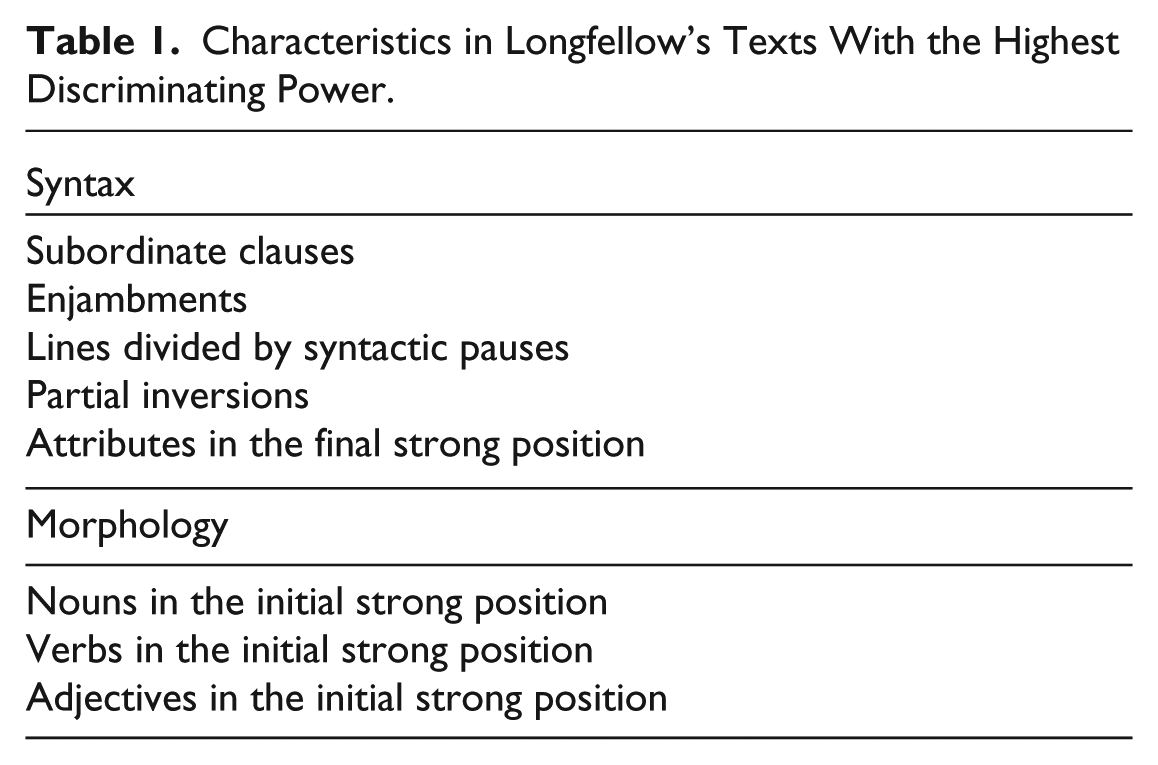
The results of the analysis showed a substantial difference between the features of Longfellow’s style at the three stages of his creative life. Out of 29 characteristics, 15 were found to possess discriminant force, that is, systematically changed to such a degree that they distinguish between texts written at different periods of the poet’s creative activity. The characteristics with the highest discriminating power are presented in Table 1.
Characteristics in Longfellow’s Texts With the Highest Discriminating Power.
Post hoc success classification rate is nearly 96.67%. It may be considered as a good result for the genre of lyrics, which is highly diverse by its very nature.
The features most typical of Longfellow’s style at each of the periods of his creative career are presented in Table 2. Features highly frequent in the period are marked with “+,” features with medium frequency—with “(+).”
The Most Typical Features in the Texts by Longfellow at Different Periods.
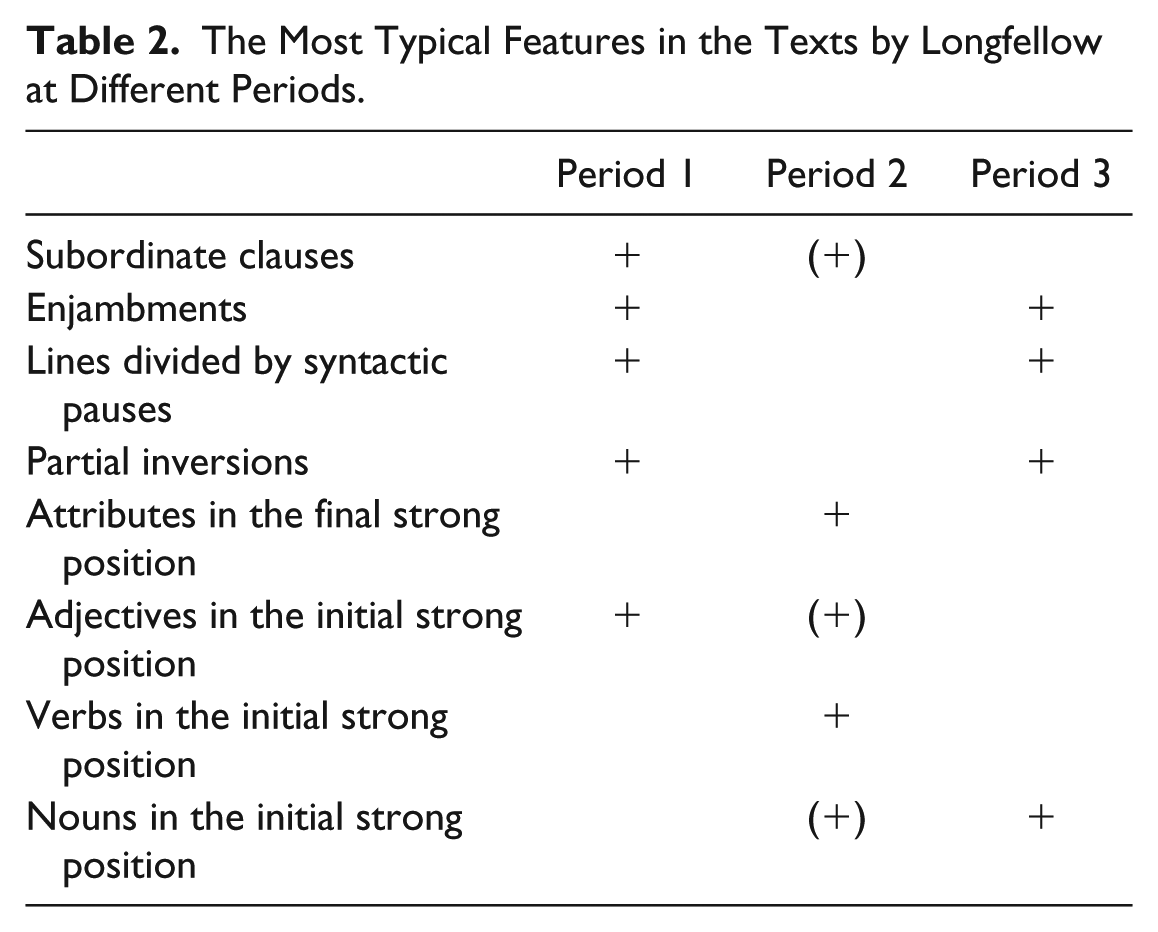
Early lyrics by Longfellow (Period 1) are characterized by a tendency to reach expressiveness with the help of inversions, expressive devices of poetic syntax and sentences, possessing a large number of subordinate clauses. The following example is a typical stanza of a poem by young Longfellow, illustrating some aspects of the poet’s style.
When the bright sunset fills The silver woods with light, the green slope throws Its shadows in the hollows of the hills, And wide the upland glows. (An April Day)
In the second period, certain alterations are observed, mainly the decrease in the frequency of expressive syntactic features and changes in the structure of a verse line. In the initial part of the line verbs become more frequent, whereas in the final position of the line the growth of the number of words in the syntactic function of attribute is observed. Subordinate clauses become less numerous, but still remain frequent enough—more frequent than in his later poems of Period 3.
A new Prometheus, chained upon the rock, Still grasping in his hand the fire of Jove, It does not hear the cry, nor heed the shock, But hails the mariner with words of love. (The Lighthouse)
The third period is marked by a further decrease in the use of subordinate clauses. On the contrary, the reduction of expressive syntactic features, observed during the transition from the first to the second periods, is followed by the growth of the number of enjambments, partial inversions, and lines divided by syntactic pauses. The number of verbs in the first stressed position decreases and the number of nouns increases. Discrepancy between line and sentence structure, which is created by enjambments, and breaks in the line, caused by syntactic pauses, resemble Longfellow’s style of the early period.
The wind blows, and uplifts thy drooping banner, And round thee throng and run The rushes, the green yeomen of thy manor, The outlaws of the sun. (Flower-de-Luce)
Features, which underwent the most changes, may also be classified on the basis of their location in the verse line (Table 3).
Verse Line Location of Characteristics Showing the Most Changes Over Time in Longfellow’s Lyrics.

As seen from this table, the largest number of discriminators separating the three periods are those at the beginning of verse line. Interestingly, out of six characteristics of the initial position, four features belong to the morphological level, whereas not a single morphological feature of the final position displayed strong variability.
Referring to the changes, two main tendencies may be singled out (Figure 1). This figure shows the distribution of the texts of all three periods in the two-dimensional space of discriminant functions. The first function reveals linear development of Longfellow’s style, which is mainly realized in the decrease of the number of subordinate clauses over time. The second function represents a wavelike pattern of style variation observed in expressive syntactic features. Their number decreases during the transition from the first to the second period and rises again in the last stage of Longfellow’s creative career.

Scatterplot of Longfellow’s texts of three periods in the space determined by the discriminant functions.
It should be noted that a number of characteristics do not differentiate style of Longfellow at different periods. These features include nouns, verbs, adjectives, adverbs, and pronouns in the final strong position in verse line; subjects, predicates, attributes, and adverbial modifiers in the initial strong position; predicates, objects, and adverbial modifiers in the final strong position; lines ending in exclamation or question marks.
It is possible to assume that the tendency of style contiguity is realized in morphological characteristics of the final part of verse line and syntactic features of the initial part of the line though to test this hypothesis and single out integral markers of Longfellow’s style, further research is necessary.
Conclusion
The comparison of style features in the different periods of Longfellow’s creative activity reveals certain tendencies.
Major differences can be summed up as follows:
Along with linear development of individual style, its evolution to a large extent follows a wavelike pattern, which consists in deviation from the syntactic structure of verse line during the middle period of the creative activities and then a return at the final stage to the style of early lyrics.
The frequency of expressive syntactic characteristics demonstrates a nonlinear pattern of alteration.
The initial part of the line is connected with style evolution, whereas the end of the line (which is the rhymed position) is stable.
On the whole the research has shown that style variation over time is not only statistically significant and is to be taken into account in such stylometric research as authorship attribution, but also follows certain patterns, which may form the basis for style classification.
Further study of style variation patterns may help develop the typology of style evolution and establish the relevance of stable and varying features for authors’ style identification.
Footnotes
Declaration of Conflicting Interests
The author(s) declared no potential conflicts of interest with respect to the research, authorship, and/or publication of this article.
Funding
The author(s) received no financial support for the research, authorship, and/or publication of this article.
