




Abstract
It is also hypothesized that proficiency level may have a voice with respect to learning styles. Therefore, to throw light on this issue, the present investigation targeted the relationship between Iranian English as a Foreign Language (EFL) learners’ learning styles and their levels of proficiency at Golestan University, Gorgan, Iran. To this end, 120 EFL learners majoring in Teaching English as a Foreign Language (TEFL) and English Literature were randomly selected based on the Rubrics of Common European Framework of Reference (A1-C2) to participate in this study. They were then divided into low-proficient (A2-B1) and high-proficient (B2-C1) learners. The instruments used in this study were an International English Language Testing System (IELTS) Mock exam through which the participants’ levels of proficiency were determined and Reid’s Perceptual Learning Style Questionnaire to identify learners’ perceptual learning style preferences. The questionnaire enclosed 30 statements allocated to each modality based on a five point Likert scale, ranging from strongly agree to strongly disagree. The results of independent samples t-test and Spearman correlation coefficient revealed that there existed some significant relationships between students’ learning style preferences and levels of proficiency. It was found that learners with high levels of proficiency favored Kinesthetic and Tactile learning styles more than other preferences, namely, Auditory, Visual, Group, and Individual learning style preferences. In addition, the low-level students were much inclined toward Visual and Group styles. Regarding the necessity of understanding learners’ different styles, the implications of the study are discussed to consider the importance of individual differences.
Keywords
Introduction
Gaining a special attention from investigators and practitioners, learning styles are still a growing area in second language acquisition. With respect to the notion that most people prefer identifiable methods for processing information and interaction, the idea of “learning styles” for individuals originated in the 1970s and achieved a lot of popularity (Pashler, McDaniel, Rohrer, & Bjork, 2008). Learning style entails individual’s method or style of learning. Psychologically, learning style is a method for students to concentrate and obtain knowledge, information, and experience, though from the cognitive point of view, learning styles refer to different ways for comprehending the process of information and creation to form meaning and principles (Fleming & Baume, 2006).
Learning styles enhance individuals’ comprehension of the process of learning from experience and increase the awareness of learners (A. Y. Kolb, 2005). Learning styles can help learners to choose learning approaches based on which they perform better in different situations. In learning styles and learning processes, instructors and learners are both aware of how to create the best and the most useful learning situation.
Quite as significant as learning styles, language proficiency plays an indispensable role in the process of language learning. Proficiency is the ability of an individual to speak or perform in a language. One of the well-known frameworks against which individuals’ language proficiency is assessed is Common European Framework of Reference (CEFR), which classifies individuals’ language proficiency into six levels, including A1, A2, B1, B2, C1, and C2 (Hulstijn, 2007). The rubric further compares the scores of other proficiency tests with these levels. For instance, in the present study, it is hereafter operationalized that the International English Language Testing System (IELTS) band scores ranging from 5.5 and upper are considered as high-proficient learners, and the IELTS band scores below 5.5 are considered as low-proficient learners in this study. Proficiency qualification shows the world that you have mastered English to an exceptional level. It proves you can communicate with the fluency and sophistication of a highly competent English speaker.
Obviously knowing different learning styles and being familiar with some individual differences would lead to a better teaching process. Some significant approaches of identifying learning styles include learning modalities (Barbe, Swassing, & Milone, 1979), several distinct learning style models (Felder, 1996), and multiple intelligences (Gardner, 1999). Researchers have conducted some studies on the relationship between perceptual learning style and gender (Zokaee, Zaferanieh, & Naseri, 2012); some studies have been done regarding the relationship between learning style and self-efficacy beliefs, and academic fields on high school students (Khaksar Boldaji, 2008); some other studies have been carried out on the influence of various learning styles and instructional methods on students’ learning and achievement (Collinson, 2000).
A review of the relevant literature suggests that there is a relationship between the level of proficiency and learning style preferences (Barron, Watson, & McGuire, 2005; Hyland, 1993). Despite the fact that most of these studies have generally concentrated on differences among various years within the same level of proficiency (Damrongpanit & Reungtragu, 2013; Hargadon, 2010; Rahmani, 2012), there seems to be a lack of research regarding the relationship between the level of proficiency (listening and reading) and learning style preferences within the Iranian context. To do so, this study aimed to investigate whether there would be any relationship between high- and low-proficient learners and their learning style preferences within the Iranian context.
Literature Review
Analyzing the available literature shows that there are several ways based on learning styles that can be classified. Human learning is like layers of an onion, with four layers. The outer layer is made of observable hallmarks, such as instructional and environmental preferences. For example, Dunn and Dunn’s (1993) learning styles model demonstrates different aspects of this layer that deal with perceptual modalities (Winebrenner, 1996). The second layer, which has social interaction models, looks at differences related to gender, age, or maturation levels. The third layer has information-processing models.
These models deal with how information is collected, categorized, gathered, and applied. D. A. Kolb’s (1984) experiential learning approach and Howard Gardner’s (1999) theory of multiple intelligence are famous models in this category. Personality models are the innermost layer, which is the fourth layer of this onion. The basis of these models is that our perception and orientation about how we interact in our world is shaped with our deepest personality traits. The Myers–Briggs type indicator (MBTI) is a well-known model within this category (as cited in Reiter, Liput, & Nirmal, 2007).
Within the scope of this literature review, learning style models designed by D. A. Kolb (1984), Gregorc (1979), Myers–Briggs (1962), Dunn and Dunn (1992), and McCarthy (1997) are described, in an effort to provide an overview of learning style models revealing different categories of classification. In addition, a brief overview of Fleming and Baume’s (2006) VARK (Visual–Aural–Read/Write–Kinesthetic) model, which is the underpinning of our research, is explicated.
D. A. Kolb’s Experiential Learning Style Model
One of the theoretical views that has been used commonly in the investigation of learning styles is D. A. Kolb’s (1984) model. He describes learning style as a preference of learners for receiving and processing the information. Chislet and Chapman (2005) claim that learning styles result from people’s preferred ways of adapting in the world. This model has been used widely in the area of educational psychology. The Kolb’s Learning Styles Inventory (LSI) is a documented test to assess learning styles (Cano-Garcia & Hughes, 2000). In Kolb’s model, individuals should use all four key learning abilities: Concrete Experience (CE), Abstract Conceptualization (AC), Reflective Observation (RO), and Active Experimentation (AE; D. A. Kolb, 1984). A mixture of these four key learning abilities, CE, AC, RO, and AE, is the form of learning styles, each of which has its unique characteristics (A. Y. Kolb, 2005).
Gregorc’s Learning Style Delineator
In Gregorc’s (1979) model, the focus is on learners’ perceptual preference for learning new information through abstract or concrete process of both of these two. In other words, there are two kinds of abilities: perception and ordering, which emerge as two qualities: abstractness and concreteness. Williamson and Watson (2007) state that there are four learning styles in Gregorc’s model (see Table 1):
Gregorc’s (1979) Model.

Myers–Briggs’ Model
Isabel Myers and her mother Katherine Briggs explored learning styles and developed the MBTI in 1962. It was one of the earliest assessment gadgets for describing personality traits (Williamson & Watson, 2007). Four types of learning styles in this model are as follows:
a. The sensing/thinking learning style (ST)
b. The intuitive/thinking learning style (NT)
c. The sensing/feeling learning style (SF)
d. The intuitive/feeling learning style (NF)
Dunn and Dunn’s Learning Style Model
Another model that is very well-liked and has much usage is Dunn and Dunn’s (1992) model. In this model, we can understand a range of five different stimuli and 21 different elements that can affect the way of learning, working, and studying. These elements are biological and developmental. The actual environment where the learner has better performance is much more essential in this model. So, a student may excel in a colder room with music though another one prefers a silent warm room. This could be a very big dilemma if this model was to be used in a classroom situation. See Figure 1 for a complete list of the stimuli and elements.

Dunn and Dunn’s (1992) model.
McCarthy’s Model
McCarthy (1997) focusing on D. A. Kolb’s (1984) model states that learning is movement in a natural cycle in which the learner makes meaning. In this movement, learners feel, reflect, think, and finally act. She discusses that there are four types of learning styles for learners: Type 1 (imaginative), Type 2 (analytic), Type 3 (common sense), and Type 4 (dynamic). In this 4MAT model, she motivates all learners to experience each one of the learning styles. In this framework, each learning type consists of core concepts of the learning cycle: experiencing, conceptualizing, applying, and creating.
Fleming and Baume’s VARK Model
There are so many learning styles, but one of the most effective models is the VARK (Visual, Aural, Read/Write, and Kinesthetic) model. It has been changed from VAK model with adding R by Fleming and Baume (2006) because he believes that while learners can be visual, they might learn better by reading the written form rather than pictures or symbols. Learners can be multimodal by having two or more modes developing equally. Fleming believes that receiving information is much more important than information processing. There are different kinds of learners in learning context; some of them might be active learners and the others passive. We can classify learners into one of these learning styles: Visual, Auditory, Read–Write, and Kinesthetic. Individuals might prefer one or some of these styles, but the key point is that only one of these styles is the dominant one.
Empirical Studies
Implementing different mentioned models, many studies have been carried out on learning styles around the world, for example, Williams (2010) performed a research on three groups of female students to determine perceptual learning styles. These groups were separated with respect to their ethnicity: African American, Hispanic American, and European American. The age was also important in this study. There were two age groups of 20- to 30-year-old students and over 55. The Multi-Modal paired Associates Learning Test was used. Consequently, there was a significant difference between age groups and ethnicity groups, and teachers need to use more visual aids in teaching to all groups.
Similarly, Hargadon (2010) accentuates that there are many differences in learning among students. Students have better performance if their teacher uses different methods of teaching. Moreover, in the study about the effect of learning styles on the academic achievement of secondary school students in Iran, significant difference was found, whereas the mean score for the converging and assimilating groups was significantly higher than for the diverging and accommodating groups (JilardiDamavandi, Mahyuddin, Elias, & Daud, & Shabani, 2011).
Rahmani (2012), in his study on 350 high school girls’ students of Isfahan, illustrated that there was a significant correlation between academic achievement and learning styles of students whose major was mathematics. There was a significant correlation for students whose major was speculative science and active–reflective learning styles. Also, both visual–verbal and sequential–global learning styles had a significant correlation with academic achievement. By the same token, Tulbure (2012) reported significant differences between academic achievement of converger, diverger, and accommodator learners after implementation of cooperative learning strategy in two faculties of a Romanian University.
Damrongpanit and Reungtragu (2013) compared the learning of 3,382 ninth-grade students and found a significant difference between students’ learning style preferences and teachers’ teaching styles. Their findings revealed students’ preferences for visual, auditory, kinesthetic, and multiple modes of learning styles, and the majority of the students benefited from the learning strategies used in the classroom. Alternatively, Brahmakasikara (2013) investigated the relationship between English III students’ learning styles and their academic performance. He believed if teachers want their students’ success, they need to find the different learning styles of their students. This makes the teachers employ a variety of teaching methods and strategies in the learning process, and students will adjust to different learning situations and will adapt with any style that does not match them. Sixty-seven college students answered the Diablo Valley College (DVC) learning style survey, which was written by Catherine Jester from DVC in northern California. The results revealed that tactile learners could hardly pass the course while auditory/verbal learners could easily pass the course without any failure. But the results of Kruskal–Wallis test indicated there was no significant difference in students’ learning styles and their grades.
Vaishnav (2013) directed a review to discover the correlation between learning styles and academic achievement of 200 secondary school students. The participants were in ninth, 10th and 11th grades who were studying in Maharashtra state. The findings showed that there was a positive significant correlation between kinesthetic, visual, and auditory learning styles and achievement, and also kinesthetic learning style is more predominant than visual and auditory styles among secondary school students. Goklap (2013) conducted another study and investigated the effect of students’ learning styles on their academic success. One hundred forty students participated. The results of pre- and posttest illustrated a significant difference. Students had more success in the posttest after they learnt how to study effectively. There were subtests on learning styles about learning, planned study, reading effectively, library usage, writing and note taking, preparing for exam, class participation, and motivation. Those students who did not plan for the study and exam at the beginning had changed completely at the end of the term.
In the same vein, Kidanemariam, Atagana, and Engida (2013) performed a study in two preparatory schools in Ethiopia. One hundred sixty-seven natural science students in 11th grade participated in the study. To prognosticate the extent of variation in academic performance in some fundamental chemical concepts, they used Felder–Soloman’s Index of Learning Style (ILS) questionnaire and chemistry test in the topics: atomic structure and periodic table, and chemical bonding and structure from variations in Felder–Silverman’s learning styles. The results showed that the role of learning styles on academic performance was not statistically significant.
More recently, Jafari Gohar and Sadeghi (2014) conducted a study on the effect of English as a Foreign Language (EFL) learners’ preferred learning styles on their foreign language achievement. There were 123 Iranian female EFL learners at ZabanSara English Language institute in Sirjan in this study. Researchers used D. A. Kolb’s (1984) learning style inventory for gathering information and they also used ANOVA to compare variance of students’ final exam scores among four learning style classifications. The presented result showed no significant difference. People have their own learning styles, which are different from each other, and some variables like age, gender, characteristics, social class and life, culture, environment, and experiences may have effect on learning styles (Akbarzadeh & Fatemipour, 2014).
Regarding the fact that learning style, as a teaching and learning tool, enjoys some merits (Hargadon, 2010; Rahmani, 2012; Tulbure, 2012; Williams, 2010), and given that most studies on relationship have primarily focused on the academic achievement of students (Goklap, 2013; Jafari Gohar & Sadeghi, 2014; Vaishnav, 2013), it stands to reason to incorporate language proficiency and learning styles in an Iranian context.
Research Question
Is there any significant difference between Iranian high- and low-proficient learners and their learning styles?
Method
Design of the Study
The design of the present study was correlational and ex post facto, looking into the relationship between Iranian EFL high- and low-proficient learners and their learning styles.
Participants
One hundred twenty participants studying English Literature and Teaching English as a Foreign Language (TEFL) at Golestan University, Gorgan, Iran, took park in the reading and listening IELTS mock exam. The students’ age ranged from 17 to 24 years old (67 females and 53 males). The students majoring in Literature and TEFL were 73 and 47, respectively. The low-proficient group consisted of 30 females and 32 males; on the other hand, the high-proficient one had 28 females and 30 males. The participants’ demographic information showed that they did not have any living experiences in English-speaking countries, and their years of language learning was between one and four.
Instruments
IELTS mock exam
To be assured of the homogeneity of all the participants in terms of English language proficiency, IELTS mock listening and reading exams were conducted. The participants were given a mock listening and reading exam to find their exact level of proficiency. The participants’ band scores were categorized based on CEFR.
Measurement rubric
The relationship between IELTS and the other tests and with the CEFR is complex; IELTS is designed to stretch across a broad proficiency continuum. When comparing tests and test scores for admissions, it is important to understand that there are differences in test purposes, measurement scales, test formats, test delivery modes, and test taker populations. Since the late 1990s, Cambridge ESOL has conducted a number of research projects to explore how IELTS band scores align with the CEFR levels, a common scale that has been adopted worldwide. In 2000, research was performed as part of the Association of Language Testers in Europe (ALTE) Can-Do Project, including accumulating can-do responses by IELTS test takers over a 1-year timeframe. Test takers’ IELTS scores were then matched to grades. Table 2 illustrates this relationship.
CEFR model.
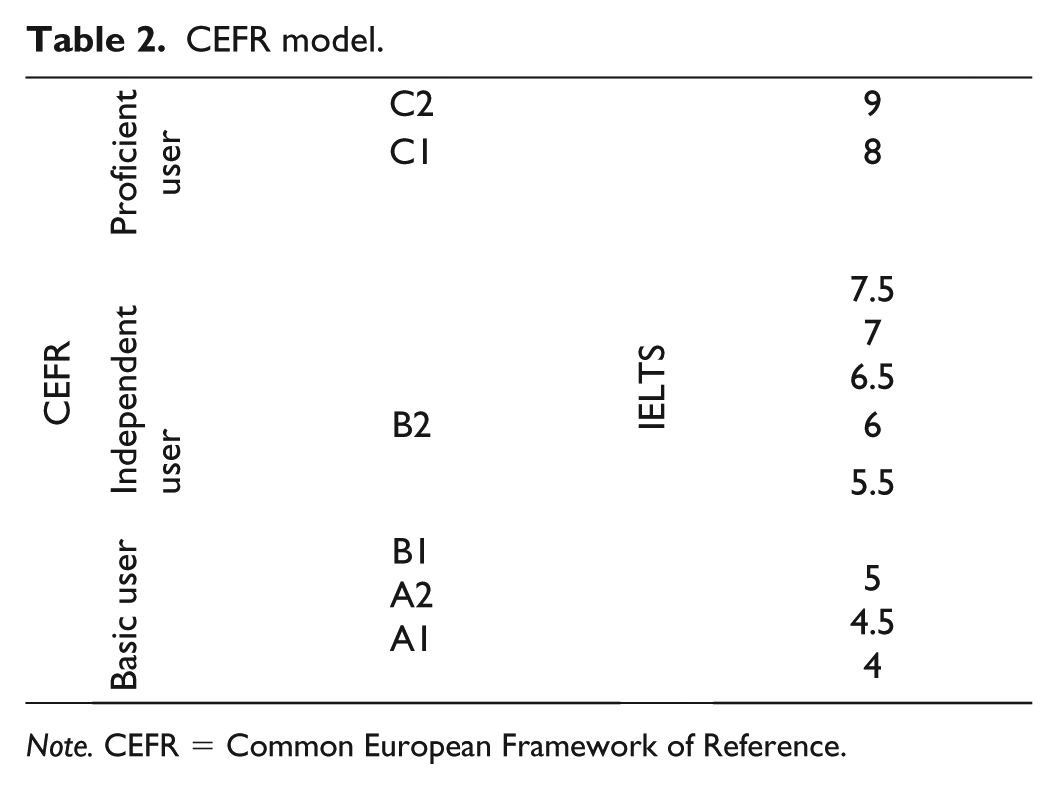
Note. CEFR = Common European Framework of Reference.
Reid’s Learning Styles Questionnaire
Reid’s (1987) Learning Styles Questionnaire makes students find out the way they prefer to learn. Moreover, Reid’s (1987) Perceptual Learning Style Preference Questionnaire (PLSPQ) was used in this study since it is the most broadly used learning styles instrument for non-native speakers of English. The questionnaire covers a multitude of variables including age, gender, and major field (Reid, 1987). The questionnaire evaluates perceptual learning style preferences of students regarding how students learn best using the following modalities: Visual, Auditory, Kinesthetic, and Tactile preferences. Furthermore, the inventory of the questionnaire assesses data based on the individual’s preference for Group and Individual learning situations.
Data collection and procedures
To identify the participants’ level of proficiency, IELTS mock reading and listening sections were given to the students to categorize them into two groups, high and low proficiency based on their band scores. The scores below 5.5 were considered as low proficiency and above 5.5 as high proficiency. Since the students’ learning styles were also under investigation, Reid’s (1987) Learning Styles Questionnaire was distributed among the participants, and the data collected were analyzed later.
Data Analysis
Assessing Normality of Data (Kolmogorov–Smirnov Test)
Since normal data are a primary assumption in the parametric testing, evaluating the normality of data is regarded as a prerequisite for many statistical tests. In doing so, the Kolmogorov–Smirnov test was used to decide whether the distribution of the population under investigation is normal. As presented in Table 3, the significant value for proficiency is p = .01, and for the learning style is p = .17, which can conclude that the data are not distributed normally, and therefore, nonparametric tests can be employed for the analysis of the data of the present research.
Tests of Normality.
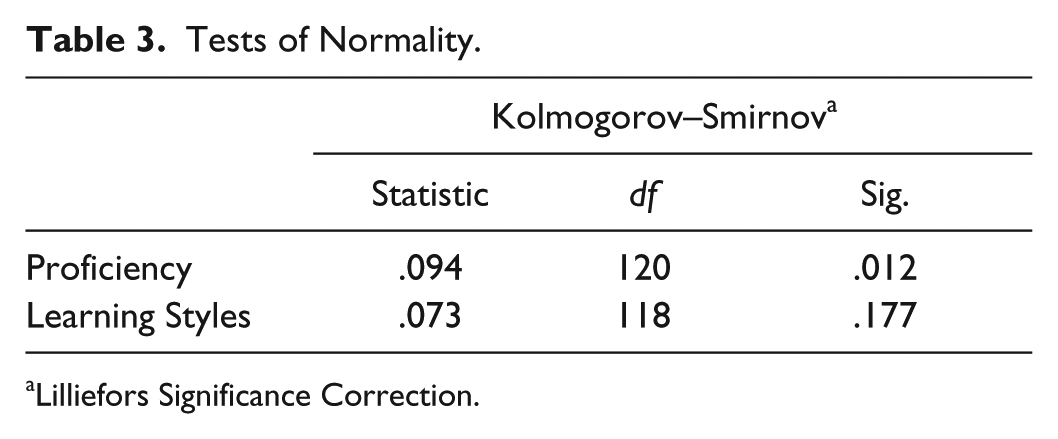
Lilliefors Significance Correction.
Descriptive Statistics
To check whether there would be a relationship between participants’ overall learning style preferences and the participants’ proficiency level, the descriptive statistics were calculated. The descriptive statistics of the participants’ learning style preferences are presented in Table 4. As can be seen in this table, the mean and SD of the low level students are 12.17 and 1.18, respectively, while the mean and SD of the high level students are 11.08 and 1.59, respectively. To find out any possible differences between the two groups, an independent samples t-test was used. The findings presented that there is a relationship between participants’ overall learning style preferences and the participants’ proficiency level.
Descriptive Statistics for the Participants’ Overall Learning Style Preferences and Proficiency Levels.

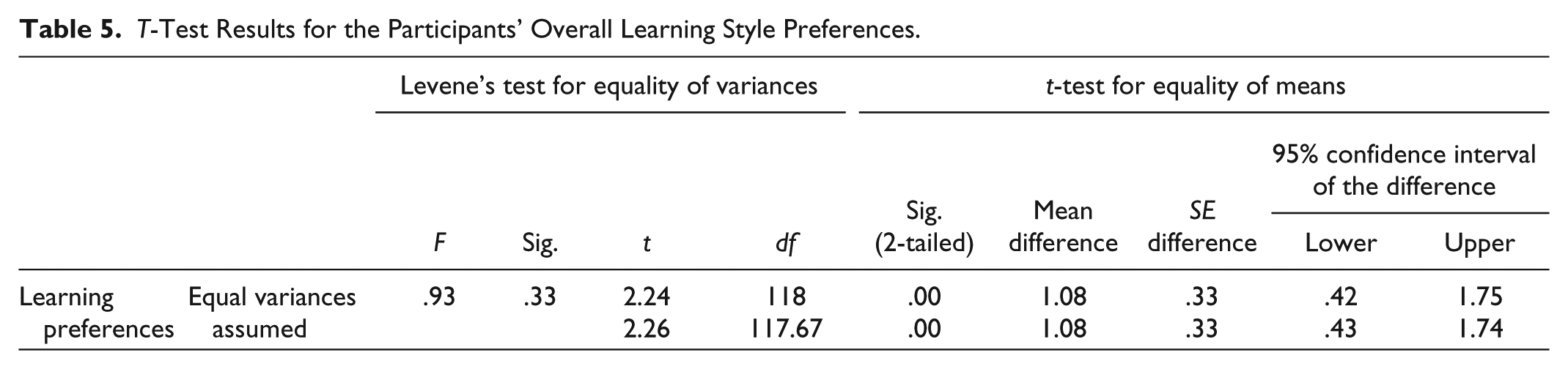
To get a panoramic view of the relationship between low- and high-proficient students’ learning styles, an independent samples t-test was used. Technically speaking, Table 5 indicates that there is a significant difference between learning styles and the proficiency level. The difference between the preferred learning style and the level is represented as, t(118) = 2.24, α = .05, p = .00. It can be, therefore, concluded that the null hypothesis is rejected, that is there was a significant difference between learning styles and the proficiency level. Moreover, the researchers were interested to find out the detailed and interrelationship of all the learning styles separately, so the descriptive and inferential statistics of these variables are shown in Tables 5 and 6.
T-Test Results for the Participants’ Overall Learning Style Preferences.
Descriptive Statistics for the Participants’ Learning Style Preferences.

To check whether there would be a relationship between participants’ learning style preferences including Auditory, Visual, Tactile, Kinesthetic, Group, and Individual and their proficiency level, the descriptive statistics were calculated. As can be seen in Table 6, there is no difference between low (L; M = 10.66, SD = 2.48) and high (H; M = 10.77, SD = 2.38) students’ scores for the Auditory style, for the Group style (L: M = 12.17, SD = 3.37, H: M = 12.74, SD = 3.85), for the Visual style (L: M = 11.21, SD = 2.70, H: M = 11.51, SD = 2.91), for the Individual style (L: M = 10.80, SD = 2.87, H: M = 10.87, SD = 3.06), but there is a difference between low- and high-proficient students’ scores for the Tactile style (L: M = 11.46, SD = 0.68, H: M = 12.25, SD = 2.53), and for the Kinesthetic style (L: M = 10.49, SD = 3.98, H: M = 11.10, SD = 2.46).
To put it precisely, an independent samples t-test was carried out to find out whether any differences existed between the two levels of proficiency. Technically speaking, Table 7 indicates that there is a significant difference between two learning styles, namely, Tactile and Kinesthetic and the level of proficiency. The difference between the Tactile learning style and the proficiency level is represented as, t(118) = −1.30, α = .05, p = .01. Furthermore, the difference between the Kinesthetic learning style and the proficiency level is shown as, t(118) = −1.30, α = .05, p = .03. Moreover, the differences between the visual and group learning styles and the proficiency level are represented as, t(118) = −0.59, α = .05, p = .63, and t(118) = –.85, α = .05, p = .01. It can be, therefore, concluded that the null hypothesis is rejected. It is rejected for four learning styles of Tactile, Kinesthetic, Visual, and Group learning styles.
T-Test Results for the Participants’ Preferred Learning Styles.

The Research Question Revisited
The research question was to examine the relationship between EFL students’ learning styles and their proficiency. Table 8 summarizes the descriptive statistics for each of the instruments. It can be seen from the data in Table 8 that learning style enjoyed a mean of 218.86 and standard deviation of 3.13, and for proficiency, the mean score was 5.25 and standard deviation was 2.61. To find out whether this difference is statistically significant or not, Spearman correlation was to be run.
Descriptive Statistics for the Learning Styles and Proficiency Level.

A Spearman correlation coefficient was estimated to assess the relationship between EFL students’ learning styles and their proficiency level. The results, as indicated in Table 9, revealed that there was a correlation between the two variables (r =.03, n = 120, p = .006, α = .01), because p > .05. Overall, there was a significant correlation between learning styles and language proficiency.
The Correlation Between the Learning Styles and Proficiency Level.

Discussion
Referring back to the results of the studies in the literature, it was understood that the results of this study are paralleled with Reid’s (1987) results. The results of the present study confirmed Reid’s study; high-proficient students favored Kinesthetic and Tactile learning styles compared with Audio and Visual. In addition, most low-proficient students showed a positive preference for group learning. The low level students were significantly more Visual oriented than the other styles. Both groups preferred Kinesthetic and Tactile learning. The result of the present study was consistent with the previous studies pertaining to learning styles. The study done by Wintergerst and DeCapua (1998) reported that Russian students preferred the Kinesthetic learning style closely followed by the Auditory learning style.
Moreover, Jones (1997) carried out a study on the Taiwanese university students and found out that students preferred Tactile and Kinesthetic styles and had negative preferences toward Individual styles. By the same token, the Singapore university students in Chu, Kitchen, and Chew’s (1997) study preferred Kinesthetic and Tactile styles, and did not disfavor any styles. Alternatively, Goodson (1993) investigated that the East Asian students preferred Visual and Kinesthetic styles of learning. Corresponding to reject the hypothesis and using Reid’s (1987) questionnaire, Hyland (1993) conducted a study on learning styles and the learning experiences of Japanese students. His study presented that college level and years of English study are all related to learning style differences. The findings of the present study partially support what was offered by Chen (2009) who conducted a study on the influence of grade level on perceptual learning style preferences and language learning strategies of Taiwanese English learners and concluded that there is a considerable relationship between grade level and Kinesthetic learning style preference, Tactile learning style preference, and Individual learning style preference.
Similarly, Ahmad (2009) conducted another study in which 86 male students (53.8%) and 74 female students (46.3%) participated: 56 Malays (35.0%), 52 Chinese (32.5%) and 52 Indian (32.5%). Findings showed that the prominent learning styles of English as a Second Language (ESL) students yielded the following results. Students preferred the Kinesthetic learning style and expressed minor preference for Visual, Group Learning, and Auditory generally. Their minor learning style preferences were Visual (12.00), Auditory (12.53), and Group (12.42) learning styles, though they disfavored Individual (11.06) and Tactile (11.25) learning styles.
By the same token, Karthigeyan and Nirmala (2013) carried out a study to recognize the distinguished learning style preference of English language learners regarding their demographic variables like locality, gender, nature of school board, and class in which they are studying. Reid’s (1987) questionnaire was applied to 582 students. The data were analyzed using descriptive and percentage analysis. The analysis indicated that the primary and secondary learning styles of the students were auditory and visual learning style.
Another study proposed by Hyland (1993) suggests that Japanese learners seem to favor three modalities and individual learning as minor styles, whereas they have no major learning style preference. The preferences for auditory, tactile, and kinesthetic learning supports Widdows and Voller’s (1991) findings, which mentioned that learners do not like classes in which they just read and translate (p. 134), nor is full advantage having the students’ auditory preference, which restricts the use of spoken English (Morrow, 1987).
Having done a thorough review of literature, it is found that most of the studies conducted on learning styles were mainly dealt with the relationship between academic achievement and learning styles (Jafari Gohar & Sadeghi, 2014; Vaishnav, 2013), the relationship between learning styles and academic success (Goklap, 2013), and the interplay between learning styles and cultural styles (Berry, 2003). None of the above-mentioned studies drew on proficiency level and the relationship between learning styles and high- and low-proficient learners, which is a relatively neglected and under-researched area of ESL/EFL research.
Conclusion and Pedagogical Implications
The present study has sought to collect the data to investigate the relationship between Iranian high- and low-proficient learners and their learning styles. With respect to the findings of the present study, it can be concluded that there is a remarkable difference between participants’ proficiency level and their learning styles. Consequently, by this research, the null hypothesis is rejected. As a result, it is vital for teachers to be more conscious of the differences in students’ learning styles and ensure that their syllabus presents information that appeal to students in different proficiency levels. Moreover, the researchers inferred that there was a difference between learning style preferences, namely, Kinesthetic and Tactile and level of proficiency compared with the Auditory, Visual, Group, and Individual learning style preferences.
In addition, the findings revealed that students with high levels of proficiency showed preference for Kinesthetic rather than other style preferences. The results also indicated that Tactile learning was the second most preferred learning style among high-proficient learners. In other words, high-level proficient learners prefer studying doing “hands-on” creativity, note-taking, model building, and experimentation. On the contrary, the learners with low level of proficiency prefer visual and group styles. They show tendency to do things by the help of others. Last but not least, learners should be taught how to use their learning styles to learn and to be involved more actively and effectively in the process of language learning. Furthermore, it can be inferred that the students’ learning styles vary from their level of proficiency.
The findings of the analyses and discussions revealed that there existed some considerable relationships between more proficient learners and their learning style preferences, namely, Tactile, and Kinesthetic, while the low-proficient ones favor Visual, and Individual styles opposed to the other learning styles. The results of the present study showed that there are some significant relationships between the Iranian high- and low-proficient learners and their perceptual learning style preferences. This conclusion of the study offers many vital pedagogical implications for teachers, students, and educators in the Iranian EFL context. First of all, in designing syllabus for teaching materials, it is better to pay attention to learning styles and students’ level and employ a wide variety of techniques to match with different learning preferences. Second, students would be conscious of their learning style preferences to comprehend the materials better.
Third, the educators would be conscious of the various learning style preferences to understand how learners receive information and gain knowledge, and to identify students’ needs more efficiently. Furthermore, teachers are recommended to be responsible for identifying either their students’ individual differences, or understand how to cater to their needs. In other words, teachers are better to consider appropriate instruments to identify their students’ learning styles, then a better use of such results to choose the most appropriate style. Besides using tools, teachers should regularly keep an eye on his or her students very closely to identify any changes in students’ learning profiles.
Footnotes
Acknowledgements
The authors truly appreciate Golestan University for the financial support, and all the students for their study participation. Besides, our special words of gratitude go to the venerable anonymous reviewers for their valuable comments.
Declaration of Conflicting Interests
The author(s) declared no potential conflicts of interest with respect to the research, authorship, and/or publication of this article.
Funding
The author(s) disclosed receipt of the following financial support for the research, authorship, and/or publication of this article: The present study was funded by Golestan University, Gorgan, Iran (Grant 96/159/1).