




Abstract
The study focuses on the strategies English as a foreign language (EFL) learners choose to take on in requests without evaluating them against the norm of a native speaker, as the concept of native speaker is ideologically problematic in the time of super-diversity. The study uses cultural scripts proposed in the field of cross-cultural pragmatics to interpret the strategies of EFL learners in making requests. Seventy-six requests were elicited from twenty-six undergraduate Omani EFL learners through Discourse Completion Tasks (DCTs). The results obtained from the DCTs were supported by the results of the focus discussion group and our personal observations as faculty members and students’ advisors. The study shows that contrary to the claims made in most of the literature on requests in interlanguage pragmatics, EFL learners use indirect strategies. In addition, they use address terms and provide reasons for their requests. These strategies are shaped by cultural scripts that prioritize the values of politeness, strong family, and tribal orientation in the Omani society. Findings suggest that awareness of these communication strategies promotes tolerance and sensitivity towards the communication styles of others.
Introduction: Why Do We Need One More Study on English as a Foreign Language (EFL) Requests?
This article reports on the results of a study that investigates the communication strategies used in English speech acts, specifically requests, by EFL learners of one of the universities located in the Sultanate of Oman.
The research has been initially inspired by the anecdotal evidence collected in our everyday encounters as faculty members with the undergraduate students. Based on this anecdotal evidence, the initial conclusion was that while making different types of requests (i.e., requesting a permission to miss the class, asking for help, requesting an extension on submitting an assignment, requesting a better mark, asking for a mark breakdown, etc.), EFL learners typically made pragmatic errors. The pragmatic errors of EFL learners were initially explained as learners’ inability (a) to take into consideration context variables, such as gender, distance, and power (i.e., the lack of sociopragmatic awareness) and (b) to use appropriate linguistic tools (e.g., grammatical structures, suprasegmental devices, such as pitch, intonation) for making requests in English (i.e., the lack of pragmalinguistic awareness).
Over the years, research on interlanguage (IL) pragmatics has generated a substantial body of literature, both theoretical and empirical, on speech acts, specifically requests (Bardovi-Harlig, 2012; Taguchi, 2011). The result of this research was that EFL learners of English typically use direct strategies while making requests in English. For example, when asking for a handout, an EFL learner might make a request by using an imperative, such as Give me a handout! instead of Can I have a handout? Pedagogical materials have been developed to reflect the importance of explicit teaching of indirect strategies used in English requests (Al Aamri, 2014; Bitterlin, Johnson, Price, Ramirez, & Savage, 2008; McCarthy, McCarten, & Sandiford, 2014; Soars & Soars, 2010). Without denying the importance of such research and its pedagogical implications, our approach to investigating requests in English is slightly different. Following Blommaert and Rampton (2011), we start with the assumption that the terms “norm” and “native speaker” are ideologically problematic at a time of linguistic super-diversity (p. 5). 1 Blommaert and Rampton (2011) further state that by abandoning these notions, research can focus on how people take on different linguistic forms when they try to form different group (dis)alignments and (dis)affiliations at different moments and stages of their lives. For our purpose, we focus on the requests that EFL learners choose to take on as part of their linguistic repertoire instead of assessing their pragmatic competence against that of native speakers of English. We explain their choices through the concept of cultural scripts that are used as templates or guidelines for certain ways of thinking and speaking and that provide the basis for the interpretation of the speech behavior of people on its own terms (Goddard, 2011; Goddard & Wierzbicka, 2014; Wierzbicka, 2003). By doing that we, first, acknowledge our own ignorance as outsiders of the social practices that shape the linguistic choices made by our students and second, develop appreciation, sensitivity, and tolerance towards the communication styles of others. Appreciation of the communication styles of other people is extremely important in today’s highly mobile world. As noted by Wierzbicka (2003), research on pragmatics that raises pragmatic awareness is needed for the purpose of “peaceful co-existence, mutual tolerance, necessary understanding in the work-place and in other walks of life in the increasingly ‘global’ and yet in many places increasingly diversified world” (p. viii). This article is structured as follows. First, the major theoretical research on requests as speech acts is introduced. An overview of the empirical research on requests focuses on a discussion of the studies conducted with EFL learners who speak different varieties of Arabic as their first language. Second, the research question is stated and major predictions of the study are discussed. Third, a description of the broader sociocultural context where the study takes place is introduced. The multicultural aspect of the Omani society and the role that English plays as the official foreign language of the country is highlighted. Fourth, the empirical study including the participants, methods, and the results is described. A discussion of the major results of the study and its implications for cross-cultural communication concludes the article.
Literature Review: Challenging the Self-Explanatory Nature of Face and (In)directness
Traditionally, requests are discussed among other speech acts in the theory of politeness proposed by Brown and Levinson (1987) that borrows the concept of face from Goffman (1967). Goffman considers interaction as a type of social action. Central to the social structure of interaction is the concept of face, which is defined as a positive social image that a person effectively claims for herself while interacting with other people. Goffman states that although a person shows emotional attachment to her face, she does not own it. Face is on loan to her and can be taken from her at any moment if she does not show (a) her protective orientation towards saving her face and (b) her defensive orientation towards saving the face of others by employing a repertoire of face-saving strategies (e.g., politeness). Thus, interaction becomes ritualized and it is in the best interest of every member of the society to follow the ritual. Once a speaker realizes that she can gain a lot from venturing nothing by staying away from the topics that are not wanted and by cooperating to save face, her social life becomes an “uncluttered and orderly thing” (p. 42).
Brown and Levinson’s (1987) politeness theory expanded on the concept of face or want as a public self-image that every adult member of the society wants to claim for themselves by introducing the two new concepts, that is positive and negative face. Positive face or a positive want is associated with the positive self-image (e.g., the desire to be ratified, understood, approved of, liked or admired by others), whereas negative face or a negative want is related to the desire to be free from imposition and have the right to self-determination. Brown and Levinson assume that face is vulnerable and can be lost; therefore, it is in everyone’s interest to cooperate in maintaining face in interaction. The assumption is that during interaction, there is a social necessity for the speaker and the hearer to orient themselves to the concept of face and this necessity is considered to be universal, whereas the content of face (i.e., what is included in that public self-image of yourself) is culture-specific.
Brown and Levinson (1987) state that some speech acts by their nature run contrary to the face wants of the hearer; therefore, they are called face-threatening acts (FTAs). For example, when a speaker utters a request, she imposes her act on the hearer, thus threatening the hearer’s negative want to be left alone, to be free and not to be imposed on. The speaker uses a specific strategy to mitigate the threat to the negative face of the hearer. This strategy is indirectness; specifically, conventionalized indirectness that is typically expressed in English as “whimperatives” (Wierzbicka, 2003), such as directives in the forms of questions that might start with can/could/would. For example, the question Can you read, please? addressed to the student attending an EFL university class is interpreted as a request to start reading but not as a question about a student’s reading ability. According to Brown and Levinson, conventionalized indirectness softens the threat to the hearer’s negative face by putting it on record and redressing it. As stated by Brown and Levinson (1987), “the fact that the speaker bothers to phrase his FTA in a conventionally indirect way shows that he is aware of and honours the negative-face wants of the hearer” (p. 317).
Since the introduction of Brown and Levinson’s politeness theory, the concepts of face or want (positive and negative), face maintenance, FTA, and (in)directness have been the center of investigation in pragmatics and IL pragmatics. While pragmatics focuses on the study of language from the point of view of its users, the choices they make, the constraints they encounter, and the effects their use of language has on other interlocutors (Crystal, 1997, as cited in Bardovi-Harlig, 2012), IL pragmatics studies how second language learners acquire pragmatics of their second or foreign language. One of the questions on the agenda of IL pragmatics is the acquisition of speech acts that are defined by Austin (1962) as utterances intended to perform a certain function, such as greeting, requesting, apologizing, complimenting, thanking, and expressing regrets. Although the acquisition of requests by EFL learners has been the focus of research in a number of studies (Economidou-Kogetsidis, 2011; Olshtain & Blum-Kulka, 1985; Rodriguez, 2001; Schauer, 2007), studies on the acquisition of requests by EFL learners who speak different varieties of Arabic as their first language is scarce. Moreover, to the best of our knowledge, empirical studies on the acquisition of requests by speakers of Omani Arabic are nonexistent. There is some anecdotal evidence provided by Al Aamri (2014), who reflects on her own experiences as an EFL teacher of Omani EFL learners. She states that while teaching, she frequently observes her students expressing requests with performatives (i.e., utterances in which the illocutionary force is clearly mentioned; for example, We want to go home or Enough teaching today, We are exhausted), and want statements, such as Teacher, I want my marks. Such direct linguistic behavior is interpreted as inappropriate by her teaching colleagues. Al Aamri advocates for explicit instruction in IL pragmatics as a way of developing the pragmatic competence of EFL learners and proposes excellent pedagogical materials to be used while teaching speech acts to EFL learners in the Omani context.
The results obtained in El Hiani’s (2015) empirical study of Moroccan advanced English learners seem to support Al Amri’s anecdotal evidence, however in a different context. The results of El Hiani’s study show that only 41% of the 100 undergraduate students who participated in the study are able to use the indirect strategies of the English requests. Specifically, the results of the study demonstrate that advanced Moroccan EFL learners are not aware of a number of strategies used by native speakers of American English, such as “I was wondering. . . ” and the use of would as a hedge performative in requests.
A similar pattern is observed in the study of 100 advanced Jordanian EFL learners who were systematically more direct than the control group of native speakers of the American English (Al-Momani, 2009). The participants of the study show negative transfer from their first language when they try to express the conventional indirectness of the target language requests.
A more nuanced study of requests that takes as its variables social ranking, social distance, and the degree of imposition is presented in Umar (2004). This study investigates the strategies used by 20 advanced learners of English whose first language is Sudanese, Saudi, Egyptian, and Bahraini Arabic. The results of the study show that, overall, the EFL learners use similar indirect strategies as the 20 native speakers of the British language included in the control group. However, the advanced Arab learners of English tend to use more direct strategies, such as “mood derivable” and “performatives” when making requests to people of a lower social ranking and status (e.g., a waiter in a restaurant, a younger brother) than their English counterparts. In addition, in those situations, when the participants request a person of a higher social ranking (e.g., a professor, a manager), native speakers included into the control group show a higher level of indirectness than the participants of the experimental group. The requests produced by the Arab ESL (English as a second language) learners show a higher level of imposition compared with the controls when the social distance between the interlocutors is relatively close (e.g., between older and younger brothers). The differences in the strategies applied by the two groups of speakers are attributed to differences in cultural values, where “directness may be assumed to express intimacy and closeness rather than rudeness or impoliteness” (Umar, 2004, p. 82).
The studies discussed above show the overall preference of EFL learners, who speak different varieties of Arabic as their first language, towards direct strategies in English requests. Some of the reasons behind this preference is the transfer of the strategies they use in requests from their first language to their second language (see, for example, El Hiani, 2015). This explanation is surprising considering the fact that the communication style accepted in different varieties of Arabic is usually presented as indirect and less explicit (Al-Mahrooqi & Al-Aghbari, 2016, p. 6), where “what is not said is sometimes more important than what is said” (Al Aamri, 2014, p. 9). One might wonder then if indirectness in Arabic and English mean the same thing under the condition that the speakers of these two languages which seem to share indirectness apply different communication strategies while mitigating the FTA. If English and Arabic prefer indirectness in communication, why is it that EFL learners have problems with indirectness in English? Are there two types of indirectness (i.e., one for English and one for Arabic)?
These questions can be answered if we assume, following the ideas proposed by Wierzbicka (2003) who criticized Brown and Levinson’s politeness theory for its Western bias, that the concepts of face, cooperation in interaction, and indirectness are not self-explanatory and are not universal at all and that they may be culture-specific. According to Wierzbicka (2003), people in different cultures speak differently because in their interaction with each other, they are guided by different cultural scripts and these cultural scripts are shaped by different cultural values. A cultural script can be defined as an instrument for expressing cultural norms (Goddard & Wierzbicka, 2004, 2014). A cultural script uses semantic primes, such as I, you, person known as substantives; good and bad known as evaluatives; and want, don’t want, say, think known as mental predicates that are universally shared by all languages. This metalanguage of cultural scripts provides culture independent tools that allow us to separate cultural universals from cultural idiosyncrasies and understand a specific culture on its own terms. Semantic primes constitute the language of cultural scripts and because of their accessibility, transparency, and universality, cultural scripts can be useful in bridging cultural gaps, as they are based on simple and ordinary language. To illustrate, consider the semantic primitives think, want, say.
In the Anglo-American culture, the following cultural script is possible based on the value of respect for independence and autonomy (the example is taken from Wierzbicka, 2003): I think: I can say: “I want this,” “I think this” I know: other people don’t have to want the same/think the same No one can say: “I want you to want this,” “I want you to think this” In the Omani culture, the following script is possible because it reflects the value of respect for family, tribe, and authority. The importance of these values in the Omani society is supported by empirical evidence (Alkindi, 2009). I think: I can say: “I want this,” “I think this” I know: when other people who have more authority over me say not to want this or not to think this I say: “I don’t want this.” “I don’t think this.”
2
(p. 91)
These two scripts use the three primitives want, think, and say and they are universally shared. However, the cultural scripts that use these semantic primitives are different. One would emphasize the importance of independence and freedom from imposition. The other one emphasizes acceptance of imposition from a person of a higher social status.
Research Question and Major Predictions
The purpose of this study is to investigate the communication strategies used by the Omani advanced EFL learners in requests. The study aims to address the lack of empirical research on EFL requests by speakers of Omani Arabic. The perspective taken by this study differs from other empirical research on requests conducted with the speakers of Moroccan, Jordanian, Sudanese, Saudi, Egyptian, and Bahraini Arabic. The present study questions the self-explanatory nature and universality of politeness and indirectness in requests by applying the concept of cultural scripts introduced by Wierzbicka (2003). Our prediction is that the choice of strategies (e.g., [in]directness) that speakers use in requests is determined by speakers’ cultural scripts that reflect a certain hierarchy of cultural values and beliefs (e.g., dependence on a family, tribe, community that are emphasized in the Omani culture).
This study also differs from other studies on requests in that we do not assess the requests produced by EFL learners against the requests of native speakers. As it is widely discussed in the literature on additional language learning (see, for example, Hall, Smith, & Wicaksono, 2017; Kramsch, 1997), the concept of native speaker is an imaginary construct that does not have any linguistic, pedagogic, and practical justification. It is outside the scope of this article to discuss the fallacy of the concept of the native speaker to be used as a benchmark for learning additional languages (for a detailed discussion, the reader is referred to Hall et al., 2017). However, we would like to emphasize that our decision of not comparing the requests of EFL learners against the requests of native speakers is based on the assumption that the goal of learning English in Oman is not to achieve a native-like competence, which is by itself an impossible task for the majority of adult EFL learners. The goal of English language learning in Oman is to acquire communicative competence, which is understood as “the ability to use language in a variety of settings, taking into account relationships between speakers and differences in situations” (Lightbown & Spada, 2017, p. 214). It should also be noted that native speakers of American, British, New Zealand, Canadian, or Australian English constitute only a small percentage among the three biggest communities of Bangladeshis, Indians, and Pilipinos, who live and work in Oman and use English as their lingua franca (Nair, 2017).
The Sociocultural Context of the Study
The purpose of this section is to provide an overview of the broader sociocultural context where the study took place. Most societies in the world are multilingual (Ethnologue: Languages of the World, 2018b). The Sultanate of Oman, one of the Gulf Cooperation Council countries located in the south eastern part of the Arabian Peninsula, is no exception. For its economic development, Oman heavily relies on expats, who constitute approximately 44.8% of its total population of 4 million people (National Center for Statistics and Information [NCSI], 2017). According to the data provided by the NCSI (2017), in addition to Omanis, the following communities are present in Oman: Bangladeshis, Indians, Pakistanis, Filipinos, Ugandans, Egyptians, Sri Lankans, Nepalese, Indonesians, and Other (North Americans, and Western and Eastern Europeans). Ethnologue: Languages of the World (2018a) lists 17 languages that are spoken in Oman. Among them are Modern Standard Arabic (MSA), different varieties of Arabic, for example Omani Arabic, the languages of expat communities, and a number of indigenous languages, for example Mehri, Jibbali, and Bathari. While MSA has the status of the official language of the country (The Basic Law of the State, 2011), English has the status of the language of wider communication (Ethnologue: Languages of the World, 2018a), the official foreign language of the country that connects members of the highly diversified workforce in Oman. By investigating what strategies second language speakers use while making requests in English, our aim is to make the wider community of speakers (including the faculty and staff at the university where the study takes place) aware of those strategies and potentially defuse situations where the intentions of the speakers can be misinterpreted and misunderstood.
Unfortunately, for the time being, we cannot report on the request strategies used by speakers of the other speech communities living in Oman; this task is left for future research. For the purpose of this article, our focus is only on the requests made by EFL learners enrolled in one of the universities in Oman as undergraduate students. By placing the study in its wider sociocultural context and acknowledging the nature of Omani’s community as multinational, multiethnic, and multilingual, we emphasize that the strategies used by EFL learners in requests constitute only one type of strategies out of many available to the speakers in the multiple speech communities living in Oman.
Method
Participants
The study took place in one of the institutions of higher education located in the Sultanate of Oman. Twenty-six female undergraduate students, whose age ranges from 19 to 23 years, participated in the study. The participants selected for the study reflect the multilingual nature of their community as they speak a number of languages, such as Omani Arabic, as a local variety of Arabic; MSA, as the official language of the country; Mehri and Jibbali, as the two indigenous languages spoken in the area where they reside; and English as their additional language. The participants’ motivation to learn English is affected by the following factors. First, English is used as a medium of instruction in all institutions of higher education in Oman (Ismail, 2011); therefore, advanced proficiency and strong academic skills in English are needed to succeed at the university level. Second, as described in the section on the broader sociocultural context where the study took place, for its economic success, Oman heavily relies on expat labor force in its major economic sectors despite an aggressive Omanization campaign (Al-Shaibany, 2018). Many major multicultural and multilingual companies in Oman use English as their lingua franca. Therefore, knowledge of English is an important prerequisite for entering the highly competitive Omani job market.
The participants’ proficiency level in English was determined based on the results of the exit test taken at the end of the 1-year Foundation Program, the successful completion of which is seen in Oman as a prerequisite for admission to the university. According to the requirements of the Foundation Program, students must achieve a band of 4.5 or higher on the Academic Module of the International English Language Testing System (IELTS) test, a general English proficiency test or its equivalence (Ismail, 2011). It should be noted, however, that there is no band score of 4.5 among the bands provided by IELTS (2018). However, a test taker with a band score of 5 is defined as a modest user of language, whose skills are described as follows: “The test taker has partial command of the language and copes with overall meaning in most situations, although they are likely to make many mistakes. They should be able to handle basic communication in their own field” (IELTS, 2018). As all the study participants were enrolled in their major programs at the university, they went through the 1-year Foundation Program and sat for the exit exam; therefore, in terms of their proficiency in English, they can be described as modest users of language.
The participants who took part in the study were female as they were randomly selected among the students who reside in the female only hostel of the university. We acknowledge the lack of male participants as one of the limitations of the study; however, our selection of the female participants reflects the overall population of the college where the study took place, which is predominantly (i.e., approximately 90%) female. In addition, several female undergraduate students enrolled in the Introduction to Linguistics course and assisted us with participants’ recruitment and data collection. It was impossible for them to approach and recruit male participants, as the Omani cultural and religious traditions disallow any communication between young males and females outside of the classroom.
In this study, we decided to focus on the strategies used in requests only by the first-year undergraduate female students. Comparison of the strategies used in the requests of EFL learners across different proficiency levels is beyond the scope of the present study. The focus of our study is not to compare the development of IL pragmatics across different proficiency levels, but rather to explore the communication strategies used in requests by language users who can be described as modest users of language. By excluding the proficiency-level variable from the study, this, in our opinion, makes the results of the study more valid. Second, by identifying the strategies and interpreting them through cultural scripts, we raise awareness among students and their teachers of the choices that EFL learners make in requests, and most importantly, of the reasons behind those choices. This awareness is important for the development of tolerance, sensitivity, and mutual understanding among the students and the multilingual and multicultural university staff. The results of the study can also be used to improve the content of pedagogical materials designed to develop pragmatic competence among the students throughout the 4 years of their university study.
Data Collection Procedure
In this study we used a triangulated approach to data collection; the goal of which is to enhance the reliability and validity of the data (see also Afful & Mwinlaaru, 2012). Specifically, the data were obtained through (a) Discourse Completion Tasks (DCTs); (b) a focus group discussion that took place after the data were collected, analyzed, and the initial findings were presented for discussion with the participants of the study; and (c) introspection of our own experiences of communicating with the students as faculty members and advisors.
DCTs
Initially, the participants were asked to complete DCTs known as a controlled elicitation procedure (Blum-Kulka & Olshtain, 1984) that were designed to elicit the following requests: (a) a request for an extension on a course assignment, (b) a request for extra help from the course instructor, and (c) a request to reschedule the date of the test (see the appendix for samples of the DCTs). All DCTs designed for the study control for the following social variables: ±social distance and ±power, as the DCT scripts include two participants (i.e., a student and a faculty member). In the DCTs, the gender variable is partly controlled for, as all recruited participants were female students; however, the gender of the faculty member to whom the request was addressed was not specified.
In total, seventy-six requests were elicited from the participants. The requests were analyzed by using the coding scheme provided in Blum-Kulka and Olshtain (1984), where the structure of the request is broken down into the following components: (a) the address term, (b) the head act (i.e., the request itself), (c) the grounder (i.e., reasons for the request). Examples 1 and 2 below illustrate the coding scheme:
Example 1
Teacher, please, change the date of exam because some students are absent. 3
In Example 1, the request about postponing the date of the exam has the following structure: (a) “Teacher” is the address term; (b) “change the date of exam” is the head act, which is the request itself; and (c) “because some students are absent” is the grounder, which is the reason for this request.
Example 2
Most of the students are not here, so better to postpone.
In Example 2, there is no address term, the utterance “so better to postpone” is the head act (i.e., the request) and “most of the students are not here” is the grounder.
The elicited requests were also analyzed for the following degree of (in)directness strategy used by the speaker: (a) direct, explicit requests that are linguistically realized as imperatives (e.g., Teacher, please, give me more time to do it) and (b) conventionally indirect requests (e.g., Excuse me, teacher, can you reschedule the date of exam?).
Focus group discussion
In addition to the DCTs as the data elicitation instrument, we also held a post-study group discussion with the participants of the study. The discussion was centered on raising awareness of the strategies that the participants used in their requests and the reasons behind them. During the discussion session, the participants were provided with some preliminary results of the study and were asked to reflect on the following questions: (a) What communication strategies did you choose to use in your requests? and (b) What were the reasons behind your choices?
Results
DCT
Requests for an extension on an assignment
The data obtained through the DCT show that in 62% of the requests the participants use the address terms when asking for an extension on their assignments, such as Teacher, Miss/Sir, and Doctor.
In all, 62% of the participants use the conventional indirectness of English requests and are able to form indirect requests by using can/could/would you mind/I was wondering. When direct requests are made, the participants use the verbs want and need, such as I want more time or I need some time or structures similar to I would like the teacher to extend the assignment to next Monday or I hope you give me an extension time. In addition, the participants use different strategies to soften their requests either by using the word please, as in Teacher, please give me more time to do it or by making an implicit request, as in I can’t solve this assignment because I have many problems.
In 38% of the requests, the participants supply grounders (i.e., reasons) for their requests. Personal reasons are used in 60% of the requests, as in Teacher, I have conditions, I can’t give it [the assignment] on this day; Miss, could you give me more time because I could not complete my assignment; I was busy with other stuff; and I couldn’t finish the assignment because I have a lot of things/many problems. The remaining 40% of all the requests with grounders list the reason of not being able to complete the assignment on time, as in Could you please give me [a chance] because I didn’t complete the assignment, and Excuse me, teacher, I have a lot of quizzes and assignments so I hope you give me an extension time and I will be thankful.
Table 1 presents the breakdown of the requests elicited in DCT 1.
Breakdown of the Requests for an Extension on an Assignment.

Requests for instructor’s help
The data elicited in DCT 2 show that in 36% of the requests, the participants use the address terms while asking a faculty member for help, such as Teacher, Professor, and Doctor.
In 64% of the requests, the participants use the indirect strategy. They form their requests while using the modals, such as can/could/would you mind, as in Can you give me extra help to high my mark? and Would you mind to give extra sessions to do well in other exams? In 36% of the requests, the participants use the direct strategy, as in I would like that you give me extra help, I need to improve my mark, and I want assignment to get good mark. In five out of nine direct requests, the participants use softeners to mitigate directness, such as please, as in Help me with my mark, please. One of the participants has softened the request by providing an apology for not studying for the exam, as in I am sorry because I did not study.
In 56% of all the elicited requests, the participants use grounders. In all the requests with grounders elicited in DCT 2, the participants stated their intention to improve their marks as their main reason for extra help from the teacher, as in Teacher, can you help me to do it excellently next time? or Can you repeat it for me please, if you can? I want assignment to get good mark. Some other reasons that are included in the students’ requests for their teacher’s help are other assignments and quizzes, as I had another quiz at the same day that’s why I did not do well on this quiz.
Table 2 presents the breakdown of the requests elicited in DCT 2.
Requesting Help From a Course Instructor.

Requests for rescheduling the date of the exam
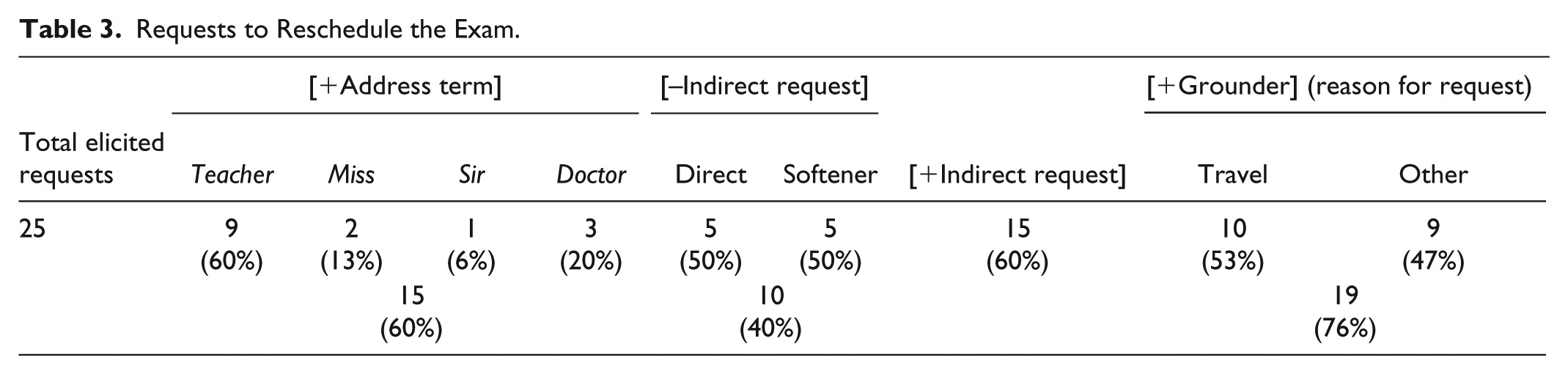
The data elicited in DCT 3 show that in 60% of all the elicited requests, the participants use address terms while making a request to a faculty member to reschedule the date of their exam, such as Teacher, Doctor, and Sir/Miss.
In 60% of all the elicited requests, the participants use the indirect request strategy. They form their requests as questions that start with the modals, such as can/could. Some of the elicited indirect requests are as follows: Doctor, could you please reschedule the date because it’s the date of my plane; Excuse me, teacher, can you reschedule the date of exam? and Excuse me, sir, could you please change the date? Some students will not be able to attend.
In 40% of all the elicited requests, the participants use the direct strategy of making requests. Some of the elicited direct requests are as follows: Teacher, please change the date of exam because some students are absent. Make it after the holiday please. In five out of 10 elicited direct requests, the participants use the softener please, as in Make it after the holiday, please.
In 76% of all the elicited requests, the participants use grounders to strengthen their requests. One of the main reasons for rescheduling the exam is their travel plans or the travel plans of their classmates, as in Please teacher, can you change the day because I have to be in Muscat in Monday? or Teacher, some of us will travel; please change the date. Some other reasons include the reason of some of their classmates being absent, as in Most of the students are not here, so better to postpone, or their classmates’ schedule conflict, as in Teacher, change time the exam because some students don’t fit their timing.
Table 3 presents a breakdown of the requests elicited in DCT 3, the purpose of which is to request to reschedule the date of the exam.
Requests to Reschedule the Exam.
Based on the analysis of the data elicited through DCT 1, DCT 2, and DCT 3, the following conclusion can be made: on average, (a) in 53% of all the elicited requests, the participants use the address terms; (b) in 62% of all the elicited requests, the participants use indirect strategies, and in those cases where direct requests are made, their level of directness is softened by the word please; (c) direct requests without a softener constitute only 16%; and (d) in 57% of the requests, the participants provide reasons to strengthen their requests.
Focus Group Discussion
In line with the results of the analysis of the data obtained through DCT, the participants demonstrated awareness of the indirectness strategy used in English requests. They stated that in order “to show more respect” and to be more polite, the speakers should begin their request with could you. The expressions excuse me, please, and if you can should be also used in requests. The participants identified the request with the performative Teacher, I want more time to finish the assignment as impolite and provided a paraphrase of the request as follows: I am sorry. I couldn’t complete it on time. Can I submit it on Tuesday? Some participants commented that the use of indirect strategies makes the request more formal, which reflects the formal relationship between a teacher and a student. Some participants emphasized that providing a good reason for a request is a good strategy as it makes requests more persuasive. They said that a request without a good reason looks unconvincing.
The participants listed the following reasons behind the strategies they use in requests. They noted that their strategies in requests are chosen by trial and error because most of them had very little or almost no explicit instruction on the strategies used in English requests. One participant emphasized the importance of learning IL pragmatics while reflecting on her own “aha” moment, We really need to learn how to reply and also we have to know how to ask someone about something and in a good way. Actually I did not know [it] before my teacher talked about it and explained it to me.
As English is not their native tongue, the participants believe that explicit instruction on requests would help them to be more “courteous” with the university staff. Some participants admitted their feelings of nervousness and anxiety when they have to speak English, which prevent them from choosing the right strategy while communicating in English.
The lack of English proficiency was mentioned among the reasons behind the pragmatic failure. One participant explained her inability to make polite requests by saying that “I don’t know how to talk proper [because] I don’t have enough skills and experience.” Another participant emphasized the difference in communication patterns between Arab students, on one hand, and Western students and teachers, on the other. She said, Arab students speak English but they use simple language as compared to [expert speakers] of English . . . for some of [the expert speakers], English is their mother tongue, but not for the Arab students . . . misunderstanding happen due to the lack of knowledge in English and differences [in] cultures.
For some of the participants, being polite in requests means using more words and providing reasons; they explained that they gained this knowledge through their experience of communicating in English. Some participants recognized the illocutionary force behind the requests that look like questions but have the intended meaning of requesting something.
Overall, the participants emphasized the importance of knowledge and ability in using requests and other speech acts for better communication with other people. The participants believe that knowledge of speech acts makes a speaker more confident and more “comfortable” in cross-cultural communication. They concluded the discussion by saying that they need to study more about pragmatics and especially about politeness in pragmatics. Most of them reconsidered the use of direct strategies in requests in favor of more indirect strategies. The participants expressed the need for explicit instruction on requests.
Discussion
This section presents a discussion of the data obtained through DCTs, focus group discussion, and our own observations of communication strategies used by EFL learners in requests during our daily encounters with the university students as faculty members and students’ advisors.
Strategy 1: The Address Terms Used in Requests
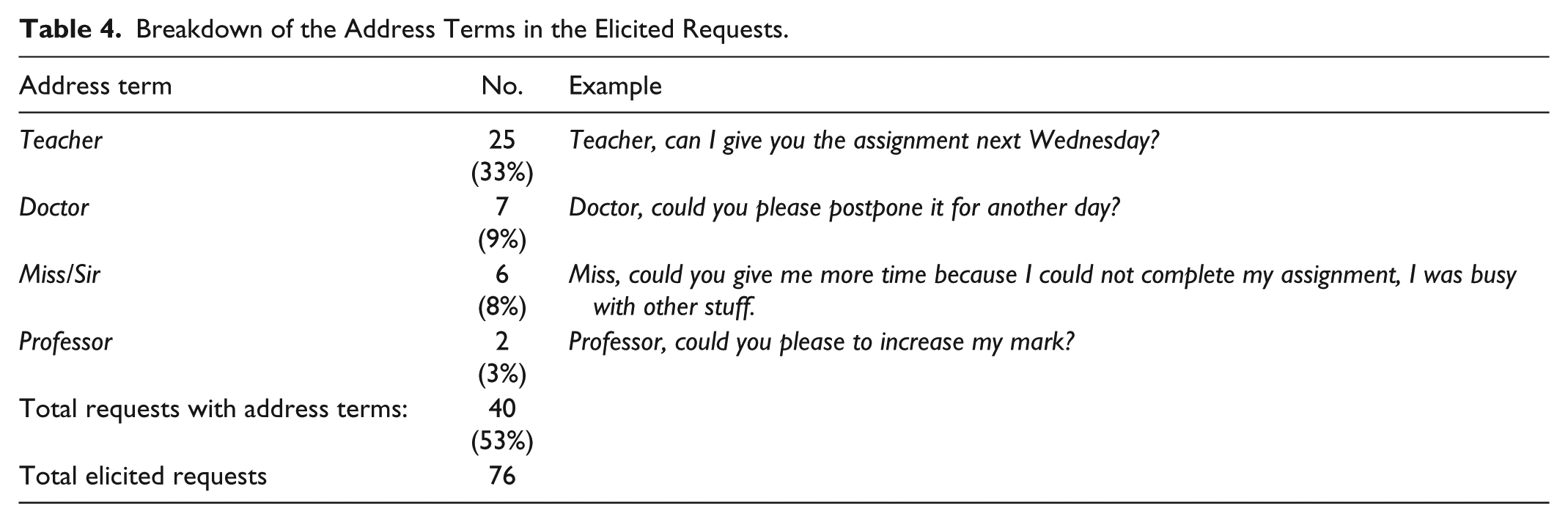
The first strategy that has been identified in the data is the use of address terms. The data show that out of 76 requests elicited in the study, 53% of all the elicited requests contain address terms, such as Teacher, Miss/Sir, Doctor, Professor. The data also show that Teacher is the most frequently used address term, which is followed by the terms Doctor, Miss/Sir. The term Professor is the least frequently used address term.
A breakdown of the address terms in all the elicited requests is presented in Table 4.
Breakdown of the Address Terms in the Elicited Requests.
Studies on the use of address and reference terms in a university setting (see, for example, Afful & Mwinlaaru, 2012; Formentelli, 2009) have shown that address and referential terms might differ cross-linguistically; however, they have a universal goal to be used as markers of social power, distance, and deference for the faculty members. Following Brown and Levinson (1987), we interpret the use of address terms in requests as a negative politeness strategy that allows the recipient of the request a potential “way out” of a FTA. By using an address term as a deference marker, the speaker acknowledges the right of their interlocutor to self-determination and non-coercion in their response to the request.
In addition to providing interpretation for the address terms used in the elicited requests, it is equally important to provide interpretation for the lack thereof. In 47% of all the elicited requests, the participants choose not to supply any address terms. This can be explained by the limitations of the research instrument, specifically DCTs where information about names and the academic titles, such as a lecturer or an Assistant Professor, was not given to the participants. Another interpretation of the lack of the address terms in the elicited responses is the avoidance strategy that some of the participants might have opted for in their requests. It should be noted here that since the early days of studies on second language acquisition, the avoidance strategy has been attributed to learners’ incorrect perception that the linguistic features of the target language are very different from those of their first language and are therefore nontransferable (see, for example, Gass & Selinker, 2008; Schachter, 1974). To avoid pragmatic failure by using incorrect address terms, some of the participants of the study have chosen to avoid using them altogether. 4
In this study, the most frequently used address term in requests is Teacher, as compared with Sir/Miss, Doctor, and Professor. It has been noted by one of the authors of the article that a number of students made their requests for her help in improving their marks on the grounds that the teacher is like a sister to them or like their mother. This strategy reflects the value that these students assign to the role of the teacher as someone who is compassionate enough to help them out in a difficult situation. Based on our own observations of how the term is used in requests, the term Teacher can be interpreted as someone who can guide a student in a difficult situation. In this interpretation, the social role of the teacher seems to be similar to that one of an elder family member or an elder in a tribe whose social role is to guide his or her less experienced members and provide counseling and guidance in difficult situations.
One of the methodological limitations of the study is that the DCTs used to elicit the requests did not include the information as to the first and last names of faculty members. Thus, we cannot comment on the preferred strategies of EFL learners in those situations, when the first and last names of faculty members are known to them, and if their preferred strategy would be to address a faculty member only (a) by the title, as in Doctor; (b) by his or her first name, as in Amer; (c) by the title and his or her first name, as in Dr. Amer; or (iv) by the title and his or her last name, as in Dr. Ahmed. Based on our observations and anecdotal evidence, the preferred strategy of EFL learners is to use the combination of the title and the first name, as in Dr. Amer. This strategy reflects the general communication style preferred at the university among faculty members and staff. It would also be interesting to investigate what address terms and reference terms, if any, students use to address faculty members among themselves. 5 These questions are left for a future research.
It should be noted here that it is challenging to interpret the intentions of the speakers in relation of what they choose to do or not to do when they interact with each other. We can only interpret their intentions indirectly based on the evidence provided to us by (a) the DCTs, whose limitations we acknowledge in this article; (b) the results of the focus discussion group; and (c) our own observations as faculty members and students’ advisors. As the goal of the study is to investigate the strategies used by EFL learners in requests, one of the strategies that is evident throughout the data is the use of address terms, even in those cases when the participants were not explicitly instructed to do so. The participants of the focus discussion group agreed that the address terms in requests are used to signal social distance and deference; however, they did not provide us with a clear explanation as to why the speakers preferred one address term over the other. No doubt, more research is needed to investigate the patterns of address terms in the university setting of the Omani context.
Strategies 2 and 3: Indirect Strategy and Grounders in Requests
The data show that out of 76 elicited requests, EFL learners have chosen to apply the indirect strategy in 47 of them (i.e., in 62% of all the elicited requests). In those cases, when the direct requests are used, they are made with softeners, for example, the word please. Unequivocal direct requests constitute only a small percentage (i.e., 16%) of all requests elicited in the study. A breakdown of the direct and indirect requests is presented in Table 5.
Breakdown of the Elicited Requests According to the (In)directness Strategy Used by the Participants.

Another strategy that EFL learners use is the use of reasons to strengthen their requests. Thus, out of 76 elicited requests, grounders are supplied in 43 of them (i.e., in 57% of the requests). In DCT 1, which elicited requests for an extension on an assignment, 38% of the participants provided reasons in their requests. The reasons vary from personal reasons, as in Teacher, I have appointment in hospital can you change it to another [date] please? to reasons, where the words stuff, things, problems are used, as in I could not complete my assignment; I was busy with other stuff. By providing personal reasons to justify their requests, the students show preference for the strategy of prioritizing their personal stuff over the course assignments. This strategy reflects their beliefs that a vague, unspecified personal reason can be used as a valid reason for not submitting their assignments on time. In addition, the participants believe that not completing the assignment by a due date can be a valid reason for an extension and therefore the participants use it in almost 40 % of all the requests elicited in DCT 1. In DCT 2, the purpose of which is to elicit requests for help, 56% of the requests include a reason as to why an extra help is needed from the course instructor. The participants who supplied the reason have stated that help is needed to improve students’ marks, as in Can you help me? I need to improve my mark. In addition, the students have asked a faculty member to give them some extra marks to improve their overall performance in the course, as in Help me with my marks, please. In DCT 3, while asking to postpone the date of the exam, reasons were given in 76% of the requests. Almost half of the participants stated as the main reason for postponing the exam their travel plans or the travel plans of their classmates.
We interpret the participants’ preference for the above-mentioned strategies in the elicited requests by using the ideas proposed by Wierzbicka (2003) and Goddard and Wierzbicka (2004) who argue that in their communication, speakers are guided by cultural scripts, which in their turn are shaped by a set of values or a certain hierarchy of values accepted in the society. According to Alkindi (2009), Oman is presented as a country with a very strong family and tribal orientation, strong connections to Islamic rules and teachings, and inherited traditions. In a collectivistic society, such as Oman, family and in-group interests take precedence over individual’s needs and goals. In such a family-oriented and collectivistic society, it is important for its members to show respect for their parents and elders, which is counted as their religious, moral, and social responsibility. In Oman, politeness and obedience are prioritized, whereas the values of achievement, self-direction, hedonism, and power constitute the least important values of the society (Alkindi, 2009). These values seem to be reflected in the cultural scripts that guide the speech behavior of the study participants when they make requests. This cultural script can be represented here as follows:
I want something. I say it.
I know that my teacher may not want what I want.
But my teacher is like my mother and my sister.
I think she will understand.
The data of the study show that the communication strategies that the participants use in their requests are shaped by this cultural script.
In contrast to the findings of other studies conducted with EFL learners who speak different varieties of Arabic (Al Aamri, 2014; Al-Momani, 2009; El Hiani, 2015), the participants of our study show preference for indirect strategies in their requests. Thus, the participants recognize the right of their interlocutors not to be imposed on and have the right to self-determination. The participants also treat requests as FTAs and mitigate the force to the interlocutor’s negative face through the use of indirect strategies and/or the softener please. The value of politeness and the recognition of social power, distance, and deference is also observed through the use of address terms in requests. The value of group interests over individual interests is reflected in requests elicited in DCT 3, where the participants have made requests to reschedule the date of the exam on behalf of their classmates. The strategies used in requests that demonstrate a lack of self-direction and reliance on the guidance of a more knowledgeable other are reflected in the reasons provided in requests for extensions on assignments. Recall that some of those reasons include the students’ inability to complete the assignment on time and some unspecified personal reasons in the hope that their teacher, similar to the elder in their family or their tribe, will be compassionate enough to understand their problems and help them out.
The above-mentioned strategies that the EFL learners use in their requests can be potentially interpreted as inappropriate when judged by the speakers of other speech communities; specifically, by faculty members whose cultural scripts reflect the values of independence, self-reliance, and autonomy including the ability of independent learning, effective time management, and responsibility for one’s own mistakes and mishaps. Without making any judgments on the values of the speakers of different speech communities, we would like to emphasize the importance of awareness, tolerance, and sensitivity towards the communicative styles of the other in a multicultural, multiethnic, and multilingual community, such as Oman. It is our strong belief that this awareness can potentially alleviate a possible cross-cultural misunderstanding and conflict.
The purpose of the study was to investigate the strategies of the Omani EFL learners used in requests without comparing them to the requests produced by native speakers of English. In contrast to other studies on the acquisition of requests by the EFL learners who speak different varieties of Arabic (Al Aamri, 2014; Al-Momani, 2009; El Hiani, 2015; Umar, 2004), the present study treats the concept of native speaker as problematic specifically in a context where English is used as a lingua franca. In this study, we analyzed the strategies used in requests of EFL learners against the cultural scripts that are shaped by the cultural values of the Omani society. Awareness of these values is important for better cross-cultural communication between faculty members and university students. In view of that, it is our belief that studies on the IL pragmatics should shift their focus from the deficit model of investigating the lack of or divergence from the strategies used in communication by native speakers of different varieties of English to investigating the strategies of EFL learners and the reasons behind those strategies. We think that this approach to research on IL pragmatics reflects the reality of many multilingual and multiethnic communities that use English as their lingua franca.
Footnotes
Appendix
Acknowledgements
The authors would like to acknowledge the help of the undergraduate students enrolled in ENGL 210: Introduction to Linguistics course, Department of Languages and Translation, Dhofar University, who assisted with the data collection for this study. They would also like to thank the two anonymous reviewers for many insightful comments and suggestions on a previous draft of this article. Their suggestions have greatly improved both the form and the content of the article.
Declaration of Conflicting Interests
The author(s) declared no potential conflicts of interest with respect to the research, authorship, and/or publication of this article.
Funding
The author(s) received no financial support for the research, authorship, and/or publication of this article.