




Abstract
Abuse of drugs by youths and its detrimental effects on security in Lafia Metropolis have recently attracted public attention. Given this background, it is important to understand the factors that influenced youths to take to drugs and the extent to which involvement in drugs has affected security in the Metropolis and thus explore effective ways toward curbing it. A survey method was adopted with samples drawn from 10 political wards in the Metropolis. Questionnaires were administered on 520 respondents with a satisfactory response rate of 76.92%. Bivariate analysis, logistic regression, and multiple regression analyses were used to evaluate the responses. The findings revealed that drug abuse was significantly practiced in the Metropolis due to lack of parental control, easy access to drugs, and emerging street culture of gangsterism. The implications of these on urban security were noted on incessant scuffle and street fighting, increased confrontation with the police, accidents and injuries, and robbery and theft. The study, therefore, recommended the creation of awareness campaigns on the implications of drug use by youths, the strengthening of government institutions that are in charge of drug control to step up their strategies to curb illicit drug production and supply in the Metropolis, and ban the roaming of Almajiri boys and girls at night in the Metropolis.
Introduction
Lafia Metropolis has a serious drug abuse problem, reported by the Arrestee Drug Abuse Monitoring (ADAM) of the National Drug Law Enforcement Agency (NDLEA; 2010) to include stimulant and depressant drugs. The pattern and trend report of drug abuse in the Metropolis in 2016 showed an increase in the number of youths arrested on account of drug use. Drugs that were commonly abused include tramadol, opiate, cannabis, amphetamines, barbiturate, benzodiazepines (Valium), and bromazepam (Lexotan). Statistics reported by the NDLEA office in Lafia indicated that between July 2017 and June 2018, 63 suspected drug dealers and traffickers were arrested with a total of 3,683 kg of suspected hard drugs, which included 804.22 kg of cannabis, 2,873.8 kg of tramadol (225 mg), 5.3 g of cocaine, and 57.2 L of codeine syrup. The 2017 year-end report revealed an increase in the number of arrests and seizures above that of 2016, especially on psychotropic substances (Ethan, 2017).
Drug consumption pattern in the Metropolis differs. While smoking, drinking, and injection are common, depending on the type of drugs involved (Ibrahim, 2016), the West African Commission on Drugs (WACD; 2014) indicated that many consumers take a mixture of cannabis with alcohol (known in ingroup language as combined). Others drink a mixture of codeine and tramadol (known in ingroup language as Reliefine). Other combinations which are popular among street boys include a mixture of lizard dung with lacasera and inhaling of paint and latrine. The smoking of Paw-Paw leaves and the seeds of “Zakami” (Datura metel) also serves as a stimulant. It is debatable which of these drugs is mostly used by the youths, but the United Nations Office on Drugs and Crime (UNODC; 2012) has argued that cannabis smokers are likely to take any other drugs, especially when their chosen drug is scarce (G. M. Smith, 1977).
The growing number of youths involved in drugs (including children and adolescents called Almajiris) is becoming more worrisome. Abdulmalik, Omigbodun, Beida, and Adedokun (2008) who investigated the involvement of Almajiris in drugs found a high prevalence rate of 66.2%. The most frequently used drugs were stimulants (49.7%), volatile solvents (21.5%), cigarettes (19.1%), and cannabis (18.5%). The Almajiris are children who are sent by their parents to live with teachers of the Qur’an to receive religious instruction. However, Abdulmalik et al. (2008) observed that sometimes the children have no means of survival and so had to go to the streets to beg and do menial jobs. Beyond begging and doing menial jobs on the streets, drug use becomes an attraction. The Muslim Rights Concern (MURIC; 2018) confirmed that the Almajiris were not only abusing drugs but are also being used by drug dealers as carriers and distributors. More than 50 Almajiris who confessed to having engaged in the business of drug peddling for a price have recently been arrested by the NDLEA (Adewale, 2018).
Drug abuse is not without consequences. Drugs create vivid distortion in the sense of the users’ consciousness (Inciardi, Horowitz, & Pottierger, 1993). It can also becloud the users’ sense of judgment (Maguire & Pastore, 1999). The UNODC (2014) gave an estimated 183,000 drug-related deaths, worldwide, in 2012. Apart from the increase in the number of patients hospitalized in connection with drug abuse, addiction, and dependence, drugs use is associated with impaired coordination and the loss of capacity for self-control (WACD, 2014). Drugs can damage brain cells and make the brain shrink, thus resulting in organic brain damage (Ejikeme, 2010). Drugs such as stimulants activate the central nervous system, which result in restlessness, nervousness, increased aggressiveness, and anxiety that may be beyond the control of the user (Lahey, 2004). Many researchers have also agreed that emotional breakdown and inability to control the self as a result of drug abuse are associated with inner-city crises, crime, and youth violence (Klantschnig, 2013; Origer, 1999; Origer & Cloos, 2003).
A report by the British Broadcasting Corporation (BBC) revealed that over three million codeine bottles are consumed daily by youths in north central Nigeria (Obinna, 2018). In Lafia Metropolis, “relevine,” pronounced “reliefine” (literary, the relief is fine), is made from a combination of “tramadol and codeine” (tramadol + codeine). Tramadol is available in different milligrams, ranging from 50, 100, 200 to 500. According to the National Agency for Food, Drug Administration and Control (NAFDAC), the consumption of tramadol + codeine can result in drowsiness, decreased alertness, and sometimes agitation and euphoria. Excess dosage of codeine can cause schizophrenia and organ failure among other health-related defects (Owoseyi, 2018).
Given the consequences of drugs, intervention control and enforcement paradigm are emerging with different approaches. The public health approach focuses on addicts and abusers. The social services approach seeks to target the root causes of drug abuse by shifting resources to prevention, treatment, and education (Fareo, 2012). The effectiveness of any approach will only be realized when the cause(s) of drug abuse is/are known. Causes become important as drug users take to drug based on different driven factors. Empirical research works into factors that influenced youth entry into drug abuse (youth drug culture) in Lafia Metropolis are either scanty or nonexisting. Equally lacking is an empirical investigation that can establish the relationship between drug abuse and insecurity in the Metropolis. Policy interventions that can effectively address drug abuse in the Metropolis beyond incessant arrest by the narcotic agents and the police require reliable empirical inputs. This research was undertaken with these objectives in mind.
As Klantschnig (2013) rightly observed, the “Nigerian drug policy has been characterized by a highly exclusive policy-making process” (p. 15). In this context, “repression has become the sole means of implementation and a strong bond with international drug agencies.” This policy lay great emphasis on prevention and punishment, with very little consideration on the causes of drug abuse, and hence addiction and dependence. This work takes a departure from other works that focused on patterns and trend of drug abuse to reports on factors responsible for widespread drug abuse in Lafia Metropolis, and their implications on security, and offers suggestions for policy intervention. Six related questions guided the analysis: (a) Do the environment and/or living condition within the Metropolis, contacts with parents, peers, occupation, and access to drug influence drug abuse? (b) What other conditions trigger drug abuse among youths in the Metropolis? (c) What are the types of behavior observed among drug abusers in the Metropolis? (d) Have you or anybody you know using drug ever been arrested for insecurity-related behaviors in the Metropolis? (e) If yes, what was the insecurity offense? (f) What do you think can be done to curb drug abuse in the Metropolis?
From the research questions, the study hypothesized that poor parental control, environmental and/or living condition, and contact with siblings and peers who use drugs, employment status, and drug availability and/or ease of getting drug will be positively correlated with drug abuse. Effect of drug abuse was expected to exert negative impacts on urban security.
Literature Review and Theory
Several explanations have been given for the causes of drug abuse by youths in the urban areas (Coleman & Davis, 1978). In Gorsuch and Butler’s (1976) argument, the absence of mother or father has a significant relationship with drug abuse by the children. This is probably true because parental absence sometimes disrupts the socialization processes (Fine & Kleinman, 1979). In the findings of Huba, Wingard, and Bentler (1979), city slums are also “good breeding places for drug addicts,” particularly for families in which parents are “so preoccupied and fatigued by their struggles to eke out a living” that they have little or no time and patience to take care of the children’s problem (p. 34). In some families, children may be asked to hawk all types of goods on the streets to contribute to the family’s income and are therefore exposed to amoral habits and all vices associated with street lives. From this background, they emerge into the larger world where they find the basic lessons of their earlier childhood reinforced in various ways. This is, therefore, the reason that exposure to gang initiation and drug use is common in city slums (Cohen, 1998).
In the prodrug socialization model, parents are seen as prodrug socialization forces. This is because they are highly respected by their children and spend more time with them (Akers, 1977). In such families, the youths are also likely to be prodrug socialization forces and hence use drugs, whether licit or illicit (Vaillant, 1966). In this context, socialization may be not only to illicit drugs but also to licit drugs. The empirical finding associated with this in the literature is that children who use drugs illicitly often come from families where one or more of the parenting figures used drugs (Gorsuch & Butler, 1976).
Besides parental influence, poor neighborhoods and peer influence also exert a positive impact on drug abuse. Availability of prodrug socializing agents in the youth’s immediate environment has been found to be common in urban areas (Brunswick & Boyle, 1979). They make access to illicit drugs easy for the youths. In such an environment, the initiation to drug needs no strong motivation as the youths simply try whatever they see others doing (Becker, 1967). On the contrary, Broom and Selznick (2002) identified major motivating factors in initial drug use to include the need for status (e.g., to be “adult”), novelty seeking, curiosity, relief from boredom, and a motivation unique to conformity (Lettieri, 2005).
The peer influence is exerted through two major means in the drug abuse culture. These include initiations and supply. In a vivid explanation provided by Huba et al. (1979), peers provide models for drug usage by teaching its members when, where, and how to use the drugs. This is in addition to providing “information on how drugs can be acquired” (Kaplan, 1975, p. 21). This finding suggests that having a large number of drug-using friends may enable youths in the Metropolis to have ready access to drugs. This may also suggest the reason why drug dealers in the Metropolis engage the Almajiris as carriers and distributors (MURIC, 2018). Such ready access leads to the high rate of initial drug use (Jacobson & Zinberg, 2005).
The tendencies to use drugs vary directly with both availability and proneness (Brunswick & Boyle, 1979). The concept of “availability” is defined by several variables. These include the physical effort required to obtain drugs, and social and economic circumstances surrounding the ease or difficulty of obtaining drugs, especially with respect to their costs (Klagsbrun & Davis, 2007). In his work, Lettieri (2005) observed that “when the cost of drugs is high or the physical effort required to obtain them is high, the tendency to use drugs will be low but can be overcome by a high level of proneness in the user” (p. 47). Availability may also refer to social aspects because drugs are more available in some social groups than in others. For instance, Coleman and Davis (1978) found frequent use of drugs in families where more than one member use drugs. In Lafia Metropolis, cannabis use is highly available and many young men tend to sample them, although few may actually become addicts (Klantschnig, 2013). Studies of male students’ drug abuse in Lafia revealed that their female friends who did not use drugs before they became friends resorted to similar drug use and even tend to cohabit (Obioma, 2012).
Schuster and Thompson (1989) classified “availability” into “perceived” and “actual.” While “actual” availability takes into account the cost of drugs, number of sellers nearby, and the number of places to buy drugs, “perceived” availability involves subjective estimates of availability by users or nonusers. According to them, “actual” availability is unknown, and so the measurement of drug availability should focus on “perceived” availability, which is a subjective estimate. When Smart (1977) used perception to measure the availability of drugs among high school students, he found through a multivariate analysis that perceived availability was a significant predictor for four of six drugs: cannabis, heroin, alcohol, and tobacco, but not lysergic acid diethylamide (LSD) or nonprescribed tranquilizers.
A complex mix of factors including attitudes, beliefs, and expectations function to sustain drug abuse. Seldin (1972) observed that alcohol, in small amounts, is widely perceived to promote conviviality and enhance the pleasure of social interaction. Cannabis is perceived to produce euphoria and enhance the enjoyment of food, sex, art, music, and hobbies for many users. On the contrary, amphetamines and cocaine are said to produce mood elevation and perceived enhancement of performance, while barbiturates and tranquilizers can diminish psychic and physical discomforts, just as opiates. These beliefs and expectations generate net effects that motivate both drug use and abuse. The more positive the net effect, the higher the probability of use (Winick, 2004). The implications of these attitudes, beliefs, and expectations have been documented in diverse studies (Catton & Shain, 1976; Kolb, 2012; R. B. Smith & Stephens, 1976).
In Catton and Shain’s (1976) analyses, drug abuse is not merely an escapist activity (from depression and/or alienation) but also offers a chance at a life which is well paid, prestigious, and exciting in comparison with legitimate opportunities. Many drug addicts, perhaps in addition to an escapist motivation, seek a lifestyle with a sense of purpose, group belonging, and excitement (Glaser, Lander, & Abbott, 1991). In their work on substance abuse, R. B. Smith and Stephens (1976) explained the benefits of drug abuse from the accounts of the addicts to include self-satisfaction, security, and self-enhancement. In such circumstances, the user’s perception of costs does not count but the benefits do (Zinberg, Jacobson, & Harding, 1975), as the users are ready to sacrifice anything to buy the drugs.
Implicit in drug abuse, therefore, is the perpetuation of the crime of violence and other illegal activities to acquire money to sustain drug habits. While these activities exert a negative impact on the livelihoods of ordinary citizens, they also cause havoc to their families as well as the public at large. Armed robbery, burglary, pickpocketing, and rape enhanced by drugs have been reported in Nigeria (UNODC, 2014). Drug abuse fuels both terrorism and insurgency (UNODC, 2011). Analysis by the Institute of Security Studies (ISS, 2015) suggested that “except members of the criminal justice system identify and deal with youths involved in illicit activities at an early stage, and by so doing disrupt illicit markets,” youths who use drug may resort to forming criminal gangs, which can create and sustain organized crime (p. 14). In Lafia Metropolis, gang-sponsored illegal activities thrive especially during electioneering campaigns and elections (Obioma, 2012).
Theoretical Consideration
The drug-subculture theory hypothesized that the predisposing factors to drug abuse include the influence of the parent culture upon youths; parent culture values on the choice of friends and patterns of friendship (Johnson, 1973). The theory draws inspiration from the effectiveness of socialization, where youths develop the emotional attachment to parental figures, and/or “the significant others,” and a belief in the moral order underlying conventional bonds (Kaplan, 1975). This theory received significant support in the social learning perspective of Akers (1977) and differential association theory of Sutherland and Cressey (2004). The theorists argued that youths learned delinquency by modeling exposure to friends’ delinquent behavior. In this context, both the “significant others” and the “generalized others” exert influence on the youth. However, peers’ social approval of drug use and anticipated rewards for engaging in drug abuse are especially likely to enhance drug addiction when there is weak bonding to the family.
Many peer groups follow their peer cultural values and conduct norms. Group members are expected to engage in various forms of unconventional behavior, of which drug abuse is one of them. As the proportion of the peer group (or other reference groups) using drugs increase, the probability of gang formation may emerge (Kandel, 1983). When this happened, R. B. Smith and Stephens (1976) observed that antisocial environment may provide opportunities for involvement in deviant behaviors such as crime, especially in urban environment where a number of additional “disorganizing” factors including family disruption (Sampson & Groves, 1989), relative poverty (Messner, 1982), and ethnic tension (Peterson, Lauren, & Krivo, 2010) exist.
Despite the explanation of drug-subculture theory about peer bonding, parents are still recognized as important agents of socialization. In this context, deviance behavior is attributed to failures in conventional bonding by the family, school, religious organizations, and other institutions whose functions are to socialize youths to norms, moral order, and societally acceptable behaviors (Kandel, 1980). In the social control theory propounded by Gottfredson and Hirschi (1990), parents are the sole motivators that determine both internal and external factors that influence the child moral upbringing. During the formative years of the child, the parents remained the alter ego that influenced socialization and the development of social bond. Such socialization and bonds determine what the child grows up to be, including behavior that has to do with obedience to the laws (Simms, 1978). In their analysis, Gottfredson and Hirschi (1969) theorized that the behavior of youths can be influenced greatly by “attachment and commitment, commitment and involvement, and attachment and belief” (p. 200).
While attachment involves the relation of the youth to parents, peers, and school, commitment represents the youth’s occupational and/or educational aspirations and/or prestige. Youths with close parental attachment are rewarded for conformity by the approval and esteemed admiration of their parents. Involvement is operationalized to include participation in conventional activities, which leads toward socially valued success and status objectives, while belief is seen as acceptance of the moral validity of the central social value system. In this context, the youths grow up to accept the rules, regulations, and laws of the society as binding on their conducts. On the basis of these arguments, Wiatrowsk, Griswold, and Robert (1981) observed that good parental control results in the parental attachments that influence the development of the child conscience and the feeling of guilt. In the context of this theory, youths who lack parental control are likely to abuse drugs because they have no sense of guilt (Sampson & Groves, 1989).
Method
Participants
Participants were randomly sampled from 10 wards in Lafia Metropolis by a team of 10 trained field assistants who were supervised by five researchers. A ward is the smallest political unit recognized by the State government with an elected councilor at the Metropolitan Council. Each field assistant was assigned a particular ward to administer 52 questionnaires, making a total of 520 questionnaires. Although the nature of urban settlement would not enhance the creation of strong social capital that can enable residents in a particular ward to know the occupation of each other, social bonding still exists, especially among the youths as residents are contiguously located. Such bonding provides a window for identifying deviants with drug-related lives. For instance, it is common to see youths playing snooker together in many of the wards. Equally, the existence of brothels, drug joints, and nightclubs, where drugs can be easily purchased and used, is known to residents of the wards. This informs why each of the political wards constituted a cluster for study.
Before the commencement of the field study, the ward leaders (Mai Angwa in the Hausa language) and the youth leaders in the wards were consulted and informed about the study. In particular, the youth leaders were informed that participation in the study was voluntary. At the commencement of the administration of the questionnaires, each participant was informed of the confidentiality of the study and assured that only the researchers will see the responses. At the time of collation, only 400 (76.9%) of the questionnaires were correctly completed and were used for analysis. Two hundred fifty-four (63.5%) participants were males, while 146 (36.5%) were females with a mean age of 23.72 years (SD = 5.57 years). The occupation of the participants revealed some undisclosed businesses (27%), students/trainees (51%), civil servants (6.5%), athletes (1.25%), unemployed (5.75%), and farmers (8.5%).
Measures
The instrument used for the collection of data for this study was developed by the Research Team for Youth Drug Abuse (RTYDA) supervised by the Research and Publication Committee of the Federal University Lafia, Nigeria. The instrument has 39 questions with a combination of measurement scales, including nominal, ordinal, and interval scales. The instrument subscales measure sociodemographic variables, parental relations, parental control, access to drugs, triggers of drug use, frequency of drug use, benefits of drug use, sources of drugs, ease of getting drugs in the Metropolis, and implications on security in the Metropolis. The reliability test of the instrument has overall Cronbach’s alpha coefficients of .78, which suggest an acceptable level of internal consistency (Nunnally, 1976).
Sociodemographic variables
These included age, education, and marital status of the respondents. Employment status was derived from responses to specific queries. For example, “Are you employed?” (Y/N). If Yes, what is your occupation? The age of respondents was measured using a five-category ordinal scale (see Table 1) ranging from 1 = “≤15 years,” 2 = “16 to 20 years,” 3 = “21 to 25 years,” 4 = “26 to 30 years,” to 5 = “≥31 years.” The categorization of age (on a scale of 1-5) was to enhance the inclusion of age as a covariate in the regression analysis.
Descriptive Statistics: Means and Standard Deviation for Sociodemographic Variables, Frequency of Drug Use, and Factors Enhancing Access to Drug Use in Lafia Metropolis (N = 400).

Note. LSD = lysergic acid diethylamide.
Drug abuse
Drug abuse was measured in three dimensions: “Use of drugs known to be outlawed” (seeks to test respondents’ knowledge that the drugs being referred to are not over-the-counter drugs and/or those prescribed by medical personnel), “types of drugs” (assesses drugs that are being used by youths in the Metropolis), and “frequency of use in the last 1 month” (assesses the extent to which each of these drugs is being abused by the youths). In this context, “drug use” and “drug abuse’ are used interchangeably. While the “use of drugs known to be outlawed” and “types of drug “ were measured dichotomously (coded as 0 = No, 1 = Yes), the “frequency of use of these drugs within a month” was measured on a 7-point scale that ranged from 1 = “none”, 2 = “1 to 2 times,” 3 = “3 to 5 times,” 4 = “6 to 9 times,” 5 = “10 to 14 times,” 6 = “15 to 20 times,” and 7 = “21 to 27 times.”
Factors enhancing entry into drug use and abuse
The study started by assessing conditions that triggered drug abuse among youths. This was in line with current scholarly literature on frustration and militancy (Ikoh & Ukpong, 2013), economic recession and unemployment nexus (Nwagwu, 2014; Taiwo, 2012), and anonymity thrown up by urbanization (Henderson, 1988). The study associated triggers of drug use with factors such as unemployment, suspension, and dismissal from work and loneliness due to being abandoned by wife, husband, and/or friends. Other variables included troubles with police and security agents, trouble in school, having medical problems, and problems with parents. Respondents were asked to rate these under 1 = Yes and 2 = No. After being exposed to drug use based on these triggers, the sustained usage was measured in terms of “benefits.” Eleven benefits found by Kolbe (2009) to promote the use of illegal drugs among urban youths were measured on the basis of Yes/No.
Parental relations
Parental relations as factors of drug use were measured using two dimensions. These included “living pattern” and “parental control.” The living pattern was assessed on whether respondents lived alone, lived with mother or father, lived with stepmother, lived with relatives, lived with friends, and other than with the two parents. In terms of “parental control,” we asked, “Do your parents care to know when you go out at night?” “What friend do you have?” “Whether or not you used drugs?” “Whether or not you get to go to school? (if you are a student).”
Significant and generalized others
These were operationalized to include (a) relatives as well as authority figures (significant others) and (b) friends (peers) and siblings (generalized others). These are regarded as behavior role models and important for the youth in learning behavior. Respondents were asked whether their parents use drugs, whether their peers use drugs, and whether their siblings use drugs. Their responses were dichotomized and coded as 0 = No and 1 = Yes.
Availability of drug
Another factor that enhances drug use and abuse is availability. The study assessed availability in terms of respondents “knowing the sources” where drugs can be gotten and the “ease with which drugs can be gotten within the Metropolis.” While knowledge of the sources of drugs was dichotomized into Yes/No, “the ease of getting access to drugs” was assessed using a 7-point Likert-type scale that ranged from “impossible” (7), “moderately impossible” (6), “slightly impossible” (5), “don’t know” (4), “slightly easy” (3), “moderately easy”(2), to “easy” (1).
Urban security
Involvement in behaviors that threaten urban security was measured on 10 antisocial behaviors using a 4-point Likert-type scale that ranged from “strongly disagree” (1) to “strongly agree” (4).
Procedure
The data analysis for this study involved bivariate correlations and logistic regression equations. The need for bivariate correlations was to assess the strength of association between the dependent variable (drug abuse) and the independent variables (living pattern, parental control, significant/generalized others, and knowledge of sources of drugs). As the dependent variable was measured in three dimensions (“use of drugs known to be outlawed,” types of drugs,” and “frequency of use of these drugs in the last 1 month”), we first assessed drug use correlation involving “use of drugs known to be outlawed” and “types of drugs” (Table 2) to see the relationship between them. Thereafter, “use of drugs known to be outlawed” were correlated with “triggers to use drugs” (Table 3). In subsequent analyses, “frequency of drug use in the last 1 month” was correlated with “perceived benefits of drugs” (Table 4) and “ease of getting drugs in the Metropolis (Table 5)
Mean, Standard Deviation, and Correlation Matrix of Drug Use (N = 400).

Note. LSD = lysergic acid diethylamide.
p < .05. **p < .01; all p values are two-tailed.
Descriptive Statistics and Correlation of Drug Use and Trigger to Drug Use (N = 400).

p < .05. **p < .01; all p values are two-tailed.
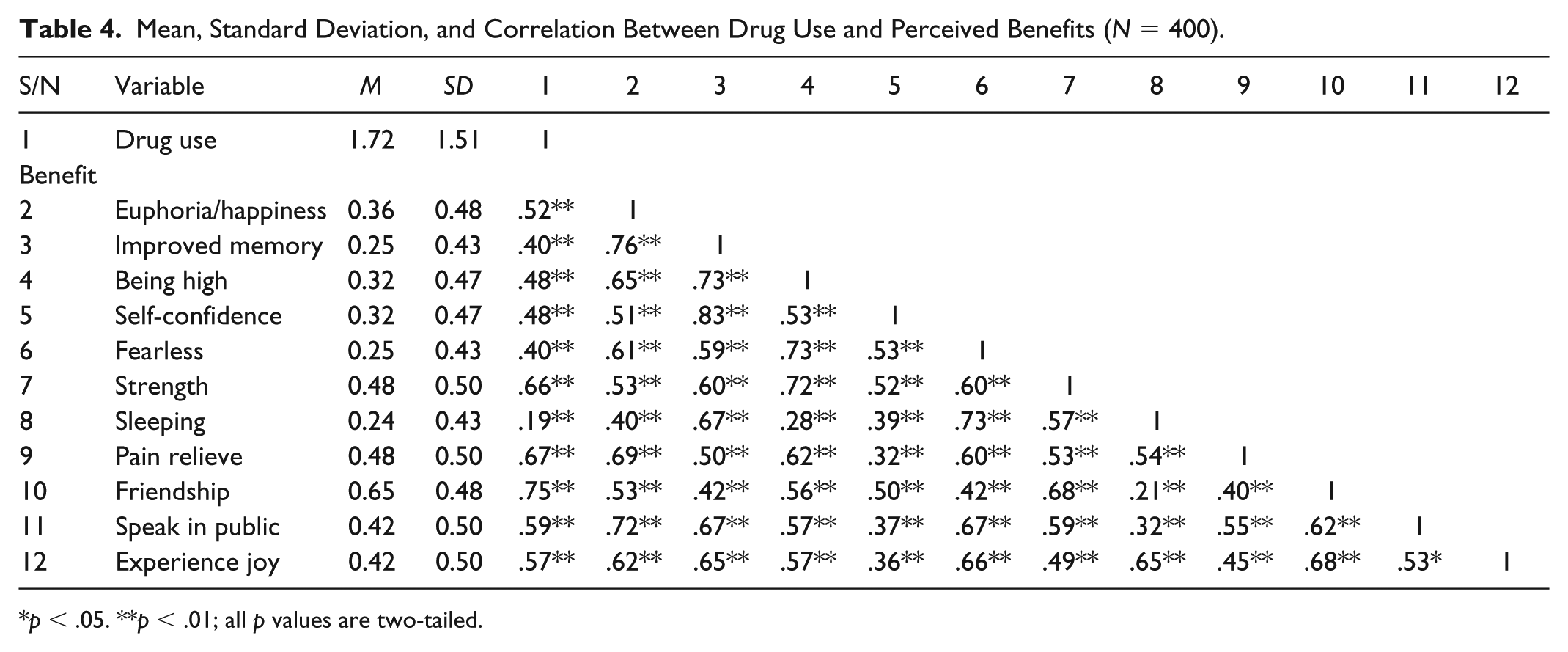
Mean, Standard Deviation, and Correlation Between Drug Use and Perceived Benefits (N = 400).
p < .05. **p < .01; all p values are two-tailed.
Mean, Standard Deviation, and Correlation Between Drug Use and Ease of Sourcing Drugs (N = 400).

Note. LSD = lysergic acid diethylamide.
p < .05. **p < .01; all p values are two-tailed.
To assess the extent to which the independent variables can predict drug use, logistic regression was used as the multivariate procedure. The analysis was started by first assessing the addictive effects of the different variables measured in the study (living pattern, parental control, significant and generalized others’ influence, knowledge of sources of drugs, and sociodemographic status). In this procedure, all the independent variables (under a particular factor, for example, living pattern, parental control) were arranged case by case and entered into the regression model for the dependent variable (use of drugs known to be outlawed). Thereafter, using a stepwise procedure, an additive equation consisting of all the variables was entered into the regression model for the dependent variable. A significant level of 95% confidence interval was set for staying in the model, and variables that did not meet that significant level were dropped.
The choice of logistic regression for analysis was informed by certain considerations. First, one of the objectives of the study was to find the best fitting and most parsimonious reasonable model that can describe the relationship between drug abuse by youths in Lafia Metropolis and the explanatory factors adopted for the study. Second, the dependent variable, “use of drugs known to be outlawed,” was measured binary. In these contexts, logistic regression seems to provide the parameters that could predict the true likelihood probability of the effect of the independent variables on the dependent variable.
The choice of using stepwise regression technique was guided by considerations of having results that are meaningful in relation to the research problem within a 95% significance level. To achieve this and ensure inclusion of the correct model in the analysis, it was necessary to guard against data dredging by checking against multicollinearity. The variable inflation factors (VIFs) constructed to test evidence of collinearity or multicollinearity generated coefficients, which ranged from 1.05 to 2.45, suggesting no serious problems with multicollinearity. Our sample size was also large (above 350). As Olejnik, Mills, and Keselman (2000) argued, a large sample size improves the capacity of stepwise regression to choose the correct model. Besides these, we relied on the residual plot to check for randomness. The residual plot for this study centered on zero, which suggested that the models’ predictions were right on the average than systematically being too high or low.
The relationship between drug use and urban security was tested using a multiple regression analysis. Respondents’ rating on “frequency of drug use” and involvement in “10 antisocial behaviors” that threaten urban security were included in the regression equation. Significant interactions were kept at p < .05.
Result and Analysis of Findings
Descriptive Statistics
Descriptive statistics are displayed in Table 1. The mean age of respondents was almost 24 years, which falls within the age range of 15 to 24 years, given by the United Nations Development Programmes (UNDP; 2006) as a benchmark for the age range of youths and the Nigerian Youth Policy (Federal Ministry of Youth and Development [FMYD], 2009) which pegs the age of youths between 18 and 35 years. While more males than females participated in the study, very few of the respondents were married. The mean score for the frequency of cannabis (marijuana) use (3.02) was above average under a scale of 6, thus suggesting the high use of marijuana in the Metropolis. This was followed by abuse of tranquilizers. The frequency of cocaine use was low; however, one finding that was common to all categories of users is that each drug was used more than once a day.
A range of factors trigger drug use and subsequent abuse. It was remarkably caused by “problem with the police,” “loneliness caused by abandonment by friends,” “drug use in the neighborhood,” and “quarrel with friends.” Although medical problem was rated as a factor (0.41), problems associated with academics and the need to live up to the expectation of peers as well as family problem exacerbated drug abuse (0.47). The similar mean score was recorded by unemployment.
The influence of peers in drug abuse was found when “perceived benefits” derived from drug abuse were assessed. “Acceptability by friends” (0.68) was rated above the use of drugs as “pain reliever” and “enhancing strength” (0.48). Expectedly, drugs were also abused for the perceived benefit of enhancing fearlessness (0.45) and being able to “speak in public” as well as “experiencing joy” (0.42). While the abuse of drugs for the purpose of inducing sleep (0.24) was rated low, the need to come out of depression as seen in “euphoria and happiness” (0.36) and improved memory (0.35) were moderately rated. The perceived benefit of being “high” and exuding with “self-confidence” (0.32) was found to have lured many youths to drug abuse.
When the “ease of getting drugs” as a factor that enhances entry into drug abuse was assessed, it generated a mean score that was above average on alcohol, combine, cannabis, tranquillizer, heroin, and solvent. Given standard deviations that ranged from 1.31 to 1.72 in all the variables, it suggests that the variation in opinion was small and closely clustered around the means. In this context, the ease of getting drugs within and around Lafia was high.
Relationship Between Dependent and Independent Variables
Correlation statistics are displayed in Tables 2 to 5. Due to a large number of variables involved and to aid analysis, we first looked at “drug use correlations” and “trigger to drug use correlation” (Tables 2 and 3, respectively). To interpret their size, we apply Cohen’s (1988) criteria for small (r ≥ .10), medium (r ≥ .30, and large (r ≥ .50) effect sizes.
Drug Use
As shown in Table 2, the relationship between “use of drugs known to be outlawed” and types of drugs” ranged from medium to large, with a magnitude representing 9.61% to 46.24% shared variance. The recognition of the drugs as being outlawed and their usage was high especially on cannabis and opiate (r = .68). The mean and standard deviation of drug use vary, with the highest mean score given to cannabis, followed by relevine (codeine + tramadol), tranquilizer, and ecstasy.
The use of cannabis had a stronger association with tranquillizer (r = .68) and opiate (r = .66) as well as crack (r = .66) than with cocaine (r = .45) and heroin (r = .53). Users of tranquilizer were more likely to use hallucinogens and opiate (r = .66), as youths who abused amphetamine were comfortable with all drugs except relevine (r = .31). There was large and significant positive relationship between the use of ecstasy and all other drugs except heroin (r = .43). A similar result was found for youths who abused LSD. The finding suggests that where other drugs in these categories were available, users tend to pay less attention to heroin. This may be due to either high cost or the role that availability of drugs in the family of opiate (like tramadol) could play in the place of heroin.
The correlations between hallucinogens and other drugs were large. Similar findings are associated with relevine, cocaine, heroin, and opiate, reflecting a strong positive relationship between them. One striking finding from this bivariate statistics is the likelihood that youths who abused drugs in the Metropolis can resort to any other drugs that can give the desired effect. No particular drug seems to be of high preference, such that unclassified drugs like the mixture of lacasera with codeine (cough syrup) are patronized as well as a combination of cannabis and hot drink (combine) and/or relevine (reliefine) codeine + tramadol.
Triggers to Drug Use
With regard to triggers of drug use, the relationship ranged from 12.25% to 62.41% shared variance. Drug use had large and significant relationship with unemployment (r = .59), suspension and/or dismissal from work (r = .57), exposed to drugs in the neighborhood (r = .62), loneliness due to being abandoned by husband or wife (r = . 51), loneliness due to being abandoned by friends (r = .73), having trouble in school (r = .64), having problem with the police (r = .61), having medical problem (r = .57), and having problems with parents (r = .63). The relationship of unemployment with other triggers to drug use indicated a large significant effect size. This is despite the fact that only “suspension/dismissal from work” suggested implication with income. It appears that besides taking drugs to escape from constant worry associated with how to eke out a living, unemployment was related to loneliness, especially when abandoned by wife or husband (r = .62) and friends (r = .79). Although pecuniary factor was suspected, previous studies found that urban youths survived by hustling on the streets and so tended to take drugs not only to outsmart the police but also to have the energy for other odd jobs (Ikoh, Agba, & Nwosu, 2010). It is likely that such becomes sustained as a result of the availability and use of drugs in the neighborhood. As the finding of this study revealed, use of drugs in the neighborhood was significantly associated with loneliness, having problems in schools, and having a medical problem. Many youths who have problem with their parents tend to find solace in places where drugs are used in the neighborhood (r = .54).
While loneliness due to being abandoned by wife or husband was a significant factor in the triggers to drug use, its association with “police trouble” had a small size effect (r = .22). However, loneliness due to being abandoned by friends had a larger significant relationship with police trouble (r = .72), quarrel with parents (r = .64), and “having trouble in school” (r = .53). Youths who had problem in school were likely to have problem with their parents (r = .58), trouble with the police (r = .59), and medical problem (r = .68). The correlations between suspension/dismissal from work and other measures of the trigger to drug use were all significant and positive (ranging from .14 to .64). It revealed that suspension/dismissal from work was significantly associated with “drug use in the neighborhood” and loneliness due to abandonment by wife or husband. Overall, the correlation analyses suggested that triggers to drug use in the Metropolis also triggered other problems. When the use of drugs trigger antisocial behaviors, there may be a breach of public peace; when the use of drugs in the neighborhood resulted in a medical problem, many youths may be thrown out of school even as parents have to source for money for drug rehabilitation expenses
Frequency of Drug Use, Perceived Benefits, and the Ease of Getting Drugs
As shown in Table 4 (about here), the frequency of drugs use was associated with several benefits. The correlation among the 11 variables (benefits) was mostly medium and large, with a consistent positive relationship that ranged from 0.32 to 0.83. The relationship was stronger in all areas of benefit except “sleeping” where a modest correlation (r = .19) was recorded. This finding suggests that drugs were not used mostly for the purpose of inducing sleep, but enhancing strength, being high, being fearless, self-confidence, and ability to speak in public, depending on the choice and type of drugs. In line with the drug-subculture theory, the relationship between “frequency of drug use” and friendship (r = .75) suggests the existence of peer influence and shared cultural values that are influenced by drug use.
When the relation between the independent variables was considered, it indicated that the benefit associated with drug use could vary. Such variation suggests the frequency and purpose of usage. For instance, drugs taken for the purpose of inducing happiness had a strong positive relationship with “improved memory” (r = .76) and “speaking in public” (r = .72) and “pain reliever”(r = .69). This may explain the high use of relevine (reliefine), a combination of codeine and tramadol, in the Metropolis. The fact that youth perceived drugs that enhance “euphoria/happiness” to be associated with “improved memory” and “pain relieve” may also make relevine popular among students and youths who hustled daily on the streets. Equally, drugs that enhance “being high” was significantly related to those that enhance “fearlessness’ (r = .73) and “strength”(r = .72). Surprisingly, taking drugs to drive away fear related positively to drugs that induce sleep. The benefit derived from “sleep-induced drugs” was also associated with “pain reliever” (r = .54) and “experiencing joy” (r = .65). Overall, the correlation analyses indicated that drugs have combination of usefulness, and that such usefulness determines the frequency of usage and the extent to which each drug is abused in the Metropolis.
The ease of getting drugs within and around the Metropolis facilitated the frequency of use of drugs (Table 5). The mean score ranged from 5.32 (cigarette and alcohol) to 3.19 (ecstasy). The frequency for use of cigarette and alcohol was above that of drinking combine (a mixture of hot drink and cannabis) as well as that of smoking cannabis and inhaling solvent. Drug users were more likely to have easy access to cigarette and alcohol (r = .79), solvent (r = .63), and cannabis (r = . 59) than LSD (r = .54) and amphetamine (r = .50). For instance, availability of cigarette and alcohol had a significant positive relationship with the availability of cannabis (r = .75). Statistically, availability of cigarette was 56.25% associated with the availability of cannabis or marijuana, and those who have access to cigarette were likely to have access to cannabis. Similarly, availability of combine was highly related to LSD, and drug users who accessed combine were likely to access solvent (r = . 63). Overall, the benefits associated with using drugs (Table 4) and the ease of getting one’s desired drug within the Metropolis suggest the high level of drug use among the youths. The correlation between the frequency of drug use and the ease of getting access to the 11 drugs tested in the study revealed a magnitude representing 3.61% to 62.41% (r = .79) shared variance.
Parental, Peer, and Environmental Factors in Drug Use
To assess the influence of parental, peer, and environmental factors in drug abuse among the youths in the Metropolis, logistic regression was used as the multivariate procedure. This is because the dependent variable (drug use) was binary coded. Logistic regression is expressed in terms of how the independent variables affected the odds of an event occurring. Using a stepwise procedure, the independent variables were entered into five logistic regression models with each having the dependent variable. The stepwise procedure enables an additive equation such that variables that did not meet the significant level of entry into the model were dropped. In this study, the significance level of staying in the model was set at p < .05. The relationship between these variables is reported and presented in Table 6.
Result of Logistic Regression Models for Parental Factors, Peer Factors, and Environmental Context.

Note. LGAs = Local Government Areas.
The regression model for the living pattern had a significant number of independent variables that affected the odds of using and hence abusing drugs. The findings revealed a statistical significant effect of χ2(22) = 126.596, p < .001. The model explained 27.10% (Cox & Snell R2) of the variance in drug abuse among the youths. Youths living with their parents were less likely to abuse drugs as well as those who lived with their stepmothers and grandparents. However, youths who lived alone as well as those who lived with their mothers and those who lived with friends were likely to use and abuse drugs. The odd increased especially for youths who lived with friends as they were more than twice likely to abuse drugs.
Parental control also has a significant effect on drug abuse. The results of the logistic model reliably distinguished between parental control that aided drug abuse and those that prevent children from being lured into drugs (χ2 = 347.743, p < .00; df = 22; Cox & Snell R2= .581). The odds ratio (OR; Exp(B)) indicates that youths whose parents “do not care to know the kind of friend they keep” were almost 3 times likely to abuse drugs compared with those whose parents control the kind of peers they keep. Comparatively, youths whose parents checked against “going out at night” and “whether they get to school or workplace” were less likely to involve in drug abuse. In line with the earlier findings in the bivariate analysis, youths who are involved in cigarette and alcohol were twice more likely to abuse drugs.
The influence of environment, contextualized here as “significant and generalized others,” revealed the impact of other agents of socialization outside the parents and how much behavior can be learned. The regression models for parental use of drugs, peers’ use of drugs, and siblings’ use of drugs had a significant effect on drug abuse by the youths. The OR revealed that youths from families where parents abuse drug were 1.266 times (or 27%) more likely to abuse drugs than those from families whose parents do not abuse drugs. The effect of peers was also significant and positive, suggesting that youths whose friends shunned drugs were likely not to use drugs. The odds of involving in drug abuse as a result of peer influence was 2.625 times (or 63%) above those who are associated with peers without drug influence. Similarly, those who live with siblings who abused drug were almost 3 times likely to abuse drugs.
When the influence of the “sources of drugs and sociodemographic variables” was assessed, it revealed statistical significance, χ2(22) = 130.070, p < .001 and χ2(22) = 409.245, p < .001, for “sources of drugs” and “sociodemographic” variables, respectively. The R2 was .55 and .64, respectively. Availability of drugs in nearby Local Government Areas and existence of drug pushers and suppliers in the Metropolis were less likely to influence drug abuse in the Metropolis compared with farms in the Metropolis (OR = 2.179), drug stores (OR = 1.852), pharmacists (OR = 1.703), and unclassified sources (OR = 2.449). The findings also revealed that males were more likely to abuse drugs than female. The odds of this experience also increased for youths who were not married.
Drug Abuse in Urban Security Challenges
The implications of drug abuse in urban security challenges were evaluated using multiple regression analysis. As Table 7 indicates, frequency of drug use was significantly predicted by quarrel and argument (β = .364), scuffle and fight (β = .518), accidents and injuries (β = –.161), loss of money (β = .378), problems with parents (β = .214), victimized by armed robbers (β = .359), and having trouble with the police (β = .114). As the standardized coefficient would show, quarrel and argument often result in scuffle and fighting, some of which ended up at the police station, and as Taiwo (2012) found elsewhere, youths who abused drugs need money to stay afloat and they must hustle and/or steal to satisfy their appetite for drugs. Given this context, stealing and robbery are not ruled out. Lafia Metropolis is, therefore, experiencing new patterns of crime and violence that were hitherto not heard of in the city.
Multicorrelation Analysis of Frequency of Drug Use on Urban Security (N = 400).

Note. Coefficientsa = coefficient of the dependent variable.
Discussion
In recent time, Lafia has emerged from being the headquarters of Lafia LGA only to become a befitting headquarters of Nasarawa State. The structure of the city is changing with a doughnut development that is fast replacing the shanties. This development is not only making rural–urban migration attractive but also migrants from other urban centers. As the population density is getting higher, the anonymity made possible by heterogeneous population is creating an urban culture that is becoming distinctive with drugs, especially among the youths. This is not without consequences.
The result of the study supported some of the major findings from other studies on drug abuse. For instance, cannabis was not only being widely used but was the most abused drugs among the youths in Lafia. This supported the earlier findings of the National Alcohol and Drug Use Survey (NADUS) (National Institute of Drug Abuse [NIDA], 2010) in Lagos. The study also revealed the high use of amphetamine-type stimulant that was comparable to the use of LSD. In addition, there are other drugs that are neither under international recognition nor recognized by the NDLEA that are increasingly being used by youths in the Metropolis. These drugs consist of a combination of ethanol and cannabis, lizard dung and lacasera soft drink, and codeine and tramadol. These unclassified drugs are expanding in terms of scope and uses.
The findings showed three possible explanations for increasing drug use among the youths in the Metropolis. These included poor parental control, availability of drugs in the Metropolis, and easy access to drugs. Each of these factors tends to reinforce the other. Within the theoretical framework of control theory, the family is expected to bring up the children, and train and socialize them into acceptable norms, rules, and values of the society (Schuster & Thompson, 1989). In such instances, parents take time to know who their children associate with. The moral context of the environment that the child is growing up also has peers and generalized others (authority figures) that are morally sound that the child would want to be like, when he or she grows up. Such socialization influence makes a child shun everything labeled as bad by the community even when the parents are no longer there to control him.
Life and pattern of living in the urban area have been implicated in the emerging drug culture. Scholars have argued that parents are prodrug socialization agents. Where parents use drugs, the children are likely going to copy same (Peterson et al., 2010; Smart, 1997). In the urban areas where parents struggle daily for the family’s upkeep, it may become difficult to monitor what goes on with the child, especially where both parents are working class. In such instances, peers become the socializing agents. When differential association sets in (Sutherland & Cressey, 2004), the child remains at the mercy of street gangs. This study found increased odds in drug abuse associated with peers’ influence and availability of drugs in the neighborhood. Drug abuse was being significantly practiced in families where parents and siblings use drugs.
One feature that suggests poor parental control of children in Lafia Metropolis is the availability of Almajiris (plural form of Almajiri). These children roam the street of the Metropolis from morning to night begging for alms of whatever size and doing other menial jobs. Street has its own culture, and ability to survive includes violence, drugs, and stealing (Short & Strodtbeck, 1965). Evidence exists that some of the Almajiris have been recruited by drug dealers to serve as their carriers and distributors (Abdulmalik et al., 2008; Adewale, 2018).
Implication on Urban Security
Drugs have severally been implicated in violence and crime (Cloward & Ohlin, 1960; Dawha, 1996; Smah, 1997; Wolfgang & Ferracuti, 1967), and the reasons are obvious. Drug subculture has its values, conduct norms, roles, rituals, and argot. Drugs are not only taken for the purpose of being high, happy, and/or for relaxation but also to be “bold, fearless and for strength as well as self-confidence.” These illusions drive drug use and abuse. When eventually addiction sets in, some youths have to resort to stealing like pickpocketing, armed robbery, burglary, and property theft and other illegal sources to acquire money to sustain their drug habits.
In Lafia Metropolis, violent activities of youths suspected to be greatly enhanced by illicit drugs have increased in recent times. Availability and the ease with which drugs are accessible in the Metropolis have made the drug culture to gain wide grounds despite incessant spot check embarked upon by officials of the NDLEA. When youths influenced by drugs become hindrances to peace and security in the society, the impact of drug use and abuse goes beyond health distortion to affect even the economy and security of the people.
Recommendations
Our findings influence the following recommendations
Create awareness of the implications of drug use by youths.
Create awareness among parents on the drug culture in the Metropolis and the need to restrain their children.
Strengthen the institutions of government in charge of drug control to curb drug production and supply.
Provide effective check on drug use in the Metropolis.
Ban the roaming of Almajiris in Lafia Metropolis at night. It encourages other children to take to the streets.
Footnotes
Acknowledgements
The authors acknowledge TETFUND that assisted in this research and the FULafia Research and Publication Committee for support and also thank the three anonymous reviewers for their helpful suggestions on improvement of the article.
Declaration of Conflicting Interests
The author(s) declared no potential conflicts of interest with respect to the research, authorship, and/or publication of this article.
Funding
The author(s) received no financial support for the research, authorship, and/or publication of this article.