




Abstract
The decline of Oman’s fish exports to the European Union (EU) since mid-2000s has caused legitimate concerns among policy makers and exporters. However, the potential reasons for the decline have not been fully elucidated. To ascertain the underlying causes of such decline, this article empirically examines the relative significance of potential economic and policy-related factors such as border rejections influenced by health and safety measures, supply and demand capacities, domestic ban, domestic structural changes, and exchange rate fluctuations on Oman’s fish exports to the EU. The results obtained from the dynamic unbalanced panel data model for the period 2000-2013 indicate that fish exports to the EU markets have been influenced by the domestic ban on export, domestic structural changes, and exchange rate fluctuations rather than by border rejections. These findings provide important signal to policy makers of the respective countries in designing adaptive policy approach to address such influences.
Introduction
With the gradual rise of global seafood trade since 1976 as recorded in the report by the Food and Agriculture Organization (FAO; 2018) of the United Nations, concerns about seafood quality and safety standards have been at the forefront of both national and global trade policy debates. At a global level, for instance, “food quality and safety” was proposed as a strategic action in the 1992 World Declaration and Plan of Action for Nutrition to ensure continued access to safe and nutritious food (Tansey, 1994). In 2012, the issue of food safety and food security was ranked third by the United Nations Environment program (UNEP) among the 21 challenging issues confronting the 21st-century global economy (UNEP, 2012). On the contrary, at a national level, this global concern resonated through the development of various legislations by major importing countries such as the European Union (EU), the United States, Japan, and so on (Arvanitoyannis & Tserkezou, 2006; Toyofuku, 1997).
More prominently, the World Trade Organization (WTO) Agreements on technical barriers to trade (hereafter, the TBT Agreement) and on sanitary and phytosanitary measures (hereafter, the SPS Agreement) are the outcomes of such safety and quality concerns. These two complementary agreements are part of nontariff measures (NTMs). Following the WTO Doha Development Round and with the advent of these agreements, the trade regime of fish and fishery products has witnessed a gradual decrease in protective tariff measures (Neeliah, Goburdhun, & Neeliah, 2012) and the proliferation of NTMs such as SPS measures (Henson, Brouder, & Mitullah, 2000).
The rationale behind SPS measures involves the following: First, to protect animal or plant life or health from the spread of pests and disease-causing organisms. Second, to protect human or animal life or health from risks arising from additives, contaminants, toxins, and so on, and the third is to protect a country from damage caused by the entry, establishment, or spread of pests (Chillaud, 1996). In this context, the SPS Agreement sets out rights and responsibilities of national authorities and provides them with a framework to develop their domestic policies on food quality and safety. The basic rules stipulated in the Agreement covers food safety, animal health and zoonoses, and plant health under the standards guidelines and recommendations established by the Codex Alimentarius Commission (CAC) relating to food additives, veterinary drug and pesticide residues, contaminants, toxins, methods of analysis and sampling, and codes and guidelines of hygienic practice, the Office International des Epizooties (the OIE), and the Secretariat of the International Plant Protection Committee (IPCC), respectively (for further details see https://www.wto.org/english/tratop_e/sps_e/spsund_e.htm. Accessed July 4, 2016). The hazard analysis and critical control point (HACCP) system has been adopted as an international standard for food safety by the CAC and has received acknowledgment in the SPS Agreement (Vapnek & Spreij, 2005).
The SPS measures affect exports of fish and fishery products in two opposite ways. First, the trade-impeding effects, which are based on “standards as barriers argument” are influenced by compliance costs associated with the adoption of SPS standards. Second, the demand-enhancing effects resonating “standard as catalyst argument” due to safety and quality assurance through the disclosure of detailed description of product attributes and certification (Anders & Caswell, 2009; Fugazza, 2013).
The global concern of seafood quality and safety and the subsequent development of rules and measures adopted by the leading fish-importing countries have important strategic implication for a country such as the Sultanate of Oman (hereafter, Oman) for, at least, the following political, economic, and strategic reasons. First, as a member of the WTO since 2000, Oman has the commitment to abide by the rules stipulated in the Agreements and by the fish-importing countries with regard to quality and safety. Second, to strengthen the role of fisheries as foreign exchange earner, and being a net exporter of fish and fishery products, it is important to respond to food safety standards introduced by the leading seafood importing nations and lucrative markets such as the EU and the United States. Last but not least, fisheries in Oman are anticipated to play a vital role in the national economic diversification portfolio (Bose, Al-Mazrouai, Al-Habsi, Al-Busaidi, & Al-Nahdi, 2010) and, in this context, the authority should boost the country’s international competitiveness using the benchmark of fish quality and safety.
With this background, it is important to investigate the potential impeding effects of economic and policy-related factors on Omani fish exports with particular focus on border rejections and domestic ban. Although perception-based qualitative statement of the potential impact of quality and safety measures is conveyed in recently conducted studies by Qatan, Bose, and Mothershaw (2015) and Al-Busaidi, Jukes, and Bose (2016), the empirical analysis of such issue is limited in Oman, and, therefore, such empirical undertaking should provide useful information to the process of policy refinements and their effective implementations in both private and public sector environments. For this reason, and considering the historical trade relations of Oman with the EU countries and the increased usage of SPS measures in seafood trade, this article first portrays the legislative and regulatory initiatives that have been undertaken by the authority in Oman to overcome challenges following the SPS Agreement and the resulting EU ban on fish exports in 1998. The article then proceeds to examine whether empirical support (or otherwise) can be given to the following two statistical hypotheses:
The remainder of the article is organized as follows. “Fish Exports and the EU Ban: A National Context” section presents a brief synopsis of the country’s fish exports status. “Trade Policy Issues Involving Fish and Seafood Products” section discusses the trade policy issues with particular reference to fish and seafood products. In “Empirical Approach” section, the empirical model with brief theoretical background, data sources and limitation, and the estimation techniques are discussed. “Results” section presents and interprets the results, “Discussion” provides further discussion with implications, and “Conclusion” section contains concluding remarks.
Fish Exports and the EU Ban: A National Context
Fisheries in Oman are predominantly small scale in nature. Although the sector’s relative share to gross domestic product (GDP) at both current and constant (2010) prices remains stable around 0.5% to 0.6% during the past decade or so, it plays an important role in the country’s socioeconomic development including food security (Al Naabi, 2018; Bose et al., 2010). 1 Oman is a net exporter of fish products and therefore, fish exports constitute an important source of foreign exchange earnings. Oman exports to regional market such as the Gulf Cooperation Council (GCC) countries and international markets such as the EU, the United States, and Southeast Asia (Al Naabi, 2018). During the period 2000-2014, on average around 44% of the total fish landings were exported to regional and international markets. For the EU market, the average share in total export in terms of quantity and value during the period from 2000 to 2014, was about 0.3% and 0.8%, respectively (Ministry of Agriculture and Fisheries [MAF], 2000-2014). The MAF is the sole authority responsible for the management of fisheries resources in Oman.
Figure 1 shows quantity (ton) and gross value of fish exports (thousand Omani rials [‘000 OMR]) 2 to the EU during the period 2000-2014. It is noted that the quantity and value of fish exports experienced a considerable decline (about 88%) after 2005 and 2007, respectively. This raises an important question: Are border rejections based on health and safety measures responsible for the apparent declines? The coefficient of variation (CV) estimates for quantity (64.57%), total value (59.18%), and unit value (31.50%) of fish exports to the EU suggest that the variation in export quantity relative to unit price is the dominant factor contributing to the variation in the total value during 2000-2014. These findings have bearings on the formulation of empirical model discussed below.

Total quantity and value of fish exports to the EU: 2000-2014.
Figure 2 shows the fish export quantity (ton) to the EU, GCC, and the Asian countries (includes Thailand, Korea, Vietnam, China, India, Sri Lanka, Malaysia, and Bangladesh) during the period 2000-2014. Although the quantity of fish exports to the EU experienced a considerable decline after 2005, the same was not the case for the GCC and Asian countries.

Total quantity of fish exports to the EU, GCC, and Asian markets: 2000-2014.
For Asian countries, the CV estimates for export quantity (64.84%) and total value (50.39%) are similar to the EU market. However, for the GCC, the CV estimates for export quantity (34.46%), and total value (37.03%) indicate that the GCC markets were relatively stable during the period 2000-2014.
The seafood processing companies (both with and without HACCP system in place) deal mainly with locally sourced fresh and frozen fish products and supply to local, regional, and international markets. Al Naabi (2018) noted that out of about 58 currently operational seafood processing firms, about 66% of the firms have adopted HACCP and hence have quality control number.
Fish export creates competition between local and foreign consumers. To promote efficiency and fairness in relation to pricing and the distribution, and improve safety and quality of seafood products a central wholesale fish market with electronic auctioning system and other modern services has been in operation since April 2014 at Al-Filaij, a village of Barka in Al-Batinah Governorate (Al-Busaidi et al., 2016; Qatan et al., 2015). In addition, to maintain domestic market stability and satisfy local demand MAF has implemented export ban on selected preferred species in recent years (Table 1). The main policy motivation behind such measures on key large pelagic and demersal species was to ensure the availability of these popular species in the domestic market and to reduce inflationary pressure on fish prices. This indicates that fisheries management is also driven by market fundamentals, preferences, and intentions of end users (Yousuf, Bose, Kotagama, & Boughanmi, 2018).
Various MD on Fish Export Ban.

Source. Ministry of Agriculture and Fisheries.
Note. MD = ministerial decisions.
To be eligible for exporting fish and fish products to the EU, it is essential for an exporting country to (a) establish a competent authority (CA), which is responsible for official controls throughout the production chain, (b) have a food safety legislation that is equivalent to the EU’s own hygiene legislation, (c) guarantee through the CA that the relevant hygiene and public health requirements are met, (d) provide a list of establishments that are authorized to export fish and fish products, (e) produce evidence of safe handling of the product covering the entire supply chain to examine its acceptability by EU inspection officials (Doherty, 2010).
On July 1, 1998, the EU banned fish and fish products from Oman due to the detection of noncompliance with the EU standards and the implementation of the Commission Decision 97/296/EC. The ban was lifted in 1999 after receiving the satisfactory written assurances by the Commission and consequently Oman was listed in Annex II to Commission Decision 2006/766/EC. Further details on the nature of noncompliance with the EU standards, and subsequent measures taken by the CA of Oman to address the raised noncompliance issues can be found in European Commission (EC; 1998, 2006). Following the EU ban in 1998, the authority safeguarded seafood quality and safety to meet internationally acceptable standards by adopting HACCP (Ministry of National Economy, 2007) and updating regulations (12/2009) that satisfy the EU requirements stipulated in EU regulations 1881/2006 in relation to fish and fishery products such as maximum limits of total volatile basic nitrogen (TVB-N), histamine, heavy metals (such as mercury [Hg], lead [Pb], Cadmium [Cd], etc.), Inorganic tin, dioxin, polycyclic aromatic hydrocarbons (PAH), marine biotoxins, additives, veterinary drug residues, and so on (MAF, 2011). Further details of other specific measures can be found in Economic and Social Commission for West Asia (ESCWA; 2007), Qatan (2010), MAF (2011), and Al-Busaidi et al. (2016).
Trade Policy Issues Involving Fish and Seafood Products
With the increasing trend of fish and fish products in international trade (FAO, 2018), and the collective attention to consumer protection paid by all actors, the issue of quality and safety of seafood products has been at the the forefront of global policy discourse under the relevant intergovernmental organizations such as the WTO, the FAO and the World Health Organization (WHO) (Ababouch, 2006; Käferstein, 2003). Broadly speaking, discussions on food quality and safety are predominantly clustered around the regulatory and the operational mind-sets. The former concentrates on the design of rules, procedures, standards, policies, and agreements under the auspices of the WTO to meet the intended objectives of food control systems (FAO/WHO, 2003; Valdimarsson, 2007; Vapnek & Spreij, 2005, to name a few), whereas the latter is concerned with the practicality of such policies and procedures at firm and country level (Ehiri, Morris, & McEwen, 1995; Henson & Jaffee, 2008; Maldonado et al., 2005; Taylor, 2001; Unnevehr & Jensen, 1999).
The architecture of the regulatory mind-set is influenced by the dynamics of a number of factors such as liberalization of food trade, globalization, climatic conditions, tolerance of potential risks, technological and scientific advancement, sophistication in transportation and communications, public awareness, consumer attitudes and perceptions, population trend, and political persuasions. However, the operational affairs depend upon the socioeconomic conditions, legal arrangements, industry structures and commitments, institutional capacities, technical capability and national policy priority, among others.
In the analysis of policy issues involved in seafood trade, a clear dichotomy of opinion exists among policy makers, academics, and industry experts regarding SPS measures. Although there is no apparent disagreement with regard to the socioeconomic importance of safety and quality control measures, the focal point of the practical debate has been the way such measures work as they involve scientific assessment of risk, the tolerable limit and assessment of which differs between developed and developing countries, the availability of technical, financial, administrative capacities, and environmental conditions in developing countries (Henson & Jaffee, 2008). The record of the WTO disputes about SPS measures on seafood trade illustrates these tensions.
From a developing country context, it has been argued that the SPS measures that have proliferated since 1995 have affected fish exports from developing countries (Neeliah, Neeliah, & Goburdhun, 2011) due to inadequate human, financial and technical resources (Doherty, 2010; Henson et al., 2000), and institutional capacity (Mayeda, 2004) to comply with such measures. For example, Cato and Lima Dos Santos (1998) estimated the cost of upgrading sanitary conditions in the Bangladesh Frozen shrimp industry to satisfy the EU requirements was to be US$17.6 million over the period 1997-1998 and the estimated annual cost of maintaining HACCP program per industry was US$225,000. Henson et al. (2000) estimated that the costs of upgrading a landing site and laboratory facilities for chemical and microbiological analysis were around US$1.2 million and US$1.1 million, respectively. For Oman, the survey results by Qatan et al. (2015) suggested that the highest outlays associated with the implementation of the HACCP system were associated with the required structural changes, followed by the compliance costs such as hiring quality controllers, product testing, and maintenance of hygiene standards. As reported by Qatan (2010), the estimated cost for restructuring seafood establishment to meet HACCP requirements was about US$ 254,545. The existence of compliance costs with regard to the adoption of HACCP, product traceability, high requirements that processors impose on small-scale fishers, and so on, act as trade barriers that hinder market access (ESCWA, 2007; Fugazza, 2013). Other issues such as potential discrimination through preferential trade agreements (PDA), differences in national standards, conformity (assessment procedures), procedural obstacles, rules of origin, and so on can have negative effects on exports (Mayeda, 2004; WTO, 2012).
On the contrary, SPS measures are also seen from the following positive perspectives: (a) the assurance of fish quality and safety through the adoption of such measures protects consumer health and well-being, (b) the potential to generate positive economic benefits for exporters by improving consumer confidence that enhance market demand, and (c) by creating competitive edge for the exporting countries in the long run (Cato & Subasinge, 2003; Fugazza, 2013; Henson & Jaffee, 2008). Following this “standard as catalyst” argument, it is recommended that developing countries should avoid reactive approach and adopt proactive approach to derive long-term benefits (Henson & Jaffee, 2008; Neeliah et al., 2012)
In a local context, Qatan et al. (2015) reported that the fish processing industry representatives and the management authority in Oman viewed that the introduction of the quality control regulations did bring important positive changes in relation to improved product quality and customer satisfaction, access to markets with stringent standards, and improved quality control through improved morale and commitment. Zaibet (2000) noted a strong interest in HACCP implementation by seafood establishments in Oman to safeguard their competitive position in the EU markets. Although, the conformity of Omani seafood products with the international quality and safety standards is the key to access lucrative markets such as the EU and maintaining international competitiveness, such conformity alters relative competitiveness to the advantage of those who are capable of adopting such standards and penalizing small-size operators in the country (Qatan et al., 2015).
Empirical Approach
Model
The empirical model used in this study is linked to the traditional gravity model that was first introduced by Tinbergen (1962) to explain the economic basis of trade between countries. Anderson (1979) laid down the theoretical foundation to the traditional gravity model. At its basic form, the theoretical foundation involves both consumption and production sides (Anderson, 1979; Anderson & Van Wincoop, 2003). From the consumption side, consumer preferences are introduced using the concept of elasticity of substitution, while from the production side various assumptions with regard to firms’ production decisions, market competitiveness, scale of operation, and costs structures including trade costs are made to explain the trade flow between countries. Further details on the theoretical foundation of the gravity model can be found in Anderson (1979) and Anderson and van Wincoop (2003).
It should be noted that although the empirical model used in this study is theoretically linked to the gravity model, the operational feature is different because the flow of fish products is unilateral rather than bilateral highlighting the fact that the country of reference (Oman) does not import fish from the EU countries selected for the study. Keeping this in mind, the following log-linear specification of a panel regression model (Equation 1) was employed to empirically assess the statistical hypotheses stated earlier in the “Introduction” section:

where, Vij indicates the monetary value of total fish exports from country “i” (i.e., Oman) to country “j” from the EU, the nominal GDP for country “i” and country “j” are used as proxies to measure the supply and demand capacities of the exporting and importing countries, respectively, DBR represents a country-specific dummy variable that takes the value “1” when an SPS notification that led to border rejection and “0” otherwise, a policy variable “DBAN” representing export ban on key species introduced by the MAF in Oman is constructed as dummy variable, which assumes value “1” when there is ban and “0” otherwise, ERij is the exchange rate per Omani Rial (OMR), the variable Distij is the distance measure between Muscat and the EU capital cities of the considered paired used as a proxy variable for trade costs, and eij is the error term.
The empirical model used to examine the situation at hand was not impromptu. In panel data situation, a similar modeling approach was advocated (Anderson & Van Wincoop, 2003) and widely used by researchers in the field of agriculture and fisheries to infer trade flow effects of various regulatory measures (Atici, 2013; Disdier, Fontagné, & Mimouni, 2008; Gebrehiwet, Ngqangweni, & Kirsten, 2007; Kareem, 2014; Nicita & Seiermann, 2016). In particular, utilizing a panel data of unilateral export flow covering the period 1995-2011, Atici (2013) followed the same approach to examine the impact of aflatoxin standards on Turkey’s fig and hazelnut exports.
From an empirical modeling perspective, gravity-like model possesses good model attributes such as parsimony (Anderson, 2010), tractability, implying that the spatial distribution of fish products is determined by the size of economic activities at each location (Anderson, 2010), predictive power (Martínez-Zarzoso, 2011), and theoretical consistency. Anderson (2010) argued that incorporating the theoretical foundations of gravity into recent practice has led to richer and more accurate estimation and interpretation of the spatial relations described by gravity. Furthermore, as suggested by Egger (2005), an econometric set-up involving country effects should be used to analyze aggregated and cross-sectional bilateral trade flows. Martínez-Zarzoso (2011) evaluated the performance of alternative estimation methods such as pseudo Poisson maximum likelihood (PPML), a gamma pseudo maximum likelihood (GPML), a nonlinear least squares (NLS) estimator, and a feasible generalized least squares (FGLS) for gravity models and recommended that the choice of estimator has to be made for each specific data set. Given, the difficulty of constructing detailed SPS data suitable for the present empirical analyses, it is believed that the present econometric model is best suited to answer the research question reflected in the title. Last, but not least, there is considerable merit in model simplicity, which is easily understood by nontechnical policy-making communities.
Data
Data for this study were collected from various sources. Export quantity and value data were obtained from the MAF Statistics Book (various years). Ten countries were selected from the EU, namely, Belgium, Cyprus, France, Germany, Greece, Italy, the Netherlands, Portugal, Spain, and the United Kingdom. The selection of a country from the EU Member-States was based on the frequency of fish imports from Oman during the study period. To avoid small sample size of specific countries, it was decided to select a country, which has imported fish products from Oman more than half of the period of 2000-2013. In this context, the number of country-specific observations (T) in the data set were 14 for France, Germany, Greece, Italy, 13 for the United Kingdom, 11 for Belgium and Portugal, 10 for the Netherlands, and 9 for Cyprus. As the number of time period varies from country to country, the panel data derived for this study was unbalanced. Data for the GDP, population size, and exchange rate were obtained from the International Monetary Fund (IMF) Statistics database. Data for distance were obtained from the Centre d’Etudes Prospectives et d’Informations Internationales (http://www.cepii.fr/CEPII/en/bdd_modele/presentation.asp?id=6). To measure the impact of border rejections, this article employs a simple dummy variable method based on the SPS notifications pertaining to Oman registered under the Rapid Alert System for Food and Feed (RASFF). The notifications of bilateral dimension for the period 2000-2013 are presented in Table 2.
Fish and Fish Products Notification Detail: 2004-2013.
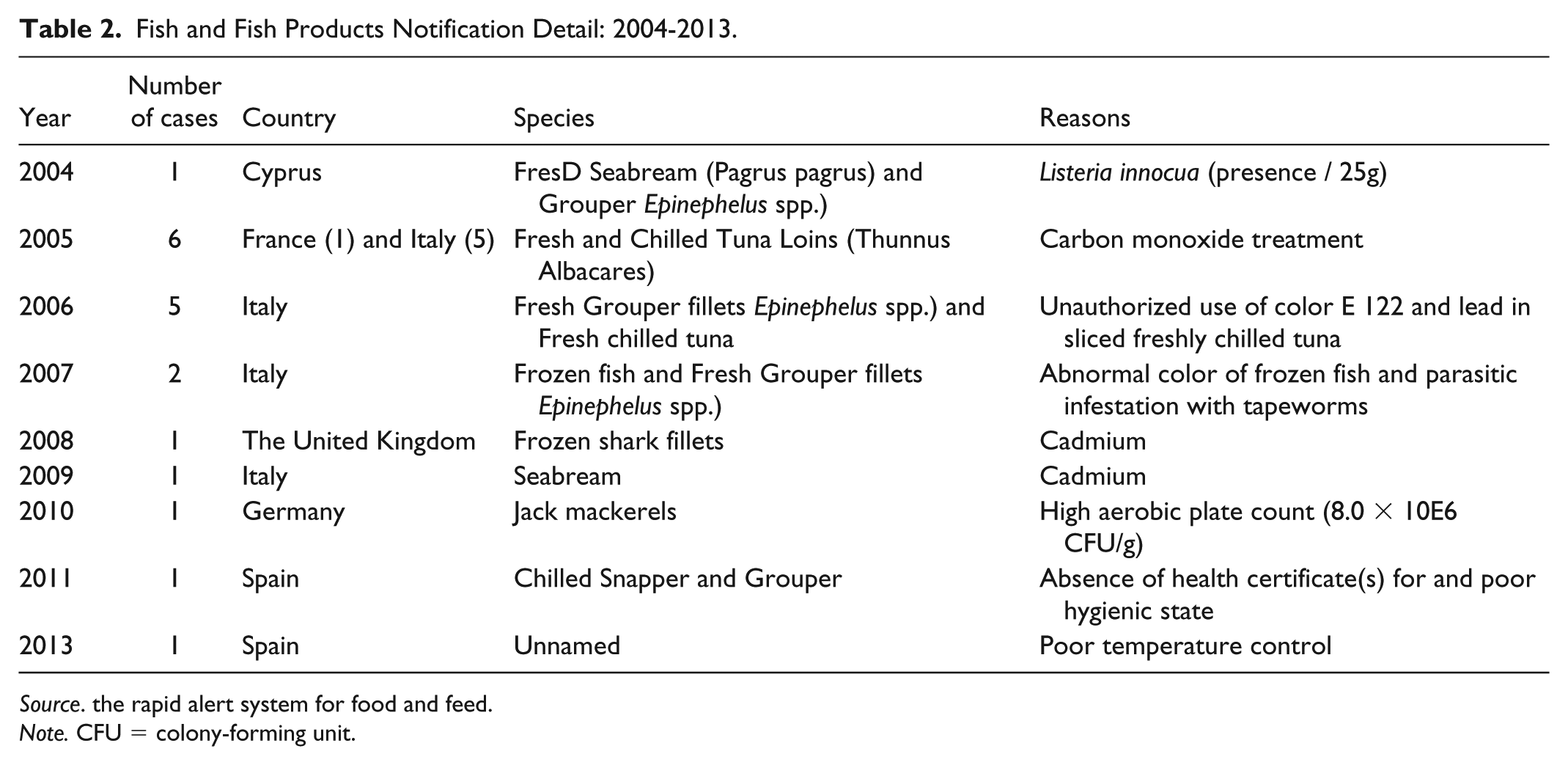
Source. the rapid alert system for food and feed.
Note. CFU = colony-forming unit.
Each notification provides information on the notifying country, the affected product, the reasons, and the action taken. The records of dismissal of exports of fish and fish products to the EU were not available from the MAF and the custom office in Oman for the period 2000-2013. Data on export ban of some selected species were obtained from the MAF (see Table 1 for the specific species, date, and the extent of ban).
Results
Two conventional models, namely, the fixed effects and the random effects are generally considered for panel data covering the period 2000-2013. To decide between the two, a formal test developed by Hausman (1978) is conducted. The estimated χ2 test value (38.25, 8 df) suggests that country-specific effects are correlated with regressors, thus the fixed effects model is pursued. Under a panel modeling framework and based on the Hausman (1978) test result, Egger (2000) demonstrated the empirical superiority of a fixed effects model. The term “fixed effects” accommodates time-invariant unobserved country-specific heterogeneity by allowing the intercept to vary across countries not with respect to time (Gujarati, 2003). To allow for the intercept to differ across countries, the widely used dummy variable technique (termed as the least square dummy variable [LSDV] model) is used by including country-specific dummy variable to the Model 1 and the dummy-variable trap is avoided by dropping one country dummy and treating the corresponding country as a reference country.
The potential “time effects” is also experimented by introducing time dummies for each year (less one to avoid the dummy-variable trap) but failed to generate any outputs due to “near singularity problem,” which, perhaps, reflects the lack of degrees of freedom. To address the potential consequences of the economic downturn experienced by the EU countries as reported by FAO (2012) and as reflected by the lower nominal GDP figures of countries such as Greece, Spain, and the United Kingdom during 2009-2011, year-specific dummy variable was sequentially introduced to the model to capture such potential time effects. This experimentation at least partially attends to the issue of time effects. The “near singularity problem” was also experienced with the distance variable and, therefore, the distance variable has been omitted from the model. Because of the geographical proximity of the EU countries, it is expected that the omission of the distance variable would not undermine the validity of empirical results. In examining Africa’s fish exports to the EU, Kareem (2014) found no significant influence of the variable “distance” used as a proxy for the trade costs on the extensive margin of fish exports.
Initial experimentation of Model 1 without the lagged dependent variable exhibits significant autocorrelation indicated by the low Durbin–Watson (D-W = 0.84) value. The low D-W value may also indicate specification error (Gujarati, 2003). To rectify the problem of autocorrelation, a lagged dependent variable was added to the model. The use of lagged dependent variable can also be justified due to technical, regulatory, and administrative rigidities affecting fish supplies (Bose & Galvan, 2005; Bose & Redkar, 2004).
The empirical results from the LSDV model along with relevant diagnostics are presented in Table 3. 3
Results From the Empirical Models.

Note. LSDV = least square dummy variable; MAE = mean absolute error; RMSE = root mean squared error; SSR = sum of squares regression; GDP = gross domestic product; ER = Euro per Omani Rial.
The coefficient of the variable with regard to the effect of border rejection (DBR) carries an expected sign, but its associated t value suggests that the fish exports to the selected EU markets have not been significantly influenced by such measures.
The coefficient of lagged dependent variable (i.e., lagged export value) is statistically significant at the 5% level and carries the expected sign. The share of the desired adjustment, which is completed in one period is about 42% and the average lag is about 1.4 years. 4 This is not unusual. In explaining the export behavior of New Zealand’s live rock lobster to Japan, Bose and Galvan (2005) introduced the lag structure into the model and it was found to be significant. They suggested that 39% of the gap between the actual and desired level was covered in each period.
The estimated coefficient of the policy decision variable (DBAN) is found to be significant with expected sign. Generally speaking, the ban represents a nontariff barrier imposed by the MAF on fish exports, which results in lower volume of exports and consequently the value of exports. The larger variation in export quantity is also depicted in the CV estimate presented earlier.
The coefficients of the year-specific dummy variables D2009 and D2010 are found to be significant with expected signs. This result is consistent with the negative trend experienced in both volume and value of fish exports due to economic downturns faced by the EU countries in 2009 (EC, 2009; FAO, 2012).
It is found that the coefficient of the variable ERij (Euro per Omani Rial) exerts significant positive influence on the value of fish exports. This is consistent with the industry perception (Qatan et al., 2015). It is also observed from the data that the OMR experienced depreciation against Euros during the study period, which, perhaps, stimulated the demand for Omani fish in some of the selected EU countries. This is consistent with the finding in case of Egypt for agricultural exports (Hatab, Romstad, & Huo, 2010). The policy implication of this finding is that the importing countries may try to adopt appropriate hedging strategy to reduce uncertainty emanate from such currency fluctuations.
Discussion
It is noted that the results provide support to the first statistical hypothesis that the domestic export ban rather than the border rejections by the EU countries has acted as significant barriers to fish exports to the EU. With regard to SPS measures, Neeliah et al. (2012), found that such measures did not act as a major barriers for Mauritian fish exports to the EU market. In a local context, the present finding is also consistent with the results obtained from the qualitative survey by Qatan et al. (2015) where the industry representatives and the management authority reported that rejections from the EU market had become rare after the adoption of the HACCP system. Furthermore, it is reported by the authority that the highest number of notifications that were launched in 2005 and 2006 involved only two establishments. The CA also provided evidence to the EU that four of the notifications in 2005 were due to samples send to Italy for analytical purpose by the establishment. In 2006, three notifications for unauthorized colorants and two for high levels of lead (Pb) involving the second establishment. The use of colorant was known to the CA as the concerned establishment informed the CA and it is specified in the accompanied health certificates. To address the high levels of Pb, the CA increased the frequency of sample analysis from one every 6 months to one sample every three shipments (EC, 2006). In this context, the border notification results are indeed relatively minor (Table 2), which provides support to the inference drawn from the empirical results.
Further support for this result can be derived from the following example. In promoting sustainable fisheries and strengthening its access to lucrative markets such as the EU, the United States, and Canada, Al-Marsa Fisheries Company in Oman received third-party certification for several fish products from “Friend of the Sea” in 2011 (Muscat Daily, accessed on June 25, 2011). This proactive strategy followed by Al-Marsa Fisheries Company illustrates that a well-managed firm has the ability to seek for private third-party certification to create competitive advantage in the market. Although, it is true that restrictions enacted by the SPS Agreement that lead to border rejections do act as a barrier to fish trade and prevent many local seafood establishments without QC number from accessing lucrative markets due to their inability to comply with such mandatory requirements, this may not be the case for the companies with QC number. In comparison with other international study, Neeliah et al. (2011) concluded that SPS measures adopted by the EU have not acted as major barriers for Mauritian exports of fish and fishery products. Kareem (2014) also drew the same conclusion for Africa’s fish exports to the EU at the extensive margin.
The finding with regard to domestic ban on some popular species, perhaps, indicates that the fish exports to the EU may have been facing competition from the domestic market as strong consumer preferences exist for those species in the domestic market (Bose et al., 2010; Yousuf et al., 2018). In addition, the ban on fish exports hinders regularity of exports to the EU markets, which may not be favored by the EU traders. The higher the extent of competition, the greater will be the irregularity of supply. Furthermore, the central wholesale fish market launched in April 2014 at Al-Filaij, a wilayat of Barka in Al-Batinah Governorate is expected to promote fierce competition among buyers and enhance local demand. Consequently, to counteract such supply uncertainty sourced from the domestic ban the EU traders may look for other competitive sources of supply.
A continual positive trend in quantity of fish exports is observed for the GCC countries and a gradual increase of the same is observed in the case of Asian countries (Figure 2). This, perhaps, signals the occurrence of export diversification toward countries with nonstringent health and safety measures. However, lower food safety standards may not be the sole driver for this apparent shift in trade flow, which may be due to geographical proximity, species preferences in these markets, economic conditions, and so on. In a recent study, Al Naabi (2018) found that (a) the export growth in the GCC and Southeast Asian markets were dominated by the growth in quantity relative to that of price and (b) small pelagics category was the highest demanded category in the Southeast Asian market followed by crustaceans and molluscs, while in the GCC market, the highest exported category was small pelagics, followed by demersal. Al Naabi (2018) also observed the sign of preference switch from the low value species to high value species in the Southeast Asian markets in recent years that may be influenced by factors such as GDP and population growth as projected by Delgado, Wada, Rosegrant, Meijer, and Ahmed (2003). Also, comparatively lower transportation costs due to geographical proximity provides a competitive advantage to the GCC market.
Although establishments’ compliance with the mandatory measures exerted upward pressure on costs (both fixed and variable), the adoption of the HACCP system has made each company a potential global competitor in the seafood business with warranted access to lucrative markets such as the EU. However, any regulatory measures in response to the adjustment to domestic market conditions as mentioned earlier should be responsive to adverse economic impact on the local seafood enterprises.
In addition, given the rise of recent national interest in the development of small and medium enterprises (SMEs) in Oman, obligation to secure public health, and to reduce the potential technical and financial hurdles faced by small companies, it is, perhaps the time to initiate measures similar to those suggested by Taylor (2001) to promote safety in small seafood companies. Further study should be carried out to identify the costs and benefits of such measures.
Conclusion
Concerned with the declining trend with regard to both volume and value of fish exports to the EU since mid-2000s, this study examines the relative significance of various economic and regulatory factors on the exports of Omani fish and fishery products to the EU. The empirical results of this study provide support to the first and second statistical hypotheses that suggest that the domestic export ban rather than the border rejections by the EU countries, economic downturn faced by the EU during 2009-2010, and exchange rate fluctuations had exerted significant influence on Oman’s fish exports to the EU.
However, some limitations of this study are worth mentioning. First, this study is based on the EU market only, and, therefore, the results presented are not representative of the other markets such as the United States. Further research involving other quality stringent markets would be of great value. The findings should provide motivation for future research concerning the preferences of export markets. Furthermore, to check the robustness of the presented results from the LSDV model and Gaussian mixture model (GMM), one can apply Heckman (1979) modeling approach as advocated by Gómez-Herrera (2013). A comparative survey of alternative estimation methods involved in dealing with problems of zero-trade flows and heteroscedasticity can be found in Gómez-Herrera (2013), Martínez-Zarzoso (2011) and Egger (2005).
Footnotes
Author Contributions
S. Bose contributed to the research design, econometric modeling and preparation of the article. A. Al-Naabi contributed to the collection and processing of data from local sources and conducted descriptive analysis. H. Boughanmi contributed to the preparation and revision of the article. J. Yousuf contributed to the collection and processing of international data and took part in literature review.
Declaration of Conflicting Interests
The author(s) declared no potential conflicts of interest with respect to the research, authorship, and/or publication of this article.
Funding
The author(s) received no financial support for the research, authorship, and/or publication of this article.
