




Abstract
This study sought to evaluate the self-learning curricula of a kindergarten in Saudi Arabia by applying the context, input, process, product (CIPP) model. To this end, the study utilized a mixed-method design, where teachers (N = 420) had been randomly selected and surveyed, and school inspectors (N = 15) had been interviewed. Furthermore, a content analysis had been carried out to analyze the curricula content based on CIPP model construction. Findings revealed that the objectives of the curricula were moderately correlated to the context. The input, process, and product also moderately contributed to the educational needs and to the Saudi community. However, the curricula failed to meet the kindergarten students’ needs and community in providing multiple sources of knowledge, teaching competencies, and training opportunities. The study recommended the need to develop a kindergarten curriculum on the basis of children’s educational needs and the community developmental needs. It suggests that future studies be conducted in various aspects of child education for preschool, continuous and comprehensive evaluation, and development of the kindergarten curriculum.
Introduction
Early childhood care is becoming a crucial avenue for measuring countries’ development because preparation of kids for future is deemed a civilized inevitability. The kindergarten is an essential stage in which children are learning, developing their varied skills, and getting an integrated child development. The kindergarten is not only a teaching environment but also an environment for the inclusive development of the child’s senses, tendencies, and preparation.
Saudi Arabia is no exception among countries that care for early childhood at a relatively early stage. The private sector showed an interest in kindergartens before the governmental sector. The first private kindergarten was established in Jeddah, Saudi Arabia, in 1955. Then, a number of governmental kindergartens have increased to reach 102 kindergartens in Riyadh only. The efforts to build kindergartens curriculum, which was based on scientific and educational basis were initiated through a collaboration agreement between the General Presidency for Girls’ Education and the Arab Gulf Program for the United Nations Educational Scientific and Cultural Organization (UNESCO). The self-learning curriculum, the target of this study, was printed in addition to seven books related to the units of this curriculum (Smaadi & Marwa, 1991).
Al-Ghamdi (2005) states that self-learning curriculum of kindergartens was subjected to criticism and suggestions from specialists, researchers, and staff from its first application. These criticisms include reassessing the curriculum, rejudging its effectiveness, and determining the need for development of content, materials, and equipment to match community interests and development. To have a more accurate and effective evaluation, the process of the self-learning curriculum of kindergartens must be based on a reliable and standardized model that has been previously employed by peer-reviewed studies. In this regard, Dar Assalam (2010) pointed out that there were a large number of different assessment models (e.g., Tyler’s objective-centered model; goal-free evaluation model; Hammond model; management-oriented evaluation models; context, input, process, product [CIPP]), which have different purposes of use according to the different evaluators and their scientific backgrounds and practical experience. Of these models, the CIPP model was chosen for this study as it is widely known worldwide for its reliability and practicality.
Contextually, the self-learning curriculum of kindergartens in Kingdom of Saudi Arabia (KSA) neither had sufficient development, nor had been evaluated since inauguration in 1976 (Ameel et al., 2009). The curriculum lacks the focus on important skills in kindergartens such as reading and writing, which requires the need to rewrite goals and plans of child activities to match the up-to-date trends in modern kindergarten education. Therefore, this study attempts to evaluate the self-learning curriculum of kindergartens using the Stufflebeam model, and to identify the extent to which the objectives of the self-learning curriculum of kindergartens are correlated to its context and the contribution of its inputs, processes, and outputs in achieving the educational needs of children and the developmental needs of Saudi society. The study will shed light on notion of early childhood and the need for evaluating the kindergarten curricula that attuned to their needs based on the CIPP model, and review the previous studies related to the research objectives.
The child is considered the core of education in kindergartens for whom the objectives, content, methods, and means are evolving. The direct experiences of the child represent the beginning of his or her educational curriculum. Hence, specialists concerned with the planning of childhood programs depend on adapting the child’s curriculum and methods of education to match the child’s preparations, needs, and abilities.
Sassila (2010) noted that children’s characteristics in kindergartens, whether those related to physical, social, or emotional needs, require an appropriate climate that allows interaction between children in kindergartens. This can be done by providing all physical and technical tools and facilities. Needs can be considered as the most relevant topics of overall growth, in general, and growth in preschool childhood, in specific, where the child goes through rapid physical, social, emotional, and mental development. The educational needs of kindergarten children vary as follows:
Psychological and social needs such as the need for love and acceptance from others, emotional security, need for social appreciation, success and excellence, self-assertion, freedom and independence, and acceptance of power and play;
Mental and cognitive needs such as research and exploration, and the need to acquire linguistic skill (Yakhlif, 2014).
Educators and researchers have identified the seriousness of the curriculum and the important role it plays in bringing up generations of learners, in making them acquire the skills and knowledge that help them in integrated development of their personalities and advancement of their societies. The curriculum reflects the culture of society with all its elements of religious beliefs, patterns of thinking, behavior, and methods of education (Sharif, 2007). Jad (2011) identified the evaluation of kindergarten curriculum as the process of gathering information on all components of the curriculum, to reveal child’s skills and aptitudes that might affect the achievement of overall balanced growth goal of the kindergarten child, to decide about the curriculum itself. Evaluation is carried out using accurate research methodology based on reliable criteria to examine the effectiveness to suit the context, which the curricula intend to develop. Of these evaluation models, Stufflebeam model is the most adopted evaluation for programs, institutions, and curricula that is used widely and well known for its efficacy, comprehensibility, and reliability, which is adapted in the current study.
CIPP Model
The model was designed first by Danial-Stufflebeam in the late 1960s to help evaluate programs, institutions, and curricula in the educational field, and then the model has been further used in different areas other than education such as social programs, business, and military (Stufflebeam, 2003). The purpose of the model is to help raters who evaluate school programs, course of instruction, and curricula design, covering four different dimensions: context, input, process, and product, and the ultimate goal is not “prove but to improve” (Stufflebeam, 2003. p. 31).
The first phase is context, which mainly concerns with identifying target population’s needs, defining problems, setting objectives, identifying resources, and putting criteria for assessing outcomes (Stufflebeam & Shinkfield, 2007). It is mainly based on finding an answer to the question, “What needs to be done?” Zhang et al. (2011) stated that context evaluation is the base of evaluation. It represents the general framework of any evaluation model that includes the cultural, political, economic, and educational philosophy of the surrounding environment. Its role lies in verifying the definition of the educational objectives and their appropriateness to students’ needs. The information about target groups is collected and the limits of evaluation are defined, which help to understand the surrounding environment and bases that must be taken into consideration when designing and structuring curriculum and setting its objectives.
The second component is input, which refers to all the plans, strategies, and budgets of approaches chosen for implementation. Stufflebeam (2003) states that input “aid evaluation users to design improvement efforts, develop defensible funding proposals, detail action plans, record the alternative plans that were considered, and record the basis for choosing one approach over the others” (p. 32). According to Karatas and Fer (2009), inputs are concerned with providing information about the potential and resources of the body, which will implement the curriculum, review similar literature and curricula, consult specialists. Furthermore, the alternative strategies for implementation and evaluating them in terms of cost, utility, timeline, and possible obstacles and identifying plans that might be more appropriate to the needs of the design of the curriculum implementation methods. It serves decision making and conducting workshops and seminars.
Concerning process, Stufflebeam (2003) argues that evaluators need to predict, assess, observe defects in the plan or its implementation, and then give feedback on how to execute improvement in the action plan. With regard to educational curricula, it means using different methods to reveal how to apply and implement the curriculum to detect feasibility of plans for implementation and execution. It corresponds to the role of structural evaluation of the curriculum in collecting information and data on the progress of the educational process to provide feedback, which will help detecting of deficiencies while implementing the curriculum. This would improve the operational plans developed by the curriculum planners, and in the interpretation of the results, and identifying the reason behind a specific result (Al-Qararaa, Al-Qaisi, & Al-Rofai, 2011).
The last component is product, which means to measure the intended and unintended learning outcomes. This factor helps to identify whether the student and beneficiary needs have been met and to what extent. It also assists in discovering the intended and unintended side effect, and to render decision as whether to continue, stop, or make an improvement plan (Stufflebeam, 2003). According to Attieh (2008), evaluation of curricula outputs means the collection and analysis of the provisions related to the success of the curriculum and its intended and unintended effects and positive and negative outcomes. The output calendar corresponds to the final evaluation of the curriculum, and aims to determine the extent to which the purpose and objectives of the methodology is achieved. This is linked to context, inputs, and processes, when measuring and interpreting outputs to serve as a review of decisions and determine the effectiveness of the methodology.
Many studies have been conducted on the context of education curricula, applying the CIPP model and evaluating higher education curricula. However, little is known about kindergarten curricula evaluation. Of those related to higher education curricula evaluation, Karatas and Fer (2009) identified how the English curricula at Yeldiz University in Turkey were correlated to CIPP model. The researchers administered a survey and an interview to 35 teachers and 415 students. Their responses have been analyzed, and findings revealed although their opinions varied on different items of the model, they tend to support the notion of CIPP model components. Similarly, Tunk (2010) evaluated the preparatory year curricula of Ankara University using the CIPP model. Four hundred six students and 12 instructors had been surveyed and interviewed. Besides, a content analysis had been run on the curricula of English. The results revealed that the curricula of Ankara University served partially the CIPP model and certain issues need to be developed.
In a recent study, Rooholamini et al. (2017) evaluated a medical program at Shiraz University utilizing the CIPP model. They studied how good the relationship was between the science basic courses and the clinical courses, as based from the responses of professors and students of the first and second years of the medical program. The authors adopted triangulated mixed methods to collect data via surveys, semi-instructed interview, brain storming sessions, and content analyses of students’ portfolios. Findings revealed that for the context evaluation, majority of respondents perceived that the educational system motivated them for active participation and the atmosphere of classes was found suitable. Concerning input evaluation, the resources were acceptable, and for the process evaluation, the quality of integrated models was good for students. With regard to product evaluation, the authors found some positive points about the integration and some points need to be improved.
On the contrary, Mirzazadeh et al. (2016) found that the CIPP model failed to address some evaluation questions and resulted in evaluation burden. The authors applied the CIPP model to revise a medical educational program on Iran. Data were collected from students, teaching staff, administrators, and undergraduates through different tools such as focus groups, questionnaires, and measurement performance. Results found that the CIPP model was the best model to inform all the people concerned with educational curricula such as stakeholders, decision makers, and curriculum designers, to make informed decision on reactions at every stage of the reform. However, the CIPP model has some limitations on evaluation.
On the relation to kindergarten curriculum evaluation, there was a single study—to the best of the author’s knowledge—that tackled this issue despite its limitations. Lin and Ching (2012) conducted a study aimed at clarifying the reality of kindergarten curricula in Taiwan and evaluating them in the light of the CIPP model. The study analyzed governmental documents and curricula to correlate them to the CIPP model. The results showed the current kindergarten curriculum in Taiwan required more transparency in its administration, and some improvements in different stages of the CIPP components should be taken. Although Lin and Ching’s (2012) was the first study in kindergarten curriculum evaluation using the CIPP model, it has some limitations on its methodology as the data have not been triangulated. Only documentary analyses had been run to elicit the data, whereas stakeholders were not involved to support the findings that came from written documents analyses. I argue that this is the first study tackling evaluation of kindergarten self-learning curricula, following the CIPP model for which data were collected qualitatively and qualitatively to come up with reliable findings that may be overgeneralized to the body of evaluating the curriculum of early childhood. This study attempts to answer the main research question and three sub–research questions:
The research subquestions are as follows:
Method
This section describes the methodology employed, sample selection, and data collection tools with steps followed to ensure their reliability and validity.
Study Approach
Qualitative methodology was used to collect data on a card corresponding to in-depth access to feedback from supervisors to reveal the reality of the self-learning curriculum for kindergartens and the content analysis card. The quantitative methodology was used by using (the built) Stufflebeam evaluation model to survey the sample’s views on the reality of the self-learning curriculum currently applied in governmental kindergartens.
Population and Sampling
The study population consisted of (a) 1,362 kindergarten staff (supervisors, directors, principals, and teachers) according to the Kindergarten Management Statistical Survey 2016, (b) 27 supervisors in charge of kindergartens in the Ministry of Education departments, and (c) the book of self-learning curriculum adopted in kindergartens to be included in the content analysis. A random sample was selected from the original population consisting of female staff in 50 public kindergartens in Riyadh, from the total sum of 102 kindergartens (50%) by drawing lots; then, 30% of the staff were randomly chosen—as an acceptable known percentage (supervisors, directors, and teachers) to answer the questionnaire in a simple random manner. Three hundred ninety six participants responded (i.e., 93% of population). The sample of the study—who had been interviewed—was a purposive sample to study a phenomenon in depth. Fifteen supervisors out of 27 supervisors voluntarily accepted to participate in the interview.
Study Tools
To achieve the objectives of the study, three tools were used. The following is a detailed description:
First tool: Questionnaire
The questionnaire was used to elicit the views of members of the study population on the actual content of the self-learning curriculum of kindergartens using the CIPP model, which was constructed in form and content according to the following resources. The general framework of the evaluation of educational curricula as defined by Stufflebeam consists of four dimensions:
context of the self-learning curriculum in KSA;
inputs of self-learning curriculum;
processes focused on the self-learning curriculum including the selection of content, activities, methods, and techniques, and their implementation;
output, which includes the changes covered by the curricula in all stages of the child’s growth as per the child’s needs and developmental needs of the community.
Validation of questionnaire
The face validity was assessed by raters, where the first draft of the questionnaire was given to a group of 13 faculty members specialized in curriculum and kindergartens. The draft was assessed in relation to the suitability of content and areas for various aspects of the subject. They were also asked to propose modifications. The raters gave their observations, and asked for amendments and proposals. Consequently, the researcher amended accordingly, so that the items had become 56 instead of 64.
Reliability of the questionnaire
The reliability of the questionnaire was verified using Cronbach’s alpha coefficient of the questionnaire. The result showed high reliability between .97 and .98 and the Cronbach’s alpha coefficient of the instrument as a whole was .96, indicating that the questionnaire has a high degree of reliability.
Second tool: Interview card
Achieving the objectives and procedures of the study requires preparing a card to interview a sample of kindergarten supervisors in the field. Data obtained from the interview contribute to answering the various study questions. To prepare the interview card, the interview aimed at obtaining more opinions and information about the reality of the self-learning curriculum in kindergartens.
Validity of interview card
To achieve validity of the interview used in this study, a draft form of the card was prepared comprising a number of questions in each of the fields of the CIPP model, which was given to three reviewers specialized in the field of kindergartens and curricula. They assessed the questionnaire in terms of suitability of the questions and relevance of the items to the investigated issue of the current study. The reviewers gave their remarks and the researcher has amended the questions on the basis of their comments.
Reliability of the interview card
To achieve the required reliability and to enable future researchers to reconduct the same study, the author has performed three actions: (a) giving an accurate description of the design of the research and the method of applying the interview card and the content analysis card; (b) recording and interpreting all the data collection, and detailing the steps of the study; and (c) analyzing of data and formulation of the results, and provide a full description of the study sample and the context in which the study was carried out.
Implementing the interview
The author conducted interviews with the sample members via mobile messages and their conversation by telephone, to make sure they accepted to be interviewed and set the date of the interview. The author conducted 15 interviews with supervisors in the offices of educational supervision, and the interview period lasted three consecutive weeks. The interview time was between 30 and 45 min. The interview card included a brief description of the study subject, its objectives, personal data for the interview, and the interview questions, which are nine questions.
Third tool: Content analysis of card of self-learning curriculum in kindergartens
The content analysis card of the curriculum book contributed to answer all various study questions and achievement of the objectives of the study. The analysis of the content, adopted by the CPPT model, is based on the analysis of contexts, inputs, processes, and products. The criteria for the analysis were 11 standards out of 60 phrases.
Validity of the content analysis card
The list of criteria was handed in to a committee that assessed the interview card. The committee suggested determining each criterion according to the dimensions of the Stufflebeam model and reducing the number of standards to facilitate the analysis process. The author responded to all suggestions and comments raised by the committee. As a result, the number has reduced to 26 instead of 60.
Data Analysis
The author has triangulated the data by using three different research instruments to gain valid results, namely, a questionnaire, an interview, and a content analysis card. To answer the first three questions of this study, data from the questionnaire and interview had been analyzed, whereas the qualitative data obtained from the content analysis card were used to answer the fourth question.
Research Question 1: To What Extent Are the Objectives of the Kindergarten Self-Learning Curriculum Correlated to the Context Using the Stufflebeam Model?
To identify the extent to which the objectives of the self-learning curriculum is correlated to context, descriptive statistics of the questionnaire’s respondents were collected and summarized in Table 1.
The Participants’ Response Toward the Correlation of Kindergarten Curricula With Context.

It is clear from Table 1 that the overall mean of the responses on the correlation of the objectives of the self-learning approach with the context was 3.30 (SD = 1.01), where the means ranged between 4.1 and 2.2 and standard deviations were 1.02 and 1.4, respectively, with a medium degree, indicating that the respondents view that the objectives of the self-learning curriculum for kindergartens are consistent with the syllabus context (67%).
Qualitative Results From the Interview
The author has transcribed the interviews of the target sample (i.e., supervisors) for later analysis. The qualitative results of the questionnaire found the following remarks:
The majority of supervisors believe that the kindergarten curriculum prepares children for learning. This indicates that kindergarten in its traditional and modern concept focuses on basic skills such as reading and writing.
The opinion of nine interviewees agree that the curriculum does not care about the integration of technology into the kindergarten curricula.
The results of the analysis revealed that the content of the self-learning curriculum, containing information and experiences provided to the child through the activities of reading and arithmetic during the periods of the daily schedule in the kindergarten, the ring, the pillars, and the playground, achieves cognitive and motor skills that meet the physical and mental needs; this explained the structure of the curriculum, which is based on Piaget’s theory of mental growth that correlates with the child’s physical growth, in what he calls the sensory-motor intelligence phase.
The results of the analysis, along with the results of the questionnaire and the interview of the supervisors, agreed on the inadequacy of the curriculum in achieving the developmental needs of the Saudi child. The result revealed the achievement of the curriculum for the physical and mental needs as clearly as previously mentioned, and the absence of emotional needs and interest in technology in education. The National Report of the Saudi Ministry of Education (2015) affirmed that its curricula should take into account the developmental criteria for building community-based knowledge to contribute to the civilization of the 21st century. Therefore, the curriculum, which is not based on scientific foundations derived from the changing society and the evolving needs of the child and undeveloped curriculum, had a clear impact on the weakness of the curriculum.
Research Question 2: To What Extent Did the Inputs of the Self-Learning Approach to Kindergartens Contribute in Achieving the Educational Needs of Kindergarten Children and the Developmental Needs of Saudi Society Using the Stufflebeam Model?
To understand the contribution of the input to the educational needs of kindergarten children and the developmental needs of the Saudi community using the Stufflebeam model, the questionnaires were analyzed by calculating the frequency, percentages, means, and standard deviations of the respondents’ responses on the consistency of curriculum objectives with context.
Table 2 shows that the general mean of participants’ responses to the contribution of curriculum inputs to the educational needs of children and the developmental needs of the Saudi society was 3.29 with a standard deviation of 0.98. This indicates that the respondents believe that the inputs of the curriculum contribute to achieving the educational needs of children and the developmental needs of the Saudi society by 65.8%, no statements reached a high score.
The Participants’ Response Toward the Correlation of Kindergarten Curricula With Input.

The results of the analysis of supervisors’ answers to the interview questions revealed an agreement as follows:
In terms of providing a specific guide to the self-learning curriculum for kindergartens, the specific guide is intended for the kindergarten teacher. The researcher reached an agreement on the results of the questionnaire with the results of the interview as obtained from the supervisors. The curriculum contained a teacher manual and the results of the supervisors were more detailed of the contents of the manual, where it supported eight of the supervisors, who constitute 53% of the sample that the manual in the general curriculum did not present behaviors and strategies that may contribute in guiding teachers to practices that deal with children’s psychological and behavioral problems.
In terms of the weakness of the environment, nine participants have argued that there was a clear discrepancy between the private sector and governmental ones, in favor of the private sector in terms of processing the kindergarten environment and classes.
In terms of lack of teaching competencies and lack of training opportunities and the lack of educational qualifications and professional development of kindergarten teachers, 12 supervisors agreed that there was a large percentage of kindergarten teachers who did not specialize in childhood. In addition, the kindergarten teacher did not have sufficient opportunities for on-the-job training to be an incentive because the teacher developed herself by her own skills and knowledge and because there was no teacher to replace her while the basic teacher was in training. The supervisor (M8) added that the curriculum is the teacher and the teacher is the curriculum.
The results of the content analysis in terms of the contribution of inputs to meeting the needs of children and the development needs of the community were limited, because the inputs (identification of plans that are more appropriate to the needs of curriculum design methods) appear much in the curriculum content (processes), and the card analysis tool did not present inputs for kindergarten but presented some applied practice, where the results of the analysis revealed a complete absence in the curriculum inputs as follows:
lack of clarity of developmental standards for the Saudi child and its applications in the field of curriculum units,
not mentioning modern concepts and methods of learning,
absence of the strategic objectives of early childhood learning and not based primarily on a national plan for early childhood development, and
the results of the content analysis also revealed the availability of a guide to the kindergarten teacher’s specifications and the specifications of kindergarten classroom by the curriculum.
The results of the content analysis also have found that the curriculum contributed to guiding the behavior of children in a limited manner and limited to introducing traditional methods in the rehabilitation of children such as punishment and reward. The curriculum also presented examples of problems faced by children and kindergarten teachers and methods of solving them, but the curriculum did not provide an integrated guide to the psychological and behavioral problems in children: their causes, motives, manifestations, methods of treatment, and effects. Therefore, the teacher is not expected to be able to solve problems in general because what already existed in the curriculum is a cure for a certain small problem at the practical level.
Research Question 3: What Is the Extent to Which Processes of the Self-Learning Curriculum to Kindergartens Contribute in Meeting the Educational Needs of Kindergarten Children and the Developmental Needs of Saudi Society Using the Stufflebeam Model?
To determine the extent to which the process of self-learning for kindergartens contributed to the curriculum, descriptive statistics were calculated on the contribution of curriculum processes about the educational needs of children and the developmental needs of Saudi society.
Table 3 shows that the mean of respondents’ answers to the extent of the contribution of curriculum processes to meet the educational needs of children and the developmental needs of the society was neutral (M = 3.21, SD = 1.09), indicating that the respondents viewed that the processes that contribute in achieving the objectives of the self-learning curriculum for kindergarten for the educational needs of children and developmental needs of the Saudi society were 64%.
The Participants’ Response Toward the Correlation of Kindergarten Curricula With Processes.
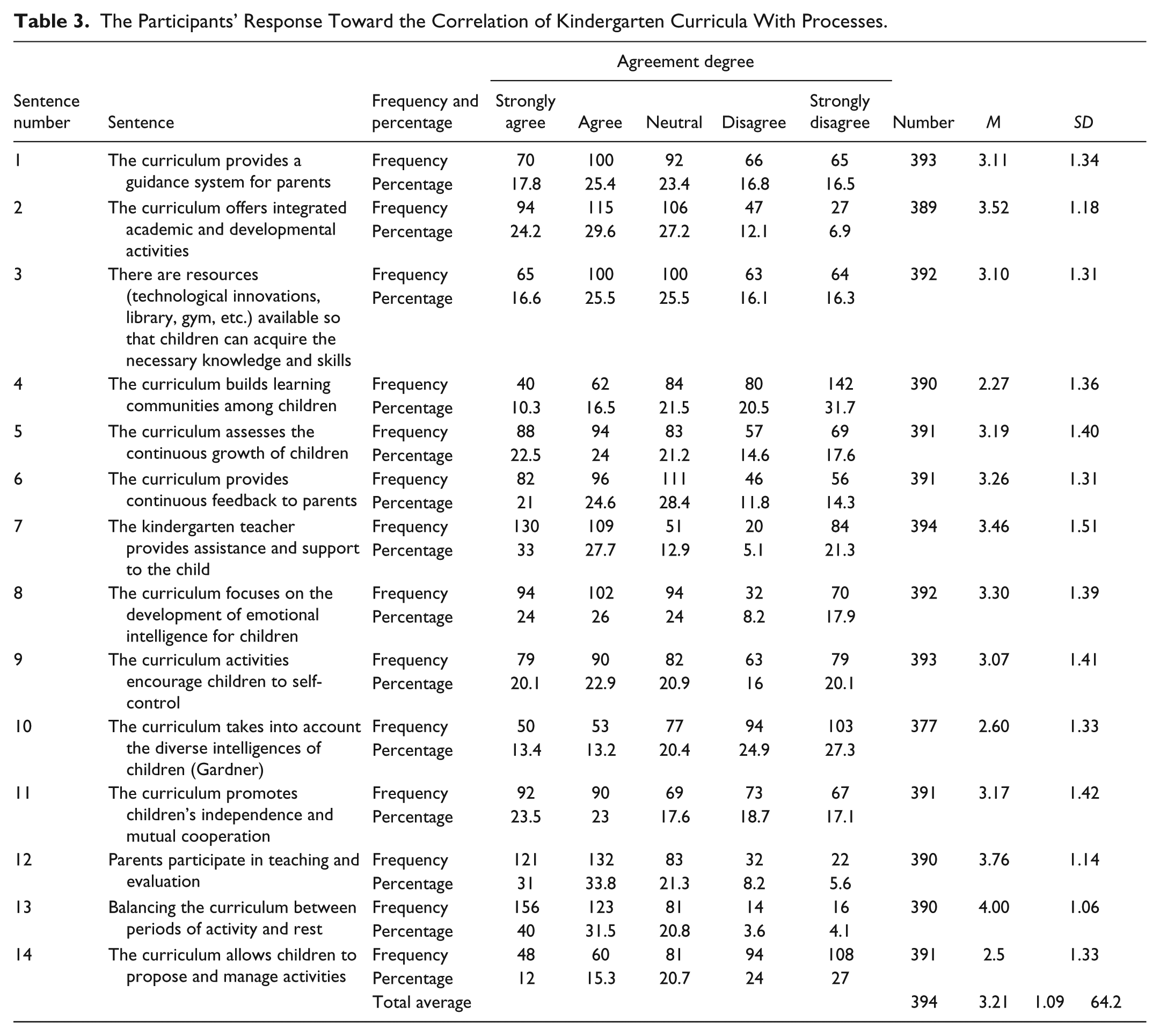
In terms of the results of the analysis of the interviews regarding the contribution of inputs to meet the educational needs of children and the development needs of the community, they were identified in the following areas:
The results of the questionnaire and the results of the analysis of the interviews agreed that the curriculum focused on the teaching of academic skills. Most supervisors agreed that the self-learning curriculum focused on literacy, numeracy, science, and religion. This was done in a traditional way. Three supervisors stated that the curriculum did not clearly focus on learning academic skills; the book did not mention the strategies and methods to provide academic skills and instill religious values. The curriculum was limited to several academic activities with working papers for teaching literacy and some short and simple Suras as mentioned by a teacher (M2).
Playing in kindergarten: Gaming is the second most important role of supervisors in this field. Are toys and games tools for learning? Or, is it an end in itself? In terms of the focus of supervisors on games as tools of teaching, six supervisors who were about 40% of the sample referred to the importance of the kindergarten teacher’s specialty, because they believed in the importance of playing as a learning tool. The following idea was repeated: Children learn through play. We have to use playing in reading, writing, and numeracy skills. Supervisor M2 explained that the specialized teacher can organize a group game during the stadium period to achieve mathematical concepts. Supervisor M5 said that the specialized teacher could provide science.
Child assessment: This study aims to identify the degree of achievement of educational goals for children to address weaknesses and shortcomings. The processes of child assessment in the self-learning curriculum were not one of the basic processes in the kindergarten, although it was important, but the curriculum did not focus on it clearly. The curriculum included an assessment card at the end of each module measuring the skills and knowledge achieved by the child, while the views of the supervisors revealed that evaluation is an essential part of the curriculum. One of the supervisors (M11) reported that the evaluation of all kinds—diagnostic, descriptive, judgmental, formal, and final—was missed from the attention of kindergarten teachers in some kindergartens. As for government kindergartens, there was an agreement among most supervisors that the evaluation was carried out in the lowest form. Thus, two respondents expressed the following opinion: “The evaluation in public kindergartens is limited to sending praise and success.”
The relationship between the family and the kindergarten: Most supervisors clearly explained, during the interviews, the difference in the degree of relationship between the family and kindergarten in some private kindergartens. Also, they explained that the role of the family extended from follow-up and visit to real participation in the management of kindergarten activities. In public governmental kindergartens, parents’ role is only through the mother’s listening to the teacher’s observations about her child or reading the report. Eight of the supervisors expressed dissatisfaction with the relationship between the kindergarten and the family. This is contrary to the results of the responses of the teachers about the statement in the questionnaire, which dealt with the relationship of the curriculum with the parents, which got a rate of approval of 75%, the curriculum has identified practical steps to build this relationship. One of the respondents said that the curriculum set several steps for the continuation of work between the family and the kindergarten throughout the school year, but implementation almost ignored these steps and perhaps the same principle.
Research Question 4: What Is the Extent to Which the Learning Products of the Kindergarten Self-Learning Curriculum Contribute in Achieving the Educational Needs of Kindergarten Children and the Developmental Needs of Saudi Society Using the Stufflebeam Model?
To answer this question, descriptive statistics were run, and they were displayed in Table 4.
The Participants’ Response Toward the Correlation of Kindergarten Curricula With Products.

Table 4 shows that the general mean of respondents’ responses to the extent to which the learning outcomes of the self-learning curriculum contribute in meeting the educational needs of children and the needs of the development community was 3.59, with a standard deviation of 0.97. This indicates that the respondents believe that the learning outcomes of the self-learning curriculum for kindergartens contribute to meeting the educational needs of children and the developmental needs of Saudi society with high approval of 71%.
The qualitative results obtained from the interview go in line with that of the questionnaire as follows:
Preparation for the primary stage: Most supervisors support that the curriculum of self-learning in the kindergarten prepares children for the curricula of the first primary stage, which means that the curriculum contributes to the achievement of cognitive, religious, and moral outputs.
Curriculum and needs: Seven supervisors believed that the curriculum’s interest in meeting all the needs of children and their developmental needs was still limited by knowledge needs. Ten supervisors agreed that the inadequacy of the curriculum in meeting all the needs of children is due to a lack of evaluation of the curriculum. The teachers are limited to the existing evaluation form that measures knowledge, conservation, and information only.
Social intelligence: Four supervisors (26%) highlighted the importance of social intelligence in the adaptation of the child and the development of his or her independence. One teacher said that if the kindergarten teacher used different means to introduce children to each other, introduce new children to others, play together, and exercise the same activities, it helps them to be more independent and successful.
Discussion
The study aims to find out how the self-learning curricula in Saudi kindergarten are correlated with the CIPP model. With regard to the first research question that asks to what extent the objectives of the kindergarten self-learning curriculum are correlated to the Stufflebeam’s context, the results of the three tools (questionnaire, interview card, content analysis card) are moderately correlated with the objectives of the syllabus context. The researcher attributes this result to the failure of any educational curriculum that was not built on a learning matrix as described by Al-Amir (2011), who states that the educational matrix is shaped in the form of rows or columns in directly related formats to measure the achievement of quality standards, to link the message and goals to learning outcomes. The matrix includes concepts associated with learning vocabulary and curriculum elements and performance indicators for learning outcomes. The curriculum did not take into account the different needs of children and the needs of society completely. This finding is in line with the findings of Lin and Ching (2012), who used the Stufflebeam model to evaluate the kindergarten curriculum and discovered that the goals of kindergarten curricula in Taiwan were not consistent with the context. This indicates that it is important for curriculum designers to be aware of the context criteria (determining the principles to be taken into account when designing and building the curriculum; understanding the environment surrounding the curriculum; determining the cultural, political, economic, and educational conditions of the surrounding environment; and identifying the needs of children) in the objectives of the curriculum. The lack of long-term curriculum development and the absence of knowledge age requirements were evident in the analysis of the responses of the three instruments of study.
Concerning the second question seeks to answer whether inputs of the self-learning approach to kindergartens could contribute in achieving the educational needs of kindergarten children and the developmental needs of Saudi society using the Stufflebeam model. Results demonstrate that participants’ perceptions toward this issue were moderate. Their responses varied between the high, medium, and low grades. Furthermore, the results of the interview coincide with the results of the questionnaire, related to the lack of teaching competencies and the professional development of kindergarten teachers. The curriculum fails to address the characteristics of children and their problems, and this is consistent with the findings of previous studies that affirmed the need to provide inputs to build rich content curricula that matches the recent trends of learning in satisfying children’s physical, emotional, and social needs, which require a climate conducive to better interaction between children through the provision of all material and technological tools (Sassila, 2010).
This indicates that inputs alone are not enough to ensure good outputs. In some cases, this depends on the processes that take place in kindergarten and on the qualifications of teachers as well. However, it remains necessary to adhere to international standards in construction, areas, tools, playgrounds, management, organization, and teachers. This is consistent with Danton (2002), who pointed to the development of three criteria for modern kindergartens: qualified teachers, the proportion of teachers for children, and the size of the classroom. In addition, there is a sore need to strengthen preschool programs with appropriate material support and the Eckert Scale of Modern Kindergarten Standards. The context, inputs, and processes interact to produce outputs, and any defect in one of them negatively affects the outputs; so, there must be organized processes led by the kindergarten administration and teachers to work in a team with different people, so that the required outputs can be obtained.
Concerning the domain of “process” and its correlation to the CIPP model, the results revealed that the curriculum focused on the processes through activities, academic teaching, play and evaluation, and the family relationship in kindergarten. The results of the questionnaire revealed the extent to which curricula processes contributed to meeting the educational needs of the children and the developmental needs of the society at a neutral level (M = 2.72). The results of the analysis of supervisors’ interviews highlighted a significant absence of child’s development assessment activities, limited contact with parents, and lack of interest in gaming activities, and much focus on teaching letters, numbers, and chanting. This is in line with Sobha’s (2011) study, which stated that the curriculum of self-learning was free from the development of creativity to reach the higher levels of thinking.
In general, it is concluded that kindergarten activities are mostly affected by the quality of inputs, especially human inputs such as qualified teachers, experience, and management. This concentrates efforts on developing curriculum inputs to reach desired outcomes through curriculum processes, especially in the development of kindergarten teacher preparation programs and in-service training programs.
With regard to the final domain “product” and how did it contribute in achieving the educational needs of kindergarten children and the developmental needs of Saudi society, results revealed a difference in the degree of contribution of the curriculum outputs in meeting the needs of the children and the needs of the society between high, medium, and low. One of the most striking statements that reached the level of approval among the sample members is the ability of the curriculum to provide children with some values, especially religious, cognitive skills, and the development of readiness to go to school; whereas, there were some statements that had been approved with medium degree or were totally rejected such as statements that dealt with the ability of the curriculum to develop socioemotional intelligence, observation, experimentation, and research decreased.
Conclusion
Results from the three tools found that the objectives of the self-learning curriculum for kindergartens are consistent with its context to a medium degree, with a mean average. The supervisors’ views were more detailed and specifically related to the needs of the Saudi society. The content analysis card revealed the clarity of the self-learning goals provided in the textbook, and the absence of explicit mission and vision. Moreover, the participants’ responses differed on the contribution of the self-learning curriculum for kindergartens in meeting the educational needs of the children and the developmental needs of the Saudi society, which was moderate. The results also uncovered the lack of interest in the application of kindergarten specifications. The results also revealed that the curriculum processes contribute in meeting the needs of the children and the needs of the community. The analysis revealed the absence of the role of the family in the curriculum, where it was limited to the message that informs the parents about the weekly plan or announcement of a trip only.
Pedagogical Implications
In the light of the results of the present study, the author has suggested a number of recommendations. First, educational needs of children and the developmental needs of the Saudi community must be stated. Second, as the results of the study revealed a nonconformity of the curriculum specifications to the specifications of the curriculum adopted in the governmental kindergartens and to the lack of professional development of the teachers and shortcoming competencies of the teachers, the author suggests that the Ministry of Education has to set up standards for kindergartens on which the curricula must be evaluated and developed. Third, it is recommended to make kindergarten adapt between the academic curriculum based on learning basic skills and the requirements of the growth of children and their emotional, physical, mental, and spiritual needs and development. Fourth, the kindergarten should carry out continuous evaluations of the child’s growth from kindergarten to school. Fifth, the kindergarten should adapt between the academic curriculum based on learning the basic skills and the requirements of the growth of children and their needs for emotional, physical, mental, and spiritual development through the application of strategies and activities. Sixth, kindergarten instructors must take care for assessing children for knowledge, skills, and different directions.
Recommendation for Future Research
Based on the results of the study, the researcher suggests that other studies be conducted to make a comparative study between the self-learning curriculum and similar curricula in other countries, to reveal the relationship of curriculum components with the needs of children and the needs of society. Furthermore, it is suggested to conduct a study to design a proposed curriculum for kindergartens that meets the objectives of the various developmental needs of children and the developmental needs of the Saudi society according to the standards of modern kindergarten. Also, future research is recommended to do comparative studies between the effectiveness of kindergartens that apply self-learning curriculum and other curricula on academic achievement, values, and skills of children.
Footnotes
Declaration of Conflicting Interests
The author(s) declared no potential conflicts of interest with respect to the research, authorship, and/or publication of this article.
Funding
The author(s) disclosed receipt of the following financial support for the research, authorship, and/or publication of this article: The author would like to thank the Research Centre for the Humanities at the Deanship of Scientific Research at KSU for supporting and funding this research project as part of “The Initiative of Enhancing Publication in the Database of Web of Science – ISI - in Humanities Departments” No. (IEPDWSHD-1-18-03).