




Abstract
Yoga for young children has become a growing area of interest in early childhood settings across the United States. Evidence suggests that yoga has the ability to improve young children’s physical development, executive functioning, self-regulation, and can aid in decreasing stress and anxiety. While the scope of research on yoga for young children has primarily focused on the experiences and outcomes of the children who participate, far less is known about the experiences and perceptions of teachers who have engaged in such programs with their students. This study utilized a qualitative case study to investigate teachers’ perceptions of yoga in a school setting. It took place at a laboratory preschool in North Mississippi over the course of 6 months from January to June 2017. A variety of qualitative research methods were employed to garner data including semi-structured interviews, classroom visits, and observations of weekly yoga classes. Findings from the study revealed teachers perceive the benefits of yoga to be increased physical development, self-regulation, and socioemotional skills, along with behavioral and cognitive benefits in the classroom. In addition, teacher buy-in was found to be critical to program success, as the teachers who perceived yoga positively were more willing to incorporate it into their classroom, thus extending its benefits. Of particular interest were reports by preschool teachers of students who continued to use yoga in their daily lives and retain many of the skills learned in yoga even months after they had taken yoga classes.
Keywords
Background
Yoga for young children has become a growing area of interest in early childhood settings across the United States (Schwind et al., 2017). With an emphasis on stretching, breathing, and mindfulness techniques, yoga has been associated with a decrease in stress and anxiety in young children (Anand & Sharma, 2014). Evidence also suggests that yoga has the ability to improve young children’s physical development, attention, and executive functioning (Galantino, Galbavy, & Quinn, 2008; Jensen & Kenny, 2004). While the scope of research on yoga for young children has primarily focused on the experiences and outcomes of the children who participate, far less is known about the experiences and perceptions of teachers who have engaged in such programs with their students. It is imperative to acknowledge that teachers have an invaluable role during the implementation phase of school yoga programs and subsequently on the ability to impart benefits of the practice for their students’ development. These benefits are not only important during program implementation, but should be examined when a program concludes. Thus, this study engaged teachers in discussion about perceptions of their school’s yoga program, their experiences with the yoga program, and their beliefs about the benefits of the program for their students and themselves.
Literature Review
Yoga is a long-standing practice that has extended across the world and is known for calming the mind and improving overall well-being. Consisting of certain stances (asanas), breathing (pranayamas), and hand positions (mudras), evidence in ancient and contemporary literature suggests that yoga has a positive impact on both physical and mental health (Iyengar, 2008). Although the majority of research on the benefits of yoga has focused on children in upper elementary through adulthood, recent empirical evidence notes that the benefits of yoga can also translate into yoga practices for young children (Hagen & Nayar, 2014).
Benefits of Yoga
Breath and self-regulation
An essential element of yoga at any age is becoming mindful of your own body while breathing through each movement. Research indicates that as young children acquire breathing techniques during yoga, their ability to self-regulate increases (Razza, Bergen-Circo, & Raymond, 2015). The ability to focus inward and become mindful of one’s body during yoga provides a platform for young children to obtain control over their own body and navigate the daily stressors of life and school from the inside out in a healthy manner (Hagen & Nayar, 2014). When children are provided daily or weekly yoga practice, it allows them to apply skills learned during yoga to everyday circumstances that require emotional, social, and physical regulation. For example, a child who learns how to balance in a tree pose must be able to filter out distractions, internalize sensations, and adjust their body accordingly. This same process can be utilized by young children when they encounter stressful situations at school by recognizing external cues that cause frustration and then applying learned techniques to aid in maintaining emotional stability. Acquiring these self-regulation skills at a young age is critical for school readiness and has also been associated with academic success (Raver, 2004).
Attention skills
Attention skills are directly associated with cognition, memory retrieval, and processing of motor and behavioral responses. Awareness of surrounding stimuli and the ability to suppress competing demands while engaging in the highlighted stimulus is the underlying premise of utilizing attention skills effectively. Both research and theory indicate that attention skills are critical to academic success. One such study showed correlations between a child’s ability to regulate their attention and academic performance (Ursache, Blair, & Raver, 2012). Although attention skills may lead to academic success, it is critical to examine the competing demands on children’s attention during the preschool years. For preschool children, inattention problems are not uncommon. Evidence suggests that young children may be unable to demonstrate positive academic behavior in the classroom due to competing demands on their attention and immature self-regulation (Riva & Ryan, 2015). As a strategy for improving and developing attention skills, yoga programs have proven beneficial for children with attention problems (Abadi, Madgaonkar, & Venkatesan, 2008; Harrison, Manocha, & Rubia, 2004). Data from a school-wide yoga education program also showed improved attention in the school setting (Chen & Pauwels, 2014). Through controlled breathing and concentration, yoga empowers children to refocus their energy in positive ways (Feuerstein, 2003). Utilizing this strategy throughout the school day has the potential to significantly affect learning in the classroom. However, early childhood teachers may only be able to facilitate the use of this advantageous strategy in the classroom when they have participated in or experienced a school yoga program.
Physical development
Early childhood is also a critical time for developing positive health behaviors and patterns that will transfer into childhood, adolescence, and even adulthood (Hinkley & Salmon, 2011). Nonetheless, many preschool children spend their days engaged in sedentary behavior (Barbosa & de Oliveria, 2016). However, yoga provides an engaging way for young children to practice motor skills that aid in improving their physical development (O’Neil, Ideishi, Benedetto, Ideishi, & Fragala-Pinkham, 2016). The physical benefits of balancing, bending, and stretching that yoga provides, allows for strengthening of the body’s muscular system, while simultaneously working toward increased flexibility. In addition, spatial and body-awareness is developed when children are required to process through controlled yoga movements. This provides children with the ability to detect their body’s positioning and be in control of their own movements. Teachers who experience yoga programs may have the ability to identify and aid in transferring these physical skills through the promotion of both self-control and body-awareness in the classroom setting.
Self-Care Practices for Teachers
Although there is evidence that suggests yoga is beneficial for young children in the school setting, less empirical research has been completed on the benefits of school yoga programs for teachers. However, researchers recently examined the impact that self-care practices, such as yoga, have on teachers’ abilities to create and maintain an effective and supportive classroom. Jennings (2014) noted that early childhood teachers who possess strong socioemotional competencies (SEC) have the ability to “better manage their classrooms” (p. 743). Moreover, teachers with stronger SEC can identify changes in children’s social and emotional skills, utilize expression and verbalization to impart enthusiasm for teaching and learning, and tend to employ positive reinforcement in lieu of punishing children (Jennings, 2014). While positive teacher practices are correlated with high levels of SEC, it is important to acknowledge that some teachers may have paucity of SEC. To counter this deficit, yoga and mindfulness programs have been noted as practical methods for teachers to develop resilience as a response to the daily stresses of teaching (Jennings et al., 2017).
One such teacher-based program that promotes self-awareness and resilience is Cultivating Awareness and Resilience in Education (CARE). This program, developed by the Garrison Institute, encourages the use of practical evidence-based mindfulness skills as a resource to relieving the daily stressors of teaching and provides ways to deal with the stressful situations that teachers encounter everyday (Jennings et al., 2017). These skills include relaxation, yoga, active listening, and emotional awareness. Although programs such as the aforesaid help to inform the education community about the importance of self-care practices, there is still a small amount of literature on the effect of the experiences that teachers have with school yoga programs on their own self-care.
School Yoga Programs and the Teacher’s Role
Yoga 4 classrooms
As the evidence supporting the efficacy of yoga practices in the school setting increases, so too do the number of programs implemented across the United States. One such program is Yoga 4 Classrooms. Butzer et al. (2015) examined Yoga 4 Kids to determine the perceptions of yoga for young children based on implementation of the program. This program focused on utilizing teachers as the primary facilitators to teach yoga. Second- and third-grade teachers were trained during a free 6-hr professional development that was offered during the summer prior to implementation. Pre and post hoc, teachers completed a behavioral observation survey. Results from the survey indicated that the second-grade teachers perceived significant changes in their students’ cognitive, social, and emotional skills, while the third-grade teachers perceived a limited change or no change at all in their students’ skills (Butzer et al., 2015). Overall findings indicated that school-based yoga could be beneficial to children’s stress management and behavior.
Mindful kids
Van de Weijer-Bergsma, Langenberg, Brandsma, Oort, and Bogels (2014) implemented a “Mindful Kids” curriculum that focused on awareness of sounds, bodily sensations, breath, thoughts, and emotional regulation. The curriculum was implemented for 6 weeks in a classroom setting, wherein a mindfulness practitioner came to the classroom to teach strategies from the program. Thus, the classroom teacher was not the primary point of contact for teaching yoga. Findings of the study indicated feasibility of integrating low-intensity mindfulness programs into elementary and middle school classrooms. While self-reported outcomes of the study were overall positive, results indicated that the mindfulness practices of children who ruminated more were much higher than those who did not ruminate (van de Weijer-Bergsma et al., 2014). In addition, teachers’ input and experiences were not evaluated during or after program implementation and there was no data provided to support further implementation of the program. Continued implementation is key to a program’s success and longevity. Because teachers did not train in or teach the yoga, their investment in the program may have been lower compared with a program where teachers devoted time and energy into learning and teaching yoga to their students.
Rainbow yoga kids
This program began in 2007 and provides trainings for teachers across the world. The philosophy behind the program is that humans have an innate need for social connections. Thus, Rainbow Yoga provides a venue through which connections can be made. In supporting social connectedness, the program aims to shift the old paradigm of yoga from a focus on solidarity and practice for individualistic reasons, to one of expanding connections to weave one’s way through life by developing interconnections among those who children practice yoga with. One teacher utilized Rainbow Yoga with 3-year-old boys who had learning and behavioral needs and noticed a dramatic difference in calmness and concentration within just a few weeks of implementation (Winchester, 2017). Although thousands of teachers have been trained in Rainbow Yoga and provide excellent reviews based on observations, there is a deficiency in the literature on empirical evidence noting overall outcomes of program implementation.
Kindness curriculum
Flook, Goldberg, Pinger, and Davidson (2015) examined 68 preschool students who participated in activities that focused on emotional regulation and attention. These activities were part of a 12-week “Kindness Curriculum” aimed at teaching mindfulness and kindness to young children. Texts, music, movement (yoga), and teaching about sharing were just some of the strategies utilized to teach students about kindness. Findings indicated that students’ executive functioning processes, academic achievement, and relationship skills all improved from participating in the program (Flook et al., 2015). Although this classroom-based curriculum showed improvements in the areas of social and emotional learning, insight was not provided into the impact it had on the teachers whose classrooms were utilized to implement the program. The research on this program solely focused on the outcomes of the students in the classroom and no measures and the teachers’ perceptions were not elicited.
Teacher Buy-In
As the aforementioned yoga and mindfulness studies indicate, schools provide an ideal setting to implement programs focused on improving young children’s overall well-being. Although directives for new programs are usually conducted by administrators, teachers are the primary agents of a program’s success (Schutte, van den Borne, Kok, Meijer, & Mevissen, 2016). A multitude of research-based programs consider teachers to be the implementers or facilitators and “core” to fostering favorable outcomes for new programs. Without teacher buy-in to new programs, a resistance to change may occur. Developed within the ethos of a school, barriers to creating change and implementing new programs can arise, presenting with it a multitude of challenges. Despite these barriers, Margolis (2009) noted that using humor, including all teachers, providing teachers ample opportunity to practice and observe new programs, framing approaches as feasible, having teachers discuss what they were already using, and presenting programs in the context of being a continual learner are all strategies that can increase teacher buy-in. While implementing a yoga program may not be considered part of a school’s reform effort, it is still critical to acknowledge that teachers are key stakeholders in any program’s success. Many research efforts have been aimed at the “how to” of teacher buy-in for school reform. However, there is a lack of evidence that correlates teachers’ perceptions and experiences with school-based yoga program successes.
Background of the Study
A qualitative case study examining a children’s yoga program was implemented during the 2016-2017 academic year at a Laboratory School in Northwest Mississippi. Yoga classes, led by a certified instructor, were taught weekly to four different preschool classes. Two of the preschool classrooms consisted of 3-year-olds and two of the classrooms consisted of 4- and 5-year-old students. The yoga program was based on a model created by Rainbow Yoga for Kids, which asserts that yoga should be interactive, social, and energizing. This article is part of a broader case study that examined the implementation of yoga in a preschool setting including the children and teacher perspectives of it. The primary focus of this article was to explore teachers’ perceptions of the yoga program implemented at their preschool. We wanted to know whether teachers perceived any benefits inside the classroom from students participating in yoga. We were also interested in learning about the teachers’ prior knowledge and/or experiences with yoga and whether their own personal experiences influenced their perceptions about the yoga program and its potential benefits.
Theoretical Framework
Underpinning this study is the belief that knowledge is constructed rather than uncovered, and that reality is not objective but rather informed by interpretation. This epistemological view is referred to as interpretivist or constructivist inquiry and is a key assumption for most qualitative inquiry (Stake, 1995). This perspective asserts that reality and thus knowledge is socially constructed. As such, nature and the material world are all completely socially constructed and reality is dependent upon the person who is constructing the meaning. Therefore, knowledge is multiple and any meanings that exist between people have to be mutually agreed upon. These mutual agreements are temporary and contextual. Interpretivist knowledge is not generalizable because it comes from an insider perspective that is embedded within a context that is bound by specifics such as location and time (Lincoln & Guba, 1985). Casual relationships are complex and events are not singularly created.
Method
This study utilized a qualitative case study to investigate teachers’ perceptions about yoga in a preschool setting. By definition, a case is the study of a “phenomenon of some sort that occurs within a bounded system” (Smith, 1978). Similarly, Merriam (1998) defined the qualitative case study as, “a single entity or a unit around which there are boundaries” (p. 27) and “an intensive, holistic descriptive and analysis of a bounded phenomenon such as a program, an institution, a person, a process or a social unit” (p. xiii). In this instance, the case is defined as the preschool laboratory school and the phenomenon being studied is the children’s yoga program. This study used a variety of qualitative research methods to garner information about teachers’ perceptions about their yoga experiences. These methods included semi-structured interviews, classroom visits, and observations of weekly yoga classes. This study took place within the preschool classrooms and outdoor space over the course of 6 months from January to June 2017.
Semi-structured interviews were conducted by the researchers with four early childhood teachers, the school director, and the yoga teacher. Two of the teachers taught 3-year-olds and two of the teachers taught 4-year-olds. An interview guide was developed that facilitated both open-ended and theoretically driven questions (Galetta, 2013). Participants were interviewed at their school to provide a level of comfort. The interviews were informal and conversational in style. Although there was an interview script, the interviewers were flexible and allowed the questions to veer off-script if, and when, the participant chooses to expand on an answer or if another question arose during the interview. This approach allowed the participants to open-up more quickly than they may have with interviewers who were more scripted. This less traditional approach also allowed analysis to begin while conducting the interview (Roulston, 2010). Follow-up questions were asked as needed to try to elicit understanding of what the participant was attempting to communicate. This required that the interviewers possess what Strauss and Corbin (1990) refer to as theoretical sensitivity, which is the ability to pay attention to the “subtleties of meaning in the data” (p. 33). In addition to interviews, a researcher conducted observations of the weekly yoga sessions and classrooms. Utilizing a participant observation method, the researcher participated in the yoga classes along with the children and also spent time in the classrooms. The intent was to become familiar with the classrooms and the content of the yoga class and observe the children participating in yoga classes and in their classrooms. In addition to participant observations, several yoga sessions were also video-taped. Field notes were written from the researcher’s point of view and specific quotes from the teachers and children were also taken down in a journal to look for connections between yoga class and the information that teachers shared in their interviews and/or in observations.
Data analysis
When interviews were conducted, they were also audiotaped with permission of the participants. The interview data were transcribed verbatim from the recordings of each interview. Once transcribed, they were uploaded onto a central file to be coded and analyzed. Analysis included several readings from the two researchers to review the transcripts for overall key ideas and broader findings. After readings occurred, the transcripts were colorcoded and broken into chunks of data and placed into a spreadsheet. This process, defined by Lincoln and Guba (1985) as unitizing, is the smallest part of information about something that can stand-alone. All units were coded, and the emerging themes were compared with each other. This process is referred to as “constant comparison” (Lincoln & Guba, 1985, p. 341). New and emerging categories, patterns, and themes were compared with the existing ones, along with subcategories. Next, the two researchers shared their findings with each other, which allowed for further comparison and deeper analysis. When the researchers were in agreement that the data were sufficiently analyzed, the main themes were identified. Within each theme lie contractions, simplifications, biases, complications, and ultimately messiness. Excerpts from the interview transcripts are provided below to highlight examples and further insight into each theme, but are not in any way meant to imply that all participants held identical perspectives.
Results
Based on the findings that emerged in analysis, four themes were most prominent to the discussion of teachers’ perspectives of children’s yoga:
Teachers’ Preconceived Notions Regarding Yoga Versus Experienced Realities
Physical Benefits
Self-Regulation and Behavioral Benefits
Classroom and Curriculum Connections
Teachers’ preconceived notions regarding yoga versus experienced realities
Teachers were asked to describe their initial reactions to hearing that yoga would be implemented at their school for children. Their reactions ranged from excitement at the opportunity for children to learn new skills to skepticism, as can be seen in the following quote: Honestly, I was like this is never going to work, because these kids are wild and yoga is calm. They are never going to be able to calm down and do this. But it was almost like they were in a trance once they started. I mean I have to give so much credit to Ms. T.
It was important for the teachers to see just how different children’s yoga was from the adult version they had been exposed to as adults. Adult yoga practices have a greater focus on form and making sure everything is placed in the correct position, holding it and breathing into those positions. On the contrary, children’s yoga is not always quiet, as there is an element of play, imagination, and adventure. Ms. T, the yoga instructor, took advantage of the fact that most kids love to pretend. She would create narrative adventures based on the school curriculum or what was happening during a particular season. For example, on Halloween, poses were named the witch pose and the black cat stretch. Each child was encouraged to create a pose of their choice and describe it to the class. This type of creativity was consistently fostered during each yoga session.
A teacher who had a negative experience with adult yoga, and who found it “boring” stated, “I was like, they’re going to get bored and it’s just not gonna go well.” However, as she was exposed to the yoga classes, she became impressed with the way Ms. T provided variety for the children. For example, the teacher stated, In January Ms. T had the students pretend they were building a snowman and they had to gather all of the materials to build a snowman. Later on in the class they might be creating a garden or making a stew or something, so it was really like they never knew what was going to happen. It kept them engaged all the time.
As teachers began to observe the yoga classes, they were able to see other differences between yoga for children and the adult yoga they practiced. One significant difference was that children’s yoga seemed to be more cooperative and social and less individualistic than adult yoga. In Ms. T’s class, children’s mats made a circle, children faced each other, and frequently the poses were cooperative. Rather than asking children to close their eyes and quiet their thoughts, one teacher stated, Ms. T often encouraged them to take a journey together as a group. She would always use “teamwork” words or “can you try together?” and “if you all work together?” a lot of togetherness which is very important at that age . . . it’s good at any age.
The teachers who were interviewed had positive perceptions about the cooperative and noncompetitive nature of the yoga program.
Another concern teachers had at the onset of the program was that there would be many children who were unwilling to participate in yoga or who would have behavioral problems during the class. Ms. T mentioned in her interview that in the beginning, teachers would hover over the children trying to control their behavior. However, as she began working with the teachers and shared her expectations for the children, the situation improved. She explained to them that the children did not need to come and be perfect and quiet and sit perfectly still. Once teachers understood this, Ms. T could see the stress levels decrease and she noticed that they became more relaxed. Subsequently, this helped the children relax and enjoy the program as well.
Physical benefits of yoga
Throughout the interviews, teachers mentioned that yoga was a wonderful way to help children improve their balance, coordination, core strength, flexibility, and spatial awareness. One teacher mentioned that “It was really great for our kids that might not have those athletic skills and coordination and it really helped them find balance and coordination.” When children participate in yoga, it encourages them to utilize a wide range of muscles. This application of muscles enables children to work their muscles in symmetry, promoting coordination, and development of motor skills. Learning to use their muscles in new ways through poses that are completed in a sitting, standing, or lying positions also facilitates increased flexibility for children. Regarding the aforementioned, one teacher stated, Some children struggled a little bit and then once we started doing yoga and they were kind of pushed each week to do it, do something that wasn’t competitive or anything like that, it was just you know a relaxing kind of thing and they were able to grow more and have more control over their body. I know it helped a lot of our friends with balance and kind of just being aware of where their space and stuff was.
In addition, participants shared the belief that it was important to expose children to different ways of becoming healthy and ways to move their bodies. Developing physical growth during the early years is essential to promoting lifelong behaviors in children that will remain with them the rest of their life.
Social-emotional benefits of yoga
Self-regulation is the ability of young children to control their emotional and cognitive impulses, and is a strong indicator of both short-term and long-term success (Baumeister, Schmeichel, & Vohs, 2007; Duckworth & Carlson, 2013). Children who are able to control their own actions and emotions are in a better position to navigate daily challenges and interact with their peers socially. All of the teachers interviewed perceived the yoga program as providing significant social-emotional benefits, including helping children to increase their self-regulation skills. One of the essential components of building their self-regulation skills was learning to take deep breaths to calm and relax the body. The breathing that Ms. T taught during yoga aligned with the approach to guidance called Conscious Discipline®, which the school had also adopted (Bailey, 2015). This approach to discipline emphasizes the importance of breath and self-regulation. One technique used in Conscious Discipline® teaches children to be a S.T.A.R. (Smile, Take a deep breath And Relax). One such example of how the yoga program complemented Conscious Discipline® was given as follows: I would say, if you’re upset what are some things you can do? And you know we would talk about how we had learned that with Conscious Discipline, but they also talked about that in yoga you know oh relaxing, what you do with your body when you’re relaxing? or you know how you breathe so they sort of would put those together. We really would emphasize that take a breath, take a moment, especially when they would get in an argument with their friend or be upset about a situation you would see them sit and like take a big deep breath and that was really awesome to see them instead of reacting. A lot of our friends didn’t know what yoga was. It was more beneficial than just, exercise, you know it helps a lot with your mind and being self-aware and all those kinds of things so you know having that set time where students are able to go somewhere and just be calm and relaxed is really nice and it’s nice for the teachers too because they learn new techniques to help their children.
Other teachers noted that they observed a tremendous change in the calmness levels of children when they started incorporating yoga. One teacher went on to explain, “their whole day was better, including their afternoon when they slept better.” It was not only the teachers who noticed the difference. Some parents also noted changes in their children. One teacher shared the following story and photo (see Figure 1): A mom shared with me just a few days ago. Her son, who is in kindergarten now and he was part of that 4k class [that had yoga] and she said “oh why don’t I show you this picture of Sam and he was sitting criss cross with his hands in his lap with his palms up. He said he really just needed to sit in his yoga poses and take a moment for myself.” This was so cool to hear because he’s not a calm natured child. He’s kind of our bull in the china cabinet. He just doesn’t really realize his size compared to other children and he was one of those kids who you didn’t think would really enjoy it and just got a lot out of it. He was always like “oh that’s a yoga pose” and he would tell people “oh did you do that yoga pose?” He was great at it.
You mentioned that she showed you a picture. Was the picture when he was utilizing the strategy?
This was just a few weeks ago, so almost a year after he started doing yoga.
Did he tell you the story behind it?
Yeah he just said he was getting really mad about something and he just said I’m going to go over here and do my yoga pose and calm down.
Was it at home?
At home, it was at home, and he’s 5!

Student self-regulating at home through utilization of yoga strategies.
Yoga within the classroom curriculum
One of the unexpected effects of the yoga program was how teachers implemented aspects of yoga into their own classrooms and curricula. One of the 3-year-old classrooms was the first to initiate a transfer of yoga into their music and movement center. They borrowed some yoga mats from Ms. T and noticed that several children enjoyed practicing their poses during center time. The teacher stated, I find somebody that’s maybe a little wound up or struggling with making good choices certain places and I might say why don’t you take a turn in music and movement and roll out the yoga mat and show me some of the things you know how to do?
Other teachers decided to introduce yoga during whole group instruction. When they observed children become particularly rambunctious, they would utilize yoga to help children recenter and refocus themselves so that they could move onto the next activity.
Teachers in the 4-year-old classroom wanted to create a book of poses because they found it challenging to always be present at a center to model the poses. Therefore, they created several flip-books for children to look through and create when they were at the yoga center. One of the books that was created incorporated their theme of space, wherein they asked children to pose in a spacesuit while doing their favorite yoga pose (see Figure 2). This book was put in the yoga center and inspired many subsequent bookmaking projects. When asked how often the children visit the yoga center, the teacher responded, Everyday. Yeah our kids love it, not every day they are doing the yoga poses, but every day they’re over there looking at the book or they’re doing some kind of movement and then you’ll see that they start to get up in the book and then they want to do it. So, I mean it happens a lot. We haven’t really noticed anything outside of that center though unless we’re all doing it together, but I think they, kind of in their mind, designated that area to be the yoga area.
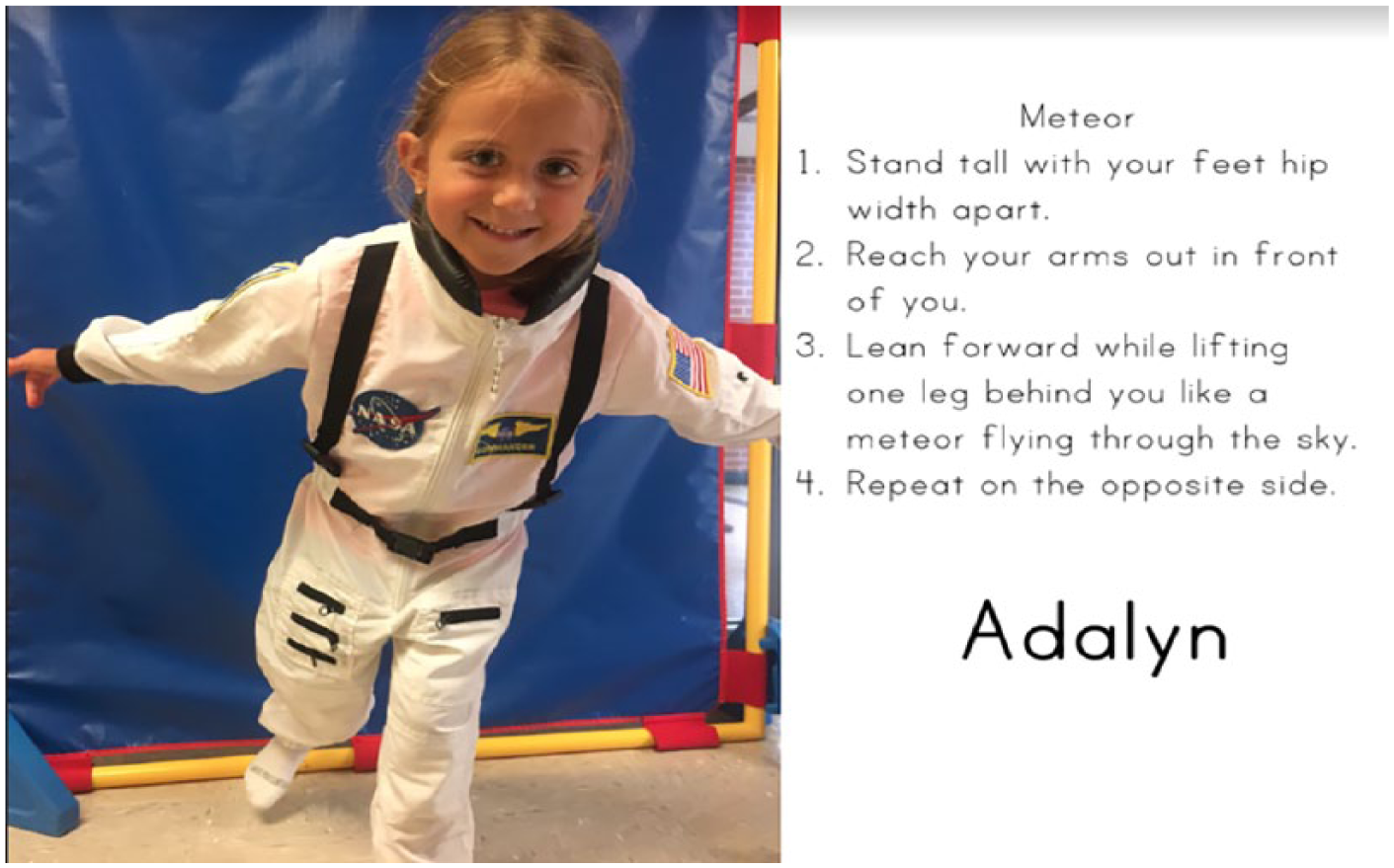
Page from the space yoga book created by the 4-year-old teachers.
Conclusion and Recommendations
Findings of the present study revealed that teachers perceived the benefits of yoga to be increased physical development, self-regulation, and socioemotional skills, along with behavioral and cognitive benefits in the classroom. When beginning any new program, it is important to acknowledge that teachers are the key stakeholders and their buy-in is critical to program success. Furthermore, teachers who are supportive may be willing to incorporate some yoga into the classroom, thus extending its benefits. This occurred at the Lab School in response to children bringing their practice into the classroom and the teachers encouraging them to do so. Teachers may not have been as willing to make space for yoga if they did not perceive it to be beneficial. Similar to studies of older children, preschool teachers reported that students were able to make connections between yoga in their classroom and in their daily lives (Chen & Pauwels, 2014). Teachers used words like calm, relaxed, focused, self-directed to describe how yoga impacted the children in their classes who participated in the yoga program.
The teachers’ perceptions were very similar to the findings of our previously published paper that examined preschool students’ perceptions of their yoga program at their school (Stapp & Wolff, 2017). This detail is important because the preschoolers described their yoga practice as enjoyable, relaxing, fun, calming, and adventurous. They also found it to be an important exercise for their bodies, saying that it made them feel strong, as well as beneficial for teaching them how to breathe deeply. While we believe preschoolers are the experts of their own bodies and were more than capable of sharing their perceptions of their yoga practice, their language abilities were limited. Hearing similar stories and descriptions about the positive aspects of yoga from teachers, not only corroborated student experiences, but also expanded on what we know about yoga’s reach into the classroom from a teacher’s perspective.
Qualitative inquiry by nature is contextual and this study was very small in scale and scope. However, this study adds to the small but growing body of research that explores the potential benefits of yoga for young children. Much more research is needed. For example, we are unaware of any studies that examine family perceptions of the benefits of yoga within a preschool program. The story of Sam, who went to his room to self-regulate, is one that was discovered through a teacher interview. There very well may be more instances of children utilizing strategies learned in yoga at home. Therefore, there is a need for future studies to explore the impact yoga has on children’s behavior, not only in the classroom but also at home. One could infer that as yoga with young children becomes increasingly utilized, parents may be able to shed light on the additional benefits that yoga is providing in the home environment.
Footnotes
Declaration of Conflicting Interests
The author(s) declared no potential conflicts of interest with respect to the research, authorship, and/or publication of this article.
Funding
The author(s) received no financial support for the research, authorship, and/or publication of this article.