




Abstract
This study examined 86 teacher candidates’ use of help seeking strategies and beliefs for preparing to pass a state certification examination. Using cluster analysis, we identified three different kinds of help seekers among the participants. One of the clusters represented teacher candidates for whom help seeking was an important and adaptive self-regulatory strategy and essential to their successful academic performance. The other two clusters represented the group of teacher candidates who had help-avoidance tendencies, but they were different in that for one group, seeking help implied inadequate use and maladaptive self-regulatory strategies while for the other, coping and adaptive self-regulatory strategies were utilized to ask for help when needed. The results revealed that students’ tendencies for help seeking vary according to their teacher’s self-efficacy beliefs, and use of self-regulatory strategies, such as delay of gratification. These findings suggested that help seeking is indeed a self-regulatory learning strategy used by learners to pursue valuable academic goals, and that differences do exist in approaches to help avoidance.
Keywords
To achieve academic success, learners often need to seek help from appropriate resources. Help seeking is an important self-regulatory learning strategy associated with motivation and academic achievement. Help seeking refers to strategic self-regulatory behaviors that learners use to obtain information from formal and informal sources to adapt and acquire knowledge and skills (Hsu, 2005; Karabenick, 2003; Karabenick, 2013; Karabenick & Berger, 2013; Karabenick & Dembo, 2011). According to Schunk and Usher (2013), self-regulated learning refers to “the process whereby learners systematically organize and direct their thoughts, feelings, and actions to attain their goals” (pp. 1-2). Seeking appropriate help when it is needed has been considered to be a strong indicator of individual differences within human agency while pursuing goals. In education, help seeking has been associated with motivation, self-regulation, goal orientation, and self-efficacy (Butler, 1998; Hsu, 2005; Karabenick, 2003; Ryan & Pintrich, 1997; White, 2011). Learners, who seek help while disregarding threat to self-esteem, tend to be highly successful and adapt better to their environment than learners who avoid seeking help (Karabenick & Knapp, 1991).
Help seeking practices, motivational beliefs, and the use of learning strategies are important predictors of teacher candidate retention. There is growing support for requiring teacher candidates to take and pass state-level examinations to advance in their teacher candidacy. As a result, high stakes testing has secured its place as a critical gate to teacher education and certification (Cochran-Smith & Zeichner, 2005). As early as the sophomore year, an aspiring teacher can be denied access to a teacher education program due to failure of a state exam, a restriction which limits access to the field for many potential candidates (Hsu, 2005). In some states, teacher education programs base admission on whether teacher candidates can pass an examination, which measures the basic skills acquired during high school. In New York State, the Liberal Arts and Science Test (LAST) is the current assessment, while in 45 other states, the Praxis I is required (Mitchell, Robinson, Plake, & Knowles, 2001).
While academic deficits are often addressed through remedial programs and workshops, teacher education programs would benefit from early awareness of self-regulatory behaviors evidenced by incoming students. Exploration of these areas of development, linkage to constructs prominent in the study of self-regulation, academic motivation, and strategy use can help teacher educators determine the degree to which specific areas of development impact success in teacher education programs for individual students.
Today, little is known about teacher candidates’ behavior and beliefs to seek help when needed to pass a required state exam. It would be important to learn teacher candidates’ tendencies to seek help whether it is to master test materials, to obtain instrumental benefits, or simply if they approach or avoid seeking help when in need of assistance. If teacher candidates have tendencies to avoid help seeking when successful performance is in jeopardy, it would be important to know what they actually do to succeed in passing a significant state teaching examination. Specifically, it is essential to uncover whether, in spite of exhibiting help seeking avoidance tendencies, teacher candidates eventually seek help to master the materials or to receive assistance only to obtain a passing score pass without mastering the content. Consequently, the aim of the study was to examine teacher candidates’ help seeking tendencies while preparing to take the LAST. The social cognitive theory of self-regulation of learning serves as the theoretical framework to delineate understanding the role of help seeking as an individual difference in academic achievement among teacher candidates.
Theoretical Background
Humans are distinctly able to engage in self-regulation of their actions, motivations, behaviors, and beliefs, and to identify and use self-directed learning strategies while pursuing short- and long-term goals (Bandura, 1997). Throughout history and across cultures, self-regulation of behavior has been assumed to increase learning and performance (Zimmerman & Schunk, 2011). Recent research has provided strong support for the importance of self-regulation as a catalyst for human agency and self-direction (Bembenutty, Cleary, & Kitsantas, 2013). The development of self-regulation begins in the home with guidance and modeling from primary caretakers, and from family and community members (Bandura, 1997). The development of self-regulation continues with a paramount importance when children enter school. It is at this developmental level that teachers have an important role to serve as mentors and models of self-regulation to scaffold learners during challenging times when seeking help is needed (DiBenedetto & White, 2013).
Self-regulation involves key meta-cognitive, motivational, and behavioral subprocesses, such as time management, organizing, rehearsing, and coding information, attending to and concentrating on instruction, establishing a productive work environment, and using social sources effectively (Zimmerman, 1998). Students’ academic effectiveness depends on their use of these self-regulatory processes and their motivational beliefs regarding the effectiveness of those processes. In school settings, help seeking is an important self-regulatory strategy (Karabenick, 2013; Karabenick & Dembo, 2011). An essential feature of all self-regulatory approaches is a recursive feedback loop. This feedback loop provides the learner with information about his or her task performance that can be used to make adjustments (Zimmerman, 2008). This cyclical process enables self-regulated students to metacognitive monitor the effectiveness of their learning strategies and make adaptive changes that lead to academic success.
To better understand the interrelation of these self- regulatory processes, Zimmerman (2000) proposed a model involving three cyclical phases, which includes help seeking in the performance phase. Help seeking was not viewed as a lack of self-regulation, but rather as a social strategy for gaining needed assistance from an appropriate source (Newman, 2008). According to Zimmerman, self-regulated learning strategies are not limited to asocial forms of education but can include social forms of learning, such as seeking guidance from peers, coaches, and teachers.
Theory and research have positioned help seeking as an important social self-regulatory strategy related to self- regulatory processes among teacher candidates (Bembenutty, 2006; White, 2011). Help seeking has been listed among the most important strategies that can contribute to university student success (Karabenick & Dembo, 2011). Unfortunately, students who are in most need of assistance are often the least likely to seek it for a variety of reasons. This is especially true of college students aspiring to be teachers, who often wait until it is too late to use available resources to pass state certification exams (Tellez, 1992). When confronted with the reality of high stakes testing, these students often give up their dream to become teachers rather than admit their need for social support (Orlich & Gifford, 2006). This decision has a significant impact on the number of teachers who enter the classroom.
According the Newman (2008), the self decides when it is time for input from an outside source. This decision to act shows a willingness to depend on others. Socially, self-regulated students find selective help seeking to be a useful strategy when they encounter obstacles in their learning process. Students who are low in overall self-regulation are reluctant to ask for assistance. By contrast, students who are high in self-regulation take the initiative to do schoolwork without prompting and continue their efforts until a task is completed. When necessary, they will selectively and actively seek enough input to complete the task successfully. They show initiative and persistence on learning tasks, confidence, and resourcefulness in overcoming problems, and are self-reactive to task performance outcomes (Zimmerman, 2008).
According to Karabenick (2013), the history of help seeking as a self-regulated strategy has four major developments. In Phase 1, the contribution of Nelson-Le Gall and Nadler reflect the conception that help seeking was important to provide assistance for learners to progress on their own while pursuing academic tasks. Within Phase 2, Zimmerman (2008) provided empirical evidence that help seeking was a strategy used by self-regulated learners. Through Phase 3, studies assessing the person and contextual motivational influences under the achievement goal theory revealed that help seeking was associated with learner’s classroom experiences (e.g., Butler, 2008; Karabenick & Dembo, 2011; Newman, 2008). During Phase 4, it was revealed that computer-mediated communications and intelligent learning systems serve as important tools used by student to seek help.
Help seeking can be conceptualized as a process of several stages during which learners set goals, make decisions, and adapt their approaches according to the cognitive, affective-emotional, contextual, and social competencies and resources available to them (Karabenick & Berger, 2013; Karabenick & Dembo, 2011). According to Karabenick’s model of help seeking (Karabenick & Berger, 2013; Karabenick & Dembo, 2011), students first determine whether there is a problem (Stage 1) and whether help is needed (Stage 2) before deciding whether to seek help (Stage 3). If they make the decision to seek help, then they need to determine the type of help they will seek (Stage 4) and from whom they will seek help (Stage 5). Once the potential sources of help are identified, which could be from a teacher, a peer, or from a technology learning context, they solicit help (Stage 6) and obtain help (Stage 7) before processing the help received (Stage 8). This progression does not necessarily occur in this particular order. At each of these stages, learners engage in one or more self-regulatory processes. To illustrate, in Stage 1, learners set goals and objectives to monitor performance. In Stage 2, they engage in task analysis while in Stage 4, learners need to decide on the type of help they will seek. In Stage 8, they engage in error analysis.
At different developmental phases, specific types of help have been identified. Nelson-Le Gall (1985) is widely credited with changing educators’ perspective on help seeking from an act which reflected immaturity, passivity, and incompetence to one of maturity, proactivity, and competence. Building on foundational research by Fisher, Nadler, and DePaulo (1983), Nelson-Le Gall focused on the students’ goals for seeking assistance, rather than the act itself. She (Nelson-Le Gall, 1985) defined help seeking as a general problem-solving strategy that allows learners to cope with academic difficulties by gaining the assistance of others. She drew a distinction between two forms of help seeking, instrumental (adaptive) and executive (nonadaptive), based on a learner’s goals. Therefore, intentions often determine how and why learners ask for help. Adaptive help seeking occurs when the help requested is limited to the amount and type of assistance needed for the student to solve the problem independently. In contrast, executive help seeking occurs when the requested help intends for someone else to solve the problem. Avoidance of help seeking focuses on situations when a student requires but chooses to not seek help. Perceived benefits of help seeking are students’ beliefs about the positive outcomes of seeking help on a task.
Research conducted by Hwang and Vrongistinos (2002) indicated a strong relationship between frequent uses of self-regulated learning strategies and high academic performance among teacher candidates. This study found that future teachers varied in their use of strategies and that strategy use distinguished high and low performing students. Unfortunately, not all teacher candidates have the opportunity to develop self-regulation, and as a result do not engage in productive work habits.
Research has shown help-avoidant college students are more anxious and perform more poorly than adaptive help seekers. Students who feel threatened by adverse consequences of help seeking report across educational settings are classified as executive help seekers (Karabenick, 2003). Karabenick (2003) compared college students’ help seeking behavior with that of younger students. He measured strategic and nonstrategic help seeking behaviors in large college classes where support services are not easily accessed. The results of his study showed similarities in help seeking behaviors of learners from K-12 when compared with college students (Karabenick, 2003). Karabenick also assessed college students’ levels of help seeking threat, their intentions to seek help, help seeking goals, preferred resources, class-related motivation, and their use of learning strategies. Using a cluster analysis, he found four clusters that could be described as strategic-adaptive help seekers, formal help seekers, help seeking avoidant students, and expedient help seekers.
Relationships also exist between help seeking and self-efficacy beliefs, self-regulation, intrinsic motivation, and delay of gratification among teacher candidates (Bembenutty, 2006). Self-efficacy for learning is individuals’ beliefs about their capability of performing a particular task (Bandura, 1997). Teachers’ self-efficacy refers to teachers’ beliefs about the capability to have a positive effect on the learning of their students. Tschannen-Moran and Woolfolk Hoy (2001) observed, “teachers’ sense of efficacy is an idea that neither researchers nor practitioners can afford to ignore” (p. 803). A sense of efficacy can help teacher candidates’ to sustain motivation, engage in self-regulation, and sustain a mastery goal orientation rather than an avoidance goal orientation. Thus, it is expected that teacher candidates’ self-efficacy beliefs would be associated with their motivational beliefs and self-regulation of learning. Another important component of self-regulation is intrinsic motivation, which refers to a learner’s engagement and enjoyment in a task for the sake of learning (Sansone & Harackiewicz, 2000). Teacher candidates’ are expected to display intrinsic interest in academic tasks associated with their teaching programs as they have willingly chosen that path as their future career. Thus, it is expected that intrinsic interest will be associated with teacher candidates’ goal orientations.
Academic delay of gratification is associated with the self-regulatory strategy of help seeking (Bembenutty & Karabenick, 1998). Bembenutty and Karabenick (1998) defined academic delay of gratification as learners’ intentions to postpone immediate available rewards to obtain larger rewards temporally distant. Delay of gratification is important for self-regulation of learning because, for example, alternatives to academic goals are attractive, in part, because they offer immediate gratification, in contrast to rewards for academic goals (e.g., grades, degrees) that are temporally remote. Delay of gratification is associated with students’ use of learning strategies such as help seeking (Bembenutty, 2006; Bembenutty & Karabenick, 1998). Bembenutty (2006) examined the associations between preservice teachers’ help seeking tendencies, homework beliefs and behavior, and their willingness to engage in academic delay of gratification. The results indicated that preservice teachers who have a positive attitude toward help seeking are those who report high homework self-efficacy beliefs and high homework intrinsic interest. Teacher candidates with a positive attitude toward help seeking are those who reported high willingness to delay gratification.
Over the last several years, research in help seeking among teacher candidates suggests that help seeking is an important self-regulatory strategy among teachers and among teacher candidates while studying to take important examinations (Bembenutty, 2006; Butler, 1998; White, 2011). For instance, White (2011) assessed the help seeking behaviors of preservice teachers who were at risk of failure of state certification examinations. The participants were preservice teachers drawn from a small private college in New York. The Preservice Teacher Help seeking Scale (PTHSS; White, 2011) was administered to preservice teachers who were preparing for the first of three state certification exams.
In spite of the benefits of help seeking for learners, often, help seeking has been described as an uncomfortable and embarrassing act that requires a degree of courage (Flynn & Lake, 2008; Shapiro, 1983). Researchers agree that despite the instrumentality of help seeking, the costs cannot be minimized (DePaulo & Fisher, 1980; Karabenick & Knapp, 1991). There exists a significant amount of research concerning why students are reluctant to seek help, even when they recognize it is needed and readily available (Newman, 2008). Ryan and Pintrich (1997) investigated the role of motivation and attitudes in adolescents’ help seeking in math class. They concluded that students who were unsure of themselves—cognitively or socially—were more likely to feel threatened when asking their peers for help. Ryan, Gheen, and Midgley (1998) assessed the context of the classroom to investigate individual and classroom influences on adolescents and reported the avoidance of help seeking. They found students were able to improve help seeking behaviors when their teachers provided socioemotional nurturing. Thus, there is evidence of widespread help avoidance and help abuse (overuse of nonadaptive help) from students who need assistance the most (Aleven & Koedinger, 2000).
Present Study
This study assessed the different help seeking tendencies of teacher candidates enrolled. Of particular interest is teacher candidates’ use of avoidance, adaptive, and executive help seeking strategies to master the content of a state certification exam. Instructors’ ratings of students’ help seeking tendencies were also examined in the study. The following research questions guided the study:
Research Question 1: What are the associations between LAST scores, teacher self-efficacy beliefs, self- efficacy beliefs, delay of gratification, self-regulation, intrinsic motivation, and help seeking tendencies?
Research Question 2: What clusters, based on the underlying structure of their help seeking preferences, could differentiate teacher candidates’ help seeking tendencies and how are these clusters differentiated based on the candidates’ self-regulatory practices, motivational beliefs, and academic performance?
Research Question 3: Will differences on pre-LAST scores, candidates’ self-regulatory practices, motivational beliefs, and academic performance, separately account for unique variance on post-LAST scores?
Method
Participants and Procedure
Participants in the study were 86 teacher candidates drawn from a small private college in an urban setting (31 males and 55 females), which enroll predominantly minority students who were junior and senior intending to teach in elementary schools. The college maintains a liberal admissions policy, giving students from diverse populations an opportunity to enter higher education. Teacher candidates were invited to participate in the study by an instructor. After submitting signed informed consent forms, teacher candidates were given a series of assessments to complete in the classroom during LAST exam preparation.
Measures
Teacher Candidates’ Reported Help Seeking
This scale has four subscales. Adaptive Help Seeking: Teacher candidates reported their adaptive help seeking from their instructors (an example item is, “When I ask for help with assignments pertaining to this class project, I prefer to be given hints or clues rather than the answer,” M = 6.70; SD = 1.9; α = .89) and from their peers (an example item is, “When I ask a peer for help with my work, I don’t want my peer to give away the whole answer,” M = 6.80; SD = 1.35; α = .87; White, 2011). Executive Help Seeking: Teacher candidates reported executive help seeking tendencies from their instructors (an example item is, “When I ask the instructor for help with assignments pertaining to this class project, I prefer the instructor do the work for me rather than explain to me how to do it,” M = 1.99; SD = 1.53; α = .92) and from their peers (an example item is, “When I ask a peer for help with my work, I don’t want my peer to give away the whole answer,” M = 1.89; SD = 1.61; α = .97; White, 2011). Avoidance Help Seeking: Teacher candidates reported executive help seeking tendencies from their instructors (an example item is, “If I need help to solve a problem, I prefer to skip it rather than to ask for help,” M = 2.55; SD = 1.54; α = .94; White, 2011). Perceived Benefits of Help Seeking: Teacher candidates reported executive help seeking tendencies from their instructors (an example item is, “I like to ask for help about my test preparation because it helps me understand the material better,” M = 5.83; SD = 1.81; α = .94; White, 2011).
Instructor’s Rating of Teacher Candidates’ Help seeking Strategies
This assessment contains four different subscales representing eleven instructor’s perception of the teacher candidates: (a) Adaptive Help Seeking (an example item is, “When this teacher candidate asks for help, he or she only wants as much help as is necessary to complete the work independently,” M = 6.22; SD = 1.77; α = .99); (b) Executive Help Seeking From Their Instructor (an example item is, “When this teacher candidate asks for help with items similar to those on the LAST, he or she prefers to be given the answer rather than an explanation of how to do the work independently,” M = 1.85; SD = 1.65; α = .99); (c) avoidance help seeking from the instructor (an example item is, “This teacher candidate does not ask questions regarding the LAST, even if he or she does not understand the items,” M = 2.11; SD = 2.03; α = .99); and (d) benefits of help seeking from their instructor (an example item is, “When this teacher candidate is struggling with course-related material, he or she shows the benefits from help received,” M = 6.02; SD = 2.12; α = .99; White, 2011).
LAST (Pre and Post)
The LAST is taken by teacher candidates who aspire to enroll in a New York State–approved teacher education programs. Items on this test were adapted from a state standardized test for teacher candidates’ licensure. The scores on a practice LAST were obtained at the first (M = 191.19; SD = 35.59) and last (M = 202.84; SD = 41.46) sessions of a series of workshops dedicated to prepare the candidates for the test.
Self-Efficacy for Learning
The Self-Efficacy for Learning Scale (Bembenutty, 2010) was used to assess self-efficacy for learning (an example item is, “I am sure that I can learn all the material to pass the LAST,” M = 5.86; SD = 1.05; α = .80).
Self-Efficacy for Teaching
The Teachers’ Sense of Efficacy Scale (Tschannen-Moran & Woolfolk Hoy, 2001) was used to assess teacher candidates’ self-efficacy beliefs (an example item is, “How much can you do to get through to the most difficult teacher candidates?” M = 7.05; SD = 1.18; α = .87).
Intrinsic Motivation for Learning
The Intrinsic Motivation Scale (Bembenutty, 2010) was used to assess intrinsic motivation (an example item is, “I enjoy studying for the LAST,” M = 3.80; SD = 1.34; α = .85).
Self-Regulation for Learning
The Self-Regulation for Learning Scale (Bembenutty, 2010) was used to assess self-regulation for learning (an example item is, “How often do you keep a record about how well you are doing in preparation for the LAST?” M = 3.70; SD = 1.48; α = .93).
Academic Delay of Gratification
Teacher candidates reported their willingness to delay gratification on the Academic Delay of Gratification Scales (Bembenutty & Karabenick, 1998). Teacher candidates chose between an immediate available reward and a reward that is temporarily distant (e.g., “Going to a party now” or “Staying home to study for a test tomorrow so I can get good grade”; M = 3.25; SD = .54; α = .74).
Homework Distraction
Teacher candidates reported their level of distraction in preparation for the LAST test with two items (an example item is, “How many hours per week are you spending watching television every day?” M = 1.91; SD = 1.33; α = .64; Bembenutty, 2010).
Results
Objective 1: Intercorrelations Between the Variables
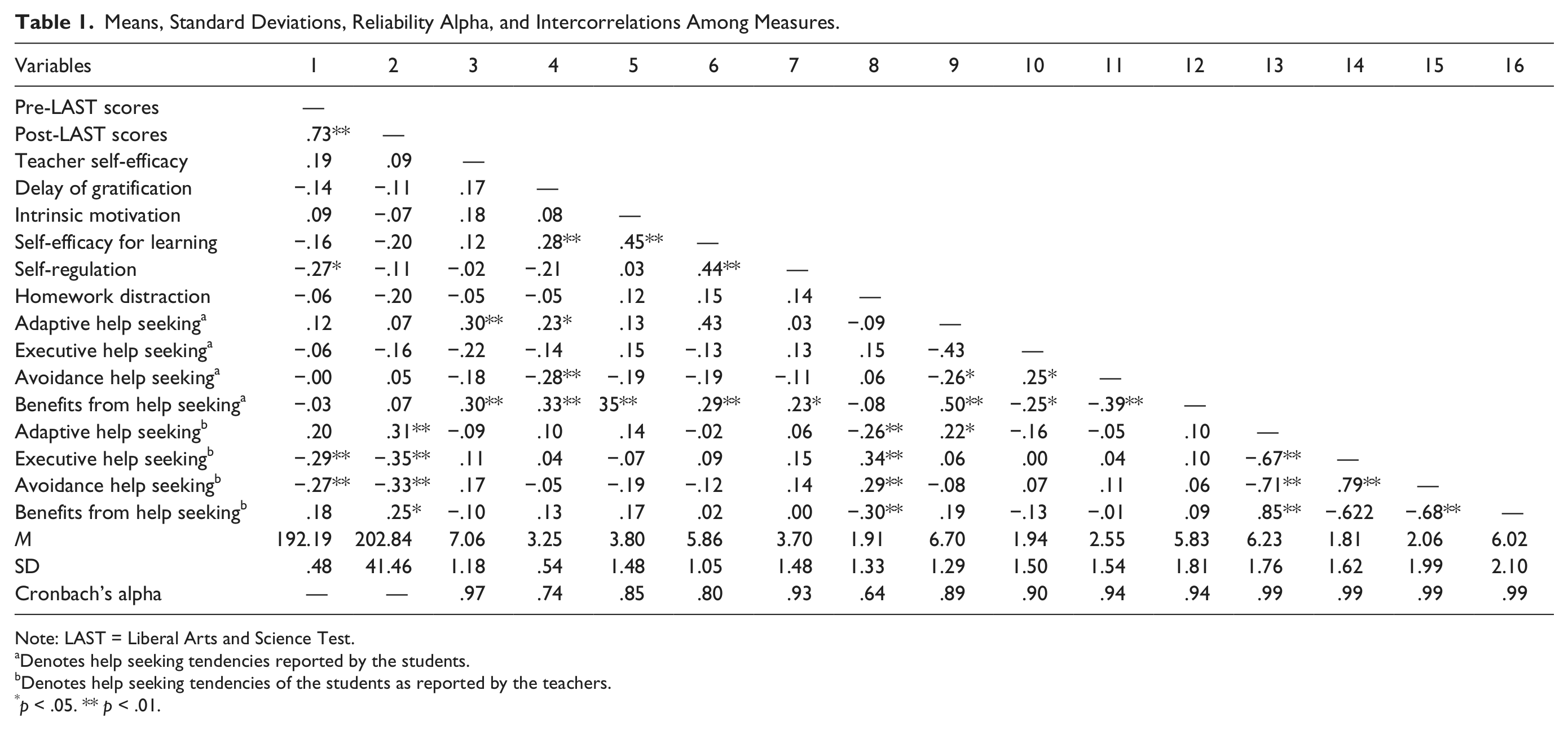
Table 1 displays the correlations between the variables. As expected, Pre-LAST and Post-LAST were highly correlated (r = .73). Teacher candidates’ reported adaptive help seeking from instructors and peers were highly correlated (r = .81); thus, we merged both variables resulting in a single variable of adaptive help seeking. Executive help seeking from instructors and peers were also highly correlated (r = .82); thus, we merged both variables to create a single index of executive help seeking. The instructors’ rating of teacher candidates’ adaptive help seeking and benefits were also highly correlated (r = .85). Thus, instructors’ rating of benefits of help seeking was not used in further analysis. Similarly, the instructors’ rating of teacher candidates’ avoidance and executive help seeking were also highly correlated (r = .79). Thus, instructors’ rating of avoidance was not used in further analysis.
Means, Standard Deviations, Reliability Alpha, and Intercorrelations Among Measures.
Note: LAST = Liberal Arts and Science Test.
Denotes help seeking tendencies reported by the students.
Denotes help seeking tendencies of the students as reported by the teachers.
p < .05. ** p < .01.
Pre- and Post-LAST scores were significantly related (r = .73). Pre- and Post-LAST scores were inversely related to executive and avoidance help seeking, respectively. Teacher self-efficacy was positively related to teacher candidates reported adaptive (r = .30) and benefits from help seeking (r = .31). Academic delay of gratification was positively related to self-efficacy for learning (r = 28), teacher candidates adaptive (r = .23) and benefit from help seeking (r = .33), but inversely related to avoidance help seeking (r = −.28). Self-efficacy was positively related to intrinsic motivation (r = .45), self-regulation (r = .44), and benefit for seeking help (r = .29).
Objective 2: Cluster and Discriminant Analysis
To classify teacher candidates’ based on their help seeking tendencies and follow the cluster analysis on help seeking by Karabenick (2003), four clusters were expected using the teacher candidates’ four self-reported indexes of help seeking. A K-means cluster analysis generated a noninterpretable four-cluster solution; however, a three-cluster solution was highly interpretable. This analysis produced an estimate of within-subjects similarity and dissimilarity according to the teacher candidates’ reported help seeking strategies.
Cluster 1 (labeled avoidance-executive help seekers) consisted of teacher candidates with a moderate avoidance and executive help seeking tendencies. Cluster 2 (labeled adaptive help seekers) consisted of teacher candidates with a high adaptive and benefits of help seeking tendencies but have low executive and avoidance help seeking tendencies. Cluster 3 (labeled avoidance-adaptive help seekers) consisted of teacher candidates moderate in avoidance and benefits, low in executive, but high in adaptive help seeking (which is confirmed with a MANOVA, see Table 2). Using Wilks’ statistic, there was a significant effect of cluster on teacher candidates’ reported use of help seeking strategies, Λ = .089, F = 46.30, p < .001; η p 2 = .70.
Mean Scores on Four Measures of Students’ Help Seeking Tendencies As a Function of Three-Cluster Solutions and Bonferroni Post Hoc Analysis.

Note: Wilks’ Lambda = .089, F = 46.30, p < .001, partial eta squared = .70.
The MANOVA was followed by a series of ANOVAs, one per dependent variable (see Table 3) and by the Benferroni’s significant differences to test group comparisons. The MANOVA compared the differences among the clusters in teacher candidates’ LAST performances, motivational beliefs, self-regulation strategies, and teachers’ rating of their help seeking strategies. An examination of mean differences among the clusters indicated that there were mean differences among the three clusters on teacher self-efficacy. Cluster 2 reported higher teacher self-efficacy beliefs than Cluster 1, which suggests that teacher candidates who seek help for the sake of learning are also those who have higher teacher self-efficacy beliefs (see Figure 1).
Mean Scores on Four Measures of Students’ Help Seeking Tendencies As a Function of Three-Cluster Solutions and Bonferroni Post Hoc Analysis.

Note: LAST = Liberal Arts and Science Test. Wilks’ Lambda = .066, F = 10.65, p < .001, partial eta squared = .74.
Denotes help seeking tendencies reported by the students.
Denotes help seeking tendencies of the students as reported by the teachers.

Centroid of three help seeking groups on two canonical discriminant functions.
Teacher candidates (Cluster 3) who moderately avoid seeking help but engage in high adaptive help seeking reported higher willingness to delay gratification than the teacher candidates (Cluster 1) with moderate avoidance but who do seek help primarily to just get answers. Teacher candidates with high preference for using adaptive help seeking strategies (Clusters 2 and 3) reported higher self-efficacy for learning and consider help seeking more beneficial than avoidance-executive teacher candidates who seek help only to get answers (Cluster 1). Using Wilks’ statistic, there was a significant effect of cluster on teacher candidates’ reported use of help seeking strategies, Λ = .066, F = 10.65, p < .001; η p 2 = .74.
To confirm the cluster solutions, the MANOVA was followed up with discriminant analysis, which revealed two discriminant functions. Overall, 96.5% of the teacher candidates were correctly classified and the correlations between help seeking and the discriminant functions are consistent with the MANOVA’s findings (see Table 4). The discriminant functions plot is displayed in Figure 2.
Correlation of Predictor Variables with Discriminant Functions (Function Structure Matrix) and Standardized Discriminant Function Coefficients.

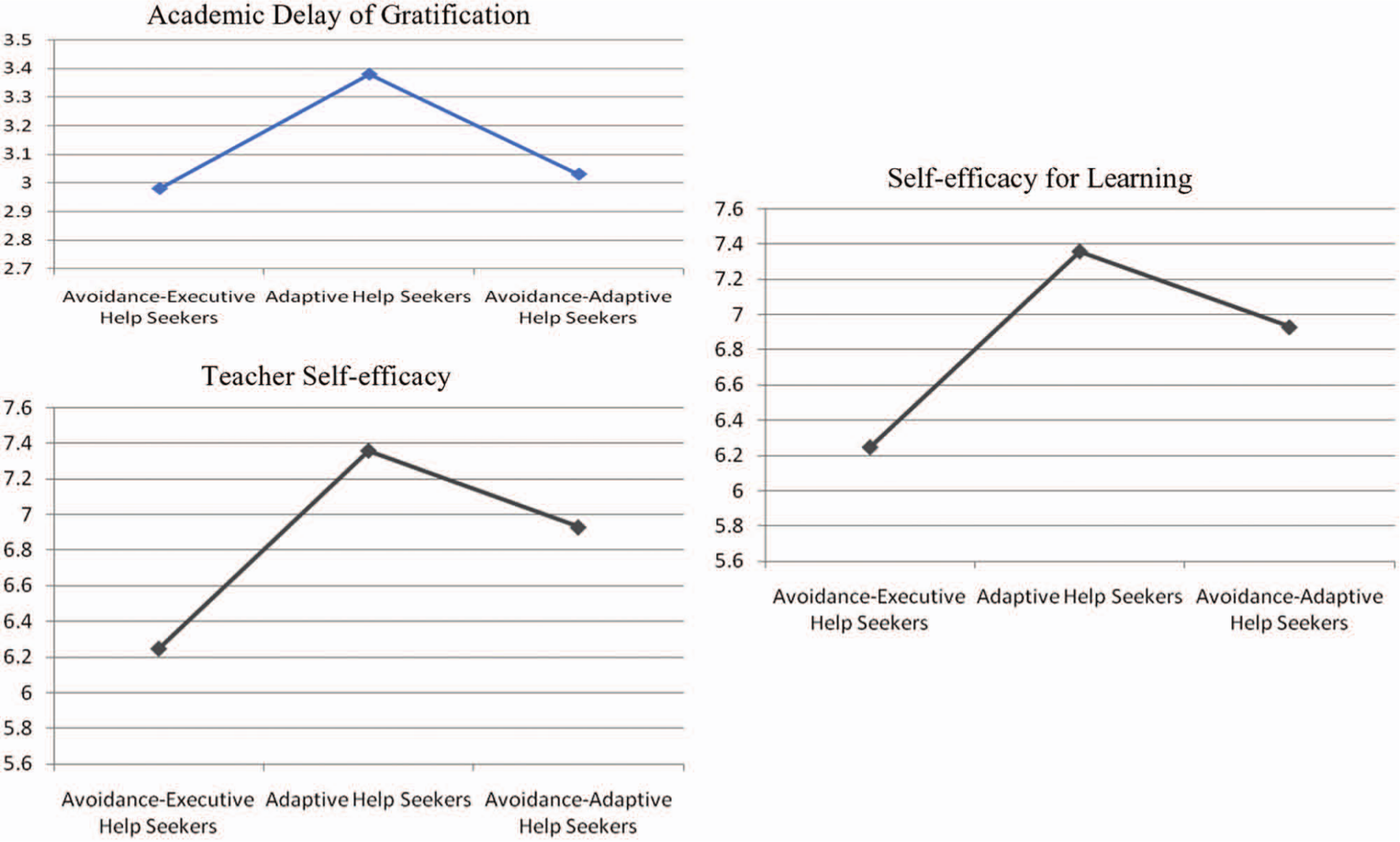
Mean differences of three-cluster solutions.
Objective 3: Regression Analysis Predicting Post-LAST Scores
We examined whether differences on variables assessed in the study separately accounted for unique variance on post-LAST scores, even after controlling for the effects of each other using hierarchical regression (entered in four steps). Gender was included in the analysis to control for its effects.
Tables 5 and 6 display the results of the final model with four steps. In Step 4, gender was a significant and positive predictor of post-LAST scores (β = .20, p = .011), which suggests that female teacher candidates (male coded 0, female coded 1) obtained higher post-LAST scores than males did (see Table 7). As expected, pre-LAST predicted post-LAST (β = .74, p = .001). Self-regulation was a positive predictor of post-LAST scores (β = .15, p = .073).
Summary of Regression Analysis Predicting Post-LAST Scores.

Note: LAST = Liberal Arts and Science Test.
Regression Analysis Predicting Post-LAST Scores.

Note: LAST = Liberal Arts and Science Test. Males are coded 0; females are coded 1.
Chi-Square Analysis of Gender Differential Performance on the Pre- and Post-LAST.

Note: LAST = Liberal Arts and Science Test. χ2(1) = 4.77, p < .029.
With regard to the teacher candidates’ self-reported use of help seeking strategies, executive help seeking was a negative predictor of post-LAST scores (β = −.12, p = .010), whereas avoidance help seeking (β = .15, p = .070) and benefits of help seeking (β = .18, p = .044) were positive predictors. The final model accounted for 71% of the variance on the outcome. The instructor’s rating of the teacher candidates’ use of help seeking strategies and all variations of interaction terms were eliminated from the final model because they did not account for unique variance on post-LAST scores.
Discussion
A major concern for those who instruct future teachers is whether teacher candidates will develop the necessary self-regulatory skills during their training at a level which results in meeting individual states’ requirements for certification. One of those important self-regulatory skills is an ability to seek help when it is needed. The results of this study are consistent with Karabenick’s (2003) self-regulatory view of help seeking and the perspective that links strategic factors in self-regulated learning with help seeking. Help seeking is an adaptive strategy for coping with difficulty; however, teacher candidates often refrain from asking for help to avoid the perception of weakness or incompetence.
In this study, we identify three different kinds of help seekers among the participants. Each of the three groups is unique in the way it approaches help avoidance. Cluster 1 represents the group of teacher candidates who have help-avoidance tendencies and to whom seeking help implies inadequacy. Consistent with Karabenick’s (2003) findings, these teacher candidates would rather fail than be judged as less capable by instructors and peers; they engage in executive rather than in adaptive help seeking. Cluster 2 represents teacher candidates for whom help seeking is an important and adaptive self-regulatory strategy and essential to their successful academic performance. Cluster 3 represents the group of teacher candidates who have help seeking avoidance tendencies, experience similar stress and anxiety regarding asking for help as their counterparts in Cluster 1, yet are able to use coping and adaptive strategies to ask for help when needed.
Retention in teacher education programs is often threatened by failure of the initial assessment of basic skills (Cochran-Smith & Zeichner, 2005; Hsu, 2005), which is often attributed to poor high school preparation. To increase retention in teacher education programs, identifying differences in the help avoidance behaviors may provide a way to recognize teacher candidates who are not likely to take advantage of opportunities provided to increase their likelihood of success in passing teacher certification exams (Hsu, 2005; White, 2011). The strength of this study rests in the findings that the help seeking goals of these three groups of help seekers are not equal: Teacher candidates with avoidance tendencies could determine to deal with their anxiety and feeling of threats by engaging in adaptive or executive self-seeking behavior.
This study has several limitations. The sample size is small and causation cannot be derived from this correlational study. Experimental research should be conducted in which the different help seeking tendencies are controlled under restricted settings to rule out potential factors unexamined in this study such as the level of anxiety of the teacher candidates, classroom characteristics, and the dispositions of the teacher candidates and their instructors.
Important educational implications are derived from the results of this study. Teacher education providers are challenged to make significant adjustments to the way they prepare teacher candidates for certification. New policies dictate the way teachers are educated, evaluated, and trained before and after taking charge of a classroom. In addition, there are higher expectations of the individual teacher candidate’s impact on student learning during the years of preparation and clinical training. The demands made on teacher candidates have escalated (Darling-Hammond & McLaughlin, 2011); therefore, teacher preparation programs must find a way to assist those who might become overwhelmed with the process. Including training in self-regulatory strategies such as goal setting, help seeking, self-monitoring, and delaying gratification can provide teacher candidates with tools that can improve performance and raise self-efficacy.
Teacher candidates, who display patterns of help avoidance that have been observed in children and traditional college students, are at risk of dropping out of teacher education programs. One can also suggest that candidates who do complete the program and display help-avoidance tendencies will contribute to the costly high attrition rate of new teachers. Although the number of teacher candidates in the cluster of avoidance-executive help seeking is limited, it is not without concern because some of these teacher candidates are members of the pool from which future teachers are drawn. The “help seeking dilemma” is instilled in early socialization practices which reflect norms which are cultural and primarily Western (Karabenick & Berger, 2013; Volet & Karabenick, 2006). Educators who train teacher candidates to become successful classroom teachers should work toward dispelling the stigmas associated with help seeking at the earliest opportunity. Often, when a learner weighs the costs and benefits of seeking help, the consequences of revealing weakness puts at risk the appearance of competence and can result in the choice to avoid any appearance of incompetence. In some cases, delaying gratification can be linked to help avoidance; the learner’s desire to appear competent can be associated with maintaining social status. In addition, the results of the study should encourage teacher educators to model and promote the effective uses of the self-regulatory strategy of seeking and obtaining assistance, specifically for students who could be isolated and persisting toward academic failure.
Closer attention should be paid to the teacher candidates who avoid asking for help as a means toward masking failure. When we examine motivational factors which result in avoiding seeking help, consideration should be given to the significance of the social cost to the teacher candidates who admits to struggling with different aspects of their training. In this way, teacher preparation programs can identify those candidates who will struggle alone rather than join a study group, meet with instructors, or take advantage of the resources readily available to contribute to their success in the program.
In summary, this study supported the notion that learners’ individual differences for help seeking vary according to their goal orientations, self-efficacy beliefs, and use of self-regulatory strategies, such as their willingness to postpone immediately available rewards to pursue long-term academic outcomes. These findings suggest that help seeking is indeed a self-regulatory learning strategy used by learners to pursue important and valuable academic and social goals. Furthermore, consistent with the work of Mischel (1996), these findings placed delay of gratification as an important individual difference associated with academic achievement. Consistent with Bandura (1997), self-efficacy is revealed in this study as having a direct association with academic performance and as an important human agency for seeking help. These findings call attention to the fact that when seeking help, learners have different goals. With regard to help seeking avoidance, all goals are not created equal. Some learners with help seeking avoidance tendencies choose to cope with a perceived threat to their self-esteem and anxiety by seeking help primarily to get answers without an understanding, whereas other teacher candidates choose to seek help to get knowledge and skills.
Footnotes
Appendix A
Appendix B
Declaration of Conflicting Interests
The author(s) declared no potential conflicts of interest with respect to the research, authorship, and/or publication of this article.
Funding
The author(s) received no financial support for the research and/or publication of this article.
Author Biographies