




Abstract
This study asks how Finnish 6-year-olds who stay at home before school start compare in educational outcomes with children who attend public day care. Earlier studies have shown that participation in public day care can enhance school performance especially among disadvantaged children. In Finland, the child home care allowance scheme supports the home care of 6-year-olds if they have a younger sibling under the age of 3 who is also not attending public day care. We used as outcome variables grade point average after compulsory school at age 15 to 16 and dichotomous variable measuring completion of further education by age 25. The study utilized data of the birth cohort 1987 (N = 4,928). The results show that staying at home before school start is associated with poorer school performance but not with completion of further education.
Keywords
Introduction
Earlier studies have shown that enrolment in public child day care can enhance school performance especially among disadvantaged children (Blau & Currie, 2006; Brilli, Del Boca, & Monfardini, 2013; Burger, 2010; Currie, 2001; National Institute of Child Health and Human Development [NICHD], 2006; Ruhm, 2004). In other words, child home care is associated with worse educational outcomes. The positive results are mainly derived from targeted and nonuniversal programs, which provide day care for disadvantaged groups. The few existing studies on the effects of systems with universal or large-scale day care programs such as the Nordic ones offering public child day care for the whole or major part of the population come with mixed results (Datta Gupta & Simonsen, 2010; Esping-Andersen et al., 2012; Felfe & Lalive, 2011; Havnes & Mogstad, 2011; Havnes & Mogstad, 2015; Karhula, Erola, & Kilpi-Jakonen, 2016). This study analyzes educational outcomes of child home care arrangements in Finland.
Given the country’s extensive cash-for-care policy, the case of Finland is interesting. The Finnish child home care allowance (CHCA) scheme offers alternative cash benefit to families who do not take advantage of universal public child day care services. A unique feature of the CHCA scheme is that if the family has an older child under the formal school age (7) who is not enrolled in public day care, the support for the family can be extended through a sibling supplement until the older child starts elementary school. Thereby, the government indirectly supports, in these cases, the home care of children until the formal school age. Other countries have also experimented with CHCA programs for children under the age of 3, but to our knowledge, Finland is the only country where the support is offered to 6-year-olds via the sibling supplement (Duvander & Ellingsæter, 2016; Haataja & Valaste, 2014).
The CHCA scheme has been criticized as a trap for women, since it offers an incentive for mothers to stay at home for long periods instead of being active in the labor market (Hiilamo & Kangas, 2009; Sipilä, 1995). The objective of this study is to analyze whether the scheme is associated with worse educational outcomes for those 6-year-olds who stay at home before school start with a younger sibling compared with those who participate in public child day care. As outcome variables, we use grade point average (GPA) after compulsory school and dichotomous variable measuring completion of further education by age 25.
Institutional Context
The institutional context of child day care arrangements in Finland opens an interesting avenue for comparing educational outcomes for children who did not participate in child day care before school with those who were enrolled in child day care.
The Center Party (previously the Agrarian League) has promoted the CHCA since the very beginning as an alternative for public child day care, which was not used by agrarian mothers, while the Social Democratic Party has promoted the development of public child day care. The Day Care Act was passed already in 1973, but municipalities were slow in building up their child day care capacity, and there was a constant shortage of day care places. As a result of a political compromise between the Center Party and the Social Democratic Party, a special legislative scheme to support the home care of young children under the age of 3 was introduced in 1985 (Sipilä & Korpinen, 1998). The reform was introduced with the provision that the right to public child day care be extended to all children under the age of 3 by 1990. Finland became the first country in the world to issue a guarantee for public day care (Anttonen & Sipilä, 2000, p. 128). Rights were enlarged not earlier than in 1996 to all children under the formal school age, which means that our cohort were not covered by these rights.
Since the realization of the right to child day care, the Finnish day care system has been strongly affected by changes in the economic and political climate. In the beginning of the 1990s, a deep economic recession practically eliminated the demand for new labor force (Haataja, 2005; Kalela et al., 2002). Unemployment increased to around 20%. The economic crises coincided with a Center Party–led coalition government. The government cut other social benefits but raised the statutory CHCA to a record high level (Haataja, 2005; Sipilä & Korpinen, 1998) with the peak in 1993. That time, the top net replacement rate of CHCA was 60% of average female wage for a single parent (Haataja, 2005).
As a consequence of a high unemployment and a high benefit level, the CHCA became very popular among mothers with young children in the early 1990s (Sipilä & Korpinen, 1998). As many as 70% of all children under 3 were cared for at home with the CHCA, whereas only 21% were in public day care (9% were without support due to parental or sickness allowance, unemployment benefits, or private arrangements). Mothers without work were understandably more interested in receiving the cash benefit than in putting their children into public day care. The CHCA option was especially attractive to low-income families, who were entitled on top of the basic allowance to a means-tested CHCA supplement. 1 CHCA can be used to pay for private day care, but it is very seldom used for that purpose, partially due to double taxation. Instead, the families take CHCA as a payment for the care input of the parent (almost exclusively the mother) who stays at home with the child. 2
For the purpose of this investigation, it is important to note that the Finnish CHCA scheme also offers a widely used opportunity for families to receive extra support for their older preschool-aged children. The widely used support is granted as a sibling supplement, which is around 20% of the basic amount. In 1993, around 160,000 or 78.2% of children received CHCA, and 35% of them were siblings between 3 and 6 years of age (Kela, 1994). The rationale of sibling supplement is purely financial. It is aimed to reduce demand for public child day care and, thereby, cut public expenditure.
There are two options for public child day care in Finland. Apart from running child day care centers, the municipalities also arrange family child day care. That takes place in private homes, where the municipalities have approved the facilities and the qualifications of the child minder. The parents pay for child day care according to the same fee schedule both in day care centers and in family day care. As for preschool activities, the municipalities were responsible at the time of this research for only arranging discretionary activities for children who were to start primary school the following autumn. A free-of-charge preschool system for 6-year-olds was implemented in 2001. Private day care plays a negligible role in Finland (Moss, 2012). Trained personnel provide public day care. 3
Child Outcomes of Care Arrangements
There are two relevant theories that make predictions of school outcomes of children who are home cared versus children who go to public child care. Group socialization (GS) theory predicts that the child’s adult personality is determined by peer groups outside of the home environment, while attachment theory (AT) emphasizes the relationship with at least one primary caregiver providing support for personality formation. According to AT the close relationship to primary carer allows the children to avoid conduct problems and antisocial behavior which lead to better educational outcomes. GS theory is also mainly a theory of personality formation, but it is related especially to the development of a mixed bag of noncognitive skills including social skills. The theory implies positive educational effects of nonparental care for preschool aged children as a result of enhanced interaction with peers. Participating in day care supports early noncognitive skills, which are considered as prerequisites for learning and success in school (Cunha & Heckman, 2006; Heckman, Stixrud, & Urzua, 2006).
AT is concerned with negative effects of nonparental care for children’s attachment to primary care givers and particularly for their ability to learn to regulate their feelings effectively. Empirical results from earlier studies have indeed identified negative effects of nonparental care especially among children under 5 years (NICHD, 2006; Baker, Gruber, & Milligan, 2008). It is obvious from earlier research that quality of child day care is important for educational outcomes (Esping-Andersen et al., 2012; NICHD, 2006). With more stimulation from the caregiver—asking questions, responding to vocalizations, and other forms of talking—high-quality child day care is linked to somewhat better cognitive and language development and, thereby, to greater school readiness (NICHD, 2006). Reviews of studies on child development and nonparental care (Blau & Currie, 2006; Brilli et al., 2013; Currie, 2001; Ruhm, 2004) demonstrated that participation in public child day care has positive effects especially for children from disadvantaged families.
The literature on the effects of public child care on child outcomes suffers from a lack of coherence. The fact that results are mixed might relate to heterogeneity across different studies. They have, for example, considered different outcomes ranging from educational attainment and earnings to cognitive and noncognitive psychological measures. If a child is enrolled in child day care, this usually also suggests that parents are in employment, which signifies higher family income and spending on goods consumed by the child compared with families where one of the parents stays at home. That also has obvious bearing on child outcomes (Cooksey, Joshi, & Verropoulou, 2009).
A large body of previous studies concentrate on targeted child day care programs such as Head Start, Early Head Start, Perry Preschool, and The Early Training Project in the United States. It is somewhat questionable to extrapolate the findings from programs targeted to disadvantaged children to a regime with universal care programs. The problems in generalizing results from the United States to Europe relate to, for example, differences in population as well as differences in child day care arrangements. In terms of ethnicity, income, and cultural backgrounds, the population is more heterogeneous in the United States than in European countries. In the United States, there is also a greater variety of child care options in terms of price, quality, and access than in Europe. Some European countries, including Finland, have universal child day care programs that are offered to the entire population, not only to disadvantaged families. Universal day care programs also involve quality control, which is not always typical of targeted programs.
The few existing studies on the effects of regimes with universal or large-scale day care programs such as the Nordic ones show mixed results. Datta Gupta and Simonsen (2010) found in Denmark that compared with home care, being enrolled in preschool did not lead to significant differences in child’s noncognitive outcomes at age 7, regardless of sex or the mother’s level of education. Esping-Andersen et al. (2012) reported that in Denmark, participation in high-quality child day care at age 3 was associated with higher cognitive scores at age 11, and with larger effects for the children from lowest-income families (see also Felfe & Lalive, 2011). Havnes and Mogstad (2015) studied the causal effects of a 1975 Norwegian policy, which basically introduced universal child day care coverage. According to the results, universal coverage had positive effects on later earnings for children from low-income and low-educated families but not for children from all family types. An earlier paper by the same authors demonstrated that the child day care reform of 1975 had a positive effect on the number of years in education (Havnes & Mogstad, 2011). Analyzing Finnish children born in 1989 and 1990, Karhula et al. (2016) demonstrate positive educational effects for day care participation between ages 1 and 3 (see also Hiilamo, Haataja, & Merikukka, 2015). In summary, it appears from earlier studies that while universal child day care regimes do not have a large effect on child educational outcomes on the average level, they could make a difference for children of disadvantaged families. This study focuses particularly on 6-year-olds who do not attend public day care before school start.
When hypothesizing connections between care arrangements and child outcome for 5- and 6-year-olds, we assume the following:
Data and Method
The data used in this study focus on a specific birth cohort, born in 1987, and more specifically, those children who had a younger sibling aged between 1 and 3 years. The data are derived from Social Insurance Institution’s (Kela) benefit register (available for 1993) and the 1987 Finnish Birth Cohort (N = 59,476). It is a longitudinal register cohort study of all Finnish children born in 1987 (Paananen & Gissler, 2012). The Kela benefit register includes detailed information on CHCA payments with data on sibling supplement payments, parental benefits, and unemployment benefits. We followed cohort members until the end of 2012. We restricted our analysis only to those 1987 cohort members who were alive on December 31, 2012, had GPA info, had known father, and whose parents were alive in December 31, 1993 and not divorced or separated before 1994.
Unfortunately, there is no register data available on child day care utilization; records are kept at the municipal level only from the last day of each year. Similarly with Karhula et al. (2016), we determine child day care participation indirectly through utilization of CHCA sibling supplement. 4 The alternative strategy dictates that we have to focus only on those cohort members who had younger siblings between 1 and 3 years. Since we have no direct information on child day care participation, we have to restrict our analysis to two-parent families (married or cohabiting). We cannot determine whether unemployed single parents had their children at home or at public day care.
Our identification of public child day care groups and home care groups is based on the following assumptions: If no CHCA was paid, the cohort member (and the younger sibling) participated in public child day care (Figure 1). If the CHCA sibling supplement was paid for the family, the cohort member was not in public day care.

Flowchart of study population.
If the family received CHCA without the sibling supplement, it can be assumed that the younger child was at home but the cohort member in public day care. This is a problematic category. As described in the institutional context, in 1993, cohort members did not have a right to public day care. In cases where the younger child was at home with the CHCA and the cohort member in public day care, the municipalities may have granted a place in public child day care on social grounds, such as sickness in the family or a difficult family situation. To reduce selection bias resulting from unspecific identification, we excluded this group (n = 301) from our analysis.
In 1993, it was possible for a household to receive unemployment benefit and CHCA simultaneously. Therefore, we also identified those cases where one parent received an unemployment benefit (we only had information on the basic unemployment benefit but no information on earnings-related unemployment benefits) and the other one CHCA. To reduce selection bias, we excluded those cohort members whose mother or father was paid the flat rate unemployment benefit (n = 143).
We looked at whether the cohort member had received CHCA supplement during the months of February through May and September through November 1993. At that time, cohort members were 5- or 6-year-olds. We assume this captures families’ long-term day care arrangement. The families’ decisions on child day care are typically not provisional. However, in some cases, families may quit public day care over the summer and Christmas holidays in exchange for CHCA. There were 8,616 cohort members with 1- to 3-year-old siblings between February 1993 and May 1993. The corresponding figure for period between September 1993 and November 1993 was 7,639. Our final sample consisted of 4,928 cohort members fulfilling inclusion criteria both for the spring and the fall period, 1,973 children in the day care group, and 2,955 children in the home care group.
We modeled two separate outcome variables to assess educational attainment. First, we studied the cohort members’ GPA (on a scale 4 to 10, both crude and standardized) after 9 years of compulsory elementary school. We standardized GPA among our study population by subtracting mean GPA from individual GPA and dividing the remainder with GPA standard deviation ((GPA - M [GPA]) / SD [GPA]).
The GPA is important in Finland since admittance into upper secondary school is based on the GPA from the compulsory elementary school. Second, we investigated whether the cohort member completed any further education (ISCED Level 3 education) after elementary school before turning 25.
It is obvious that placing a child in public day care is not a random event. Both GS theory and AT suggest, but for different reasons, that parents’ characteristics should matter for children’s educational outcomes. Previous studies have shown that parent and family characteristics are more strongly linked to child outcomes than child care features (e.g., NICHC, 2006). To reduce selection bias, we controlled our models for the mother’s educational level (measured in 2008, four categories: tertiary degree, lowest level tertiary education, upper secondary level education, primary education only), mother’s receipt of social assistance (last tier means-tested benefit) before 1993, after 1993 and type of municipality in 1994 (urban, semiurban, rural), number of siblings (born between 1988 and 1993), and mother’s age (at the time of cohort member’s birth). Number of siblings is controlled for because it is possible that families with a greater number of children are more likely to take care of the children at home. It can also be assumed that older mothers with more education and work experience are more likely to be in employment. We assume that educational level and number of siblings are exogenous but social assistance endogenous, meaning that receipt of social assistance has an effect on the choice of day care option but not vice versa. Due to lack of date, we were not able to control for income or parents’ employment status.
To study the association of child day care options and educational outcomes for disadvantaged children, we carried out our analysis by educational groups.
Using the 1987 Finnish Birth Cohort data for this study provides two advantages: First, children born in 1987 were the last birth cohort without a right to public day care in Finland. For later birth cohorts, the 5- and 6-year-olds staying at home would have be even more selected group. Second, when the cohort members turned 6 years in 1993, the peak level of CHCA coincided with high unemployment. This means that there was a substantial incentive for cohort member parents with a younger sibling to use CHCA instead of public day care. This means the home care group was large enough.
We used the two-sample test of proportions to compare proportions between home care and day care group. General linear regression and logistic regression analyses were used to study whether participation in home care was associated with continuous GPA after compulsory school and dichotomous variable measuring entry into further education by age 25. Main effects and two-way interactions with day care type were included in both analyses. The analyses were performed by using IBM® SPSS® Statistics version 22.
Results
The comparison of our sample with all cohort members in two-parent families revealed that those cohort members with a younger sibling had more educated mothers, received social assistance less often in 1987 to 1993, and lived more often in rural settings (Table 1). They also had higher GPA and completed further education more often. However, the differences between our sample and the cohort are fairly small and do not reveal strong selection processes. On average, mothers in our study sample were younger and had more births between 1988 and 1993.
The Composition of the 1987 Finnish Birth Cohort and Care Arrangement (Day Care + Home Care) Data.

Note. FBC = Finnish Birth Cohort; GPA = grade point average; M = mean; SD = standard deviation.
The two-sample test of proportions showed that children who were in day care completed further education more often and had higher GPA (Table 2). The analysis also showed that, as expected, mother with higher education level had their children enrolled in day care more often. The results confirm that CHCA does act as an incentive for low educated mothers to take care of their children at home. Children whose mothers received social assistance were more often staying at home before school start.
Basic Descriptives in Home Care and Day Care Group.
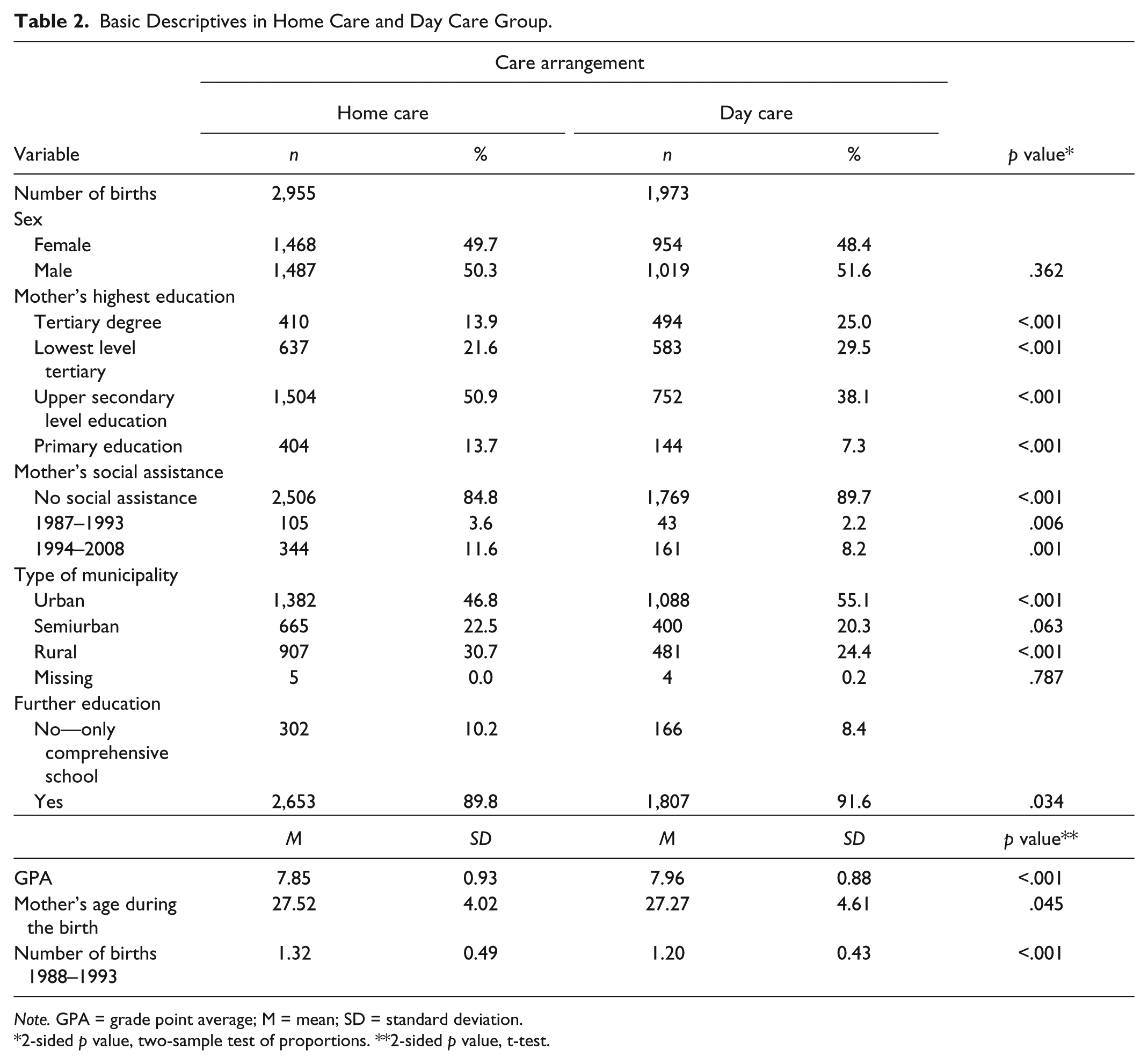
Note. GPA = grade point average; M = mean; SD = standard deviation.
2-sided p value, two-sample test of proportions. **2-sided p value, t-test.
The general linear regression analysis of GPA were carried out with both unstandardized and standardized GPA (Table 3). As an additional variable to improve the precision for our estimates, we included interaction term for number of siblings and care arrangements. For both GPA measures, participation in day care increased GPA. Day care participation increased GPA with 0.19 points (95% confidence interval [CI] [0.058, 0.327]) and standardized GPA with 0.21 points (95% CI [0.064, 0.357]). A greater number of siblings was also associated with higher GPA. Also the interaction term for care arrangements and number of siblings was statistically significant. Municipality type was not significant and was dropped from final analysis.
Parameter Estimates for Determinants in General Linear Model With Unstandardized and Standardized Grade Point Average as the Dependent Variable.

Note. CI = confidence interval; B = beta-estimate; LCI = lower confidence interval; UCI = upper confidence interval.
Second, we analyzed completion of further education (Table 4). Interaction effect between sex and day care type was statistically significant (p = .012), and we constructed separate models for females and males. The crude effect of day care type for females showed a protective effect of day care odds ratio (OR = 0.55, 95% CI [0.39, 0.78]), indicating that day care is associated with completing further education. For males, crude effect of day care type was not statistically significant. In the adjusted model care arrangement was no longer statistically significant even for females (OR = 0.74, 95% CI [0.52, 1.07]).
Crude and Adjusted ORs With 95% CIs for Females and Males, No Further Education After Primary School Before Turning 25 as the Dependent Variable.

Note. CI = confidence interval; OR = odds ratio; LCI = lower confidence interval; UCI = upper confidence interval.
p value (Care arrangement × Sex) = .012.
Finally, we carried out the same analysis by educational groups. With regard to GPA, we did not find statistically significant differences in GPA across educational groups (Table 5). For completing further education, we found that females whose mothers had upper secondary level education did not complete further education as often if they were in home care (Table 6). Odds ratio for not completing further education was 0.56 (95% CI [0.33, 0.95]).
Parameter Estimates for Determinants in General Linear Model With Unstandardized Grade Point Average as the Dependent Variable.

Note. CI = confidence interval; B = beta-estimate; LCI = lower confidence interval; UCI = upper confidence interval.
Adjusted ORs With 95% CIs by Educational Groups for Females and Males, No Further Education After Primary School Before Turning 25 as the Dependent Variable.

Note. CI = confidence interval; OR = odds ratio; LCI = lower confidence interval; UCI = upper confidence interval.
Discussion
This study asked whether educational outcomes are worse for Finnish 6-year-olds who stay at home before school start when compared with children who are enrolled in public child day care. Cross-tabulation showed that mothers with higher education and better economic situation place their children in day care more often than stay at home with them. This indicates that the CHCA scheme may trap low-educated and low-income mothers to stay at home. Results from regression models demonstrate that being cared for at home with a younger sibling before the formal school age is associated with poorer educational outcomes after 9 years of compulsory education. To answer the question of whether CHCA sibling supplement is a trap for 6-year-olds, our response is a cautious “yes.”
Our results are generally in line with the study by Karhula et al. (2016), which demonstrates positive educational effects for day care participation between ages 1 and 3. However, their identification was based on receipt of CHCA only, and they were not able to determine whether parents who received unemployment benefits, a common event over the study period, had their children in day care or in home care. Another problem of identification in Karhula et al. (2016) was that they used annual information on paid home care allowance, while we are able to use monthly data.
As for the second research question, we did not discover clear differences across educational groups. Only children whose mothers had upper secondary level education completed further education less often if they were in home care.
The findings for GPA are in accordance with the previous evidence showing that stimuli outside of the home environment help children perform better in school (cf. Brilli et al., 2013), giving support to GS theory over AT. Our results do not allow causal inferences, but it is likely that participating in public day care gives children an opportunity to learn cognitive and noncognitive skills that are useful in school and that these skills lead later to better educational outcomes compared with children who stayed at home before school start. The effects size of GPA is considerable taking into account the importance of GPA in accessing further education (Ristikari et al., 2016). It seems that CHCA sibling supplement may help cut public expenditure in public child day care, but it may also create persisting educational disadvantages between those 6-year-olds who stay at home and those who participate in public day care. Our results also confirm earlier findings from the Nordic countries (Esping-Andersen et al., 2012; Havnes & Mogstad, 2011, 2015; Karhula, Erola, & Kilpi-Jakonen, 2016), showing partly mixed but mostly positive effects of day care participation.
The positive news is that day care arrangements were not generally associated with completing further education. This can be explained by intervening factors such as counseling and peer-effects and the nature of the outcome variable, which only measures completing education beyond the lowest level. It is also noteworthy that mothers’ education did not affect the results besides on one particular instance (higher odds for not completing further education among females whose mothers had upper secondary level education). The results can be explained by the universal nature of child day care in Finland. Quality of child day care does not differ greatly among population groups.
The role of the CHCA has been fiercely debated in Finland far before and ever since its implementation (Hiilamo & Kangas, 2009). As a result of the CHCA and its sibling supplement, the share of children in early childhood education and care continues to be the lowest in Finland among the Nordic countries (Haataja & Valaste, 2014; Nordic Social Statistical Committee [NOSOSCO], 2015) and among Organization for Economic Co-Operation and Development (OECD, 2015) countries. No previous study has paid attention to the role of sibling supplement in the CHCA scheme. Our results indicate that the scheme may be harmful for participating children’s education outcomes. As part of its austerity measures, the Center Party–led Sipilä cabinet decided to weaken the right to child day care for those families where one parent is unemployed, on disability pension, or caring for the youngest child on parental leave or with CHCA at home from the beginning in August 2016. Our results indicate that the decision may be harmful to the affected children’s educational outcomes.
Strengths and Limitations
The study was built on a comprehensive cohort data with follow-up information for 25 years. The benefits and drawbacks of child day care options have been fiercely debated in Finland, but so far, there has been hardly any empirical evidence to back up various claims. The CHCA benefit scheme with the sibling supplement allowed us to study if being cared for at home before starting school affected educational outcomes with register-based birth cohort data.
Despite these strengths, our study has four major limitations. First, our analysis does not identify a causal effect. Despite controls, the fact remains that the analysis is a comparison of two groups who have self-selected into their care option. Second, we were not able to make a distinction between care at public day care centers and family care, that is, care provided by registered child minders. In terms of stimuli and social contacts, the care provided for children in family day care may not differ dramatically from home care (given the fact that there is a younger sibling at home). The cohort members staying at home with a younger sibling may have learned social skills similar to public day care. A comprehensive NICHD (2006) study in the United States showed that children in child care centers had somewhat better cognitive and language development than children with a less center-based child care experience.
Third, the home care option could also be ambiguous. The entitlement to CHCA does not formally oblige parents to stay at home with their children. 5 In addition, we were not able to gain information on parents’ earnings, employment, and earnings-related unemployment benefit. It is theoretically possible that some parents receiving CHCA have taken care of their children at home, but their employed spouses have not claimed CHCA.
Fourth, the identification of the public day care group was based on 4-month and 3-month periods in 1993. It is possible that the cohort members have been enrolled in public day care between, before, or after these periods. 6 In interpreting the results, it has to be observed that our analysis was concentrated only on families where there were at least two children born within a fairly short time interval. This is a common fertility pattern but does mean that we cannot generalize our results to apply for the full cohort or for a larger child population. 7
Finally, it is also evident that cohort member families in our child day care and home care groups may differ in a number of dimensions we were not able to account for. For example, it is possible that due to the severe economic recession in 1993, cohort member families in the home care group may have suffered from unemployment more than cohort member families in the public day care group and/or they may have, on average, lower incomes since the CHCA option was especially attractive to low-income families. As a result of our identification strategy, we had to focus our analysis to two-parent families only. Single parenthood affects both the use of child day care options and school outcomes (Brilli et al., 2013). It is also not possible to directly generalize our findings to present day conditions in Finland where preschool is free of charge and compulsory for 6-year-olds, or to children in other countries. We also acknowledge the existence of a large number of additional confounding factors, which have a potential to affect the results. We argue, though, that it is unlikely that they would systematically vary between our study groups.
Conclusion
The child home care before school entry is associated with poorer educational performance after 9 years of compulsory education. They call into question the rationale of the widely utilized sibling supplement in the CHCA scheme and cutting rights to attend full-time in early childhood education.
Footnotes
Declaration of Conflicting Interests
The author(s) declared no potential conflicts of interest with respect to the research, authorship, and/or publication of this article.
Funding
The author(s) disclosed receipt of the following financial support for the research, authorship, and/or publication of this article: The study received funding from Families and Societies project in the European Union’s Seventh Framework Programme (grant no. 320116).
