




Abstract
With a survey of physical education (PE) among a national representative sample of fifth to tenth grade students (N = 3,226) in Norway, we investigated how students experience the changing room situation in relation to PE classes. Most students find the changing room situation unproblematic, while some report problems. A majority (59.6%) of the students disagreed with the statement “I experience that an adult is looking after us when we change/shower.” It seems PE teachers, especially the male teachers, consider the lesson finished when students move from the gym into the changing room. We question whether we can learn from earlier formal curricula in Norway on how changing room activity was more adequately implemented in accordance with the sociopolitical aspects relevant at the time. Today, these are about Bildung, mentioned in both the general part of the curriculum and the PE curriculum. However, the lack of clarity makes the changing room a contested field, open for struggles of hegemony within fields.
Introduction
Every day thousands of children enter school ready for physical education (PE) classes, and an inevitable part of PE is that the children also enter the changing room. As many of us might recall, many things happened in the changing room. However, what happened in the changing room stayed in the changing room, maybe because the teacher was seldom present. As, researchers of PE, we know that in the Scandinavian context PE is a subject many pupils seem to like (Moen, Westlie, Bjørke, & Brattli, 2018; Munk & von Seelen, 2012; Stensaasen, 1975). We know that boys, children active in organized sport, and pupils with “ideal” bodies seems to be in a privileged position in the subject (Dowling, 2016; Munk & von Seelen, 2012; Öhman, Almqvist, Meckbach, & Quennerstedt, 2014; Säfvenbom, Haugen, & Bulie, 2014). Hence, research on pupils’ experiences of PE is much related to the activity part of PE. How the pupils experience the changing room as part of PE is more or less still a “black box” since little research has been devoted to this aspect of PE.
Research considering changing room experiences in relation to PE is limited and descriptive in nature. Couturier, Chepko, and Coughlin (2005) studied American middle school and high school students’ experiences of PE, and related to the changing room they found that more than half of the students (52.9%) experienced they had insufficient time for changing and showering. The study also showed that students in middle school felt less comfortable when changing in front of others than students in high school (45.1% versus 28.4%). Taking a gender perspective, Couturier, Chepko, and Coughlin (2007) found that more girls than boys felt uncomfortable changing in front of the same sex students (43.7% versus 27.5%). They also found that more girls than boys experienced insufficient time to change (64.8% versus 41.3%). An American study of middle school girls (Fisette, 2011) found that the girls felt relaxed in the changing room as long as they could dress/undress behind a curtain. In other words, the girls sought privacy in a public setting. Woodruff and Curtner-Smith (2007) found that the scary stories PE teachers and undergraduate students recalled being told to them when entering junior high/middle/high school were mostly about the changing room and “having to dress, shower and expose their bodies in front of others” (p. 424). Furthermore, O’Donovan and Kirk (2007) have conducted a qualitative study, based on observations, research diary and interviews, to elaborate on the interaction between teachers and pupils in the changing rooms in one UK secondary school. They found that pupils tend to modify participation requirements in a way that allowed them to pursue their own agendas, and at the same time act in accordance with the school, department, and teacher rules.
In a recent study on fifth to tenth grade students in a medium size municipality in Norway, we found that the students deal with showering in relation to PE, and that there was a taken-for-granted assumption that showering is part of PE (Moen, Westlie, & Skille, 2017). The study also revealed that there are other issues related to the changing room that were more complicated for students to handle than nudity. For example, the students reported that time pressure, noise, and cold water was experienced as challenging when in the changing room.
This literary review reflects the lack of research into the changing room, especially studies drawing on national samples of pupils’ experiences in the changing room, as well as Scandinavian studies. In accordance with O’Donovan, Sandford, and Kirk’s (2015) call to “open up the changing-room as a space for research” (p. 64), this article seeks to acquire a glimpse into this “black box,” hence exploring a topic (the changing room) often overlooked by PE teachers and teacher educators. Drawing on a survey of a nationally representative sample of fifth to tenth grade PE students in Norway, we use Bourdieu’s (1990) field theory to “identify the changing-room as a juncture between a number of fields” (O’Donovan, Sandford, & Kirk, 2015, p. 57). As the experiences in the changing room touch upon a definition debate of what is what in PE, we supplement Bourdieu’s field theory with Goodlad’s (1979) curriculum theory. In other words, in this study we report from a national survey on students experiences in the changing room, as well as discuss these findings both sociologically (using Bourdieu’s field theory) and pedagogically (using Goodlad’s curriculum theory).
More broadly, we aim at contributing to especially three aspects of the limited knowledge base into PE changing rooms; first, bring knowledge on how most pupils in a nation experience the changing room (a national survey), second, contribute with knowledge from a Scandinavian context, and third, discuss the findings both sociologically and pedagogically. We do so primarily by seeking an answer to the following research question: How do Norwegian fifth to tenth grade students (10 to 16 years old) experience the changing room situation in relation to PE classes? On that basis, we further discuss how knowledge of students’ experiences in the changing room is relevant to curricula development in PE. We present a brief history of Norwegian PE curricula in the next section, together with Goodlad’s (1979) curriculum levels, prior to outlining Bourdieu’s (1990) field theory. In the method section, we present the survey and analysis in detail. The results are then presented followed by a discussion and conclusions. However, to contextualize, there is a need for a brief clarification of what is included into the “changing-room situation” in PE in different countries.
The Changing Room Situation in PE in Nordic Countries
In Norway, pupils use the changing room for changing clothes before and after the PE class as well as to shower after class. Related to showering, law tells that the schools in Norway cannot force pupils to shower (Utdanningsdirektoratet [Udir], 2014). However, as already commented, Moen and colleagues (2017) found that most pupils shower in relation to PE. Colleagues in Iceland and Denmark tell that this is also the case in their countries; however, we do not have evidence to support these statements. Based on international observation through the participation in collaborative research projects of two of the authors, we are aware that showering after PE class is unusual in many countries such as, for example, New Zealand and the United States. However, we also know that in countries like Great Britain and Sweden, some schools practice showering after PE while others do not. In Sweden and Denmark, there are no laws regulating showering in relation to PE. Despite these different practices in different countries when it comes to showering, the overall relevance of this article lies in the fact that more or less all children use the changing room (in one way or another) in relation to PE. Moreover, the article contributes to a discussion of curriculum through the application of field theory.
Context and Theory: The Norwegian Curricula, Curriculum Theory, and Field Theory
Goodlad (1979) points to five curriculum levels: the ideological, the formal, the perceived, the operational, and the experiential. The formal curriculum refers to the content of the curriculum revealed, for example, through learning outcomes, content, teaching methods, and assessment (in other words the “what”). The ideological curriculum refers to how the curriculum is legitimated in society based on the intentions of society, in other words the curriculum’s “why.” The perceived curriculum is how the teacher (and others) perceives the written curriculum and how the teacher plans and conducts his or her teaching. The operational curriculum is related to human and material resources, or how the curriculum is implemented in practical everyday life. The experiential curriculum refers to how the students experience the curriculum.
Looking into Norwegian curricula, and more specifically issues in the curricula related to changing room activities, Augestad (2003) found that changing and showering has been part of the PE history in Norway since the mid-1900s. The reason for implementing showering as part of PE was related to hygiene and to avoid infections in society in general.
In the National Curriculum from 1959, we find hygiene rules in PE; it is also explicitly stated that the gym had to be clean to avoid infection among students. Furthermore, it is clearly expressed that high intensity PE lessons shall conclude with a shower (Kirke og undervisningsdepartementet [KUD], 1960, p. 236). The National Curriculum from 1974 (Kirke og undervisningsdepartementet [KUD], 1974) states that teachers must make sure that the students change into suitable outfits for PE, and that they have sufficient time to shower after PE (KUD, 1974, pp. 257-258). Though formulated differently (shower as a “finish” versus something “after” the PE lesson) the explicit expressions on hygiene in these curricula had to do with increased knowledge in Western society about hygiene and infections (Augestad, 2003). Hence, the inclusion of hygiene in the curricula is an example of how sociopolitical ideologies in society made an impact on the formal curricula in PE.
In 1987, Norwegian education had a new national curriculum that included learning outcomes in PE on having knowledge of personal hygiene (KUD, 1987). The same learning outcomes are found in the national curricula from 1997 (Kirke, utdannings- og forskningsdepartementet [KUF], 1997), 2006 (Kunnskapsdepartementet [KD], 2006), 2012 (Udir, 2012), and 2015 (Udir, 2015). Hence, the aims related to showering expressed in the earlier curricula were removed in the plans from 1987 and beyond, probably because the Norwegian society had developed and become more modern and that households have private shower facilities.
However, an interesting change with reference to curriculum development is found in the overall aim for PE in the 2006 curriculum (this change has been retained in the revised versions of PE curricula from 2012 and 2015), namely, the emphasis on PE as an allmenndannende fag. In the English version of the PE curriculum from 2006 allmenndannande fag is translated into “general study subject” (Udir, 2006). However, in the English version of the core curriculum the term “allmenndannet” is translated into “all-round general education” (Udir, 2011). We find neither of these terms suitable to describe the fully depth of allmenndannet. However, Bildung is more appropriate, and is used in the following text. Bildung is a German term that covers more than education alone. While education attempts to reach specific learning outcomes or skills, Bildung includes elements of upbringing and seeks increasing maturity of the person as a whole—personally, intellectually and morally (Hagtvedt, 2011). Bildung in the core curriculum includes:
Concrete knowledge about the human being, society and nature which can provide a broad outlook and perspective;
Know-how and maturity to face life’s practical, social and personal challenges;
Qualities and values that facilitate cooperation between people and make it enriching and exciting for them to live together (Udir, 2011).
One question that can be asked is if personal hygiene (changing and showering which was explicitly expressed in the curricula from 1959 and 1974) is implicitly part of today’s national PE curriculum through the overall aim of Bildung. In that respect, it is important to state that the authors are not moralists when it comes to hygiene, and do not consider changing and showering to be the only important aspects related to the aim of Bildung in PE. We highlight how PE, on both a practical level as well as a political level, is in a unique position to implement the changing room as part of the PE lessons. Contributing to young people’s Bildung is especially appropriate for fostering young people with “knowledge and maturity to meet life—practically, socially and personally” (KD, 2006; Udir, 2011). In other words, while hygiene was an important Bildung element in the changing room in the 1950s, the focus today—for example—is on learning respect for each other’s differences as well as the ability to act naturally together with others in a “private” setting.
In this article, we shed light on how Norwegian fifth to tenth grade students experience the changing room situation in PE (the experiential curriculum). The Norwegian national curriculum show historical variations considering incorporating the changing room into the formal PE curriculum. While former curricula, in accordance with the sociopolitical views of the time, defined PE to include the pre- and postactivity phases, that is the time spent in the changing room, more recent curricula seem to define the field of PE as solely an activity phase of the PE lesson. However, as argued above, there is reason to discuss whether Bildung is an aim in today’s PE curriculum calling for a discussion about including the changing room in PE lessons in policy documents (the formal curriculum) more explicitly. In this study, we empirically investigate the experiential level of the curriculum, and employ that as the basis for discussing other curriculum levels.
Acknowledging that the changing room can be considered as PE (consult with [cf.] the Norwegian curricula summary) and as connected to other spheres (O’Donovan et al., 2015), we apply Bourdieu’s field theory. Moreover, we follow O’Donovan and colleagues (2015) who maintain that by
defamiliarising the present practice of the changing-room, we hope to open up the changing-room space as a space research on the social construction of the bodies and to consider the implications of how bodies are being schooled for physical education in the changing-room. (p. 64)
Similar to O’Donovan et al. (2015), we study the changing room by the application of Bourdieu’s concepts of field and habitus. A field is a specific and relatively autonomous area of practice (Bourdieu, 1990). It is specific, meaning that it is independent of other fields of social life and has its specific features. According to field theory, there will be “rules” for PE, and “rules” for the changing room. Simultaneously, a field is a part of a broader societal space and related to other fields. Considering PE as a field, PE influences other fields (e.g., other elements in school), and is influenced by other fields. The latter refers, of course, to other elements of school life, but is also influenced by other physical activities, especially sport (Moen et al., 2018) and other bodily cultures more generally (O’Donovan et al., 2015).
For a field to survive, actors with common interests are needed. The struggle for positions in the field reproduces the field through a shared belief in the field’s benefits. However, interests in a field can only be articulated by actors who possess the right type of knowledge which is applicable to the specific field. Such knowledge is both a prerequisite for, and a product of, the practice in the field (Bourdieu, 1990). The second concept adopted from Bourdieu (1990) is habitus; habitus is structured and structuring structures. That it is structured means that it is learned through socialization and means that it is changeable through new socialization. The change is slow, however, because structures refer to relative stable dispositions for participation in a field. That it is structuring, means that the dispositions creates the basis for the individual’s interpretations of and actions in the world (Bourdieu, 1990). The meaning an individual ascribes to a field practice and struggle depends on when and how one learn the field rules, how and in which context it is practiced, and how much one invests in it (Bourdieu, 1986). With a defined habitus an individual then tends to—but is not determined to—participate and/or succeed in a specific field. (Bourdieu does not deny free will although he underscores embodied socialization) such as a PE field.
Closing the theoretical understanding that will guide us in the discussion, we base this on O’Donovan et al. (2015):
. . . to identify the changing-room as a site of juncture between a number of core fields (principally schooling, physical education and physical culture), and thus we argue that as a “changing place” (both literarily and metaphorically) changing rooms are in fact highly charged transitional spaces. (p. 57)
In other words, O’Donovan et al. identify three fields relevant for our study; principally schooling, physical education, and physical culture, whereas the changing room is the juncture between these three fields. The starting point for our study is the field of PE itself.
In our study, we draw empirically on data from the experiential curriculum (Goodlad, 1979) as a basis for a discussion on a broader level. Analytically, based on different understandings of the curricula, our main discussion is on whether the changing room is included in the PE field or not. Furthermore, we continue to follow O’Donovan and colleagues on their understanding of physical culture as a core field influencing PE (and the changing room). Last, and still in line with O’Donovan et al. (2015), there is a field of principally schooling guided by the general part of the curriculum. As our discussion shows, Bildung is relevant across all these three fields.
Method
Sample
Winter/spring 2016 two of the authors conducted a survey on PE in Norway, and the overall aim of the study was to gain knowledge, on a national level, on how fifth and tenth grade students experience PE. To reach this aim of a national representative sample, we have based the sampling process on “The Norwegian Primary School Information System” (our translation, https://gsi.udir.no/), and the seven national regions reported by Statistics Norway (http://www.ssb.no/). We have mainly used random sampling strategies supplemented with probability sampling due to geographical conditions (Norway is a country with long distances between urban settlements), and at this point we had 47 schools in our sample. However, due to time limitations to complete the data gathering within the same school year, we reached 42 out of the 47 primary and secondary schools. The sample population within the 42 schools consisted of 3,644 students. While 418 students were not present on the day of the survey, a total of 3,226 students completed the questionnaire, a response rate of 88.5%. There are equal numbers of girls (1,613) and boys (1,613) in the sample. When it comes to school level, 1,666 students in the sample are from secondary school, while 1,560 students from primary schools.
The sample is presented in Table 1. Estimates based on Raosoft sample size calculator gives a margin of failure at p = 1.72 for the total sample.
Presentation of the Sample; Grade and Sex (N = 3226).
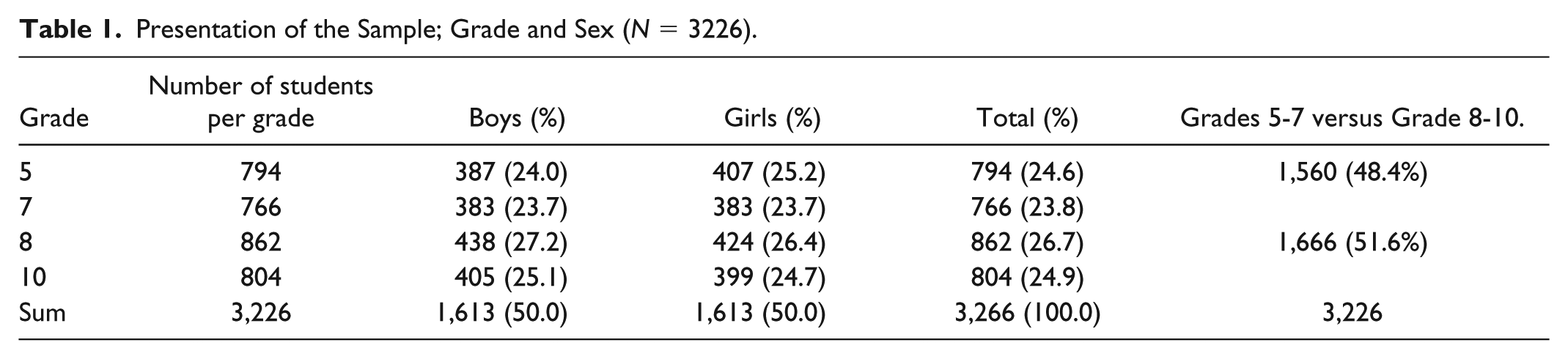
Table 1 illustrates the distribution of the sample. In the further presentation we distinguish between the primary school (Grades 5-7), and secondary school (Grades 8-10).
Questionnaire and Data Gathering
The questionnaire for the survey in PE was developed in accordance with the national curriculum in PE from 2015 (Udir, 2015), as well as a recent media debate in Norway related to PE in general, and the changing room in PE in particular. In 2014 we conducted a pilot study in a local municipality (N = 751) where the questionnaire underwent validity and reliability tests using factor analysis and Cronbach’s alpha (Moen, Westlie, Brattli, Bjørke, & og Vaktskjold, 2015). All these things considered, the questionnaire for the national survey were revised, and the final questionnaire contains of seven sections: About you; Why PE; The content of PE lessons; Teaching and learning in PE; Other questions about PE (hours of PE, changing clothes, showering, changing room experiences and absence); Your opinion about PE, and Your opinion about health.
In this article, we focus on questions from the section “Other questions about PE,” and more specifically questions about changing clothes, showering and changing room experiences. Regarding insight into exact wording of the questions in the questionnaire and the answering options, we refer to the Tables 2 to 4 in the results chapter.
How Students Experience the Changing Room and Showering, Divided Into Gender (N = 3,226).

Significant difference between boys and girls p < .01.
Data collection was undertaken in winter/spring 2016; the students filled in an electronic questionnaire during school hours. All questions in the questionnaire were in a closed format and made mandatory; hence, the students had to answer each question before moving forward in the questionnaire.
To reassure the research protocol were followed in all schools taking part in the study, one person from the research team was present in all 42 classes participating. Students in need of reading assistance got help from their teacher or an assistant. The students spent approximately 20 min answering the entire questionnaire. Older students used less time to complete the questionnaire. The study has obtained ethical clearance from NSD—Norwegian Centre for Research Data.
Data Analyses
The results are based on descriptive analyses in crosstabs using SPSS software. Chi-square tests were used to identify significant differences between boys and girls as well as differences between students in primary and secondary schools, and different student experiences according to their teacher’s gender. All statements in Tables 2, 3, and 4 were examined for further analyses of this kind. The analysis were not theoretically driven; however, theory were applied to understand and discuss the students experiences of the changing room.
How Students Experience the Changing Room and Showering Divided Into Teacher’s Sex N = 3,226).

Significant difference between student with female teachers versus students withe male teachers p < .05.
Results
In this section, we present the students’ experiences from the changing room. Initially, we employ descriptive statistics for each gender. Furthermore, the experiences are compared with gender of the PE teacher, and with level of education (primary vs. secondary).
Table 2 shows that almost seven of 10 students either disagree or strongly disagree that they experience being looked after by an adult when they are in the changing room. This applies particularly to girls. More boys than girls seem to find showering unproblematic.
Looking into Table 2, we find that the majority of the students seem to handle the changing room situation satisfactorily. However, some students express they have problematic experiences. One of four students report that they are afraid that someone will take a picture of them. While 6.4% report that they had experienced being teased or bullied in the changing room. In a national context, this suggests that over 20,000 students have experienced being bullied in the changing room. Approximately three out of 10 students find the changing room noisy, and there seems to be more noise in the boys’ changing room than in the girls’ room. Four of 10 report that they have too little time to change/shower; this is more prominent among girls than boys.
Of the statements summarized in Table 2, we further sought for differences related to the teacher’s gender. First, a larger proportion of the students report having male than female PE teachers. Second, and most striking, the only statement that showed significant difference was “I experience that an adult looks after us when we change/shower.”
Table 3 shows that 59.6% of the students with a male teacher strongly disagree with the statement, while 53.5% of the students with a female teacher strongly disagree.
As mentioned earlier we also analyzed the statements measured by school level to get a deeper understanding of the distribution of student’s experience of the changing room. This is presented in Table 4.
How Students Experience the Changing Room and Showering Divided Into Primary/Secondary Schools (N = 3,226).

Significant difference between groups p < .01.
All statements in Table 4 show differences in the level of response between primary and secondary school. While over 50% of the students in primary school do not experience that an adult (presumably the PE teacher) is looking after them, more than 80% in secondary school students experience the same. Of the students in primary school, 77.6% find it unproblematic to shower after PE, and 69.1% in secondary schools report the same. Table 4 shows that students in primary school are more afraid of being photographed in the changing room than students in secondary school. Moreover, while almost 50% of students in primary schools report that the changing room is noisy, less than 30% of secondary school students report the same. The table shows a tendency whereby a larger proportion of students in secondary than primary school think they have insufficient time to change/shower.
All in all, the vast majority of Norwegian primary and secondary school students find the changing room situation satisfying and unproblematic. Nevertheless, the indication of differences, for example, and especially whether the students experience being looked after—establishes some interesting points for discussion regarding the fields relating to the changing room and the curriculum.
Discussion
Following O’Donovan et al. (2015), we have identified the changing room as a juncture between three fields; principally schooling, physical education, and physical culture. All of these fields include elements of Bildung. Of special interest for us is the relationship between the principally schooling field and the PE field. First of all, PE is a school subject; consequently, according to the curriculum, PE is a field with specific learning outcomes exclusively for that school subject. Considering PE a subfield of the field of principally schooling, PE should also include elements from the general part of the curriculum. In other words, as long as there are elements of Bildung in the general part of the curriculum (which there are—very specifically, cf. context and theory section above), PE is a field for Bildung. In Norway, it is formally stated in the general part of the curriculum that this is valid for every subject, which also includes the PE curriculum. Considering PE as a field, it is relatively autonomous; however, research pinpoints that the autonomy is challenged by the strong influence from what we here refer to as the physical culture field—and especially sports (Green, 2002; Moen et al., 2018; Säfvenbom et al., 2014) as well as narrow views of the “right” body or body shapes (Öhman et al., 2014).
The field of physical culture includes both physical activity (including sports) as well as bodily culture more generally. In that respect, PE stands out as unique in the school setting as it is the only subject which includes bodily achievements to gain credits (literally in secondary school and upward, where all subjects are assessed and graded). In Bourdieu’s terms, the PE field includes a struggle where the presentation and performance of the body is at stake, and gains rewards. Moreover, the changing room and shower situation is the only setting in school where student’s bodies are exposed in a “public setting.” As long as PE is a school subject, the understanding of Bildung as developing skills to meet life and the future in practical, personal and social terms, has to be included. The development of such skills takes place alone as well as together with peers (KD, 2006; Udir, 2006, 2011, 2015).
With reference to Berger and Luckmann (1996) it is a pedagogical, psychological, and sociological principle to develop as human beings in interaction with others. School is an arena where everybody meets; students have different religious beliefs, cultural backgrounds, ethnicity, class, and gender. It is assumed that the Bildung element of the curriculum’s general part leads to consciousness regarding these aspects. Furthermore, in all other parts of the school field (including breaks and intervals), teachers and other adults ensure that everybody shows respect for the various religions, cultures, ethnicities, classes, and genders. It is even presumed that—if needed—adults intervene when students do not behave accordingly and respectfully. Schools are organized to take care of this in all other situations, with a teacher in the classroom and even with teachers on inspection during intervals.
Just as students differ regarding beliefs and backgrounds, social and mental skills, students have different body shapes, sizes, and levels of bodily maturity, as well as different perceptions about the body related to activity in PE (Lodewyk & Sullivan, 2015; Öhman et al., 2014). The changing room is the only place and space in school where students are literally uncovered. This means that the changing room creates possibilities for Bildung being unique to the changing room. However, the changing room is value-laden, and “the proximity to other bodies facilitates (perhaps even necessitates) a process of comparison, surveillance and self-regulation” (O’Donovan et al., 2015, p. 57). In other words, being in the changing room with others implies tensions. These are tensions we theorize by claiming that the changing room is a juncture of three fields. Regarding the changing room’s relationship to these fields, we see some challenges that lead to a number of questions. First, is the changing room a part of the PE field, or is it part of an interval between the PE class and another class? Second, if there is an overlap of the physical culture field and the changing room, is it potentially a challenge whereby those with a habitus for sport and an athletic body rule the changing room at the cost of others? Third, is the changing room viewed as a part of the principally schooling field? The point is that when three fields influence the changing room, they may do so in different ways, with different weighting.
Although many students report that the changing room is not experienced as problematic and although most problems reported seem minor, some students report that there are actually challenges when entering the changing room. The challenges are related, for example, to bullying, photos taken, noise, and time pressure. Similar findings are reported in international as well as national research (Couturier et al., 2005, 2007; Fisette, 2011; Moen et al., 2017; Woodruff & Curtner-Smith, 2007). For one thing, the minor problems may culminate in a stressful atmosphere because of time pressure and unpleasantness. Most importantly is, of course, that there are reports of fear (for photos) and of bullying. Although we do not have details in our data about those reporting negative experiences, it is reasonable to believe—on an analytical level—that there is a relationship between having the “wrong” habitus for a physical culture field and a sport-dominated PE field, and negative reports. Our most striking finding is that there are such large differences regarding whether there is an adult looking after the students in the changing room or not. More than 50% of the students experience not being looked after in a changing room situation, especially those with male teachers. This indicates that many (especially male) PE teachers consider the lesson as over when students move from the gym into the changing room. If the experience among the students is that changing and showering is outside the PE lesson, this signals that the teachers define the changing room situation as being outside their job. Thus, many PE teachers operationalize the curriculum in a way that defines the changing room out of the PE field.
Given the degree of fear and unpleasantness reported by the students from the changing room, our results indicate that students need guidance and supervision to develop Bildung regarding experiences with bullying, photos taken, nudity, and so on. For some, these issues are of more concern than for others, when girls and older students experience more problems with the changing room and being naked in front of others. These results correspond to international research findings (Couturier et al., 2005, 2007) Independent of who is experiencing what, the field of principally schooling—operationalized by the general part of the curriculum—can be more permeating/pervasive in the PE. One way of doing this is to define the changing room as part of the PE field (and not as something in-between other subfields of school). Figure 1 illustrates the development of what has been included into PE in Norway. In the 1960s and 1970s, showering, for example, was explicitly included (KUD, 1960, 1974). In the 1980s and 1990s, this element was removed (at best, less clear) (KUD, 1987; KUF, 1997). Our point is that the current PE curriculum text is even more vague. We maintain that the general curriculum including elements relevant for PE (such as Bildung) is relatively clear. Moreover, everything included in the general curriculum is valid also for each specific school subject. However, as long as the PE curriculum does not explicitly include showering or other elements of the changing room (KD, 2006; Udir, 2006, 2011, 2012, 2015), this vagueness opens up for individual interpretations among teachers. Research shows that such influence from other fields is common (Larsson, 2009; Moen, 2011).
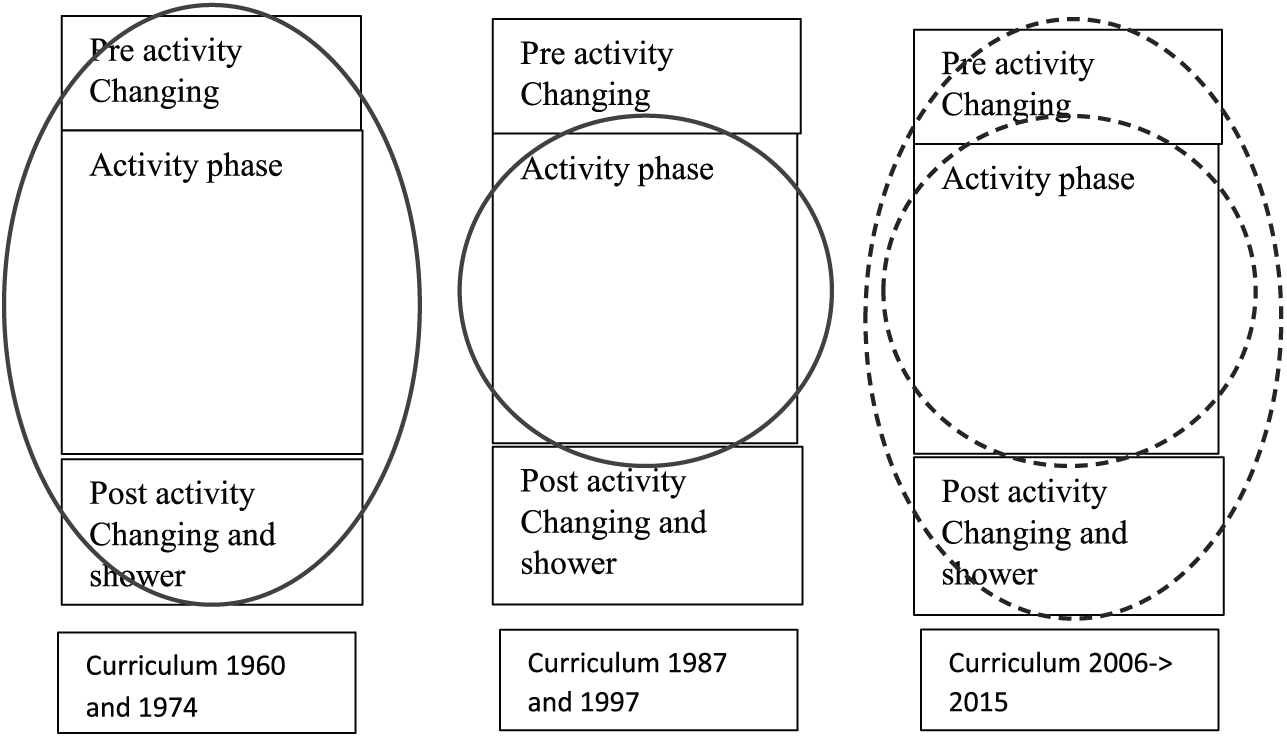
The status of pre- and past activity changing in historical and present curriculums in Norway.
The changing room must in that regard also be understood as more than just a PE responsibility, but as a Bildung element, taking into consideration aspects of all the three fields we have defined as merging in the changing room. While O’Donovan and Kirk (2007) seem to assume that the PE teacher is present in the locker-room in PE, findings from our study, however, indicate that students are alone in the changing room. This means that the experienced curriculum is somewhat negative and it is timely to ask if the Bildung element is taken care of in both the perceived and the operationalized curriculum. In other words, is the implicit way of dealing with the changing room in relation to PE sufficient? More precisely, can we—in Norway—learn from the formal curricula from the 1960s and 1970s, how changing room activity was adequately implemented in accordance with the sociopolitical aspects relevant at the time? While it was rather explicit that the changing room was part of the PE field of reasons of hygiene, we experience a phase where it was excluded, and are now in a situation where it is unclear (see Figure 1). The lack of clarity of the current curriculum (perceived, operationalized, and experienced), makes the changing room a contested field, open for struggles of hegemony within fields.
Conclusion
Based on a theoretical understanding of the changing room as a juncture between three fields; principally schooling, physical education, and physical culture, and a national representative survey among primary and secondary school students, we have first investigated the experiences in Norwegian changing rooms in PE. On that theoretical and empirical basis, we have discussed the curriculum of PE, and the relationship between the PE field and other fields with Bildung as a cross-field element of main interest. We have used Goodland’s curriculum theory, and especially the formal, perceived, and experienced curriculum, in our discussion. In that regard, we suggest that teachers seems to have differential interpretations of the formal and perceived curriculum when it comes to implementing the changing room as a part of PE, as our study shows that students experience the changing room situation differently (experiential curriculum). In other words, regarding the content of the formal curriculum, elements from our empirical material can function as background information. For example, the different practices of teachers regarding being present in the changing room, and the different experiences regarding a feeling of security in the changing room in both primary and secondary schools, are elements that could be discussed during the creation and administration of the formal curriculum. In Bourdieu’s terms, the curriculum for all schools in a country should fit and secure all kinds of habitus, not only those with a positive experience from the body culture field. Today, the general part of the curriculum valid for all subjects makes it possible to introduce a Bildung element in PE. However, our results clearly reveal that the experienced curriculum varies a lot. We, therefore, call for a clarification by Norwegian authorities with regard to the formal curriculum, to make it easier for those whose responsibility it is to operationalize it. Combining the policy and research elements given here, it is our contention that research could assist policymakers in practical terms, to clarify what the content of the curriculum is actually meant to be.
Overall, our discussion which is only based on data from the experiential level of the curriculum, could and should be further scrutinized by empirically investigating other curriculum levels than discussed here (Goodlad, 1979). There are mainly two groups of interest to our mind. First, teachers could be interviewed about their perception and operationalization of the current curriculum, both the specific PE curriculum and particularly the relationship between the PE and the general part of the curriculum (where the Bildung element is evident). Second, policymakers (and bureaucrats administrating the policy on behalf of the school authorities) could be interviewed to identify the ideologies lying behind the formal curriculum. They should also be challenged to discuss and employ implications of the present study.
Footnotes
Declaration of Conflicting Interests
The author(s) declared no potential conflicts of interest with respect to the research, authorship, and/or publication of this article.
Funding
The author(s) received no financial support for the research, authorship, and/or publication of this article.