




Abstract
Research to date in mobile (m-)learning has focused mainly on the learners and the processes they utilize when learning using mobile technologies. This action research study considers the role of the teacher in (m-)learning—the responsibilities, the pedagogies employed in teaching when using mobile devices, and also the changing levels of power and control in the m-learning context. Activity theory (AT) is used as the lens through which the teacher’s role during m-learning is analyzed. The findings propose an enhanced AT model assuming a three-dimensional (3D) representation that encapsulates the teacher at the heart of the activity system radiating power and control to maintain the balance between the components necessary for effective learning. In addition, the term “adaptive framing” is used to denote the changing power dynamic and level of control in activity systems using the proposed enhanced model.
Introduction
Mobile learning (m-learning) is a contested and multifaceted term (Coyle et al., 2007) meaning different things to different people. According to Kukulska-Hulme and Traxler (2005), m-learning is both a new reality and one that has some familiar connotations. However, European and Government agencies espouse its relationship with e-learning, technologists emphasize its novelty and functionality, while researchers focus on the mobility of the learner or its learning potential in informal settings (Coyle et al., 2007). As a result, multiple definitions of m-learning exist, including “the use of mobile and handheld IT (information technology) devices, such as PDAs, mobile phones, laptops and tablet PCs, in teaching and learning” (Wood, 2003, p. 65) or m-learning is “taking place when the learner is not at a fixed, predetermined location, or when the learner takes advantage of the learning opportunities offered by mobile technologies” (O’Malley et al., 2005, p. 7). The latter definition is supported by Sharples, Taylor, and Vavoula (2007) and Sharples, Milrad, Arnedillo Sanchez, and Vavoula (2009). Kukulska-Hulme and Traxler (2005) expand it further to encompass the portability of modern devices saying m-learning constitutes “the possibilities opened up by portable, lightweight devices that are sometimes small enough to fit in a pocket or in the palm of one’s hand” and which facilitate learning that is “spontaneous, personal, informal, contextual, portable, ubiquitous (available anywhere) and pervasive (so integrated with daily activities that it is hardly noticed)” (pp. 1-2). Nevertheless, it is widely accepted (Faux, McFarlane, Roche, & Facer, 2006; Stead, 2005; Wagner, 2005) that m-learning is a new pedagogical option for teachers. Indeed, “in a short space of five years, mobile learning (m-learning) has moved from being a theory, explored by academic and technology enthusiasts, into a real and valuable contribution to learning” (Stead, 2005, p. 1) making it a viable tool for the classroom.
Current research focuses on the use of m-learning from a pupil or learner’s perspective and investigates how the process of learning can be enhanced or modified to increase pupil engagement. The perceived benefits of m-learning such as increased levels of independence, self-direction, motivation, and improved self-esteem (Attewell, Savill-Smith, Douch, & Parker, 2010; Burkett, 2008; Mobilearn, 2005) offer an impressive list of affective measures to encourage a more widespread use of mobile technologies in teaching and learning. Cognitive factors also loom large in the research with m-learning being commended for improving pupil communication and collaboration, promoting the use of subject-specific terminology leading to enhanced performance and attainment, making learning more personal by supporting different learning styles, and engaging reluctant learners through active and participatory techniques (Battista, 2008; Davey, 2007; Facer et al., 2004; Loveless, Denning, Fisher, & Higgins, 2008; Sharples, 2007). Researchers have also acknowledged the pedagogical changes associated with m-learning, as it offers more choice to teachers and pupils, enables learning to take place outside traditional teaching venues, and taps into pupils’ current experiences of the digital world (Kukulska-Hulme & Traxler, 2005; McFarlane, Roches, & Trigs, 2007; Sharples & Roschelle, 2010). However, mobile technology is not for everyone (McFarlane et al., 2007; Sharples, 2007) as initial learner motivation is required (Stead, 2005) and it can be time-consuming to create resources and become familiar with the new technology (Battista, 2008). Technical problems and the logistics of managing pupils outside the classroom can also diminish the m-learning experience (Futurelab, 2006), while content overload or unclear learning intentions can negate the fun and enjoyable aspects of m-learning for the pupils.
Although m-learning has received a positive reception in the technology-enhanced learning arena, much of the research has focused on its impact on learners and its role in offering pupils rich and authentic learning experiences. In general, studies have been short term, and learners have used the ready-made learning experiences already uploaded on the mobile devices, often referred to as “teacher-led mobile learning experiences” as pupils have no input into the design, content, or method of use of these “programs.” The research in this article is unique in that it considers the power and control dynamics of the role of the teacher using m-learning over the course of an academic year for teaching geography. Unlike previous research, the teacher is the focus of this study, and the transition from a teacher-led m-learning experience to a pupil-created m-learning activity is used as the context for reviewing the pedagogies employed in teaching when using mobile devices and also the changing levels of power and control between teachers and pupils in the m-learning context. Activity theory (AT) is used as the lens through which the teacher’s role during m-learning is analyzed in an attempt to find a “language of description” to coin Bernstein’s phrase, which captures the centrality of the role of teachers in this multimodal digital world of learning.
AT Models
Engestrom’s (1987) first generation model of AT emerged from the work of Vygotsky on mediation. The initial model comprised three elements: the subject, the object, and the mediating artifacts (tools or instruments) as indicated in the upper triangle of Figure 1. The basic concept of AT is that all human activities are mediated by culturally defined or created signs or tools; that is, the “subject” (person) interacts with the “object” (lesson content) through the use of the mediating tools (mobile technology) to achieve the “outcome” (goal). Through external interactions with these tools, the internal mental state of the individual is transformed (Aboulafia, Gould, & Spyrou, 1995). AT has strong links to the constructivist learning tradition, offering a model to explain the developmental process where a person is shaped by and shapes their environment through activities. The social context is key to the transformation of the individual or “subject,” and therefore three additional elements—rules, community, and division of labor—were added to the model. “Rules” are the formal or informal mechanisms controlling how the system operates and, in the context of a school, are defined by the teachers or school community. For peer interactions, such as groupwork, additional rules can be defined by the pupils. Some rules are implicit such as turn-taking or listening to instructions, while other rules are explicitly stated to ensure the smooth running of the school, such as health and safety issues and classroom behavior. The “community” is something other than the individual “subject” and is usually the class, school, or wider society. The “division of labor” acts in two dimensions—vertically and horizontally—and refers to “the horizontal division of tasks between the members of the community and to the vertical division of power and status” (Engestrom, 1993, p. 67). These six elements of the model interact with one another as shown in Figure 1.
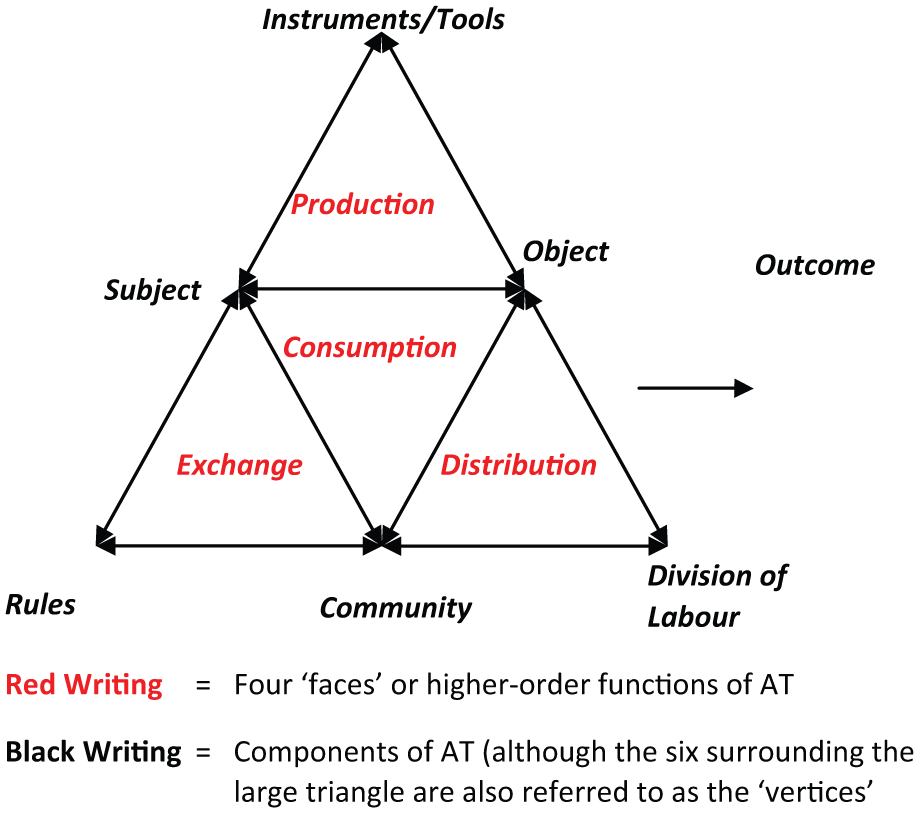
Engestrom’s model of AT.
Embedded within the AT model are four higher order functions arising from mutual relationships among the nearest neighbors within the model (Holt & Morris, 1993; Nardi, 1998). Each function represents an aspect of human activity: “production,” “distribution,” “exchange,” and “consumption” (Youn & Baptiste, 2007). According to Engestrom (1987), “production” creates objects that correspond to the given needs or desired objectives of the system. “Distribution” divides the workload or activities in accordance with the social laws of the community, while “exchange” captures the social interactions from the previously agreed distribution of activities. Finally, “consumption” relates to the achieving of the objective within the community or system by the subject. Within the activity system, “production” is viewed as the starting point, “consumption” as the conclusion, with “distribution” and “exchange,” the interim processes (Engestrom, 1987). For ease of reference, these aspects will be referred to later in the article as the four “faces” of AT and are shown in Figure 1 in red.
AT encourages an in-depth analysis of activity systems, which in turn provoke change and development (Engestrom, 1999). Through investigating a system in detail, contradictions and internal tensions between the elements are revealed. Classrooms are multifaceted, multidimensional organizations in which, traditionally, the teacher had the power to control all aspects of the learning process or activity system of tasks. With the introduction of a more constructivist approach to teaching and learning by the teachers who were “early adopters” of technology (Rogers, 2005), the control has shifted with these new pedagogical practices. For other teachers, the contradictions arising from the integration of technology into an already complex set of activities created tensions necessitating a cultural change often at whole school level. As Cole and Engestrom (1993) aver “reflective appropriation of advanced models and tools provide ways out of internal contradictions” (p. 40) resulting in new activity systems. These new activity systems are inclusive of technology and are worthy of further investigation.
Existing research (Edwards & D’Arcy, 2004; Fraser, 2010; Postholm, 2009) has focused on the use of AT when defining the role of teachers in activity systems devoid of pupils. Engestrom’s (1999) “third generation” AT reveals that multiple applications of AT can be applied to a joint activity system as a mechanism to analyze and review the role of various “subjects” as the dominant perspective in the system. Using this strategy, the role of the teacher can be viewed as one perspective of the activity system; however, as a result, the detail on the role of the pupils is diminished as this is a separate application of AT existing in parallel to the teacher perspective. This switching of focus between the subjects in AT to produce multiple parallel perspectives (or intra-systems) highlights the inability of the current model of AT to capture in the inter-system interactions from both the teacher and pupil perspectives simultaneously. In this article, the singular activity system in Figure 1, of using mobile technology for classroom teaching, is used to determine the position of the teacher within the system while maintaining the focus on pupils’ learning and therefore proposes placing the teacher within the pupils’ AT model rather than existing in parallel to it.
Power and Control in AT
Bernstein (2000, 1981) considers the impact of rules, inherent in the ethos of the institution, on the communicative discourse used by teachers and pupils alike. He defines the power and control in pedagogical practices in two tiers: structural and interactional. The structural level relates to the social division of labor and the strength of the boundaries between divisions or subject specialism in the school context. These divisions are measured by their classification or degree of insulation from other subjects both vertically and horizontally. Vertical insulation is used to rank the subjects in order of perceived importance in the school or institution, while horizontal insulation is the extent to which they remain unique or independent of each other. Insulation is used to protect the uniqueness of the subject, for example, Statistics is separated from Mathematics, or Chemistry is separated from Science. The interactional level refers to the social relationships in the learning context, as determined by the extent of transmission and/or acquisition between the teacher and the pupils—that is, the pedagogical processes used in the classroom environment. These social relations are measured by framing, the extent to which control is asserted by the teacher/transmitter in the learning context. This control can range from strong in a teacher-led, objectives-based teaching environment where the pace, sequence, and assessment process is controlled by the teacher, to a weak or low level of regulation as typified in a student-centered classroom where pupils control the order and pace of the lesson, and self-assessment is used often. The “rules” in an institution or school therefore impact the division of labor and actions of the community in terms of the learners’ freedom to direct and negotiate the outcomes.
Within AT, Engestrom (1999) supports the assertion by Leont’ev (1978) that “The activity of individual people thus depends on their social position” (p. 10) and therefore the impact of “framing” is embedded in the activity system within the learning environment. Teachers can invoke a strong influence on the activity system through their choice of tools, rules and predefined division of labor within the community, or they can assume a low level of regulation and allow the activity system to continually find an equilibrium position in which the pupils can work effectively as a community, sharing leadership and agreeing to their own rules to optimize performance at any given moment in time. Within the context of m-learning, the technology affords the pupils a new level of independence and control due to the personal nature of the devices. It also provides control to the student over the pace and direction of their learning albeit within a broader curricular time frame. Nonetheless, the “social position” of the pupils using mobile technology is elevated relative to the role of the teacher—whose power and control at the individual level have diminished relative to traditional teaching. Using the AT framework, an analysis of the distribution of power and control can be investigated within this new technology-enhanced activity system and the position of the teacher determined. As Daniels and Warmington (2007) posit “activity theory should also develop a language of description which allows for the parameters of power and control to be considered at structural and interactional levels of analysis” (p. 388).
Method
This research aims to problematize the role of the post-primary geography teacher using m-learning during one academic year. The study was designed to capture the experiences of a teacher introducing mediascapes (mscapes) to a first year examination class of 16 pupils (aged 14-15 years) who were enrolled on a 2-year Geography course to be assessed by national examinations. Two geographical topics were considered in the m-learning experience—the long river profile and ordnance survey map skills—accounting for approximately one third of the 2-year course. Informed consent was given by the Principal of The Grammar School, the parents of the pupils involved in the study, and the pupils themselves. All participants were aware that they were free to withdraw from the study at any time, and there would be no adverse impact on their examination scores/grades. It was agreed that all data would be anonymized and stored securely. Names would not be disclosed in any publications arising from the study. The Grammar School is therefore a pseudonym for the school involved in this study. For ethical reasons, the request to use m-learning was only for 1 year of the 2-year course due to the importance of the national examinations and the unknown impact of mobile technology on the pupils’ learning at the outset of the study.
Action research was used in this predominantly qualitative study, as it provided the teacher involved in the m-learning activities with the autonomy to structure and organize the m-learning tasks to map into the existing curricular requirements and scheme of work (McNiff, 1994). It also empowered the teacher to capture the decision-making process of all participants in the study—teacher, pupils, and technical/research support—through detailed observations recorded in a journal or log over the duration of the research. As Mills (2003) notes, action research facilitates the process of engaging with change, improving pupil learning, and enhancing teaching. It works “with” the participants rather than “on” them, promoting collaborative processes that strengthen the teacher–pupil relationships leading to enriched findings (Doyle, 2007). Through critical reflection and evaluation of the m-learning experience, the teacher should be able to dismiss challenges of subjectivity, insider-researcher bias, and lack of generalizability, which are typically applied to small-scale action research studies (Ladkin, 2005).
The m-learning activities were planned to take account of the existing literature and limitations of other small scale studies (Battista, 2008; Facer et al., 2004; Huizenga, Admiraal, Akkerman, & ten Dam, 2009). The pupils were therefore given time to acclimatize themselves to the use of the personal digital assistants (PDAs) through informal games outdoors, so that they could experience the global positioning systems (GPS) in action and better understand how location-aware technology operates. Focus group interviews, composed of four pupils (Morgan, 1988), were used to capture the pupils’ perspectives on the m-learning experience within 1 week of each outdoor mscape event. Different pupils represented the class in each focus group, and whole class discussions were used to verify the accuracy of these interviews (Denscombe, 1995) by allowing all pupils to listen to others’ views and have the opportunity to either amend these or present a stauncher belief (Lewis, 1992). This use of “respondent triangulation” (Burgess, 1984) through peer group scrutiny and evaluation legitimizes the data from the pupils and also provides an alternative perspective to challenge or confirm the validity and reliability of the teacher/researcher journal entries. When pupil-centered mscape activities were used, the pupils maintained a group journal recording their decision-making processes and personal reflections before, during, and after the mscape work. In some cases, the group discussion forum also provided insights into the group dynamics and tensions at various stages in the design process. Where appropriate, these additional sources of data are utilized in the analysis of the study.
The Mobile Learning Environment
A place is a place. A mediascape is an experience . . . Mediascapes are rich in interactivity—full of sound and music, images and text, videos and animation, narrative and dialogue, all embedded in the space where you are standing. (Hewlett-Packard [HP], 2008)
Mscapes superimpose our everyday environments with a “digital canvas,” meaning locations are geo-tagged with multimedia (Loveless et al., 2008). By integrating GPS with mobile devices, sensors can be used to trigger the multimedia as the user enters or exits a specific space or geographical region. Based on previous research (Sharples et al., 2007; Sharples, Taylor, & Vavoula, 2005), it was clear that pupils need to experience the use of mobile technology for the purposes of learning before they could embark on creating their own m-learning activity. The long river profile was therefore used as an illustration of an anchored mscape activity, superimposed on the school grounds, with images and sound embedded as elements of the interactive media used to deliver the subject content. The pupils were able to “walk” the length of the river from source to mouth seeing the key physical features typical at each stage of the river’s profile. The geographical processes associated with the formation of specific features in the long river profile were explained both visually and orally as the pupils walked through these regions. There were quiz questions embedded at key stages along the route in an attempt to sustain the pupils’ attention and to promote recall of the important river features and physical processes such as erosion, transportation, and deposition. In this case, the Thames mscape was a teacher created, pupil experienced linear multimedia experience in which the teacher had full control over the content of the activity and the inclusion of the learning intentions for the task. In Bernstein’s terms, there was strong classification (teacher power) and strong framing (teacher control).
In contrast, the treasure hunt mscapes were pupil directed and created, and then once tested, the pupils experienced each other’s mscape activities and offered feedback to their peers. This student-centered pedagogy showed the presence of low classification (low levels of teacher direction/power) and weak framing (due to increased pupil control). Battista (2008) and Wood, Williams, Fleuriot, and Jones (2004) both found that pupils could construct knowledge more easily and gain a deeper understanding of the content when immersed in the learning activity. They and other researchers (Davey, 2007; Facer et al., 2004; Huizenga et al., 2009) recommended a shared approach among participants to divide the workload and afford pupils greater opportunities for the collaborative construction of knowledge with their peers, while maintaining a link with the support and guidance offered by their teacher (Blatchford, Baines, Bassett, Rubie-Davies, & Chowne, 2008; Smith, 2006). The existing research evidence of pupil-centered activity spurred the teacher/researcher into adopting this approach from the outset with the pupil cohort.
For the treasure hunt mscape, the pupils were assigned into three groups by the teacher. The requirements of the task were delivered to provide pupils with the focus and purpose of the activity, and some advice on how to manage the task as a whole was offered by the teacher. The treasure hunts were set in the school grounds using the history of the old school buildings as the backdrop for the “story” in the treasure hunt. As the geography topic was ordnance survey map skills, the clues embedded both four-figure and six-figure grid references, compass directions, and map symbols. The key points from the clues were presented on the PDA screen as a reminder to the user, while the clues themselves were constructed as a rhyme or riddle and recorded orally. Due to the student-led nature of this task, the groups elected a leader who distributed the sub-tasks, coordinated the direction and progress of the group, and managed the social interactions and group collaboration. Where teacher support was needed, the leader approached the teacher to outline the group’s problem and request assistance in finding a suitable solution. It can therefore be assumed that the rules, community, and division of labor were controlled by each group leader in the activity system.
Although a mixture of the Thames mscape and the pupils’ treasure hunt mscapes is used in the remainder of the article, the processes used in the pupil-designed treasure hunt mscapes offered maximum information in relation to the application of AT in m-learning.
Analyzing m-Learning Through the Lens of AT
m-Learning is about learning-by-doing, that is, pupils getting a hands-on experience using mobile technologies as part of the learning process. The very essence of AT is “activity.” It is not so much interested in how the participant uses the technology but their interaction with this mediating device for learning. The advantage of using AT to analyze m-learning is that AT is adaptable and does not stipulate where the learning must take place. Like mobile technology, AT is not impinged temporally or spatially (Uden & Kumaresan, 2007). In addition, the activity system does not exist in a vacuum nor is it a static framework. It is dynamic, allowing for the unexpected, which may come from within the system (internal contradictions) or from outside (external contradictions). Mobile technology requires engagement for learning to succeed, and so the mediating tools (mobile devices) are being used to enhance learning and their role can be determined through the analysis of the activity system in action. Data observed and collected from the m-learning activities can be analyzed through the lens of AT, allowing for historical events in the learning environments to be reflected upon in a structured manner with a view to making m-learning more effective (Jones, Issroff, & Scanlon, 2007).
When faced with the challenge of creating their own mscape, the pupils’ group journals revealed insights into the struggle this became for some pupils over the duration of the project. Group F commenced the task with a positive disposition as indicated by comments in their journal such as “It all appeared very exciting; everyone in the class couldn’t wait to get started and experience the mobile technology.” However, once they began to take control of the task, journal entries changed to “It did appear a bit daunting and technical for some in our group but everyone was still keen to keep going,” and then during the design phase, insights were revealed such as “At times there was disagreement with where to place the clues but in the end we all agreed, with a bit of compromising!” Before the pilot stage was reached, the group admitted that
It was very hard and time-consuming trying to make the mscape treasure hunt. There was a lot of work to do for it, and it was hard to actually stay focused and work on it because it began to get boring as it dragged on for ages. At the start we were keen but there was so much to do.
The division of labor was a concern at one stage in the process with the group admitting that
As a group we worked well together, and the task was good. However the work wasn’t split evenly between everyone. The leader of the group and some other people did most of the work, but altogether our group was good and we managed to complete the task well.
By the end of the process, the pupils’ reflections indicated a sense of achievement that was tainted slightly by an anti-climax:
Our mscape went well. We managed to sort out all the problems thanks to the pilot and it worked well on the day. Our mscape was good and we were happy with it, but I thought it could have been much better because we put so much work into it. I think this is why a few people lost heart at the end. The mscapes were enjoyable and we were all familiar with mobile devices, but they were so quick to complete outdoors considering the amount of time and effort it took to create them.
The other two groups of students reported in their journals a similar transition from “excitement” and “enthusiasm,” to accepting the work was “challenging and time-consuming to complete.” In addition the group had to address the lack of equity in the workload and finally they experienced a sense of fulfillment at completing the task but slight disappointment in the final product as “it didn’t last long.” These feelings were further confirmed in the focus group interviews and whole class triangulation, where students declared “It was good but a bit boring having to do all three of them.” Similarly, there was consensus that the workload was unevenly distributed with pupils declaring “The group leaders got too much.” This was supported by the leaders who complained “It was really long to make the mscape and sometimes I was left to do the work and it was frustrating” and “Sometimes you had more work to do than others and that was unfair. At times some people just sat there and it was me doing most of the work.” These declarations were confirmed by individual pupils who admitted “I didn’t create enough work in my group” and another said “I was dependent on everyone, they were just working away.” In terms of the four “faces,” these tensions could be located in the production phase, due to the overburdening of the group leaders, and the “exchange phase” resulting from the lack of commitment from the group members to share the workload and offer ideas, thus negating the community spirit within the group that in turn influenced the “distribution” face.
It should be noted, however, that the class review of the focus group interviews raised an important issue about the lack of awareness of the inequity in workload by the pupils when one girl declared “The people who got too much could have easily said “we have too much” and then we could have spread it around more but they never said.” To confirm this reaction, the teacher-researcher said “No-one ever came to me to say there was a major problem within the group. Is that a fair statement?” There was unanimous agreement from the pupils on this point and also general agreement to one pupil’s suggested solution that the teacher assigned work to individual pupils in future mscape activities. Although these workload concerns lie predominantly in the “distribution” face, the role of the overburdened individual indicates feelings of isolation from the rest of the group community who did not notice the problem nor did she or the other leaders feel that they could approach their group to request support, revealing tensions also existed in the “exchange” face.
Some pupils simply did not like the technology stating this plainly as “I don’t like technology,” while another added “Neither do I.” This statement was clarified by the comment “Not this activity just technology in general.” In a similar vein, one student declared she got “stressed—I kept getting lost”—which caused her to feel isolated from her peer group during the Thames mscape and another student reflected on her experiences during the treasure hunt mscape task declaring, “Every time I got confused, I’d crack up,” indicating she would get very frustrated with herself for being unable to cope with the technology and this format of learning. Further technical frustrations related to the treasure hunt mscape were reported such as “Sometimes you put so much work into things and at the end they did not work out the way you wanted them to, such as pictures and sounds that would not work properly.” These troubles with the tools or instruments in the learning process created tensions in the “production” face, where, first, pupils felt isolated from their peer group as they were lost when using the GPS, or second, the technology was posing problems in terms of functionality or when pupils were creating sounds or editing pictures in their own mscape. Third, the pupils felt that they were not achieving their objectives due to their disappointment with the final product. The sheer volume of work needed to create the mscape also caused concerns. Even the suggestion by the researcher of a different topic (to replace Ordnance Survey skills) was met with pupil reluctance— “What about if a different topic had been used?”—to which there was the response, “No, there was just too much work to do.”
These contradictions indicate that AT can be utilized effectively to capture the tensions that often go unnoticed in groupwork or remain hidden from the teacher as traditionally the pupils do not have a voice to express their concerns about the learning processes being utilized by teachers. The use of AT prompted the teacher and researcher to consider the dynamics of learning through the use of mobile technology and qualified the photographic evidence they had captured during the mscape activities in which pupils were identified as switching between working individually, in pairs, or in groups at their own behest.
The teacher and researchers’ reflections on these outdoor events noted the changing role being adopted within and across groups of pupils. Teacher directives were carefully adhered to by the pupils, especially regarding health and safety issues and also school rules that still applied even though they were working outside the classroom. The power/control dynamic in these cases rested squarely with the teacher (and researcher) during this phase of the work. Similarly, training in the use of the mobile devices and mscape toolkit was another area in which the teacher/researcher combination dominated the activity system. Once the pupils became familiar with the toolkit, it was noted that the groups were able to progress with minimal assistance apart from unique cases of teacher support to solve problems peculiar to their mscape design. Technical problems with the equipment were another source of teacher control, especially during the pilot stage, and once again the power/control dynamic reverted to the teacher/researcher. During the actual completion of the mscape activities outdoors, apart from the occasional technical glitch, the pupils worked independently of the teacher/researcher seeking support or assistance from their peers and problem-solving minor issues using their collective expertise based on experiences to date. It was at this point that the research highlighted the importance of distinguishing where the teacher’s role was positioned within the activity system and what factors preempted the movement of the power/control dynamic back to the teacher. The findings section draws together the reflections on these instances and uses evidence from the focus group interviews and respondent triangulation based on the class feedback, the teacher/researcher observations, and journal entries/photographs to justify the proposed modification to the AT model.
Findings
The analysis from the pupil and teacher/researcher perspectives reveals that unlike Figure 1 where the vertices of AT were equidistant forming four equilateral triangles, in reality, tensions existed between these vertices in the activity system causing the figurative representations of the activity system at any moment in time to be a distorted version of Figure 1. By focusing on each of the faces in turn, “consumption,” “exchange,” “production,” and “distribution,” it is possible to analyze the contradictions experienced by the pupils in the activity system at various stages in the m-learning activities. The orientation of the following figures, size of the triangle, and angles are not significant apart from them being scalene to denote the “distancing” of one element from the other two in each case.
The “consumption” aspect of AT lies at the heart of knowledge creation and could therefore be considered as the cornerstone of m-learning. Figure 2 illustrates that the equilibrium between the subject (S), object (O), and community (C) can be negatively affected by the isolation or perceived lack of support given to some individuals during the m-learning activities. For instance, technical problems experienced by an individual subject (S) when using the PDA (for the Thames mscape) can distance the subject from the community and the object of learning, meaning some students lag behind the main body of the group and complete the objectives of the task much later than their peers (Figure 2a). Conversely, if the subject becomes too dominant within the peer group in an effort to achieve the learning objectives (Figure 2b), then the rest of the group will suffer as the opportunity for learning (through the treasure hunts) has been removed. In the absence of constructive and inclusive leadership, the community (C) itself can become isolated, and the collective “consumption” of knowledge through m-learning is diminished. Finally as depicted in Figure 2c, if the subject and the community collaborate too closely on the task, there can be a detrimental effect on the achievement of the learning objectives (O), resulting in a negative impact on “consumption” of knowledge. This is more typically associated with the creation of an m-learning activity, in which pupils may struggle with the technological aspects of m-learning or become frustrated with the slow pace of development that often overspills into the group ethos or community where tensions are shared and so the subjects and the community lose focus on the learning objectives, thus “distancing” the latter from the close interactions between the members of the community.

Consumption face.
Using the same strategy for analyzing the three elements of the “exchange” face, namely, rules (R), subject (S), and community (C), the equilibrium between these three elements was not sustained across all the m-learning tasks. Initially, the formal and informal rules governing the use of m-learning activities overwhelmed some of the participants, driving the subjects and the community together and away from the rules (R) as shown in Figure 3a. On other occasions, the rules became the focal point of the verbal exchanges between pupils due to increased levels of apprehension about the expectations being placed upon them (treasure hunts). Overdominance of one person (S) could also adversely affect the balance between the exchange of information and knowledge within the group community (C; Figure 3b), especially when group members remained true to the formal and informal rules, which resulted in fewer exchanges between the group members and the isolated position of the domineering pupil. Figure 3c captures the occasions when the group community dominated the m-learning experiences and the individual subject’s voice could not be heard. This situation was observed in one group during the creation phase of the treasure hunts when pupils breached the rules of effective groupwork and an individual’s initiative was stifled by the community resulting in less productive exchange of ideas and a reduced learning experience.

Exchange face.
The “production” face captures the more competitive elements of using m-learning as the pupils were designing and creating their own product in groups. Each group wanted to outperform the others, and so the inter-relationship between subject (S), instruments (I), and object (O) experienced tensions at key moments. For instance, in the initial stages of designing their own m-learning treasure hunt activity, some pupils (usually the group leaders) felt overburdened and isolated when left with the responsibility of gathering resources for the task as denoted by the subject (S) being “distanced” from the instruments (I) and object (O). In the early stages of production, the pupils were distant from the instrument and the learning objectives (Figure 4a); however, once the PDA became available for piloting their work, the instruments and subjects began to move closer toward the object for the task. For other pupils who understood the task and were comfortable with the objectives of the activity, their challenge was coping with the new technology (instruments [I]) as shown in Figure 4b. On other occasions, the pupils became fixated with the instruments, such as the PDAs or resource creation, resulting in the subjects losing sight of the learning objectives (O) as shown in Figure 4c. Realignment was achieved by pupils stepping back from the instruments and refreshing their understanding of the task or through comments made by the teacher who observed the lack of progress in the groupwork.
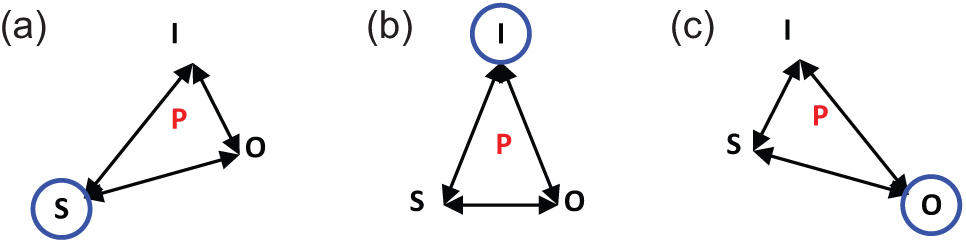
Production face.
The final face, “distribution” also experienced tensions at various stages in the research. The three elements of community (C), division of labor (D), and object (O) experienced challenges throughout the m-learning activity. In some groups, the objectives (O) were achieved at the expense of community (C) as collaboration and support for those pupils with heavy workloads (D) were not addressed, causing tensions within the group as discussed by the group leaders (Figure 5a). Where an individualized m-learning task was used such as the quiz questions in the Thames mscape, some pupils decided to form a group (C) and divide the task of answering the quiz questions (D); however, this shared ownership of the learning experience resulted in some pupils creating a gap in their subject knowledge (the object of the learning [O]) as shown in Figure 5b where the object became isolated from the community and division of labor. Finally, when the division of labor (D) to achieve the object (O) of the m-learning task became the focus of the community (C), valuable time was wasted agreeing to roles instead of working together as a team sharing ideas to achieve the common goal (Figure 5c) of the m-learning task. In this case, the division of labor (D) became parted from the purposeful interactions within the community (C) of learners to achieve the object (O).
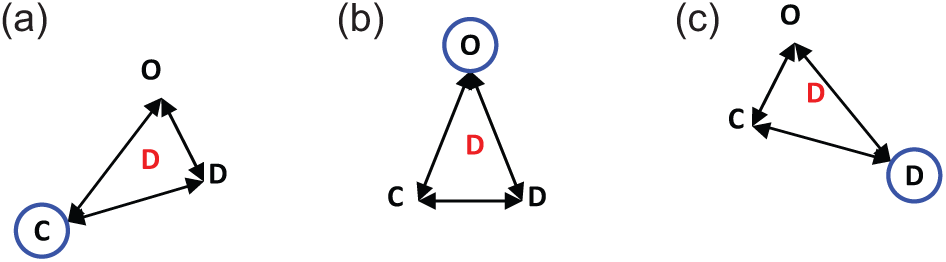
Distribution face.
Despite using the AT model and focusing on the four faces to analyze the processes at work within the activity system of m-learning, AT is more than a geometrical representation of faces and vertices. As Frohberg, Goth, and Schwabe (2009) assert, all six vertices of AT are in constant flux with each impacting directly and indirectly all faces resulting in the entire activity system being affected, including the outcomes.
Once pupils became engaged with the m-learning activity, they were selecting the extent to which they were prepared to commit to the “digital community.” Similarly, as the pupils moved around outdoors, they were opting to engage with the “physical community.” Finally, the level of interaction and collaboration associated with the m-learning tasks indicated the pupils’ involvement in the “social community.” The initial degree of a subject’s interaction with the “community” as a whole was a product of the “rules” established by the teacher and adjusted by the pupils as they became more confident in utilizing m-learning tools and managing the workload. In terms of the power/control relationship, the transition from a teacher-centered (strong classification and strong framing) Thames mscape to pupil-directed (weak classification, weak framing) treasure hunts denotes the shift in power and control over the duration of the academic year. However as discussed next, the teacher’s role can be located anywhere along this continuum at any moment in time as a result of the needs of the pupils.
The role of the teacher varied across the m-learning activities ranging from a driver to a facilitator of the learning process or a participant in the problem-solving within a group. The m-learning tasks were instigated by the teacher (strong framing); however, that role was not hierarchical, the teacher was actively involved in assisting pupils cognitively, technically, and socially as a group. Conflicts over the division of labor were resolved by the teacher, and tensions within a group were addressed to restore the community as well as assisting pupils to define the rules for their group to ensure that the learning outcomes were achieved. This central involvement with the pupils resulted in shared responsibility for the outcomes of the m-learning experience (weak framing), so the degree of control shifted between the teacher and the pupils. The use of the mobile technology itself impacted the horizontal insulation of geography as a subject. Pupils noted their ICT skills developed as part of the mscape creation process with new packages for editing images, and sounds such as the voice-overs for the treasure hunt clues were being developed alongside the use of the Mediascape toolkit. The blurring of the boundaries between geography and ICT challenged both the structural and interactional processes of power and control in the activity system.
Although AT was effective in interpreting the specific elements of the m-learning experience from the pupils’ perspective, it seemed to fail to simultaneously capture the complexity of the real-world experience for all participants—teacher and pupils. As Uden and Kumaresan (2007) acknowledge, AT is a simplification of reality and multiple activity systems are at work in parallel around us. However, it is evident from the analysis above that there is no direct reference to the changing role of the teacher who was instrumental in ensuring that the pupils’ m-learning experience ran smoothly. The absence of the teacher from the single system model highlights a major contradiction or obstacle for teachers wishing to use AT in the future to reflect upon their mobile activity and implement change. It could be asserted that within AT, the “subject” can be interpreted as both the teacher and the pupil as they are participants in the activity system; however, this arrangement fails to recognize the reality of the situation where a synergy exists between both these players in the m-learning process. Teachers or educators who engage in action research usually have the desire to distinguish more clearly between the role of the teacher and the pupils; that is, to differentiate between the pedagogical factors and the pupils within the learning environment. In its current form, AT does not readily facilitate this level of discrimination within a single activity system.
Locating the Teacher in a Single AT Model
From the teacher’s perspective, the power and control relations discussed earlier as part of the activity system changed through the use of the m-learning activities. Sometimes, the teacher was the driver of the learning retaining power and control (strong framing as evidenced in the Thames mscape), while on other occasions (e.g., the creation of treasure hunts), a more facilitative role was adopted by the teacher actively assisting the groups of pupils with their cognitive understanding of the content and supporting them technically in the use of the m-learning tools. Specific instances of control emerged when the teacher’s help was needed to address group concerns over the distribution of workload or to reestablish the community spirit between the group members when the “rules” of groupwork needed refinement. In other instances, the teacher’s role was marginal in terms of the social systems operating within the group communities (weak framing as pupils controlled the pace of the work and self-assessed the standard of work considered acceptable for their treasure hunt). The traditional hierarchical relationship between the teacher and the pupils was therefore diminished in the m-learning context and replaced by a shared responsibility for learning and consequently shared power and control of the processes of learning.
As illustrated in the above analysis of the activity system in action, the role of the teacher becomes excluded when m-learning is viewed through the lens of the AT model, whereas in reality, a control continuum existed along which the teacher’s and pupils’ level of authority shifted. As it stands, the single AT model ousts teachers from the central position they assume when leading and facilitating the m-learning activities and removes the opportunity to describe their unique role alongside the pupils in m-learning. This outcome is in sharp contrast to the purpose of AT, which relies on social interaction and is underpinned by inclusion, flexibility, and the importance of identifying the contribution of all components and their inter-relationships (Uden, 2007). To reinstate the teacher in the activity system, a refinement to the existing model of AT was considered.
A Three-Dimensional (3D) AT Model
The complexity of the real world is often difficult to capture in a model. The pupils’ interactions in an m-learning environment have been discussed in the context of the four “faces”: production, distribution, exchange, and consumption, which were found to vary in shape depending on the dominant element in the triad of vertices (see Figures 2-5). The reality of the competing forces exerted by the activity system on each element in the AT model resulted in scalene triangles replacing the equilateral triangles shown in Figure 1. However, when these scalene “faces” existed the higher order functions represented by these faces were negatively affected and so learning was diminished. To counterbalance these effects, the teacher needs to assume control of the activity system on occasions to reduce the skewing effects and to reestablish and maintain the equilateral “faces” to ensure maximum pupil learning.
The facilitative role of the teacher in ensuring a positive learning experience for all pupils requires dynamic interactions between pupils and teachers. Successful m-learning is achieved when the teacher is centrally placed in the activity system, enabling observation of group dynamics and progress as well as being approachable to the pupils who require direction or guidance to support their learning. This prominent position is not necessarily a position of authority or hierarchy. Within the current AT model, any new vertex placed inside the model to represent the teacher would need to be equidistant from all other vertices; otherwise, the teacher is placed closer to some components than others, suggesting a greater impact on those elements. A new vertex inside the AT model would upset the equilibrium that currently exists within the system. Similarly placing the teacher outside the current AT model indicates a hierarchy where the teacher sits at the pinnacle of the system with overall control and power. By converting the current two-dimensional (2D) model to a 3D model, the teacher can be located at the center of the triangular pyramid, equidistant from all vertices but still within the activity system and avoiding a hierarchical status (see Figure 6). Remaining true to the original AT model, the only component outside the triangular pyramid is the “outcome” of the activity as before.
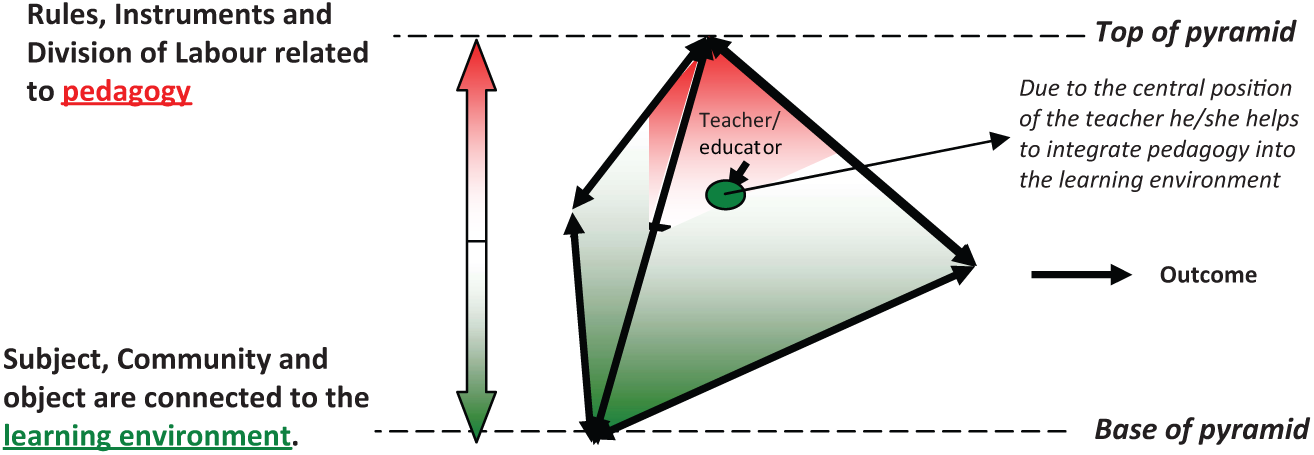
The 3D model to accommodate the role of the teacher.
By using a 3D model as a representation of the m-learning activity system, the positioning of the vertices needs to be established. The “consumption” of m-learning is key to the activity system and therefore should act as the base or foundation of the 3D triangular pyramid, making the subject, community, and object vertices the base of the pyramid. These three elements are linked by the learning environment itself—so they provide the “platform” from which m-learning can take place. The sides of the pyramid are therefore the remaining three faces—production, distribution, and exchange. At the apex of the pyramid, the three elements, rules, instruments, and division of labor converge, symbolizing the “pedagogy” of the activity system. It should be noted however that the positioning of the vertices in the new model is not an indication of their relative power or level of control, with pedagogy dominating over the learning environment; instead, it highlights the centrality of the teacher in connecting the learning environment and pedagogy to create an effective m-learning experience for the pupils. The control continuum no longer extends in a linear fashion but radiates out in all directions from the teacher, indicating initial control of all elements of the activity system (strong framing). However, over time, this control can be withdrawn allowing for the transition in the teacher–pupil partnership to evolve with pupils’ increased familiarity with the tools of m-learning and increased experience of managing their roles (rules and division of labor) within the activity system as a community (weak framing).
Within the new 3D model of AT, the higher order functions of “production,” “distribution,” “exchange,” and “consumption” are more clearly defined as playing a key role in sustaining the balance within the activity system as a whole. This enhanced AT model illustrates the dynamism and exchange of control that exists through the interaction of the components of the system and emphasizes the importance of the teacher/educator role at the heart of the model exerting controlling forces as necessary to retain the balance by reacting to any power shifts within the model. This force from within the AT model could be referred to as adaptive framing.
Conclusion
This research set out to problematize the role of the teacher in m-learning using the single model of AT as the lens through which to analyze the data arising from the study. Action research was used to capture the experiences of a teacher introducing mscapes to a first year examination cohort of pupils (aged 14-15 years) who were enrolled on a 2-year Geography course to be assessed by national examinations. Focus group interviews and class discussions were used to capture the pupils’ perspectives of the mscape experiences on the two geographical topics—the long river profile and ordnance survey map skills—accounting for approximately one third of the 2-year course. Teacher/researcher journals, comprising text and photographs, were used to support the action research element of the study and to question the reflections and assumptions against the realities of the pupils’ experiences.
Pedagogically, the teacher’s role changed notably over the course of the academic year as the mobile technology became accepted into the teaching environment. The use of the teacher-created Thames mscape was effective in exemplifying good practice in the design and use of m-learning. Although strong framing was invoked in the first mscape (Thames mscape) as it was strongly teacher-led and retained a high level of pupil control due to its design features, this m-learning experience highlighted the power of technology in learning and defined a goal for the pupils when they commenced their mscape development for the ordnance survey map skills activity. The transition from strong classification and strong framing as denoted in the Thames mscape to low classification and weak framing when the pupils accepted the challenge of creating their own mscape in groups revealed the key contradiction in the AT model. Despite the pupils’ continued reliance on support and guidance from their teacher to resolve group problems and assist with technical issues, the use of the AT model to analyze the processes involved in m-learning during this time revealed no clearly defined, inclusive position for the teacher in the model which suitably represented this synergy between the pupils and their teacher.
Detailed analysis of the interplay between the four higher order functions in operation in the activity system revealed the need to position the teacher at the heart of the process with control radiating out all directions to the AT components. To accommodate this requirement, an enhanced version of the AT model was proposed using a 3D triangular pyramid to represent the teacher-inclusive activity system in operation in the study. The higher order functions of “production,” “distribution,” “exchange,” and “consumption” were the four “faces” of the pyramid with “consumption” forming the base as it encapsulates the three components of subject, object, and community, which are conceptually connected as the “learning environment,” the platform upon which the processes of learning are founded. At the apex of the pyramid, the three components, rules, instrument, and division of labor, converge, which are conceptually connected by the “pedagogy” of learning. As Figure 7 illustrates, the teacher can therefore be placed at the heart of the 3D pyramid equidistant from all four faces and all six components of the activity system. The analysis of the two mscape activities from the pupil and teacher/researcher perspectives revealed that as contradictions emerged within the activity system, the power relations between the faces or the components in the AT model became unbalanced leading to a skewing of the pyramid and a reduced learning experience for the pupils. It was therefore imperative that the teacher assumed this central position in the 3D model from which increased levels of control can be exerted to resume the balance in the activity system. It is suggested that this dynamic social interaction between the teacher and pupils is termed adaptive framing to denote the “just-in-time” structural and interactional changes needed to be implemented by the teacher to sustain a balanced and efficient m-learning environment.

3D model of the Activity System associated with mobile learning with the teacher/educator at the heart of the system.
It should be noted, however, that this model evolves from one research study in a school context where power relations and control are typically the preserve of the classroom teacher. From the pupils’ perspectives, shared, tacit understandings or well-known protocols of acceptable behavior result in teachers being accepted as the dominant player in controlling the learning processes. Any positive interference from the teacher to restore the balance in the activity system and to maximize learning is therefore welcomed by the pupils. The use of this model in a third-level education system may reveal similar levels of acceptance of the educator in the central position; however, it would be anticipated that less control may be needed to sustain the balance of power within the system as the learners should be more competent at addressing any imbalances with their learning community by adjusting the division of labor appropriately or redefining the rules to promote effective collaboration. A more interesting case may be found in the nontraditional (informal) learning context, especially if the 3D AT model revealed the existence of a central, coordinating force in these informal learning situations.
It is accepted that additional challenges to the proposed 3D AT model will emerge from the fact that this is one case study investigation into the use of m-learning when teaching physical geography. Although due care and attention was paid to ensure rigor during the data collection and analysis phases, to avoid bias and unsubstantiated claims when interpreting the subjective evidence from the journals, focus group interviews, and class discussions, it is acknowledged that some researchers will continue to challenge this proposed enhanced AT model. It is therefore recommended that further research is needed in other m-learning situations across a range of subjects and a variety of age groups in differing school situations before the proposed 3D model could be accepted as a viable framework for analyzing school-based m-learning. Indeed, the need to validate the applicability of the 3D AT model to analyze learning outside compulsory education—either in higher or further education or for informal learning—has been noted above. It is therefore acknowledged that further research in a broad range of teaching and learning situations is needed to determine the feasibility of the 3D AT model for all m-learning situations. Nonetheless, for teachers aspiring to make the transition to using mobile technologies in their teaching, this study is the first to provide a unique insight into the complexity of the teacher–pupil power dynamics that exist over the duration of a full academic year in an examination-focused post-primary classroom, and it offers an original framework to prompt teachers’ thinking about the dynamics in their classroom practice. The 3D AT model, combined with the use of adaptive framing, provides a clear indication of teachers’ roles and responsibilities in organizing and managing an effective m-learning experience for their charges and aims to bridge the gap between existing studies and future research into m-learning pedagogy.
Footnotes
Declaration of Conflicting Interests
The author(s) declared no potential conflicts of interest with respect to the research, authorship, and/or publication of this article.
Funding
The author(s) received no financial support for the research and/or authorship of this article.