




Abstract
This article investigates the influence of the position of occlusion, structural composition, and design educational status on Chinese character recognition accuracy and response time. Tsao and Liao conducted an experiment using 18 of the 4,000 most commonly used Chinese characters and suggested that the primary and secondary recognition features of a “single-sided” occluded Chinese character are the key radical (or initial strokes) and the key component (i.e., combination of strokes), respectively. The study concluded that right-side occluded characters require a shorter response time and yield more accurate recognition and that educational background does not significantly affect recognition accuracy and response time. The present study considered the same 18 Chinese characters and extended the work of Tsao and Liao by exploring accuracy rate and response time in design and nondesign educational groups for the recognition of “double-sided” occluded Chinese characters. The experimental results indicated that right-side occlusion (including both bottom-right and top-right occlusion) requires a shorter response time and yields more accurate recognition than left-side occlusion. These results agree with those of Tsao and Liao, who found that the key radical of a Chinese character is its key visual recognition feature. Even double-sided occlusion of Chinese characters does not affect the recognition outcome if the position of occlusion does not blur the key radical. Moreover, the participants majoring in design recognized the occluded Chinese characters more slowly than those with no educational background in design.
Keywords
Introduction
Occluded Chinese characters are used by graphic designers to attract attention, helping to fill-in information automatically and inciting easy recall of these images (Zeigarnik, 1999). From the perspective of germane cognitive load proposed by Sweller, Van Merrienboer, and Paas (1998) and Gerjets and Scheiter (2003), among other scholars, improvements to teaching materials and methods can motivate learners. In addition, such improvements can enhance the germane cognitive load. For the same reason, when viewers are challenged to recognize an occluded word in a short time, their cognitive load is increased, but their focus on character recognition is greatly enhanced as well.
Occluded text is that which is unknown to the viewer and not completely in view, obscured by a foreground that may be visible or partially obscured (Luijkx, Thillou, & Gosselin, 2006). Graphic designers often apply partially occluded Chinese characters to products following their own judgment. Creating an image as part of the product design process is costly and time-consuming. As shown in Figure 1, the effort to recognize occluded characters can result in three outcomes: recognizable, difficult to recognize, and misrecognized. A clear foundation is needed for design based on empirical data gathered from viewers’ recognition tests. Motivated by this need, in this article, we explore how to recover occluded strokes and ensure that characters are recognized correctly under certain circumstances. We present a basis and principles for the recognition of partially occluded Chinese characters through experimental data regarding 18 commonly used Chinese characters to assist designers to create images for graphic design, product design, package design, or other relevant media. By doing so, we aim to shorten the time for judging both the position of occlusion and occlusion ratio as well as to reduce the uncertainty and guessing time.

Instances of a partially occluded Chinese character on a product.
Published research suggests that designers and nondesigners exhibit different recognition patterns under the same circumstances. People who are trained in design and art can more easily accept diversified elements; their training encourages them to be creative (Eisner, 1994). Chiang and Sun (2014) asserted that designers are trained to think using the right side of the brain, which is in charge of perceptual space; therefore, designers are better at image thinking. Lin and Chang (2012) explored differences in the perception of classic chair design for young students with design or nondesign educational backgrounds and find that a statistically significant difference exists between the two student groups. Students with a nondesign educational background do not have a clear concept of modern and unique styles. Moreover, Hsu and Wang (2009, 2010) suggested that, in terms of the preference for image degradation, nondesigners prefer concrete images more than designers do.
Tsao and Liao (2015) demonstrated that design majors and nondesign majors do not exhibit significant differences in accuracy and response time for recognizing single-sided occluded Chinese characters. It is, therefore, valuable to extend this work to study how design educational status influences recognition responses for double-sided occluded Chinese characters and to compare the results with those of Tsao and Liao (2015). Such comparisons might be beneficial to designers for understanding viewer differences.
Biederman (1981, 1987) proposed the recognition-by-components theory. According to this theory, viewers recognize an object by its composition, not its wholeness. An object becomes easily recognizable if we separate it into 36 geons. In addition, an object is said to be recognizable if it is separated into two or more geons, even if the object is partially occluded, steered, extensively degraded, or a novelty item. By applying the recognition-by-components concept to Chinese character recognition, viewers can understand a character’s main component parts. It is, therefore, crucial to explore the relevancy of structural composition to Chinese character recognition. Many studies (such as Seidenberg, 1985; Fang & Wu, 1989; Flores d’Arcais, Saito, & Kawakami, 1995; Feldman & Siok, 1997; Taft & Zhu, 1997; Taft, Zhu, & Peng, 1999; and Tsang & Chen, 2009) have presented evidence that the comprehension of a complex Chinese character requires the processing of the character’s component parts.
Each Chinese character is composed of radicals (or components) that are integrated according to particular formational relationships (Cheng, 1981). These radicals contain messages, and if the radicals are learned, their message can be used to analyze Chinese characters (Wang & Fan, 2001). According to the explanation in the Taiwan Ministry of Education’s Concise Mandarin Chinese Dictionary, a radical refers to a distinct part of a Chinese character that is present in the top, bottom, left, or right position of the character. According to Taft and Zhu (1997) and Ding, Peng, and Taft (2004), approximately 214 radicals are used in Chinese language dictionaries and indexing. For example, a 工 radical appears on the right side of the character 江, and the key radical of 江 is 水; a 林 radical is present on the bottom of the character 霖, and the key radical of 霖 is 雨. In this article, for clarity, we term each basic component of a character a “radical” and the radical used for searching in dictionaries the “key radical.”
Chinese phrases normally comprise at least two characters (Hoosain, 1992). As phrases can be read horizontally (from left to right or from right to left) or vertically (from top to bottom), the position of the occlusion in the phrase must consider reading direction, the linkage between the initial and ending characters, and the relationship among the components.
The Chinese language has a multitude of Chinese characters, most of which are quite complex. They have been categorized into different structure types depending on the focus of the research (Sugiura, 2006; Wang & Fan, 2001). Chinese characters are formed with different numbers of strokes and structural compositions (Chen, 1974; Wu & Chiu, 1995). Accordingly, as shown in Table 1, this article categorizes Chinese characters into nine structure types: (1) single body or independent structure, (2) left-right structure, (3) upper-right enveloping the rest, (4) upper-left enveloping the rest, (5) top-bottom structure, (6) left-to-right and bottom structure, (7) left-to-right and top structure, (8) top-middle-bottom structure, and (9) left-middle-right structure. Chen (1974) mentioned that the key radical is typically the most crucial component of a Chinese character. Key radicals define the orthographic similarity of Chinese characters (i.e., similarity in the combination of strokes). In Chinese, both the radical and the combination of strokes have meaning (Peng, 1982). In the cases of Type 2, Type 3, and Type 9 in Table 1, if the key radical is on the left side of the character, the other components are on the right side. In the case of Type 4, if the key radical appears at the right, the other components are on the left side of the character. If the key radical is at the top of the character, but the rest of the components are at the bottom, the structure of the character can be top-down (see Type 7 and Type 8 in Table 1). In the cases of Type 5 and Type 6, if the key radical is at the bottom, the rest of the components are at the top of the character. A character can also have an inseparable, single-body structure, such as that of 米 (see Type 1 in Table 1).
Nine Structure Types of Chinese Characters.
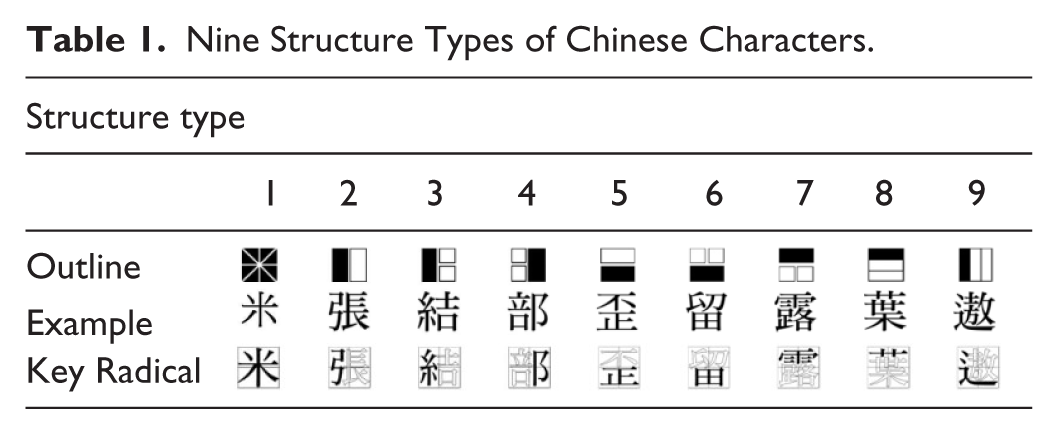
Sugiura (2006) addressed the argument by Iwanami Shoten that a Chinese character can still be recognized if only the central component of the character is occluded, but a Chinese character is difficult to recognize if components on all four sides of the character are occluded. Accordingly, this study used Chinese characters with left-middle-right structures or top-middle-bottom structures, that is, Type 8 and Type 9 in Table 1. In the visual recognition experiment, the four surrounding sides were occluded.
For word recognition, the upper part of a word or letters and initial words are more essential than the bottom part of a word (Rayner & Kaiser, 1975). Peng (1982) verified that it is more difficult to recognize a Chinese character with an occluded upper-left side. Researchers such as Saito (1986), Huey (1968/1908), and Flores d’Arcais (1994) suggest that a Chinese character stroke is easier to comprehend at the upper-left corner. Tseng, Chang, and Wang (1965) found that it is easier to recall occluded strokes from a Chinese character when the occluded strokes are front strokes. Yan et al. (2011) explored the influence of stroke order on Chinese character recognition and argue that a character with occluded initial strokes is the most difficult to recognize.
Tsao and Liao (2015) suggested that recognition is relatively accurate for characters for which the main identifiable key radicals (or initial strokes) or components (i.e., combination of strokes) are visible. In addition, the optimal proportion of occlusion is 2/9 of the length on each side of the character. To extend the work of Tsao and Liao (2015), this article discusses the following four hypotheses:
Method
Participants
From two universities in Taiwan, 160 students (39 male and 121 female) were randomly selected. The age of the participants ranged from 18 to 28 years, with a mean age of 20.59 years (SD = 1.79; Table 2). All participants were regular computer users who used a computer 3 times or more per week. Regarding the educational background, one half of the participants were design majors, and the other half were nondesign majors. All participants reported that they had no known reading difficulties and had normal or corrected-to-normal vision. After they completed the experiment, the participants received a small gift as a reward.
Demographic Variables.

Note. The numbers in the first row under age distribution indicate the participants’ ages; the numbers with a gray background indicate the number of participants of each age.
School of Design students, irrespective of whether they are majoring in product design, commercial design, digital media design, or architectural design, are required to attend foundational professional courses during their first 2 years of university study. These courses include esthetics, introduction to design, color theory, design drawing, and basic design. Concurrently, these students normally process design elements such as text, images, and space. For the purposes of this research, students who had completed these courses were considered to have a design background, and those who had not taken these courses were considered nondesign participants.
Design of Experiment
A 2 × 4 × 2 mixed design was conducted to test how accuracy rate and response time were affected by the position of occlusion and structural composition of the character as well as the educational background of the participant. Accordingly, educational background, position of occlusion, and structural composition were treated as independent variables in the experiment, whereas response accuracy rate and response time were regarded as dependent variables. Structural composition was considered to have two levels: top-middle-bottom structure (hereafter referred to as “vertical structure”) and left-middle-right structure (hereafter referred to as “horizontal structure”). A within-subjects factorial design was calculated on the effects of structural composition. The position of occlusion was of four types: top left, bottom-left, top right, and bottom-right. To avoid the learning effects of repeated identification of the same Chinese characters, each participant was tested on a set of vertical and horizontal Chinese characters that were occluded in only one of the four positions. Accordingly, the position of occlusion is also a within-subjects factorial design. In addition, educational background was considered to have two levels: design background and nondesign background. A between-subjects factorial design was conducted on educational background.
Stimuli
Research indicates that Chinese characters with a high frequency of appearance and low stroke complexity are recognized more quickly (Huang & Hsu, 2005; Seidenberg, 1985). Wu (1987) selected the 4,000 most commonly used Chinese characters of 800,000 characters that appear in the textbooks read by college students. Accordingly, the recognition experiment of this article adopted 18 Chinese characters of the 4,000 most commonly used Chinese characters selected by Wu (1987). In the experiment, the occluded character displays were formed from 18 Chinese characters. Nine of the 18 Chinese characters have a vertical structure, and the other nine have a horizontal structure. Among these 18 Chinese characters, three (謝, 喜, and 邀) are selected because they are frequently used on greeting cards. Regarding frequency of appearance as a single word in text, eight of the 18 Chinese characters—謝, 潮, 邀, 尋, 桌, 賣, 葉, and 暴—are low-frequency words, appearing approximately 90 to 200 times; eight characters—樹, 衛, 例, 辦, 鄉, 職, 算, and 喜—are medium-frequency words, appearing approximately 201 to 500 times; and the remaining two characters—意 and—are high-frequency words, appearing approximately 1,000 to 1,390 times.
The typeface of a text affects character recognition speed and accuracy for that text. Shieh, Chen, and Cuang (1997) and Cai, Chi, and You (2001) found that the Ming typeface has a shorter response time than the regular script typeface. Thus, the double-sided occluded character displays applied in the recognition experiment of this article were in the Ming typeface. To highlight displays, bold formatting was applied, and the character’s size was increased.
Furthermore, the study of Tsao and Liao (2015) concluded that the position of occlusion affects recognition response to a single-sided occluded Chinese character. The right position is the optimal occlusion position because such occlusion has the least influence on the recognition of the radical or character feature, leading to faster response and more accurate recognition.
For characters with a vertical structure, the key radicals are typically positioned at the tops or bottoms of the characters, making it more difficult to recognize a character that is occluded on both the top and bottom sides. For characters with a horizontal structure, most key radicals are positioned on either the left or the right side of the character. Only a few characters have key radicals positioned in the center. The Chinese characters 鄉 and 辨, which were displayed in the experiment of this article, have key radicals positioned on the right side of the characters. The rest of the horizontal Chinese characters displayed in the experiment have key radicals positioned on the left side of the characters. Therefore, when the right sides are occluded, their main recognizable features are entirely visible.
Moreover, Tsao and Liao (2015) and Liao (2017) calculated that the optimal ratio of occlusion should be 2/9 of the length on each side of the character. If the trimming ratio is too great (i.e., 3/9), the occluded image result becomes less recognizable. On the contrary, the occlusion effect is too small if only 1/9 is trimmed. To avoid drastically poor recognition of the occluded Chinese characters displayed in this recognition experiment, the researchers trimmed 1/9 off the side of each character’s key radical and 2/9 on other sides. That is, for characters with a vertical structure, such as 桌, the ratios of occlusion were 1/9 of the height from the top, where the key radical appears, and 2/9 of the width on the left side of the character (see the first row of Part A in Table 3). For characters with a horizontal structure, such as 潮, the ratios of occlusion were 1/9 of the width on the left side of the character and 2/9 of the height from the top of the character (see the first row of Part B in Table 3)
Experimental Stimuli: 72 Occluded Chinese Characters.
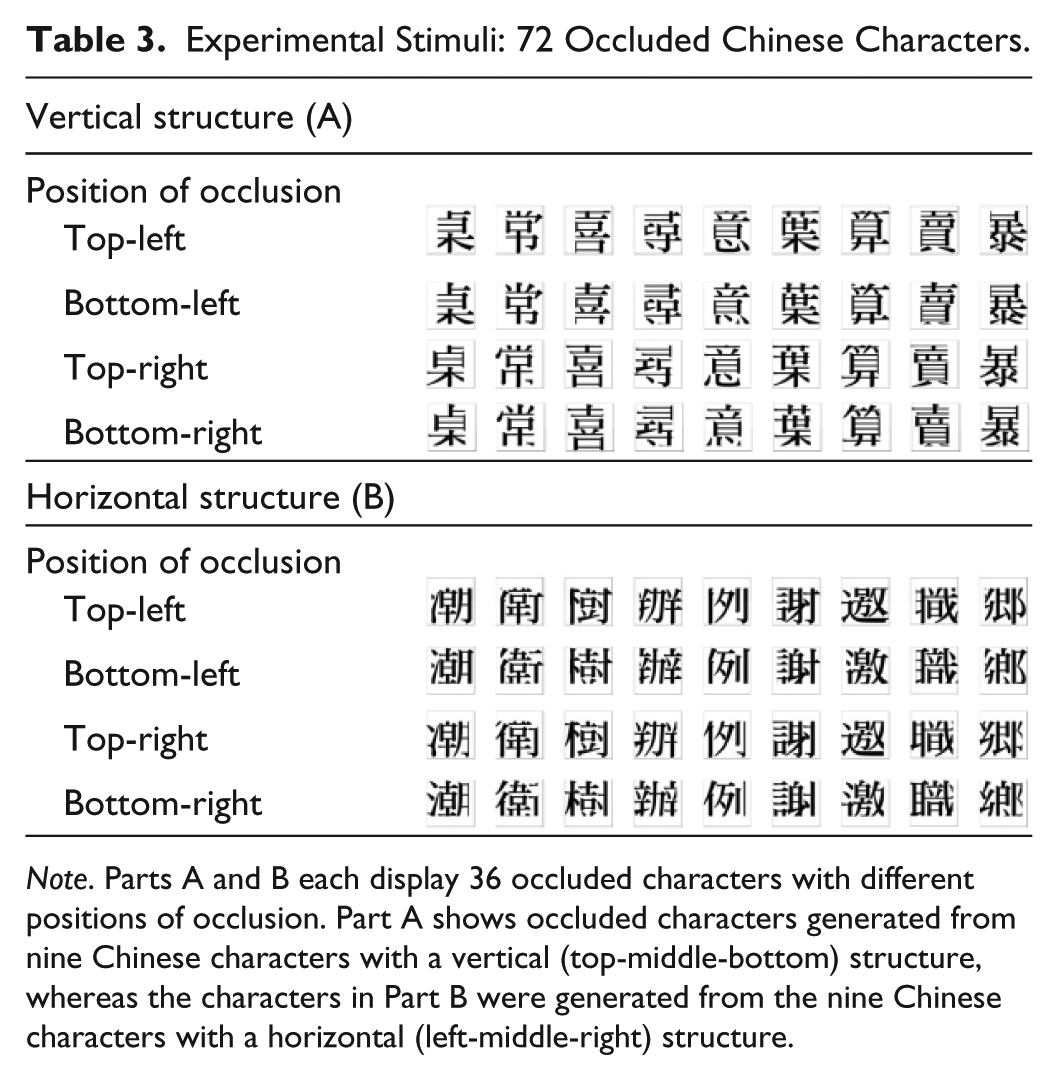
Note. Parts A and B each display 36 occluded characters with different positions of occlusion. Part A shows occluded characters generated from nine Chinese characters with a vertical (top-middle-bottom) structure, whereas the characters in Part B were generated from the nine Chinese characters with a horizontal (left-middle-right) structure.
Apparatus
The recognition experiment was executed on IBM workstations connected to ViewSonic 17-inch color monitors (width × height = 34 × 27.2 cm) with a resolution of 1,024 × 768 pixels. Each participant focused on the monitor at a viewing distance of 45 cm with a 15-degree visual angle. Each participant viewed one stimulus (in the form of a PowerPoint slide) at a time. Response time was measured with a Casio timer.
Procedure
The recognition experiment was conducted in the computer laboratories at the participants’ schools. Each participant worked independently. On a random basis, the participants were categorized into four groups of 40 (20 with a design educational background and 20 without). To forestall order and learning effects, each group was asked to recognize a set of Chinese characters occluded in one of the four positions for both vertical and horizontal structures, as shown in Table 3. The occluded character displays were presented to each participant in a random order.
In the experiment, the participants were informed that they would be shown 18 Chinese characters one after the other and that they should pace themselves comfortably and look silently by themselves. They were informed that timed recognition tasks would be performed. Each group took approximately 10 min to perform the recognition tasks. Each participant filled out a short questionnaire before leaving the room.
To ensure that all participants knew what they were doing, they all first completed a set of warm-up exercises with materials that resembled those applied in the experiment. In these exercises, participants were also shown how to use a start/finish button to perform the test. Tapping this button caused a Chinese character to appear on the screen. After looking at the Chinese character and reciting it aloud, the participant tapped the button again to summon the next Chinese character. As participants tried to recognize the set of nine occluded Chinese characters presented in Part A of Table 3, the researcher used a timer to time how long each participant took to finish each task and recorded how many errors the participant made. The participants then continued to perform the task for the set of nine occluded Chinese characters shown in Part B of Table 3. The responses were timed in seconds, and response accuracy rates were calculated as a participant’s percentage of correct answers for a collection of Chinese characters.
Results and Analysis
Anticipating that gender might influence the experimental results, the researcher made gender a factor in the analysis of variance; however, no interaction was found between gender and response time, F(1, 156) = 0.206, p = .651; that is, gender has no significant effect on recognition speed. Moreover, gender has no effect on character response accuracy, F(1, 156) = 2.67, p = .606. Hence, gender is not further discussed in the “Results and Analysis” and “Discussion” sections.
Response Time
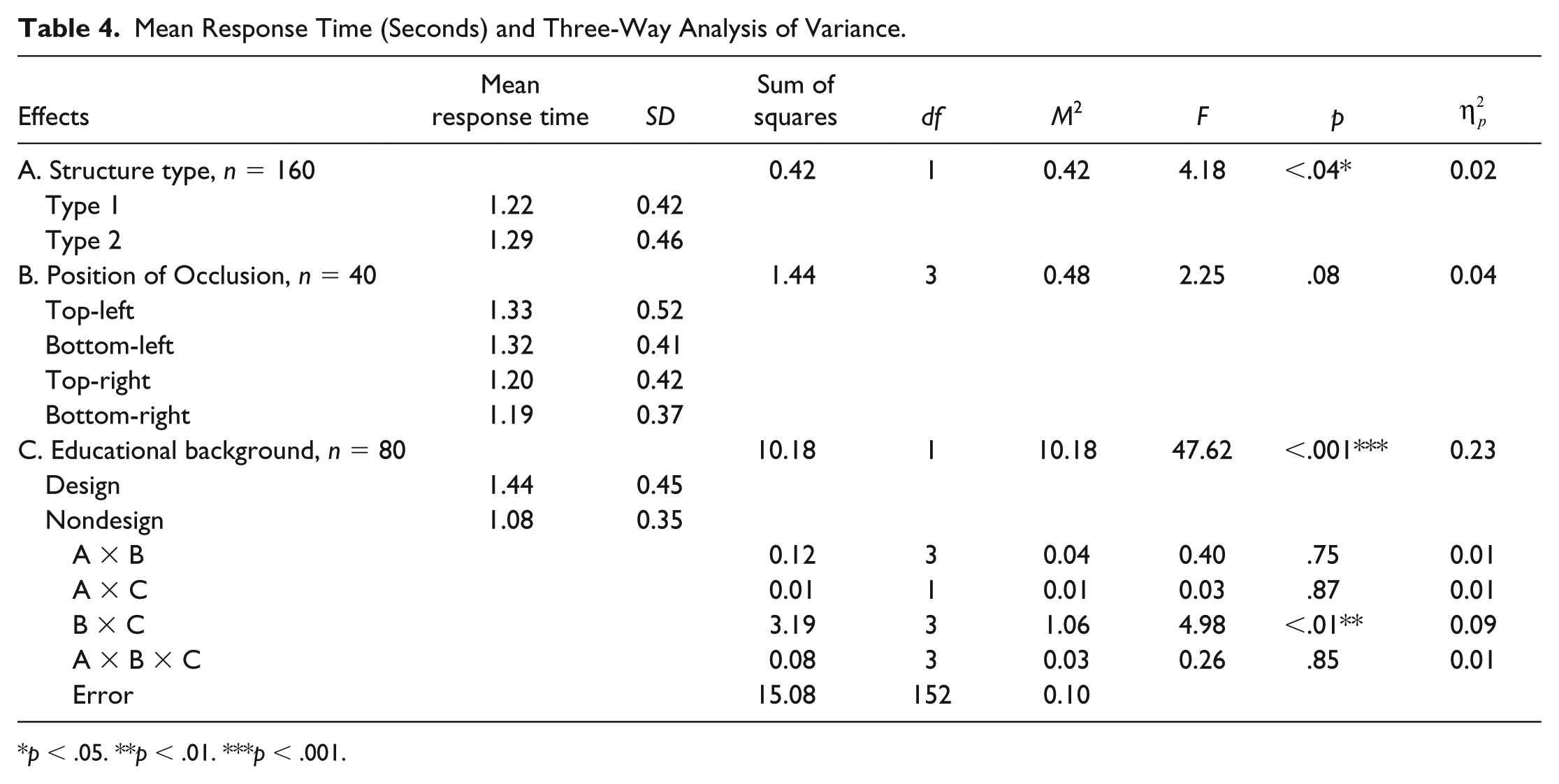
Table 4 shows the descriptive statistics of three-way analysis of variance with interaction. With F(1, 152) = 4.18, p < .05, and
Mean Response Time (Seconds) and Three-Way Analysis of Variance.
p < .05. **p < .01. ***p < .001.
Table 4 shows that among the three factors, that is, structural composition, educational background, and position of occlusion, only position of occlusion has a strong interaction with educational background; F(3, 152) = 4.98, p < .05,
Moreover, the Scheffe’s post hoc comparison result reveals that, as shown in Figure 2, regarding Chinese characters with a vertical structure, structural composition provokes a quick response to both bottom-right and top-right occlusions. Furthermore, top-left-side occlusion results in the slowest response speed. For characters with a horizontal structure, recognition response times for both top-right and bottom-right occlusions are much shorter than for bottom-left occlusions. As previously discussed, participants with a design background demonstrate slower recognition responses to both “structural composition” and “position of occlusion” than participants without an education in design.
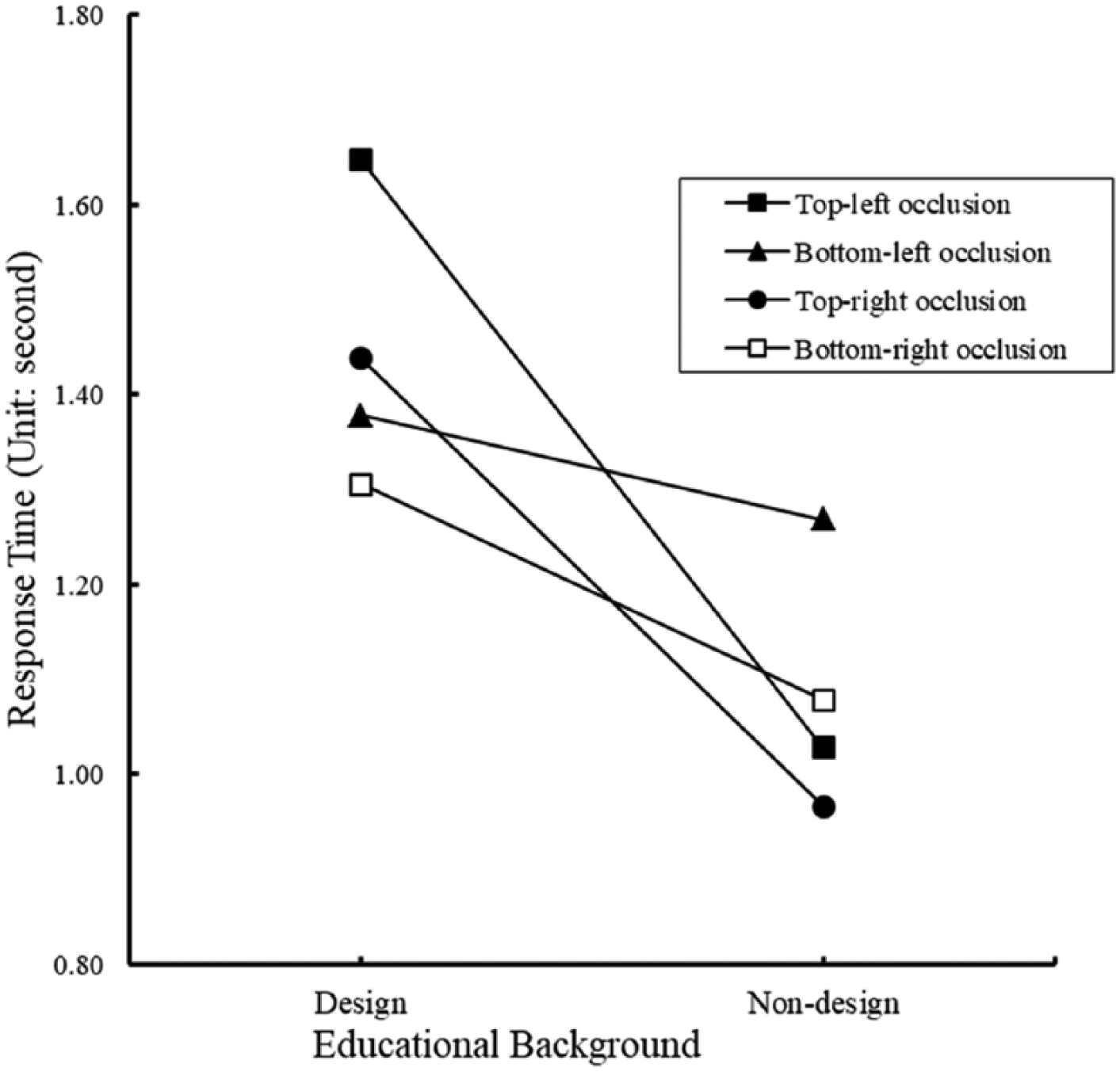
Both the position of occlusion and the structure of Chinese characters affect response time; the results are segmented by educational background.
Table 4 shows an interaction effect between educational background and position of occlusion. To better understand the relationship between design background and position of occlusion, we segmented the data according to these independent variables. Participants with a design educational background displayed no significant difference in response times to different positions of occlusion. However, those without a design background exhibited a significant difference in their response time to characters with horizontal and vertical structures.
Furthermore, data segmentation reveals differential effects for the three positions of occlusion, top-left, top-right, and bottom-right, depending on the educational background. Moreover, some characters with bottom-left occlusion were not easy for either group to recognize; for example, 邀 was easily mistaken for 激. This finding illustrates the effect of occluding the part of a character where the key radical is positioned, which leads to easy misreading of characters.
Response Accuracy
As shown in Table 5, the structural composition of Chinese characters significantly affects participants’ recognition accuracy of occluded Chinese characters; F(1, 152) = 135.59, p < .05,
Response Accuracy (%) and Three-Way Analysis of Variance.

p < .05. **p < .01. ***p < .001.
The position of occlusion strongly interacts with the structural composition; F(3, 152) = 27.57, p < .05,

Both the position of occlusion and the structure of Chinese characters affect the accuracy rate.
Mistakenly Recognized Chinese Characters
Table 6 shows that double-sided occluded Chinese characters lead to higher recognition accuracy than single-sided occluded Chinese characters, a result that is similar to that of Tsao and Liao (2015). Among the 18 Chinese characters used in this experiment, the participants mistakenly recognized 辦 as 辨. The Chinese character 例 was also mistakenly recognized as another Chinese character, 列. The Chinese character 邀 encountered error recognition 44 times and hence is viewed as the most frequently mistaken character. This error recognition rate is much higher than that of single-sided occlusion. When 邀 is occluded, it tends to be mistakenly recognized as another Chinese character, 激. Accordingly, the experimental results suggest that the frequency of mistaken identification is unlikely to be affected by whether occlusions are single-sided or double-sided for the 18 Chinese characters used in the experiment. In other words, the occlusion ratio of 1/9 is unlikely to affect the recognition response. The Chinese character 邀 has a high frequency of mistaken identification because participants have difficulty recognizing this character when it is occluded on both the bottom-right and bottom-left side. When it is occluded on a single side, it also looks like 激. Furthermore, occluding by 1/9 on the left side or bottom-right side increased the similarity of 邀 to 激.
Frequencies of Mistaken Identification and Mistaken Perceptions of Occluded Chinese Characters.
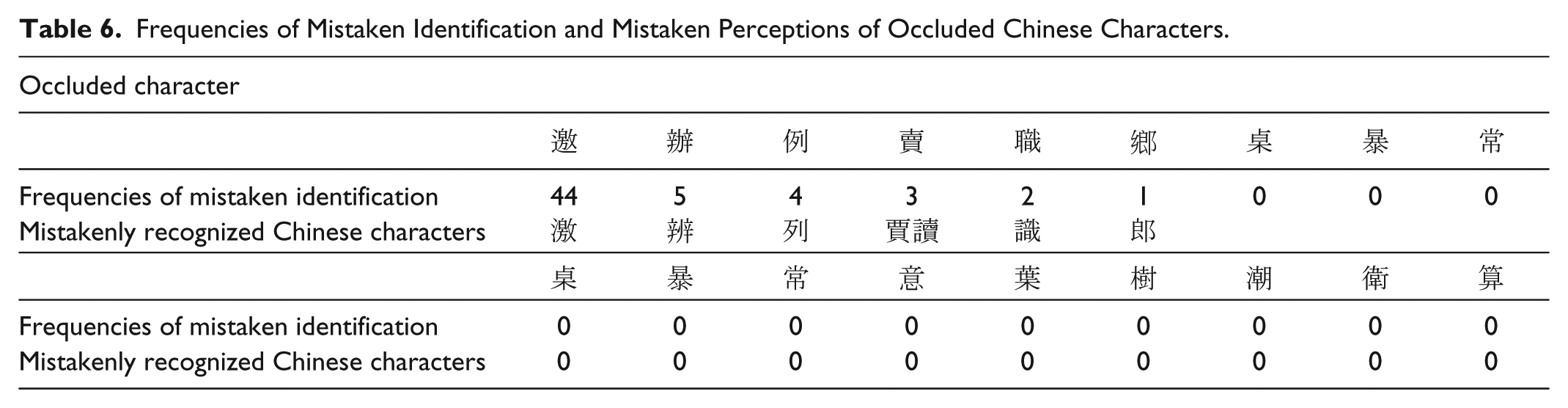
When occluded on the left, 例 is easily mistaken for 列 because the 人 radical is virtually invisible, and what is left is identical to 列. Similarly, 職 is easily misread as 識 when occluded on the left side, and the same is true for 鄉 being misread as 郎. In addition, a vertically structured character such as 賣 may be misread as 賈 when occluded on the top or might be mistaken for 讀 when the 言 is occluded on the left. Another example worth noting is that of 辦, which was misread as 辨, which is unrelated to the position of occlusion but rather has to do with a misreading of the 力 radical positioned in the middle as  . The close similarity of these two characters and the time pressure likely led to the mistaken identification.
The aforementioned examples illustrate that the structure of most Chinese characters that incorporate one or more radicals, each of which has meaning, can result in easily mistaken identification when a character is occluded. This finding is reflected in the effect of the key radical’s position on recognition response and is consistent with the results of other studies.
After the experiment, we randomly interviewed 15 participants who have a design educational background. Many of them said that they extended the occluded strokes of the Chinese characters displayed in the experiment to match the characters stored in their brains. The participants also treated occluded characters as characters with a complete structural composition because many occluded characters still retain their key visual recognition features even with an occlusion ratio of 3/9. A few noted that they looked closely at occluded Chinese characters with higher proportions of occlusion and took more time to recognize them because these characters looked like text images. For example, the Chinese character 意 becomes piecemeal and looks like an image if it is occluded at 3/9 of the width on the bottom side or on the bottom-left side of the character.
Concurrently, 18 participants with a nondesign educational background were also interviewed. None of them indicated that they would consider occluded characters to look like a text image; rather, they would directly judge which Chinese character it was without much additional thought. As these characters should all be familiar, they could guess which radical or key radical had been occluded or connect the strokes that were visible to lead them to a guess. From the descriptions provided by these two groups of participants, it can be more clearly understood that those with a design background have a slower response time due to a higher prevalence of image thinking.
Discussion
This study considers 18 Chinese characters, divides them into two different structural compositions and applies four positions of occlusion (i.e., top-left, bottom-left, top-right, and bottom-right) in a recognition experiment. A three-way analysis of variance with interaction is then performed to explore the effect of an educational background in design on character recognition accuracy and response time. The experimental results indicate that structural composition has a significant effect on response time for the recognition of double-sided occluded Chinese characters. Moreover, the experimental results suggest that educational background significantly influences recognition response time. Participants majoring in design take more time to recognize occluded Chinese characters than participants without a design education. However, a design educational background does not demonstrate a significant influence on response accuracy. A significant influence is also shown on the response time and accuracy of recognizing Chinese characters with different compositional structures and positions of occlusion. For optimal recognition, the optimal positions of occlusion for characters with a vertical structure are the top-right and right-bottom sides of the character, whereas the optimal position of occlusion is the top-right side for characters with a horizontal structure. These positions of occlusion have quick recognition responses because the key radicals (or initial strokes) of Chinese characters are not occluded; thus, it is easier to recognize them correctly.
Compared with participants with nondesign educational backgrounds, participants with a design educational background have slower recognition responses for the occluded Chinese characters. Hence, we interviewed 15 participants majoring in design regarding how they recognized the occluded characters displayed in the experiment. Chinese characters with higher proportions of occlusion look like text images, and the participants note that they looked closely at these occluded Chinese characters and took more time to recognize them, possibly because participants majoring in design use more graphics or text images in their work than nondesign majors do.
Regarding the interaction of recognition response and structural composition for all participants, it took more time to recognize characters with a horizontal structure than characters with a vertical structure. The reason is probably that more strokes remain on the right side of the characters with a horizontal structure when these characters are occluded on their left sides; thus, their similarity to other characters is greatly increased. For example, 鄉 resembles 郎, 職 resembles 識, and 例 resembles 列. Furthermore, the responses of the experiment participants to mistakenly recognized Chinese characters indicate that the tendency is to recognize occluded characters from similar features when the key radicals or components of the character are occluded. This finding confirms Hypothesis 3 of this article: Participants in the experiment will attempt to recognize a Chinese character based on feature similarity when the key radical or component of the character is occluded.
Having a design educational background did not significantly influence the recognition accuracy response to occluded Chinese characters. This finding suggests that the participants were familiar with the 18 Chinese characters adopted for the recognition experiment. The participants quickly recognized 16 of the Chinese characters, with the exception of 邀 and 桌, even when they were occluded by 1/9 of the width on the side of the character’s key radical and 2/9 on the other side. That is, the recognition of a character with an occlusion ratio of 1/9 is the same as that of the character with a complete structural composition. Yan et al. (2011) similarly concluded that it is as easy to recognize a character with a segmentation ratio of 15% as it is to recognize one with a complete structural composition. This finding is consistent with those of Tsao and Liao (2015) and Liao (2017). The optimal occlusion ratio is 2/9 of the width on each side of the character. If a character is trimmed by 3/9, the occlusion results in too little readability, whereas the image occlusion effect is too low when trimming only 1/9.
Conclusion
This article explores the effect of double-sided occlusion of Chinese characters on recognition responses between participants with and without design background. The experimental results will help researchers to confirm the primary visual recognition features of a Chinese character as well as to identify both the optimal position of occlusion and the optimal occlusion ratio. Furthermore, the results indicate that recognition differences exist between design and nondesign majors. The findings demonstrate that it is paramount to not occlude the key radicals (or initial strokes) of Chinese characters. Based on our data, for a graphic designer to deliver designs that achieve a shorter recognition response time and superior recognition accuracy, it is advisable to occlude the right side (either the top-right or bottom-right side) of a character because this occlusion has the smallest effect on the main recognition features of characters with both vertical and horizontal structures.
Both the typeface and the structural composition of Chinese characters are diverse. Future research might explore the effect of other structural composition features (e.g., radical in the top-left or bottom-left or a single structure) on recognition responses. Such research can be extended to investigate the effect of segmentation of both English words and Chinese characters on recognition responses because it is common to see both occluded and segmented within the same graphic design.
A limitation of this study is that it was conducted with traditional characters that are used mainly in Taiwan; future research should include simplified characters, thus expanding the application range of the results. In addition, because more female students than male students attend the School of Design, as is also true of the nondesign students at the other university from which participants were drawn, gender imbalance is present in this study. Future research could include more variables, such as different patterns of occlusion or decreased space for occlusion position, and examine the effect of these variables on recognition accuracy.
Footnotes
Acknowledgements
The author is grateful to the Ministry of Science and Technology for providing a Social Science Council Research Grant for this project (Grant number: MOST 105-2410-H-130-030).
Declaration of Conflicting Interests
The author(s) declared no potential conflicts of interest with respect to the research, authorship, and/or publication of this article.
Funding
The author(s) disclosed receipt of the following financial support for the research, authorship, and/or publication of this article: The author(s) received the Ministry of Science and Technology for providing financial support for the authorship of this article.
