




Abstract
For unknown reasons, the research investigating police officers’ attitudes toward drug use is underdeveloped. One study, by Wilson, Cullen, Latessa, and Wills, has directly investigated police officers’ perceptions toward general vice crimes (including drug use) and perceived appropriate sanctions for committing these offenses. This article built upon that study. A survey measuring officers’ attitudes toward drugs was developed and used to gather data from a large metropolitan police department in the South. Responding officers displayed fairly serious and punitive attitudes toward drug offenses. In addition, they reported an interventionist attitude, believing that more can and should be done to control drug activity. Individual officer characteristics, such as education attainment and political ideology, were more strongly associated with drug attitudes than law enforcement indicators, such as rank and experience with the vice/narcotics unit.
Introduction
The criminal law is supposed to express societal values and provide boundaries of acceptable conduct (Walker, 2008). Acts such as murder, rape, robbery, assault, and theft of or damage to property are perceived to negatively affect society and are worthy of prohibition and sanctions. Research has shown that offenses producing physical harm are perceived as the most serious offenses and deserving of the most serious consequences (Cullen, Link, & Polanzi, 1982; Wolfgang, Figlio, Tracy, & Singer, 1985). Property crimes, on the contrary, are perceived as less serious and therefore are sanctioned less severely (Douglas & Ogloff, 1997; Evans & Scott, 1984; Wolfgang et al., 1985). Property and violent crimes are met with sanctions because their underlying behaviors involve both an offender and a victim. In these cases, someone is being subjected to unwanted and harmful force (i.e., violence) or fraud (i.e., theft) at the hands of an offender.
Some behaviors and actions do not impart any harmful force or fraud on an unwilling person, yet they are defined in criminal statutes as illegal. The laws prohibiting these types of behaviors exist because they reflect the public’s moral sentiment (Patrick, 1965). Some of the most popular of these crimes include drug use, prostitution, and gambling, which are also commonly referred to as “vice crimes” because they represent behavior that the public views as contrary to what is moral and virtuous. Unlike more serious crimes described in the previous paragraph, these “victimless” or “vice” (these terms are often used interchangeably) crimes are not universally condemned. For example, Wolfgang et al. (1985) found that vice offenses were generally viewed as not severe compared with violent and property crime. Some people do not support criminalizing these behaviors, whereas others do as it could be argued that these sin incarnate offenses are not truly victimless because an indirect victim can be affected. Either way, legislating morality can be problematic at times because morality varies across the population. Packer (1968) questioned whose morality is to be legislated and if morality is to be legislated just how will these laws be enforced and offenders sanctioned?
Police officers are the legal system’s representatives tasked with enforcing the law, including victimless crime laws. The police deal with these types of offenders on a daily basis. However, research on police perceptions of vice crime, and drug offenses in particular, is quite sparse, especially when it comes to investigating nuances in and correlates of police officers’ attitudes of the vice behaviors themselves, as opposed to enforcement tactics directed toward controlling drug offenses, policies meant to reduce harm, or other policy alternatives (Beletsky, Macalino, & Burris, 2005; Beyer, Crofts, & Reid, 2002; Jorgensen, 2018; Moore & Palmiotto, 1997; Petrocelli, Oberweis, Smith, & Petrocelli, 2014). In short, the bulk of the literature focuses more on officers’ perceptions of institutional reaction to drug activity rather than their perception of the drug activity itself. One study has directly investigated police officers’ perceptions toward general vice crimes and perceived appropriate sanctions for violating these offenses (Wilson, Cullen, Latessa, & Wills, 1985). This important exploratory study took the first steps to systematically investigate police perceptions of vice crime and the correlates therein. However, many questions are still left unanswered and there remains opportunity for further research considering the fact that our perceptions influence our behavior. It is therefore reasonable to conclude that how the police view drug use and other drug offenses will influence how they enforce drug laws.
The lack of research involving police populations is unfortunate because the police can offer valuable insight into this topic and may have some influence on policy. After all, they are the ones arresting drug users and drug dealers. Policy makers can take into consideration the attitudes of police regarding drug use. Police could argue, for example, that strong enforcement of drug offenses is warranted because they feel that such offenses are objectively harmful to their city and/or that drug use leads to more serious crime. On the contrary, it may be the case that police favor harsh enforcement of drug offenses based on ulterior motives such as the profit motive via asset forfeiture or pumping up arrest numbers to gain promotions (Worrall & Kovandzic, 2008). For example, if police officers perceive that marijuana use is less harmful than alcohol use but also harbor punitive attitudes toward marijuana use, it could be reasoned that some other motivation outside of harm is driving their perceptions toward the enforcement of marijuana laws. What is more, there are no studies that measure police officers’ attitudes about vice crimes, or drug use in particular, while controlling for various demographics, religious beliefs, and political ideologies. Past research using general population samples has shown that attitudes about various vice behaviors, including drug use, are influenced by a variety of factors, including primarily religion and politics (Kalant, 2010; Stylianou, 2003). It is therefore imperative to control for these factors to get at the root of police officers’ attitudes and perceptions toward unsavory behaviors.
Another reason it is important to study police officers’ attitudes toward vice crime is because the police have wide discretion in how they enforce the law. Evidence suggests that police officers’ perceptions and attitudes toward suspects, crime, crime control policies, and the law influence how they exercise discretion and enforce the law (Gaines & Kappeler, 2005; Worden, 1989). It is likely the case, therefore, that perceptions about drugs and drug users have an effect on officer discretion when interacting with a drug offender. For example, officers who view marijuana use negatively will be more likely to arrest suspects for possession of a small amount of marijuana for personal use as compared with officers who do not espouse such negative attitudes toward marijuana use. Such differential legal actions may be the result of the arresting officer’s moral compass rather than an objective assessment of legal harms associated with drug possession. Differential treatment based on nonlegal justifications is commonly viewed as unjust and typically has harmful ramifications for the criminal justice system’s credibility (Tyler, 1990). Unintended consequences of illegitimate enforcement of the law may be counterproductive to the legal system’s goals of controlling crime.
The purpose of this research is to refine and extend the exploratory work done by Wilson and colleagues (1985) regarding police officers’ attitudes toward drugs. Two main goals were accomplished. First, a survey designed to measure police officers’ attitudes toward drugs was crafted. Second, data derived from the survey were analyzed and the results discussed. Finally, policy implications derived from the findings of this study are discussed. The subsequent pages will first review relevant literature concerning the topic at hand followed by a description of the methods implemented in this study and a discussion of the findings and conclusions.
Literature Review
Public Perceptions of Drugs
A proper place to start a discussion about drug attitudes concerns drug prevalence. It follows that drug users should tend to have more favorable attitudes toward drug use. Data from Monitoring the Future (MTF) and the National Survey of Drug Use and Health have shown that, in general, drug use has declined over the past few decades peaking in the late 1970s and early 1980s (Kandel & Logan, 1984; Mieczkowski, 1996). However, drug prevalence is still fairly high. National data have shown that around half of Americans have used an illicit drug in their lifetime and about 20 million Americans used an illicit drug in the past month (U.S. Department of Health and Human Services, 2005). Marijuana was by far the most popular illicit drug used, followed by cocaine/crack. MTF data have shown that about 30% of respondents had used illicit drugs in the past year. It could be inferred that such a high level of drug use prevalence is conducive to a lax attitude about drug use among young Americans.
Although there is much consensus across temporal and geospatial settings about more serious crimes, attitudes about drug use are not homogeneous. Several factors, many cultural, are related to drug use perceptions. For example, Kuwaitis and the Chinese are less likely than Americans to have favorable attitudes about drug use (Evans & Scott, 1984; Yu, 1993). At the aggregate level, Clement and Barbrey (2008) found much variation in vice sanctions at the state level in the United States. Sanctions for vice acts represent a collective attitude toward them.
The classification of substances on a drug schedule offers a unique insight into the aggregate attitudes about those substances. For example, in the United States, marijuana is a Schedule I drug, whereas in Canada marijuana is much further down on the schedule. Kalant (2010) argued that assessments regarding harm to individuals and society by substances is not value free. Instead, these assessments are subjective and partially influenced by political attitudes. The United States is generally more conservative politically than Canada, which may offer a partial explanation of why marijuana is on top of the drug schedule in America.
At the individual level, morality has been routinely associated with drug use attitudes. Religiosity, a likely source of one’s moral intuitions, is one of the strongest correlates with these behavioral attitudes (Abrams & Della-Fave, 1976; Blum-West, 1985; Newman, 1976; Stylianou, 2002). Mullen and Francis (1995) found that religiosity was a strong predictor of attitudes toward drug use. Francis (1997) found that the belief in God was the strongest indicator of religiosity and that the effect of this item was a significant predictor of drug use attitudes controlling for age, sex, socioeconomic status, and a variety of personality traits. Stylianou (2004) found that immorality, a construct derived from religiosity, was associated with willingness to control substance use. Put another way, respondents felt that using drugs (“evil” chemicals) was immoral and deserving of social control because it was offensive to their religious sensibilities.
Within the United States, political affiliation has been shown to influence support for a legal, regulated cannabis market. Looby, Earleywine, and Gieringer (2007) examined a national sample of registered voters and found that Democrats were more likely to support legal, regulated marijuana, much like how alcohol is legal and regulated. Marijuana legalization is a hot topic in the contemporary American public discourse. There is evidence that Americans are developing more accepting attitudes toward legal pot because it is viewed as less dangerous than other drugs on the drug schedule. Results from a 2017 Gallup poll showed that 64% of Americans favored legalizing marijuana. The poll also indicated a political divide in favoring legal pot, with 72% of Democrats in favor of legalizing marijuana, while only 51% of Republicans were in favor. As of this writing, Colorado, Washington, Oregon, Alaska, California, Nevada, Maine, and Massachusetts have legalized marijuana (in defiance of federal law), and 29 states plus Washington, D.C., have legalized the use of medicinal marijuana. In the end, there appears to be shifting attitudes in America about the acceptability of marijuana. It is yet to be seen if such a shift in attitudes exists among criminal justice practitioners. To be able to compare and contrast drug attitudes between the general public and agents of the criminal justice system, a discussion on police officers’ attitudes toward drug follows.
Police Perceptions of Drugs
Of particular interest to this research are the attitudes of police officers about drugs and drug use. They are the ones enforcing such laws and it makes sense that researchers should investigate their perceptions of such offenses. However, one important exploratory study was found that directly measured police officers’ attitudes toward victimless crime in the American context (Wilson et al., 1985).
Wilson and colleagues (1985) surveyed a small suburban police department in a metropolitan area. The survey measured general attitudes toward vice crimes. The study was published nearly 30 years ago and suffered some notable limitations. Despite the limitations of Wilson et al. (1985), the exploratory study reported some interesting findings and indeed addressed a curious gap in the criminological knowledge base. Only the findings related to drug attitudes are discussed here.
Wilson et al. (1985) found that, in general, respondents felt that vice did not require immediate attention from the police although an overwhelming majority of officers agreed that vice leads to more serious crime. The researchers found no support for devoting more resources to control vice. Similarly, police officers also did not care to “legislate morality.” Instead, a “noninterventionist” position was held among the sample, with officers believing that the department should not intensify its efforts to enforce public order laws. The study also showed that variation in punitiveness exists between the types of victimless crimes. As expected, the more serious offenses deserved more punitive sanctions. For example, selling drugs was viewed much more harshly than using drugs. Officers felt that a 2-year prison sentence was appropriate for selling heroin and cocaine but only a short jail term for selling marijuana. Roughly 10% of the sample supported nonenforcement for marijuana and cocaine use.
Finally, multivariate analysis showed that age was the only significant predictor of attitudes toward vice and appropriate interventions. In general, younger officers were less punitive. This may be because younger officers were more liberal, perhaps coming from a more progressive generation. It also may be that the longer a person is an officer, the more punitive his or her attitudes became because of the perceived negative consequences associated with vice. In addition, regression coefficients showed that the effect of age on the general intervention, sex offense, and drug offense intervention scales was quite modest (.211-.244).
Subsequent research has supporting the findings that police officers tend to have negative and punitive attitudes about drug use and drug users as well as feeling pessimistic about the effectiveness of law enforcement strategies combating drug offenses. In their study of police officers at a midsize department in the Midwest, Moore and Palmiotto (1997) found that almost all respondents believed that attempts to control illicit drug use were unsuccessful, that illegal drug use would continue into the foreseeable future, and that both drug dealers and users deserve imprisonment. What is more, 75% of the officers who responded supported the death penalty for drug dealers. However, considering the current opioid epidemic, police may have reason to be optimistic about their efforts into reducing opioid overdoses, given the success of naloxone delivery programs (Ray, O’Donnell, & Karhe, 2015). Some evidence also suggests that there are also differences in attitudes toward drugs based on age, race, and assignment where younger officers and patrol officers are more likely to hold punitive “get tough” attitudes, whereas minorities and police managers are less likely to hold such punitive attitudes, with the latter worrying about the unintended consequences of punitive practices being counterproductive (Beyer et al., 2002; Moore and Palmiotto, 1997). In addition, more recent research finds that there is variation in punitiveness based on type of drug and their perceived harm to society where officers at the state, county, and municipal level tend to agree that the three most harmful drugs are methamphetamines, heroin, and crack, respectively (Petrocelli et al., 2014). Information such as the kind described above may serve useful in understanding how police approach drug crimes and their enforcement and other drug-related policies.
Police Perceptions of Crime and Enforcement
There is a sizable literature investigating police officers’ view regarding crime in general (typically more serious crimes), crime control policy, and how these perceptions influence police discretion and decision making. It is important to understand officers’ attitudes about crime and policy because research has shown that these perceptions influence how the police behave on the job (Gaines & Kappeler, 2005; Worden, 1989). A few salient studies on this topic are discussed below.
Attitudes toward certain crimes are not the sole predictor of police behavior. Instead, situational characteristics appear to be the most important factor influencing policing decision making. Riksheim and Chermak (1993) argued that situational factors (of an event involving the police) have a stronger effect on police behavior than attitudinal determinants, an argument that supports earlier research findings by Worden (1989). For example, volatile situations and unruly/disrespectful suspects influence police officer decision making more so than the officer’s preconceived perceptions about the criminal behaviors themselves.
Researchers have also delved into police officers’ perceptions of drug enforcement and drug policy. Generally speaking, the police tend to have punitive attitudes toward drug offenses and drug offenders, favor conventional drug war approaches, and typically do not favor harm reduction programs (Moore & Palmiotto, 1997; Petrocelli et al., 2014). Petrocelli and colleagues (2014) surveyed self-identified American drug enforcement officers who took a drug enforcement training course. The study found that the officers had very punitive attitudes regarding drug enforcement. Officers heavily favored incarceration over treatment as a response to drug use. In addition, officers overwhelmingly thought that laws prohibiting drug use, sale, and manufacture were not strict enough. Few officers believed in decriminalizing marijuana use although officers tended to believe that alcohol was a more harmful substance. That said, a reasonable conclusion to be drawn thus far is that offenses that police officers view as serious are more likely to be strictly enforced. Contrary to the general trend in American police attitudes toward drug enforcement, a study of Australian senior criminal justice practitioners found support for a medical or health-based approach to dealing with drug use rather than treating drug use as a criminal issue (Beyer et al., 2002). Treating drug abuse as a health issue rather than a criminal issue is a key assumption of the harm reduction approach. One way of reducing the harm associated with drug use is by reducing HIV transmission through needle exchange programs. Beletsky et al. (2005) argued that the success of syringe access programs may be hampered by police intervention, finding that police in their sample were generally misinformed about such programs and inadequately trained to interact with injecting drug users. However, there is some evidence to suggest that reducing officer’s occupational risk to needlesticks and modifying their attitudes about harm reduction strategies can align the goals of police practices and harm reduction goals thereby making harm reduction strategies more effective (Cepeda et al., 2017).
Theories explaining police behavior revolve around two main factors: individual characteristics and the police environment (Crank, 1998). The findings discussed above can be contextualized by these two factors. While a selection effect does occur and individuals with certain personality characteristics self-select into law enforcement jobs, the police culture also has an effect on how officers perceive their environment and act on it. That said, however, it appears that individualism has a stronger effect on police decision making compared with the larger police culture (Paoline, Meyers, & Worden, 2000). As such, it is reasonable for researchers to focus on the individual characteristics of police officers to discover what is driving their attitudes toward drug use.
Method
The following sections detail the research questions, the survey instrument used, data collection procedures, measures and covariates, and the analytical strategy used to answer the research questions.
Research Questions
The Instrument
One goal of this study was to present a survey instrument that measures police officers’ attitudes toward drugs and factors regarding demographics and experience with law enforcement. This survey used the Wilson et al. (1985) instrument as a springboard. It followed similarly to Wilson et al. (1985), but made adjustments to their survey items while also adding additional novel survey items and survey items borrowed from prior drug use scales to obtain more nuanced information for factor analysis. The survey is presented in Appendix A. The survey also includes items measuring attitudes toward prostitution and gambling. However, only the survey items regarding drug attitudes and the data garnered from them is discussed in this article.
Sampling and Data
The sampling frame came from a large metropolitan police department located in the South. Surveys were administered via SurveyMonkey. The data were collected at one point in time and are cross-sectional. Given the constraints of the research by the department, a probability sampling method was not possible. As such, the data come from a nonprobability convenience sample. Invitations to participate in this survey research were sent via official city email to all of the 3,516 sworn officers in the department. The language in the email and the link to the SurveyMonkey website were provided by the author. To maximize response rates, the total design method for survey research was implemented (Dillman, 2007). Of the roughly 3,500 sworn officers employed by the department, 314 of them responded for an initial response rate of 9%. It was not possible to calculate an exact response rate because the number of officers who opened and read the invitation was not known. The proper denominator to use for calculating a response rate in this situation would be the number of officers who actually opened and read the email inviting them to participate in the survey and this number was not available. The invitation to participate in this survey was a mass email to officers from a deputy chief. It could be the case that many, if not most, officers simply ignored the mass email like university professors ignore mass emails from the university president or provost. What is more, it is not uncommon for studies using police officer samples to have low response rates (Klockars, Haberfield, Ivkovich, & Uydess, 2001). In addition, low response rates do not necessarily preclude publication in top tier journals. For example, a recently published study in Criminology investigated police legitimacy and reported a response rate of 13% (Mazerolle, Antrobus, Bennet, & Tyler, 2013).
Missing Data
Missing data were addressed via listwise deletion, which is an appropriate technique commonly used in social science research and is the default option for the statistical package used in this research (STATA 12). Nearly 50 respondents who started the survey ended their participation within the first eight questions of survey. It is not recommended to impute missing data for observations from respondents who ended their participation in the survey shortly after it began (Acock, 2005). Respondents who finished the survey rarely did not answer every question. These missing data points were also dealt with via listwise deletion and only accounted for a handful of cases. The final sample sizes in multivariate models ranged from 206 to 235, which is large enough for a meaningful analysis.
Sample Weights
As noted above, the data came from a nonprobabilistic convenience sample. The sample of responders was different from the population of officers in several regards. Whites were overrepresented, whereas Blacks and Hispanics were underrepresented. In addition, there was disparate representation based on rank. For example, the lowest ranking officers were underrepresented, whereas lieutenants, sergeants, and senior corporals were overrepresented in the sample. Officers holding a bachelor’s degree or higher were also overrepresented in the data. To make respondents more akin to the population of police officers and to limit bias as much as possible, the sample data were weighted via the inverse probability weight (Lee & Forthofer, 2006).
Measures
Latent factor variables were constructed to measure constructs that were not directly measureable (Carmines & Zeller, 1979). Factor scores were calculated for the latent factor variables. The novel latent constructs included attitudes toward drug seriousness and punitiveness toward drug offenses. The survey items used in the current study come from items used in Wilson et al. (1985) and the Drug Attitude Scale (Campbell & Chang, 2006). Some of the items from the Wilson et al. (1985) survey were adjusted to make the items more clear and to separate double-barreled questions. The correlation coefficient for these two factors was .53. These latent variables were coded in such a way where increasing factor scores represent attitudes that view drug activities as more threatening and serious and attitudes that view drug offenses more punitively. Kaiser–Meyer–Olkin (KMO) statistics indicated that the measures were reliable (.81 and .87, respectively). Survey items with weak factor loadings less than .3 were dropped from the latent factors. The correlation coefficient, KMO statistics, and factor loadings greater than .3 for these latent variables indicate a valid and reliable measurement strategy (Carmines & Zeller, 1979).
Covariates and Controls
Aspects about the respondent’s demographics and his or her career as a law enforcement officer were captured and used as covariates and controls. Measures included tenure as a police officer, rank, vice/narcotics assignment, tenure in vice/narcotics, job dissatisfaction, age, ethnicity, gender, marriage, children, education, religion, religious commitment, and political ideology. The coding strategies for these variables are presented in Appendix B.
Analytical Strategy
To address the research questions proposed, the data were analyzed with several techniques. First, summary and descriptive statistics and histograms were estimated to get a sense of what the data look like. Next, correlation matrices were calculated. To answer the first and second research questions, an ordinary least squares (OLS) model of drug seriousness attitudes, followed by an OLS model of drug offense punitiveness, was regressed on the covariates listed above. Next, an OLS model regressed drug offense punitiveness (the dependent variable) on drug seriousness attitudes (the independent variable) while holding other covariates constant. Given the characteristics of the data, OLS was chosen because it produces the best least unbiased estimates (Tibachnick & Fidell, 2007) and because OLS was used in the Wilson et al. (1985) study that this article intended to replicate. Interaction effects were then investigated. Multiplicative interaction terms were created to test which significant factors, if any, moderated the relationship between drug seriousness attitudes and drug offense punitiveness. The last research question was assessed via summary statistics. 1
Results
Demographics and Police Characteristics
Descriptive and summary statistics regarding respondent demographics and experience as a law enforcement officer are presented in Table 1 below. Demographic measures included age, ethnicity, gender, marriage, children, education, political ideology, religion, and religious commitment.
Demographics and Police Characteristics.
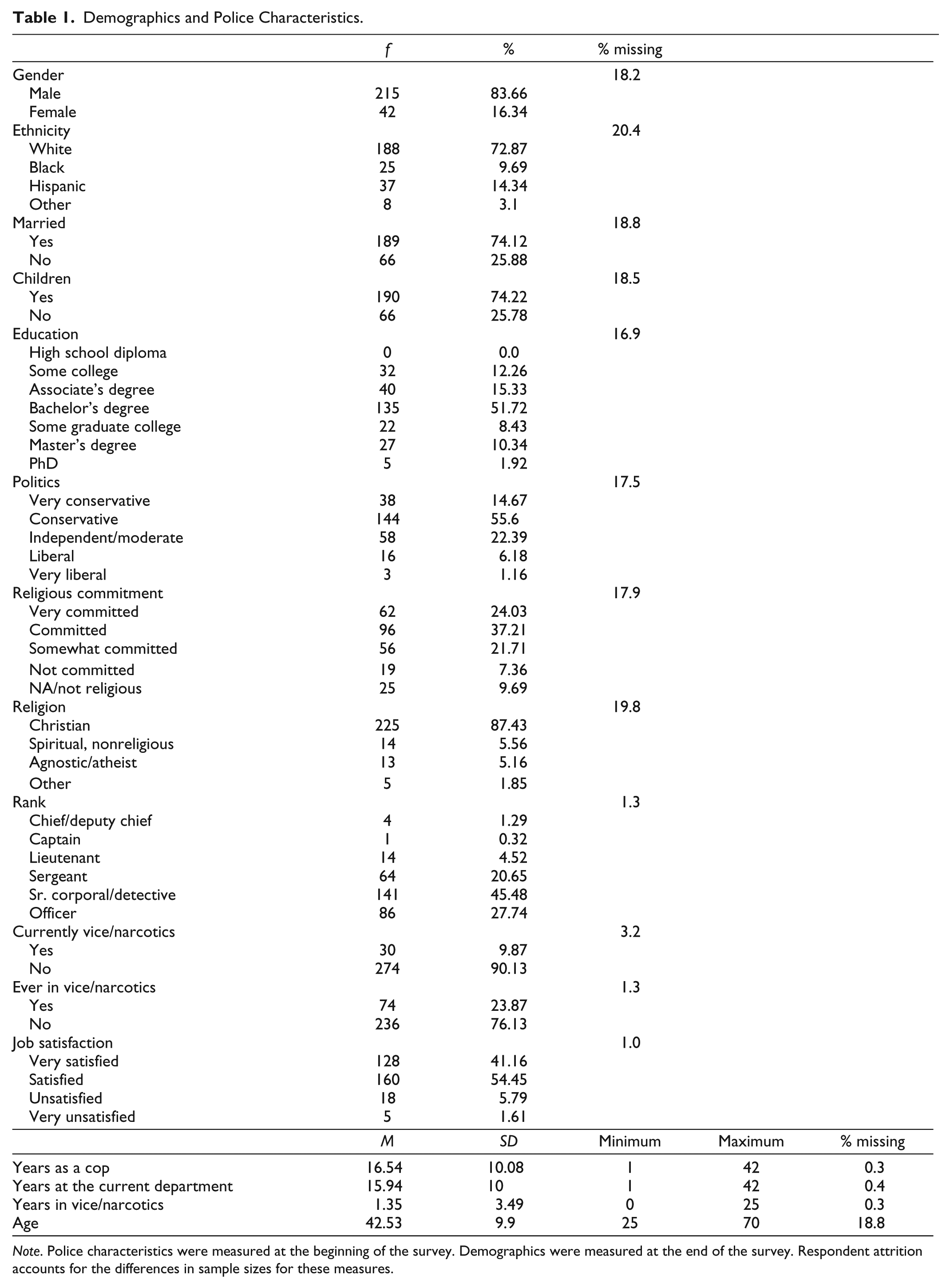
Note. Police characteristics were measured at the beginning of the survey. Demographics were measured at the end of the survey. Respondent attrition accounts for the differences in sample sizes for these measures.
Survey Item Descriptive Statistics
Descriptive statistics for the individual survey items are discussed below. Table 2 displays the results for these items. For the sake of brevity, only the most interesting and particularly salient survey items measuring attitudes about drug seriousness will be discussed here. There are too many items altogether to discuss the results of each and every item. Generally speaking, officers viewed drug offenses fairly seriously.
Descriptive Statistics for Drug-Related Items.

Note. Descriptive statistics for all items are available upon request. SA = strongly agree; A = agree; D = disagree.
Only 11% of the sample agreed that the War on Drugs is reducing drug use. A little over a third of the officers agreed that a youth should be prevented from receiving financial aid for college expenses because of a drug offense. Two thirds of officers believed that it is wrong to use drugs to reduce anxiety, stress, and tension. Only 7% of the sample agreed that it was safe for a stable person to use drugs. Only a third of officers believed that the use of marijuana is more dangerous than the use of alcohol. Nearly all officers agreed that the illicit drug trade will always exist regardless of law enforcement activities, yet almost two thirds of the sample agreed that tougher laws to fight drug use are needed. More than 40% of the officers agreed that drug users are lazy. Over 95% of the sample believed that drug use is a serious problem in their city and that drug use leads to more serious crime. In short, officers tended to view drug offenses as fairly serious and threatening, yet they also tended to view that current law enforcement responses to drug offenses are not very effective.
Table 3 displays what police officers felt were appropriate sanctions for various drug offenses. Thirty-five percent of officers believed that selling marijuana deserves more than a year in prison. More than 80% believed that selling heroin deserves more than a year in prison. Officers were also fairly punitive toward selling crack/cocaine, methamphetamine, and prescription drugs. The majority of officers felt that using marijuana does not deserve incarceration. Although, 85% of officers thought that some sort of sanction was appropriate for using marijuana. This is perplexing because the majority of officers believed that using marijuana is not more dangerous than using alcohol. However, officers tended to favor incarceration for using heroin, crack/cocaine, methamphetamine, and prescription drugs. In short, the data suggest that officers have punitive attitudes toward drug selling and drug use.
Officer Perceptions of Appropriate Sanctions for Various Drug Offenses.

Multivariate Results
The results of an OLS model predicting drug seriousness attitudes are presented in Table 4 below. An increase in education level was associated with a decrease in drug seriousness attitudes (B = –.21, p < .01). In addition, having ever been in the vice/narcotics unit was significant and was associated with a decrease in drug seriousness attitudes by .20 standard deviation (p < .05). Regression diagnostics suggested that assumptions for OLS were met, and the model explained 12% of the variance in the dependent variable.
OLS Regression Model of Drug Seriousness Attitudes.

Note. The data were weighted and robust standard errors were used. OLS = ordinary least squares.
p < .05.*p < .01.
Table 5 below presents the output for an OLS regression model of drug punitiveness attitudes. Only education and liberal were significant (p < .01, p < .05). An increase in education by 1 SD was associated with a .17-SD decrease in punitiveness toward drug offenses. In addition, being more liberal was associated with a decrease in drug punitiveness attitudes (B = –.20). The model explained 8% of the variance in drug punitiveness attitudes. What is more, the distribution in drug punitiveness attitudes was negatively skewed to a moderate degree. However, attempts to transform the variable did not make the distribution of factor scores any more normal. For the sake of parsimony and clarity, it was therefore decided to keep the original distribution of drug puntiveness factor scores.
OLS Regression Model of Drug Punitiveness Attitudes.

Note. The data were weighted and robust standard errors were used. OLS = ordinary least squares.
p < .05. **p < .01.
The results of an OLS model investigating the relationship between drug seriousness attitudes (the independent variable) and drug punitiveness attitudes (the dependent variable) are presented in Table 6 below. Also shown in the table are the results of testing the moderating effect of significant variables. As expected, there was a strong relationship between drug seriousness attitudes and drug punitiveness attitudes holding various other factors constant (B = .53, p < .001). Moderating effects were tested by first creating multiplicative interaction terms between drug seriousness attitudes and the variables that were significant in the model. Because it was hypothesized to moderate the relationship between drug seriousness attitudes and drug punitiveness attitudes, an interaction term was created for testing the moderating effect of ever being in the vice/narcotics unit even though it was not significant in the previous model. Each interaction term was introduced into the model individually but included in Table 6 collectively to save space. None of the interaction terms were significant, suggesting that none of the variables moderated the relationship between drug seriousness attitudes and drug punitiveness attitudes. The model explained 32% of the variance in drug punitiveness attitudes. Other than the moderate negative skew in drug punitiveness attitudes, the assumptions for OLS regression were met. Again, transforming the factor scores did not make them normally distributed. What is more, OLS regression has shown to be a robust estimator in cases of assumption violation (Tibachnick & Fidell, 2007).
OLS Regression Model Estimating the Relationship Between Drug Seriousness Attitudes and Drug Punitiveness Attitudes.

Note. The data were weighted and robust standard errors were used. OLS = ordinary least squares.
p < .05. **p < .01. p*** < .001.
Discussion
Generally speaking, officers examined in this study had fairly serious attitudes regarding drug offenses. In addition, they also tended to have a more interventionist attitude as a response to drug offenses, believing that stronger laws and more law enforcement resources are needed. Respondents were also punitive toward drug-related offenses. Generally, officers favored putting a drug offender behind bars. However, the data show variation in punitiveness depending on the type of drug crime. Officers were more punitive toward drug selling than drug using and were more punitive toward harsher drugs than marijuana. In addition, it seems that officers are much more punitive toward these offenses than the general public. For example, a 2017 Gallup poll found that 64% of Americans favor marijuana legalization. Only 15% of the sample from this study thought that marijuana use should not be treated as a crime. This does not necessarily mean that 15% of the officers also favored legalization. It just means that a small portion of officers have a decriminalization attitude toward using marijuana. Another curious finding regarding marijuana use is that a large majority of officers disagreed that marijuana use was more dangerous than alcohol use, yet nearly 40% of officers also thought that some form of incarceration was an appropriate sanction for marijuana use. Concerning the sample as a whole, the data also suggest a fair amount of variation in drug attitudes between officers. This finding gives some support to the argument that individual characteristics are important determinants of officer’s attitudes. If the police environment were a stronger influence, less variation among officer attitudes would be expected.
Most police officers reported an attitudinal change in how punitive/lenient they were toward drug offenses as a result of becoming a police officer. Forty-four percent of the respondents indicated that becoming a police officer has made their views toward drug offenses more punitive. Seventeen percent reported becoming more lenient toward drug offenses, and 39% reported no change. Similar to other aspects of the police subculture, like conservatism and adopting the code of silence, this suggests that while people bring certain characteristics (like perceptions and attitudes) into the police department, officers’ perceptions can be influenced through socialization, learning, and experience while on the job (Crank, 1998). This phenomenon is also similar to the importation/deportation model in the corrections literature.
A few of the covariates investigated in multivariate models were associated with drug attitudes and punitiveness. However, several covariates were insignificant predictors even though they were expected to be. Rank was never a significant predictor in the analysis, even though it was expected that officers on the street who deal with drug offenders face-to-face would have more punitive and serious attitudes toward drug offenses. In addition, being religious (as opposed to being nonreligious) was never a significant predictor in the analysis. This is a curious finding because much of the literature on attitudes toward drug use among the general public has found that religion is strongly associated with negative perceptions toward drug activities (Stylainou, 2002, 2003, 2004). The reason for the nonsignificant findings in these models may be due to the lack of religious variation within the sample. The overwhelming majority of the sample was religious.
Although being religious did not have an impact on drug attitudes, commitment to religion did have a significant effect. There was a modest relationship between becoming less committed to religion and viewing drug offenses less punitively. Similarly, being more liberal was moderately associated with less serious and punitive attitudes toward drug offenses. These findings make intuitive sense. Liberals do not have the reputation of being a values voting constituency as compared with conservatives and are less likely to support marijuana prohibition. Along similar lines, higher education attainment was also a moderately powerful predictor of drug attitudes and punitiveness. These variables having similar effects on drug attitudes and punitiveness is understandable because people who are more educated also tend to be more liberal (Kanazawa, 2010).
The effects of age, gender, and ethnicity on drug attitudes were examined in this study. Contrary to expectations, none of these factors were related to perceptions of drug offenses. Surprisingly, experience in the vice/narcotics unit played a much smaller role in this analysis than was expected. It is theoretically reasonable that serving in the vice/narcotics unit should have an influence on officers’ attitudes toward vice. The data from this research suggested that this may not always be the case. Items measuring vice/narcotics experience were only significant once in this analysis negatively influencing attitudes of drug seriousness. They played a much smaller role than factors like education, religiosity, and political ideology, for example. This is a curious finding that is hard to explain. It may be that simply having ever been in the vice/narcotics unit make officers realize that these types of offenses are not a serious threat to society (as compared with more serious crimes). The findings from multivariate models suggest that individual characteristics were more influential than police environmental characteristics, although both mattered to some degree.
This study replicated and expanded upon the study by Wilson and colleagues (1985). One of the limitations of the Wilson et al. (1985) study was the homogeneous sample. Nearly all of the officers in their study were White males. As such, their study could not investigate gender and ethnicity differences, a fact the authors lamented. The present study was able to decompose such effects. Generally speaking, gender and ethnicity played no role in this analysis.
Both samples were fairly similar in how punitive they were concerning drug-dealing. Nearly all officers from both samples felt that some form of incarceration was appropriate for selling heroin, cocaine, and marijuana. In addition, similar percentages of officers from both studies felt that selling drugs was worthy of fine and probation or should not be treated as a crime. What is more, both samples were similarly punitive regard using drugs. Heroin and cocaine use were viewed more punitively than marijuana use in both samples. Less than half of the officers thought that incarceration was an appropriate response for marijuana use. Both samples were much more punitive toward selling drugs as juxtaposed to using drugs.
This study added to our understanding of how police officers view drugs and drug use. However, as with all studies, this study had several notable limitations. First, the survey instrument used in this study is imperfect. Several revisions could be made to the survey that could reduce measurement error. Similarly, the survey may be incomplete. The instrument surely did not capture data on every possible variable related to the outcome variables of interest in this analysis. In short, the analytical models in this research may suffer from omitted variable bias. What is more, the models estimated in this study only explained a small portion of the variance in the dependent variable. This is indicative of an incomplete specification. Unless the remaining variance was stochastic, some factors important to explaining drug attitudes were absent. In addition, some survey items could be made more specific to reduce measurement error. For example, the survey items about selling drugs for profit could include a specified dollar value. It could be the case that some respondents were thinking about selling small amounts of drugs (which is common for street corner dealers) and other may be thinking about selling larger quantities when submitting their responses. As such, survey items could use the following logic: Selling US$50 of marijuana for profit; selling US$500 of marijuana for profit, and so forth.
The sample also presents a limitation in this study. Due to uncontrollable constraints put on this research project, it was not possible to derive a probability sample. In the end, the sample used here was a convenience sample. Such a sample makes generalizing the findings not possible. Instead, the findings only relate to the limited respondents examined. It therefore cannot be said that the findings from this study are representative of the police department from which the sample of officers come from as a whole. In addition, the data from this sample were cross-sectional. The sample of officers took the survey at a single point in time. As such, no causal inferences can be made.
The most significant limitation in this study was the low response rate. The initial response rate was 9%. Also, many respondents dropped out of the survey shortly after beginning it. Due to listwise deletion procedures in multivariate models, the total number of respondents was even fewer. Low response rates are problematic because they likely introduce bias into the analysis. It is likely that responders and nonresponders differ in some systematic way. Unfortunately, it was not possible to test for these differences between responders and nonresponders. The information necessary to conduct such tests was not available. However, researchers must do the best they can with what they have. Important information can still be produced in cases of low response rates.
Future research on this topic may be conducted to address the limitations mentioned above as well as further developing current knowledge. Researchers should replicate this study by sampling independent police departments and using the survey in Appendix A (either in its current form or amended to address limitations within the survey). Researchers could also sample the public with the same survey and compare those results with findings derived from police samples. Doing so would enable scholars to further investigate the individualistic and environmental components of police behavior. In addition, the current survey could be modified to exclude poor performing items and add survey items that measure aspects of the police culture and/or possible ulterior motives for drug seriousness/punitiveness attitudes such as the profit motive or even vengeance.
Conclusion
For unknown reasons, the research investigating police officers’ attitudes toward vice crime, including drug use, is underdeveloped. Criminologists have not devoted much time to unpacking this topical area, even though this phenomenon could have important ramifications. Some studies have looked into police officers’ perceptions about law enforcement r esponses to drug crimes (Petrocelli et al., 2014) while others have focused on nonenforcement drug policies (Beletsky et al., 2005; Beyer et al., 2002; Moore & Palmiotto, 1997). However, only one study was found that attempted to study the nuance of police officers’ attitudes about vice-related behaviors specifically (Wilson et al., 1985).
Several conclusions can be made from this analysis. Officers from this sample had fairly serious and punitive attitudes toward drug offenses. The relationship between drug seriousness attitudes and drug punitiveness attitudes was strong, and the relationship was not moderated by other factors. Characteristics of individual officers, such as education attainment, religiosity, and political ideology, were more important factors associated with drug attitudes than several law enforcement indicators, such as rank and experience with the vice/narcotics unit. Finally, it was common for officers to develop more punitive attitudes toward drug offenses as a result of becoming a police officer.
It is important to continue this avenue of research because how the police view drug crimes may influence policy decisions. For example, legislators can turn to the police for advice regarding criminal legislation. Officers may feel that drug use is a serious criminal problem that warrants harsher legislation. In such cases, policy makers may make laws toward drug crimes more punitive with increasingly harsher sanctions. However, the opposite may also be true. Officers may view drug crimes as not very serious (compared with other crimes), and that the police should focus on controlling more serious forms of street crime instead of squandering precious policing resources on petty drug offenders. Considering this, legislators may ease the legal restrictions placed upon minor drug offenses thus freeing up valuable police resources to confront more serious types of crimes.
In addition, the police have wide discretion in how they enforce the law, and how that discretion is used is likely influenced by police officers’ attitudes and perceptions (Worden, 1989). Understanding how the police view drugs and drug use can help researchers understand how police use discretion regarding drug offenders. However, such wide discretion may be problematic in terms of fair and equal treatment of citizens. For example, one person may be arrested for drug possession, whereas another person is not arrested for the same offense simply because of the police officer’s preconceived attitudes toward drug use. Whether or not someone is arrested for a vice crime, like drug possession, may be contingent on several extralegal factors including the political ideology, education level, or religious commitment of the police officer. This may be viewed as unfair and unequal treatment by law enforcement, which has negative consequences for the criminal justice system. Fairness and equality are hallmarks of democracy and procedural justice, the basis of police legitimacy (Tyler, 1990). As such, the police need to treat citizens fairly and equally and doing so will increase the likelihood of the public voluntarily complying and cooperating with authorities. Therefore, the police should be cognizant of their own attitudes and perceptions toward drugs and drug use and should also be aware that these attitudes and perceptions influence how they behave on the job. What is more, officers should be trained to remain objective when dealing with such offenders so that their own subjective views do not cause unfair and unequal treatment of citizens.
Police managers may also make use of the findings presented in this study by considering the motivations behind having punitive attitudes toward drug use. There may be an ulterior motive outside of objective harms caused by drugs and individual characteristics of police officers that could be contributing to their punitive attitudes about drugs. The Drug War may be partially responsible for police officers having such punitive attitudes toward drugs because police may seize assets from the offender and departments may receive military equipment for free via the Pentagon’s 1033 program to help fight the Drug War. The bulk of respondents from this study agreed that marijuana is not more dangerous than alcohol, yet the vast majority of them preferred some sort of legal intervention for marijuana offenders. This finding may be indicative of such an ulterior motive. In the end, it is in the police department’s best interest to maintain a positive and cooperative relationship with the people they serve. Extralegal differential treatment of citizens by police, nefarious Drug War motivations, and making a criminal out of an otherwise law-abiding pot smoker may do significant harm to that relationship.
Footnotes
Appendix A
Appendix B
Declaration of Conflicting Interests
The author(s) declared no potential conflicts of interest with respect to the research, authorship, and/or publication of this article.
Funding
The author(s) received no financial support for the research, authorship, and/or publication of this article.