



Abstract
The European Union (EU) is a decision-making, polycentric political community, with double-layer boundaries and constitutionally and procedurally plural decisions. Likewise, it may be assumed that the existence and the peculiar functioning of European-level policy-making governance, the increase in number of its structures, and its multilevel character may result in a new policy regime. The institutionalization-Europeanization level of the organizational field may become indispensable in determining which type of policy network and what styles of policy are established, or in influencing the degree of responsiveness and accountability, quality and intensity of interaction between the actors involved, the degree of territorial and functional consistency established in the Member States, and the decision-making skills of the EU itself. The aim of this work is to develop and evaluate basic assumptions, by means of an exploratory survey, focusing on the policy outcomes (as dependent variable) of the institutionalization-Europeanization of the common security policy (as independent variable).
Introduction
Much research has supported the hypothesis that the effects caused by the policies in the European Union’s (EU’s) second and third pillar were limited, and that they would affect weakly the ongoing processes, structures, and decisional outcomes of the national stakeholders involved. More recently, this assumption has been put into question due to the occurrence of specific factors, such as the institutional cross-pillarization, the reframing of the scope of action, the expectation of new decision-making mechanisms, the great impact of organizational factors, and the presence of de facto decision-making bodies (Locatelli, 2010; Radaelli, 2000). The very participation in the European policy-making processes would thus seem to be enough to change the characteristics of the parties involved and determine the outcomes of political decision-making and performance, even in fundamentally intergovernmental areas (referring to the third pillar). This is the result of Member States being required to actively exercise the right to veto, being drawn into the European institutional network and thus being exposed to the dynamic mechanisms of socialization, learning and adaptation (Harmsen & Wilson, 2000; Knill & Lehmkuhl, 1999; Radaelli, 2003).
This article is intended to answer the following questions: To which extent the different levels of institutionalization-Europeanization of the organizational field affect the policy outcomes and, at a large scale, the level of performance of a particular policy?
For this reason, this article is organized as follows: The first part will include a preliminary survey of the literature focusing on the concept of “Europeanization,” in an attempt to provide a clear pathway and to obtain a definition of the concept that may be implemented at the empirical level during the following stages. The second part will deal with the theoretical and methodological issues of our research. Some hypotheses will be put forward about the possible influence of the institutionalization-Europeanization level of the organizational field (independent variable) on the outcomes of the decision-making process (dependent variable). This part will include a context analysis to frame the specific case in a diachronic perspective, through a least-likely-based research approach: The context is limited to the organizational field of common security policy and the fight against organized crime, which refer to the “third pillar” of the EU, where the decision-making procedure adopted by the States is essentially intergovernmental in nature. The analysis will therefore focus on the creation and development of the European Police Office (Europol), the EU agency for police, and judicial cooperation in criminal matters (pertaining to the third pillar). The third part will be divided into two sections and will be dedicated to an empirical test of the hypothesis: The first section will evaluate the Europeanization of the organizational field of common security policy and the fight against organized crime; the second section will focus on the effects of the Europeanization of the organizational field on the outcomes of the decision-making process and the policy itself.
On the Concept of “Europeanization”
Europeanization is “complicated” and heterogeneous in its different meanings. Olsen (2002, p. 1) made reference to a “multi-faceted Europeanization,” claiming that, at present, there is no single definition that could explain and clarify such term. It is therefore a “variable-geometry” 1 concept (Giuliani, 2004, p. 10) that has been at the heart of the theoretical and methodological debate for a long time, supported by several experts in the EU governance field. The steep path to describe clearly the connotation poses so many questions that it has enticed more and more researchers (Cole & Drake, 2000; Cowles, Caporaso, & Risse, 2001; Fabbrini, 2003; Featherstone & Radaelli, 2003; Ferrera & Giuliani, 2008; Goetz & Hix, 2000; Harmsen & Wilson, 2000).
Therefore, just like other “big” and “fashionable” issues dealt with by social scientists, the debate on the nature of Europeanization requires a preliminary effort so as not to confuse or stray to adjacent semantic fields, such as those related to the topics of European integration, market communitarization, and harmonization, and to more complex macrophenomena (namely, internationalization and globalization). Moreover, as mentioned by Bulmer and Radaelli (2004), “some aspects of what goes under the label of Europeanization are more often than not a simple re-branding of classic research themes,” which require a major analytical effort in terms of “conceptual cleaning” (p. 1).
To show the “multi-faceted character” of this concept, by adapting Featherstone and Radaelli’s (2003) hypotheses, three different interpretations of Europeanization may be proposed: (a) as a historical phenomenon, with explicit reference to the “export” of authority and the “construction” of genuinely European institutions, organizations, practices, and regulations; (b) as a cultural phenomenon, with regard to the dissemination of ideas, identity, cognitive, and behavioral patterns within the European polity 2 ; (c) as the national institutional adaptation to pressures arising directly or indirectly from EU participation.
This third class is very broad and could be further articulated in two different subclasses. In the first one, (c1) the concept of Europeanization is often used to describe the degree of influence of the European policy-making processes on public policy and on decision-making processes within States in various fields (Nilson, 1993; Radaelli, 1997), or on the way and degree to which governments fulfill their obligations in compliance with EU laws and regulations (Àgh, 1999; Bulmer & Burch, 2001; Harmsen, 1999); (c2) in a second perspective, Europeanization has been described as the adaptation of other institutional actors to the process of transformation. In this context, several studies have focused on the “shift” of parliamentary structures (Àgh, 1999), the role played by political parties (Ladrech, 1994; Mair, 2000, 2007), or trade unions (Turner, 1996). On this matter, several authors are worth mentioning as they connect Europeanization to the strengthening of subnational governmental bodies (Goetz, 1995; Goldsmith, 1993; John & Le Galès, 1997; John & Whitehead, 1997; Martin, 1993); the attempts to coordinate national foreign policies (Charles & Albright, 1984; Knutsen, 1996); the attempts to harmonize them with the decisions taken in Brussels on foreign policy (Torreblanca, 2001; Yost, 1996); and the transformation of territorial representation (Fargion, Morlino, & Profeti, 2006; Morlino, 1999).
Regardless of the conceptualization of the term, a first analysis of the secondary literature on the subject shows that Europeanization is an independent variable that may actually have the capacity to influence (albeit in different forms and at different levels) all three sides of politics, policy, and polity. Indeed, Radaelli (2003) defined Europeanization as a “complex process of construction, diffusion and institutionalization of formal and informal rules, procedures, policy paradigms, believes and norms firstly defined on the EU level and then incorporated to the domestic policies, politics and discourses” (p. 30).
Therefore, the peculiarities of the concept of Europeanization are at the basis of the difficulty of accounting for it through a general theoretical framework. This is why a sector-oriented approach has been selected for the current study. This work focuses, in particular, on a specific interpretation of Europeanization, which deals with it as a process characterized by the birth and development of one or more EU institutions, capable of formalizing the interactions between the stakeholders involved in the functioning of a policy network, and affect the outcomes of the policy-making processes by means of independent decisions (Cowles et al., 2001; Olsen, 2002). It is clear that this particular interpretation of Europeanization is strictly connected to the concept of institutionalization because, in a nutshell, it might be construed as a specific development of institutionalization processes, involving EU institutions in a different policy area.
In an attempt to lay solid heuristic foundations for this work, tightening the bond with the neo-institutional approach (Lanzalaco, 1995; March & Olsen, 1989, 1995), this article will only deal with the influence of Europeanization on the policy-making process. In particular, it tackles the influence of Europeanization as institutionalized organizational fields on policy outcomes.
Theoretical and Methodological Issues
The Independent Variable: The Europeanization of Organizational Fields as a Process of Institutionalization
Following a scientific path recently paved by some researchers (Giuliani, 2004, p. 10), a “minimalist definition” of Europeanization will be used in the following pages, by considering it as “the European institutionalization process.” 3 More precisely, Europeanization will be intended as the process of institutionalization of the organizational fields of EU policies.
The label “organizational field” will refer to the concept proposed by Powell and Di Maggio (1991) who suggested that it might be seen as the set of institutions interacting with each other, which are acknowledged as a part of the institutional life, continuously regulating and controlling the activities of other actors.
Therefore, a high level of Europeanization will be acknowledged in the event of (a) an extensive—not purely formal—specialization of EU competencies, that is, in the presence of a “differentiation of governance structures” of the organizational fields of specific policies (Cowles et al., 2001, p. 3); (b) a self-referential validation, internalization, acceptance (taken for granted), despite criticisms against the very same structures; and (c) an autonomization and independence of the policy organizational field (Powell & Di Maggio, 1983) according to the preferences expressed by the Member States (Lanzalaco, 1995). If this not the case or the results expected are limited in scope, the level of Europeanization will be regarded as low or null.
Therefore, the highest level of Europeanization is acknowledged whenever a policy organizational field is provided with one or more governance bodies, or supernational institutional core actors. The field is imbued with legal, economic, and organizational capability, making said bodies self-sufficient in terms of efficiency and effectiveness. That means that such core actors may generate autonomous decision-making processes and equally autonomous implementation processes, regardless of the decisions taken by national bodies on a specific policy area, or of the opinions voiced by noninstitutional bodies belonging to the policy network, at national or subnational levels (Tebaldi, 2010).
The Dependent Variable: The Outcomes of European Policy
The decision-making and implementation processes of public policies may generate either effective or ineffective results. Varied and well-established evaluation methodologies may be implemented to study the effects of policies on society.
Despite being well aware that such methodology is only one of the possible choices—nonetheless noteworthy—the scope of this work will be limited to four aspects of the policy, which will serve as the basis for the evaluation itself. These four aspects have been thoroughly studied by several surveys, which have focused on institutions and public decision-making processes. They seem to be suitable for the specific purposes of this work, that is, evaluating their outcomes.
The factors refer to (a) the level of responsiveness, that is, the ability of the policy to respond to social issues; (b) the type and quality of the “relational fabric” of the organizational field, with particular reference to the disposition to cooperate or to clash with the other actors belonging to the policy network; (c) the level of territorial integration generated and, that is, the administrative and territorial consistency of the actions taken by the Member States; and (d) the effect of the checks and balances of the policy network, that is, the progressive weakening or strengthening of accountability mechanisms (internal and external).
The Relations Among the Variables: Some Hypotheses on How and Why the Europeanization of the Organizational Fields Tends to Affect Policy Outcomes
In light of the selected variables, the issue at the basis of this work may be summarized in a single question: Which effects may the institutionalization of the organizational field of a specific policy have on the outcomes of the decision-making processes?
In general, the level of Europeanization, that is, the level of institutionalization of the policy organizational fields, may affect in different ways the generation or structuring of a new policy regime and the outcomes of policy itself. What really affects such variability and which cause–effect mechanisms may be traced back to it?
Indeed, concerning the policy capacity to respond to social challenges, institutionalization-Europeanization seems to generate policy-making process outcomes that are rather independent from contextual changes; a natural response to economic and political variables (other institutional spheres, other public policies) is nonetheless possible.
As Mathur and Skelcher (2004) suggested, highly institutionalized contexts are characterized by the ability to filter, interpret, tune, adjust the time of response (or nonresponse) through the implementation of regulatory standards and instruments (constitutional hardware; see De Bruijn, 2002; Foweraker & Landman, 2002; Ingraham, Joyce, & Donahue, 2003) and the control of cognitive maps and epistemic assets (constitutional software; see Dryzek & Berejikian, 1993; Yanow, 1996, 2000) by the policy network stakeholders. Social, economic, and political pressures are therefore reinterpreted and reconfigured, and may lead to a change of the existing procedures or to the development of a new policy cycle. Therefore, concerted policies are much more common, governing broader scopes of medium- to long-term interests with macroeconomic effects.
On the contrary, the lower the level of institutionalization-Europeanization is, the more likely public policy will remain undefined in its scope and objectives. In poorly institutionalized contexts, the presence of different principles of legitimacy, different organizational forms, and paradigms, and different types of social relationships within the organizational scope of action, makes it possible for external elements to frequently and suddenly affect resources and, therefore, the balance of power among all network stakeholders. The vulnerability of ruling coalitions and the low level of gate-keeping capability generate “fragmented,” “disorganized” policies. The decision-making and implementation processes—which are put together and influenced by specific groups—aim at acquiring “disaggregated resources” (see Foweraker & Landman, 2002). Second, it may be assumed that institutionalization-Europeanization may indeed have a constructive or diminishing effect on the tendency of policy network stakeholders to cooperate or not. As underlined by Lanzalaco (1995, esp. chaps. 6-7), the higher the level of policy institutionalization, the more it will be affected by the depoliticization process, that is, several issues related to it will become common administrative issues and will not be subject to political decisions. Noticeably, the allocative consequences of redistributive and selective measures should not generate, in general, extrainstitutional opposition given the high degree of legitimacy of the ruling coalition. The high level of institutionalization makes it possible to obtain, in particular, high levels of loyalty when potential opponents find their place within a system of structural relationships, which include procedural and ideological-regulatory constraints (Ingraham, Joyce, & Donahue, 2003; Koppenjan & Klijn, 2004). When the symbols of identity are provided and forms of membership are established as a result of policy subcultures, which are characterized by a commonly shared orientation (and not by the self-interest of individual participants), voluntary agreements are facilitated, even when individual interests and rights are waived (Scharpf, 1989).
Third, it may be assumed that the level of institutionalization-Europeanization may affect the uniformity of administrative and territorial decisions. The development of public policy turns out to depend, in the event of low institutionalization levels, on the resources of “strong” national economic stakeholders, the organizational capacity of specific trade unions and the ability to mobilize widespread interests at sector level, not to mention the conflict/alliance relations established among said stakeholders, and the type of relationship connecting them with the European bureaucracy. A pervasive particularism is thus generated, resulting in different types of implementations at the national level, a low degree of integration between action programs and subprograms, and the emergence of clashing elements in different regulatory and administrative measures governing their implementation in the Member States.
Fourth, a high level of institutionalization could lead to a weakening of the accountability mechanisms, based on the perverse effects connected to the strength and stability of the dominant coalition; the high levels of legitimacy, loyalty, spatial (normative and cognitive) uniformity of policy; and the early stage barriers. The underlying thesis is that the stakeholders involved in the decision-making and implementation process acquire, due to these factors, an increased specialization of their own technical expertise in the field of interest, a higher level of discretion, and the ability to interpret and manipulate the rules and the data they possess. The high levels of policy compliance and good performances may, in this case, be accompanied by an ex ante or ex post absence, failure or weakening of the institutional constraints affecting the organizations, and the agencies responsible for the implementation of public policy.
Table 1 shows a comparison of the institutional policy-making process, their policy networks, and the possible outcomes of the decisions taken. It focuses on two hypothetical ideal-typical patterns (the explanans and the explanandum), describing political arenas and bodies: the explanans of which is the level of institutionalization-Europeanization of the organizational field of public policies, and the explanandum of which is the decision-making capacity of the governance system (Tebaldi & Calaresu, 2009).
Europeanization Level of the Organizational Field and the Decision-Making Capacity of the System of Governance.

Methodological Note
This article is conceived as an exploratory study, which adopts a process-tracing-oriented approach (George & Bennett, 1997) explicitly designed to highlight some path-dependency phenomena (Pierson, 1996, 2000). The structuring of policy-making networks and the institutionalization of policy regimes stem from the environmental dynamics in which they operate, either of economic, political, or social nature. To understand the current morphology of the organizational fields of public policy, it is necessary to go back to the historical factors that characterized their establishment and consolidation, in a specific context (see Calaresu, 2012). The description of current forms of governance cannot disregard their generating processes, namely their interorganizational dynamics (the structuring of the territorial unit, the “original model” of interaction, the different outcomes of the processes of change, and adaptation to environmental modifications). By appropriately adjusting the hypotheses suggested by the experts in the field of interorganizational relations, the organizational characteristics of public policies depend on their origin (Tebaldi, 1999), that is, among other things, on how the organizational field was generated and institutionalized. The very creation of the policy network and its original features can indeed influence its interorganizational features, even after several decades. 4 This means that an organizational network contains the imprint of its generating modalities and the crucial political and administrative decisions taken by its founders, namely, the decisions, which “shaped” its original form (Calaresu, 2010a, 2010b; Tebaldi, 2010). The original model, that is, the original structural and behavioral set that is attached to the institutionalization model, plays a crucial role in the organizational field life cycle, as it tends to self-reproduce over time by nature and permeate interorganizational relations, even after the organizational field has further developed 5 (Zan, 1988). This work will not focus on a “field” research, but it will evaluate secondary data to analyze the diachronic nature of the current subject. As a result, the generalization of this report will be limited, its objective still being to highlight possible future guidelines for empirical research in the field of European governance, and to suggest a theoretical and explanatory approach that would require further formulation and, in particular, a more systematic empirical evaluation.
The context of analysis chosen for a first demonstration of the hypothesis refers to the organizational field of European policies to combat organized crime, which is related to the EU third pillar and characterized by a mainly intergovernmental decision-making process. The concept of pillars is generally used to describe the architecture of the EU, where the first pillar—also called “Community pillar”—refers to the following three communities: the European Economic Community, the European Atomic Energy Community (EURATOM), and the old European Coal and Steel Community (ECSC); the second pillar refers to the common foreign and security policy, which is governed by the Treaty on European Union (Title V); the third and last pillar refers to the police and judicial cooperation in criminal matters, which is covered by Title VI of the treaty. Following the passage of the Treaty of Amsterdam, some of the topics included in the third pillar were then transferred to the first pillar (i.e., the free movement of people).
For a long time, researchers have argued that the effects of partaking in the EU policy-making processes within the EU second and the third pillars scope of action were limited for the national stakeholders involved, and that, ultimately, Europeanization (as an independent variable) had a minor impact on the processes of change related to politics, policy, and polity.
As a matter of fact, the three pillars work according to different decision-making processes: the Community process is implemented on a regular basis on the first pillar, while the intergovernmental approach (that is of great interest for us) is applied in the other two cases. As a result, as far as the first pillar is concerned, only the Commission may submit proposals to the Council and the Parliament, and a qualified majority is enough for the Council to approve an act. Within the second and third pillar frameworks, the Commission and the Member States share this particular proactive approach, and unanimity (with the right to veto to protect national interests) is generally required for the Council to take any decision.
The existence of peculiar factors, such as the cross-pillarization of institutional and procedural gaps, the reframing of the scope of action, the anticipation of new decision-making processes and scenarios, the great impact of organizational factors, and the existence of de facto decision-making bodies, has resulted in a change of approach within the social scientific community. Researchers now argue that the sole participation in the EU policy-making process is enough to modify the processes, the identities, and the structures of the actors involved, and also to determine the decision-related outcomes and policy performance, even at intergovernmental level (third pillar). That is, the result of Member States being required to participate in decision-making arenas where they enjoy the right of veto, which are captured in the EU institutional net and exposed in the dynamic mechanisms of socialization, education, and adaptation (Radaelli, 2003).
Testing the Hypothesis: The Europeanization of the Organizational Field of the Common Security Policy and the Fight Against Organized Crime
On the basis of the points presented above, the analysis of the organizational field of the EU security policy and the fight against organized crime may be analyzed to assess their level of institutionalization-Europeanization (our explanans). Therefore, our analysis will focus on an (a) extensive and comprehensive understanding of the EU scope of action in fields such police cooperation and judicial cooperation in criminal matters, namely, the “differentiation of the structures of governance”; (b) even critical self-validation, internalization, and acceptance of such structures; and (c) autonomization and independence from the decisions taken by the Member States.
Regarding the level of institutionalization-Europeanization, Giuliani (2004) argued that notably “the development of new EU agencies” may be regarded as “a clear result of such differentiation” (p. 11). As the institutional websites of reference report,
6
during the mid-1980s, A number of specialized and decentralized EU agencies have been created in order to provide assistance and advice to the Member States and their citizens. The creation of those agencies meets the desire for a geographical devolution and the need to cope with new tasks of a legal, technical and/or scientific nature.
EU agencies are divided into the following five categories (each category refers to a specific organizational field):
Community agencies: European public legal bodies, which are different from EU institutions (such as, the Council, the Parliament, and the Commission) and enjoy legal status. They were first established by secondary legislation and they perform very specific tasks of technical, scientific, and management nature, as part of the “first pillar” of the EU.
The common foreign and security policy agencies: They perform specific tasks of technical, scientific, and management nature within the Common Foreign and Security Policy of the European Union (CFSP), as part of the “second pillar.”
Executive agencies are organizations established under Regulation (EC) No 58/2003 (OJ L 11, 16.1.2003) that manage one or more EU programs. They operate for a set period of time and they work in close contact (also for proximity reasons) with the European Commission, being based in Brussels or Luxembourg.
EURATOM Agencies and bodies: They were created to pursue the objectives of the European Atomic Energy Treaty (EURATOM Treaty) through the coordination of research programs carried out by the Member States to promote the peaceful use of nuclear energy. In addition, they seek to foster the movement of knowledge, the construction of infrastructures, the availability of funds for the development of nuclear energy, and the possibility to obtain an adequate and secure nuclear energy source.
Agencies for police and judicial cooperation in criminal matters: Designed to help the Member States to cooperate in the fight against international organized crime. Such cooperation in criminal matters in the “third pillar” of the EU aims to encourage the establishment of the area of justice, freedom, and security according to the Tampere (1999-2004) and the Hague (2004-2009) programs, based on the Treaty establishing the European Community (Title IV). They include all sectors, except for police and judicial cooperation in criminal matters, which are governed by the provisions stated in the Treaty on the European Union (Title VI). For this reason, since the passage of the Treaty of Amsterdam, the area of justice, freedom, and security has lied within the Community (first pillar) and the intergovernmental framework (third pillar), while when it was first published in the Maastricht Treaty, its scope was limited to the intergovernmental field.
As for the organizational field of our interest, there are at least three full agencies created to foster police cooperation and judicial cooperation in criminal matters:
European Police College (CEPOL),
European Police Office (Europol), and
European Union’s Judicial Cooperation Unit (Eurojust).
Nonetheless, they play an important role within the intergovernmental pillar: In the first place, ensuring the safety and security of their citizens, as Pizzimenti and Vannucci (2005) argued, such goals have always been “the main task of modern States” (p. 51). The very concept of State refers to a centralized organizational construct that provides a sufficiently coherent electoral system with the power to rule over a limited territory. The boundaries of a State should coincide with the boundaries of the political life of a community, thus determining which subjects, what territory, and which events fall under the jurisdiction of the authority; in turn, other incompatible political competitors are dismissed. This structure is the result of a centuries-old eventful historical process of construction of political institutions, bureaucratic apparatus, rational and legal instruments, and, above all, the coercive apparatus, thus ensuring a monopoly of legitimate powers (Weber, 1922). Through the creation of these set of instruments, a central political power manages to rule despite the different local authorities, intertwined and often competing with each other, and the political and religious powers that claim to be universal (Poggi, 1991). Starting from the original concept of security intended as the protection of the citizens’ bodily integrity and property by the State, a broad spectrum of activities has been included, based on the assumption that public intervention should be supported to protect civil, social, and political rights (e.g., today we talk about security when referring to national borders, health, property, labor, bodily safety, and even the environment). Despite this conceptual extension—leading to the identification of security in the light of the squeezebox concept—through the Government, the national State tries to consolidate its monopoly in the production of “security” goods. Second, as far as the judiciary is concerned, the historical and ideological discrepancies among Member States in the fields of criminal law and procedures are worth mentioning, as they deeply impair unification and harmonization.
In the light of the above, the will of national States to surrender part of their autonomy to decentralized security agencies and organizations, which are also engaged in cooperation activities with the police and the judiciary, may not be underestimated. Clearly, the mere existence of dedicated governance agencies or organizations is not sufficient to fully appreciate the institutionalization-Europeanization level in the field of security. Are those governance “bodies” required to be constantly accounted for and justified to the Member States and their citizens, or are they taken for granted, thus enjoying a self-referential value and validation? Since their role within the policy-making procedures has been internalized and accepted, despite the criticism and “even the distortion of their . . . original tasks” (Giuliani, 2004, p. 11). Last, to evaluate the third dimension of institutionalization, their level of independence must be assessed (even if they do not enjoy full autonomy) according to the choice taken by each Member State, beyond the formal expectations set in agreements and treaties.
Due to the limited extent and nature of this article, attention will instead be paid to the emergence and development of the European Police Office, as it is the EU Agency dedicated to police and judicial cooperation in criminal matters (third pillar).
The Institutionalization of the European Police Office (Europol, 1999-2010)
Europol’s Organizational Structure and Material Resources
Europol became a full EU Agency on January 1, 2010, but the establishment of a European Police Office is the result of an intergovernmental resolution taken in the framework of the Maastricht Treaty (art. K 3), on February 7, 1992, within the above-mentioned “European Area of Freedom, Security and Justice.”
Europol is conceived as a new governance structure with the purpose of improving cooperation, thus simplifying communications and supporting selected activities of the police organizations (Deflem, 2006), among the police of the EU Member States (Marotta, 1999; Occhipinti, 2003). It started operating on January 3, 1994, carrying out limited tasks under the name of Europol Drugs Unit (EDU). As an executive police force without “autonomous investigative powers” (Deflem, 2006, p. 342), it mainly combats the trafficking and distribution of drugs and deals with criminal intelligence issues. The Convention establishing the European Police Office (Europol), signed by 15 EU Member States on July 26, 1995, came into force on October 10, 1998 (Europol, 1995).
Additional areas of the fight against crime were added on a regular basis to the original convention (see Table 2 for a chronological prospectus). Due to the great number of legal acts related to the Convention, Europol started its full operation on July 1, 1999.
Intergovernmental Acts and Resolutions (European Council) Establishing and Modifying the Europol Convention.

Source. SCADPlus Europol.
On January 1, 2002, Europol mandate was extended to fight “all forms of serious international organized crime.” 7
According to Mathieu Deflem (2006), from a structural point of view Europol detains the following functions: a) The facilitation of information exchange among the so-called Europol Liaison Officers, who are seconded to the Europol headquarters in The Hague by the Member states to act as representatives of their national police; b) the supply of operational analysis in support of relevant police operations conducted by the Member states; c) the drawing up of strategic reports, such as threat assessments, and crime analyses on the basis of information supplied by police of the Member states or generated at Europol headquarters; and d) the offering of technical support for police investigations conducted in the EU Member states. Each Member state of the EU must designate a particular agency to act as the Europol National Unit or contact point for Europol communications, but the specific organization of the National Units is determined by each Member state. (p. 343)
The Europol agency has experienced an increase in the number of Full-Time Equivalent staff members (FTEs) and in the 5-year annual budget funds at its disposal (see Figures 1 and 2); in 2008, it accounted for a total of 622 employees (634 in 2009, according to Europol, 2009b), 461 of which were official service providers operating in The Hague (except the staff of the National Liaison Units available to the Office), and a budget of nearly EUR 65 million for the year 2008 (see Table 3).

Yearly increase of the number of Europol staff members, 1994-2008.

Europol staff distribution, 2008.
Development of the Europol Budget, 2000-2008.

Source. Adapted from Europol, 2009a.
On April 6, 2009, the Europol Convention was replaced by 2009/371/JHA Council Decision, establishing Europol as a fully fledged Union Agency. While defending Europol’s operational capabilities, an internal Council Decision Program (ECD) was launched to implement the Decision. Officially operational as of January 1, 2010, the EU budget–funded European Police Office complies with all EU Justice and Home Affairs rules and regulations. Budgetwise, it is controlled by the European Parliament and must comply with European Commission financial and staff regulations. Nonetheless, the European Police Office budget is not part of the overall EU budget; a Joint Audit Committee, consisting of selected members of the European Court of Auditors, but not part of it per se, provides financial supervision. This particular organizational design is intended to preserve the intergovernmental character of Europol. The European Court of Justice has minimal jurisdiction over the Office, having a limited scope of action, that is, the interpretation of the Europol Convention.
The European Police Office currently answers for its actions to the EU Council of Ministers of Justice and Home Affairs, that is, to all the ministers of Justice and Home Affairs of the Member States, via the Europol Management Board and its Chairman (appointed by the Council itself).
The Board consists of one representative for each Member State who is selected among the staff members of the Ministries of Home Affairs. It gathers at least twice a year and exercises political control over routine staffing and budgetary matters. The Council is responsible for the appointment of Europol’s Director and Deputy Director. It exercises control over Europol’s budgetary decisions and it is funded by Member State contributions, rather than the EU general budget. If necessary, additional funding may also be granted by the Council. A Joint Supervisory Body, consisting of two representatives of the data protection supervisory authorities of each participating state, oversees Europol’s data protection actions.
Europol’s Functions and Operational Capabilities
The recent change in the legal framework (2010) has led to an extension of Europol’s mandate and tasks, in addition to a deep improvement of data processing and protection procedures. Europol now enjoys full operational and administrative capabilities in general.
As already noted, the operational capabilities and the tasks originally (Europol, 1995) envisaged for Europol have been expanding over time (1999-2010) from drug trafficking and control to crucial areas, such as combating terrorism, counterfeiting of currency, environmental crimes, and crimes against the person. Former Europol rapporteur for the European Parliament, Lode Van Outrive, argues that the Agency increases in power whenever the Ministers of Justice meet in Brussels: First it was drugs. But then the Spanish added terrorism; then others child pornography, and so on . . . no one has all this under his own command. It is like a satellite that flies into the atmosphere, beyond the Law’s grip, without having to democratically respond to anyone. (Evans-Pritchard, 2001)
Since 2002, Europol has been able to sign cooperation agreements with non-EU Member States, in addition to agencies and community organizations. The Office is also in contact with the police forces of each Member State through the National Units, which are responsible for the contacts between the Office and each national services (i.e., Member States’ national public bodies devoted to the prevention and the fight against crime).
Table 4 shows the 2006 intel analysis and the field operations conducted by the Office, grouped by crime category, and its operational support to Member States in 2010 (Figure 3).
Number of Intelligence Analyses and Operations Grouped by Crime Category—Analysis Work Files (AWF).
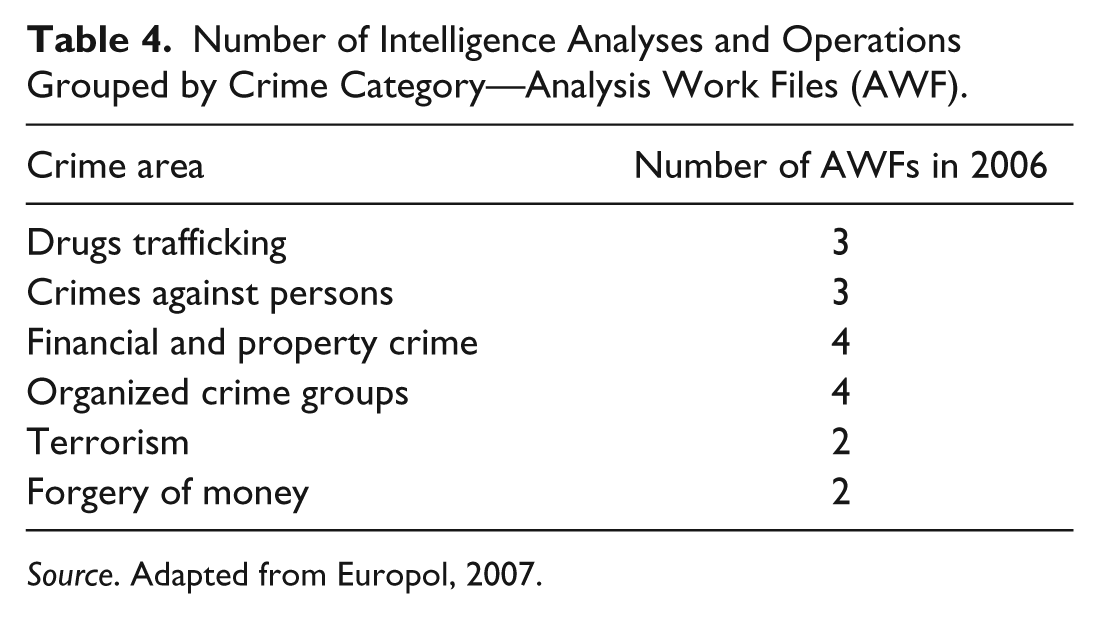
Source. Adapted from Europol, 2007.

Europol operational support to Member State, 2010.
In 2001, the British Press largely dealt with the issues related to the increase in the number of agency’s staff members, the availability of funds, and the agency’s operational capability: The elite agency is rapidly evolving from a small anti-drugs office into a sort of “Euro-FBI” with growing powers to launch investigations and tackle a wide range of cross-border crimes. The Belgian government, which takes over the EU’s presidency at the end of this month, plans to table proposals giving Europol a greater role in fighting money laundering and carrying out field operations in Member States. Belgium has the backing of French and German leaders, who have called publicly for Europol to be converted into a fully-fledged European police force. Europol is already authorized to investigate fraud, illegal immigration, trafficking in nuclear materials and ill-defined offences such as “corruption,” “environmental crime,” “racism and xenophobia.” It can also play a role in cases of murder and grievous bodily injury. Last year it was given extra powers to tackle money-laundering stemming from “all forms of crime.” Its budget has risen from £4 million in 1998 to £17 million in 2000, with 212 staff. (Evans-Pritchard, 2001)
To ensure the effectiveness of the Agency and facilitate the implementation of strategic and operational actions, the Europol Convention provides that Europol may—on the basis of a “simple” act of its Board of Directors—undersign bilateral cooperation agreements with other European and international institutions and with third (non-EU) countries (see Tables 5-7).
Operational and Strategic Agreements Between Europol and Institutions, Organizations and Third Non-EU Countries, 1999-2004.

Source. Adapted from Europol, 2009b.
Note. EMCDDA = European Monitoring Centre for Drugs and Drug Addiction; ECB = European Central Bank; WCO = World Customs Organization; UNODC = United Nations Office on Drugs and Crime; OLAF = European Anti-Fraud Office.
Operational and Strategic Agreements Between Europol and Institutions, Organizations and Third Non-EU Countries, 1994-2004.

Source. Adapted from Europol, 2009b.
Note. SITCEN = EU Joint Situation Center; FYROM = Former Yugoslav Republic of Macedonia; CEPOL = European Police College; Frontex = European Agency for the Management of Operational Cooperation at the External Borders of the Member States of the European Union.
Operational and Strategic Agreements Between Europol and Institutions, Organizations and Third Non-EU Countries, 1994-2004.

Source. Adapted from Europol, 2009a.
Liaison Officers stationed at Europol’s premises in the Hague.
The following chart (Figure 4) on the perception of institutional users on Europol demonstrates the progressive consolidation of a functional relationship, which is possible to define as continued, accepted, internalized, and stable over time (taken for granted). In particular, the graph indicates an increasing degree of internalization and unconditional acceptance of the decisions made by Europol.

Europol perception from institutional users, 2010.
Europol is a body capable of making decisions and implementing cooperation policies by virtue of an independent act of its Board of Directors.
Indeed, police cooperation in Europe does not simply include the provision of assistance by one or more Member States to the benefit of another or more Member States, or a mere exchange of information among them. On the contrary, it entails a consistent support action performed by means of institutions, personnel, and equipment making up a proper European apparatus, with its own hierarchy, its own distribution on the territory, its own “liaison officers,” and its own training facilities. In a nutshell, Europol is a fully fledged institution managed and funded directly by the EU.
Due to its operational and institutional potential, the members of its staff decided to deepen their specialized technical skills (by means of the structural differentiation and the functional specialization that inevitably follows the development of complex organizations) in their fields of interest. The organization has become increasingly aware of its capabilities and developed data, interpretation, and processing skills. Europol’s staff members show greater expertise and experience, savoir faire and savoir pouvoir (i.e., higher specialization), and a developed “police culture” based on a rooted and harmonized EU institutional identity, despite the legislative and organizational discrepancies at Member States level (Bigo, 1996). For instance, Deflem (2006) stated, Europol can rely on a well-developed international police culture, in Europe and across the world, which has for a long time forged international relations on the basis of a common understanding of the function of police. As research has shown . . . the development of an international police culture in the industrialized world can be traced back to at least the late 19th century when police institutions began to develop international cooperation for the policing of criminal, rather than political, offences. Therefore, also, Europol’s participating agencies and those with whom Europol cooperates typically will be able to agree on the scope of terrorism-related activities, despite the diversity of the legal systems of the EU Member states. (p. 347)
Organizational factors deeply affect policy-making processes, namely, the willingness of States (according to an intergovernmental resolution) to appoint a bureaucratic organization, to perform a number of cross-border operational capabilities, and to solve increasingly complex public security-related issues. The organization has turned into a de facto leading policy-making body, that is, able to develop and implement policies almost autonomously according to the decisions taken by each Member State.
Despite the scope and importance of Europol for European cooperation and counterterrorism (den Boer, 2003; Marotta, 1999), as acknowledged by national governments, the role of the Agency remains at the heart of heated discussions within the scientific (and judicial) community
8
(Bruggeman, 2002; Busuioc, Curtin, & Groenleer, 2011; Deflem, 2006; den Boer, 2002, 2003). The role of the Agency is also frequently debated by: the European Parliament (LIBE Commission, PARLOPOL group, the Committee on Civil Liberties and Internal Affairs of the European Parliament), the Commission,
9
within Parliamentary commissions of each Member State (Evans-Pritchard, 2001),
10
the European Court of Auditors (that has dealt with the threat of corruption inside the organization),
11
in trade associations (EDA—European Democratic Lawyers), and civil right groups (State Watch). The media and civil society has engaged with this issue.
12
The following quote illustrates this point: Under the Amsterdam Treaty, Europol is supposed to share some information with the European Parliament, but MEPs complain that it has refused to provide even the most elementary documents such as the full annual report. The main check on Europol is a management board appointed by the 15 EU justice ministers, which questions the director in secret session. A separate supervisory board examines the data protection angle, but has no operational oversight. Both bodies have had difficulty obtaining documents. Unlike national police officers, Europol staff is not compelled to testify in court and are immune from prosecution for “acts performed by them in the exercise of their official functions”. This can be waived on the order of the director. (Evans-Pritchard, 2001)
The risk is that an Europeanization of the fight against organized crime is not accompanied, at the same time, by the creation of an equally effective judicial control. Such supranational organization could deprive national courts of the possibility to effectively control the activities of an agency that is now able to directly affect the rights and freedoms of EU citizens (see, for instance, the ticklish issue of the collection, use, and access to personal data
13
or the possibility that the Office is used at national level with judicial police functions). On the latter matter, Giuseppe D’Elia’s (2002) work on the limited space guaranteed to national legislations and constitutional provisions should be quoted: The problem of availability, especially if interpreted as a relation of dependence (albeit functional only) with any subject performing judicial police functions, is bound to recur in relation to those institutions that, in the EU context, wish to contribute to the fight against organized crime. In particular, the “European Police Office” (Europol) and the corresponding “Europol National Unit” should be noted, having being created within the EU context to coordinate, promote and inform and support criminal investigations. It is not clear whether the classification of these subjects as judicial police bodies makes them national bodies, although they were created in a supranational context.” (pp. 31-32)
In a nutshell, it is possible to suggest that an institutionalization-Europeanization of the organizational field has indeed occurred in the second and third dimensions, given that the following points apply: a stable presence of the Agency in the policy-making process as a “governance structure”; the Agency bureaucratization, self-referential validation, autonomization and independence of the policy organizational field; and a high degree of acceptance despite criticism and the demands for a more democratic change and transformation.
The Effects of the Europeanization of the Organizational Field on the Policy Outcomes
Now, let us check whether the level of institutionalization of norms, practices, rules, values, procedures and cultures—and therefore of Europeanization—does affect the four main aspects of public policy efficiency, which are intertwined with each other.
First, a high level of institutionalization-Europeanization seems to have a positive impact on policy responsiveness. To test the level of citizens’ satisfaction, extremely simple but effective methods may be applied, such as the Euro barometer surveys (Morlino, 1998, chap. 7). As Figure 5 shows, in 2008 the vast majority of the European citizens found it necessary to sign an agreement with the EU on the decisions taken by their governments on matters such as terrorism (79%) and organized crime (59%), which are two of the policy areas that most concerned the European public with 80% of preferential votes (see Figure 6). More than 50% of the interviewees said to be interested in the exchange of information on the police and the judiciary. But perhaps Figure 7 shows a more interesting piece of information, that is, citizens believe that the decisions taken at European level on specific policy areas have a higher “added value” than the ones taken at national level. Of the interviewees 72% believed, for example, that a joint action is essential to combat terrorism and organized crime, while nearly 70% think likewise with regard to the fight against drug trafficking. Almost the same percentage gave the same importance to actions at European level regarding the exchange of information between the police and the judiciary. Only few of them, 18%, 25%, and 22% respectively, did not attach an added value to EU actions, as the “five-year work plan” drawn up by the Agency’s Board of Directors in collaboration with the Council and the Directorate shows to a certain extent.

Decisions that national governments should share with the EU, by intervention area, 2008.

Level of concern, by policy area, 2008.

EU added value on the choices made by national governments, by policy area, 2008.
The institutionalization-Europeanization of the organizational field of the common security policy and the fight against organized crime seems to allow a reduction of the conflict level among the policy field stakeholders, especially the public ones, to the extent of which many issues are not subject to constant renegotiation by public stakeholders. The reasoning is that the responsibilities and guidelines at the basis of the cognitive framework and a common approach—for example, aiming to harmonizing criminal law for transnational crimes (Harmsen & Wilson, 2000; Locatelli, 2010)—are clearly defined and accepted among the network. The increase of the level of policy institutionalization has “depoliticized” policy itself. This means that Europol, as a cooperative agency, is guided by an “efficiency-oriented view point” (Deflem, 2009, p. 132); and that many of the issues related to it have been administratively routinized, standardized (Flournoy & Smith, 2005, pp. 34-35), and highly bureaucratized, in respect of the knowledge and know-how of their enforcement duties (Deflem, 2009, p. 132). This has resulted in a gradual loss of their political configuration features. Police bureaucratization, in terms of efficiency, leads Europol officers to “independently determine the proper means of policing, but also that they can specify the objectives of police work given a broad and generally formulated mandate of crime control” (Deflem, 2006, p. 351).
The issues related to the European Police Office seem indeed more connected to the administrative and organizational management, rather than being connected with party politics dynamics, that is, they do not have a peculiar political connotation and seem “unrelated” to the interest of national parties.
As regard the influence on the level of territorial and functional coherence of the actions taken, in this case where the level of institutionalization is high, the resistance of the dominant coalition against microsectional external pressures is accompanied by the ability to establish stable and predictable courses of action—in space and time—without constantly being required to renegotiate the terms of the agreements (Harmsen & Wilson, 2000). This allows, first, to define multiannual action programs, which are consistent and irreversible, and to, second, restrict territorial imbalances often generated by the transition from the “European resolution” to the “national implementation,” due to the different territorial levels involved (Europol, 2007, 2009a, chap. 5; Fischer, 2000; Lynn, Heinrich & Hill, 2001; Rosenau, 2000).
Last, as far as the level of accountability is concerned, it gradually decreases as the level of Europeanization increases. As already pointed out, the stakeholders of the organization become increasingly involved in the functioning of the EU internal security agencies (Bigo, 2006, 2007; Bigo, Bonelli, & Olsson, 2007). Their specialized technical expertise, along with a greater discretion and ability to interpret and process the rules and the information at their disposal (Balzacq, 2008), becomes part of the new institutional and legal architecture (Occhipinti, 2003).
A greater expertise and experience, a “common understanding of the function of police” (Deflem, 2009, p. 140), a pertinent knowledge concerning threats risks and vulnerabilities, savoir faire and savoir pouvoir (Bigo, 1996) may be appreciated, that is, a greater professional expertise of the (transnational) staff members generates a retroactive feedback, spiritual and corporal cohesion, creates professional solidarities practices and culture (Deflem, 2009), and validates a genuine European institutional role and identity (Bigo, Guild, & Carrera, 2010; Rieker, 2005).
Due to the presence of a “field of (in)security professional” (Bigo et al., 2007, 2010), actors within the organization would tend to respond using an instrumental rationality (March & Olsen, 1998) with an emphasis on efficiency in operations (Deflem, 2002, 2004, 2006). This utility-oriented behavior (Lanzalaco, 1995) may cause a potential lack in terms of rule of law implementation and citizens’ political and civil rights. Moreover, empirical research tends to show that police officers identify accountability requirements as interferences on their actions (Alain, 2001).
Conclusion
This research shows that the high and increasing level of institutionalization-Europeanization of the organizational field of the common European security policy, limited to the creation and implementation of the European Police Office (Europol), has promoted the construction of a Euro-centric, highly institutionalized, policy network. Furthermore, this study suggests that a high level of institutionalization of the European Police Office seems to be an important factor capable of affecting the following decision outcomes of European security policy: a higher level of public policy responsiveness, a gradual reduction of institutional constraints (accountability) that may generate a pervasive network of mutual cross-check, as well as an increasing predisposition to organize cooperation-based interactions. In other words, the public policy analyzed in this article seems to show better performance and higher level of effectiveness, thanks to its high level of institutionalization.
However, there is the threat that, in the long run, an excessively high level of institutionalization-Europeanization may have negative effects on policy development. Hyperinstitutionalized policy fields might generate a sort of freezing of the public policies, which might prevent any form of adaptation. Moreover, the excess of legitimacy may weaken or even terminate the physiological link between applications and the level of responsiveness, thereby developing a self-referential decision-making mechanism.
Footnotes
Acknowledgements
This article is the result of joint research undertaken by the two authors. Marco Calaresu conceived of the study, prepared the hypothetical framework of the analysis, carried out the collection of empirical data, provided the interpretation of data and drafted the manuscript alongside tables and figures. Mauro Tebaldi participated in the design of the study, provided the interpretation of data and edited the manuscript. Both authors read and approved the final manuscript.
Declaration of Conflicting Interests
The author(s) declared no potential conflicts of interest with respect to the research, authorship, and/or publication of this article.
Funding
The author(s) disclosed receipt of the following financial support for the research, authorship, and/or publication of this article: This work was partially supported by the funding for publication of the Istituto Studi e Ricerche Camillo Bellieni (ISBE).