




Abstract
Social symbolic action is interpreted through binary narrative as a discourse constructed by motives, relationships, and institutions. This discourse is based on a distinction between the pure and the impure, the good and the bad, and the sacred and the profane, and it is linked with the cultural imaginary that lends a particular meaning to social acts. In this case, the analysis of the binary narrative of self-defense groups in Tierra Caliente (Michoacán) allowed interpretations to be made regarding regional armed social action in a national setting, shaped by the government discourse that blames organized crime for national public insecurity.
Introduction
Social action not only mobilizes people, but it also materializes or manifests itself in collective acts that are simultaneously interpreted by those who observe or experience them and those who carry them out. These interpretations shape narratives based on values (beliefs) and classifications (dichotomous) that generate sense or meaning in the civil sphere, which includes communicative and regulatory institutions (Alexander, 2013).
Social action is symbolic because it is understood through the meanings it generates that allow intelligibility and interpretation. Embedded in a diversity of worldviews, social action’s expression occurs through communication; that is, it is a communicative act (Kuper, 2001).
Therefore, the armed collective action of self-defense groups in Tierra Caliente (Michoacán), which is considered to be a communicative act, was linked to a staging of violence (a performance) whereby the collective belief-in-public-insecurity script was shared. This allowed the use of force to harm individuals classified as the creators of a social situation of plundering and theft (Maldonado, 2014).
However, it also revealed the disputes that arose from the use of violence in the civil sphere through the wielding of democratic values (more inclusive or universal) or contrary values (not inclusive or particular) that produced exclusive processes of stigmatization and segregation, and even greater violence that was based on beliefs of order and disorder (Alexander, 2006).
As a result, for the purposes of studying the meaning of the armed collective action of self-defense groups, it was useful to observe it as a social drama but as one that unfolds in the civil sphere, made up of communication and regulation institutions where interpretations expressed the Mexican State’s weakness through its inability to ensure public security and impede the emergence of armed civil groups or combat the criminal actions of traffickers of drugs.
The objective of this article is to develop an interpretation 1 that aids in the understanding of a communicative collective act in the civil sphere that is defined by the armed social action in Tierra Caliente (Michoacán) and whose binary discourse, from a general point of view, expressed that the universal value of inclusion derived from the liberal democracy model 2 was incompatible with the social situation in Tierra Caliente (Astorga, 2015; Das, 2016). 3
In the case of Mexico, the meaning of collective or individual illegality lies in the narrative of social justice. 4 This is made evident by the supposed weakness of social welfare state institutions, 5 which are considered to be more than anything a negation of the universal validity of social rights (Bayón, 2015; Duhau & Giglia, 2008).
In this sense, from Wacquant’s (2000) point of view, the narrative of poverty and misery expressed a “flaw” of the neoliberal capitalist system. This flaw consists specifically of the system’s creation of violent people who became so because they lacked a social function in the new social regime (Beck, 2006; Castel, 2004; Castel & Haroche, 2003; Sotelo, 2010; Wacquant, 2009).
For this reason, the academic discourses generated in Mexico have been constructed based on past beliefs. Nonetheless, one belief in particular stands out: Violence has been provoked at the regional level by the “absence” of the State or by the “voids” of political power or due to the existence of “marginal” zones of the State (see Buscaglia, 2015; Maldonado, 2010).
However, these narratives are based on the structuralist view 6 that denies the autonomous dynamic of social action and the role of culture as the externalization of subjective meaning that can also be analyzed as a communicative act constructed as a binary discourse (Alexander, 2010).
The article is divided into four parts. In the first part, a general methodological note is presented to show, in a summarized manner, how the social actions of the self-defense groups and Los Caballeros Templarios are understood through Jeffrey Alexander’s proposed cultural sociology. In the second part of the article, the construction of the self-defense groups’ binary narrative is analyzed in terms of the performances or symbolic actions that defined Los Caballeros Templarios as the enemy, which established its method of plunder in Tierra Caliente through the use of force and coercion. The third part of the article focuses on the narrative of the other actors who interpreted the armed actions of the Tierra Caliente self-defense groups as illegal actions related to a lack of “security” on the part of the State.
The fourth part establishes a characterization of the new scenario that turned the self-defense groups into a punitive force, subordinated to the logic of state public security. Following this are final reflections that seek to obtain a holistic interpretation of the performance of Tierra Caliente self-defense groups.
Methodological Note of Symbolic Action in the Civil Sphere
The civil sphere has made possible the institutionalization of values and regulations that favor collective action that is characterized by shared values or beliefs and worldviews that produce solidarity and are expressed through public opinion. For example, this diversity of cultural codes makes possible the emergence of different social practices whose meanings are tied to universal or particular values that allow individuals to internalize norms that generate common or new scenarios (performance) based on the existence of free will (Collins, 2009). To reiterate, the important factor here is social action, not the subject who produces it (Gergen & Gergen, 2011).
However, according to Jeffrey Alexander’s (2006) proposal, the discourse of the agent’s binary narrative develops in three spheres of social action: the sphere of motives (attributed to agents), the sphere of the relationships (legitimate and illegitimate) that are constructed to form links to other actors, and the sphere of institutions (i.e., the type of organization that is formed and whether it is regulated by impersonal norms or discretionary and exclusive).
Table 1 summarizes the motives expressed as discourse by the opposing agents (the self-defense groups and Los Caballeros Templarios). The self-defense groups expressed the motives from which their armed collective action sprung as a consequence of public insecurity that was created by the presence of a particular method of payment, controlled in a discretionary way by Los Caballeros Templarios and based on force and coercion. Meanwhile, Los Caballeros Templarios present themselves as producers of public security, and therefore, they interpret the armed actions of the self-defense groups as part of a dispute for control of the drug trade, supported by enemy criminal organizations such as the Zetas or the Jalisco Nueva Generación drug cartel.
Binary Discourse of the Opposing Agents’ Motives.

Source. Created by the author.
Table 2 contains the type of binary relationships created by the violent social action of both contenders. The self-defense groups created an open organization for the inhabitants of the diverse localities of the Tierra Caliente region who shared their same ideal of struggle. This strengthened relationships of trust and credibility and granted the groups legitimacy. In the case of Los Caballeros Templarios, their organization established particular relationships of exclusion and suspicion and then entered into a stage of de-legitimization. However, the symbolic struggle of the self-defense groups’ leaders also served to create a national collective conscience that took a stand against the producers of public insecurity.
The Binary Structure of Relationships.

Source. Created by the author.
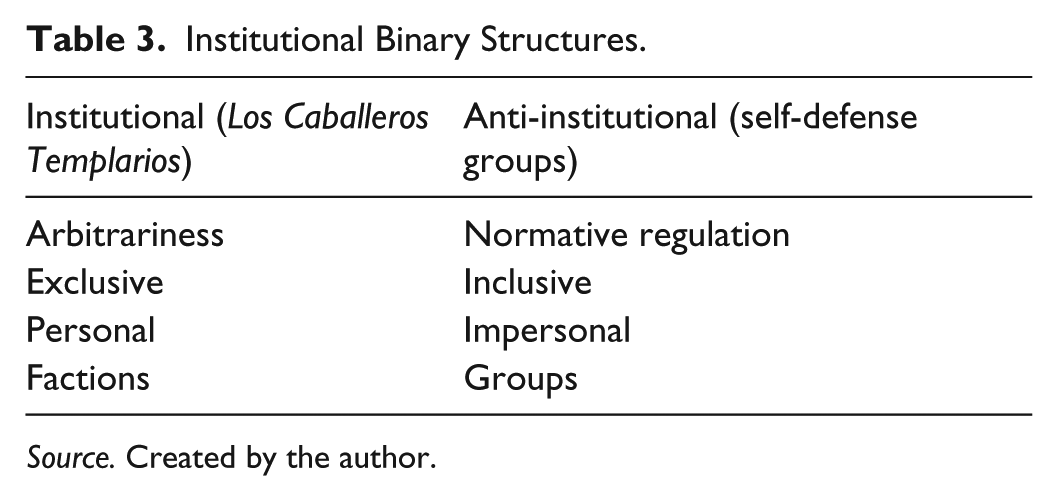
Table 3 shows in a general way the type of organization that was formed during the armed social conflict. From an anti-institutional framework, the collective action of self-defense groups was transformed into an inclusive and impersonal regulated organization when the groups became a rural armed police force. This was primarily due to the fact that in the institutional sphere, Los Caballeros Templarios alongside their allies, some of whom were local police and some of whom were government authorities of Michoacán, established relationships governed by arbitrariness, exclusiveness, and the personal.
Institutional Binary Structures.
Source. Created by the author.
The aforementioned methodology has been possible because public opinion has been expressed in the printed mass media. The printed mass media is the vehicle of the civil sphere where the discourses and narratives of actors range from generalities and ideals (Alexander, 2006).
The Construction of the Tierra Caliente Self-Defense Groups’ Binary Narrative
On February 24, 2013,
7
Hipólito Mora, a neighbor from the town known as la Ruana whose official name is the Municipality of Felipe Carrillo Puerto, went to the main square to attend a meeting that he had convened days before where he made the following statement: Sirs, I invited you here because you know the position that Los Caballeros Templarios have put us in. They don’t let us work; they are taking the food out of our families’ mouths. He who has the courage to defend his rights, his family and get rid of Los Caballeros Templarios, come over to our side—and everyone should come over to our side—remembering with great concern—many people. Your actions will bring great joy. It is worth the effort. (Maerker, 2014a, p. 22)
Thus, Hipólito Mora began to construct a binary narrative that justified the organization of the armed rebellion against the methods of exploitation and plunder used by Los Caballeros Templarios to keep part of the earnings of private businesses generated by lemon, melon, and avocado farming, a productive activity accompanied by other monetary benefits derived from drug trafficking (Maldonado, 2014). However, this particular narrative was interpreted through a discourse of public insecurity that has been characterized by the following classifying terms that are present in communication institutions and generally refer to violent acts: hitman, cartel, pick-up, lookout, headman, lieutenant, and financial operator (Escalante, 2012).
Another interpretation of the narrative facts of the event that took place in La Ruana was based on the belief that a war of the poor had appeared in Tierra Caliente. According to Luis Prados (2013), in a lemon farming town, there occurred “a war of the poor in which there was only one certainty: In this region of the country, Tierra Caliente of Michoacán—and it is not the only region—the Mexican State does not exist.” 8
Nevertheless, in the municipality of Tepalcatepec, the doctor José Manuel Mireles established the leadership of the self-defense groups. He expressed the motive of his rebellion in the following way: Its self-defense group was conceived in order to protect Tepalcatepec from the violence and extortion of Los Templarios (which he later denounced in an interview that he gave at a radio news station called Radio Fórmula) that Nazario Moreno (. . . alias El Chayo and the founder of La Familia Michoacana, the predecessors of Los Caballeros Templarios) did not die in 2010 (. . . as was announced by the then-President Felipe Calderón Hinojosa). He is alive. (De Llano, 2013)
Meanwhile, José Manuel Mirele’s narrative appeared from the beginning in YouTube video. Mireles expressed that motivated his armed uprising was the destruction of the extortion method of Los Caballeros Templarios: “A quota for each cow that they sold, another for each kilo of meat sold, another for each kilo of tortilla, and they reacted (the self-defense groups) when they began to rape their daughters” (Chouza, 2013).
In the armed conflict, the leader of Los Caballeros Templarios (Servando Gómez Martínez, La Tuta) constructed his own narrative to interpret it. He used videos as communicative acts through which to express his intentions and motives. In one of these videos, he expressed his intention of disarming on the condition that the federal, state, and municipal government reestablished the state of law to ensure the peace and security of the people of Michoacán.
La Tuta interpreted the violence as a result of the lack of agreement and negotiation of the involved parties and accused the self-defense groups’ leaders “[. . . of belonging] to criminal gangs linked to the cartels of Los Zetas or to the group known as Jalisco nueva generación, whose objective it is . . . to dismantle Los Caballeros Templarios” (Martínez, 2013; Méndez, 2013).
At the same time, the self-defense group headed by José Manuel Mireles 9 continued to advance in Tierra Caliente. In each municipality, the same performance that took place in the municipality of Churumuco was reproduced: Fifteen trucks entered the municipality with armed individuals, and a meeting was called. The meeting was held in the public square where Mireles invited the attendees to organize self-defense groups to combat Los Caballeros Templarios. Once this had taken place, barricades or check points, with armed guards, were set up at the municipality’s entry and exit points. Prior to this, the municipal police were disarmed after being accused of being in the service of Los Caballeros Templarios (Martínez Elorriaga, 2013).
On February 24, 2013, in the municipality of Tepalcatepec, the offices of the Livestock Union provided a setting for a meeting of residents who sought to organize self-defense groups. 10 A barricade was erected at the town’s entrance where a rancher, lemon, and sorghum farmer as well as a mango farmer stood guard. 11
For its part, the narrative of the former spokesman of the General Council of Community Self-Defense Groups, Estanislao Beltrán (Papá Pitufo), sought to justify a particular legality for the self-defense movement: “We take up the legal line of argument, anyone who plays dirty will be indicted, and relatives of Los Caballeros Templarios defame us when we detain them” (Castellanos, 2014a).
The main detention center used by the self-defense groups was located in the town of Los Reyes (a city with a population of 50,000 residents in the Purépecha indigenous plateau). There were 49 lookouts or dealers, defined as such by the work they carried out for Los Caballeros Templarios in which they used radios to inform those in charge of the town square of police and military presence or to detect possible kidnapping and extortion victims: “They were the eyes and ears of criminals.”
However, his narrative did not include an admission of guilt for participating in the Los Templarios organization. Rather, he only expressed regret: . . . the cartel (Los Caballeros Templarios) came to their neighborhoods offering 1,800 pesos per week, motorcycles, groceries and cigarettes for monitoring, unarmed, federal units on an initial schedule of eight hours that was later increased to 12 hours [. . . but] the drug lords didn’t hold up their end of the bargain. They terrorized them by threatening to attack their families and they did not pay them. To some men they owed as much as six months’ salary. [And one man added] and if we lost the radio, we had to pay for it. (Castellanos, 2014c)
12
The need to justify the legal origins of the guns used by the self-defense groups presented itself through the discourse of the participation of the principle agents of regional development. These agents included local-rancher businessmen and landowners who farmed fruit and vegetables for export. The contributions of migrants from Michoacán living in the United States were also noted. 13
But it should also be considered that some self-defense groups had emerged as community police before 2013, especially in localities with a majority indigenous population. 14 These were armed groups that safeguarded communal property to avoid their commercial exploitation by private companies (Castellanos, 2014b).
The integration of more Tierra Caliente residents into the self-defense groups of Mireles and Mora led a public official of the U.S. Department of State to say that Barak Obama’s government was concerned about the events that had placed communities between the gunfire of trafficking drug organizations and self-defense organizations (Agency Federal Press, 2014).
The U.S. official’s declaration influenced the subsequent intervention of Enrique Peña’s government in the Michoacán conflict in a discursive way and at the international level. For example, in Canada, Peña denied that during the first year of his administration, he allowed the self-defense groups to “grow”: In no way, to the contrary, I think that the space this year of intervention has allowed us, as the figures and statistics clearly prove . . . there is a real decrease, really, of levels of violence [. . . and in Michoacán] the government of the Republic [. . . should] ensure security . . . apply the law [. . . the] strategy [. . . is] not only to combat insecurity and crime . . . rather . . . to reconstruct the social fabric . . . achieve an integral development of [. . . the] entity. (Vargas, 2014)
As a result, some public officials of Enrique Peña Nieto’s government expressed the same opinion at international events, as was the case in the 2014 Exceltur Tourism Leadership Forum that was held in the city of Madrid (Spain) where the then-secretary of tourism (Claudia Ruiz Massieu) stated, “The matter of Michoacán is not one which has affected the sector’s performance, which grew during the year, both in employment and arrivals as well as in expenditure and spill-over” (Aranda, 2014; Tejeda, 2014).
At the same time, the process of cultural construction of the self-defense groups’ armed action began to materialize in icons, not only because of their attire (covered faces or white t-shirts bearing the slogan “self-defense”) but also in the main leaders such as José Manuel Mireles and Hipólito Mora (Bartmanski & Alexander, 2012).
For this reason, their iconic power allowed them to be seen as “fighters” against national public insecurity caused by organized crime. This image was overshadowed by official discourse that sustained that illegality is not combatted by illegality (Ramírez, 2011).
On October 26, 2013, in an action carried out by Mireles, his followers described him as “heroic” and “symbolic” because he agreed to enter the city of Apatzingán unarmed when the military did not allow his group to enter with their weapons. Despite this prohibition, the meeting was held in the main square where a grenade exploded. Nonetheless, he delivered his speech for 30 min, inviting those present to create self-defense groups (Chouza, 2014b). 15
By October 28, 2013, the self-defense groups had formed the General Council of Community Self-Defense Groups of Michoacán. The council facilitated government intervention because it became the only organization that the government allowed to coordinate the army and self-defense groups’ military actions against Los Caballeros Templarios. Following a private meeting with the then-Attorney General of the Republic (Jesús Murillo Karam), Mireles, as spokesman for the General Council, reported that they had accepted the proposal (Castellanos, 2014a).
Government collaboration with the self-defense groups “contaminated” the movement. This became evident in the following juncture: January 4, 2014, José Manuel Mireles suffered an accident in a small plane that he was flying and fell out of the media limelight on being hospitalized. Estanislao Beltrán (Papá Pitufo) took his place as spokesman. On January 27 of the same year, Beltrán signed an agreement with the federal government to legalize the self-defense groups as rural police forces. This measure was sanctioned by a commissioner (Alfredo Castillo Cervantes) whose position was created by President Peña Nieto 16 (Calderón, 2014d; Ferrer, 2014).
The issue of self-defense groups was presented by the federal government as a national security problem. At an event held in the capital of Michoacán (Morelia), Interior Secretary Miguel Ángel Osorio Chong participated as the keynote speaker. Osorio explained that the zone (where self-defense groups were found) had been in a state of insecurity for more than a decade; however, he asked the self-defense groups to return to their places of origin because the (Mexican) State would assume the responsibility of ensuring the security of the communities in conflict (Calderón, 2014a).
The governmental intervention or “contamination” of the self-defense groups’ movement generated a media conflict because Osorio Chong stated that the reestablishment of municipal order where the self-defense groups had been present depended on the handover of weapons and an operation carried out by the military and federal police to establish local public security.
However, Mireles, recovered from the accident and without his position of Council spokesman, used a video that was disseminated on social media to request that the self-defense groups not accept the federal government’s proposal to disarm. This video was also transmitted on an evening news channel to a larger national audience of the private television network (Televisa). A few hours later, Mireles contradicted himself in a second video where he supported the prior rejection by some of the self-defense group leaders of the government’s offer to disarm, conditioned by the arrest of all of the trafficking leaders of the region 17 (Calderón, 2014c).
The federal governments’ reason for turning the self-defense groups into rural police forces was not only to regain punitive control of the region but also to reinforce the social belief that national insecurity is the result of the territorial expansion of organized crime, identified by the illegal business of narco trafficking (Chignola, 2016).
The Binary Discourse Between Autonomy and Government Colonization 18
The norms and practices of Mexican indigenous communities have been the basis for a civil sphere that has reproduced a particular solidarity that has, thus, conferred its autonomy, which is legally guaranteed in Article 2 of the Political Constitution of the United States of Mexico. This legal act led one part of public opinion to consider the self-defense groups as legal community guards. However, they forgot that some of the self-defense groups were formed, in the majority of cases, by mestizos and not only indigenous people. That is, they were not governed by indigenous norms and practices (Noticiarios Televisa, 2013).
However, others considered the organizational autonomy of the self-defense groups to be a means of executing an armed confrontation among the neighbors of Tierra Caliente because “Michoacán represent [. . . ed] the sum of all of the failures of the Mexican State to confront organized crime [. . . the] self-armed guards . . . and on finding themselves orphans of the State, honored local tradition by choosing to bring about justice themselves” (Zepeda, 2014).
In this sense, historian Enrique Krauze (2014) interpreted the appearance of the Tierra Caliente self-defense groups as a consequence of generalized violent crime in the country due to the fact that democracy had a centrifuge effect. Not only did it limit presidential authoritative power, but it also favored the autonomy of criminal powers allied with local politicians and corrupt police officers.
The autonomy of the self-defense groups’ armed action was criticized with the argument that carrying out punitive measures was the exclusive function of the Mexican State. This was the opinion of the former Colombian president Álvaro Uribe: “When the State’s institutions do not operate in a timely fashion, violence and counter-violence emerge, and it is necessary to confront them with equal severity and promptness. It is a very serious matter that the State’s function has come to be replaced by a private organization, very serious” (Guardiola, 2013).
For his part, the director—José Miguel Vivanco—of Human Rights Watch (HRW) of the Americas expressed the opinion that “the weak application of law” led to the appearance of the self-defense groups because security forces have participated in forced disappearances since the 6-year term of former president Felipe Calderón (2006-2012) who decreed the so-called “war on drugs,” in this way multiplying impunity through the increase of human rights violations perpetrated by the military (Delgado, 2013; Otero, 2014).
However, further, based on one of the videos that La Tuta publicized on social media, according to Ricardo Alemán (2014), it could be observed that the self-defense groups lacked autonomy due to the fact that one of its leaders “Antonio Torres González—branded as El Americano—not only [. . . received] instructions from La Tuta but also bid him goodbye with an eloquent ‘As you wish, Sir!’”
The videos used by the leader of Los Caballeros Templarios (La Tuta) also showed that the Michoacán authorities had ties to the cartels’ interests: “. . . we all saw the Interior Secretary (of the governor absent on sick leave, Fausto Vallejo) receiving instructions from Servando Gómez, La Tuta, leader of Los Caballeros Templarios [. . . and] photographs [. . . that showed the governor’s son] with the same criminal” (Maerker, 2014b).
In sum, the autonomy of the self-defense groups’ armed organization, according to the binary discourse used, was due to the absence of public security caused by a weak State (Sicilia, 2014) or also by “. . . social exhaustion [. . . due to] the increase of rentier fees and extortion,” according to the entity’s former governor Leonel Godoy (Camacho, 2014; Michel, 2014).
The discursive criticism against the Mexican government oscillated between the weakness of the State that could not apply the law and its late response through the dispatching of federal forces that did not manage to prevent the emergence of the self-defense groups (Lemus, 2015). 19
In this sense, the civil sphere of the self-defense groups was a sphere of particular solidarity that underwent changes and transformation due to the federal government’s interventions and also due to the former collaborators of Los Caballeros Templarios who joined their ranks on being pardoned by the community itself (De Mauleón, 2014).
In this way, the existence of the sphere of solidarity created by the self-defense groups cannot be understood as harmony achieved through the intervention of other spheres. Rather, it should be understood as a consequence of its plurality that, in the case of Mexico, was not oriented by democratic values (Alexander, 2013).
The New Performance of the Self-Defense Groups as Rural Police
The commissioner Alfredo Castillo Cervantes, who presided over the Commission for the Security and Integral Development of Michoacán, said that his main task was to disarm the self-defense groups and establish official social welfare programs with the help of the federation. 20
On January 27, 2014, the commissioner announced that the self-defense groups would become institutionalized on incorporating themselves into the rural defense bodies of the Mexican military. Months later (May 16 of 2014), he corrected this statement and announced that the self-defense groups would form part of the state rural forces.
According to the commissioner, the option for the self-defense groups’ transformation into rural guards presented itself due to the existence of a legal form that dates back to the 19th century in the rural sphere. However, now the self-defense groups needed preparation and training, and this was the explanation for why they should register themselves and declare the number and types of firearms in their possession (Camarena, 2014).
Through the commissioner, the government signed an agreement with the leaders of the self-defense groups when José Manuel Mireles was not the Council spokesman due to his convalescence in the hospital as a result of the plane accident he suffered. This event led the new spokesman Papá Pitufo to state the following: “We have made the appointment public because the declarations of Dr. Mireles are not authorized by the citizen council, they are personal statements” (Chouza, 2014a).
Papá Pitufo insisted that they were discharging to become “rural defense groups.” This agreement, which was made on May 10, 2014, changed the scenario of the self-defense groups in the municipality of Tepalcatepec that was one of the places where the armed uprising of Mireles began when the commissioner made the creation of the rural forces official: “Today, you are the ones who represent the State, and it is your responsibility that, in the future, say in a month or 15 months, we won’t have other people requesting the presence of the State because they feel that you are not representing the communities and families” (Muedano, 2014b).
Meanwhile, José Manuel Mireles, who was no longer the spokesman for the Council of Community Self-Defense, criticized the transformation of the self-defense groups into rural forces, stating that it was an act of foolishness considering that members of organized crime formed the ranks of the rural forces. Mireles made this statement in a talk he had with students and other groups of Mexican society in an urban setting (Mexico City) in the auditorium of the Autonomous University of Mexico City.
Now, he considered himself to be a social fighter. He stated such when asked why he was dismissed as a spokesman of the self-defense groups: “A spokesman is someone who is hired. Social fighters are not anyone’s spokesmen, because as a leader, no one can take from me a position that they did not give me” (Muedano, 2014a).
Before his trip to Mexico City, in the municipality where he grew up (Tepalcatepec), he said that he felt betrayed by the federal government and by some members of the self-defense groups. However, he stated that he would continue with his community self-defense movement so that it might become a national movement (Muedano, 2014c).
However, by not accepting the disarmament and declaring that some of the members of the rural force had links to organized crime and by forming a new armed self-defense group in the town of La Mira (located in the municipality of Lázaro Cárdenas, close to the Pacific Ocean), Mireles brought about his arrest and imprisonment on June 27, 2014 (Chouza, 2014a).
As a result, the creation of a new governmental scenario using agreements that were classified as legal has led participants, spectators, and those who have suffered the consequences of their forceful actions to recognize new forms of organization through other narratives, removed from the values or ideals tied to democracy, which is considered to be a legal order that has defined citizenship through universal rights (Durand, 2010; Neocleous, 2010).
Final Reflections
The performance of the Tierra Caliente self-defense groups not only showed the peculiarities of an armed rural rebellion against the control of Los Caballeros Templarios. It also showed this movement’s authenticity that was diluted as its leaders began to legitimize themselves through national social representation that attributed the country’s public insecurity to organized crime.
This social representation was what sustained the state intervention in the conflict and, at the same time, the subsequent “resolution” of this conflict with the creation of a new scenario for the transformation of the self-defense groups into rural police (the so-called legalization). This legalization allowed the intervention of other actors, such as political parties, to attempt to turn some self-defense group leaders into candidates for public posts due to the fact that they had the support of some local communities (Martínez Elorriaga, 2015).
The symbolic struggle to show the authenticity of the armed actions of the self-defense groups led some of their leaders to become divided in their pursuit for recognition as the spokespersons for a struggle against organized crime and in their endeavor to preserve their regional presence in the legality granted to them by the federal government when they agreed to assume security-related tasks in their towns. This meant that their punitive function was given to them by the State in the face of a situation characterized by the existence of municipal police who became part of the security system for narco traffickers’ private businesses.
Footnotes
Author’s Note
My areas of research interest focus on social performance and paying particular attention to violence and surveillance in the territory of self-groups in arms in rural Mexico.
Declaration of Conflicting Interests
The author(s) declared no potential conflicts of interest with respect to the research, authorship, and/or publication of this article.
Funding
The author(s) received no financial support for the research, authorship, and/or publication of this article.