




Abstract
How engaged families are in their children’s lives, whether at home or in school, predicts their success in school and in life. The purpose of this study was to explore parent, educator, and community member perspectives of family engagement, preschool through grade 12, to inform state-level policy from an ecological framework. Ten semi-structured focus groups were conducted throughout one midwestern state, including five urban groups, four rural groups, and one suburban group. All focus groups were held in high-poverty areas serving high-need communities. All school communities received Title I funds and the average free and reduced lunch rate across participating districts was 75%. Several themes emerged through focus groups, including the importance of relationships, inclusive opportunities, communication, parent education, and family activities. Potential outcomes are included for policy and program development, as well as implications to further expand on issues relative to special education, fatherhood, and English language learners.
Keywords
Introduction
Description of Research Problem
Studies of family engagement in children’s education reveal large associations between family engagement and success for students. Family engagement improves classroom dynamics and increases teacher expectations, student–teacher relationships, and cultural competence, regardless of students’ age groups (Boberiene, 2013). While research supports the educational association between family engagement and educational success for children, little research has been performed on understanding the perspective of all groups—families, educators, and community members—within a single community, regarding what practices are effective in fully supporting families as partners in their child’s education. This study was designed to capture holistic community-wide pictures of family engagement needs and was conducted to inform the development of a statewide Family Engagement Framework with the state department of education (SEA). Consequently, the purpose of this study was to explore family engagement in schools, to develop and foster research-based family engagement activities and strategies particular to educational programs and schools.
Family engagement leading to enriched social experiences is a significant predictor of children’s cognitive skills, and social-emotional skills, including motivation, attention, impulse control, and self-confidence (Boberiene, 2013). Heckman (2008) argued that change in family structure in the last several decades has contributed to low academic achievement.
In 2014, the Dual-Capacity Framework was presented by the United States Department of Education (Mapp & Kuttner, 2013), promoting collaboration between families and schools to promote academic achievement and school improvement. The Framework emphasized that, to sustain a “cradle to career” relationship with students, conventional parent involvement activities like checking homework, attending open houses, and parent teacher meetings do not necessarily engage families. Moving beyond parent involvement to family engagement meant that the responsibility to “involve” is not only placed on the parents. Schools must also actively reach out to children’s primary caregivers, who may not necessarily be parents, to jointly support children’s learning and development in ways most effective yet comfortable for families. Rather than “fixing parents and families,” schools need to build the “dual capacity of school staff while developing effective partnerships in support of student achievement” (Mapp & Kuttner, 2013). Engagement efforts focus on an inclusive and welcoming school environment for all families regardless of race, culture, language, and class. Researchers now focus on developing and promoting meaningful opportunities to engage family priorities and knowledge to support their child’s education (Olivos, 2006; Pushor, 2014). Thus, families may be engaged in children’s informal learning in areas of their expertise. This family engagement framework thus supports family culture and suggests that powerful and often unrecognized knowledge exists in family cultural and linguistic repertoires (Ishimaru et al., 2016).
To become a top education state, this SEA developed a strategic plan for education for learners prenatal through college and career transition (Michigan Department of Education [MDE], 2016). In addition, the SEA included family engagement in their Every Student Succeeds Act (ESSA) state plan, thus recognizing that family engagement is pertinent to student success, yet did not have an official statewide framework. The data analyzed and reported in this study were originally collected to inform this state-level work by the first author, who is also a SEA employee. The goal, therefore, was to explore parent, educator, and community member perspectives of family engagement in schools across the state to develop and foster research-based family engagement activities and strategies particular to educational programs and schools.
Research Goal
The purpose of this specific study is to analyze an existing qualitative data as a systematic academic endeavor. While the data were collected to explore and inform state-level policy, for this specific analysis, we used grounded theory to illuminate how parents, educators, and community members perceive family engagement and their experiences with family engagement in schools (Corbin & Strauss, 2015). We conceptualize the data we collect within Bronfenbrenner’s Ecological Systems Model (Bronfenbrenner, 1977) to capture interactions among families, schools, and communities at large. We provide a holistic analysis of stories we heard from our participants. Given the nature of the data we accessed, we believe that reporting our results by age of children or any other demographic factors is beyond the scope of this project.
Background
Definitions
Family engagement is defined by the National Association for Family, School, and Community Engagement (NAFSCE) as a “shared responsibility in which schools and other community agencies and organizations are committed to reaching out to engage families in meaningful ways and which families are committed to actively support their children’s learning and development” (National Association for Family, School, and Community Engagement, 2010). In addition, family engagement is a continuous and changing process across a child’s life, which evolves as a child matures into an adult. Effective family engagement strategies cut across all contexts and settings in which a child learns and grows, including schools, after-school programs, and community-based programs. Family engagement must ensure that parents play an active role in developing their child’s learning, that parents are actively involved in their child’s education at school, and that parents are full partners in their child’s education and included in decision-making (Evans, 2011).
Family engagement includes activities and behaviors that connect with and support children in ways that are interactive, purposeful, and directed toward meaningful learning and affective outcomes (Sheridan et al., 2011). Family engagement practices can be divided into three types—engagement in the home, community, and school. Family engagement in the home is the most important resource for early learning. Some examples include book reading and parent–child conversations. Family engagement in the community offers opportunities for the student to learn about the world and how to learn within the context of community. Activities may include story time at the library, attending a museum together, or volunteering in the community. Engagement in the school includes activities such as volunteering in children’s classrooms, participating in policy councils, or acting as a school liaison (Hindman et al., 2012). Other aspects of family engagement in the schools can be nurtured through school or class newsletters or other online forums, in which the school makes intentional effort to connect with home. Engagement is fostered when two-way communication is fostered between the school and home, where parents can initiate and direct interactions through the use of technology.
Family Engagement Strategies
While there are several strategies to engage to fully include families as partners in their child’s education, a review of the literature identified several strategies yielding the greatest success in engaging families.
Home visits by school staff can strengthen relationships with children through activities that reinforce the parent–child bond and promote positive child development (Ishimaru et al., 2016). While home visiting programs are most often known for taking place during early childhood years and support families as leaders for their children’s education before kindergarten, home visiting programs are increasingly incorporated in elementary and secondary school, specifically supporting children who are struggling in core academic areas or who have chronic absenteeism (Ishimaru et al., 2016).
Family engagement liaisons are increasingly being integrated in a number of U.S. schools and can develop positive culture and climate in schools. Family engagement liaisons enact cultural brokering roles between families and the school community. Some activities cultural brokers in schools might incorporate include developing welcoming school climates, fostering parent–parent relationships, developing a social network within the school, and embedding family engagement outside the school environment and into the community (Ishimaru et al., 2016). Through cultural brokering, the family engagement worker can bring cultural values into the school community, as well as help nondominant families understand school-centric norms, expectations, and agendas, and consequently, effectively advocate for their children (Evans, 2011).
A fundamental requirement for relationship building is actual physical proximity of families to the school or program. In one study, when physical interactions did occur, they were often routinized (e.g., the parent–teacher conference or back-to-school nights) and interactions were less frequent at the secondary level. When parents did interact with teachers at the secondary level, it was mostly negative regarding behavioral or academic performance (Evans, 2011). Some recommended strategies to combat the physical and emotional distance between schools and families include tying engagement practices to school outcomes (Evans, 2011) and adding accountability for all by distributing responsibility among schools, families, and communities. One example of this is Boston Public Schools’ Parent University (Boston Public Schools, 2010). The district offers daylong learning sessions on Saturdays to address topics such as cyber bullying, literacy, and financial aid for college. Boston Public Schools partners with community-based organizations to market and deliver sessions.
Research suggests that federal mandates alone do not ensure policy success in schools. Quality implementation depends on the values and skills of local family, community, and school leaders and stakeholders. Powerful examples of systemic and sustained family engagement have highlighted the importance of developing powerful school cultures through partnerships with families and communities with continuous quality improvement (Boberiene, 2013), focusing on improving trusting relationships between the school and home, and building two-way systems of support that promote strategies to build quality family engagement supports.
Family Engagement and Culturally and Linguistically Diverse Populations and Children With Disabilities
The educational experience for underserved children, including children with special needs, lower income, immigrant/refugee, or dual-language learner (DLL)/English-language learner (ELL), can be bolstered through means that create connections among social systems and through the development of family and school partnerships. Families and schools can coordinate and collaborate to enhance opportunities and success for all children (Sheridan et al., 2011). While those children from higher resource families with highly educated parents have the highest rates of family engagement (Hindman et al., 2012), underserved families often engage less due to perceived language or cultural barriers. Furthermore, family characteristics such as parent emotional or mental health challenges, stress, or depression can negatively impact family engagement. Family engagement practices in the program or school may not be tailored to meet the needs of the individual family, therefore marginalizing families from potential engagement opportunities.
Student population trends continue to move toward increased students from linguistically and culturally diverse families. Despite these trends, the teaching force remains mostly White, female, and middle class (Evans, 2011). This leads to a sociocultural disconnect between teachers, students, and families. Families with language minority status often demonstrate a lower level of family engagement due to the difficulty of engaging with a school or community structure that cannot communicate with them. Families with language or cultural barriers often feel unwelcome, powerless, and marginalized within their child’s school (Ishimaru et al., 2016). Some individuals within the school can serve as “cultural brokers” to play a role in bridging the racial, cultural, linguistic, and power divides between schools and families. Cultural brokers can create safe spaces to help families understand the school culture, educate parents about improving their child’s achievement, connect parents to institutional resources, and advocate for change (Ishimaru et al., 2016).
Teachers of students with severe behavior and academic problems often develop negative perceptions not only of the students, but of their families (Stormont et al., 2013). Children at high risk for antisocial behavior often develop negative relationships with teachers and school staff, receiving less instruction and more criticism in the classroom (Herman & Reinke, 2017). Those children are often rejected by their teachers and classmates over the course of elementary school and fail to develop school and social skills essential for success. By ninth grade, having just one suspension doubles the chance that a student will drop out of school, suggesting the need for services addressing problem behavior as early as elementary school (Smolkowski et al., 2017).
Many families, particularly those from special populations, have had a negative experience with school themselves, which reduces the likelihood of their initiating engagement with their child’s school without intentional strategies on the teachers’ side to engage families (Hindman et al., 2012). Negative experience of the parents or caregivers may also hinder follow-through of family engagement activities. The challenges may be mutual. That is, not only might the parents feel uncomfortable re-engaging with the school as a parent, but the school may not welcome them back into the school environment. Parents may feel judged or marginalized, discouraging them from taking up on any family engagement opportunities at school.
Theoretical Perspectives
The foundation of engaging families within the networks of communities, schools, and families is placed in the Ecological systems theory (Bronfenbrenner, 1977). Ecological systems theory demonstrated how child development is supported and embedded within a set of nested structures, from immediate microsystems, such as the home and school, to more remote systems such as policies, neighborhoods, laws, and social archetypes. The theory holds that these models are concretely established in children’s immediate experiences (i.e., microsystems). Thus, the priority for engaged partnerships between families and schools in the surrounding social, cultural, and political context (i.e., macrosystem) is manifested in everyday support that children’s microsystems can provide for their learning and development.
Family engagement in any context can be shaped by factors at several levels, such as child factors, community factors, and process factors (Hindman et al., 2012). Child factors may include child characteristics and disability status. Family engagement by child disability status has not been explored in the research in depth but is reported to influence the types of involvement activities and expectations (Hindman et al., 2012). Family factors include components such as parents’ educational achievement, proficiency in the society’s dominant language, and family structure.
In one meta-analysis of family engagement, it was found that educators acknowledge families more as bystanders than as partners in their child’s learning at any developmental age (Boberiene, 2013). Engagement is often disconnected from everyday instruction and school programs. Uncoordinated school engagement efforts yield random acts of involvement, such as parent meetings and curriculum changes, but little sustained, purposeful, or intended support for families as partners (Boberiene, 2013).
Method
The data analyzed and reported in this study were originally collected to inform a state-level work by the first author, who is also a SEA employee. While study procedures are described in this section, we utilized existing qualitative data. We obtained a data sharing agreement from the SEA and approval to conduct a nonhuman subject research from the University Internal Review Board (IRB) in 2018.
Study Data Sources
Researchers description
The data were collected by the first author as a part of her role and responsibility as a state-level family engagement consultant. She designed the survey and facilitated the focus groups. Therefore, initially, the focus groups were not meant to be a research study, rather a “listening tour,” and the participants understood the purpose as such. Much of the information collected, therefore, is what parents, educators, and community members shared to inform a SEA employee with a potential power to influence state policy. While the data and this study ultimately served to inform Michigan’s family engagement framework (MDE, 2020), the present analysis was conducted as university-based research utilizing state data. The first author also has an extensive background as practitioner/teacher and administrator at school/program and intermediate school district (ISD; county) levels, and as a parent. She also worked with families and children with special needs and has personal experience being raised in a household with an adult who has disabilities. The second author has extensive experience in program evaluation and qualitative research methodologies. Her research has focused on children and families in under-resourced communities and schools, and language and cultural diversity. She also has experience raising bilingual and bicultural children in the American public school system. Together, our background facilitated connecting with the views and experiences of our diverse participants. The first author, who has firsthand knowledge of the focus groups, conducted the preliminary rounds of coding and analysis. The second author served to check for researcher effects and alternative interpretations. We triangulated results and interpretations to ensure analytical bias did not occur. Following the grounded theory tradition, we acknowledge that our experiences can lead to biases. We, thus, made every effort to reflect on and “bracket” our individual and collective biases as we analyzed and interpreted our findings (Corbin & Strauss, 2015).
Participants
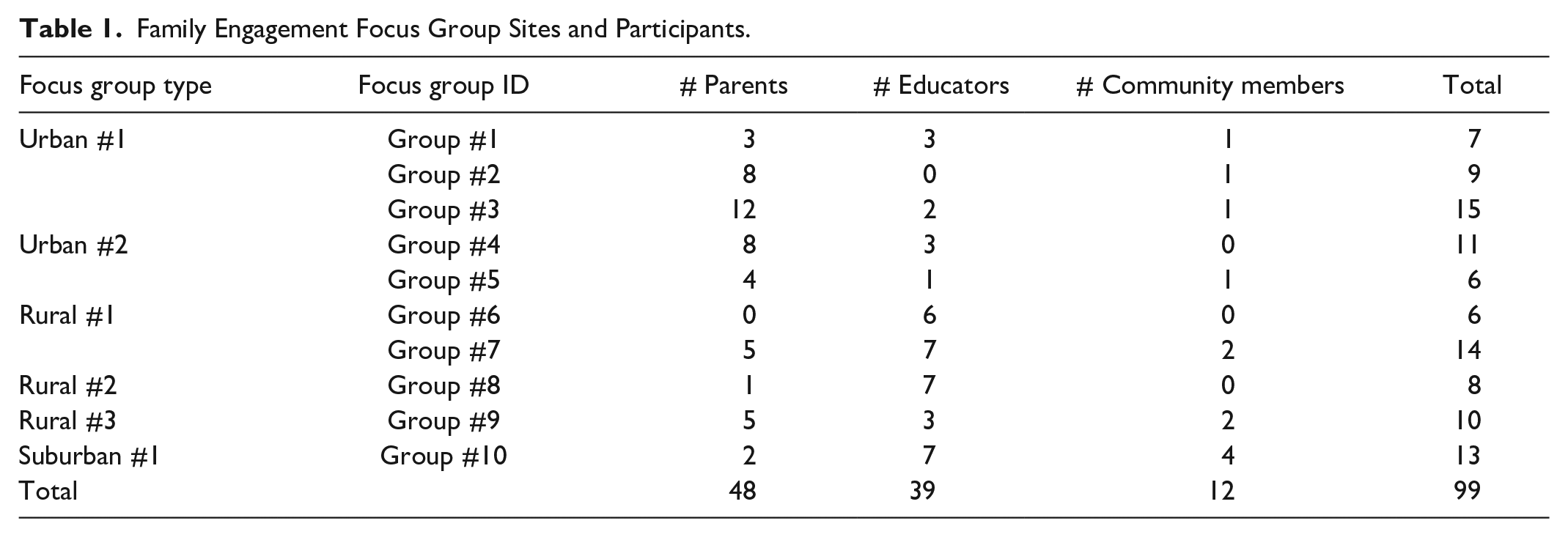
Data from a total of 99 individuals, originally collected by the first author for the SEA, were used. Participants self-identified their roles, with many reporting having dual roles, such as both parent and teacher. Participants opted whether to participate as a parent, educator, or community member, representing themselves in one role for the focus group. Of the 99 respondents, 48 participants self-selected as parents, 39 were educators, and 12 were community members. Many more mothers participated in groups than fathers. Mothers and fathers participated in groups together with educators and community members. Of 48 parent participants, 43 were mothers and five were fathers. All parents participating in focus groups had at least one child in preschool through grade 12 program. Parents reported having between one and seven children. Children of the represented family members ranged in age from 10 days to 33 years old, with the average age child being 10 to 12 years old. An overview of the focus group, including site and number of participants, is included in Table 1.
Family Engagement Focus Group Sites and Participants.
Educators included a superintendent, principals, teachers, early literacy consultants, teachers, curriculum directors, social workers, and early childhood program staff. Community members included nonprofit, community-based organization staff members, faith-based program members, literacy coalition members, and higher education. A summary of participants is shown in Table 2.
Family Engagement in Schools: Participant Representation.

All focus groups were held in high-poverty areas serving high-need communities. All school communities received Title I funds and the average free and reduced lunch rate across participating districts was 75%. Thus, all parent participants had at least one child enrolled in a designated “at-risk” program such as Head Start, state-funded prekindergarten, or in a high-poverty school district. The range of needs as indicated by focus group members included employment, transportation, and resources such as access to grocery stores and medical care.
Participant recruitment
Recruitment for the focus groups was conducted with help from statewide ISDs. The researcher worked with one representative from each of five ISDs to develop recruitment flyers and to disperse the flyers at parent groups and classes, play groups, schools, and community organizations (including community action organizations, faith-based organizations, parent–teacher organizations, and local government organizations). Each ISD, in partnership with the researcher, took registrations for 1 month to 1 day before the scheduled focus group, enrolling between 10 and 30 participants per group. First, focus group sites were identified with help from 11 ISDs and community service organizations. Focus group participants did not receive an honorarium for participation, but were provided a meal through ISD funds, which was a dinner or lunch, depending on the timing of the focus group. Participants came to the focus group with an interest in the topic and appeared to be eager to discuss family engagement, delving into issues and opportunities specific to their geography to inform family engagement practices.
Data collection
Four questions were developed at the beginning of the study, intended to understand family, educator, and community perceptions of family engagement. Primary questions driving this study included the following:
What is a parent’s definition of family engagement?
What does quality family engagement look like?
What are the best ways to engage families who are not currently engaged?
Who are primary partners in promoting family engagement? What are their roles?
Surveys
Methodologies contributing to this study included participant surveys and focus groups. A short survey was developed for participants to take prior to the focus group session to gain an understanding of who was participating in focus groups, the role they were representing, and the ages of children being represented (see online Appendix A).
Focus groups
Ten focus groups were conducted. All focus groups were in English and included parents and educators; eight focus groups included community members. Each focus group lasted approximately an hour-and-half. Focus groups were selected as the study design to garner and understand voice from parents, educators, and community members. Following is the list of basic questions asked of all 10 focus groups:
What does family engagement mean to you?
How do schools and communities promote family engagement?
What activities support family engagement?
What works with nonengaged families?
What partners support family engagement? How?
What are the crucial elements of family engagement?
What makes a school welcoming?
What does not work in promoting family engagement?
If you could do one thing to support families, what would it be?
The first author conducted all focus groups while an assistant managed technology by recording focus group sessions and taking notes to code and analyze responses following groups. Focus groups were semi-structured (Seidman, 2019; Stewart & Shamdasani, 2014), in that while the above questions were asked of all focus group participants, responses often resulted in additional topics being broached, including the use of technology to support family engagement, the lack and need of secondary supports for children and families, and descriptions of practices that prove to be ineffective in engaging families. When topics appeared to be of interest to the majority of focus group participants, the interviewer allowed the conversation to shift to that topic of interest. All participants actively participated during all focus groups. We followed the procedures for facilitating focus groups in Creswell (2019) and Stewart and Shamdasani (2014).
Data Analysis
Data analysis included complete transcriptions of recordings of focus groups. Transcripts were broken into responses and recorded in Excel by both structured and unstructured questions. Responses were coded and themes were identified by examining the response for each question per respondent and across all structured and unstructured questions. Analysis occurred by finding the mode of responses for each question, calculating percent of each code, and identifying primary themes for each question. Primary themes for each question were recorded and cross-matched with primary themes for other questions, resulting in primary themes for the study. Quotes were developed from quotations throughout each transcript. Some quotes were as small as a single word and others were descriptive sentences.
Data analysis was validated by cross-checking across data resources (survey and focus group responses). Cross-checking occurred within each data source to develop a complete code analysis for each methodology with the following steps:
Sort both structured and unstructured questions together, identifying codes and themes within questions. Complete a separate analysis of responses by aggregating responses.
Review all highlighted quotes, now attached to codes. Make a comprehensive list of codes and quotes.
Align codes to categories. Calculate what categories were most represented by identifying mode and percentage for each coded response, and identifying what codes emerged the most for each category. Only primary codes that are attached to quotes and represent participant voice are listed.
Develop charts for each methodology.
Establish themes for each methodology.
Once a code analysis was completed for each methodology, a fourth code analysis was completed for all data sources, both to gain a full understanding of what the overall data yielded and to establish themes across all methodologies.
The following tables represent the analysis of surveys and focus groups, which were examined for significant quotes, associated codes, and categories. For each methodology, we included the sum of all category responses and presented the four categories that garnered the most response. From the participant quotes, codes, and categories developed, we established themes that emerged from the quotes, concepts, and a tally of the strength of response.
Several iterations of codes were developed along the process. Many codes were created at the beginning of the process which were winnowed down through continued analysis. Preliminary analyses included 66 codes across nine focus group questions. Primary themes were identified in each of the nine questions through Excel statistics, including the calculation of most-answered themes and percent, resulting in 23 codes. Once codes were established, they were cross-checked across nine questions, identifying responses with the highest frequencies across the nine questions, and resulting in five primary themes. Methodological integrity was established through frequent self-correcting of the iterative analysis by the first author, and multiple cross-checking and triangulations between the authors throughout the process (Levitt et al., 2018).
Findings
The code-analysis group response table indicates category responses for each methodology. Table 3 provides a description of the code analysis of focus group responses.
Code Analysis of Focus Group Responses.

Themes that emerged from each of the focus groups had similarities. Following are common themes that emerged from the analysis.
Relationships Among Families, Schools, and Communities Are Essential
Relationships were the primary theme in supporting family engagement. One focus group participant parent emphasized the importance of relationships by stating, “nothing about us without us.” Relationships were woven throughout all focus groups as an essential element in supporting family engagement. Relative to relationships, inclusive activities and communication strongly prevailed as essential elements supporting family engagement. Activities for children and families support child outcomes and adult learning in the context of their child’s development.
Focus group participants were asked to describe what contributes to ineffective family engagement. Primary themes that emerged from this question included judgment or fear of judgment (50%) and lack of communication (21%). While fear of judgment was most frequently mentioned, judgment of the school community against families was articulated in many responses. One educator participant stated that the school had used scare tactics on deportation of undocumented children and families, which kept parents and children away from the school. Fear of judgment and lack of communication were articulated as strong concerns by parent participants. It was suggested that more staff training on strategies to enhance cultural competence could help bridge a perceived divide between families and educators. Research demonstrates the role trusting relationships plays in families’ ability to advocate for their students, as it is essential for families to feel comfortable interacting with staff. To foster strong relationships with families, schools can capitalize on the strength of families and build on the capacity of families to effectively support their child’s education at home and in the community (Caspe et al., 2011).
While community members only comprised 12% of focus group representation, the importance of community involvement in the schools to nurture and support family engagement was emphasized within focus groups. When communities are part of the school, the school feels supported and supportive of the family. One community participant stated, “when communities are engaged, that helps level the playing field for all families.” Another parent participant stated, “when families fall apart, communities fall apart.” The interdependence between families, schools, and communities was valued by several focus group members.
Schools Need to Provide Inclusive and Individualized Opportunities for Families
Throughout all focus groups, a strong voice from families, educators, and community members echoed the sentiment that families felt unwelcome in the school environment and that engagement opportunities were “traditional” opportunities for “traditional” families, not inclusive of diverse family types. This includes families at the secondary level and the concern families have of being judged by the school community, including the schools’ perception of the families’ willingness and capacity to be engaged. One parent stated, “schools have taken parent voice and parent support away. They (the schools) need to give power back to parents.”
Additional factors can negatively affect family engagement such as poverty, language minority status, and family structure (Hindman et al., 2012). One focus group parent stated, “Put the family first. The parents are the first teacher, parents are always learning and teaching their family; give families information to help empower their families.” Another parent from an inner-city focus group expressed frustration over the number of services available in the school, yet none of them tailored to help her engage with the school community, “Give me opportunities. Understand [that] I might have barriers to get into this opportunity and address those barriers.” One educator shared a story of a parent she engaged who refused to go to the school at all, (the) Mom wouldn’t leave the house. I started doing home visits and built a relationship with her. I re-invited mom to a meeting. Mom came to the meeting, continued coming to meetings and is now a leader within our school.
Families’ unwillingness to come to school does not indicate their unwillingness to be engaged. Schools and educators need to make every effort to meet families where they are most comfortable to effectively engage them.
Two-Way Communication Strategies Foster Engagement
Both family members and school staff reported concerns with two-way communication, with 19% of respondents indicating that communication is the most important element of family engagement. One educator reported, “Education is important both in and out of school, little efforts to communicate with the family makes a big difference.” One parent reported, “I can send a quick message to the teacher letting them know they had a rough night or whatever and they can know what is happening.” These strategies develop a linkage between home and school, connecting the child’s learning. Developing trusting relationships require two-way engagement between the home and school to discuss and understand social norms and cultural capacities that can inform schools and families (Henderson & Mapp, 2002).
Parents of children across all developmental ages indicated that they do not know what they need to do to be engaged parents. Multiple ways of communicating, such as through newsletters, texting, emailing, and in-person communication, were valued, as was two-way communication. Family members of children in early childhood through adult education programs articulated several struggles with teachers and other school personnel who would use technology such as web-based interfaces or phone applications that would not allow them to answer back or provide feedback.
One parent stated that all materials were sent home in English, even though the school knew the school was over 70% Arabic speaking. This parent stated they used to get everything translated, paying for translations out of their own pocket, only to learn that most communications were a “waste of time” to them, so they stopped trying. The parent stated that none of the information that they had translated had meaning to their child or their family and didn’t help them understand how to support their child. The flyers contained information the family deemed unhelpful in educating their child, such as book fair advertisements or school theme days. No focus group study participants shared that materials sent home were translated into their home language by the school. This included children’s material associated with special education programs and/or services.
Parent Education Fosters Family Engagement in the School and Home
Parents and educators alike articulated value in potentially increasing parent education opportunities. One parent shared, “behavioral therapy has been helping the whole family. We are learning to pay attention to good behaviors in all of our children.” Many parents and staff emphasized that more training on child development would help mitigate concerns related to behavior and discipline both in the home and in the school. Several parents articulated that they want to help more in their child’s school, but they don’t understand what to do or why. Some parents shared that they come to meetings, but are never asked to share their opinions or participate. Several other parents articulated that they feel “judged” when they come to their child’s school. While they want to help, they feel educators don’t want them there or ask too many questions. Several educators echoed that it is often the case that they are told to have parents come to meetings, but they aren’t quite sure what to do with them. In several focus groups, both educators and parents mentioned making agreements to have follow-up meetings to develop training and guidelines to purposefully engage families, rather than just invite them.
The concern families and educators had regarding the lack of support for families in middle and high school was emphasized. One parent stated, “our involvement doesn’t diminish just because our kids are older.” Another parent shared a story of not being allowed in the school at all, even though her child was having trouble adjusting to high school and had an individualized education plan. As children progress through school, family engagement continues to be as important as it was in the early years, yet families and school staff often comment about the decline in family engagement opportunities at the middle and high school levels. While this decline can be misinterpreted as a lack of engagement and incorrectly relate it to a lack of desire to be engaged, studies have shown that families want to be included in their children’s education at the middle and high school level, regardless of demographics (Ferguson & Rodriguez, 2005). Parents and educators alike articulated a need for increased parent training, particularly at the middle and high school levels in child development, college and career planning, English language support, and financial aid. Most importantly, parent education opportunities should stem from family interest, planned, and be implemented with family support and feedback.
Families Need More Activities in the Schools
Themes that emerged under the topic of secondary education included benefits for school activities which include both students and parents, supportive networks to help parents be more connected to each other, and more parent education opportunities within middle and high school. While school activities included many traditional routes for engagement, such as sports boosters, science fairs, and sports events, many parents and educators mentioned the importance of additional supportive learning networks and opportunities, including peer tutoring or workshops for parents to learn about the college application process or how to apply for financial aid. As this topic emerged organically through many focus groups and was articulated as a need for increased intervention, it is recommended that secondary schools look for additional ways to provide support and education to families.
While primary themes emerged across questions, secondary education themes such as the need for secondary supports, the role of the community, and fear of judgment by school staff emerged through focus group discussion as isolated but strong concepts. An overview of focus group questions and primary themes within each question is included in Table 4.
Focus Group Questions and Primary Themes.

While the majority of emerging themes centered on relationships, communication, and the importance of developing strategies to support family engagement, additional themes emerged regarding support for secondary education and communities with a need for implementing nonjudgmental support. The older the child becomes, the more disconnected families feel from the school community and the more unsupported by the school and community. The themes that emerged centered on relationships, communication, parent learning and education opportunities, and nonjudgmental support from schools. These themes prevailed not only into secondary school, but were particularly true for nondominant languages and cultures. This finding supports Evan’s study (2011), identifying a sociocultural disconnect between teachers, students, and families. Families with language minority status often demonstrate a lower level of family engagement due to the difficulty of engaging with a school or community structure that cannot communicate with the family. Families from nondominant communities often feel unwelcome, powerless, and marginalized within their child’s school. One parent shared that their 12-year-old son had been suspended for having a ponytail, which is part of their culture. When the mother refused to cut off the ponytail, the son was suspended for several weeks for not adhering to the school’s dress code. The teacher who suspended the focus group participant’s son reportedly had a ponytail longer than the child’s ponytail.
Discussion
Emergent themes were consistent across the two data collection methods used (survey and focus group) and subsequent analyses. The survey analysis was performed on discrete questions, while the focus group analysis examined the data as a whole. Table 5 demonstrates significant themes with supportive parent quotes.
Major Study Themes With Significant Parent Quotes.

All parents participating in focus groups had at least one child either in an early childhood program or K-12 public school. This may partially explain the passion parents demonstrated in engaging with their child’s school. School and community personnel who participated in focus groups were very interested in improving family engagement opportunities for their families. They reported that they learned a lot from families just through the focus groups and hope to potentially integrate what they learned into programming. Several members of focus groups, both parents and school personnel, stated that they would be doing additional meetings with parents to improve family engagement efforts as a result.
As previously discussed, we analyzed data both in aggregate and through discrete questions to establish the convergence between data sources. Through that analysis, we were able to confidently identify five significant themes. The generation of the code sheet and analysis of methodologies with categories assisted in developing our confidence. We believe it would be valuable to reflect deeper on each theme, considering what research and promising practices exist to best support the improvement within each theme and how systemic changes can occur to improve family engagement, inclusive of community supports.
Evidence demonstrates the critical role of families in supporting educational achievement and the field has begun to recognize the importance of moving “beyond the bake sale” parent involvement practices to fully engage families in their child’s learning. This study sought to examine family engagement from the perspective of families, educators, and community members to help schools effectively support family engagement initiatives.
This study supports an ecologically oriented systems theory, emphasizing how connections between the child, home, school, peers, and neighborhood factors can create a network of iterative relationships to collaboratively influence a child’s academic outcomes. Families and schools are essential meaningful change grounded in Ecological Systems Theory. Ecological Systems Theory considers child development within the context of interacting systems, including the child, peers, adults, learning environments, community agencies, and policy that influence and are influenced by one another (Bronfenbrenner, 1977). Table 6 demonstrates the generated themes with an illustrative quote per theme.
Study Themes With Supportive Quotes.

This study could significantly contribute to the pool of research on family engagement, as it discusses tangible support strategies reflective of the perspectives of family members and educators. This study can also support the need to integrate further training and initiatives in implementing culturally and linguistically responsive practices in schools to foster home to school relationships. Families that feel most marginalized by the school community include minorities, families experiencing poverty, and families with children with disabilities. Each theme presents opportunities for developing improved strategies to enhance family school and community partnerships. Promising practices, such as parent education programs, can be further implemented and studied through the continuum of kindergarten through 12th grade.
Limitations
This study has several limitations. Due to the original intent of the study, which was to inform the development of a statewide family engagement framework, demographics that may have informed the work were not collected from participants, such as race/ethnicity, family structure, educational level, marital status, and whether parents were first time parents. These data may have been informative in drawing study conclusions and implications. In considering demographic data for educators, race/ethnicity, educational level, credentials, and length of time in present career were not collected, which may have further informed the development of targeted strategies and supports.
Most parent participants were mothers. The lack of father engagement in focus groups was noted by all but one group. Further reaching out to fathers for feedback on their role in supporting student success would be a valuable addition to the body of research. Furthermore, very few focus group participants had a child with a delay or disability nor served children with delays or disabilities. It would be helpful to intentionally identify families, educators, and community members engaged in the special education to find similarities or differences in perception.
Focus groups combined parents, educators, and community members for shared conversation. In many cases, parents held schools accountable for lack of engagement while educators held parents responsible for lack of initiative, education, or understanding of their role. To further investigate potential learning, roles, and assumption of responsibility between families and educators, it may be beneficial to conduct separate focus groups, one solely with parents and another solely with educators to learn more about what may or may not work, and what concrete supports could benefit families, schools, and communities. While all participants appeared to be honest in their comments, separate focus groups of families and educators may provide each group a safe environment to delve into these themes.
While many evidence-based activities are described in the research, very few of them were practiced within these focus group locations. Identifying some locations within the state that implement evidence-based family engagement practices and conducting focus groups with them may give us a comparison of content between schools initiating evidence-based parenting intervention and those schools not implementing evidence-based parenting interventions. Such comparisons can potentially lead to additional policy and program recommendations for schools and families.
While similar themes were identified across focus group sites, which were held in a variety of locations across one Midwest state, including urban and rural, most findings replicated earlier findings and thus may be generalized nationally. It would be valuable to extend this study to other family members, including kinship care. As one parent stated, “family engagement should be what we are.”
Supplemental Material
AppendixA-Family_Engagement_in_Programs_and_Schools_SAGE_REVISION_final_APA – Supplemental material for Family Engagement in Schools: Parent, Educator, and Community Perspectives
Supplemental material, AppendixA-Family_Engagement_in_Programs_and_Schools_SAGE_REVISION_final_APA for Family Engagement in Schools: Parent, Educator, and Community Perspectives by Noel E. Kelty and Tomoko Wakabayashi in SAGE Open
Footnotes
Declaration of Conflicting Interests
The author(s) declared no potential conflicts of interest with respect to the research, authorship, and/or publication of this article.
Funding
The author(s) received no financial support for the research, authorship, and/or publication of this article.

Supplemental Material
Supplemental material for this article is available online.
References
Supplementary Material
Please find the following supplemental material available below.
For Open Access articles published under a Creative Commons License, all supplemental material carries the same license as the article it is associated with.
For non-Open Access articles published, all supplemental material carries a non-exclusive license, and permission requests for re-use of supplemental material or any part of supplemental material shall be sent directly to the copyright owner as specified in the copyright notice associated with the article.
