




Abstract
Rohingya people being sheltered in East Aceh, Indonesia, are taught English to prepare them for their future resettlement in Western countries; these countries are as determined by the United Nation High Commissioner for Refugees (UNHCR). The Rohingya are taught English by local Acehnese mentors at UNHCR refugee camps. This research was designed to study the classroom environment, teaching processes, and cultural barriers between mentors and refugees. Data were collected at one UNHCR camp in East Aceh using three instruments: classroom observation, video recordings, and interviews with six mentors and 30 refugees taking part in the course. The data were analyzed qualitatively based on Prosser and Loxley, and Miles, Huberman, and Saldaña. This article provides a detailed discussion of the research findings. It is hoped that this research will be a starting point for further investigation into effective teaching process to overcome cultural barriers, not just in Aceh, but in other places that provide temporary shelter for Rohingya refugees.
Keywords
Introduction
The Province of Aceh has become a refuge of last resort for stateless Muslim Rohingya people fleeing targeted violence and persecution in Myanmar’s Western Rakkain state of Arakan (Lindblom, Marsh, Motala, & Munyan, 2015). The Indonesian Government has allowed them temporary residence for 1 year before they can be accepted by another country. Based on data from the office of Langsa Immigration in 2015, there were 290 Rohingya refugees at four camps located in East Aceh, Langsa, and North Aceh. The local immigration office collaborates with the United Nation High Commissioner for Refugees (UNHCR) for legal protection, while logistics, medical treatment, and food supplies are provided by International Organization Migration (IOM), other partners, and nongovernmental organizations (NGOs). Language barriers are a key problem faced by these organizations as the majority of the Rohingya refugees cannot speak Indonesian or English. Although a few have the ability to understand basic English, this is of limited benefit for the majority of Rohingya at the camps.
It is very important that the refugees understand conversational English because after being sheltered for 1 year in Aceh, they are to be settled in Western countries by the UNHCR. As part of their preparation to live abroad, the refugees are taught English by Acehnese English teachers known as mentors at the camps. In 2016, a book on the teaching and learning process for mentors and refugees was published by Dompet Dhuafa, an Indonesian nonprofit institution devoted to raising the social welfare of the weak, poor, and oppressed, titled School for Refugees (SFR), the Shelter of Happiness. This book focuses on young refugees aged 5 to 10 years. It explains the simple methods of teaching English to young learners. But because children learn differently and thus should be given different instruction than adults, the book might not be appropriate for Rohingya refugees as most of them were adults. In addition, previous research studies have reported that another potential problem that could arise from teacher and student interaction is a miscommunication problem due to cultural barriers (Kenesei & Stier, 2016; Khuwaileh, 2010; Tripp-Reimer, Choi, Kelley, & Enslein, 2001; Xie, 2013). The greater the differences, the greater are the chances for cross-cultural miscommunication to occur (Adler & Gundersen, 2007).
Previous research on refugee adults’ English learning has been conducted, such as by MacKay and Tavares (2005) about the educational and social needs of adolescent refugee students from war affected African countries in Manitoba, but none have focused on Rohingya refugees. In addition, studies that investigated on the teaching and learning process in a classroom between teachers and refugees who come from different cultures is limited; therefore, the current study is aimed at filling in the gap. The following research questions for this study are formulated:
It is expected that with a better understanding of the current teaching methods and challenges faced by the mentors and refugees, beneficial and effective solutions can be identified. Through the research process, the mentors can evaluate the effectiveness of a classroom activity and important aspects such as cultural barriers that are affecting learning outcomes. Therefore, investigating the teaching process is vital for providing teachers with the insights and knowledge to anticipate and overcome these barriers with future students.
Literature Review
The Refugees of Muslim Rohingya
Myanmar is a country with diverse ethnic groups; various ethnic minorities make up 40% of Myanmar’s population (May & Brooke, 2014). The dominant and majority ethnic group in Myanmar is the Buddhist Barmas, also known as Burmans (May & Brooke, 2014). The Rohingya people are Muslim and reside in the Rakhine State, previously known as Arakan, on the western coast of Myanmar. Rohingya people have been living in Arakan for centuries. Sikri (2012) explains that it was during the 15th and 16th centuries that the Muslims from Bengal migrated to Arakan.
Despite centuries of history in Arakan, nearly 1.1 million Rohingya are considered to be illegal Bangladeshi immigrants by the Myanmar government that has rejected their citizenship (Green, MacManus, & de la Cour Venning, 2015). The Rohingya encounter living restrictions in the country and the United Nations sees them as one of the world’s most oppressed people. The Myanmar Government’s policy and extensive discrimination has made the Rohingya people stateless and homeless on their own land (Islam, 2006). Since 2012, thousands of Rohingya have escaped from Myanmar by taking boats to Thailand, Malaysia, and beyond in search of refuge. In 2015, the UN’s refugee agency (UNHCR) believed that there were at least 2.000 migrants stranded off the Myanmar–Bangladesh coast in dreadful conditions. They were stranded for weeks or even months by traffickers who demanded they pay to be released (Tran, 2015).
In 2015, around 1,000 Rohingya people were stranded off the coast of East Aceh, North Aceh, and Kuala Langsa in various boats (Missbach, 2016). The Aceh Government placed them in four camps: North Aceh (in Blang Adoe, Lhokseumawe), East Aceh (in Bayeun, Rantau Selamat District), and Langsa city (in Lhokbani and Kuala Langsa). Of the 1,000 initial refugees, about 400 remained in the camps and others are believed to have engaged smugglers and traveled to Malaysia (Vit, 2015). By January 2016, there were only 316 individuals remaining (Thom, 2016).
The Culture of the Muslim Rohingya
The Rohingya people are largely farmers. Most agricultural activity in the Rakhine state is run by Rohingya. Other occupations include foresters, craftsmen, blacksmiths, mariners, sailors, and laborers. A small percentage also engages in trade and business, but at present, the number of Rohingya traders and business people is sharply declining. The Myanmar military regime prohibits their rights and freedoms, and thus, they are not permitted to do trade and business freely. Their ability to own businesses is restricted and often they are forced to share their business with Buddhists; these conditions are affecting their sociocultural, economic, and educational activities (Islam, 2006).
The Government’s restrictions on Rohingya citizenship mean that they are not eligible to attend government schools. In response, the Rohingya have built some voluntary religious schools. However, due to the Government restrictions, these schools have limited funding, facilities, and teaching capacity. These conditions restrict the students’ ability to gain skills and knowledge and reduce their employment opportunities.
The Rohingya are ethnically, religiously, and culturally very similar to the Bangladeshis who reside across the border in the South East of Bangladesh (Danish Immigration Service, 2011). However, the Rohingya are more conservative than the Bangladeshi as the women more frequently wear a burka, the enveloping outer garment worn by Muslim women (Danish Immigration Service, 2011). Most Rohingya men wear sarong, a large tube or length of fabric, often wrapped around the waist to the knee or ankles. Some cultural habits such as eating betel leaf and touching people’s heads while they are talking to each other are practices shared by both Rohingya and Bangladeshi. These practices were observed in the UNHCR camps in Aceh (Yasin, Yusuf, & Junita, 2016).
The Rohingya speak the Rohingya language (Lindblom et al., 2015). Their language is linguistically similar to the Chittagonian language spoken in the neighboring southeastern Chittagong Division of Bangladesh (Hoque, 2015). However, a few words may differ depending on how close to the Bangladesh borders the Rohingya people are residing. Rohingyalish is the modern writing system of the Rohingya people (Hoque, 2015). This name is derived from Rohingya and English because the writing mainly uses the Roman script that is different from scripts in Arabic, Urdu, Hanifi-Script, and Burmese.
For the Rohingya, village bonds are important and daily life in the villages is informed by Islamic religious practices. The Samaj or head of village society (Tha, 2007) conduct welfare activities in the villages such as the distribution of meat during religious holidays, caring for the needs for the poor, widows, orphan, and needy, and the matters of marriages and funerals. The ulama or Islamic scholar plays an important role related to personal laws and family affairs. Madrasah, Islamic religious schools, are commonly found in Rohingya villages. The men conduct daily prayers together at mosques, while the women conduct them at home. Houses are fenced with high bamboo walls for privacy. These religious and cultural norms are considered by the Myanmar Government to be a foreign way of life, having no origin in Myanmar. These differences are seen as ideologically and culturally distinct to Buddhist traditions. The military regime promotes and enforces a homogeneous Buddhist culture for all people in Myanmar (Islam, 2006).
Cultural Barriers in Language Learning
Culture is defined by Chastain (1988) as the way people live. According to Trinovitch (1980), native culture is defined as an inclusive system, combining the biological and technical behavior of human beings related to their verbal and nonverbal systems. Culture is a process that creates patterns in society (Trinovitch, 1980). Thomas (1983) explains that cultures vary in their ways of thinking, rules of speaking, social values, and pragmatic principles. Therefore, the topics in cultural barrier between people coming from different culture perspectives have been very popularly researched (Barkema, Bell, & Pennings, 1996; Hart & Mareno, 2014; McDermott & O’Dell, 2001; Vrânceanu & Leca, 2015). The most common problem arising from cultural barriers is miscommunication (Kenesei & Stier, 2016; Tripp-Reimer et al., 2001; Xie, 2013).
In the classroom context, cultural factors can be noticed during the teaching and learning process (Amin, 2015). When cultural differences are not understood, they can become communication barriers. These problems relate to different ways of thinking, seeing, hearing, and interpreting the world. Farabi (2015) discusses how “cultural barriers are considered as those traditions which become hurdles in path of understanding or teaching/learning different languages, among which body language, religious beliefs, etiquette and social habits are noteworthy” (p. 71). These differences can cause cross-cultural miscommunication (Adler & Gundersen, 2007) because a person or people from one culture do not receive or understand the intended message from people from a different culture. The greater the cultural differences, the greater the barriers to communication.
Language cannot be separated from culture. Mitchell and Myles (2004) say “language and culture are not separate, but are acquired together, with each providing support for the development of the other” (p. 235). Moreover, Brown (1994) argues that culture influences language and both form simultaneously. Culture can be seen in the language of the speaker or group of speakers. Therefore, the relationship between language and culture is very significant for the language teaching process. To understand the role of culture in language learning, the application of sociocultural theories is required, more so than cognitive theories. Farabi (2015) argues that cognitive theories only “challenge behaviors and rely on the concept of the thinking mind, where learning is a process of active construction of knowledge in the mind” (p. 75). Sociocultural theories explain how learning happens through social/cultural interaction, by considering the relationship between thinking and the sociocultural, historical, and institutional context in which it occurs, whereas cognitive theories emphasize thinking as it occurs in the mind of the individual.
Teaching English to English as a Foreign Language (EFL) Learners
Learning EFL is a “social process” (Lantolf & Thorne, 2006, p. 86). Classroom activities are sociocultural interactions that mediate the construction of knowledge and lead the student’s development in making sense of the language. It is necessary to understand the cultural system in which the learner and learning are located. While learning a language, the learners gain language skills as well as methods of interacting, thinking, and valuing through the use of this language (Lantolf & Thorne, 2006).
Teaching EFL learners from different cultures is a challenge. A study by Lihui and Jianbin (2010) on Chinese EFL learners suggests that social conventions, values, thinking patterns, social habits (SH), and customs are all sources of pragmatic failure when they are all in different view. Teachers have reported there is much inappropriateness in the classroom as a result of cultural differences between teachers and their students (Khuwaileh, 2010). Ivey (2011) revealed that cultural difference is one of the problems that contributed to less successful learning achievement compared with students without cultural barriers. Khuwaileh (2010) have also demonstrated that cultural differences bring many problems related to teaching and learning in the classroom. Therefore, English teachers must pay attention to cultural differences to reduce misunderstandings in the classroom (He, 1988). When teaching English to refugees, teachers need to understand the potential cultural differences between learners and teachers to create effective classroom communication and eliminate barriers. Amin (2015) further reports that, in India, teachers found language teaching a good way to prepare students, who are going to live and study abroad, for cultural differences. He also suggests that teachers’ use of various materials related to cultural differences can help the students to learn better about the particular pedagogy of the students’ home cultures and adapt their teaching to the learning styles of their students.
When teaching EFL for refugees, it is important that teachers are aware of the students’ different cultures. Because most of refugees may come from countries where they went through traumatic life experiences, it definitely affects their progress in learning and time in adapting to the new societies in which they are settled (Kanu, 2008; MacKay & Tavares, 2005; Magro, 2009). It is more than just teaching; besides preparing materials that are appropriate to their age and needs, teachers must also be aware of and be able to cope with the stresses due to the experiences that these refugees have went through (Macksoud, 2000). Therefore, for the majority of refugees in the English language teaching (ELT) class in using English as the only language definitely depends on the strategies and the teachers’ attitude toward them during the class. For example, if EFL teachers repeat the question or give a partial answer, it can encourage the students to correct the teacher and increase their participation in the classroom (Farabi, 2015). Whether or not the classroom activities are interesting is also a factor in whether students participate in the classroom. Thus, the students’ ability to learn English depends on the teacher’s understanding of cultural differences.
Based on the studies described above, it is clear that teachers or mentors need to understand how differences in culture, values, thinking patterns, social conventions, SH, and customs affect the language learning process. Moreover, teachers or mentors need to ensure that classroom activities are interesting to encourage the refugees to enjoy learning and using their new language in daily life.
The effects of language barriers, especially for EFL students, are problems that need to be understood by mentors and teachers. According to Lauring (2008), language is a medium of communication that is linked to an individual’s identity. For refugees who are seeking protection in foreign countries, cultural barriers could not only be obstacles in the classroom but also later when speaking English after they have been resettled abroad. Therefore, it is important to recognize the barriers between teachers and students learning English to ease communication and make the most of the classroom opportunity. This study focuses on the barriers faced by the English teachers for Rohingya refugees at one UNHCR camp in East Aceh.
Method
Research Design
The design of this research was qualitative. Qualitative research is conducted through intense and/or prolonged contact with participants in a natural setting to investigate the everyday and/or exceptional lives of individuals, groups, societies, and organizations (Miles & Huberman, 1994). According to Seliger and Shohamy (1989), descriptive research may involve some techniques used to specify, delineate, or describe naturally occurring phenomena without experimental manipulation. This research focused on the classroom interactions of mentors and Rohingya refugees. We observed, recorded, and interviewed the participants to gain insights and explanations regarding the cultural barriers and obstacles among the mentors and Rohingya refugees while learning English at the UNHCR camp in East Aceh.
Location
This research was carried out at the UNHCR camp for Rohingya refugees in East Aceh next to Jalan Nasional Medan-Banda Aceh. They are located in Desa Bayeun of Rantau Selamat Subdistrict in East Aceh. The camp is on a former palm tree farm that has some old office buildings from the previous owners. One building has eight rooms that are now used to accommodate women and children refugees, while men stay in tents outside the building provided by IOM and other NGOs. The men study English in two gazebos, typically used for public meetings. The women study in the room next to their bedroom.
Participants
The total number of Rohingya refugees in the Bayeun camp is 119. Of the 119, only 60 took part in the English courses of whom only 30 of whom are interviewed because the other 30 had been resettled abroad by UNHCR. These 30 students were taught by eight Acehnese mentors. The students range in age from 15 to 39 years, most of whom can read and write in their mother tongue but barely understand English. The majority of the refugees did not go to formal schools in Myanmar. However, some had informal schooling at their local mosque. In Myanmar, outside these informal school hours, they would stay at home and could not go out to earn money due to the restrictions in place by the Myanmar army.
Of the eight mentors who initially taught the Rohingya refugees, six mentors remained when we collected data. The mentors included four males and two females aged between 26 and 30 years. One mentor is an English lecturer at a nearby University in Langsa. The others are teachers at state and Islamic schools near the camp. All six mentors have a bachelor’s of education; three have a BE in English from Universities in Aceh, and two have a BE in Arabic (one from a University in Egypt). The Arabic language teachers have experience teaching English to local students in nearby villages. Given their university and teaching experience, all mentors are deemed qualified to teach EFL.
Instruments
For data collection, we used three instruments, namely, observation sheets, video recording, and interview. The first observation sheet on the classroom environment was adapted from Reder and Cohn (1984). It observes about type of building, temperature, external noise, lighting, amount of space, classroom location, number of students, and other factors that determine a classroom environment. Meanwhile, the second observation on the teaching process is adapted from Farabi (2015). It focuses on the language of interaction (question and answer practice), recitation of the question and answer, student role-play (students’ interaction or individual work), and correction pattern (repeating the question or giving a partial answer) for the teaching processes in English language learning classrooms. Finally, the third observation sheet on the cultural barriers in English language learning was also adapted from Farabi (2015). It looks at the aspects of body language (BL), religious beliefs (RB), etiquette (EQ), and SH that typically cause culture barriers in the classroom.
The video recordings were used to complement the observation sheets; the recordings were of interactions between the refugees and the mentors and the process of teaching and learning in the English classes. The recordings also enabled us to observe the attitudes and strategies used by the teachers in teaching and helping the refugees to participate in the English class.
Furthermore, the interviews were designed to obtain information from the mentors and refugees on the cultural barriers and obstacles they faced during the process of teaching and learning English at the camps. Most importantly, the mentors and refugees gave consent to be recorded, noted, and interviewed during this research.
Technique of Data Collection
At the camp, there were two English classes each weekday, one from 10:00 a.m. to 11:00 a.m. and another from 3:00 p.m. to 4:00 p.m. over a 1-year period from 2015 to 2016. Two mentors taught each lesson, assisted by a refugee who could speak a little English. In each class, one refugee was appointed as a teacher’s aide, that is, a male for the male classes and a female for the female classes. Their task was to explain the lessons in the Rohingya language.
For this research, class meetings were observed over 5 days. The third author observed and noted down the classroom conditions, activities, and interactions in the classroom. She acted as a nonparticipant observer. This is an individual who is not directly involved with the administration or conduct of the particular program (Posavac & Carey, 1997) and had no specific role as a participant (Bernard, 1988). Furthermore, in every class meeting, the video recording was situated at one corner of the square-shaped classroom. It was kept turned on from when the class started until it ended.
Finally, the interviews were done after the four meetings had been observed and recorded. The interviews with every student refugee and mentor were conducted at the camp. The interviews were recorded using a recorder application of Apple iPad Mini and recorded with a Canon D1500 camera. Each interview lasted for approximately15 min. Interviews with the mentors were conducted in Indonesian; this language was chosen as both the mentors and interviewers are Indonesian speakers. It was believed that by interviewing the mentors in their first language, more detailed information could be obtained for this research. Interviews with the refugees involved a Bangladeshi interpreter and one refugee who can speak enough English to translate for the interviewer.
Technique of Data Analysis
Based on recommendations from Prosser and Loxley (2008), a two-step process for analyzing the observation and video recording data was used. The video recording needed additional transcription about interactions between the mentors and the refugees. The first step was progressive focusing whereby we limited and clarified the amount of data gained from the observation to answer the research questions of this study. This means that notes directly related to the research questions were kept and those notes that were on alternative topics were removed. The second stage employed grounded theory, which is the process of examining the data to develop ideas and interpretations. The data were then interpreted into different narratives.
The interviews were transcribed and translated into English. Miles, Huberman, and Saldaña’s research methods (2013) were used to inform the analysis process. First, the data were displayed to prepare them for coding. The interview data were coded according to how they related to the cultural barriers in language learning, namely, classroom environment, BL, RB, EQ, SH, and “Other factors” (Farabi, 2015). The aspect “others” was added as facts appeared in data that were not related to in the previous categories. After the data were coded, they were examined to find connections and interrelations in the data from one aspect to another. Appropriate data were kept for interpretation, while data that were not relevant to the research questions were removed. Finally, the data were verified by interpreting the results by creating explanatory accounts.
Results and Discussion
Classroom Environment as Supporting Condition in the Process of Teaching and Learning English
This section answers the first research question that inquires about the classroom environment as supporting condition in the process of teaching and learning English for the Rohingya refugees and their mentors. From the observation and video recording conducted, we found several aspects in relation to these issues, which are illustrated in Table 1 below.
Observation Sheet 1 on the Classroom Environment.

The type of building used for the English classes for male refugees was a balai (a public building for meetings or a small gazebo) built by humanitarian NGOs to support the refugees (see Figure 1). This balai was used by the male refugees, while female refugees had English classes in a room inside the building where they lived (see Figure 2). The temperature in the balai was good because the room was an open area, which does not require air conditioning and already had ventilation for air circulation. The room for female refugees’ English classes had an electric fan when the temperature got warm.
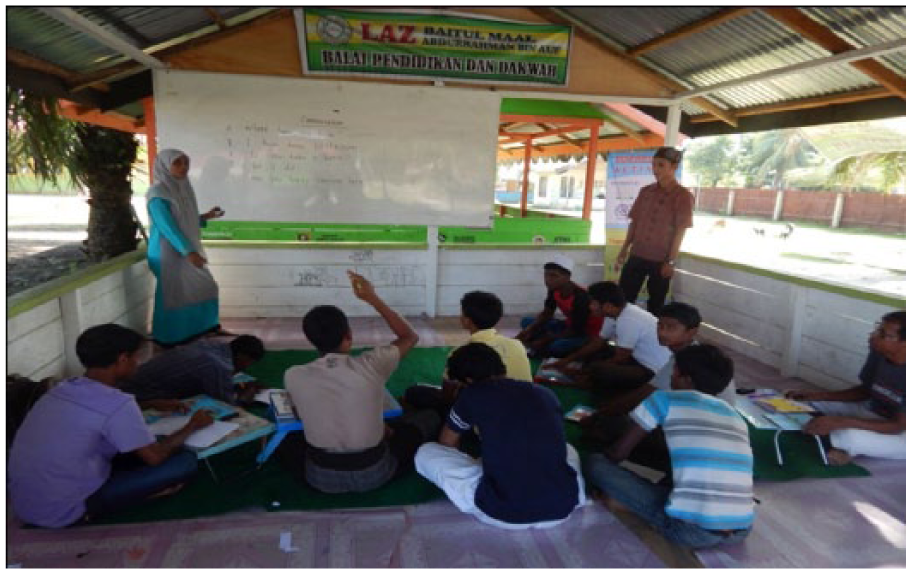
The balai (gazebo) used to teach the male refugees.

The room used to teach the female refugees.
There was no external noise because the English classes were from 10:00 a.m. to 11:00 a.m. and from 3:00 p.m. to 4:00 p.m. every weekday and the other refugees not taking part in the classes were resting or napping. Young children aged around 2 to 6 years in another room were also playing some learning activities guided by facilitators from Save the Children and Dompet Dhuafa from 10:00 a.m. to 11:00 a.m. The light level was good as the room was open and because class was during daylight hours. The balai and the room did not need any lights for lighting.
In the balai, the male refugees sat on a floor covered with mats and the room lacks benches and tables for them to write. This condition makes it difficult to write notes during the lessons. In the female class, the study room had tables and chairs. The number of female refugees who attended the classes was less than the males. The study areas are located about 50 to 80 m from the tent but still within one area of the refugee camp. The size of the balai and classroom was about 5 × 5 m. Although 30 refugees take English classes, the number who attended was inconsistent; sometimes the classes had 20 to 30 refugees but at other times there were only 10 to 15. The mentors often had to go and call them for the English classes. Although the refugees knew the importance of English for their future resettlement, some were not interested to attend class. The mentors understand perhaps this may be due to their traumatic experiences in Myanmar that cause them the lack of enthusiasm and problems in learning. And so, when it was time for the lessons, the mentors would go and call them patiently one by one to attend the class.
Hence, it can be concluded that the conditions of the classroom environment were adequate for learning English as there were no significant external disturbances. This was also because most of the learning activities are held in the morning and sometimes in the afternoon with no significant environmental distracters to either the mentors or the student refugees.
The Teaching Processes Employed by the Acehnese Mentors When Teaching the Refugees
This section answers the second research question, which inquires about the teaching processes employed by the Acehnese mentors when teaching the Rohingya refugees at the camp. Based on the observations of the teaching process, each class began by reciting do’a, checking the students’ attendance, and by greeting them with “Good morning! How are you today?” The mentors then explained words associated with the day’s topic, for instance, Public Place, and wrote the topic on the whiteboard. The mentors sometimes asked one of the students who already understood English a little bit to explain the meaning of the word in the Rohingya language. The mentors also used BL or sometimes model the action of the verb regarding the topic.
The following Table 2 shows the main points of the syllabus of teaching process used by the mentors on the topic of Public Transportation.
Main Points of a Teaching Process on Public Transportation.
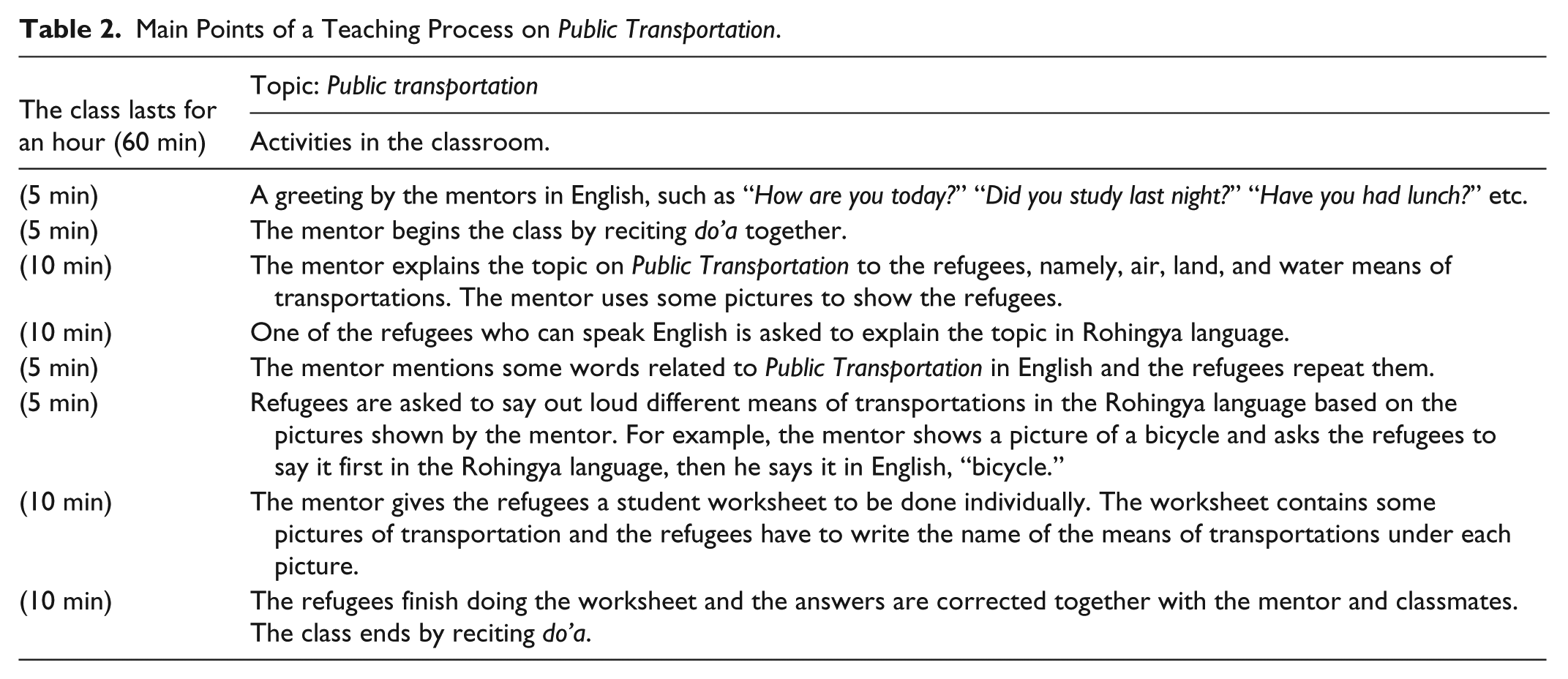
Table 2 shows that the syllabus for teaching the refugees was very simple. The use of materials by the mentors appeared to play an important part in the EFL instruction for the refugees. Although the greatest emphasis in the English language class for them was on spoken English, most materials used in classroom were simply materials on the whiteboard such as drawings and there were also posters or printed color pictures that can be seen occasionally during the teaching and learning process. Meanwhile, technological materials such as tapes and videos were rarely used.
Meanwhile, from the observation and video recording conducted, the general teaching processes in every meeting are illustrated in Table 3 below.
Observation Sheet 2 on the Teaching Processes.

Based on Table 3, the first aspect that should be paid attention to in the teaching process is the language of interaction. The language used by the mentor and the refugees in the class was very simple English and a lot of BL was involved. The mentor asked the refugees to repeat the words by showing the pictures that have been provided by the mentors. Then they were asked to say the English word for the item displayed in the pictures. The following is an example (where “M” refers to Mentor, “R” refers to Refugee, and thus, “Rs” refer to refugees, and “D” refers to Data).
D1 M: This is hair . . . ha-ir! Hair! (the mentor touches his hair and waves it around until the refugees laugh) Now, say ha-ir . . . hair!
Rs: Ha-ir! Hair!
M: Yes! How do you say it in Rohingya? Rohingya? Hair? (emphasizes the word while touching his hair)
Rs: Chool!
M: Good, in Rohingya it is “chool” . . . in English it is . . .?
Rs: Hair!
M: Very good! (puts his thumbs up)
The explanation was occasionally provided in Rohingya and English to increase understanding and encourage the students to remember the words. The mentors repeat the words to teach the refugees the correct pronunciation. We note that the Rohingya people could not read or write in English at all before attending the English classes at the camp, this obviously had a huge impact on their ability to understand the lessons and pronounce words in English.
Recitation plays an important aspect in the teaching process; it trains these students’ language ability. The following is an example of recitation between a mentor and a student refugee:
D2 M: What is this? (the mentor shows a bag)
R: Bak!
M: (shakes her head) Ba-ag . . . This is a bag. (opens her mouth wide while pronouncing the words)
R: This bak!
M: This is a ba-ag . . . bag!
R: Ba-ag . . . bag! This a bag!
M: Very good (puts her thumbs up to express “very good”)
The next aspect is student role-play. In the teaching process, the mentors asked the refugees to practice a short conversation in pairs related to the topic or words that had been explained. The mentors encouraged them to interact and to ask something associated with the topic that had been discussed. For example, the mentors asked the students to come to the front of class to practice a short conversation in pairs and one student who already understood English is asked to explain the meaning of certain words in the Rohingya language should their friends need help during the conversations. For example,
D3 R1: How are you?
R2: Hmmm . . . (could not answer)
R3: Tui gomasone? (translated R1’s question into Rohingya to R2)
R2: I am fine (he finally could answer after R3 translated it into Rohingya)
M: Very good! (puts her two thumbs up to show the meaning of “very good”)
The last aspect that is important in the teaching process is correction patterns. The mentors frequently asked the refugees to repeat a word or expression part by part or based on the syllable to make them easily repeat the words or the expression. The mentors say the answers to the questions before they ask the students to repeat them. The questions can be expressions or dialogues. This repeating question or giving partial answer showed direct impact for the refugees in pronouncing the words correctly.
D4 M: I am happy today. (the mentor asks R to repeat the sentence) R: . . .? (looks confused) M: Please repeat the words after me. (explains a few times, when the refugee still looks confused, he asks one of the Rohingya who can speak English to explain the meaning of the sentence in the Rohingya language) R: I am hapi today. (cannot mention the word “happy” clearly) M: No . . . (shakes his head in disapproval) Not ha-pi, but hap-py . . . happy! (shows a smiley face)
R: Hap-py . . . happy!
M: Good. (puts his thumbs up). Let’s say the phrase again: I am happy today.
R: I happy. . .
M: . . . to-day . . . today.
R: I happy today.
M: Very good! (puts his thumbs up)
Cultural Barriers Faced by the Acehnese Mentors and Rohingya Refugees in Teaching and Learning English
This section answers the third research question of this study, which inquires on the cultural barriers faced by the Acehnese mentors and Rohingya refugees in teaching and learning English. The aspects focused on were language, RB, EQ, SH, and others (shown in Table 4).
Observation Sheet 3 on the Cultural Barriers.
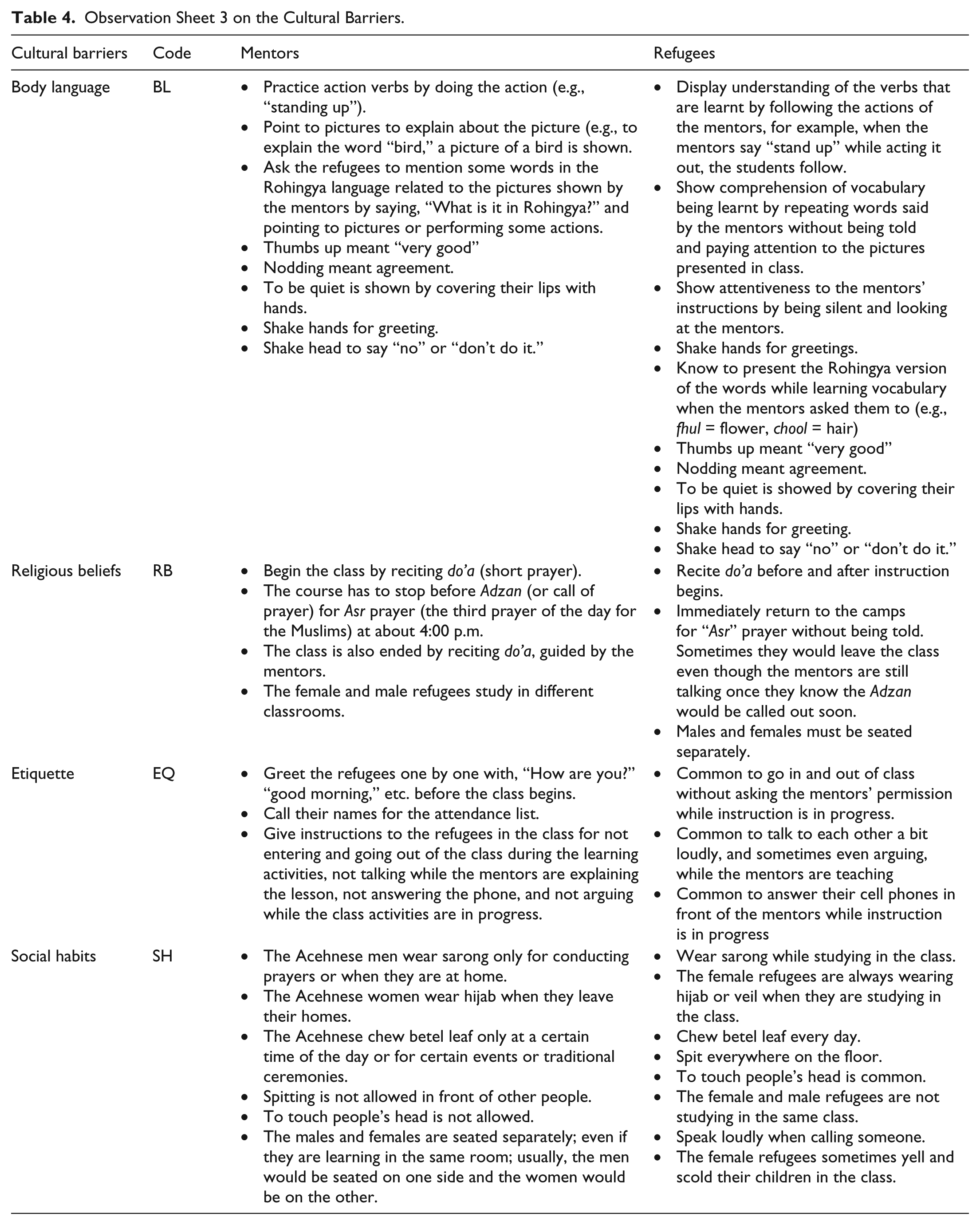
From Table 4, it is evident that aspects of cultural barriers were indeed found during the class activities. On BL, the mentors commonly used BL when teaching the refugees such as shaking their heads to say “no” or “don’t do it,” covering their lips to ask the refugees to be silent, or sometimes tapping the whiteboard to get their attention for not chatting with each other during the instructions. Many of these BL signals were similar to both the Rohingya and Acehnese cultures. The use of BL was very effective for the mentors and the refugees to understand each other and the lessons.
Regarding the aspect of RB, the class always started and ended by reciting do’a (short prayers). The refugees greatly appreciate the Adzan time (call of prayers, called out five times a day) and the learning activities have to stop no matter what. If the mentors were trying to explain some last bit of the lessons while the Adzan was calling, the students would stop them by raising their hands indicating that the Adzan was calling and they need to leave the class immediately for prayers.
There are some EQs observed among the refugees during the teaching and learning process as regards calling out to their friends loudly in the classroom, talking to each other and laughing with each other when the mentors were teaching, entering and exiting the classroom without asking permission from the mentors, scolding their children in front of the mentors during the learning process, spitting anywhere while chewing betel leaf, and sometimes answering the telephone during the learning process. These habits hindered the teaching and learning process and became obstacles for the mentors in creating a good atmosphere for teaching English in the classrooms. Thus, the mentors informed us that these practices were prominent in the first few months of the English classes. The refugees became more aware of the classroom EQ in the following months.
From their SH, it was observed that the male refugees always wore sarong, while the female wore hijab (scarf) when they go out of the camps, including little girls who are aged older than 5 years. They were not accustomed to gathering in combined groups of men and women in a meeting. Thus, the refugees always sat separately when attending a meeting or medical treatment at the camps. Similarly, this social habit is also shared with the Acehnese, where it is common for men to wear sarong at home and women would wear the hijab when they leave their houses. Acehnese men and women do not gather in the same place as well. In meetings, for example, the men would sit on one side and the women would be seated on the other side of the room.
Referring to the theory of cultural barriers proposed by Farabi (2015), the four aspects found in this study were not all barriers between the Acehnese mentors and the Rohingya student refugees. In a way, both mentors and refugees were learning about each other’s cultures, EQs, and habits. This was previously discussed by Yasin et al. (2016) during their preliminary observation of the student refugees in the English classes prior to this research. The use of BL and RB worked well to enhance understanding with each other in the classes. During the teaching and learning process, the mentors mostly employed BL by practicing or giving the examples of the action or conversation using their body movements. This effort provided better comprehension for the refugees in understanding the instructions from the mentors. Moreover, similar RB between the mentors and the refugees also enabled them to communicate better. Similarly, the Acehnese are also Muslims who respect the Adzan and would stop teaching at the call to prayer. Moreover, Acehnese people respect the Rohingya’s practice of sitting separately because the Acehnese also practiced the same culture. Similar practices made the refugees comfortable to live and interact with the Acehnese villagers around the camps.
Nevertheless, some EQ and SH were barriers in the teaching and learning process, particularly the refugees’ habits of talking loudly in the classroom and spitting from their chewed betel leaf, which were uncomfortable to the Acehnese mentors. Thus, the mentors did inform them that the habit of chewing betel leaves must be gradually decreased because they would not find these leaves when they settle abroad. In Aceh, these leaves are also commonly used in traditional ceremonies as a symbol of culture to the Acehnese (see Fata, Yusuf, & Sari, 2018; Yusuf & Yusuf, 2014); this meant it was relatively simple for the refugees to easily access them. Some Acehnese elders also chewed these leaves daily because it is said that they have health benefits to the body; however, it is not much practiced anymore by the Acehnese today (Yusuf, 2002).
Interviews With Mentors on the Cultural Barrier and Teaching Process
A key challenge for the mentors is the issue that the majority of the Rohingya refugees cannot read or write in their own language because they have not studied formally at school in their country. The mentors had to teach the refugees the alphabet and how to read and write at the same time as teaching simple English communication.
The second obstacle faced by the mentors is the language barrier. In the interview with Mentor 3 (M3, male, age 28), he explained that the biggest problem he faces is language.
It’s difficult to explain the meaning of English words to the refugees since they cannot speak in either English, or Indonesian, or Acehnese, the languages that we speak here in Aceh. I have to explain a word repeatedly and ask them to repeat after me many times. Body language and pictures are the best way to help me explain the words to the refugees. There are one or two refugees in my class who already understand English a little so that I usually ask them to explain the meaning of the words to their friends in Rohingya. This condition really helps me in teaching them.
As explained by M3, it is difficult to explain certain words or actions to them as they do not speak English, Indonesian, or Acehnese.
In every class meeting, there were two mentors in a class. The first mentor explains a word and the second mentor performs the action of the word. The mentors frequently wrote the words on the whiteboard and used BL to explain them to the refugees. The refugees were also asked to practice and perform the verb in front of the class. The refugee teachers’ aid then explained both the lesson topic and the words in the Rohingya language to the student refugees. M1 (female, age 26) discussed the effectiveness of using a teacher aid.
Having two mentors in teaching the refugees in the class is a big help to me. I have difficulty in explaining to all the refugees in the class because they have different abilities in understanding the lesson. With the help of a teacher aid, the confused refugees can be handled directly. This refugee who already understands a little English helps us a lot in helping his friends to explain the meaning of a word in the Rohingya language.
Other barriers in the classroom were the habits and EQ of the refugees that the mentors found to be disturbing. M4 (male, age 30) explained as follows:
We also experience some obstacles in the class regarding the etiquette and habits of the refugees, such as spitting around the floor even in front of the mentors, talking while the mentors are explaining the lesson, answering the phone, arguing while the class activities are in progress, and often speaking loudly or shouting when calling each other.
M4 further explained that it took some time to explain to them that some of their EQ and habits were not acceptable in the classroom. He reflected that the teacher aid assisted them a lot in outlining this situation to the refugees; he provided explanation in Rohingya to them that those habits were not acceptable here and even abroad when they arrive at their designated resettlement countries. M4 claimed that the most important thing in the teaching process was that the refugees could understand which EQ and habits needed to be changed for the better. Furthermore, it was important that they could at least communicate in simple English when they need help or ask other people questions in their daily life. This skill will be vital once they are settled in a country that is even more foreign to them than Aceh.
It is an important point to mention that the Rohingya people never attended formal schooling while in Myanmar. This has an immense impact on classroom behavior because if they had been to school before, it is expected that they would have learnt and understood to not talk while the teacher is talking, to not use phones in the classroom, to not enter or leave the classroom without permission from the teacher, and to not spit inside the classroom. We suggest that these practices are due to the refugees never having attended formal schooling before rather than being their cultural norms. As of the requirements in all educational curriculums today, students typically learn ethics and proper practices at school.
Interviews With Refugees on the Cultural Barriers and Teaching Process
For the Rohingya refugees, the interviews were conducted with the help of a translator from Bangladesh together with a UNHCR officer who could speak the Rohingya language. The results of the interview show that some of the refugees felt happy in taking the English classes. They found it interesting to learn English with the mentors as they had never been to school in Myanmar. The English vocabulary and expressions they learnt would be needed when they settle abroad in Western countries.
I am very happy to take this class in here with my friends. In Myanmar, we could not go to any formal school but now I can read, write, and understand English! I know how to ask, “How are you?” “Where are you from?” “How old are you?” . . . none of which I could understand before. I think English is very important when I get to resettle to another country. And I can practice it every day with my mentors or my friends at this camp before I leave.
Based on the explanation by R2 (male, age 30), he looked proud that he finally could read and write in another language. He understood some expressions and ways of greeting and asking something about another person. Thus, the refugees felt that some problems still exist in understanding the lesson. They often found it difficult to understand their mentors’ explanation of the words or sentences in English and Indonesian.
I barely understand the explanation from my mentors about the meaning of words, expression, or conversation. I cannot understand English and Indonesian. But, the mentors usually try to repeat the words and use body language to demonstrate them. The body language or gesture really helps me understand the meaning of the word. My friend (i.e., teacher aid) also helps a lot in explaining things to me in the classroom so I can understand the lesson better.
R3 (female, age 22) explained that having a friend who knew a little English is helpful in the class. In addition, the use of BL and gesture and/or demonstration technique by the mentors was also a great help in making them understand English.
Being unable to understand Indonesian and English was also a difficulty when the mentors asked the students to practice the activities in front of the class. They were aware that the biggest challenge for them was to understand both Indonesian and English to understand the mentors’ requests. They found it easier to understand the words when the mentors simply explain the words, especially verbs, through demonstration and/or practice. Nouns worked best when pictures were provided.
I think it will be easier if the mentors are also able to speak in Rohingya to teach us English, but anyways, I have learnt a lot of new words both in English and Indonesian, which are very important for me. The mentors also teach us about the social habit and culture in Aceh. We are told not to stare at a woman when she is passing by in front of us, because that is not polite. We have to stop spitting when eating the betel leaves and speak in lower voices. I am learning a lot at the camp. I am very happy, especially when I was never ever allowed to go to school in Myanmar by the government.
R4 (male, age 18) inferred that the refugees would prefer the mentors to speak the Rohingya language to teach them. The teaching process was seen as interesting because the student refugees could learn simple English and Indonesian and the SH or culture of the Acehnese. The refugees find their English courses a blessing as they were not allowed to attend school in Myanmar.
Conclusion
The results of the research suggest even though the classroom environment was still lacking facilities, such as chairs and tables for the male student refugees in the gazebo, it provided enough air and light (as the classes were held during daytime). Noises were also less and helped the male students concentrate better in learning; even though the gazebo was still within the camp area, it was not too near the living camps where the children are playing. The female refugees were more privileged in having an indoor classroom facilitated with a fan, chairs, and tables. Thus, the drawback of their environment is that it was next to the living camps where sometimes noises can be a hindrance in the teaching and learning process. Nevertheless, despite the disadvantages of both conditions, the classroom environment for both the male and female refugees was deemed adequate.
In the teaching and learning process, to overcome confusion between the mentors and refugees due to language barriers, refugee teacher aids assisted the mentors. There were two refugees who understood a little English and they helped the mentors in the teaching process. One male refugee helped the mentors in the male classes and one female helped the mentors in the female classes. They helped provide translation and explanation in Rohingya to the other refugees. Again, the use of BL and modeling were useful for the mentors and the refugees to understand each other. The mentors also provided simple media, such as picture books, posters, and, sometimes, daily conversation videos to assist the refugees in learning English. Thus, it is important that teachers make sure the materials are appropriate to the refugee students’ needs and conditions (Macksoud, 2000).
EQ and SH were found to be cultural barriers for both the refugees and mentors. Some practices were uncommon to the Acehnese mentors and it took some time for the refugees to understand which practices were unacceptable in Acehnese culture. A shared religion and religious practices as well as shared BL cues proved advantageous to both mentors and refugees. Demonstrative BL was used successfully to explain meanings, such as thumbs up for approval, shaking the head for disapproval, and nodding the head for agreement. The mentors used them to reduce misunderstandings in the classroom, and this is important because if teachers do not pay attention to cultural differences, then misinterpretation (He, 1988) or pragmatic failure can occur (Lihui & Jianbin, 2010).
Likewise, as the refuges came to Aceh with traumatic experiences from their country of origin, Kanu (2008) and MacKay and Tavares (2005) point out that these groups of learners may go through more difficulties in adjusting to a new society and may be slower in learning. Therefore, the mentors kept their gradual pace and patience in teaching English to these refugees. They were not forced to learn but were persuaded to learn by explaining to them the future situations of residing in Western countries.
As a final point, this research is not without limitations. It was focused on one UNHCR camp in East Aceh, yet, there are other Rohingya refugee camps in Aceh, located in Lhokbani, Kuala Langsa, and North Aceh. Future research is needed to understand whether the insights from this research are shared by mentors and refugees in those camps. The number of data collection days was limited to consecutive days, which meant that both mentors and students were aware of the research underway and may have modified their behavior during that time. A longer period of observation may reduce this bias and provide further insights into the teaching and learning process for both mentors and students.
Footnotes
Declaration of Conflicting Interests
The author(s) declared no potential conflicts of interest with respect to the research, authorship, and/or publication of this article.
Funding
The author(s) disclosed receipt of the following financial support for the research, authorship, and/or publication of this article: The authors gratefully acknowledge Prof. Dr. Ir. Hasanuddin, MS, and Lembaga Penelitian dan Pengabdian kepada Masyarakat (LPPM; or Institute for Research and Community Service) of Syiah Kuala University for their support on this research, Grant No. 258/UN11.1/PP/SP3/2016.