




Abstract
This article presents a study of desired leadership behavior in the educational sector in Iceland. This sector has been undergoing major challenges during recent years, including restructuring and mergers of schools, strikes of teachers’ professional unions, and increasing dropout rates. This situation requires exceptional leadership together with the understanding that leadership is a culture and context contingent phenomenon. However, research on managerial leadership in the education sector in Iceland is virtually nonexistent, presenting a gap in literature as well as failure to contribute to solving issues in practice. This article contributes to closing this gap by investigating the desired leader profile from a follower-centric perspective. The results indicate that the most desired leader behaviors in this sector tend to be relationship orientated, suggesting a need to focus on the “soft” side of leadership and reconsider overemphasis on bureaucracy. Effects of gender and demographic differences are minimal, suggesting coherence with structural theory. Managerial leadership implications and future research directions are discussed.
Introduction
Major challenges are being faced by leaders in the education sector globally (Fullan, 2007); hence, research on managerial leadership is of high relevance in today’s world. Leaders of educational institutions are expected to fulfill multiple roles from educational visionaries to overseers of legal aspects (Bartoletti & Connelly, 2013), which indicates the complexity of leadership in the education sector. Hoy and Miskel (2008) suggest that educational leaders are expected not only to be the problem and conflict resolvers in the relationships with teachers, students, parents, unions, officials, and federal and state agencies, but also to be aware of and fulfill the increasing student needs.
Knowledge of developing leadership effectiveness in the education sector is paramount due to the need to keep up with technological and societal developments (Roco & Bainnbridge, 2005). Furthermore, education sector is faced with distinct challenges in every society. The most visible ones within Icelandic educational sector in recent years are restructuring and mergers of schools, strikes of professional unions of the teachers, and increasing dropout rates of the students. This illustrates that school leaders in Iceland are continuously facing new challenges, and need to react to the situation and solve more problems beyond managerial–administrative tasks. One of the current challenges leaders face is the requirement to work effectively in increasingly diverse surroundings (House, Hanges, Javidan, Dorfman, & Gupta, 2004). This is particularly relevant for the Icelandic educational sector due to increasing cultural diversity in recent years (Hagstofa, n.d.) and the need to insure inclusion of non–Icelandic-speaking students in the system. The need to improve the educational process and its leadership has been discussed at length in daily media (Hálfdánardóttir, 2014) as well as by the parliament (White Paper, 2016).
Much of research on leadership in the educational field focuses mainly on the role of the teacher as a leader (Greenwood & Gaunt, 1994), but research on managerial leadership within higher managerial levels of the education sector in Iceland is virtually nonexistent or focuses just on one level of educational institutions (Hansen, 2013; Hansen, Jóhannsson, & Lárusdóttir, 2005). Thus, research is needed as the sector has been undergoing major challenges in recent years (Organisation for Economic Co-operation and Development [OECD] Report, 2012) and calls are made for more effective leadership (Hansen, 2013).
This study contributes to filling the abovementioned gap, by defining followers’ preferences for desired leader behavior sets, which is the bases for leadership effectiveness improvement, in the education sector in Iceland (Schyns & Schilling, 2011). Furthermore, the study provides theoretical contribution by elaborating on a profile of desired leader behavior descriptions evaluated within the Icelandic cultural context employing a follower-centric approach (Snaebjornsson, 2016). The research question is as follows:
Literature Review
Followers in leadership process and desired leader behavior
Bass and Bass (2008) divided leadership theories into two broad categories: leader-centric approaches (e.g., trait and skills theories) and follower-centric approaches (e.g., situational theory; Northouse, 2013). Moreover, leadership theorists (Bass & Bass, 2008; Littrell, 2010; Rowold & Schlotz, 2009) suggest that most leadership research is traditionally oriented to the leader and his or her self-evaluation, influence of leadership style on the organizational processes, culture, and members. Much less attention is paid to the follower-centered approach (Keller, 1992; Sosik, 1997).
Followers’ perspectives are essential as leadership is an interaction between a leader and his or her followers (Antonakis, Cianciolo, & Sternberg, 2004). Leadership is a process of influence, and that is why the effectiveness of leadership is influenced not only by behavior and personal characteristics of the leader but also by the followers’ characteristics (Yukl, 2013). The leader prototype is formed in early childhood (Goethals, Sorenson, & Burns, 2004) but changes with experience (Van Quaquebeke & Van Knippenberg, 2012) due to social and cultural events (Epitropaki & Robin, 2004). A leader faces expectations built up by the followers, based on physical features, gender, race, and ethnicity that might influence the prototypes unconsciously existing in followers’ minds (Lord & Emrich, 2001).
All societies, organizations, and groups have their own ways to transfer culture and values to their members (Littrell, 2010). Members of an organization create leadership contexts together while indicating their opinions about a leader, sharing ideas as to what is desired. Thus, this context builds leader prototypes describing features and behavior of the desired leader (Goethals & Sorenson, 2007). In this way, every group (Hogg, 2001; Van Knippenberg & Hogg, 2003) creates leader prototypes, and defines an ideal. Although these idealized leader prototypes might not correspond to reality, group members use them in predicting and evaluating leaders’ effectiveness (Lord & Maher, 2002). The more actual leader behavior conforms to the prototype created by a follower, the more the follower is ready to accept the leader and follow his or her ideas, hence the more effective the leader will be (Hogg, 2001; House, Wright, & Aditya, 1997; Lord & Maher, 1991; Yukl, 2013).
Gender and preferences of desired leader profiles
The growing number of women in the international workforce has increased the discussion of effects of gender in leadership (Trinidad & Normore, 2005), and the question whether men and women have common prototypes of leader behavior still remains (Bellou, 2011). The teaching profession is overwhelmingly female in European countries, with 70% of teachers women at lower or middle levels (European Commission report, 2013). In 2011, there were 19,923 people working in the educational sector in Iceland, 22% of them were male (Statistics Iceland, n.d.).
Bellou (2011) suggests that men and women cannot be viewed as one unique group while examining leadership preferences. This conclusion is derived from research supporting role congruity theory (Eagly & Karau, 2002), which is based on social role theory (Eagly, 1987), suggesting that societies have certain behavioral expectations of men and women, which are acquired during the socialization process of both sexes (Gilligan, 1982; Peterson, Rhoads, & Vaught, 2001), with emphases on dependency and nurturing for women and independency and aggressiveness for men (Alvesson & Billing, 2009). However, structural approach (Roxas & Stoneback, 2004) suggests that gender differences are dissolved as a result of women and men working in the same occupational environment, and is supported by research indicating that women are becoming more like men under similar occupational conditions (Betz, O’Connell, & Shepherd, 1989). Opposing evidence presented above suggest the need to investigate whether a “feminine” profession (education sector) will have gender differences in leader behavior preferences among women and men, as opposed to the “masculine” business sector.
Age and preferences of desired leader profile
Inglehart (1997) investigated preferences of different generations worldwide and found that older people give higher priority to materialistic values, whereas younger ones prefer postmaterial values. Littrell (2010) suggests that generational preferences, including desired leadership preferences, might differ across countries as different generations in different countries were influenced by historical events among other criteria.
OECD (2016) report presents the age of teachers in Iceland, divided into three categories of generally accepted generations, and the change of the percent of employees during the period 1998 to 2013. According to the report, the number of the teachers above 50 years is rapidly increasing and reached 38.6% of all the teaching staff in 2013 (OECD, 2016). The literature suggests (Boatwright & Forrest, 2000; Hofstede, Hofstede, Minkov & Vinken, 2008; Salahuddin, 2010) that followers’ age influences leader behavior priorities over time. Thus, the age influence on followers’ preferences is analyzed in this article to determine whether these previous finding apply to the Icelandic educational sector.
Education level and preferences of desired leader profile
Studies (Littrell & Snaebjornsson, 2016) suggest that difference in education level can be effected by different emphases on certain values and priorities. Personal beliefs and expectations change as a person becomes more experienced and educated, hence resulting in differences in leader preferences. Employees working at different educational levels in European countries and Iceland are mostly required to have university or special college education (OECD, 2016). Since 2012, teachers in all educational levels in Iceland are required to have a master’s degree in education or in their field of teaching, as well as the confirmation of Teacher Certification Studies (OECD, 2016). Vecchio and Boatwright (2012) suggested that employees with higher education expressed less preference for leader structuring behavior. The relevance of these previous findings will be investigated in this article to determine whether they apply to the specific context of Icelandic educational sector.
Challenges for the educational system in Iceland
Education in Iceland has traditionally been organized within the public sector, though there are a few private institutions in the school system. Almost all private schools receive public funding, promoting uniformity of development within the sector. The parliament and Ministry of Education, Science and Culture determine the basic objectives and main administrative framework. Political and economic changes and restructuring of the sector have caused some instability, as mentioned previously. Several strikes, the most severe form of protest in Iceland, occurred recently that lasted for 3 weeks. Finally, a consensus was reached and the collective agreements were signed on April 4, 2014 (Þórðarson, 2014).
Today, leaders of education institutions in Iceland are facing new types of challenges. First is the dramatically worsening results of students’ performance in main areas of study (see Figure 1) as showed by the Program for International Student Assessment (PISA) test (2016). This situation puts pressure on school leaders from important stakeholders (e.g., parents) and, combined with budgeting issues schools are facing, creates the need for effective managerial leadership.

Icelandic students’ PISA results in science, mathematics, and reading for the period 2000 to 2015.
Another challenge (OECD, 2012) is high dropout rates from upper secondary school level, suggesting that the school structure needs to be revised and measures taken. Several possible reasons for students’ dropout are mentioned, such as a lack of relevance of the curricula, duration of studies, guidance effectiveness, and others—all indicating the need for school leaders to work effectively with many stakeholders, resolve any conflicting demands, and be able to implement changes on multiple levels within organizations, all the way to presenting the needs of the education sector for governmental officials and decision makers.
A third challenge leaders face is related to academic staff. Recent reforms emphasize the need to increase the quality of teachers’ work, resulting in a master’s degree now being required for teaching at all levels, prolonging teachers’ studies from 3 years to 5 years. This reform resulted in fewer people choosing teachers’ studies. The OECD Teaching and Learning International Survey (TALIS, 2002) results point out such challenges for teachers as too little teaching time, low starting salaries, high level of absenteeism, and poor participation in professional development. The results also show that teacher training is not systematically planned but decided according to the particular needs at the moment, and this challenge is named to be the critical one in the report (TALIS, 2002). This implies that leaders of educational institutions are facing high uncertainty and the need to apply situational leadership.
Furthermore, the decentralized governance system in Iceland is not providing enough of support or accountability for school. There is lack of redistribution strategies within and between schools and, thus, there is less capacity to hold actors accountable. This means that students do not have equal access to resources and their needs are not always met. According to Statistics Iceland, the average age of teachers has been increasing since the year 2000, when it was 42.2 years to 46.6 years in 2015; at the current rate, this will result in a shortage of teachers in the future from retirements and fewer people choosing the teaching profession (Skaftadóttir, 2017).
Research on leadership in the educational sector in Iceland
Research on managerial leadership within the educational sector in Iceland is virtually nonexistent. However, the little evidence available suggests the need for investigation of this field to improve leadership effectiveness. Guðmundsson (2009) conducted research on the relationship between school authorities and upper secondary school teachers in Iceland. Results revealed that effective communication with managers, support, encouragement, and teamwork are of vital importance for headmaster–teacher communication (Guðmundsson, 2009), as perceived by followers working in upper secondary school levels.
Research, that could be, in some way, relevant to managerial leadership in the educational sector in Iceland can be mentioned. For example, Hansen, Jóhannsson, and Lárusdóttir (2002) concluded that the post-1995 change, when control over compulsory schools was transferred from the state to the municipalities, positively influenced the working environment due to the increased visibility and authority of the school headmasters’ role, making it more clear and structured. This indicates, that more visible leadership within the educational sector in Iceland results in positive outcomes. Hansen et al. (2005) investigated the views of the headmasters and teachers on the implementation of self-evaluation practices and concluded that critical factors are the knowledge and skills of headmasters and teachers of self-evaluation methods, clear leadership within schools, and the attitudes of headmasters and teachers toward self-evaluation as a means for change and development (Hansen, 2013). These finding again highlight the importance of structure and communication for effective leadership within the education sector in Iceland.
Most of the research on managerial leadership in Iceland is fragmented and focuses on narrow levels such as compulsory school level (Guðmundsson, 2009). Education leadership in the other three levels, preschool, upper secondary school, and university levels, and especially the leader–employee relationships are underresearched (Guðmundsson, 2009; Hansen, 2013; Hansen et al., 2005); this gap will, thus, be addressed in this study.
Method
The overall aim of the study is to describe the desired leader profile in the education sector in Iceland, using a follower-centric approach. However, as indicated above, effects on desired leader behavior attitudes can be due to differences in sociodemographic characteristics of the followers; hence specific hypotheses are formulated:
The Leader Behavior Description Questionnaire Form XII (LBDQXII; Littrell, 2002; Stogdill, 1974) is an integral part of the Preferred Leader Behavior Across Cultures project (see Littrell, 2013), and was used in this study. The Icelandic version of the questionnaire (see Snaebjornsson, 2016) was adapted to meet specific requirements of the education sector and to assess and eliminate sector-specific particularities if any would arise. Two focus groups were organized for validating the translations. Fifteen questionnaires were answered by respondents in the pilot test of the adapted questionnaire. The final questionnaire was composed after receiving this feedback.
During the second phase, a survey link was sent to the offices of secondary and compulsory schools and kindergartens that were found on the Internet, asking to share the link with the employees of the organization; due to a low response rate, snowballing strategy was used in the data collection process.
Survey Instrument
The LBDQXII is designed to specifically investigate desired leader behavior as described by 12 dimensions (see Table 1). This instrument serves as a template for determining whether or not targets behave as do typical leaders, and hence are more likely to be accepted as leaders. The survey is comprised of 100 items that ask respondents to rate desirability of behaviors as representing an ideal leader, using a 5-point Likert-type scale ranging from the ideal leader should always (5) to never (1) exhibit the behavior.
Preferred Leader Behavior Dimensions Defined by LBDQXII.
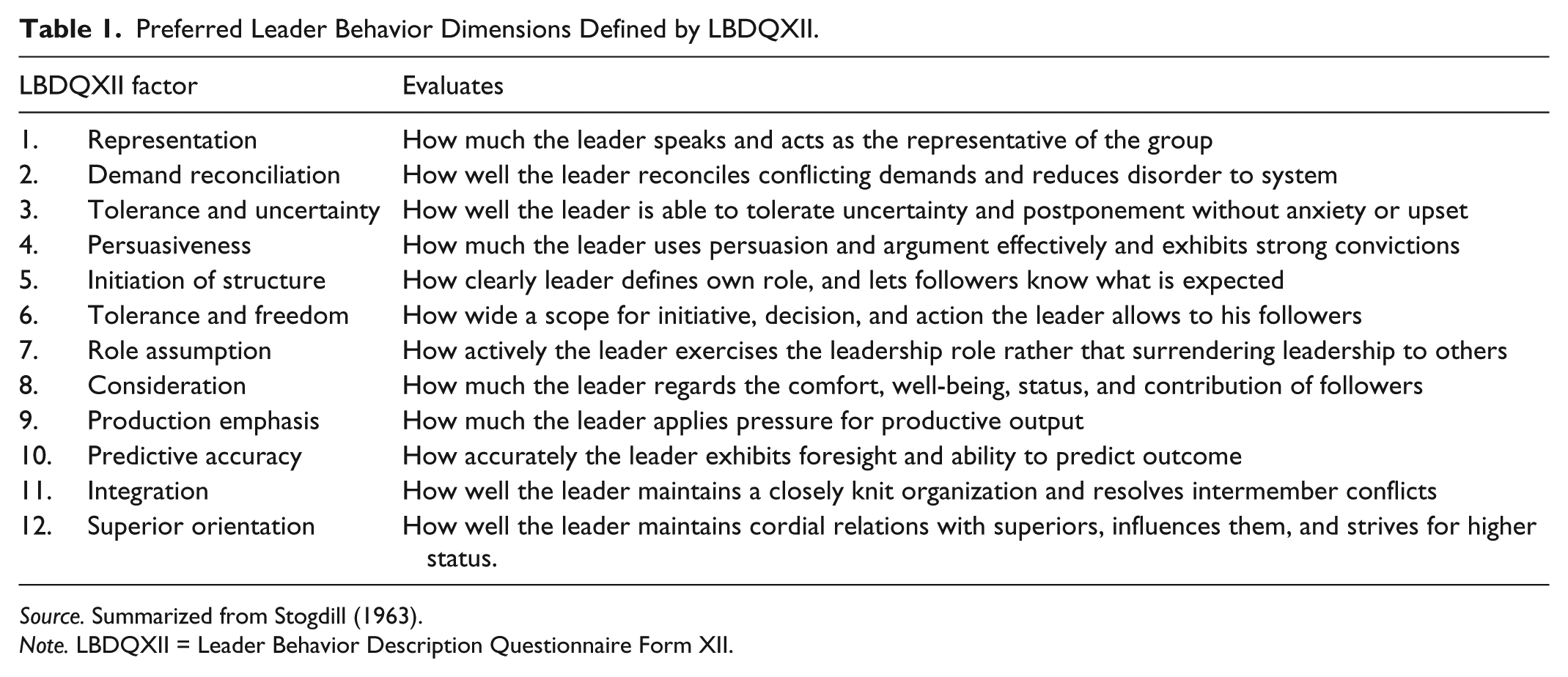
Source. Summarized from Stogdill (1963).
Note. LBDQXII = Leader Behavior Description Questionnaire Form XII.
LBDQXII is a widely used, valid, and reliable instrument in assessing desired leader behavior across cultures and industries, and can be used for informing, teaching, and preparing specialists and leaders about leadership expectations (Judge, Piccolo, & Ilies, 2004; Littrell, 2013; Northouse, 2013; Vecchio, 1987).
Sample Size, Validity, and Reliability
An online link to the survey was sent to potential respondents; 115 respondents answered the questionnaire online during April and May 2017. After the cleaning process, 105 surveys were retained.
The reliability of the questionnaire was evaluated using Cronbach’s alpha and the alphas ranged from .69 to .91. Cronbach’s alphas of the 12 dimensions indicate acceptable levels of item-to-scale consistency. The survey instrument is valid and reliable.
The implementation of analysis methods in the SPSS software was used for the Levene test, ANOVA test, and Pearson correlation coefficients for hypotheses testing. Descriptives are provided for the sample characteristics and leader behavior preferences.
Ten principles of ethical considerations proposed by Bryman and Bell (2007) were followed in this research to insure ethical conduct of the research.
Results
ANOVA tables, which indicate no significant differences at the p < .05 level, are available on request via email from any author, as are the data sets.
Characteristics of the Sample
Analysis of the demographic characteristics of the sample and population (see Table 2) indicates representation of the sample compared with the demographics of the population in Iceland.
Sociodemographic Characteristics of the Sample Versus Statistics and OECD Iceland.

Source. Statistics Iceland and OECD report.
Note. OECD = Organisation for Economic Co-operation and Development.
Desired Leader Behavior Preferences
The main goal of this research was to describe the behavior profile of the desired leader in the educational sector in Iceland from the followers’ point of view. The findings as described by the 12 factors show that the dimensions with the strongest preferences in the educational sector in Iceland are demand reconciliation, representation, integration, consideration, and tolerance of freedom (see Figure 2). The least desired behavior of a leader, as seen by followers in the education sector in Iceland, is product emphasis, in other words, encouragement for overtime work, competing, and urging to beat previous records is not appreciated. Elaboration on results and its implications are presented below (in “Conclusion and Discussion” section).

The followers’ desired leader behavior preferences according to LBDQXII 12 factors.
One-way ANOVA tests were performed for this hypothesis. At the .05 significance level, no statistically significant gender differences were found in describing the desired leader’s profile, confirming the hypothesis of no difference among men and women in desired leader behavior preferences in coherence with the structural approach (Roxas & Stoneback, 2004), indicating a gender-homogeneous preferred leader behavior template for the samples.
Correlation analysis (Table 3) was used for testing this hypothesis to investigate the relations between respondents’ age and their LBDQXII preferences and confirming or rejecting the hypothesis.
Correlation Analysis: Respondents’ Age and LBDQXII Dimensions.

Note. N = 103, Significance: two tailed. LBDQXII = Leader Behavior Description Questionnaire Form XII.
Pearson correlation (p) is significant at the .05 level (two tailed).
Significant positive correlations for coefficients of about .20 are indicated between age of the respondent and demand reconciliation and consideration dimensions, suggesting that the older the respondent is, the higher the priority placed on the behavior set describing the dimension. Nevertheless, the correlation is rather weak, again about .20. Hence, the results should be evaluated carefully and considered to be more indicative than absolute.
Correlation analysis (Table 4) was performed to establish whether the profile of the desired leader in the educational sector in Iceland is influenced by the employee’s education.
Correlation Analysis—Respondents’ Education and LBDQXII Dimensions.

Note. LBDQXII = Leader Behavior Description Questionnaire Form XII.
Pearson correlation (p) significant at the .05 level (two tailed).
Correlation analyses indicate that there are few significant correlations among 12 LBDQXII factors and education of the respondents, indicating that there are few differences in preferences of desired leader behavior according to the LBDQXII 12 factors depending on respondent’s level of education.
Levene tests of homogeneity of variances and one-way ANOVA tests were performed for testing this hypothesis. The Levene test of homogeneity indicates group variances are homogeneous.
The ANOVA results show that there are no significant differences regarding effects of type of the organization on the respondents’ desired leader behavior preferences according to LBDQXII (hypothesis accepted). However, this finding does not support the statements in the “Literature Review” section (see above).
Additional exploratory hypotheses are formulated and tested, attempting to indicate other sociodemographic factors that could influence followers’ attitudes toward desired leader behavior preferences.
Correlation analysis (Table 5) is performed for checking this hypothesis. The analysis indicated no effects on desired leader behavior dimension means in the educational sector in Iceland due to the size of the organization the respondent works in.
Correlation Analysis—Size of the Organization and LBDQXII Dimensions.

Note. LBDQXII = Leader Behavior Description Questionnaire Form XII.
The Levene test and one-way ANOVA were performed for testing this hypothesis, and at a .05 significance level the Levene test indicates groups are homogeneous giving. For the ANOVA, all p values are above .05, indicating no significant difference. Hence, the ownership type of the organization does not influence the respondents’ desired leader preferences, according to LBDQXII dimensions.
Levene and one-way ANOVA tests were performed for testing this hypothesis. This hypothesis tests whether place of residence (great capital area vs. province) of the respondent affects the desired leader behavior (LBDQXII) preferences. At a .05 level of significance, the Levine test indicates homogeneity of variance for the samples, and respondents’ place of residence does not affect their desired leader behavior preferences for the LBDQXII dimensions.
Summarizing the results from hypothesis testing, it is evident that followers in the Icelandic educational sector have uniform and nondiverse attitudes toward desired leader behavior. All the tested hypotheses regarding the effects of followers’ demographic characteristics (gender, age, education, type, size and ownership of organization, and place of residence) toward LBDQXII preferences showed very little or no differences in attitudes. This is coherent with research described in the “Literature Review” section where other sectors, for example, business, in Iceland is also described by uniform attitudes of the followers (see Snaebjornsson, 2016).
Conclusion and Discussion
Results of the research indicate that the most effective leadership style within the educational sector in Iceland is relationship oriented, as seen by followers. Followers’ higher preferences regarding desired leader behavior dimensions include demand reconciliation, representation, integration, consideration and tolerance of freedom dimensions, and more relationship-orientated behaviors. Production emphasis is the least desired behavior, indicating an aversion to being pushed to perform at higher levels (a common finding among professional employees in Europe; see Schneider & Littrell, 2003). Followers’ sociodemographic characteristics do not significantly affect their preferences toward desired leader behavior preferences in the education sector in Iceland.
Meeting Leadership Challenges in the Educational Sector in Iceland
The educational sector and its leaders in Iceland face many challenges (Hansen, 2013; Haraldsdottir, 2013; OECD, 2016). The latter explains the preferences of the followers in the education sector in Iceland toward the demand reconciliation dimension, which indicates a leader’s ability to reduce disorder and reconcile conflicting demands stemming from the overarching organization to which the group belongs. Followers expect their leaders to solve problems efficiently, without getting confused by many demands, and support the staff in complicated situations. Leaders are expected to maintain a closely knit organization, keep the group working as a team and resolve intermember conflicts and differences when they occur. This again can be explained by the need to feel team spirit at work, having in mind that educators in Iceland spend many years in one institution.
Also valued is representation of the group, speaking on its behalf, being a visible representative and spokesperson of the group. Consideration is a desired behavior from the leaders in the educational sector, where leaders are expected to regard the comfort, well-being, status, and contribution of their followers; this indicates charismatic behavior of the leader. House et al. (2004) find that charismatic leadership is a universally desired behavior of a leader; hence, preference toward representation might indicate universally desired leader behavior.
Production emphasis, emphasizing increasing output and encouraging exceeding previous results, is the least desired in the results. Professional employees tend to indicate a low preference for this dimension. Qualitative research, in particular, could clarify reasons behind the low preference. The most important preferences within the educational sector in Iceland is related to empowerment of employees by providing them with tolerance of freedom to act, support, and care, as well as understanding and having awareness that the followers in the educational sector are leaders themselves as well as followers.
Factors Influencing Leader Behavior Preferences in the Educational Sector in Iceland
The analysis of the results indicates that there is no difference in desired leader behavior preferences in the educational sector in Iceland between men and women, showing coherence with structural theoretical approach (Roxas & Stoneback, 2004). These findings are consistent with previous findings within the business sector in Iceland (Snaebjornsson, 2016), suggesting that a “favourable environment has been created in Iceland, which resulted in convergence of attitudes of women and men” (p. 136), referring to a high degree of gender equality in Iceland (Global Gender Gap Index, 2016), and explaining little to no differences in attitudes between men and women in a work environment.
The research results indicate positive correlation between age of the respondent and demand reconciliation and consideration dimensions. This suggests that the older the respondent is, the higher importance he or she attaches to the leader’s ability to handle complex problems efficiently and not getting confused by many demands, as well as the extent the leader regards the comfort, well-being, status, and contributions of followers. However, the results should be evaluated carefully due to weak correlations.
Research has shown that the difference in education level of the follower can affect differences in desired leader behavior preferences due to differences in values and priorities (Vecchio & Boatwright, 2012). This was not confirmed in this study. Data analysis indicated that the education level of the follower in these samples does not affect follower’s desired leader behavior preferences. This could be influenced by the fact that majority of the respondents have a university education and are educated and trained within the education field, internalizing the values and norms prevalent in this field.
The research was conducted in the educational sector in Iceland, covering primary, compulsory, and secondary school levels; kindergartens; and after-school programs. All these institutions are very much alike, and there were no differences indicated in followers’ desired leader behavior preferences. The influence of other sociodemographic characteristics is not indicated in the followers’ preferences in this research, hence adding to the body of research and theory by providing evidence of no difference when evaluating followers’ gender, age, and level of education.
Findings regarding the sociodemographic factors having limited effect on desired leader behavior preferences in the educational sector in Iceland make the work of the leader less complicated when applying follower-centric leadership to improve leadership effectiveness. This is due to reduced need to adjust leadership style to diversity of followers’ preferences, hence, enabling easier application of authentic leadership style.
This is a distinct group in a rather small and homogeneous society; nevertheless, the leadership research in this sector is valuable: for describing leadership attitudes, using it as a benchmark for future research to investigate changes in attitudes and contributing in the solution of present issues in the education sector in Iceland. This research provides bases of possible effects of sector/industry type in the desired leader behavior and the need to study different industry sectors, additionally to the country profile in Icelandic cultural context.
Limitations and Future Research
First, permission to send the link of the survey through the educational system links was not received, reducing sample size and breadth of coverage. Second, the length of the survey, as indicated by the feedback of participants in the pilot study, was demotivating and might have influenced unwillingness to participate.
Footnotes
Declaration of Conflicting Interests
The author(s) declared no potential conflicts of interest with respect to the research, authorship, and/or publication of this article.
Funding
The author(s) received no financial support for the research, authorship, and/or publication of this article.