




Abstract
Illegally breeding babies for marketing purposes otherwise known as “infant commodification” is increasing in Nigeria. This menace is a vice that threatens the lives and wellbeing of babies, young girls, and women. This article investigates through an in-depth review of scholarly publication and media coverages the factors that have contributed to the emergence and growth of the illicit industry in Nigeria. It examines the role of cultural beliefs, social attitudes, and norms as well as the harsh economic conditions of the nation as factors playing pivotal roles in the continual growth of baby farming in Nigeria. Some of these sociocultural factors are social stigmatization of pregnancy outside wedlock, stigmatization of adopted children, and the importance attached to fertility and the demonization of childlessness. The article draws on Emile Durkheim anomie theory and Chambers dimensions of poverty to explain how breakdown within the nation’s socioeconomic structure has a concomitant impact in breading social vices. It concludes by recommending that there is a need to jettison stigmatizing sociocultural beliefs within the nation’s social fabrics. Responsive attitude toward family reproductive issues should be encouraged and finally the activities of health care providers, operators of nongovernmental organizations taking custody of babies and young girls be properly monitored. As well, stringent punishment be meted out to apprehended operators of these baby farms to serve as deterrent to others.
Introduction
Baby factory is a word generically used to classify a location where women and young girls are encouraged/forced to get pregnant for selling their babies (Eseadi, Achagh, Ikechukwu-Ilomuanya, & Ogbuabor, 2015). The term “baby factory” was coined by the media to classify such location and it has been adopted in the mainstream society of Nigeria as a popular nomenclature for the illicit act (British Broadcasting Corporation, 2011; The Guardian, 2011; News24, 2011). In over a decade the emergence of baby farming in Nigeria, several locations have been uncovered by the Nigerian police and other Government Agencies across the country with increasing number of pregnant women and young girls being rescued (Huntley, 2013). This challenge is becoming alarming, threatening, and pejorative to the safety of young girls and women who do not voluntarily participate in this act, as well as the babies that are products of these processes. The prevalence of human trafficking, abuse, and sexual violence within Africa cannot be divorced from the growing practice of baby factories in Nigeria. Notwithstanding, this is not to establish a definite causation between baby factories, human trafficking, abuse, and sexual violence but a justification that the climate these prevalent abuses create provide a fertile ground for baby factories to thrive in Nigeria. Eseadi et al. (2015) argued that Nigerian child and women are faced with new challenges brought about by human trafficking network christened baby factory by the media. The threat to the safety of young girls and women is daunting and breeds tensions within the international community and local populace. The international crimes Database Report describes the phenomenon of baby factory in Nigeria as a growing organized and interlinked crime which is allegedly connected to serial killers and established as a part of human trafficking networks (Huntley, 2013).
Onohua (2014) noted that Nigeria has been identified as one of the leading countries for human trafficking in the world. Hence, the global recognition of human trafficking as a transnational crime groomed within a social milieu that is permissive to vices that exploits the domesticated abilities of women and is supported by a corrupt social system is a bane that continually exploit and dehumanizes. Human trafficking has developed into organized criminal activity masking itself in different forms and platforms. The activities of baby factories have been linked to the successive progression in human trafficking in Nigeria and environs (Eseadi et al., 2015; Huntley, 2013).
The market base for baby farmers are argued to be enriched by various sociocultural factors demonizing childlessness and stigmatizing adoption, surrogacy or other form of assisted reproductive techniques (Omeire, Iheriohanma, Osita-Njoku, & Omeire, 2015; Makinde, Makinde, Olaleye, Brown, & Odimegwu, 2016). These prevalent social perception of ideal fertility criteria has forced so many childless couple into seeking solace and solution in deviating and unscrupulous ways within society. The Nigerian society is driven by a traditional belief that values and prioritizes fertility especially reproduction within marriages and the entire family system (Ezeah & Achonwa, 2015). Children are important members of the society and evidence of the prospect and success of such community. Although marriages are regarded as an attainment of social status, procreation is a seal of fatherhood and motherhood and is often seen as a rite of passage to validate the completeness of a man and woman. Hence, the need to procreate and bear children is germane in Nigeria and couples are expected to invite members of the society for christening after the expected months of gestation succeeding the marriage.
The commodification of babies is not peculiar to Nigeria and neither is it new through history (Ojedokun & Atoi, 2016). Its prevalence has been reported in countries like Spain, China, Chad, Ethiopia, India, Guatemala, and the United States (de Bessa, 2006; Pande, 2010, 2014; Tankersley, 2009). Kapstein (2003) argued that like all valuable resources within societies, children are accorded such important value and are being traded across borders to eager adoptive parents. Although baby selling and buying in places like India exists as a significant part of the process of surrogacy and other assisted reproductive techniques (Pande, 2010, 2014). The commodification of infants is establishing itself as a major aspect of trafficking and ravaging various regions of Africa. Mezmur (2010) reported that Chad, Egypt, Ethiopia, Ghana, Kenya, Liberia, Serra Leone, South Africa, and Uganda have all experienced instances of child trafficking/ illicit activities across countries. Although there are similarities in the processes of baby commodification between Nigeria and other parts of the globe, the phenomenon of baby factory in Nigeria has degenerated to a serious dehumanizing process where some young girls and women are held hostage and turned into baby manufacturing engines. This is not a question of altruism as the case may be in some surrogacy arrangement but rather an intentional act by some unscrupulous actors within the country to profit from the exploitation and dehumanization of babies, young girls, and women.
Method
This article is a compilation of reports from academic journals, articles, and media reports. A search on the words, “baby factory” or “baby farming” was initiated on Google scholar and Google which returned lots of relevant publications. From this harvest of documents that have recorded baby factory in their reports, it was narrowed down by reading their titles and the most desirable and suitable articles were downloaded for review. Most of these reviewed literatures were gray reports and media information from both local and international outlets. The findings of this article presented the scourge of baby factory in Nigeria as a phenomenon that has overlapping consequences for nation building, health, and wellbeing of babies, young girl, and women. It theoretically provided an intersection between poor economic conditions, sociocultural imperatives for fertility and the prevalence of baby factory in Nigeria by substantiating claim with relevant references. Owing to the fact that baby factories are recent phenomenon which have not been adequately researched (Makinde, 2016), most of the discussion were theoretically driven and were applicable, relevant literatures were cited, however, other assertion on the implication of the process to the victims and the nation at large are based on extrapolation from known facts and anecdotal evidence.
Definition of Concept
Baby Factory
Huntley (2013) mentioned that there is no legal definition of the term baby factory, as it strands from journalistic description of an inhumane act that is becoming prevalent in Nigeria:
These terms are used by journalists to describe criminal activities in Nigeria involving restriction of a person’s movement against such person’s will, forced impregnations, sale of babies and illegal adoptions. (p. 10)
Baby factory, therefore, refers to a location that is excluded solely for the reproduction of babies for commercial purpose with persons (women) who willingly or unwillingly collaborate in such process. The act has been described as criminalistics and dehumanizing.
Commercialism
Commercialism refers to the syndromic tendency of people who are preoccupied with the desire to earn money or buy/sell goods rather than other values (cf. “Commercialism,” 2013). It is also the over prioritization of profit against value creation (Okoli, 2014). Commercialism is a manifestation of capitalist characteristics for continuing profiteering, however, it journeys with greed birth humans that are striped off conscience and respect for human life and wellbeing.
Commodification
A normative understanding of commodification if often linked to commodity-referring to a product that has marketable values. Hence, commodities are manifestation of a commercial process of meeting needs. According to Jessop (2012),
. . . a commodity is a good or service that is actively produced for sale in a labour process. A Commodity can result from peasant petty commodity, state production, co-operative production, or societal enterprise as well as capitalist production. What matters is its production for sale. (p. 8)
Hence, commodification is the creation of financial value from a process of meeting needs. It is puerperal with monetization and it is the very fundamental essence and thriving force of the capitalist economy.
Baby Buying/Selling
This refers to the sale of infants. It is a process that commodifies a baby as a product for financial value. Okoli (2014) described baby buying/selling as a phenomenon that reflects the perverseness of a society where core elements of capitalism—commercialization and commodification—have become an impetus for wealth creation at all cost irrespective of its legality. The process of baby buying/selling is growing into a black market transnational network in Nigeria, further substantiating the predominant activities of trafficking in the region.
Factors Promulgating the Growth and Prevalence of Baby Factories in Nigeria
The escalated growth of baby factories is alarming and necessitates attention from all concerned stakeholders within society. The first case of baby farming in Nigeria was reported by the United Nations Education, Scientific and Cultural Organization (UNESCO), policy paper in 2006. It is reported that the earliest cases of baby factory in Nigeria was in Ebonyi, Abia, and Lagos states (UNESCO, 2006). Succeeding this discovery is an escalated growth that is unprecedented and fearsome. The implication is that several women are being exploited and more babies are being sold to modern day slavery or for ritual purpose (Madike, 2013). It is more disheartening to have been reported that most of the host communities of this baby factories are aware of the activities of the operators and watch without cautioning the way babies and young women are being exploited and dehumanized (Madike, 2013).
Economic Factors
The protuberance sum of remuneration given to young ladies whose bodies have become commercialized as reproductive machines for something they believe is a harmless normalized responsibility they are meant to perform (gestation) and the profiteering nature of the enterprise for operators of baby farms is undoubtedly a core promulgating factor. As the marketization of babies has become a global issue, from the Western point of view, Albers (1999) opined that this prevalence is piloted by a global demand and supply relationship that is borne out of increasing childless marriages.
It became evident from the American trajectory of baby factories that the unexpected consequences posed by adoption paved way for baby factories to be in demand.
The sentimentalization of adoption had un-anticipated and paradoxical effect. By creating a demand for babies, it also stimulated a new kind of baby market. While the nineteenth century mothers had paid baby farmers to accept their “unwanted babies,” twentieth-century adoptive parents were willing to pay to obtain on infant. “Baby traffickers” thus found an additional line of business making money not only from the surrender of babies, but doubling their profit by then selling them to their new customers. As a result, the value of a priceless child became increasingly monetized and commercialized. (Albers, 1999, p. 108)
As this process becomes more commercialized as described above and the finances committed by childless couples into the enterprise increases, a global market was set in place that regulates this illicit demand and supply of children. Moreover, contextualizing this in Nigeria is very paramount to understand the dynamism of economic relativity in the maintenance of social stability. The economic quagmire in which the country is currently wired has given room to various nonconformist behaviors like baby factories. With an estimate of 46% of the Nigerian population living below poverty line, poverty becomes an eminent threat to the maintenance of social order within the country (Alfred, Francis, & Ale, 2014). Aside the tensed economically depriving social milieu that characterize Nigeria because of intense hunger, poverty, and youth unemployment (Huntley, 2013). Okoli (2014) is of the opinion that the prevalence of baby factories is as a result of the over commercialization of baby formation as a manifestation of mediums to maintain contemporary capitalist commodification of all entities. It is sacrosanct to understand that the logic driving capitalism is commodification and this system of economic relation in literal sense seeks to quantify all aspect of society for profitability (Skoll, 2011). The vulnerability of the poor becomes an important leverage for opportunistic entrepreneurs who seek to profit at all cost. Chambers (1983, 2014) argued that the general conception of poverty has been defined from the lens of professionals, policy actors and may not necessarily be the true reflection of the experiences of the poor. So, he gave a breakdown of the interlinkages of conditions that perpetually places the poor in a state of poverty and makes them vulnerable within society. Although this five-dimensional breakdown is popularly used in developmental sociology but it is important to examine these phenomenon in the understanding of baby factory because poverty is a crucial motivator and underlining factor for the prevalence and growth of the illicit act. Cammack (2004) opined that poverty is not because of the lack of one thing in life but as a product of interlocking wants and needs surrounding the experiences and life of the poor. The definition of poverty has moved across spectrum, transcending the lack of income to limited access to basic social amenities. According to Ludi and Bird (2007, p. 1),
Poverty is described in different ways. Historically, poverty has been related to income, which still remains the core of the concept today. It has evolved from the 19th century idea about “subsistence needs”—what a person needs to survive, to the mid-20th century conceptualisation of lacking “basic needs,” extending the subsistence idea by also including basic facilities and services such as healthcare, sanitation and education, to the late 20th century understanding of poverty as “relative deprivation,” including of income and other resources, as well as social conditions.
These different ways of looking at poverty is very important in understanding how global poverty is structured. It is a valuable lens to understanding the intersection between socioeconomic deprivation and eminent social vices. Chambers unpacked what he referred to as deprivation trap, a condition in which five clusters of disadvantages interact to keep poor people in a disadvantaged state. The first phase is poverty itself, a socioeconomic condition whereby people lack basic asset and amenities for sustainable living. Physical weakness is described as a condition in which lack of ability makes people prone to poverty- this includes illness, disability and migration. He further highlighted isolation, vulnerability, and powerlessness. Vulnerability is a product of all other conditions earlier described, most of the women and young girls that are victims of baby farmers are educationally, socially and economically vulnerable to exploitation. The state of powerlessness makes them weak negotiators when faced with exploitative scenarios. The social stigma for pregnancy outside wedlock and teenage pregnancy puts these women in a vulnerable state and those that have chosen reproductive entrepreneurship as a viable source of livelihood lack sustainable economic resources to make a living for themselves. The discussions presented thus far shows that poverty results in discrimination, vulnerability, obstacles, and exclusion that will require a concerted effort of empowering the disadvantaged and enhancing their capacity to mitigate disparities and to stop the advancement of impoverishment.
Social Stigmas
There is a need to examine the sociocultural environment in Nigeria and how it influences the unabated growth of baby factories. Nigeria as an heterogeneous society imbues similar cultural imperative that places high value on children as an important member of the society, in the same manner proscribe normative guidelines for fertility procedure, reproduction and the entire operation of the family system within it social context. Hence, some of these sociocultural factors that have been identified as influencing the prevalence of baby factories in literatures are succinctly discussed.
There are popular social stigmas against teenage pregnancy, pregnancy outside wedlock, couple’s infertility, legal adoption, and surrogacy in Nigeria. Huntley (2013) argued that while stigmas against teenage and outside wedlock pregnancies provide adequate supply of new-born, young girls, and women for baby factories; stigmatizing couple’s infertility, legal adoption, and surrogacy creates a ready-made market and clients for baby factories. The sale of new-born to infertile couple within Nigeria helps this couples avoid the stigmatized status of adoptive parents. Hence, women that have sort relief in baby factories as against following stipulated processes of legal adoption fake pregnancy until they get indicating signal of available new-born from the baby factory which is usually the same time required for normal gestation of pregnancy.
Feeding the various stigmas as identified above are cultural practices that prioritizes child bearing and demonizes infertility and childlessness (Ojelabi, Osamor, & Owumi, 2015; Okoli, 2014). These very strong social policing agents that regulate the fertility space in Nigeria are of grave concern if the unabated surge of baby factories is to be addressed.
Baby Factories as a Fundamental Abuse of the Reproductive Rights of Women
The commercialization of reproduction through breeding children for a presumed growing undercover market is not just dangerous for the health and wellbeing of these innocent babies, young girls, and women but a fundamental disregard for the reproductive right of women. Ladan (2003) argued that reproductive rights are in two broad fold: “the right to reproductive health care and right to reproductive self-determination” (p. 16). The categorizations emphasize a need to provide access to functional health facility and an autonomy to controlling fertility choice such as spacing and number of offspring. The first duty demanded is the provision of viable health care system. However, within the Nigerian society, to what extent is these fundamental reproductive right honored? It is evident that, access to health care is very limited and in places where health care systems are present, up-to-date equipment and personnel becomes an impeding challenge. Galadanci et al. (2010) noted that “inadequate human resources for health, inadequate funding, out of stock syndrome, inadequate infrastructure, and poor staff remuneration” (p. 31) are the major challenges assailing the Nigerian health sector and its efficiency. The challenges are very daunting ranging from personnel shortage, structural deficiency, to supply shortage, hence, putting the sector in state of comatose (Obansa & Orimisan, 2013). Although the major challenges discussed above are prevalent in government owned hospitals, the private health care providers are often very expensive and their charges are beyond the economic ability of the average Nigerian. It is therefore imperative for the health care system in Nigeria to be revamped.
Exposed Baby Factories in Nigeria.
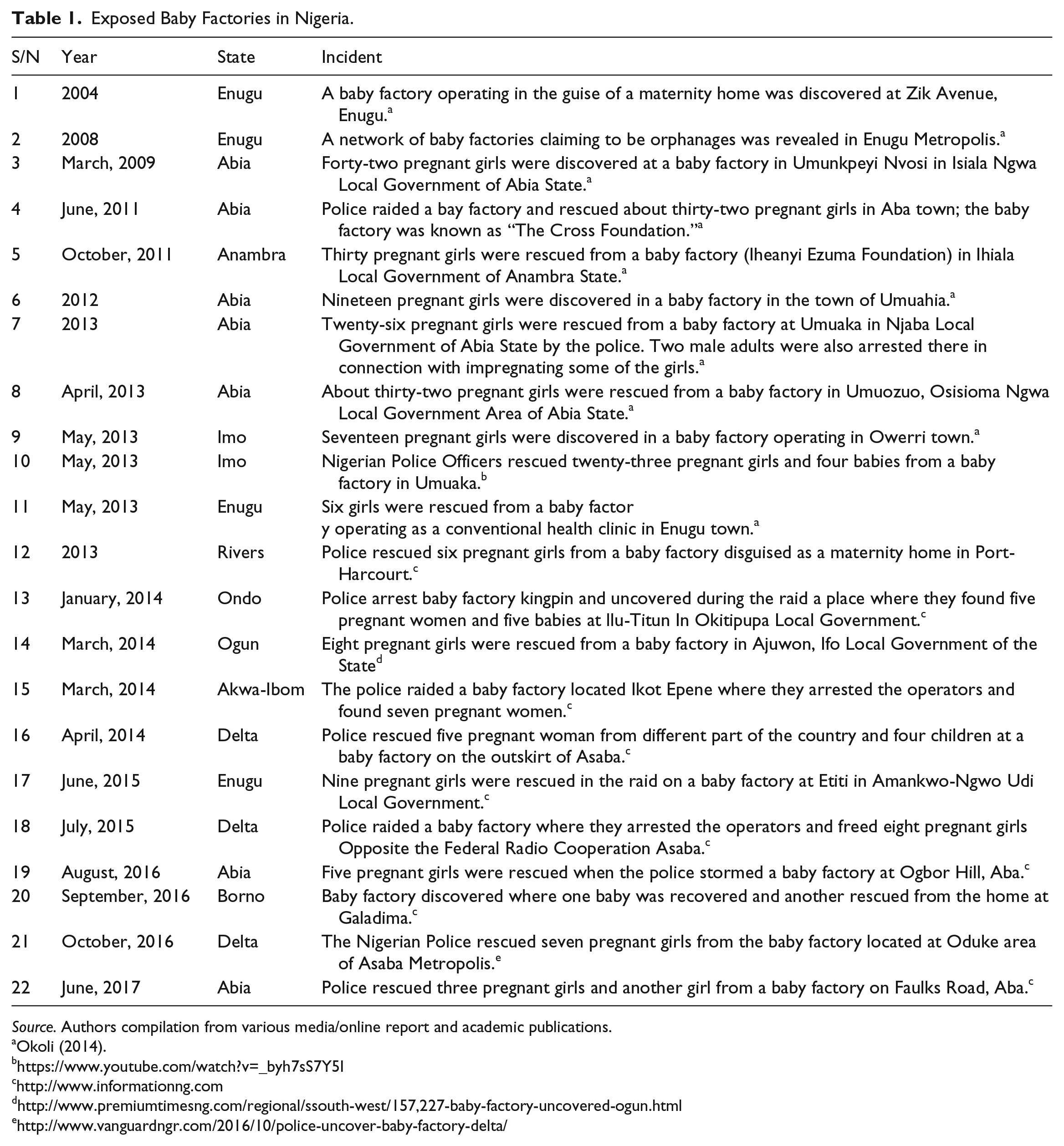
Source. Authors compilation from various media/online report and academic publications.
Baby factories are faceoff disregard for the rights guiding reproduction as there are no specific legislations addressing the menace in Nigeria. Nwosu-Jebira et al. (2007) opined that reproductive rights are entitlements and a protective weapon for all citizens against infringement on the reproductive space. However, in a situation where young girl and women are forcefully impregnated, agency has been violated and sanction must be meted out appropriately. The defiance of reproductive and sexual rights is foundational to many problems demanding a global attention the world over (Chika, 2011).
The table above depicts the various revelations of growing baby factories in Nigeria with emphasis on the Eastern region of the country. Of the 22 baby factories listed above, 14 of them were uncovered in the Eastern region (Abia, Enugu, Anambra, and Imo). This is a substantiation of the claim that the entrepreneurial spirit/profiteering business acumen often associated with the Eastern part of Nigeria alongside unfavorable socioeconomic conditions prevalent within the country has provided a fertile ground for a booming business opportunity in baby factory across the region (Okoli, 2014).
This menace is gradually becoming a major source of income for the operators and an avenue to make money for some women and young girls who voluntarily get involved. However, it is also a medium that has commodified and commercialized babies and the reproductive abilities of women for continual exploitation. This growing incidence has preyed on the vulnerable young, pregnant, economically impoverished, and poverty-stricken women and pregnant girls who give away their baby after birth for financial remuneration. Hence, labeling Nigeria as a nation with one of the most dehumanizing form of child abuse, women sexual assault and trafficking in the world (Eseadi et al., 2015). Makinde (2016) noted that the operation of baby factories is an abuse to young girls and babies and an act that violates fundamental human rights. For instance, the child born in such factories is denied birth registration and lack status, denial of proper health care for child and mother, and prevalence of illegal adoption.
These farms are disguised in different forms as fertility clinics, nongovernmental organization (NGO) assisting young ladies and women or through a calculated recruitment exercise of pregnant and young ladies. However, a typical baby factory consists of the following actors:
Actors and Roles in Baby Factories
Baby factories also operate like any functional institution within the society that requires the combined effort of different units to thrive. The core agents within this illicit trade includes operators of the home who are responsible for the daily affairs of the baby factory. Following are unethical medical professionals who provide the medical expertise for these baby factories. They include doctors and nurses who attend to the antenatal needs and delivery care of the pregnant ladies. The factories also play host to and recruits able and agile young men who are responsible for impregnating the girls whose babies are been sold. Providing a safe passage for this act are corrupt security officers who accept bribes and overlook this process of dehumanization. Widespread corruption in the Nigerian Police Force is fueling abuses against ordinary citizens and severely undermining the rule of law in Nigeria. Agbiboa (2015) argued that the common opinion of the public about the Nigerian police force as a corrupt and violent institution is not evidently insincere and is doing a great disservice to public trust in and effectiveness of the police service. Ineffectiveness of a very important social institution that is supposed to ensure the security of life and properties cannot be divorced from the various upsurge of vices within the country, hence, it is important to state that, good policing is the bedrock for the rule of law and public safety in any society. There are also young girls and women who might be voluntarily/involuntarily involved in the process to gestate and/or carry pregnancy to term for the sole purpose of selling the child. The most actively engaged with the society are the scouts/facilitators who are responsible for recruiting young girls and able-bodied men for the factories, they work actively with documents forgers who provide fake identity documents for some of the babies that needs to be trafficked abroad. Onohua (2014) argued that Nigerians are major actors in baby factories however, the destinations of these babies are usually within or outside Nigeria hence making the process a new trend of trafficking in the country.
Okoli (2014) reiterated the need to promptly and effectively address the unabated growth of baby factories especially in South Eastern Nigeria. It is believed that there is an emerging political economy of baby buying/selling in the region which is adduceable to several factors within the dilapidating socioeconomic structure of the country.
Baby factory targets poverty-stricken teenagers and women. Teenage and grown up mothers are paid a token for their babies who would eventually be sold out to childless couples (Chioma, 2014). In conceptualizing the operation of baby factories in Nigeria, Onohua (2014) stated that baby factories are mostly located where young ladies or girls are harbored and deliberately encouraged or forced to become pregnant and subsequently give up their babies for sale. In this context, baby factory reinforces baby trafficking, as part of human trafficking networks on a larger scale. Baby trafficking refers to all acts involved in the transfers, sale, or receipt of a baby, within national or across international borders, through stealing, false adoption, fraud, or deception, to be used for satisfying social, material, and ritual purposes, among others (Onohua, 2014). Women and babies can be referred as the category at risk within a society where baby factory thrives. Baby trafficking is inhumane and has consequences on the health and wellbeing of the victims. The girls and women whose bodies have been seized deceitfully or forcefully turned into factories for reproduction are exposed to hazardous health and social conditions that dampens their being as humans.
Anomie Theory and the Baby Factory Boom in Nigeria
Emile Durkheim in his ground-breaking understanding of crime within societies argue that deviance becomes a norm and is birth when normative and structural regulatory measures are ineffective within societies. Durkheim as a functionalist agrees that crime is unavoidable within society, hence, it is a functional part of it structural existence but caution must be taken not to begin to perceive crime as preferable. According to Smith (2008), the basis of Durkheim’s theoretical ideological construct rest on “collective conscience” of societies. This collective conscience forms the basis on which norms are developed and shared and laws are instituted as regulatory frameworks within the society. According to Durkheim (1893/1964), as societies continue to evolve into modernity, needs and wants of humans begin to change and there is a more intense desire for upward social mobility and increased economic prospect that is manifested through serious migration across borders. This change within society that can be traced to industrial revolution birth new norms and values that do not completely share the same light as the previously held ones. This imbalance is what Durkheim called “anomie” which refers to a state of normlessness and effective regulation that spurs a tendency to deviate within societies.
The socioeconomic mire of Nigeria characterized by prevalent hunger, poverty, and unemployment creates a gap within institutional and normative framework for conformity in the country. It is also notable to state that Nigeria like most part of Africa has normative expectation of success and ideal lifestyle, hence, like Robert Merton (1938) explained, when ideal goal and means are strained within societies, individual seeks alternative in deviating mediums to attain success. As Nam et al., (2014) highlighted, anomie-strain theory was developed by Robert Merton in 1938 to explain the means-end relationship in the understanding of social actions. Anomie theoretical discussion clearly explains how the socioeconomic breakdown in Nigeria birth greed, dire desire to get wealthy quickly that has made deviant behaviors such as baby factory prevalent. Merton discussed many adaptive strategies employed by humans in response to failing to attain society’s prescribed expectations of success. These adaptations process also regarded as plus-minus typology are conformity (+ +) where established goals are accepted and pursued via culturally legitimized means; innovation (+ –) breeds a condition whereby goals are pursued but through an illegitimate means that has been adopted as an alternative for the culturally legitimized process; in ritualism (– +), the institutional goals are rejected and the cultural means ritualized as an end in itself as in religion fanaticism are pursued; retreatism (– –) produces a condition where both the goals and means are rejected and the individual withdraws into isolation and may find peace in drugs or alcohol. The last adaption mechanism is what Merton called rebellion (_+ _+), here both the society institutional goals and cultural means are rejected and replaced and a new structure is advocated and pursued by the group (Haralambos et al., 2008; Omeire & Omeire, 2015). Okoli (2014) believes the prevalence of baby factories cannot be divorced from the gaps created by the dilapidating socioeconomic structure of Nigeria.
Anomie as a theoretical perspective is very important in conceptualizing the menace of baby factories in Nigeria (Omeire et al., 2015). Alfred et al. (2014) found that extreme poverty and illiteracy are promulgating influencer of baby factories, providing veritable platforms for mothers in these camps to give up their babies for money as most of the girls and women haven immense need for money without adequate legal source become easy prey for operators of the baby factories. They also opined that greed is a motivating factor for these baby factories in Nigeria, as most of the clients resell these babies at lump sum to barren women in diaspora and very few people buy babies for ritual purposes. So as Ritzer (2008) points out, deviance often take the form of alternative, unacceptable, and sometimes illegitimate means of achieving socially approved goals. The Nigerian society celebrates wealth meanwhile poverty is rife among it citizenry, it culturally and religiously emphasizes child bearing and the same time stigmatizes barrenness without recognizing the increasing number of couples struggling to have children. The availability of patrons and clients for baby factories fuels the business to boom.
Recommendation and Conclusion
Baby factories are prevalent in Nigeria and are currently expanding their network as an important part of the trafficking grid. The more this illicit trade spread, the greater risk posed to the lives of babies and the safety of young girls and women, hence, it should be considered as an issue of urgent importance within the national developmental policy framework of Nigeria. There are no adequate and specific laws addressing this type of offense and there should be a concerted effort to curb the unscrupulous activities of this sect of illicit entrepreneurs who have chosen to profit from wicked exploitation and dehumanization of fellow humans. The subtle contribution of various sociocultural beliefs about reproduction and child bearing also create a fertile environment for the activities of baby factories to thrive. In this light, there is a need for a serious social reorientation that will encourage couples with infertility to tail the route of legal adoption; a sensitization that will teach moralistic sexual relations as against stigmatizing teenage pregnancies and pregnancy outside wedlock; and surrogacy and other mediums in assisted reproductive technology (ART) should be embraced as viable alternatives to infertility treatment. Programs and enlightenment campaigns should be instituted to educate young girls about this practice and how to avoid being a victim.
As argued in literatures, most of the baby factories have disguised as maternity clinics and NGO helping young women and girls. There is, therefore, a very important need to effectively monitor and regulate the activities of such organizations within the country not to allow miscreants that seek to exploit find solace in the sector and tarnish the good humanitarian benefit that is intended to be provided by genuine NGOs. Adequate punishment must also be meted out to apprehended operators of baby factories to serve as deterrent for others that might want to profit from the trade. The operation of baby factories is detrimental to societal development and an abuse of the fundamental human right, hence, there is a need for a global awareness and a recognition of baby factories as crime against humanity or as an offense that dehumanizes, impoverish, and abuses the essence for life and living. In retrospect, this review has searched through literatures and media reports to further bring the practice of baby factory to the forefront of public debate. The practice is prevalent and rapidly expanding as a major caucus of human trafficking network exploiting young girls and women. The health hazards faced by victims of baby factories are of grave concern to social wellbeing because it poses serious physical, sexual, and psychological threat to these babies, young girls, and women. It became clear that the stigmatization of teenage pregnancy, pregnancy outside wedlock, infertility, and surrogacy provide a fertile ground for baby factories to thrive. Hence, there is a need for baby factories to be recognized globally as a crime against humanity and the Nigerian government needs to implement effective legislations punishing all stakeholders involved in this illicit act and at the same time properly legislate and monitor the avenues for ART.
Footnotes
Declaration of Conflicting Interests
The author(s) declared no potential conflicts of interest with respect to the research, authorship, and/or publication of this article.
Funding
The author(s) received no financial support for the research, authorship, and/or publication of this article.
