




Abstract
Knowledge of child development influences parental expectations of, and interactions with, children. Studies have shown that maternal knowledge supports cognitive and social–emotional development of young children and can have long-lasting benefits. Level of developmental knowledge of parents and grandparents has seldom been investigated on a population level. Our aim was to compare Canadian and Dutch samples of urban parents and grandparents in terms of normative knowledge of children’s cognitive and social–emotional development. Urban parents (n = 379) and grandparents (n = 174) from the province of Alberta, Canada (N = 553) and parents (n = 634) and grandparents (n = 96) of the city of The Hague in the Netherlands (N = 730) answered questions related to knowledge of cognitive and social–emotional development of young children, including topics such as “do children have stronger bonds with parents who stay at home instead of working outside the home?” and “do children learn more from hearing someone in the same room talk than hearing someone on TV?” Overall, the Canadian respondents were more likely to answer these questions correctly. In both samples, women were more likely than men to answer correctly. No significant relationship between age or role (parent or grandparent) and knowledge was identified, but there was a positive correlation between knowledge and level of education. Little is known about international differences in caregivers’ knowledge about normative child development. This study suggests that differences exist. Understanding differences between countries in parental knowledge may provide insight into cross-cultural variability in child behavioral and developmental outcomes.
Introduction
Researchers agree that the quality of parenting in early childhood is fundamental to a child’s lifetime well-being. Optimal child development outcomes are more likely to occur when parenting is sensitive, supportive, structured, and positive (Collins, Maccoby, Steinberg, Hetherington, & Bornstein, 2000; Shaw, 2014; Shonkhoff, 2009; Stack, Serbin, Enns, Ruttle, & Barrieau, 2010). On the contrary, children exposed to negative parenting in early childhood characterized as neglectful, harsh, distant, punitive, intrusive, and reactive have been associated with various types of maladjustment (Shaw, 2014). Improving caregiving practices is an important, modifiable target of preventive population-based parenting programs to support parents and enhance the quality of parenting to optimize child development and behavioral outcomes (Sanders, 2012).
As Winter, Morawska, and Sanders (2012) stated, the evaluation of effective population-based parenting approaches indicates improvements in skills and self-efficacy (Guajardo, Snyder, & Petersen, 2009; Jones & Prinz, 2005; Stack et al., 2010). Less evidence exists related to parental knowledge, which is an aspect of adult social cognition that comprises one’s understanding of child developmental processes, caregiving and child-rearing skills, and developmental norms (Dichtelmiller et al., 1992).
Research on the impact of parental knowledge on children’s developmental outcomes has several limitations (Huang, O’Brien Caughy, Genevro, & Miller, 2005). For instance, most research has been based on high-risk samples, such as teenage mothers, first-time mothers, mothers of premature babies, or depressed mothers (e.g., Huang et al., 2005; Winter et al., 2012). These studies suggest that maternal knowledge is related to mothers’ expectations of, as well as their interactions with, young children (Benasich & Brooks-Gunn, 1996; Conrad, Gross, Fogg, & Ruchala, 1992; Damast, Tamis-LeMonda, & Bornstein, 1996; Hess, Teti, & Hussey-Gardner, 2004; Huang et al., 2005; Reich, 2005; Smith, 2002; Stevens, 1984; Veddovi, Gibson, Kenny, Bowen, & Starte, 2004). Mothers’ knowledge of child development has also been shown to be positively correlated with their ability to enhance the development of their children (Benasich & Brooks-Gunn, 1996; Bornstein et al., 2003; Miller, 1988; Stevens, 1984; Veddovi et al., 2004), and these mothers are more sensitive in interactions with their children (Huang et al., 2005; Smith, 2002).
Another limitation of the existing studies is that to date, studies about caregiver knowledge have focused primarily on mothers and the impact on their children, as mothers are seen as the main caregiver. Fathers and grandparents are neglected. However, a growing body of evidence indicates the increased involvement and advantages of fathers and grandparents in caring for children (Harper & McLanahan, 2004; King, 1994; Lundahl, Tollefson, Risser, & Lovejoy, 2008; Sarkadi, Kristiansson, Oberklaid, & Bremberg, 2008; Van Ijzendoorn, 1992).
Grandparents do play a role in parenting, either directly via taking care of their grandchildren or indirectly by providing models and advice. Consequently, grandparents often have a substantial influence on daily child-rearing practices and their influence is increasing (Geurts, Van Tilburg, Poortman, & Dykstra, 2014). For example, in the Netherlands, the percentage of parents who involve grandparents in the care of their children has risen remarkably in the last two decades, from 23% in 1992 to 41% in 2006 and to 66% in 2015 (Geurts et al., 2014). At present, similar percentages are found for the United States (61 %, Luo, LaPierre, & Hughes, 2012) and for Canada (65%, Joy, 2013).
Furthermore, grandparents are an important source of information for parents as they frequently give child-rearing advice to their adult children (DYG, Inc., 2001; O’Connor & Madge, 2004; Walker, 2005). The intergenerational transmission of parenting is a “process of purposively or unintendedly influencing parenting attitudes and behavior of the next generation by an earlier generation” (Van Ijzendoorn, 1992, p. 76). This model points to the importance of the influence of grandparents, even if they are not directly taking care of their grandchildren.
Investigations of factors related to parental knowledge of child development suggests that men, adolescent parents, parents with less education, and those with limited financial resources have lower levels of knowledge about child development compared with parents without these characteristics (Benasich & Brooks-Gunn, 1996; Bornstein, Cote, Haynes, Hahn, & Park, 2010; Conrad et al., 1992; Crouter, Helms-Erikson, Updegraff, & McHale, 1999; Hess et al., 2004; Huang et al., 2005; Reich, 2005; Smith, 2002; Stevens, 1984, 1988). Earlier studies did not address the question whether grandparents differ in their parental knowledge from parents.
There are culture-specific child-rearing beliefs and behaviours among parents, which have not been accounted for in the research literature (Berk, 2009; Huang et al., 2005) and there are cultural differences among Western countries regarding parenting in early childhood (Bornstein et al., 1996; Senese, Bornstein, Haynes, Rossi, & Venuti, 2012; Wendland, Maggi, & Wolff, 2010). Several researchers have suggested that culture can be a moderator between several parental processes, for example, the association between parental knowledge and parenting behavior (Bornstein, Putnick, & Lansford, 2011; Huang et al., 2005).
Currently, it is difficult to generalize the outcomes of parenting programs focused on high-risk populations to low-risk populations, including fathers and grandparents. Understanding this generalizability is important because population-based parenting programs (such as Triple P and Incredible Years Training) focus on enhancing knowledge of all caregivers, regardless of their cultural background, to improve the quality of parenting and to promote child well-being. Insight into the level of parental knowledge of primary caregivers, in population studies, can reveal what caregivers know and understand about child development and parenting, and further, reveal differences between subgroups; this may provide input for preventive parenting programs.
To date, only three studies could be identified that have investigated what parents and grandparents know or understand about child development in a population sample. The first of these investigated adults’ understanding of the intellectual, emotional, and social development of young children (newborns to 6-year olds) in the United States (DYG, Inc., 2001). Eight years later, researchers in Canada (Rikhy et al., 2010) and in the Netherlands (Diekstra, Wubs, Vreeburg, Sklad, & de Ruiter, 2008) independently studied knowledge and understanding of child development (respectively until 14 years and 17 years old) among adults in their respective countries. All three studies concluded that most adults are knowledgeable about certain domains of child development. However, there were important areas in which there are significant knowledge gaps. In all three studies, mothers were more often than fathers, answering in line with what research indicates to be correct. However, in the Canadian study (Rikhy et al., 2010), this only applied for physical development and not for social, emotional, and cognitive development. The United States (DYG, Inc., 2001) and Dutch (Diekstra et al., 2008) studies pointed to education and age effects; respondents who were more highly educated and those who were younger were more likely to provide correct answers. Age and education effects were not reported in the Canadian study (Rikhy et al., 2010).
The Canadian (Rikhy et al., 2010) and Dutch (Diekstra et al., 2008) studies independently concluded that knowledge gaps were primarily found with regard to cognitive and social–emotional development of (young) children, compared with achievement of physical developmental milestones. Literature shows that a strong foundation of social–emotional development is associated with emotional well-being and the child’s later ability to adjust in school and to maintain successful relationships (National Scientific Council on the Developing Child, 2005); that cognitive and social–emotional development are intertwined (Berk, 2013); and that early cognitive development has a major impact on academic achievement later in life (Berk, 2013). The social–emotional development of a child begins at birth (Bushneil, Sai, & Mullin, 1989; Murray, 1992). Caregivers who are aware of this can actively stimulate and support their child’s development by providing responsive caregiving (e.g., a safe and stable home environment, healthy nutrition, etc.), and having sensitive interactions with their child to create a secure bond (Burchinal et al., 2000; De Wolff & Van Ijzendoorn, 1997). Caregivers who understand early cognitive development and the influence of both the child’s biology and the environment on development may be more likely to respond appropriately to the needs of their child, have realistic expectations of child behavior, and create environments that support child development (Huang et al., 2005; Smith, 2002; Stevens, 1984). For example, exposure to language through story books, shared book reading, and real-life conversation, in contrast to exposure to television, supports language development (Bus & Van Ijzendoorn, 1997; Bus, Van Ijzendoorn, Pellegrini, & Terpstra, 1993; Tamis-LeMonda & Rodriguez, 2009). Caregivers who are aware of this can create an effective learning environment for their children.
The Canadian and Dutch studies both assessed the same six topics of early cognitive and social–emotional development (observe and react to the world, experiences in the first years of life, bond with parent, learning language, fantasy play and ability to learn). This overlap provides a meaningful opportunity to gain insight into possible similarities and differences of parental knowledge in two “Western” countries. Both countries share important similarities, such as economic standing, government-regulated health care and high educational attainment. However, Canada has been described as a masculine society driven by competition, achievement, and success, and the Netherlands as a feminine society, with emphasis on cooperation, caring for others, and quality of life (Hofstede, 2001).
These differences in values are evidenced by the beneficial governmental regulations for Dutch caregivers. Firstly, Dutch women have full paid maternity leave (16 weeks) and later, both parents have the possibility for taking an equivalent of 13 weeks of full-time parental leave before the eighth birthday of the child, with a partial compensation from the government (Rijksoverheid, 2018). Canadian women have 52 weeks of parental leave with a reduced salary (55% of their salary [up to maximum]; Service Canada, 2018). Second, child-care services in the Netherlands are subsidized to a greater extent than in Canada. Third, both countries provide antenatal education classes to prepare for labor and delivery.
Afore mentioned differences in values may also be reflected in labor status of parents in these two countries. For instance, Canadian women are more likely to work outside the home and for more hours than Dutch women. In 2009, in the Netherlands, 59.7% of women between 15 years and 65 years of age were in the workforce for an average of 25.3 hr per week (Central Bureau for Statistics [CBS], 2014), and 29.8% of women (15-65 years old) worked 35 or more hr per week. In 2009, in Alberta (the province studied by the Canadian researchers,) 64.1% of women with children below 3 years of age were employed, of which 73% were working 37.5 hr per week or more (Statcan, 2011). Also Dutch men are more likely to be employed part-time (19.4%) in comparison with Canadian men (12.2%; Organisation for Economic Co-operation and Development [OECD], 2017). This gives them opportunity to take care of the children. One day when a father takes care of the children, while the mother works, is often referred to as “daddy-day” in the Netherlands. In the Netherlands, there is more focus and support for balance of work, family, and caring of children by both men and women (Hofstede, 2001). Therefore, Dutch parents have more time available to spend with their children and might be better informed when children are expected to acquire a developmental milestone.
In summary, parental knowledge is an important outcome of universal population-based preventive parenting programs. Literature suggests that parental knowledge is important for optimal child outcomes, particularly for high-risk and vulnerable groups. However, it is unclear what adult caregivers know and understand about child development, and how knowledge levels differ between countries. The purpose of this study was to compare Canadian and Dutch population samples of urban parents and grandparents in terms of their knowledge regarding six topics of cognitive and social–emotional early childhood development. In addition, the relationship between gender, age, education, and role (parent or grandparent) and knowledge of child development was examined.
We hypothesize, based on the literature and the earlier population studies, that younger parents, women, and parents with higher education will have more accurate knowledge of child development compared with older parents and grandparents, men and those with less education. In addition, we hypothesize that Dutch parents will have higher levels of developmental knowledge compared with Canadian parents. This is supposed, among other things, to be due to the fact that in the Netherlands mothers work outside the home considerably less and consequently spend more time with their children. However, whether this also applies to Dutch grandparents compared with Canadian grandparents remains to be seen, given the fact that the percentages of grandparents actively involved in care for their grandchildren in both countries are almost the same.
Method
Comparisons between the Canadian and Dutch samples were feasible because of the similarities in study methods. Both studies recruited a stratified and representative population sample, and the survey questionnaires were pilot tested and then administered through phone interviews by trained interviewers. The study periods overlapped to a large extent (2007-2008). A full description of the Canadian and Dutch study designs can be found in the original reports (respectively Diekstra et al., 2008; Rikhy et al., 2010). This manuscript combines the data of both studies to provide a comparison between Canadian and Dutch parents and grandparents.
Samples
Canadian participants were eligible if they were over 17 years of age, lived in Alberta, and had interacted with a child less than 14 years of age in the past 6 months. Parents (379) and grandparents (174) living in the cities of Alberta (Calgary or Edmonton) were included in this analysis. The Dutch sample included parents and grandparents representative of the population of the Hague. In the comparison, we included 634 parents and 96 grandparents who had a (grand) child younger than 14 years of age. All participating Dutch grandparents either lived with children (6.9%) or were in contact with them, 89.4% often, 8.5% from time to time and 2.1% seldom.
Demographic Characteristics
To adequately compare surveys, the demographic characteristics were recorded into comparable variables: age, education, and ethnic group. The level of education was coded into three categories: low, middle, and high level. A low level of education included respondents who had not received any schooling, or who had been to primary or secondary school only: the middle level included participants who had taken some form of vocational education: respondents who received a college or higher degree were coded as having a high level of education.
Table 1 shows the demographic characteristics of both samples. The distribution of the number of children per household was similar in both countries, χ2(N = 1013, 4) = 8.71, p = .069. However for gender, education, age, and role, there were differences between the samples. More women participated in the Canadian survey than in the Dutch one, and consequently, there were significantly more Canadian mothers, χ2(N = 1013, 1) = 22.17, p < .001, and grandmothers, χ2(N = 270, 1) = 8.94, p = .004. More Canadian respondents had a higher level of education and the difference between countries was statistically significant among parents, χ2(N = 1003, 2) = 13.52, p = .001, and grandparents, χ2(N = 268, 2) = 15.02, p = .001. Dutch parents were older than their Canadian counterparts, t(1003) = 3.63, p = .014, but Canadian grandparents were older than Dutch grandparents, t(268) = −5.27, p < .001. The Dutch sample includes significantly more parents than the Canadian sample, χ2(N = 470, 1) = 8.36, p < .004. Due to these differences, subsequent analyses were controlled for age, gender, role (parent or grandparent), and education.
Overview of Demographic Characteristics of Canadian and Dutch Parents and Grandparents.

Measures
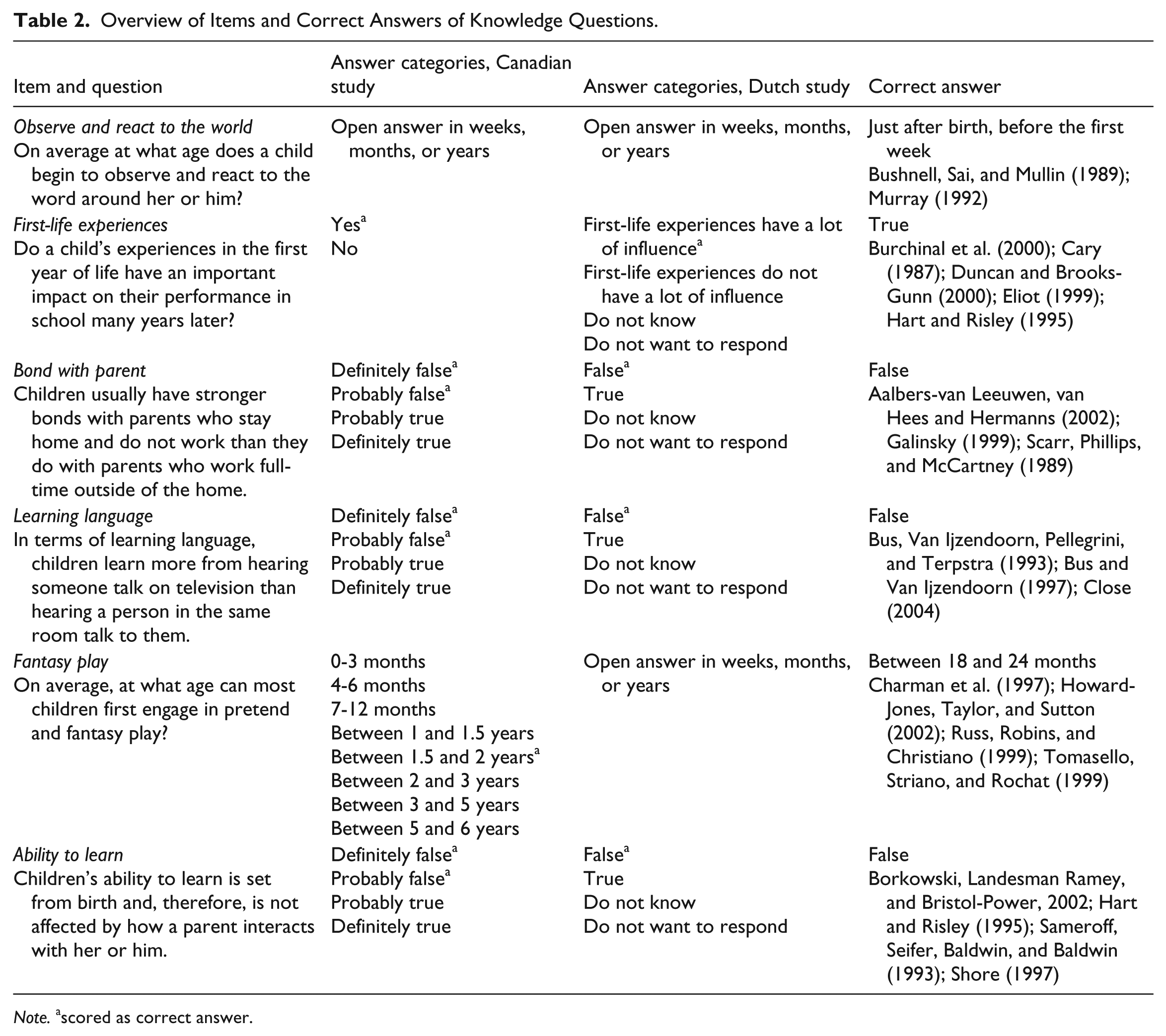
Both surveys contained topics adapted from the National Benchmark Survey carried out in the United States (DYG, Inc., 2001), as well as additional questions on child development related to older children up to the age of 14 years (Canada) and 18 years (the Netherlands). The National Benchmark Survey was created by experts in science and practice regarding child development from across the United States. Comparison of both samples (Canada = 62 topics; the Netherlands = 58 topics) identified six topics in addition to demographics, that were similar in content, formulation, and type of measurement, and were, therefore, deemed suitable for comparison. The six comparable topics, which were also part of the American National Benchmark Survey (DYG, Inc., 2001), were designed to measure adult knowledge of children’s cognitive and social–emotional development (Table 2).
Overview of Items and Correct Answers of Knowledge Questions.
Note. ascored as correct answer.
To assess parental knowledge in a reliable, systematic, and consistent way, all responses were recorded to two alternatives: correct or incorrect. Answer categories “don’t know” and “refused to answer” (Dutch study only) were recorded as incorrect, as the respondent did not identify the correct answer.
Data Analysis
For each topic, logistic regression models were developed to predict the odds of giving a correct answer based on the country of residence, gender, caregiving role, age, and level of education. Models were expressed using odds ratios (ORs) and 95% confidence intervals.
Results
Exploration of the relationship between the six topics showed low intercorrelations (Table 3). This lack of intercorrelations indicates the relative independence of these six topics.
Correlations (Point Biserial) of Six Items and Corrected Item-Total Correlation.

Note. Diagonal presents correlations of each item with total number of correct answers to other items (n = 1214).
p ≤ .05. **p ≤ .01.
Overall Correct Score
Table 4 shows the distribution and descriptive statistics of the answers in both samples. On average, participants correctly answered 3.18 topics out of six. A very small group of respondents (less than 2%) provided correct answers on all topics, and an equally small group (less than 2%) provided no correct answers at all. Respondents of 40% correctly answered at least half of the topics.
Distribution and Descriptive Statistics of the Number of Correct Answers per Item and Country.

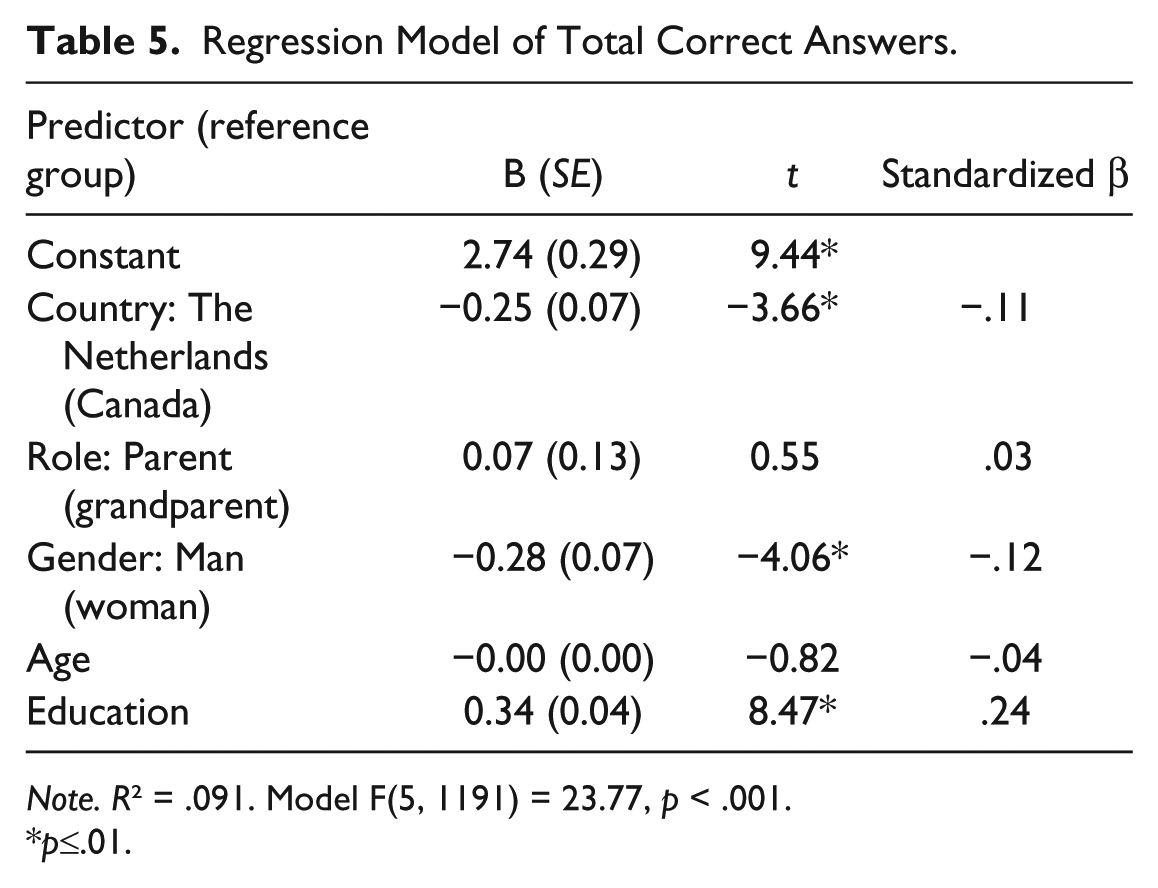
To determine the influence of demographic characteristics, a regression model was developed. As Table 5 indicates, there were significant differences based on geographic location, gender, and education. Dutch participants, men, and participants with a lower education provided fewer correct answers overall. Canadian respondents answered, on average, 3.4 topics (SD = 1.14) correctly, while this average was a bit lower for Dutch respondents at 3.0 topics (SD = 1.14). Age and relation to the child (parent or grandparent) did not influence responses.
Regression Model of Total Correct Answers.
Note. R² = .091. Model F(5, 1191) = 23.77, p < .001.
p≤.01.
Correct Score per Topic
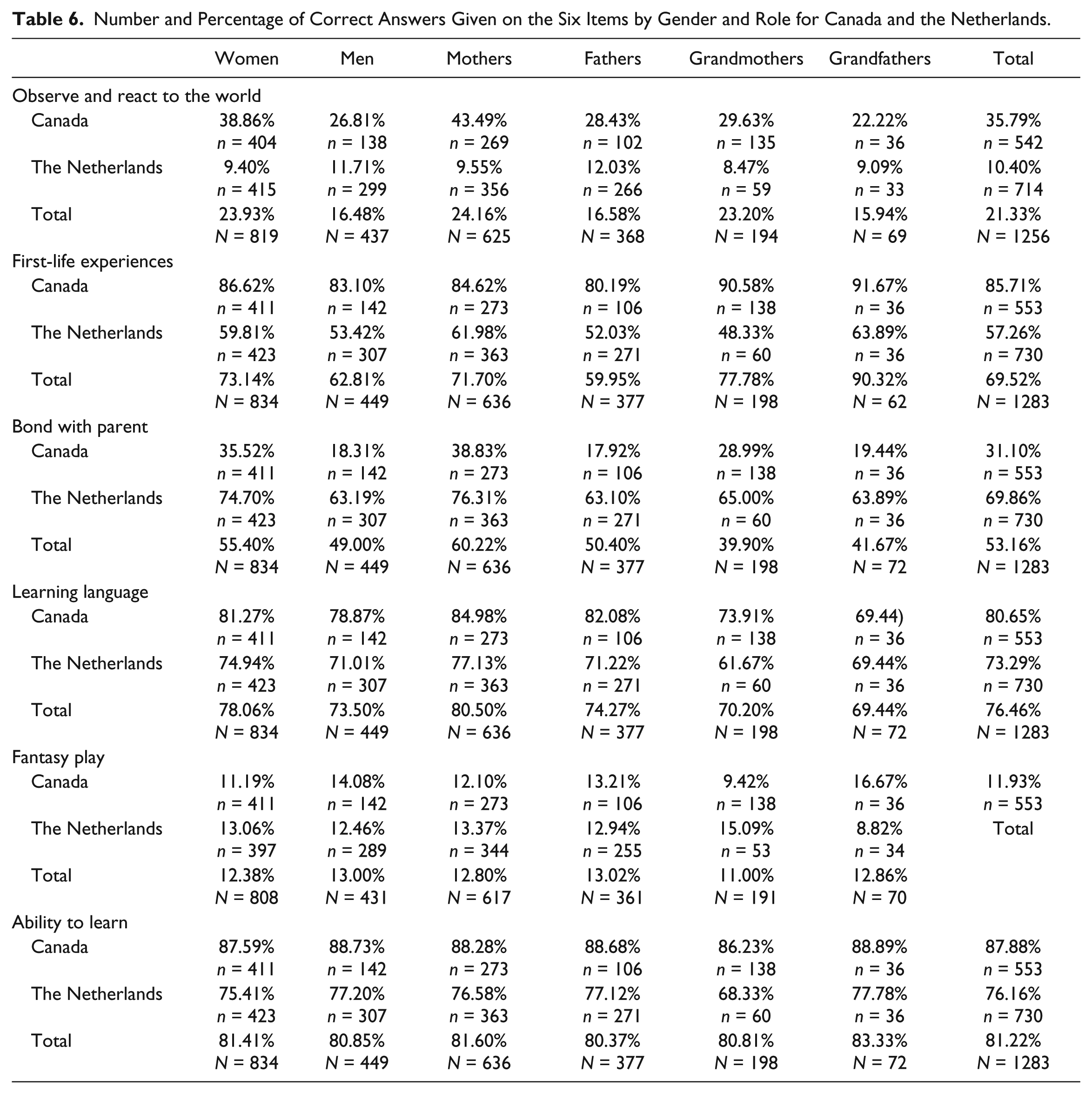
As Table 6 shows, the proportion of respondents who answered each topic correctly varies substantially across topics in both samples. The topic on a child’s ability to learn was most often answered correctly (81.2%), while the topic on fantasy play was least often answered correctly (12.6%). At least two thirds of the respondents answered the topic on language learning and the impact of experiences in the first year of life correctly. The topic regarding parental bonding was answered correctly by more than half of the respondents, and the topic about the ability to observe and react to the world was answered correctly by fewer than a quarter of the respondents.
Number and Percentage of Correct Answers Given on the Six Items by Gender and Role for Canada and the Netherlands.
Separate logistic regression models were built to analyze the differences between Canada and the Netherlands. In these logistic regression models, demographic characteristics (age, education level, gender, and relation to child) were controlled for to determine differences between samples.
Topics on the child’s ability to learn, language learning, impact of experiences in the first year of life, and ability to observe and react to the world were more likely to be answered correctly by the Canadian mothers, fathers, and grandmothers compared with their Dutch counterparts. All topics, excluding language learning, were more likely to be answered correctly by Canadian grandfathers than Dutch grandfathers. Canadian and Dutch grandfathers had equal knowledge on the topic about learning language (Table 6). Logistic regression models revealed significant differences, controlling for demographical features. The Dutch participants were half as likely as Canadians to correctly answer the question about a child’s ability to learn (OR = 0.47), 4 times less likely to identify the relevance of the first-life experiences (OR = 0.25), 5 times less likely to identify when children begin to observe and react to the world (OR = 0.20), and nearly 7 times less likely to identify when children begin to learn language (OR = 0.15). However, Dutch parents and grandparents were nearly 7 times more likely than Canadian parents and grandparents to provide correct answers to the topic asking about quality of bonds with working parents (OR = 6.88). Results presented in Table 7 indicated that the effects of the country were statistically significant for almost all topics. There was no significant difference between Canadian and Dutch respondents for the topic about fantasy play, and this topic was not significantly affected by any of the demographic predictors.
Logistic Regression Models: Determinants of Correctly Answering Developmental Knowledge Items.

Note. CI = confidence interval; OR = odds ratio.
p≤.05, **p≤.01.
Logistic regression analysis further demonstrated that education had a significant positive effect on answers to all the topics except fantasy play, and that women demonstrated significantly more accuracy answering topics about bonds with working parents and impact of experiences in the first years of life. However, participants’ age and relation to the child did not influence the accuracy of the responses.
Discussion
The investigators compared parental knowledge about six topics of child development using data from two independently implemented population-based studies, one in Canada and one in the Netherlands. On average, respondents in both samples answered half of the topics correctly, and some topics were more likely to be answered incorrectly by the majority of respondents. It was postulated that younger parents, women, Dutch respondents, and parents with higher education would have more accurate knowledge compared with older parents and grandparents, men, Canadian parents and grandparents with lower education. Results confirmed that women those with higher education provided more correct answers, there was no effect of age or relationship to the child (parent or grandparent) on knowledge. Our hypothesis that Canadian parents and grandparents would provide more correct answers is rejected.
The knowledge levels reflected in the present study are in accordance with earlier research (DYG, Inc., 2001), indicating that parents and grandparents are well informed about some aspects of child development, particularly physical development, but are less informed about other aspects of child development, such as cognitive, social, or emotional development. This research further demonstrates that men are less informed than women about some aspects of child development, a finding, which has been noted by others (Crouter et al., 1999; De Castro Ribas & Bornstein, 2005; DYG, Inc., 2001; Stevens, 1988).
In addition, regardless of country (Canada or the Netherlands), respondents with low education levels were more likely to provide incorrect responses to child development topics, compared with those with high education levels, a finding noted by earlier studies (Benasich & Brooks-Gunn, 1996; Conrad et al., 1992; Hess et al., 2004; Huang et al., 2005; Pickett, Marlenga, & Berg, 2003; Reich, 2005; Stevens, 1984). Better educated mothers more actively request information regarding their child (Reich, 2005) and tend to use more information from formal resources (e.g., books and other written materials) and experts (pediatricians and nurses) about child development (Bornstein et al., 2010; Vukelich & Kliman, 1985) than less educated mums. The association between lower caregiver knowledge and low income suggests that some approaches to improve parental knowledge, and potentially parenting practices may be of value in low resource settings. This also sheds light on the discussion of intergenerational immobility. Children of wealthy, healthy, and educated parents often receive more positive parenting (Hoff, Laursen, Tardif, & Bornstein, 2002; Van Ijzendoorn,1992) and are more healthy and higher educated (Bus et al., 1993) themselves (Borkowski, Ramey, & Bristol-Power, 2002; Goodman, 1999). These children are more likely to provide their children also with positive parenting practices, and this enhances the transfer of optimal child development to the next generation.
Neither caregiving role (parent or grandparent) nor age significantly influenced the likelihood of giving a correct answer. This is in accordance with Reich (2005) and may suggest that maternal knowledge of child development is less age dependent and more related to interaction with young children.
This comparison revealed differences in knowledge about child development and in knowledge of developmental milestones between Canadian and Dutch respondents. Canadian respondents were more likely to provide the correct answers on four topics (observe and react to the world, experiences in first years of life, learning language, and ability to learn), whereas Dutch respondents were more likely to provide the correct answer on one (bond with parent). These differences suggest that aspects of developmental knowledge can vary between countries. However, it is beyond the scope of these data to determine why these differences exist, although possible explanations are offered.
First, while Canadian respondents provided more correct answers overall, Dutch respondents were more likely to give the correct answer for the topic on the strength of children’s bonds with working parents compared with nonworking parents (Canada 31% vs. the Netherlands 70%). This topic was also part of the American National Benchmark (DYG, Inc., 2001), where only 19% of the respondents provided the correct answer. A recent follow-up study of Canadian parents and grandparents replicated these earlier findings, with 35% of parents and grandparents providing the correct answer (Botey et al., 2014). Although this evidence is limited to four studies, there is consistency in the findings. Although, Dutch respondents seem to be more aware that working parents can have strong bonds with their children, this has not resulted in higher rates of Dutch women working outside the home. Since 2005, the Dutch government has actively encouraged women to work outside the home, and to work more hours (Merens, Hartgers, & Van den Brakel, 2012). Several policy measures have been implemented, such as financial support of child care and flexible working hours. As a result, there has been an intense discussion in the media about the impact of child care on the development of children. Therefore, Dutch respondents may be better informed due to the sociopolitical climate surrounding working mothers in Europe. In addition, the aforementioned result aligns itself well with the concept of the Netherlands being a less masculine, achievement-oriented society (Hofstede, 2001), creating more acceptance for part-time work and possibility of finding satisfactory compromise between professional activity and parenthood.
Second, Canadian and Dutch respondents were equally unlikely to recognize when children are able to engage in fantasy play. Both groups overestimated the average age at which children begin to engage in this type of activity, which research has determined as between 1.5 years and 2 years (Charman et al., 1997; Howard-Jones, Taylor, & Sutton, 2002; Russ, Robins, & Christiano, 1999; Tomasello, Striano, & Rochat, 1999). The average age indicated by Dutch respondents, however, was 3.5 years (Diekstra et al., 2008) and more than 80% of Canadian respondents answered that children would be older than 2 years (Rikhy et al., 2010). This illustrates that a majority of respondents are either unaware that children engage in fantasy play so young, or are misunderstanding what behavior constitutes fantasy play. This gap in knowledge regarding the early start of fantasy play could have implications for the development of a variety of mental abilities (such as language and literacy skills, imagination, understanding of emotions, and self-regulation) as parents miss the opportunity to foster this behavior (Berk, 2009; Elias & Berk, 2002; Lindsey & Colwell, 2003). The misunderstanding of what behavior constitutes fantasy play could be due to the original wording of the topic, which asked “on average, at what age can most children first engage in pretend and fantasy play?” Respondents may have interpreted this to mean two diverse types of activities, and overestimated the complexity implied by “fantasy play” in contrast to “pretend play.” Fantasy play could have been misinterpreted as a completely imaginary, role-playing game, which is characteristic for older children (Berk, 2009; Singer, 1977), prompting respondents to provide higher estimates of the typical age. Cultural differences regarding the topics and frequency of pretend play are visible. However, in all communities the sequence and the level of occurrence was equal to European and Euro-American children (Lillard, Pinkham, & Smith, 2011).
Limitations
This study was able to compare six knowledge topics related to the development of young children. These six topics represent only a small part of parental knowledge regarding children’s cognitive and social and emotional development processes and milestones. The generalization of these findings to a broader spectrum of parental knowledge should be done with caution. Further research is required to determine if these findings would apply to other constructs of parental knowledge than developmental processes and milestones, for example, effective parenting strategies, and if these findings also apply to parental knowledge about the development of school children.
The six knowledge topics addressed different subdomains of parental knowledge: low intercorrelations between the topics confirmed this. With a single topic addressing each domain, it is impossible to estimate its reliability and measurement error without repeating the study. Therefore, the authors suggest extending the number of topics per construct for future research on parental knowledge.
It remains uncertain to what extent the differences between the two samples reflect differences in knowledge rather than differences in topic wording. However, the finding that the Canadian sample overall, with one exception, appears to be more knowledgeable, may suggest that real knowledge differences exist.
Furthermore, the very slight difference in response scales used in each country presents a limitation to the conclusion. For the majority of topics, the differences in response scales could create a small bias benefiting Canadian respondents. Authors estimated the possible size of the bias using correction for guessing. Results indicated that due to being provided with “don’t know” option, Dutch respondents could lose 1.75% on average, with a maximum of 2.6% for the most affected topic. Therefore, the differences in the answer scale could not account for observed differences between the countries, as they were much larger than the abovementioned guessing factor. Only one topic that had a less predictable effect of difference in answering scale between countries, fantasy play topic, did not reveal significant difference between countries.
Finally, both studies were limited to individuals who were available by phone, spoke either Dutch or English, had interacted with children of a certain age in recent months, and were willing to participate. These individuals may have had an interest in this area and, as such, may not be representative of all adults who interact with children less than 14 years of age.
Despite limitations, this first international comparison of topics of parental knowledge of child development shows that parents and grandparents in two developed countries with universal health care and public education, as Canada and the Netherlands, have limited knowledge of some aspects of child development. This finding, combined with research that suggests knowledge of child development can enhance parenting practices, suggests that efforts to ensure broad public knowledge about practices that support child development could improve outcomes for children. Furthermore, there may be international differences in topics of parental knowledge that go unexplained thus far. These preliminary results raise the question, “are these results an occasional finding or is this study a reflection of real differences between knowledge of parents and grandparents regarding child development between countries?” Subsequently, if differences do exist in parental knowledge, “what is the impact of those differences on the development of children between countries?” In addition, the authors identify two important questions related to this study for future research. First, “which aspects of child development knowledge do parents and grandparents need in their child-rearing toolbox to stimulate and support children?” And secondly, “in what ways can child-care organizations, parenting support agencies and policy makers provide this developmental knowledge?”
Footnotes
Acknowledgements
Canadian researchers acknowledge the Population Research Laboratory at the University of Alberta for undertaking the surveys and Shivani Rikhy for her research assistance. Dutch researchers acknowledge Lectoraat Jeugd en Opvoeding of the Hague University and Janneke Wubs and Melanie de Ruiter for their research assistance. Canadian and Dutch researchers acknowledge Heather Ginez for her thoughtful editing.
Declaration of Conflicting Interests
The author(s) declared no potential conflicts of interest with respect to the research, authorship, and/or publication of this article.
Funding
The author(s) disclosed receipt of the following financial support for the research and/or authorship of this article: Canadian researchers acknowledge the Alberta Centre for Child, Family, and Community Research for funding this study. And Dutch researchers acknowledge the municipality of the Hague for funding this study.