




Abstract
While parental influences on adolescent health behaviors are well recognized, there is limited understanding of the relationship between adolescents’ perceptions of their parents’ expectations and their sexual behaviors. This mixed-methods study explored how White and Asian American adolescents perceive parental expectations via parent–child interactions, and how such expectations relate to adolescents’ self-reported sexual activities over time. Using gender-matched, in-depth interviews with 28 White and Asian American adolescents, ages 17 to 19, we explored adolescents’ perceptions of parental expectations about when, how, and under what conditions adolescents should engage in sexual activity. Stronger conservative parental sexual expectations and disapproving parental attitudes were closely related to later sexual debut and fewer sexual partners. Perceived closeness determined the degree to which adolescents respected and incorporated their parents’ beliefs, values, and sexual expectations. Future research should focus on developing family strategies to utilize the concept of perceived parental expectations.
Keywords
Adolescence is a period of initiation and discovery, with an increased potential for adolescents to experiment for the first time with activities that could have long-term effects on their heath (Fang, Schinke, & Cole, 2009). Promoting healthy sexual behaviors during adolescence is recognized as the most cost-effective way to reduce risky behaviors and minimize the medical costs and health consequences of sexually transmitted infections (STIs; Berlan & Holland-Hall, 2010; Di Noia & Schinke, 2008; Hendershot, Magnan, & Bryan, 2010). Within the context of family ecology perspectives (Granic, 2006), parent–child interactions reflect an interpersonal relationship of relatively long-term duration, with parents and families representing a significant and generally stable influence in adolescents’ lives. Studies (Chen, Dornbusch, & Liu, 2007; Markham et al., 2003) have shown that although peers’ sexual behaviors play an important role in adolescents’ decisions to initiate sexual intercourse, parents are the primary source of information about sex, and most importantly, that adolescents are influenced by their parents’ attitudes and behaviors. Specifically, positive parenting skills and close maternal relationships are significantly protective against adolescents’ associations with deviant peers and engagement in risky behaviors (Carroll et al., 2009; Lopez et al., 2009; Prado, Pantin, Schwartz, Lupei, & Szapocznik, 2006; Wagner et al., 2010). Positive parental role-modeling, parental monitoring, perceived connectedness, and general communication have been shown to be positively associated with less frequent sexual activities, later sexual initiation, and fewer teenage pregnancies among adolescents (Koniak-Griffin, Lesser, Uman, & Nyamathi, 2003). Ultimately, parental influence established via constant, prolonged interactions between parents and children is recognized as the primary influence on adolescents’ sexual attitudes and behaviors (Kao, Loveland-Cherry, & Guthrie, 2010; Kao, Lupia, & Clemen-Stone, 2014; Kao & Manczak, 2013).
The expectancy violation–realignment model (Collins & Luebker, 1994), derived from symbolic interactionism (Blumer, 1969), is frequently used to explain interactions that occur throughout the parent–child relationship. The model posits that adolescents perceive parental expectancies about behaviors through constant, dyadic parent–child interactions. During times of transition and development, expectations may be violated and realigned. The conflict that can result may lead to a subsequent realignment of the expectation, leading to a shift in behavior and/or the expectation by the adolescent, parent, or both parties. This is a cyclical, complex process. As such, the perceived expectations derived from these interactions are not yet fully understood, particularly when considered within the context of culture and family (Kao, Guthrie, & Loveland-Cherry, 2007; Kao et al., 2010).
In an effort to operationalize the concept of perceived parental expectations, this study seeks to understand how parents influence their adolescents’ sexual attitudes and behaviors. Thus far, models designed to generate protective effects via the utilization of family strengths are limited. Some studies have investigated the effects of parent–child communication on adolescents’ risky behaviors (Hutchinson, 2002; Lac et al., 2011), but their results are not consistent (Guilamo-Ramos, Jaccard, Dittus, & Collins, 2008; Kao et al., 2010; McKee et al., 2007; Wight, Williamson, & Henderson, 2006). Ineffective parental communication is often attributed to delayed discussion, lack of in-depth discussion (Fang & Schinke, 2013; Ryan, Franzetta, Manlove, & Holcombe, 2007), or inconsistent reports of discussion between parents and adolescent (McElhaney, Porter, Thompson, & Allen, 2008; Villarruel, Loveland-Cherry, & Ronis, 2010). Inconsistencies are especially notable across cultural or gender groups, where effects varied due to endorsed familial and/or parental values. For example, Chao (2000) noted that definitions of the term parenting varied among immigrant Chinese and European American parents. In particular, immigrant Chinese mothers emphasized the concept of socializing, or training, children to become responsible citizens, a concept that overlaps with Baumrind’s (1966) definition of authoritarian parenting, but does not align entirely. Ultimately, Chao emphasized the significance of conceptualizing and measuring the role culture plays in parenting style and practices.
Family strengths and efficacies often reside in a family’s traditions, heritage, cultural and religious beliefs, and are transmitted from one generation to another through parent–child interactions (Bandura, Caprara, Barbaranelli, Regalia, & Scabini, 2011; Hwang, & Wood, 2009; Liu & Goto, 2007; Schwartz & Zamboanga, 2008). During adolescent developmental transitions, families reframe and redefine what their essential values are by establishing family boundaries—that is, by establishing which behaviors or actions are considered healthy or safe (Kao et al., 2014; S. Y. Kim, Chen, Li, Huang, & Moon, 2009; Tsai-Chae & Nagata, 2008; Wilson, 2009). These parental expectations may be communicated in a variety of ways, including via non-verbal or indirection communication. Furthermore, patterns of parent–child interactions may differ according to an adolescent’s developmental stage, needs, prior experience, and other factors such as gender, culture, and social orientation. Some gender differences are noted in adolescents’ dyadic relationships with their mothers versus their fathers (Lac et al., 2011 Markham et al., 2003). Ultimately, the style, depth, and effect of parent–child communication may play an essential role in an adolescent’s perception of parental expectations (Kao et al., 2007; Kao et al., 2010). In a community-based study of 1,083 youth aged 13 to 17, adolescents were much less likely to have initiated sexual intercourse if parents taught their children refusal skills, communicated about family values, and set clear family boundaries (Aspy et al., 2007; Fang & Schinke, 2013). Simply urging parents to talk with their youth about sex may not be sufficient (Bersamin et al., 2008; Kao et al., 2010)—the breadth, depth, meaning, and repetition of sexual topics may be essential (Martino, Elliott, Corona, Kanouse, & Schuster, 2008; Kao et al., 2014).
Indirect and non-verbal communication has been found to be particularly significant among Asian American families (Kao & Salerno, 2014; Tsai-Chae & Nagata, 2008), as their societal and cultural norms about parenting styles and practices may be different from that of the dominant Western culture. Asian American or other minority parents may be more likely to employ indirect or non-verbal practices such as role-modeling, monitoring, and disapproving attitudes. In one mixed-methods study, J. L. Kim and Ward (2007) explored perceptions of parental sexual communication patterns among 165 Asian American college students. Participants reported that parents often used implicit, non-verbal ways to communicate sexual values. Male participants reported minimal paternal communication.
Overall, there are limited studies available to understand how Asian American adolescents’ sexual behaviors are related to their perceived parental expectations. Sexuality and sexual health are often seen as taboo topics among Asian American families (Kao et al., 2007). Fang, Barnes-Ceeney, and Schinke (2011) have suggested that Asian American adolescent girls face increasing health risks because they confront developmental tasks and challenges associated with bridging two different cultures. Acculturation gaps between Asian parents and their adolescents, for example, might compromise the effectiveness of parental sexual communication. Furthermore, the misperception that Asian American youth are a trouble-free “model minority” creates additional barriers, harassment, and risks for healthy behaviors (Grunbaum, Lowery, Kann, & Pateman, 2000; Qin, Way, & Rana, 2008). Research has found that while Asian American adolescents tend to delay sexual onset, once they become sexually active, their risk for STIs and HIV/AIDS is similar to that of adolescents from other racial/ethnic groups (Hahm, Lahiff, & Barreto, 2006). Furthermore, while Asian Americans account for only about 2% of the total number of HIV/AIDS cases in the United States, the number of HIV/AIDS diagnoses among this population has increased steadily in recent years, particularly for gay, bisexual, and other Asian men who have sex with men (Centers for Disease Control and Prevention [CDC], 2013). This number may be underestimated, misidentified, or underreported; Asian Americans screen for HIV at lower rates, and AIDS diagnoses are often made late in the course of disease (CDC, 2013).
In an effort to understand how adolescents’ sexual behaviors are related to their perceived parental expectations as derived from parent–child interactions, this study explores the role familial beliefs and values play in adolescent perceptions of parental expectations, and how these perceptions of parental expectations relate to adolescents’ self-reported sexual activities over time with a group of Asian American and White adolescents. White American adolescents serve as an excellent reference group for examination of Asian American sexual behaviors. The literature has examined White adolescent sexual behavior (Aspy et al., 2007; Kao, Gibbs, Clemen-Stone, & Duffy, 2013; Klein & White, 1996; Reitman, Rhode, Hupp, & Altobello, 2002) with greater frequency than that of Asian American adolescents. Similar to Asian American adolescents, however, White adolescents are generally perceived and reported to engage in risky behaviors at lower rates than other racial/ethnic groups, such as Hispanic and African American adolescents (CDC, 2013). Inclusion of White adolescents also provided an opportunity to reference two populations with similar education levels and family income (Mau, 1997).
To operationalize the concept of perceived parental expectations, it is necessary to consider adolescent perspectives about when and under what condition adolescents believe their parents might permit or expect them to have sex. Adolescent perception of parental sexual attitudes—how upset an adolescent believes his or her parents would be if the adolescent was to have sex—should also be considered. This study explored three research questions:
Method
This mixed-methods (Creswell, 2007; Plano Clark, Huddleston-Casas, Churchill, O’Neil Green, & Garrett, 2008), cross-sectional study utilized semi-structured qualitative interviews and quantitative event history calendars, or EHCs (Martyn & Belli, 2002), to assess how adolescents’ perceptions of interactions with their parents relate to perceived parental expectations, and how such expectations relate to their self-reported sexual behaviors over time.
Sample
Our sample included 28 adolescents who self-identified as either White or Asian American. Adolescents of other racial/ethnic backgrounds were excluded. We purposefully stratified our sample by ethnic background, age, and gender. The age criteria (ages 17-19) allowed us to assess adolescents’ personal activities over the prior 4 years, starting when they were 13 to 15 years old. We included only adolescents who had resided in the United States for 10 or more years, to ensure that participants recalled experiences that occurred while living within the United States. Our sample included 13 White, 13 Asian American, and 2 mixed-race (Asian and White) adolescents, with a mean age of 17.91 years (SD = 0.82 years). Participants lived in suburban areas on the outskirts of a major metropolitan area in the Midwest. Most adolescents resided with two parents and were from middle- to high-income families. Roughly, 40% of participants were enrolled in high school; 60% were enrolled in 2- or 4-year colleges.
Recruitment
All study procedures were reviewed and approved by the University of Michigan Institutional Review Board. To maintain consistency, two research assistants were trained on study procedures, including interviewing, EHC assessments, and human subject protocols, prior to conducting prescreening and interviews. During the prescreening process, research assistants provided prospective participants with study information and their rights as study subjects, and conducted an eligibility interview. Potential participants below the age of 18 were informed of the need for parental consent. Parental consent was obtained via a consent letter mailed to the parents’ home. To address potential language barriers, translation services and/or in-person explanations of the study were offered to potential participants and their parents. (Neither service was requested.) All adolescents were fluent in English. Adolescents who were 18 years and older provided informed consent prior to their interviews. Audio files, consent/assent documents, and keys linking participants’ identity with their study information were stored in a locked cabinet within a locked office. Transcripts were entered in a password-protected computer and were not linked to participants’ identity. Aliases were used throughout the analysis and reporting process.
Participants were recruited from southeast Michigan via flyers posted at local language schools, high schools, and colleges/universities, via an online posting, and by using snowball sampling techniques. The majority of participants (20 of 28) contacted us by email after seeing our flyers and/or online posting. Eight participants were referred by word-of-mouth (snowball sampling). During our 4-month recruitment period, a total of 32 adolescents contacted us by email or phone to express interest in the study. Four adolescents were unable to finalize an interview date due to scheduling, and eventually declined participation. Because of the time it took to obtain parental consent, the 17-year-olds were the final group to complete interviews. Participants received a US$30 incentive after interview completion.
Measures
Interviews were conducted using a semi-structured interview guide (see Figure 1) and an EHC (see Figure 2). Participants also completed a demographic sheet that assessed racial/ethnic background, years of U.S. residency, gender, age, family income, and parents’ marital status. The interview guide was structured with the intent to assess and understand patterns of parent–child interaction, with questions designed to explore participant perceptions of parental expectations/attitudes about their future and their health behaviors. To relate adolescent perceptions to their actual health behaviors, we asked participants to report their extracurricular activities, perceived parental relationship, and sexual activities over the previous 4 years. Participants reported these data via the EHC, which was modeled after a calendar developed by Martyn and Belli (2002). Using reflection and autobiographic memory, the EHC allowed participants to recall sexual activities (e.g., sexual debut, sexual partner/s, and condom use), parental relationships, and perceived parental attitudes over a 4-year period, beginning when they were 13 to 15 years of age. The interview guide and EHC were pretested with three adolescents: two were Asian American and one was White. Modifications to the interview guide and EHC were made based on pretesting feedback to ensure that language was appropriate for the identified age groups and that the content had cultural relevance.

Pilot tested interview guide.
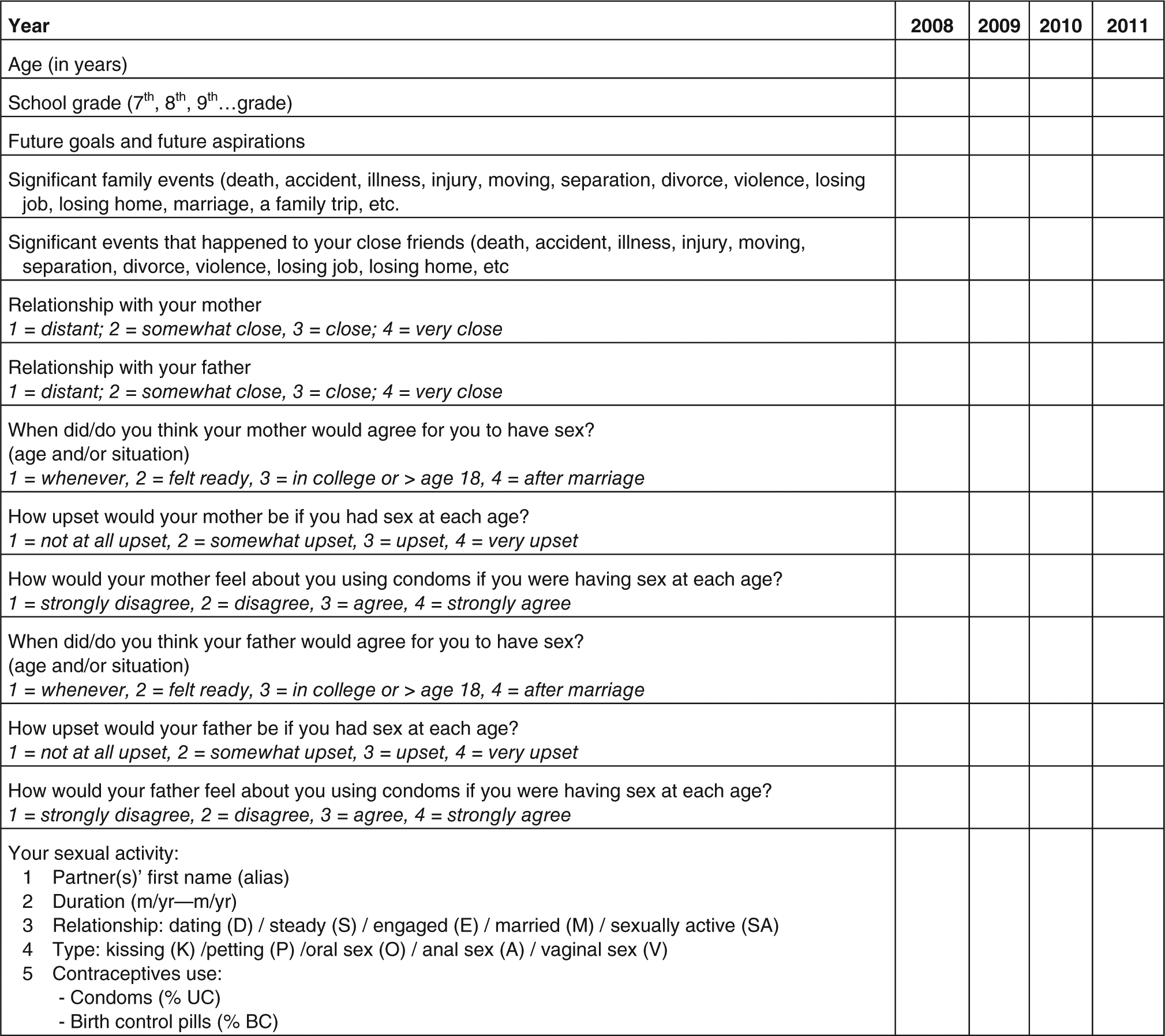
Event history calendar.
Interview Procedure
Gender-matched, face-to-face interviews were conducted with each participant. Two digital audio recorders were used to ensure accuracy of data collection. Research assistants took field notes to record initial impressions and non-verbal cues. Interviews lasted roughly 1 hr. Participants first completed the demographic sheet. Using the interview guide, interviewers explored adolescents’ parental relationships, their perceived parental sexual attitudes, and their perceptions of what their parents want for them (Figure 1, Questions 1-4). The EHC was then administered. Interviewers remained in the room, but sat at a distance to allow participants privacy. Participants were encouraged to ask questions as needed. They were reassured that the information they provided would be confidential and that aliases would be used for their names or the names of anyone they mentioned in the analysis or reporting process. During the final segment of the interview, adolescents were asked to identify and explain what they considered the most important recommendation for parents with adolescents similar to themselves (Figure 1, Question 5).
Data Analysis
To cancel out potential biases innate in any single qualitative or quantitative research design (Bryman, 2006; Johnson, Onwuegbuzie, & Turner, 2007), we used between-method triangulation to integrate findings from our qualitative and quantitative data sources (Creswell, 2007; Flick, 1992; Thurmond, 2001). In addition, we used data triangulation to capture a more complete and holistic interpretation of adolescents’ perceived parental expectations toward sexual behaviors (Sale, Lohfeld, & Brazil, 2002; Tobin & Begley, 2004).
Quantitative data
We extracted several EHC items (see Figure 1) to assess adolescents’ perceived parental attitudes toward sex, their relationship with their parents, and their sexual activities over the prior 4 years. To assess adolescents’ perceptions of their relationships with their mothers, we summarized reported maternal closeness (1 = distant, 4 = very close) over the previous 4 years to represent their overall maternal relationships. Similar procedures were applied to other EHC items to create variables representing adolescents’ perceived paternal relationships, perceived parental sexual attitudes, and various sexual activities (abstinence status, age of sexual onset, total sexual partners, and frequency of condom use). To assess within-subject differences, we obtained the mean of each variable for each group by year. We then examined and compared 4-year trends between each group and variable. In addition, bivariate correlations were performed using SPSS 19 to determine relationships among variables extracted from the EHCs (summed scores across 4 years). Two participants of mixed racial heritage (Asian and White) self-identified as Asian American and were therefore included in the Asian American group.
Qualitative data
Digital audio files were transcribed by a trained research assistant and verified by a second research assistant prior to analysis. We used inductive content analysis (Elo & Kyngäs, 2008) and constant comparative analysis (Kurasaki, 2000; Morse, Barrett, Mayan, Olson, & Spiers, 2002; Turner, 2010) to analyze the 28 interview transcripts and field notes. Guided by symbolic interactionism (Blumer, 1969), analysis focused on understanding how adolescents perceived the meaning of “parental expectations about sex” through the description of daily interactions with their parents, and how these expectations related to decisions about sexual activity. We used concepts drawn from the expectancy violation–realignment model (Collins & Luebker, 1994) to guide our understanding about the meaning and process of how adolescents perceived, violated, and realigned parental expectations about sex via daily interactions with their parents.
To create the codebook, three coders (i.e., the two research assistants and the principal investigator) annotated the text, sorted the annotation list, and labeled thematic categories. A text sample was used to establish acceptable inter-coder reliability for each codebook theme before conducting a comparative analysis. NVivo 10 software was used to facilitate the coding process and data analysis (e.g., crossing referencing). Specifically, EHC information regarding sexual debut and number of sexual partners was entered as attributes in NVivo 10 to assess the relationship between emerging themes and adolescents’ self-reported sexual behaviors. A sexually active adolescent was defined as an adolescent who had had oral, anal, or vaginal sex. A non-sexually active adolescent was defined as an adolescent who had no sexual intercourse, although they may have reported kissing or petting.
Pareicipating Adolescent Demographic Information.

Participants of White and Asian descent self-identified as Asian American and were therefore included in the Asian American group for quantitative data analysis.
Results
This mixed-methods study used gender-matched, in-depth interviews to explore how White and Asian American adolescents perceive parental expectations via parent–child interactions, and how such expectations relate to self-reported sexual activities over time.
Quantitative Results
Compared with their White counterparts, Asian American adolescents in our sample were more likely to report being sexually abstinent (Levene’s test, p = .002): 50% of Asian American adolescents (n = 7) reported being sexually abstinent, versus 14% of White adolescents (n = 2). Among sexually active adolescents, the mean age of sexual initiation was similar for both groups (Asian American: 16.25 years; White: 16.18 years). Male adolescents were more likely to be sexually experienced (p = .033) and to have more sex partners (p = .036). Of the 14 males, 11 (79%) reported being sexually active, versus 6 of the 14 females (43%). The mean age of sexual initiation was 16.5 years for females and 16 years for males. Of the 19 adolescents who were sexually active, 4 had more than four or more sexual partners (21%), 7 had two to three partners (37%), and 8 had one sexual partner (42%). Comparatively, the adolescents in our sample were less likely than those in a recent, nationally representative sample, the 2011 national Youth Risk Behavior Surveillance sample (CDC, 2012) to have used a condom during their last sexual intercourse (52% vs. 60.2%).
Results of our correlational analysis indicated that sexual abstinence, later sexual debut, and fewer sex partners were closely related to adolescent perceptions of conservative, disapproving parental attitudes (measured by the age or situation when parents might permit and/or expect sexual activity, and how upset adolescents thought their parents would be if they had had sex at each age during the prior 4 years). Table 2 presents bivariate correlations among extracted EHC variables. Adolescent perceptions of conservative parental attitudes and disapproving parental attitudes toward sex were consistent (r = .577 and .748, p < .01, respectively). In addition, we examined patterns of association among these two variables against adolescents’ self-reported sexual activities across the four time points. We noted that as the mean score of disapproving and conservative parental attitudes decreased, the mean score of reported sexual activities and number of partners increased. In particular, there was an obvious association between perceived maternal disapproving attitudes and the number of sex partners.
Bivariate Correlations Among EHC Variables.
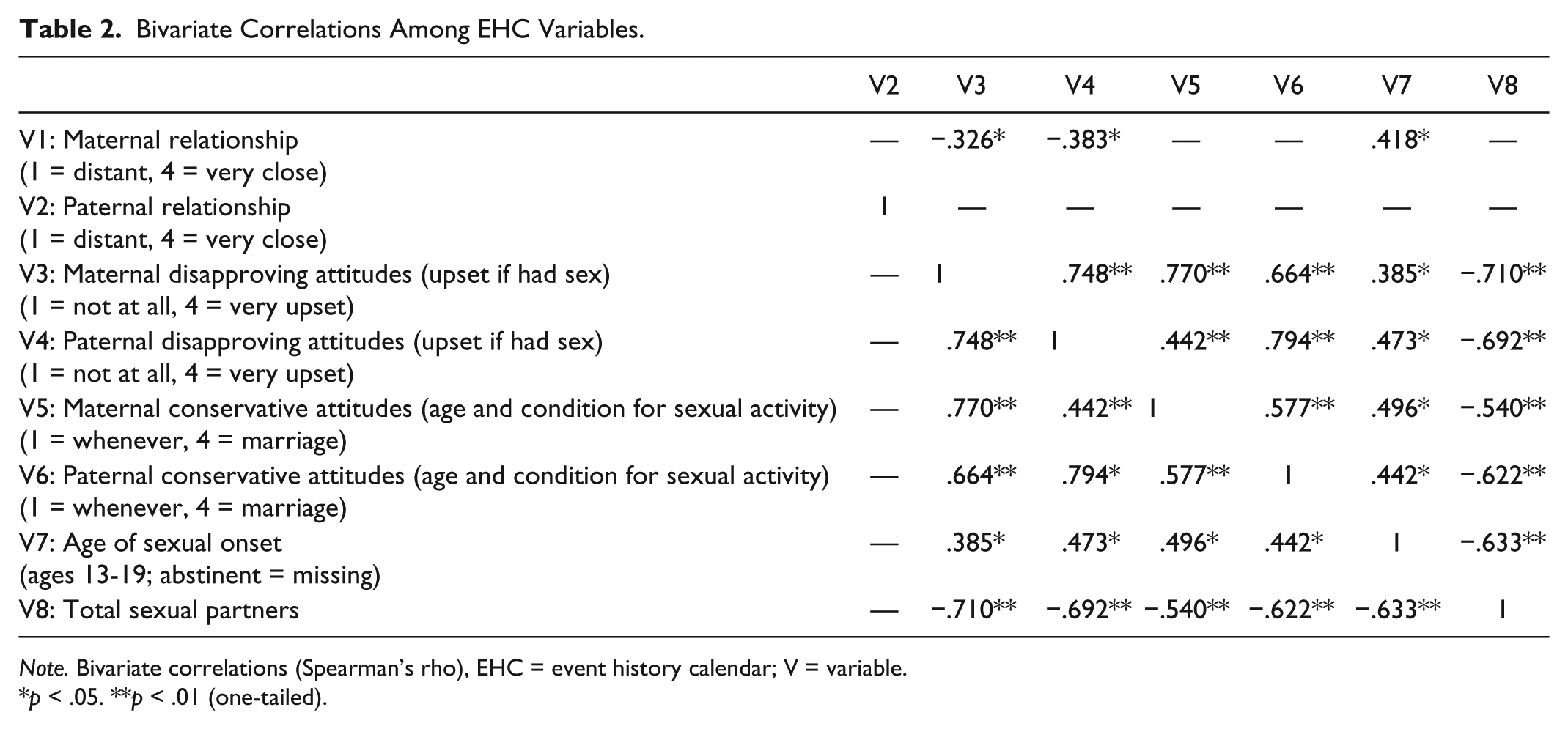
Note. Bivariate correlations (Spearman’s rho), EHC = event history calendar; V = variable.
p < .05. **p < .01 (one-tailed).
In terms of perceived parental relationships reported in the EHC, there was no significant difference between Asian and White American adolescents. There was no noticeable trend in the relationship between perceived parental relationships and reported sexual activities. In fact, closer maternal relationships were associated with less disapproving parental attitudes (mother, r = −.326; father, r = −.383) and being sexually active (r = .344). Among adolescents who were sexually active, those who perceived a closer maternal relationship reported later sexual onset (r = .418). Notably, disapproving and conservative parental attitudes were closely related. Overall, our quantitative results show that adolescent perceptions of conservative and disapproving parental attitudes/expectations were protective against early sexual onset and multiple sex partners (see Table 2).
Qualitative Results
Four themes emerged from our analysis relating to adolescents’ perceptions of their parents’ perspectives and attitudes toward sex. Specifically, this included how adolescents learned about, interpreted, and responded to their parents’ expectations.
Theme 1: Expectations are culture-specific and value-laden
Perceived parental sexual attitudes were closely associated with families’ cultural or religious beliefs. Concerns about disappointing parents, for example, were significant for both Asian American and White adolescents, although the cultural/family values that shaped parental expectations were different. Many Asian American adolescents reported parental expectations relevant to their parents’ native culture. One participant commented, “Being an Asian . . . there are more expectations of you” (Anna, age 17, Asian American female).
1
Every year Anna and her parents traveled to Taiwan, her parents’ native home, so that they could show her the “Asian ways of doing things.” Sexuality development was not a priority for her parents. Rather, they expected her to “practice violin . . . get straight A’s . . . go to Chinese school” and to avoid activities such as partying and dating. Another participant stated, There’s definitely parental expectation [to not have a romantic or sexual relationship]; you [the child] must be academically successful so you can get a good job and provide for your family, that’s definitely a good thing . . . Society sees Asians as . . . we all grow up to be accountants or engineers or doctors, like, career, but it is not the true representation of Asian Americans. (William, age 19, Asian American male)
This participant felt that the lack of accurate representation made it difficult for many Asian adolescents “to figure out a sense of identity”—that is, to cultivate their social and sexual development.
Parental expectations about sexual behavior were influenced heavily by parents’ views of culturally appropriate gender roles. A majority of participants stated that their parents would be more protective toward daughters, including stricter curfews, more rules, and increased monitoring. One participant described her father’s gender expectations: If my father got to choose the way I lived, I would never leave the house past 6 o’clock, I would never wear shorts shorter than my knees, I would never talk to a guy, I would never wear a two-piece bathing suit. He’s super conservative . . . But he is different with my brothers. (Karen, age 17, Asian American female)
Some adolescents mentioned religious belief as an important part of their families’ values, and as an influence that governed their relationships with their parents and their own sexual attitudes/behaviors. Karen linked her family’s religious affiliation to her self-identification, personality traits, and sexual attitudes/behaviors: “Like my parents, I’m Hindu . . . my religion has played a big role in pretty much everything I do.” Another participant also noted that her parents, who were Hindu, had overall expectations that were guided by their religion: “I guess they showed me more of the benefits than the cons so it [Hinduism] just, it seemed the most, like, right idea in my head and it’s always just been that way.” She explained that her behaviors were related to “the way my parents raised me.” For example, she did not wear shorts at home or in front of her father or brother. She described her father’s rules to be “No drinking, no drugs, and no dating” [and] “Before you do anything, be like, ‘What would [my religious mentor] do?’” . . . [My father] was right, and I figure, three-fourths of the rules work, I mean I’ve dated but I’ve never had alcohol, I’ve never had a cigarette, you know those are just things that I’m willing to give up for the sake of my heritage or my background. (Helen, age 19, Asian American female)
Family religious beliefs and activities also played an important role in how White adolescents perceived parental sexual expectations. One participant described his parents’ attitudes as conservative, and specifically to not have sex until marriage. He believed that this expectation derived from the ethics and morals of his family’s Baptist religion. These beliefs influenced his perceptions, attitudes, and behaviors: The first time I had sex it was so scary. I guess, it’s because of my dad’s [Christian] views on it, and . . . at a subconscious level I was disappointing my father even though it’s not like he knew it. He still doesn’t know about it. But, definitely what your parents think and tell you influences your actions whether you realize it or not, they always do. (Paul, age 18, White male)
High parental expectations were taxing on some of the adolescents. One participant felt guilty about not letting his father know about his “last two sex partners” (Ben, age 19, White male). He was unable to meet his parents’ high expectations of “no sex until marriage” and experienced role strain because of “not wanting to let down my parents and . . . my church background. It was kind of a whole guilt things . . . sometimes keeping me up at night.” Another participant discussed her reaction to her mother’s high expectation of “no sex until marriage”: I don’t want her to think any less of me, I don’t want her to know everything about my relationships, but I do let her know that I’m safe and, like, “What I’m doing hopefully you can trust me.” . . . It was so uncomfortable for me to talk to her because I was always the goody-good child in the family, and she would always say, “Oh, I always thought that you would wait until marriage to have sex.” Me, like, “Why do I have to have some expectations?” . . . so that . . . kind of hit home. (Jennifer, age 18, White female)
Cultural and religious background seemed to play an important role in when and under what conditions adolescents believed their parents would approve of them engaging in sexual activity. Three subthemes emerged in regard to parental expectations for sexual timing: abstinence until college and/or age 18, abstinence until marriage, or acceptable as long as the adolescent practiced safe sex (see Table 3). Asian American adolescents were more likely to describe their parents’ sexual attitudes as “conservative,” with the expectation that their youth abstain from sex until marriage. White adolescents were more likely to describe parental attitudes about sexual timing as acceptable “abstinence until college” or “okay as long as they are being safe.”
Subthemes of Parental Sexual Expectations: Timing and Consequences.

Note. STI = sexually transmitted infection; STD = sexually transmitted disease.
Three parental concerns about adolescent sexual activities emerged from the interviews (see Table 3). Many parents warned that having sex would limit opportunities for future success. Other adolescents reported that parents talked about unwanted consequences—specifically, contracting STIs or becoming pregnant—to steer them away from sexual activities.
Theme 2: A trusting parent–child relationship is fundamental
A close and trusting relationship factored significantly into how adolescents perceived their parents’ expectations. A close, trusting, and supportive relationship influenced how well adolescents respected their parents’ cultural beliefs, values, and sexual expectations.
I trust her. She’s not my best friend, she’s my mother. She looks out for me on a level that a best friend cannot comprehend. (Helen, age 19, Asian American female) [My father and I] trusted each other a lot more [than my mother and I]. He knew that I was smart and that I wasn’t gonna get myself into too much trouble. (Betty, age 19, White female) I’ve had a girlfriend for the past 3 years . . . And, uh . . . [my parents] would joke like, “Don’t do anything stupid. If you get her pregnant, you know, her parents will come kill us.” . . . I mean, actually, I really like how they went about, it to be honest. ‘Cause there’s a lot of trust. I guess the only risk part was if I was going to do something that I would regret later. But, I assumed that when they said “Don’t do anything stupid,” I knew what that meant and maybe once or twice they mentioned the word pregnant maybe, but it’s pretty much given. (Chris, age 19, Asian American male)
Adolescents also viewed a close and trusting parental relationship as a way to enable them to learn how to handle emotional needs in their sexuality development. One participant wished her parents would talk with her about how she would “feel” in a sexual relationship. She described sex as a form of “connection” and said that her decision to have sex was related to her need to connect emotionally with a male partner.
Being a female, we want to have that emotional connection way more than guys, and so we’re a little bit more desperate and then once we find that someone we’re a little bit more attached . . . this is gonna be very improper, but that’s the sucky part of being a girl. (Jennifer, age 18, White female)
Similarly, one participant advised other parents to “make sure that their adolescents are not emotionally torn too bad” (Ben, age 19, White male). Another participant stated, “If [parents] have an open and trusting relationship with your kids from the start, your effect on them will be a lot stronger” (Linda, age 19, White female). One 19-year-old Asian American participant, who had been sexually active since age 16, with three sexual partners, shared experiences relating to his sexuality development and observed that “I’ve always been emotionally detached as a teenager growing up” and that “having sexual relationships” seemed to be a way to “connect” with others.
Theme 3: Parents convey expectations in different ways
Adolescents learned about parents’ sexual attitudes and expectations via direct and/or non-direct communication. White adolescents tended to learn from their parents via conversation, while Asian American adolescents tended to learn from their parents via non-verbal routes. White participants were more likely to talk with their parents about personal or relational problems and feelings with their parents, and were more likely to request open communication with their parents. Open parent–child communication was essential for their ability to establish a trusting relationship with their parents: [My mother] asked me about my boyfriend, and if I got a new boyfriend she’s, like, “Are you guys having sex?” It’s a pretty straightforward answer, “Yeah.” (Grace, age 17, White female) [Parents should have an] open relationship, like being able to talk, not the awkward kind of, like, “All right here’s a book [about sex], read it, we’ll talk if you have any questions,” but, like, to be able to relate and say, like, “I’ve been in your situation before, I kinda know what you’re going through, and it’s important for me to be involved [in your sexuality development],” like, I think it’s really important that you, to have that really special bond between, like, a parent and child. (Linda, age 17, White female) I’ve always been really close with my mom and I’ve never been afraid to talk to her about anything, so I’ve always valued my relationship with my mom . . . She never tried to hide the fact that she was eighteen when she had my sister. And you know she told me about, you know it was, like, her first time and . . . it was a mistake and then she got pregnant the very first time it happened and she never she never laid sex out to me as like it was, umm, like, a really bad thing. She just kinda wanted me to be careful, to be really careful . . . Yeah, being open is for sure is the most important, but . . . I mean you wanna make sure you disciplining them, but you don’t, you also don’t wanna make them feel like they’re a bad person for doing anything. (Paul, age 18, White male)
Conversely, language could be a barrier to parental communication. Some preferred observation: I wouldn’t say that we’re, like, very close because there was, like, sort of, like, a small language barrier, because I learned English here and I grew up speaking English, whereas my mom doesn’t know any English, but, like, I can still speak Chinese, it’s just not as well as I can speak English, I’m not, like, fluent, but I’ll still be able to talk to her, but I didn’t, I never talked to her about, like, my problems or, like, what’s really going on in my life [i.e., dating or a having sexual relationship] . . . I think parents should teach [how to avoid risk] by example. (Nancy, age 18, Asian American female)
Many Asian American adolescents learned about parents’ sexual expectations via non-verbal communication, such as observing their actions and behaviors. Many noted difficulties in opening up to their parents, particularly because sex is a taboo topic in many Asian cultures. One participant speculated that his parents did not have the “sex talk” because they viewed him as a child, whereas another interpreted their avoidance of sexual topics as an attempt to keep him focused on the merits of hard work and achievement: I feel like it’s because they’re, they’re just, like, shy away from the subject and they don’t want to . . . they’re not ready yet to accept that, that I’m like, like, grown enough for it, you know, I feel like they still look at me as a child, so they feel like they shouldn’t talk about that issue, then I will eventually figure it out by myself. (Ralph, age 19, Asian American male) As vigilance, my mother and father . . . they have a restaurant and they work . . . they always worked hard a lot. So, they always . . . you know, they want me to have a better life so . . . and they always help me, the key to that, you know, have a good . . . education, uh, career . . . so they always . . . tell me to uh, do my best. (George, age 19, Asian American male)
Overall, the Asian American adolescents seemed to understand their parents’ reluctance to engage in “sex talk.” One participant stated, “I understand why my parents are both a little standoffish about the topic . . . they are not comfortable” (Donna, age 18, Asian American female). Another rationalized that avoidance was the only approach that Asian parents were familiar with: “Asian parents are just doing things that they are good [emphasis added] at [i.e., avoiding topics or situations],” including not allowing romantic or sexual relationships (Carol, age 19, Asian American female).
Some Asian adolescents mentioned that excessive parental emphasis on academic success made them feel that their parents’ care for them was “conditional.” This was different from that of their White counterparts, who were more likely to report their parents’ care as unconditional—that is, to ultimately desire their children to be happy.
Adolescents were very observant of their parents’ behavior. When there was a difference between what parents said and did, adolescents tended to ignore parental expectations and aligned with their own beliefs instead: [My father is] kind of a hypocrite . . . it’s kind of off-topic, but he smoked. I’ve been caught smoking . . . he’s just really, really judgmental with a lot of things [about my boyfriend] though. He’s hard on me a lot of the time. (Grace, age 17, White female)
Overall, parental expectations played a significant role in adolescents’ decisions about engaging in sexual activities that might jeopardize their future success. One participant recalled that her mother told her, “You know, you have so much to live for. Why ruin it now to have a baby [or sex] so young?” (Jennifer, age 18, White female). Another stated, I’m pretty much American, since I’ve lived here my whole life, and I guess my parents, they’ve had different rules than other parents. That’s one main thing I’ve noticed, like, through high school I would have a curfew. They were kinda more strict about the grades. Maybe for my whole upbringing they’ve had a higher emphasis on grades and so [abstinence has] been good for me, I guess. (Steve, age 19, Asian American male)
Generally, if adolescents felt that their parents’ expectations were acceptable, they were more likely to take them into consideration when making decisions about engaging in sexual activities. Some participants agreed with or thought that their parents’ attitudes were realistic.
I am not [sexually active] . . . I think [my parents] influenced me by having that sort of [conservative] attitude towards sexual relationships. (Carol, age 18, Asian American female) My parents do not want me to have sex right now . . . I thought that it was really good that my parents were attentive to who I was hanging out with or what I’m doing . . . this is different from some of my friends’ parents. (Lisa, age 17, White female)
While there was a consensus among adolescents that “sex takes away opportunities,” female adolescents were more likely to mention parental concerns about STIs and early pregnancy. Male adolescents were less likely to have had such conversations with their parents.
Theme 4: Parenting practices matter
Parenting styles and practices influenced how adolescents viewed parental expectations. The majority of adolescents disliked it when their parents preached or lectured, but they responded well when their parents shared personal experiences with them, and they felt closer to them after listening to their stories: Even though my [mother] made mistakes about having kids at an early age, she made sure that we knew to value . . . self-worth. (Jennifer, age 18, White female) One time I was, umm, going on a date with a guy that was a few years older than me and [my father] kinda, like, warned me about he thinks guys are only thinking about one thing . . . he knows that when how he was when he was, you know, 20 or 21 years old, so he was just telling me, like, “watch out” so I guess to me that made me think . . . how his experience is affecting how he sees mine . . . well, for like a father and a daughter, specifically . . . just you know kinda giving the guys perspective of the whole thing, so that [the daughter] understands that better. (Sandra, age 18, White female)
Other positive parenting practices included knowing an adolescent’s whereabouts, being involved in an adolescent’s decision making, and having same-gender, parent–child dyadic sexual discussion. Negative practices included being “overprotective” and “controlling.” Asian adolescents, in particular, were more likely to describe parenting styles as “controlling” and “strict,” in which parents paid the majority of attention to their children’s whereabouts and academic achievement. White participants rarely mentioned parental monitoring activities.
Participants made both positive and negative comments about “strict” parenting styles. For one adolescent, her father’s strict parenting style discouraged independent decision making: I obviously don’t have as open of a relationship [with my father] as I do with my mom . . . he’s much more strict, he’s extremely like . . . very strict. “If I say you’re coming home at 12, you’re coming home at 12,” and there’s no negotiation about that, like things are his way or I don’t get anything. (Linda, age 17, Asian American female)
Conversely, another participant interpreted parental strictness as a way to protect her from making mistakes and to ensure future success: I have to be really careful about balance [between what I want and what my parents want] . . . I can’t screw up . . . that’s why I was pressured to be pre-med. Or, like at least go into health . . . it’s because medicine is almost a guaranteed $100K+ career. My parents both know what it’s like to grow up with nothing. (Helen, age 19, Asian American female)
Some adolescents urged parents to have “realistic” expectations, while others advised parents to love and support their adolescents unconditionally.
Don’t have unrealistic views, make sure that your child knows that they can come to you with anything. It’s important for you to be there and support them. (Jennifer, age 18, White female) Give [adolescents] a lot of love every day, show them a lot of attention. (Ben, age 19, White male)
Other participants echoed the importance of spending quality time together to support and improve the parent–child relationship in general, thereby making it easier for parents to talk about important topics such as sexual activities or behavior.
If [parents] ignore it, it’s gonna be more of a problem. That’s why so many kids are pregnant these days or because the parents don’t wanna talk about it. They think if they just ignore it, it’s not gonna be a problem, well that’s not true. Just like if your kid was doing drugs, you’d wanna talk to them, you wouldn’t just ignore it. (Betty, age 19, White female) I’ve been good at holding off peer pressure, but peer pressure can be very strong so I think parents definitely need to bring it up more, no matter how awkward it is, I know we [Asians] don’t wanna talk about it, but peer pressure’s getting worse and worse and if your all your friends starting doing it, it becomes, like, ok to start doing it, so [Asian parents] definitely need to talk about it. (Karen, age 17, Asian American female)
In summary, our qualitative analysis revealed that adolescents’ decisions about sex were associated with their perceptions of parental sexual attitudes, expectations, and relationships. Adolescents appeared to experience repeated cycles of expectation violation and realignment, and eventually developed an understanding of their parents’ sexual expectations. In particular, we noted behavioral realignment in the actions of adolescents who considered the consequences of engaging in sexual activity when they felt that such behavior would disappoint their parents or violate their trust and expectations. Although this consideration may not have completely deterred these adolescents from sexual activity, they appeared to have been more likely to attempt to minimize risks or consequences associated with sexual activity, such as using birth control pills or condoms. Ultimately, they did not want to become a teenage parent or to contract STIs, which they believed would “take away future opportunities.”
Discussion
This study explored how adolescents perceive and frame their parents’ sexual expectations. Specifically, we examined how perceived parental expectations relate to the parent–child relationship and adolescents’ reported sexual activities over time. Four important themes about adolescent perceptions of parental expectations were derived from our analysis: (a) expectations are culture-specific and value-laden, (b) a trusting parent–adolescent relationship is fundamental, (c) parents convey expectations in different ways, and (d) parenting practices matter.
Congruent with the expectancy violation–realignment model (Collins & Luebker, 1994), adolescents’ sexual activities were associated with their perceptions of parental sexual expectations, and were the result of dyadic parent–child interactions. Our results indicate that adolescents’ perceived parental attitudes (or expectations) demarcated what behaviors were acceptable or unacceptable. In particular, our qualitative results indicate that if an adolescent was to mind his or her parents’ expectations, it was important for the adolescent to have a trusting and supportive parental relationship. Our qualitative and quantitative results also illustrate that disapproving and conservative parental attitudes are protective against adolescent risky sexual behaviors. This is congruent with other research findings (Dittus & Jaccard, 2000; O’Donnell et al., 2008; Weber-Shifrin, 2003), and suggests that promoting an adolescent’s perceived parental expectations may be effective for preventing risky sexual behavior.
We also note that the Asian American adolescents in our sample observed that their parents practiced the distinct parenting practice/style of focusing on and expecting a significant degree of academic success. Adolescents warned that this excessive attention might be misinterpreted as “conditional” love, resulting in a misperception that could strain the parent–child relationship. This could be problematic for adolescents who fail to meet their parents’ high expectations and experience psychological stress. Hwang and Wood (2009) have suggested that distant parent–child relationships may be related to symptoms and risks for clinical depression among Asian American adolescents. Thus, it might be important for health professionals to seek ways to strengthen the parent–child relationship. In such cases, adolescents may feel accepted and more willing to share personal problems with their parents.
Reported parental closeness, as indicated by the EHC data, was similar between White and Asian American adolescents. Our interview data demonstrate that White adolescents were less likely to report parental regulation or monitoring of their activities or whereabouts. It is not clear if the comparatively higher rate of sexual activity reported by White adolescents is related to their reports of less parental monitoring. However, it is important to note that parental monitoring has a protective effect against adolescent risky sexual behaviors (Wagner et al., 2010). We also observed that as adolescents grew older, their perceptions of disapproving parental sexual attitudes decreased while sexual activities increased. This pattern of association was most obvious among White adolescents. Overall, it seems that sexual activities were closely related to how adolescents perceived parental attitudes over time.
Enhancing positive parenting practices can strengthen the parent–adolescent relationship, particularly when the practices work to build an adolescent’s sense of parental trust and closeness. Our results indicate that adolescents tended to trust and perceive a closer relationship with their parents if parental demands and expectations were clearly explained and/or were perceived as realistic. Adolescents who perceived parental expectations to be realistic and valuable were more likely to commit to their cultural/familial values and behave accordingly. Helping parents realize their cultural/familial strengths and to shape or reframe them into realistic expectations may be a good way to promote family strengths and maximize parental influences in the positive development of healthy adolescent behaviors.
Consistency between what parents said and how they behaved was an important factor for adolescents in determining how much they would “mind,” or follow, their parents’ expectations. In general, adolescents disliked when parents “preached” or lectured, but they were very interested in learning about their parents’ experiences and perspectives. Having a parent share personal stories was a great way for adolescents to understand their parents’ perspectives, values, and beliefs. Consistent parental attitudes and modeling behaviors merged as critical to adolescents’ decision making about what behaviors were appropriate and acceptable. Adolescents were more likely to honor parental expectations about appropriate or safe behaviors if they understood and accepted the rationale behind such expectations.
Although adolescents in this study “requested” autonomy or independence from their parents, their recommendations for parents of adolescents similar to themselves included being “close” with their adolescents and being “watchful” of peer influences. Health care providers should be aware of the importance of guiding and assisting parents to build a trusting, close relationship with their children, and of establishing clear and realistic expectations.
While the Asian American adolescents in this study were less likely to report being sexually active and more likely to respect their parents’ expectations to remain abstinent, they were more likely to report difficulty communicating with their parents and to wish for greater autonomy. In this study, we observed that the sexual activities reported by these seemingly “problem-free” adolescents were not as risk-free as previously thought. Participant reports of multiple sex partners and/or engaging in unprotected sexual activities were higher than those reported in a recent, nationally representative survey of adolescent health-risk behaviors (CDC, 2012). Due to our small sample size, it is not sufficient to suggest Asian American and White adolescents as at-risk groups, but it does suggest that stereotyping them as “problem-free” may be unhelpful for promoting their sexual health development.
Limitations
This study was limited by our sample distribution, particularly as many participants were from middle- to high-income families and had parents who held a college degree. This could partly explain participants’ higher-than-normal aspirations for success, as well as their relatively later sexual onset. However, it is important to note that there is no empirical evidence to suggest that adolescents from highly educated, high-income homes engage in sexual activities at lower rates. Our sample was also limited to one geographical area, and the use of snowball sample techniques tended to draw other participants of similar backgrounds and/or socioeconomic status. Asian Americans are a heterogeneous group with many different cultural beliefs, and results should be interpreted with caution. A larger and more diverse sample could provide deeper insight into adolescent perceptions of parental expectations across socioeconomic and cultural backgrounds. Given the size and make-up of the sample, the knowledge produced may not be generalizable to other individuals or settings. Finally, face-to-face interviews provide opportunities for synchronous communication and observation, but the researcher’s presence can affect participant responses. Robust procedures were applied during data analysis, but potential researcher bias and idiosyncrasies embedded in the qualitative design could exist.
Implications
Despite the limitations of our sample, our findings have important theoretical implications for understanding and operationalizing the concept of perceived parental expectations. Knowing how White and Asian American adolescents perceive parental expectations about sex and how such expectations might be related to their sexual behaviors can help practitioners develop strategies to facilitate parent–child interactions. In addition, a thorough understanding about the effect of perceived parental expectations can be very useful in the effort to improve parent–child interactions. For example, an in-depth understanding of how adolescents perceive parental expectations may enhance the development of measures based on expectancy theory (Smith & Goldman, 1994), allowing practitioners to target factors that are significant in shaping adolescents’ perceived parental expectations. This knowledge can be used to tailor family strategies to improve parent–child interactions. Subsequently, such tailored family interventions would be more effective in enhancing parent and adolescent efficacy for healthy behaviors.
Overall, our study demonstrates that the concept of perceived parental expectations can be used to help practitioners understand how adolescents perceive and respond to parental sexual expectations. The parent–child relationship and parental attitudes play an important role in fostering such expectations. Thus, family practitioners can utilize this concept to enhance parent–child interactions and minimize adolescent risky behaviors. Further research is needed to develop an expectancy-focused family intervention to improve parent–adolescent interactions and thereby prevent risky behaviors.
Footnotes
Acknowledgements
The authors thank the participants who generously shared their experiences. We also would like to extend our appreciation to research assistants who have been involved in this project, including Vanessa Hoyos, MS, RN; Jeremy Lapham, MS, RN; and Vanesa Muratovic, BS. We also would like to recognize editorial help from Sara Versluis, MA.
Declaration of Conflicting Interests
The author(s) declared no potential conflicts of interest with respect to the research, authorship, and/or publication of this article.
Funding
The author(s) disclosed receipt of the following financial support for the research and/or authorship of this article: This study was funded by a grant awarded to the first author from the Office of the Vice President for Research Faculty at the University of Michigan.