




Abstract
This study aimed to examine motor proficiency in young children, focusing on potential gender differences. For that purpose, the Bruininks-Oseretsky Test of Motor Proficiency–Long Form (BOTMP-LF) was administered to 540 children (272 boys), 4½ to 6 years old. First, the 2 (sex) × 4 (age groups) ANOVA computed on children’s total BOTMP-LF scores showed that age had a statistically significant effect, whereas gender did not. Second, the one-way MANCOVA applied on subtest scores, with age as covariate, revealed statistical significant gender differences; however, η2 values were found to be small or moderate. Finally, the MANCOVA applied on items where significant gender differences have been reported showed a significant effect of gender. Nonetheless, η2 values exceeded the limit of practical significance only on two items (“standing on preferred leg on floor”, “throwing a ball at a target with preferred hand”) that are associated with gender-stereotyped activities. It can be concluded that (a) besides statistical significance, effect sizes should be examined for the results of a study to be adequately interpreted; (b) young boys’ and girls’ motor proficiency is similar rather than different. Gender differences in specific skills should be used for movement programs to be individualized.
Keywords
Introduction
It is now well documented that children’s participation in physical activity (PA) is associated with many aspects of health (Binkley & Specker, 2004; Iivonen, Sääkslahti, & Nissinen, 2011; Metcalf et al., 2008; Niederer et al., 2012; Vale et al., 2010; Yazejian & Peisner-Feinberg, 2009). However, recent research findings have revealed that today’s children, even the younger ones, seem to be sedentary and present low PA levels (Hinkley, Crawford, Salmon, Okely, & Hesketh, 2008; Kambas et al., 2012b; Kambas, Venetsanou, et al., 2014; Oliver, Schofield, & Kolt, 2007; Pate, Pfeiffer, Trost, Ziegler, & Dowda, 2004; Timmons, Naylor, & Pfeiffer, 2007). This evidence makes the need for the enhancement of young children’s PA apparent, if public health is to be protected.
Among the most important factors contributing to PA participation is thought to be children’s motor proficiency (Kambas et al., 2012b; Rivilis et al., 2011). Motor proficiency is determined by qualitatively different aspects of both gross and fine motor development and serves as an index of children’s motor development (Bruininks, 1978). Children that are competent movers seem to find their participation in PA and/or sports enjoyable and, in so doing, form a lifelong association with PA (Barnett et al., 2008; Stodden et al., 2008). However, those with poor movement skills appear to avoid PA (Cairney, Kwan, Hay, & Faught, 2012), therefore, hindering the development of their skills, a fact that further restricts their participation in PA. This phenomenon, known as a “vicious circle” (Zimmer, 2003), underlines the need for the timely enhancement of children’s movement skills.
Early childhood comprises an important period in a human’s life for both his or her development (Gallahue & Donnely, 2003) and the adoption of a physically active lifestyle (Timmons et al., 2012); thus, it should not remain unexploited. Even the smallest movement difficulties a child might have should be identified, so that adequate intervention be implemented and the “vicious circle” be avoided. Moreover, developmentally appropriate movement programs should be implemented for young children to become competent movers.
If children’s optimal motor proficiency is to be achieved and movement programs are to be planned on the individual needs of each child, the first step for teachers is to be aware of factors affecting motor development and resulting in performance differences. Potential differences among age groups, as well as possible gender differences, are among the first to be examined (Goodway & Branta, 2003). Regarding age, numerous studies have shown that motor proficiency develops with age (Castetbon & Andreyeva, 2012; Chow, Hsu, Henderson, Barnett, & Lo, 2006; Fjørtoft, 2000; Kambas et al., 2012a; Livesey, Coleman, & Piek, 2007; Venetsanou, Kambas, Aggeloussis, Fatouros, & Taxildaris, 2009).
However, controversy exists concerning the occurrence and the importance which should be attached to gender differences in young children. In a large volume of studies examining a total battery score (Durmazlar, Ozturk, Ural, Karaagaoglou, & Anlar, 1998; Giagazoglou et al., 2011; Kambas, Aggeloussis, Proviadaki, Taxildaris, & Mavromatis, 2002; Kambas et al., 2012a; Pollatou, Karadimou, & Gerodimos, 2005; van Rossum & Vermeer, 1990), a composite score (Chambers & Sugden, 2002; Goodway, Robinson, & Crowe, 2010; Hardy, King, Farrell, Macniven, & Howlett, 2010; Ittenbach & Harrison, 1990), or individual item scores (Butterfeld, Lehnhard, & Coladarci, 2002; Fjørtoft, 2000; Waelvelde, Peersman, Lenoir, Smits Engelsman, & Henderson, 2008), both boys’ and girls’ performance has been found to be quite similar.
Nevertheless, in a number of studies, motor proficiency gender differences have been reported. To start with, significant differences favoring girls were found in studies providing a total battery score (Charlop & Atwell, 1980; Sigmundsson & Rostoft, 2003) and a composite battery score (Sigmundsson & Rostoft, 2003; Silva & Ross, 1980), and in skills like hopping (Castetbon & Andreyeva, 2012; du Toit & Pienaar, 2002), skipping (Ulrich & Ulrich, 1985), posting coins (Chow et al., 2006), threading beads, drawing trail (Chow, Henderson, & Barnett, 2001; Chow et al., 2006; Sigmundsson & Rostoft, 2003), or tasks involving balance (Castetbon & Andreyeva, 2012; Fjørtoft, 2000; Lam, Ip, Lui, & Koong, 2003; Lejarraga et al., 2002; Morris, Williams, Atwater, & Wilmore, 1982) and flexibility (Bala, 2003; Table 1).
Tasks Frequently Reported as Having Statistically Significant Gender Differences.

Studies reporting effect sizes.
On the contrary, boys have been found to attain higher scores than girls in catching (Loovis & Butterfield, 1993; Morris et al., 1982; Toriola & Igbokwe, 1986), throwing (du Toit & Pienaar, 2002; Lam et al., 2003; Oja & Jurimäe, 1997), striking (Ulrich & Ulrich, 1985), standing long jump (Bala, 2003; Castetbon & Andreyeva, 2012; du Toit & Pienaar, 2002; Oja & Jurimäe, 1997), kicking (Al-Haroun, 1988; Ulrich & Ulrich, 1985), and short dashes (Bala, 2003; Lam et al., 2003; Morris et al., 1982; Toriola & Igbokwe, 1986; Table 1).
As was stated earlier in this article, early childhood is an ideal period for motor development (Gallahue & Ozmun, 1998), and a major role of the educational research findings is to help educators to plan and implement developmentally appropriate programs that will correspond to the individual needs of each student. However, research findings about boys’ and girls’ motor proficiency confuse rather than help educators. It is obvious that further research is needed to examine whether gender differences of young children’s motor proficiency exist. Thus, the purpose of the present study was to examine motor proficiency in young children aged 4 to 6 years, focusing on possible gender differences.
Method
Participants
A total of 540 children (272 boys and 268 girls), 4½ to 6 years old (M = 61.8 months, SD = 5.4), from 22 schools located in five of the 13 Greek geographic regions, participated in the study. Among them, 177 were 54- to 59-month-old (86 boys and 91 girls) with a mean age of 54.63 months (SD = 1.3 months), 183 were 60- to 65-month-old (92 boys and 91 girls) with a mean age of 62.23 months (SD = 1.6 months), and 180 were 66- to 71-month-old (94 boys and 86 girls) with a mean age of 67.77 months (SD = 0.9 months).
The method of stratified sampling was used to select the participants from a number of randomly selected public schools, using sex as the selection variable. Children having been identified as having motor, sensory, or neurological problems were not included in the sample. All the participants were required to bring a consent form written and signed by their parents prior to their participation in the study. Twenty-five of the initial sample (n = 265) did not bring the consent form and they were not measured with the Bruininks-Oseretsky Test of Motor Proficiency (BOTMP; response rate = 95.6%).
Measures
The Long Form of the BOTMP (BOTMP-LF; Bruininks, 1978) was used for the motor assessment of children. The BOTMP (Bruininks, 1978) is among the most popular instruments used to assess motor proficiency (Burton & Miller, 1998; Crawford, Wilson, & Dewey, 2001). The BOTMP-LF includes 46 gross and fine motor tasks, divided into eight subtests (Table 2), and provides “a comprehensive index of motor proficiency as well as separate measures of both gross and fine motor skills” (Bruininks, 1978, p. 11).
Subtests and Items of BOTMP-LF.

Note. BOTMP-LF = Bruininks-Oseretsky Test of Motor Proficiency–Long Form.
The technical adequacy of the BOTMP-LF is supported by (a) strong correlations (.57-.86) among age and subtests scores, (b) adequate internal consistency, (c) differentiation among the scores of groups with different characteristics (normally developed children, children with learning difficulties, and children with mild, moderate, and severe mental retardation), and (d) adequate test–retest reliability (intraclass correlation [ICC] = .89 for young children and .86 for older ones; Bruininks, 1978). Regarding the psychometric properties of the BOTMP-LF in the Greek population, there is evidence supporting its construct validity and internal consistency. Specifically, in Proviadaki’s (2004) study, age was found to significantly differentiate the performance of children aged 4 to 8 years on the 46 items of the battery, and 44 of the 46 items of the battery were significantly correlated with the total score. Moreover, Cronbach’s alpha was found to be .89. Finally, both the BOTMP-LF and its balance subtest have been used in several studies conducted in Greece (Proviadaki, 2004; Venetsanou & Kambas, 2011; Venetsanou, Kambas, Aggeloussis, Serbezis, & Taxildaris, 2007).
A child’s performance on the BOTMP-LF can be scored in various ways. Raw scores (number of dots made, number of beads threaded, seconds needed to complete a task, etc.) are recorded on the test’s evaluation form and are converted into numerical point scores. The point scores of each subtest are added to provide the subtest point score that can be converted to a standard score, according to the test norms. The sum of subtests standard scores gives the gross, fine, and total battery composites. Apart from the above, percentile ranks, z scores, T-scores, stanines, or age equivalents can be computed for the composites. According to Bruininks (1978), a battery composite of 42 or less represents “low motor proficiency,” between 43 and 57 “average,” and above 58 “high motor proficiency.” For the purposes of this study, the total battery composite score, the subtests standard scores, and the raw scores of selected items were used.
Procedure
Participants were individually assessed with the BOTMP-LF by the first author, who is an experienced examiner of the BOTMP. For the administration of the test, we used the Greek translation of the English guidelines and evaluation forms from the study of Proviadaki (2004), as not only have they been checked for their precision and reliability (Proviadaki, 2004) but have been utilized in other published researches conducted in Greece as well (Venetsanou & Kambas, 2011; Venetsanou et al., 2007).
Statistical Analyses
First, a 2 (sex) × 4 (age groups) ANOVA was performed on the total battery scores. Post hoc comparisons were carried out with the Bonferroni test (α set at .05). Then a one-way (gender) MANCOVA, with age category as covariate and the standard scores of the eight subtests as the dependent variables, was applied.
Finally, an attempt was made to shed light on the tasks where significant gender differences are most frequently reported in the literature. Those tasks are speed run, standing long jump, throwing, catching, balance on one leg, threading beads, and drawing trail (Table 1).
The BOTMP has items that are very close to the aforementioned tasks. Those are running speed, standing on preferred leg on floor, standing long jump, throwing a ball at a target, catching a tossed ball with both hands, stringing beads with preferred hand, and drawing a line through a curved path. A one-way (gender) MANCOVA was carried out with age category as covariate and the raw scores (with the aim of producing more unadulterated information) of the above items as dependent variables.
In addition to p values, effect sizes as measured by η2 values were utilized for data interpretation, following Cohen’s (1988) guidelines (η2 of ≥.14 is considered sufficiently large to be of any importance).
Results
Descriptive statistics of participants’ scores revealed that 135 children (25% of the total sample) had a battery composite score of 42 or less, corresponding to a “low motor proficiency” level; 308 children (57%) had a score between 43 and 57, corresponding to an “average motor proficiency” level; and 97 children (18%) had a score of 58 or higher, corresponding to a “high motor proficiency” level.
According to the ANOVA’s results, there were no gender differences, F(1, 534)= 0.69, p = .688. Boys’ scores (M = 47.73, SD = 10.47) were similar to those of girls (M = 47.03, SD = 8.27; Table 3). Furthermore, age was found to significantly affect children’s total BOTMP score, F(1, 534)= 17.146, p < .001, η2 = .20. The Bonferroni test showed that children of each age category had statistically significant higher scores than their younger counterparts.
Means and Standard Deviations for Total BOTMP Scores by Gender and Age Group.

Note. BOTMP = Bruininks-Oseretsky Test of Motor Proficiency.
The MANCOVA that was applied to the subtests scores revealed a significant gender effect (Pillai’s trace = 13.98, p < .001, η2 = .46), while age was found to be a significant covariate (Pillai’s trace = 13.70, p < .001, η2 = .45). When the eight subtest standard scores were examined individually, gender was found to have a significant effect on all of them (Table 4). Specifically, boys surpassed girls in running speed and agility, strength, upper-limb coordination, and response speed, while girls had higher scores than boys in balance, bilateral coordination, visual-motor control, and upper-limb speed and dexterity. However, η2 did not exceed the recommended value of .14.
Means, Standard Deviations, F Ratios, and η2 Values for Subtest Scores by Gender.
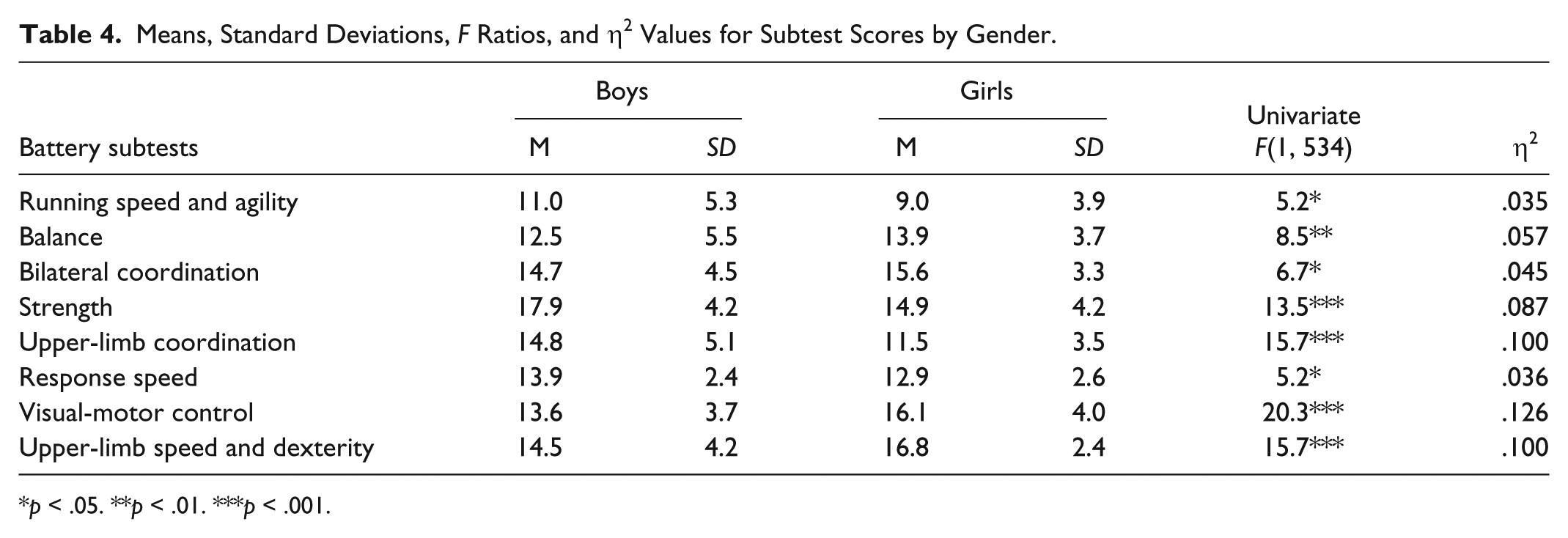
p < .05. **p < .01. ***p < .001.
Finally, the MANCOVA applied on the seven selected items of the BOTMP revealed a significant gender effect (Pillai’s trace = 35.139, p < .001, η2 = .65). When the seven item scores were examined individually, gender was found to significantly affect six of them (Table 5). Specifically, boys had higher scores than girls in “standing broad jump,” “catching a tossed ball with both hands,” “throwing a ball at a target,” and “drawing a line through a curved path,” whereas girls had higher scores in “standing on preferred leg on floor” and “stringing beads with preferred hand.” However, in only two items (“standing on preferred leg on floor” and “throwing a ball at a target with preferred hand”) did η2 exceed the value of .14.
Means, Standard Deviations, F Ratios, and η2 Values for Selected Item Raw Scores by Gender.

Note. BOTMP = Bruininks-Oseretsky Test of Motor Proficiency.
p < .01. ***p < .001.
Discussion
The aim of the present study was to investigate 4- to 6-year-old children’s motor proficiency, focusing on possible gender differences. Descriptive statistics showed that 25% of the tested children had “low motor proficiency,” 57% had “average motor proficiency,” and 18% had “high motor proficiency”. The percentage of children with low motor proficiency in the current study is slightly above that of BOTMP standardization sample (23%; Bruininks, 1978), but well below the percentage (35%) found in the study of Venetsanou et al. (2007) in which Greek children of the age of 5 participated. At this point, it should be noted that the above categorization of children’s performance must be interpreted with caution, because the suitability of the original BOTMP norms for Greek population has yet to be examined. In the knowledge that the standardization of an assessment instrument must be reassessed even if a single boundary is crossed (Miyahara et al., 1998), applying the norms of a test to other populations is not without risk (Chow et al., 2006); thus, we present the aforementioned categories with reservation, merely attempting to offer a rough outline of Greek children’s motor proficiency. Agreeing with Venetsanou et al. (2007), we believe that a low score on a motor assessment tool by itself is not adequate evidence for a child to be characterized as having motor impairment. These children should be referred for further and more comprehensive assessments for a diagnosis to be carried out. However, it is apparent that they deserve plenty of opportunities to access developmentally appropriate movement programs to overcome, or at least to minimize, their motor development delays.
The ANOVA that was applied to the total battery scores showed a significant effect of age category leading us to conclude that the level of motor proficiency was different among those age groups. In addition, children of both genders had similar total battery scores, a finding in close agreement with several previous studies (Aponte, French, & Sherrill, 1990; Durmazlar et al., 1998; Kambas et al., 2002; Pollatou et al., 2005; Silva & Ross, 1980; van Rossum & Vermeer, 1990). However, other researchers have found that girls had significantly higher total battery scores than boys (Charlop & Atwell, 1980; Sigmundsson & Rostoft, 2003).
Taking into account that a total battery score may “mask” potential gender differences in specific aspects of motor proficiency, the children’s performance on the eight BOTMP subtests were examined. According to the results, boys had statistically higher scores than girls in running speed and agility, strength, upper-limb coordination, and response speed subtests, while girls outperformed boys in balance, bilateral coordination, visual-motor control, and upper-limb speed and dexterity. However, values of η2 did not reach Cohen’s (1988) limit of practical significance (η2 = .14), thus revealing that there was not a strong relationship between the independent variable and the depended ones (Gliner, Morgan, Leech, & Harmon, 2001). Among the few researchers having examined subtest scores in young children, some report a similar performance of boys and girls (Chambers & Sugden, 2002; Giagazoglou et al., 2011; Ittenbach & Harrison, 1990; Venetsanou & Kambas, 2011), while some others have found girls’ superiority in subtests regarding balance (Sigmundsson & Rostoft, 2003), leg coordination (Silva & Ross, 1980), and manual dexterity (Sigmundsson & Rostoft, 2003).
Finally, an attempt was made to investigate specific skills that are most often reported as showing gender differences (Table 1). According to the results, girls outperformed boys on “standing on preferred leg on floor,” “drawing a line through a curved path,” and “stringing beads with preferred hand,” whereas boys had statistically significant higher scores on “standing broad jump,” “catching a tossed ball with both hands,” and “throwing a ball at a target.” As Table 1 shows, a large number of articles report statistically significant performance differences between young boys and girls in the aforementioned tasks. For that reason, some researchers support the notion that separate motor performance norms for each gender should be established, even for children in early childhood (du Toit & Pienaar, 2002; Livesey et al., 2007; Saraiva, Rodrigues, Cordovil, & Barreiros, 2013).
However, before agreeing—or not—with that opinion, a closer look at the results of the studies of Table 1 reporting gender differences would be productive. The majority of the researchers (with the exception of Chow et al., 2006; Livesey et al., 2007; Venetsanou & Kambas, 2011) based their conclusions on the statistical significance of their results, while they do not report effect sizes. Nevertheless, the effect size of the interest factor provides useful information about its influence on dependent variables (Gliner et al., 2001), and it should be taken into account to adequately interpret the results of a study. In the present study, only on two items (“standing on preferred leg on floor” and “throwing a ball at a target with preferred hand”) did η2 exceed the value of .14, thus illustrating that gender differences on most of the tasks were not of practical significance. If our statistical analyses had been restricted to the statistical significance alone, we would have come to different conclusions. Consequently, doubts arise about how “real” the gender differences found in studies not reporting effect sizes actually are.
Nonetheless, the superiority of boys on “throwing a ball at a target” and that of girls on “standing on preferred leg on floor” have to be discussed. It is known that prior to puberty, boys’ and girls’ physical characteristics are similar except some small differences in body composition, length of upper limbs, and strength (Malina, Bouchard, & Bar-Or, 2004). Thus, in agreement with several authors (Thomas, 2000; Thomas & French, 1985, 1987; Ulrich & Ulrich, 1985), we believe that the factors causing gender motor proficiency differences in early childhood should be investigated in the cultural context rather than that of biological factors.
The strong influence of the cultural context on children’s motor development is to be expected in societies where totally different anticipated roles for the two sexes are formed in the first years of their lives. In Middle Eastern cultures, for example, the role of the female and her appropriate motor behavior are rigidly defined, limiting girls’ opportunities to develop movement skills considered masculine (e.g., kicking; Al-Haroun, 1988), while in Hong Kong, boys are more physically active than girls due to the Chinese tradition, according to which girls are encouraged to participate in sedentary activities, such as playing piano, crayoning, and so on, while boys are motivated to engage in vigorous activities (du Toit & Pienaar, 2002). In a cultural context like those described above, both genders, forced into their stereotyped gender roles, avoid specific activities and miss out on the opportunity of practicing a variety of motor skills. In several studies conducted in such societies, the performance differences found were attributed to the rigid gender stereotypes (Al-Haroun, 1988; du Toit & Pienaar, 2002; Louie & Chan, 2003; Pahlevanian & Ahmadizadeh, 2014).
However, our results have interesting implications for young Greek children’s motor behavior. Children’s rearing practices in Greece follow the Western patterns and there are not rigidly anticipated gender roles. Nevertheless, it seems that even in “modern” societies, boys and girls tend to participate in gender-stereotyped activities (Hardy et al., 2010; Pellegrini, Blatchford, & Kato, 2004). As several researchers (McKenzie et al., 2002; Vandaele, Cools, de Decker, & de Martelaer, 2011) have noted, boys play more ball games, consequently developing the skills of throwing and catching, while girls are engaged in activities like dancing or gymnastics involving balancing and hopping. At this point, it is interesting to report Goodway and colleagues’ (2010) observation, according to which, preschool boys were more familiar than girls with both the vocabulary and the equipment used for the examination of object control tasks in their study, a fact indicating boys’ prior experience that possibly influenced results. The differences in the kind of games young boys and girls participate will inevitably result in both of them having a lack of skill practice, leading to negative results on skills development. Taking into consideration that studies in primary schoolchildren have revealed that object control skills are more crucial than locomotor ones for PA participation in adolescence (Barnett et al., 2009), it can be assumed that girls’ poor object control performance may be a risk factor for their long-term PA.
This study has some limitations that should be discussed. To begin with, only Greek children participated; therefore, our results cannot be generalized to other populations. In addition, the BOTMP-LF (Bruininks, 1978) that was used in order that children’s motor proficiency be assessed is a product-oriented tool; thus, it failed to provide any information about how each task was performed. Further information regarding the movement process followed by examinees and correlated to a specific performance outcome would be valuable, especially for children with poor product scores. A future research using both a product- and a process-oriented tool could provide a comprehensive picture of young children’s motor proficiency.
Moreover, the old version of the BOTMP-LF was administered instead of the new one (Bruininks & Bruininks, 2005). The reason for that choice was that there is no evidence about the validity of the BOTMP-2 Long Form on the Greek population. Only the BOTMP-2 Short Form has been used in Greece (Logkizidou et al., 2012). We, however, preferred to use the Long Form, even in its previous version, to have a more detailed assessment of children’s motor proficiency.
Notwithstanding its limitations, this article provides valuable information about young children’s motor proficiency and useful conclusions can be drawn. First, when comparisons among different groups are to be made, apart from statistical significance, effect sizes should be examined so that the results can be interpreted adequately. Second, it seems that in early childhood, boys’ and girls’ motor proficiency can be characterized as similar rather than different. Gender differences in specific movement skills seem to stem from participation in gender-stereotyped activities; thus, they should be used as valuable information about the aspects of motor proficiency that should be enhanced and not merely exist as a social label that may affect teachers’, parents’, and/or physical educators’ expectations of boys and girls.
Both genders need practice opportunities, adequate equipment, available space, and proper feedback for their movement skills to be developed (Goodway & Branta, 2003). School settings can play a vital role in that direction, offering structured opportunities for children’s motor proficiency enhancement. Investments in projects including (a) the assessment of young children’s motor proficiency, (b) the inclusion of developmentally appropriate movement programs in the daily school schedule, (c) the training of both physical educators and preschool educators in planning and implementing adequate motor activities as well as opportunities for PA, (d) educating parents to support their children’s motor development and to encourage their participation in PA seem to be the only way forward, if the physical health and activity of the future citizens of our world is to be safeguarded.
Footnotes
Declaration of Conflicting Interests
The author(s) declared no potential conflicts of interest with respect to the research, authorship, and/or publication of this article.
Funding
The author(s) received no financial support for the research and/or authorship of this article.