




Abstract
Human resource development is one of the major goals of Brunei’s current development plan to be achieved under Wawasan 2035 policy. The University of Brunei Darussalam’s foundation program aims to increase students’ access to higher education among disadvantaged and underrepresented groups. The present field survey investigated how the coping strategies and help-seeking behaviors of 146 (103 females and 43 males) Brunei foundation students would assist. Participants from government secondary schools scored significantly higher on the productive coping and reference to others coping styles than peers from private schools. Main effective predictors of achievement included productive coping, referencing to others, and using resources (library, Internet, peers, lecturers, and self-efficacy). Two-way interactions of the male gender with the library, Internet, lecturers, peers, and self-efficacy would help improve men’s achievement. The interaction of Internet and nonproductive coping also predicted achievement. Interventions for vulnerable and at-risk students were recommended to increase the success rate.
Introduction, Background, and Setting
Since obtaining political independence from Britain in 1984, the Government of the Sultanate of Brunei Darussalam has endeavored to provide quality education to all eligible students irrespective of their gender, religion, or disability to ensure that nobody is left behind (see Ministry of Education, 1997, 1998). The curriculum has also been reformed to ensure that 21st-century skills are imparted (Ministry of Education, 2007). The need for high-quality teaching ultimately led to the reformation of teacher education (Mundia, 2012). Despite all these reforms, however, a number of students who complete the General Certificate of Education Ordinary Level, GCE “O” Level (Year 11), General Certificate of Education Advanced Subsidiary Level, GCE “AS” Level (Year 12), and General Certificate of Education Advanced Level, GCE “A” Level (Year 13) were still unable to access higher education due to failing the terminal examinations. Such students are often redirected to vocational and technical education (VTE) institutions to learn practical trade skills that could be used for gainful employment or self-employment purposes (see Mundia & Salleh, 2017). Other academically less successful students voluntarily opt to leave the school system and enter the workforce. The majority of these school leavers join the uniformed services (e.g., the military, police force, and security companies). Still, others join the public and private sectors, and perform jobs that do not require high education (e.g., working for supermarkets, hotels, and restaurants, and as clerks in government departments).
Gender Gap in Brunei Higher Education Institutions
In the past, many factors such as traditional gender roles and cultural preferences for males in most societies created and perpetuated a gender gap in students’ school achievement (Metussin, 2015). Now that educational opportunities were widely available and unrestricted by traditional gender orientations in developed countries such as the United States, males tend to have more academic problems than females (Legewie & Diprete, 2008), with females obtaining better grades at school (Buchmann, DiPrete, & McDaniel, 2008). Research has, further, found that parents’ education and socioeconomic status were strongly associated with students’ academic achievement (Sirin, 2005; Wenglinsky, 1998). Metussin’s (2015) study examined the potential factors that caused a gender gap to admissions in Brunei institutions of higher learning. The issues investigated in this study (which involved GCE “A” Level preuniversity students) included achievement in mathematics and English language (as dependent variables [DVs]) versus learning styles, study strategies, self-efficacy, coping styles, and personality (as independent variables [IVs]). Mathematics and English language were subjects commonly used as admission criteria in Brunei institutions of higher learning. Females scored significantly higher than males on both mathematics and English language tests (Metussin, 2015). High achievers in mathematics (mostly females) used task-oriented coping strategy, read textbooks, and prepared well before examinations (Metussin, 2015). In terms of personality, high math achieving females were found to be assertive, analytical, intellectual, extroverted, resilient, and caring (Metussin, 2015). In addition to being analytical, resilient, caring, and intellectual, high scorers on the English language test (also mainly females) used deep processing when reading and studying the subject (Metussin, 2015).
Foundation Program as an Inclusive Alternative Pathway to Higher Education in Brunei
Some high school students who fail marginally for various reasons such as disability and learning difficulties enter tertiary university education by enrolling initially in a foundation program. The fast-track foundation course (also commonly referred to as the university bridging or UniBridge program) is a one-semester full-time course that offers students who do not meet the admission criteria or requirements (particularly English and mathematics) an alternative entry route to the university’s diploma and bachelor degrees. It is an intensive half-year foundation program that requires students to be active in their academic work. The program is a major shift in inclusive higher education policy initiative, in that it provides a bridge or stepping stone between senior high school (Year 13) and university (first year) for would-be school drop-outs. This inclusive educational policy response was intended to address three national problems or concerns: First, the inclusive policy and UniBridge program were partly intended to narrow the gender gap at the University of Brunei Darussalam (UBD) where females far outnumber their male counterparts due mainly to males not meeting the English and mathematics admission criteria. Second, the policy and program increased the equality of opportunity for education and training in the country, and optimized Brunei’s human resource development for future workforce in both the public and private sectors. Third, besides students with disabilities and learning difficulties, the UniBridge program admits other eligible categories of learners with high support needs such as mature-age persons and people with behavioral or chronic health problems. Students are required to take four modules and accumulate 16 modular credits. The program is comprised of three core modules and one optional module. The optional module determines the student’s intended degree specialization program. Participating students are encouraged to take up more than one optional module to broaden their academic choices. Upon successful completion of the program and subject to fulfilling the requirements of faculties, students are able to apply for admission into the relevant diploma or bachelor degree programs of the university. Because of its critical short duration and intensive nature, some students fail the program and once again miss the elusive opportunity for higher education. Although the program has been in operation for many years, no formal empirical research has been conducted to determine some of the factors that lead to failing, and recommend how vulnerable and at-risk students may be assisted.
Research on Coping and Help Seeking in Brunei Educational Contexts
With implementation of the ongoing intensive foundation program at UBD, finding ways of helping students to cope effectively has become a priority of the university. People address distress in a variety of ways, including seeking help and using coping strategies (Mundia, Shahrill, Jaidin, Jawawi, & Mahadi, 2016). Usually, people initially try to cope with the stress before they resort to seeking help. To this end, several research instruments have been devised that measure a wide range of coping styles such as the Ways of Coping Questionnaire (WCQ; Lazarus & Folkman, 1984, 1988), the Coping Inventory for Stressful Situations (CISS; Endler & Parker, 1990), and the Adolescent Coping Scale (ACS; Frydenberg & Lewis, 1993). Seeking help appears to occur mainly when people were unable to resolve their stress, but not all stressed persons seek help (Mundia, Shahrill, Jaidin, Jawawi, & Mahadi, 2016). Atkinson and Gim (1989) defined seeking professional help as an attempt to reach out for assistance from people with special skills. The literature describes two types of seeking help, informal and formal (Rickwood, Deane, Wilson, & Ciarrochi, 2005). Informal sources of help include family members and friends, whereas formal sources refer to mental health professionals (Rickwood et al., 2005). Of these two sources, the formal sources were associated with both perceived public stigma and self-stigma, and often avoided by people with psychological or mental health problems (Corrigan, 2004). Women’s perceived public stigma scores were higher than men’s scores according to Ina and Morita (2015). On the contrary, other studies found that men were likely to experience more public stigma and self-stigma than females because they internalized these issues (Hackler, Vogel, & Wade, 2010; Komiya, Good, & Sherrod, 2000; Topkaya, 2014). People suffering from mental health problems are among the most stigmatized, discriminated, marginalized, disadvantaged, and vulnerable members of the society (Johnstone, 2001). Most differences in seeking help were based along gender lines due to emphasis on masculinity and femininity inclinations and cultural attitudes to mental health. Previous research found that males were the most resistant to seeking help (Komiya et al., 2000; Lindinger-Sternart, 2014). In addition, males who were engaged in sports or armed forces occupations identified themselves to a higher level with the norms of masculinity and toughness, and often failed to recognize the benefits of seeking professional help from mental health specialists such as counselors, psychologists, and psychiatrists (Mundia, Shahrill et al., 2016; Steinfeldt & Steinfeldt, 2012). However, females were, in general, more likely to seek help from mental health professionals than males (Çebi, 2009; Sahin & Uyar, 2011; Vogel, Wade, & Hackler, 2007). In Japan, however, the studies by Kimura and Mizuno (2008) and Ina and Morita (2015) revealed no significant differences between males and females in their attitudes toward seeking professional psychological help. These findings raised a possibility that the inconsistencies with other previous studies might be due to cultural differences.
Theoretical Framework of the Study
The conceptual framework of the present study is based on Brunei’s current and ongoing development plan. Brunei’s 10th National Development Plan has six main strategic development goals known as thrusts, namely (a) developing an educated and highly skilled population, (b) ensuring a high quality of life for people, (c) creating a conducive business environment, (d) generating a productive and progressive economy based on knowledge and innovation, (e) promoting good governance and government modernization, and (f) maintaining a high-quality and sustainable development infrastructure (Department of Economic Planning and Development, 2012). This plan includes a vision and mission statement of what the country intends to achieve by 2035, called Wawasan 2035. To achieve the first goal of the development plan under Wawasan (Vision and Mission) 2035, Brunei Darussalam aims at (a) investing in early childhood education; (b) adopting international best practices in teaching and learning; (c) providing high standards of secondary and tertiary education, including vocational schools, which will produce experts, professionals, and technicians required in commerce and industry; and (d) strengthening competency in information-communications technology (ICT) among students, teachers, and educational administrators, including the integration of ICT in the school curriculum (Department of Economic Planning and Development, 2012). The foundation program at UBD is part and parcel of these pathway efforts.
Objectives of the Study
There are many broad and diverse factors that can affect positively or negatively an educational program such as the UniBridge. However, most of these issues (such as the budget; quantity and quality of academic staff teaching the program’s modules; learning resources; and effectiveness of the program) were outside and beyond the scope of the present study. The main goal of the current study was to find out the contributions of gender, coping, and help-seeking behaviors to students’ academic achievement on the UniBridge program. Previous research (Mundia, Shahrill et al., 2016) indicated that trainee teachers at UBD achieved good results when they used certain coping and help-seeking strategies well. Although Shahrill and Mundia (2014) and Mundia, Shahrill et al. (2016) discussed numerous ways of measuring coping and help-seeking behaviors in the Australian and Brunei higher education contexts, respectively, not much similar research has been done at the preuniversity level in Brunei. In short, the present study aimed at identifying, if any, the predictors of success on the UniBridge program from the demographic variables, sources of help, and coping styles investigated. Specifically, the study investigated the following issues: (a) coping style differences by gender; (b) coping style differences by type of secondary school attended; (c) preferred sources of help by gender and type of secondary school attended; (d) extent and direction to which demographic variables, help seeking, and coping styles predict achievement; and (e) identify what was most useful in enabling program participants to achieve good results. Coping and help-seeking behaviors that were most helpful to males were sought in the present study, and this is what differentiated the current study from previous investigations. Altogether, these are the factors that could be included and emphasized in any educational, counseling, and psychological interventions for UniBridge students with high support needs.
Method
In carrying out the investigation, we followed the steps described separately below under Sections “Design” to “Data Analysis.”
Design
The field survey strategy was used, and allowed us to directly administer the instruments to participants, including assisting respondents in completing the questionnaires correctly. These actions could not be done if we had used other survey methods (e.g., postal, online, and telephone surveys).
Participants
Instead of using a formula (e.g., Chand, Upadhyay, & Maskey, 2012; Yamane, 1967) to determine the sample size, we employed the table of population numbers matched with appropriate samples (see Krejcie & Morgan, 1970). The instrument was distributed to all 157 students registered in the UniBridge program during the semester and academic year in which the study was conducted. Only 146 (93%) returned the completed questionnaires. Of the 146 participants, 103 (70.5%) were females and 115 (78.8%) attended government secondary schools, while the rest came from private schools. A sample of 146 from a population of 157 was considered by the researchers to be adequate and representative to generalize the findings to the parent population according to sample size tables of Krejcie and Morgan (1970). Although age data were not collected, all the participants had just completed senior high school (Year 13) and were in the late adolescent stage.
Instruments
We used the 79-item ACS (Frydenberg & Lewis, 1993) to measure coping. Items on this paper-and-pencil self-report instrument make up three subscales: Productive Coping, PC; Reference to Others, RO; and Nonproductive Coping, NP. Each statement or item is rated on 5-point Likert-type scales: (1) doesn’t apply or don’t do it, (2) used very little, (3) used sometimes, (4) used often, and (5) used a great deal. Information regarding the quality and suitability of these scales in the present study is given in Table 1.
Subscale Descriptive Statistics and Reliability (N = 146).
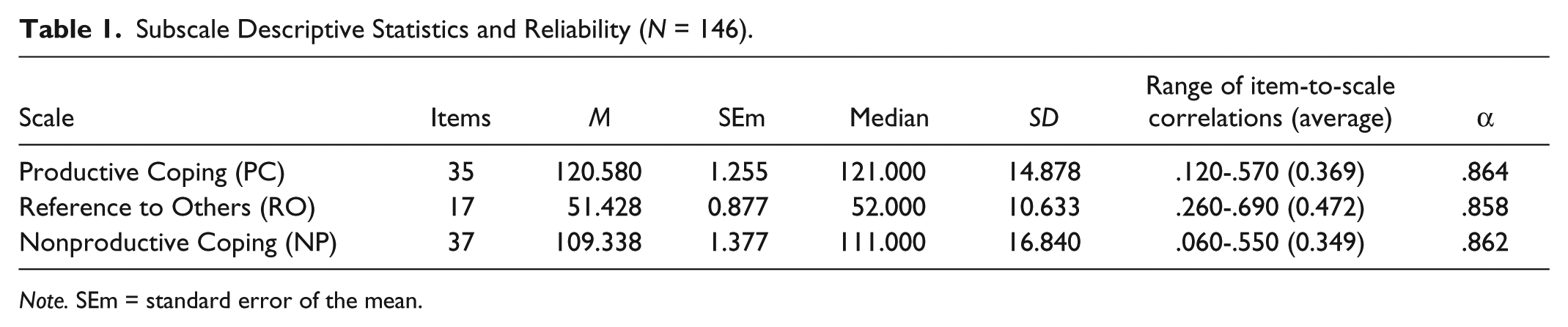
Note. SEm = standard error of the mean.
We also assessed the degree to which the scales discriminated or diverged from each other. In so doing, we obtained three low positive but significant interscale correlations (N = 146): .397, p < .01 (between PC and RO); .255, p < .01 (PC and NP); and .167, p < .05 (RO and NP). These low correlations provided quantitative evidence that (a) the ACS scale was not unidimensional, and the items were not homogeneous; (b) the three subscales were measures of conceptually different and distinct psychological constructs; and (c) the entire ACS instrument had satisfactory criterion-related discrimination validity.
Attached to the ACS instrument was the researchers’ own constructed structured self-report demographic questionnaire that collected the participants’ personal background information such as gender, type of secondary school attended, funding agency, help-seeking strategies during the one-semester foundation course, and achievement in the form of the grade point average (GPA) score obtained at the end of the semester. GPA scores were self-reported by the participants. The GPAs at UBD are standardized weighted mean scores computed by the same formula across all the faculties, and can therefore be used to compare students’ performance directly. Noftle and Robins (2007) and Reevy (2011) also used GPA as a measure of students’ academic achievement. The eight sources of help included in the help-seeking categorical variable were the University Counseling Centre, Students’ Representative Council, prayers, library, Internet, lecturers, peers, and the Self. The rationale and justification for including and investigating these sources of help in the present study were based on previous research which showed that some of these help sources were helpful to Brunei university students (see Mundia, Shahrill et al., 2016).
Procedures
Written consent to participate in the study was obtained from all the participants. In addition, the students’ GPA scores were self-reported and strictly kept confidential. Furthermore, all the data were analyzed at the group level to mask and conceal the identity of participating students. Descriptive statistics of the GPA scores (mean, median, and standard deviation) are not reported in the study to protect the identity of the participants.
Data Analysis
Upon analyzing the raw quantitative data, we used SPSS Version 22 to perform a wide range of analyses such as descriptive statistics, t tests for independent groups, hierarchical multiple regression analysis, binary logistic regression analysis, and analysis of interaction variables using the generalized linear model (GLM). The presence of statistical significance was denoted by p = .050.
Results
The results of this study are not compared with previous cohort trends in Brunei due to lack of similar past research and data based on the same variables as investigated in the current study. The findings are briefly explained below according to the objectives of the study stated above.
Differences in Coping Strategies by Gender
Females and males did not differ significantly on all the three coping variables (see Table 2). Both genders scored quite high and used all the three coping styles. The effect sizes regarding the gender differences on these variables were small and negligible.
Coping Style Differences by Gender (N = 146).

Note. ES = effect size; ns = not significant.
Differences in Coping Strategies by Type of Secondary School Attended
Students from government secondary schools scored significantly higher on two coping subscales (Productive and Reference) than those from private schools, but the differences were associated with low and nonexciting effect sizes (see Table 3). No significant difference was obtained on the Nonproductive Coping scale, but both groups scored high on this dysfunctional coping style, suggesting that the two categories of students needed assistance to improve their coping skills. As productive coping and reference to others were better and effective ways of coping, the findings implied that participants from private secondary schools needed more help to improve their coping skills than peers from government schools.
Coping Style Differences by Type of Secondary School Attended (N = 143).

Note. ES = effect size; ns = not significant.
p < .05 (two tailed). **p < .01 (two tailed).
Sources of Help Preferred by Gender and Secondary School Attended
Of the eight possible sources of help provided to participants to endorse, two (University Counseling Centre and the Students’ Representative Council) were not selected by both genders from two types of schools. We therefore dropped these variables from subsequent analyses and excluded them in Table 4. The University (UBD) also has a Centre for Students with Diverse Needs which was not included in the present study, but probably this too was possibly underused. There were a small number of students in the present study (all females from both types of schools) who used religion/prayers for divine intervention to solve their problems. Prayer appears to be helpful in controlling emotional distress, but this notion or claim was not measured in the present study. Only a few students indicated that they depended on the Self or self-efficacy to solve their problems. This too was dropped out from further analysis. The majority of the participants of both genders and from both types of secondary schools obtained help from the library, Internet sources, lecturers, and peers. However, the differences in cell frequencies were insignificant. The best and most popular sources of help were peers followed by Internet and the library. Chi-square and phi coefficients were not computed due to the presence of many cells with small frequencies less than 5 in magnitude.
Preferred Sources of Help by Gender and Type of Secondary School Attended (N = 146).

Relationship of Demographic Variables, Help-Seeking Behaviors, and Coping Styles to Achievement by Hierarchical Multiple Regression Analysis
The first required output from the hierarchical multiple regression analysis with backward elimination is presented in Table 5 showing the changes that occurred to the Model F, R2, R square change and F change statistics after adjusting and dropping out the unneeded variable(s). Only the first and last models are shown in Table 5 for brevity, data reduction, and space conservation reasons. The DV was GPA achievement scores. The ΔF was only significant in Model 1.
Model F, R2, R Square Change and F Change Statistics (N = 146).
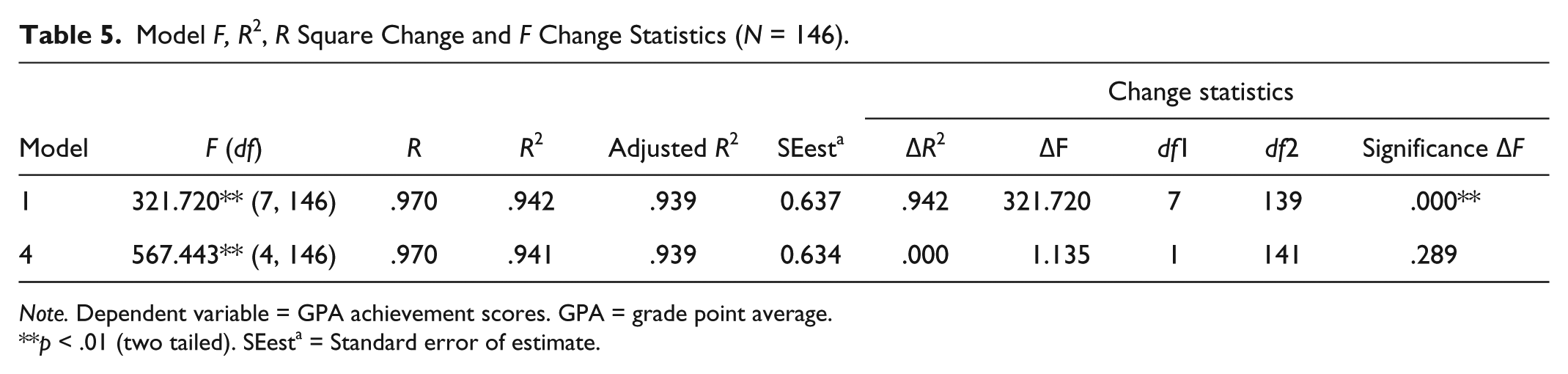
Note. Dependent variable = GPA achievement scores. GPA = grade point average.
p < .01 (two tailed). SEesta = Standard error of estimate.
The second required output of the hierarchical multiple regression analysis is presented in Table 6. Again only Step 1 and Step 4 are shown for the same reasons given in connection with Table 5. According to Table 6, the suitable IVs in the present Brunei study were gender, help seeking, productive coping, and reference to others. Both Model 1 and Model 4 accounted for 94% of the common variance between the IVs and the DV (see Table 5 above).
Relationship of Demographic Variables, Help Seeking, and Coping Styles to Achievement by Hierarchical Multiple Regression Analysis With Backward Elimination (N = 146).

Note. Dependent variable = GPA achievement scores. GPA = grade point average.
p < .05 (two tailed). **p < .01 (two tailed). SEesta = Standard error of estimate.
Relationship of Demographic Variables, Help-Seeking Behaviors, and Coping Styles to Achievement by Binary Logistic Regression Analysis
In Table 6, we could not specifically tell which gender and sources of help were significantly related to academic achievement as these variables were dichotomous and multicategorical, respectively. To determine this, we performed the binary logistic regression analysis with backward elimination which required a binary DV and categorical IVs. In the present study, our DV (GPA achievement scores) was dichotomized at the median value to obtain two categories of scores—high and low GPAs. High and low GPA scores were coded 1 and 0, respectively. For ethical reasons explained above under the section on procedures, the descriptive statistics (mean, mode, and median) pertaining to the sample’s GPA data are deliberately not reported in this article to hide the identity of the participants. Similarly, we also dichotomized the three coping variables (productive, reference, and nonproductive) at the median score as indicated in Table 1 to obtain two categories—high and low scorers. On the dichotomized coping variables, low scorers were coded 0, whereas high scorers were coded 1. In this way, all our IVs and DV were categorical and suitably formatted for logistic regression analysis. The rationale and justification for dichotomizing these variables (IVs and DV) and performing logistic analyses were based on previous research, which showed that high and low scorers in Brunei samples behaved differently (see Mundia, Matzin, Mahalle, Hamid, & Osman, 2016, 2017). The findings of the binary logistic regression analysis are presented in Table 7.
Relationship of Demographic Variables, Sources of Help, and Coping Styles to GPA Achievement Scores by Binary Logistic Regression Analysis With Backward Elimination (N = 146).

Note. Dependent variable = GPA achievement scores. GPA = grade point average; AOR = adjusted odds ratio; CI = confidence interval.
Step 1: R squares = . 097 (Cox & Snell), .130 (Nagelkerke); Hosmer and Lemeshow χ2 (df = 7) = 15.165, p = .143. Step 7: R squares = .019 (Cox & Snell), .026 (Nagelkerke); Hosmer and Lemeshow χ2 (df = 0) = .000, p = 0.
Last or comparison group for help sources = Self (myself/self-efficacy, coded 6, n = 8).
p < .05 (two tailed).
Although underspecified, Step 7 (last model) contained the only best and statistically significant categorical predictor of achievement that had the lowest standard error after adjusting for nondesirable variables. The most suitable categorical IV and best predictor of achievement was the male gender (see Table 7, Step 7). The whole binary logistic model accounted for about 10% to 13% of the common variance between the IVs and DV in the first step, and approximately 2% to 3% in the last step after adjusting and dropping the unnecessary terms. The model was also acceptable and fitted the data as illustrated by the nonsignificant χ2 fit indices at the bottom of Table 7. Compared with females (reference group, coded 0, n = 103), the males (coded 1, n = 43) were far less likely to obtain good academic achievement, B = −0.523, p < .05; adjusted odds ratio (AOR) = 0.593, 95% confidence interval (CI) = [0.319, 1.100]. In Table 6, the help-seeking variable was initially found and reported to be a significant predictor of achievement (B = 0.084, p < .01). After breaking down help seeking into its six separate individual parts or components coded 1 to 6 in a binary logistic regression analysis, the statistical significance disappeared (see Table 7). This finding suggested that the six categories of the help-seeking variable had a strong joint or collective effect on achievement rather than large separate influences. Nevertheless, important trends or patterns emerged from the five distinct sources of help presented in Table 7 that are worth noting and explaining. For example, participants who used prayers/religion (a form of multicultural counseling, coded 1, n = 6) to control and address their emotional distress were 3 times more likely to succeed and achieve good academic results (B = 1.132, p > .05; AOR = 3.101, 95% CI = [0.462, 20.797]) compared with counterparts who relied on the Self or self-efficacy (last or reference group, coded 6, n = 8) despite the regression coefficient being statistically insignificant. Similarly, participants who consulted Internet sources (coded 3, n = 37) had higher likelihood of achieving academically (B = 0.942, p > .05; AOR = 2.566, 95% CI = [0.848, 7.763]) than their peers who largely depended on the Self (comparison group coded 6, n = 8). Learners who worked collaboratively with peers (e.g., via group work, cooperative learning, peer tutoring, or peer assessment practices; coded 5, n = 48) to resolve academic problems were associated with having higher odds ratios for performing well (B = 0.926, p > .05; AOR = 2.524, 95% CI = [0.864, 7.378]) than those who focused on the Self (reference group coded 6, n = 8). High scorers on the productive coping variable (coded 1, n = 76) who confront head on the academic problems were 1.5 times more likely to do well on the UniBridge program (B = 0.433, p > .05; AOR = 1.542, 95% CI = [0.668, 3.563]) than the low scoring counterparts who did not confront the issues (reference group, coded 0, n = 70).
High scorers on the Reference to Others scale (coded 1, n = 74) were far less likely to obtain good academic results (B = −0.798, p > .05; AOR = 0.450, 95% CI = [0.196, 1.032]) than low scorers (reference group, coded 0, n = 72). Although seeking help is reasonable and logical, this finding emphasized the importance of making good individual efforts or developing high self-efficacy in academic work situations where assessments tend to be individualized. Interestingly and important to note was the finding that high scorers on the Nonproductive Coping scale who used dysfunctional coping mechanisms (coded 1, n = 76) had poor likelihood for success (B = −0.047, p > .05; AOR = 0.954, 95% CI = [0.470, 1.933]) compared with low scorers (reference group, coded 0, n = 70) who employed relatively less ineffective coping strategies. This finding demonstrated the need to teach vulnerable and at-risk students the effective and most viable coping techniques.
Sources of Help and Coping Styles That Worked Best With Each and Both Genders
In Table 7, we noted two major points: First, we observed that most of the variables investigated were not significantly related to academic achievement, although they projected a pattern or trend to that effect. Second, we saw that gender was the only significant and most important predictor of success on the UniBridge program according to the present study. The absence of significant main effects and the central role of gender necessitated the need to identify specific interaction effects that were predictive of achievement and helpful to both genders, particularly males who were the most vulnerable and at-risk students. In addition, we chose and emphasized gender interactions because of the gross underrepresentation of males and the dominant presence of females in Brunei high institutions of learning (see Metussin, 2015). To achieve this, we examined the viability of several low-order interactions (two combined variables at a time) and higher order interactions (three or more combined factors at a time) that we regressed on GPA achievement scores using the GLM. All the higher order interaction effects were statistically insignificant and unsuitable predictors. However, we obtained 12 interaction effects altogether that were significantly related to GPA achievement scores as indicated in Table 8. The five interaction variables that were found to be helpful in enabling struggling male participants with high support needs to achieve good results required men to make full use of the library resources, Internet sources, lecturer consultations, peer tutoring activities, and self-efficacy (see Table 8). The same five interaction factors were also equally useful and helpful to females with high support needs as shown in Table 8. The other two interaction factors with positive and helpful joint effects in facilitating academic achievement were Internet and productive coping as well as Internet and nonproductive coping. This finding has identified Internet as the single most helpful resource to both genders using either productive coping strategies or nonproductive coping mechanisms. The increasing importance of Internet may be attributed to the wide availability and easy accessibility of this facility in university computer laboratories, university libraries, home computers, and in mobile or hand phones. In addition, more and more different electronic formats of information are being added to the Internet for free use. For example, the online information in mobile phones can be accessed, and used at any time and place with Wi-Fi facility. We chose and emphasized gender interactions because of the overwhelming underrepresentation of males and the disproportionately high number of females in Brunei tertiary institutions (see Metussin, 2015).
Useful Joint Interactions Between Gender, Sources of Help and Coping Styles With GPA Achievement Scores (N = 146).

Note. Dependent variable = GPA achievement scores. GPA = grade point average; CI = confidence interval.
p < .05 (two tailed). **p < .01 (two tailed).
Discussion, Implications, and Recommendations
The major results from the present study are briefly discussed below according to the objectives of the investigation. Due to lack of previous similar research in Brunei, it was only possible to make references to past studies from elsewhere.
Coping Style Differences by Gender
The current study focused on the plight of UBD foundation students who could not access university education due to not meeting the university’s admission criteria as a result of obtaining low GPA achievement scores. The male gender in the present study predicted GPA achievement scores significantly but negatively, implying that many men were less likely to secure a study place in the university compared with women. This finding concurred with Metussin’s (2015) study which revealed that there were more female than male students at UBD. The main cause of this gender inequality in Brunei was that females at high school level were academically performing better than males in two UBD admission criteria subjects, mathematics and English language (Metussin, 2015). In general, females were outperforming males in other countries as well in various school subjects (Buchmann et al., 2008; Legewie & Diprete, 2008). No significant gender differences in coping mechanisms were obtained in this study. However, according to the ACS technical manual (Frydenberg & Lewis, 1993) productive coping was the best and most effective coping method that students should ideally be using. As coping strategies are alterable and teachable, we recommend that all UniBridge students at UBD be trained the skills of using the productive coping strategy, and be encouraged to increase the frequency and quality of its usage. The training could be given via practical workshops by counselors and psychologists or lecturers as part of educational interventions. Students who do not know the most practical and realistic ways to solve their problems often resort to using the nonproductive coping techniques. Because these are dysfunctional procedures for addressing problems, attention, efforts, and priority should be directed at reducing their use. Through the provision of pastoral care services, counselors, psychologists, and academics at UBD have a big challenge to help students develop and acquire salient coping skills. Problems regarding the use of nonproductive coping strategies were also found in different categories of Brunei university students by previous studies (Mundia, Shahrill et al., 2016); Shahrill & Mundia, 2014).
Coping Style Differences by Type of Secondary School Attended
In the present study, students who formerly attended government secondary schools scored significantly higher on the productive coping and reference to others variables than those who went to private and international schools. As the scale’s name suggests, the variable “reference to others” in the ACS instrument refers to help seeking. Previous related studies in Brunei identified peers and lecturers as the principal avenues for students’ help (Mundia, Shahrill et al., 2016; Shahrill & Mundia, 2014). Between these two main sources of help, peers were the most preferred in the present Brunei study. The university (UBD) might wish to consider facilitating student collaborations to help students with high support needs. Students who have learning difficulties or challenges as a result of possessing a disability and other barriers (inhibiting factors) should be accorded support well before they come to UBD foundation program. Prevention and early intervention efforts at lower levels of education would be more effective than secondary and tertiary interventions (late initiatives at the university level).
Preferred Sources of Help by Gender and Type of Secondary School Attended
Most of the participants of both genders and types of secondary schools used the library, Internet sources, lecturers, and peers for help. A few students (all females) in the present study sought help from religion or prayers as a means of solving their problems. This is neither new nor strange. In previous studies, students were also found turning to religion and prayers for solutions to their problems (see Mundia, Shahrill et al., 2016; Shahrill & Mundia, 2014). Because of the important role of religion in helping people to address their emotional and spiritual problems, UBD encourages Muslim students, who are the majority, to pray in designated prayer rooms within the university and in the university mosque. Students from other religions should also be encouraged to use religion to help address their emotional concerns related to learning.
One unexpected and surprising finding of the present study (which was also a source of concern for the researchers) was none use of the University Counseling Centre by UniBridge students. In the absence of an interview component, this result was difficult to explain. However, several plausible explanations may be offered for this unforeseen result. As the UniBridge program runs for only 6 months (one semester), it is quite possible that the participants were unaware of the Counseling facility. The students’ orientation program should include a talk about and visitation to the Center to familiarize and sensitize new students about the benefits of using its services. Interview research should be carried out to determine the reasons why students avoided using the Center. Other issues to be looked into could include qualifications and experience of the Center staff, resources available, as well as the quality of services provided. Students may also have avoided the Center for fear of labeling and stigma associated with visiting the Center for help. Research showed that both perceived public stigma and self-stigma played a role in preventing people with psychological or mental health problems from seeking professional help (Corrigan, 2004). Although females’ perceived public stigma scores were reported to be higher than those for males, the latter seem to experience more public stigma and self-stigma (Hackler et al., 2010; Ina & Morita, 2015; Komiya et al., 2000; Topkaya, 2014). In general, people suffering from mental health problems were among the most stigmatized (Johnstone, 2001).
Overview, Recommendations, and Conclusion
Gender, two coping strategies (productive coping and reference to others), and three sources of help (Internet, lecturers, and peers) were identified as the major factors with the highest potential to improve students’ academic achievement in the current UniBridge study. In addition, the study identified the specific factors that were predictors of achievement for both genders. Altogether, the identified predictors of achievement need to be incorporated into the relevant educational, counseling, and psychotherapy interventions to benefit students with high support needs. The goal of all these interventions would be to help achieve the present policies of UBD, which include (a) increasing students’ access and intake, (b) increasing access to males and retention of males in the university, (c) improving learning and study skills among foundation students to reduce the drop-out rate and wastage, and (d) improving the quality of teaching in all the university programs collectively known as the “Next Generation programs” (commonly referred to as the GenNEXT programs). The success of UBD’s GenNEXT programs will partly depend on the success of the university’s fast-track foundation program (UniBridge) which brings many new students admitted into various faculties and programs each academic year (particularly disadvantaged and underrepresented groups such as males, mature-age persons, and people with special or high support needs). Overall, evidence from the present study suggests that coping and help seeking could improve students’ academic achievement in a variety of ways. Further mixed-methods research is required to explore and elaborate qualitatively the findings from the present study.
Limitations of the Study
This study had three limitations: The main limitation was that it lacked qualitative inputs to complement findings from the quantitative survey. In addition, the small-to-moderate sample size was another constraint that inhibited the generalization of the findings to subsequent cohorts at UBD. Furthermore, a cross-sectional design would have been preferable to the field survey to determine if the findings were repetitive and recurrent from one cohort to another. However, the study’s findings have practical significance, and may be useful to other universities elsewhere that run short intensive foundation programs to boost admission numbers of vulnerable and at-risk students.
Highlights of the Study
We investigated the coping strategies and help sources used by foundation students at UBD.
Task-oriented and reference to others were significant and best coping predictors of academic achievement.
Collaborating with peers, using Internet sources, and consulting lecturers had high odds ratios for performing well.
Interaction variables helpful to both male and female students were identified.
Students did not make use of the University Counseling Centre possibly for fear of labeling and stigma associated with visiting a mental health facility.
Footnotes
Author Contributions
LM: study conception; developed the demographic and help-seeking instruments; data analysis; statistical interpretations; literature review; drafting the article; doing all revisions; checking spellings and grammar. MS: supplied the coping instrument; collected data. Each author sighted and approved the final version of the manuscript prior to submitting it to the journal.
Declaration of Conflicting Interests
The author(s) declared no potential conflicts of interest with respect to the research, authorship, and/or publication of this article.
Funding
The author(s) received no financial support for the research, authorship, and/or publication of this article.
Ethics Approval
Each respondent gave both a verbal consent and written agreement for participating in the study.