




Abstract
Personalization of the user interface (UI) to certain individuals’ characteristics is crucial for ensuring satisfaction with the service. Unfortunately, the attention in most UI personalization methods have been shifted from being behavioral-personalization to self-personalization. Practically, we explored the potential of linking users’ personality dimensions with their design preferences to shape the design of an interface. It is assumed that such design may effectively promote users’ satisfaction with the service. A total of 87 participants were used to design the UI for certain personality types, and 50 students were used to evaluate their satisfaction with the UI. The results that UI designed based on the users’ personality characteristics helped to stimulate their satisfaction in a mobile learning context. This study offers a new way for customizing the design of the interface based on the correlational link between individuals’ preferences and the structure of personality characteristics.
Introduction
User experience (UX) encompasses the concepts of usability and affective engineering. It broadly explains major interaction aspects between a user and a product such as interface. Thus, to have better interface experience, several methods have been proposed, and individuals’ personality characteristics is one of those proposed methods. Users’ personality features can be a strategic advantage for the design of adaptive and personalized user interfaces (UIs; Al-Samarraie, Eldenfria, & Dawoud, 2017; de Oliveira, Karatzoglou, Concejero Cerezo, Armenta Lopez de Vicuña, & Oliver, 2011). This can be formed clearly in interface design elements such as the color element, and previous studies such as Marcus and Gould (2000); Brazier, Deakin, Cooke, Russell, and Jones (2001); and Reinecke and Bernstein (2013) highlighted the significant role of the color in the interface. In contrast, many studies have been conducted to clarify general theories that characterizes its psychological impact (Al-Samarraie, Sarsam, Alzahrani, Alalwan, & Masood, 2016; Karsvall, 2002), in which personality has been linked with technology in several various manners (Svendsen, Johnsen, Almås-Sørensen, & Vittersø, 2013). Precisely, from the personality perspectives, users’ differences in personality dimensions may results in certain preferences and tendencies to adopt particular habits or pattern when learning (Butt & Phillips, 2008). Nunes, Cerri, and Blanc (2008) noted that the designers of an interface are leveraging users’ personality in the design of interactive environments for the aim of improving the interaction factors between users and environment. Thus, we explored the association between personality profile and mobile user interface design elements (MUIDEs) to provide an effective experience for learners.
Previous studies also showed how classical concept of usability (Rudy, 1997) has been extended to involve user satisfaction in certain context. This is because satisfaction with a service or technology in general can be obtained through tailoring the objects that an individual prefers to use. A study by Oliveira, Cherubini, and Oliver (2013) addressed the importance of studying users’ different personalities for promoting user satisfaction with mobile phone services. This is because individual differences have a considerable impact on user’s overall feelings (Ziemkiewicz et al., 2011). This led us to say that understanding how to provide a better UI in a mobile context can help to increase our satisfaction in a way that objects of presentation are configured to reflect certain usage behavior (mental model; Sun & May, 2013). Lan, Jianjun, and Qizhi (2013) have pointed out that personalized interface design is commonly associated with user-cantered design to which it provides user a distinctive visual satisfaction and interaction. Later, studies like Viveros, Rubio, and Ceballos’ (2014) have asserted that users’ personality and cognitive abilities could influence the way user perceive the design of activity in mobile applications. From this, we assumed that the personality of a person can play a significant role in his or her learning experience with mobile applications. Moreover, satisfaction is the aggregate of individual’s feelings or behavior to the issues that inspire a certain circumstance (Liaw & Huang, 2013). When browsing information, it is important to understand the process involved in designing the interface to accommodate the cognitive demands while performing such task. This would help to attract users’ attention and get them involved in the task (Bose, Singhai, Patankar, & Kumar, 2016).
Prior study in human–computer interaction (HCI) considered the use of the psychology in the design of UI; hence, personalization research of UI design was established under various frameworks like adaptive UI, user modeling, and intelligent UIs. Maybury and Wahlster (1998) defined such adaptive UIs as “human-machine interfaces that aim to improve the efficiency, effectiveness and naturalness of human-machine interaction by representing, reasoning and acting on models of the user, domain, task, discourse and media (e.g., graphics, natural language, gesture)” (p. 3). However, in spite of this significant role of psychology in building the design of the technologies, an evidence from the literature (like Zhou & Lu, 2011) pointed out that the effects of personality traits have seldom been examined. Moreover, according to Agarwal and Prasad’s (1999) personality differences, which were previously ignored. This forms clear understanding of personality differences is necessary as various personalities are expected to interact differently with design of UI and this can be due to different personal factors such as motivation. Arazy, Nov, and Kumar (2015) stated that UI personalization methods have been divorced from psychological theories of personality, and the user profiles derived from the exited personalization approaches may not be related to the personality traits tested in the prior work of psychology. Nevertheless, current design of information visualization systems are still applying one-standard-design format to accommodate perceptual needs of all users without considering their different demands (Steichen, Carenini, & Conati, 2013). This would negatively affect how learners interact with the display. Therefore, we designed in this study a UI based on users’ personality types in a mobile learning context.
Assessment of Personality and Design Preferences
Addressing user preferences is a fundamental issue in developing successful learning applications (Chen, Conner, & Yannou, 2015). According to Kujala, Roto, Väänänen-Vainio-Mattila, Karapanos, and Sinnelä (2011), the purpose of UX is to produce a general positive utility experience to the user, usage simplicity and pleasure that can be obtained through active interaction with the display, which produces the satisfaction level of utility. Hence, creating a positive experience becomes necessary demand in retaining a competitive edge (Djamasbi et al., 2014), especially in the design of mobile UI.
On the contrary, UX with the device or service may vary from one application to another. UI design preferences can exist in the design of mobile phone UI and websites. From the literature designing UI of mobile devices, it can be observed that, having a particular design format may influence one’s experience based on their familiarity with the displayed objects. For instance, Welch and Kim (2013) found that increasing the size of menu elements results in a significant increase in user’s performance. However, in terms of designing web page, the behavior of the users can be changed specially that some users practiced to see web objects such as search, home button, and navigation at particular location in the web page (Roth, Schmutz, Pauwels, Bargas-Avila, & Opwis, 2010; Roth, Tuch, Mekler, Bargas-Avila, & Opwis, 2013) after exploring object placement on different types of websites (online shops, online newspapers, and company web pages). Researchers found that placing web objects at expected locations and designing their display according to user expectations facilitates orientation that is useful experience for first impressions and the overall UX as well. Meanwhile, de Barros, Leitão, and Ribeiro (2014) asserted the potential of different types of navigations (Panorama or Panorama along with Pivot controls, and home screen menu) in regulating UX. They recommend the idea of displaying all the application’s main functionalities on the start screen to offer more control of the screen contents.
Method
The process of incorporating the personality features of individuals into the design of an interface was fully explained in the work of Sarsam and Al-Samarraie (2018).
Participants
A total of 87 undergraduate students (37 male, and 50 female) were used to shape the design of the UI for certain personality characteristics. They were screened in the initial phase to ensure that they have an acceptable level of experience and familiarity with mobile applications. Their ages ranged between 18 and 23 years old.
Design Features
The design phases of UI are represented in Figure 1, where we firstly assessed learners’ personality characteristics to identify the design preferences for each personality type. The Big Five model of personality developed by Goldberg (1981) and Norman (1963) was used to build the main dimensions for articulating one’s personality (McCrae & Costa, 1985, 1987); these were Neuroticism, Extraversion, Openness, Agreeableness, and Conscientiousness. The IPIP-NEO (International Personality Item Pool Representation of the NEO PI-R™) designed by Goldberg (1999) was used in this study to examine the association between different personality related traits of a person. It is commonly termed as the “Big Five” which consists of extraversion, agreeableness, conscientiousness, neuroticism, and openness to experience. The IPIP-NEO scale includes 120-items, and its items can be found at http://www.personal.psu.edu/~j5j/IPIP/ipipneo120.htm. Learners were asked to provide their name, sex, age, and country before start answering the personality questions. Items of this instrument were designed to ensure covering different personal aspects where a 5-point Likert-type scale was used (very inaccurate, moderately inaccurate, neither accurate nor inaccurate, moderately accurate, and very accurate).

UI design phases.
Then, we administrated the second instrument to help us gain further insights about learners’ preferences of certain MUIDEs. The MUIDE instrument consists of multiscale questions with graphs (see Supplementary). It was based on a 10-point Likert-type scale (low preference to high preference). The main MUIDEs were as follows:
Information structure: It refers to the organization of the data. It consists of linear structure, hierarchical structure, network structure, and matrix structure.
Navigation: It refers to the process of controlling the movement from one page to another. In this study, six types of navigations were considered, such as drill down navigation, list navigation, segmented control, stepping, scroll thumb, and slidable top navigation.
Layout: It refers to the arrangement of the interface components. Linear layout, relative layout, and web view layout were used in this study.
Font style: It refers to the properties applied to change the appearance of the text. We used the commonly used font styles of Arial, Times New Roman, Georgia, and Verdana.
Font size: It refers to the size of the text. Four font sizes were provided (40, 51, 53, and 75 points).
Buttons: It refers to the action script for performing an action. In this study, three types of buttons were used, such as buttons with name, button with image, and button with name and image.
Color: Different types of color schemes were used. The selection of colors was in accordance to hue, saturation, and brightness.
List: It refers to the way of listing items on a page. It helps to divide complex information into chunks. Three types of lists were used, such as expanding list, infinite list, and thumbnail list.
Information density: It denotes to the volume of graphical and textual elements in the display. In the present study, three types of information density were used (low, medium, and high information density).
Support: It indicates the hints that are usually embedded within the design. Two types of support items in terms of iconic button and short help tips were used in this study.
Alignment: It refers to the arrangement of information (i.e., justify, left and center).
Participants’ viewpoints about various design principles were also determined. This was essential to indicate any possible differences in users’ familiarity with design principles (quantity, clarity, simplicity, and affordance of the general design) with regard to the MUIDEs. These principles were formed based on recommendations of Hewitt and Scardamalia (1998) and Al-Samarraie, Selim, and Zaqout (2016). However, to prepare the content for each design cluster, the book of “Fundamentals of Multimedia” written by Li, Drew, and Liu (2004) was used. Furthermore, materials of the book address various learning aspects related to the design of effective multimedia content.
Clustering of Personality Characteristics
Clustering is a technique that can be used when there is no class attribute to be predicted. In cluster method, instances are divided into natural groups “clusters,” where they reflect certain pattern or profile in accordance to the source of the instances (Ian, Frank, & Hall, 2011). These instances are shaped according to their similarities or distances (Das, Sau, & Panigrahi, 2015). Based on Das et al. (2015), there are two types of clustering: (a) hierarchical clustering method and (b) nonhierarchical clustering method. However, since the number of clusters is unknown yet in our study, we used hierarchical clustering algorithm to identify the number of clusters to be used in K-means algorithm.
Hierarchical clustering: It is a technique that creates a hierarchical decomposition of the data set (Han, Kamber, & Pei, 2011). According to Han et al. (2011), the hierarchical method can be categorized into either agglomerative or divisive based on the formation of the hierarchical decomposition. Several studies applied the hierarchical clustering method because of its role in producing classification tree and generating similarity scores from distances of ratio-level variables (Swobodzinski & Jankowski, 2015). Hence, in this study, hieratical clustering was applied using Ward’s cluster method to identify the patterns associated with learners’ personality in accordance to their MUIDEs preferences. The clustering result yield two-cluster solutions at the coefficient value of r2 = .45. The personality facets for each group are presented in Figure 2. After obtaining the number of clusters, K-means algorithm was invoked to identify the instances of the two clusters.
K-means clustering algorithm: It is one of the most popular unsupervised algorithms used for classifying instances among clusters (Wang, Wang, Ke, Zeng, & Li, 2015). It regulates the objects of a specific set into numerous clusters. It also arranges the objects into K partitions which used to shape the clusters based on the similarity and dissimilarity features-function-based distance (Han et al., 2011) by applying the centroid-based partitioning approach. The difference between instance and cluster’s representative was measured using Euclidean distance. In addition, the quality of cluster was measured based on the within-cluster variation. Here, we applied K-means algorithm to the two-cluster solutions from the previous phase to allocate the MUIDEs in accordance to the personality profiles (or clusters). Based on this, we used K-means algorithm to the two clusters from the previous phase, to match group the personality profiles in each cluster with their associated preferences of MUIDEs.

Personality facets for each group.
For the first cluster, we noted that learners in this cluster scored high in neuroticism (M = 62.75, SD = 20.47) followed by agreeableness (M = 34.06, SD = 25.60), extraversion (M = 31.00, SD = 15.22), conscientiousness (M = 29.72, SD = 17.768), and openness to experience (M = 20.31, SD = 13.44), respectively (see Table 1). Thus, for simplicity, we labeled this cluster as “Neuroticism” it reserves the highest mean. Participants of the second cluster were found to score high in both extraversion (M = 67.66, SD = 16.49) and conscientiousness (M = 66.04, SD = 20.87). It is also notable that the dimension of agreeableness (M = 50.57, SD = 22.35) scored higher than openness to experience (M = 44.23, SD = 19.15) and neuroticism (M = 39.61, SD = 22.83), respectively. As extraversion is having the highest mean followed by conscientiousness as compared with other traits, we labeled this cluster as the “Extra-conscientiousness” cluster.
Results of K-Means Algorithm.

Figure 3 shows a three-dimensional (3D) graphical representation of the personality nuances mean for the first and the second cluster along with Table 1. To validate participants’ personality traits in both clusters is identical, an ANOVA was used in which a significant difference (p < .05) in all personality traits among personality traits in the two clusters. This in turn confirms that the instances of personality traits in the one cluster differs from other instances in other clusters. After identifying the personality groups, an association rules method was used to identify the design preferences for each personality type. This was described in the following section.

3D graphical representation for the two personality groups.
Association Rules Technique
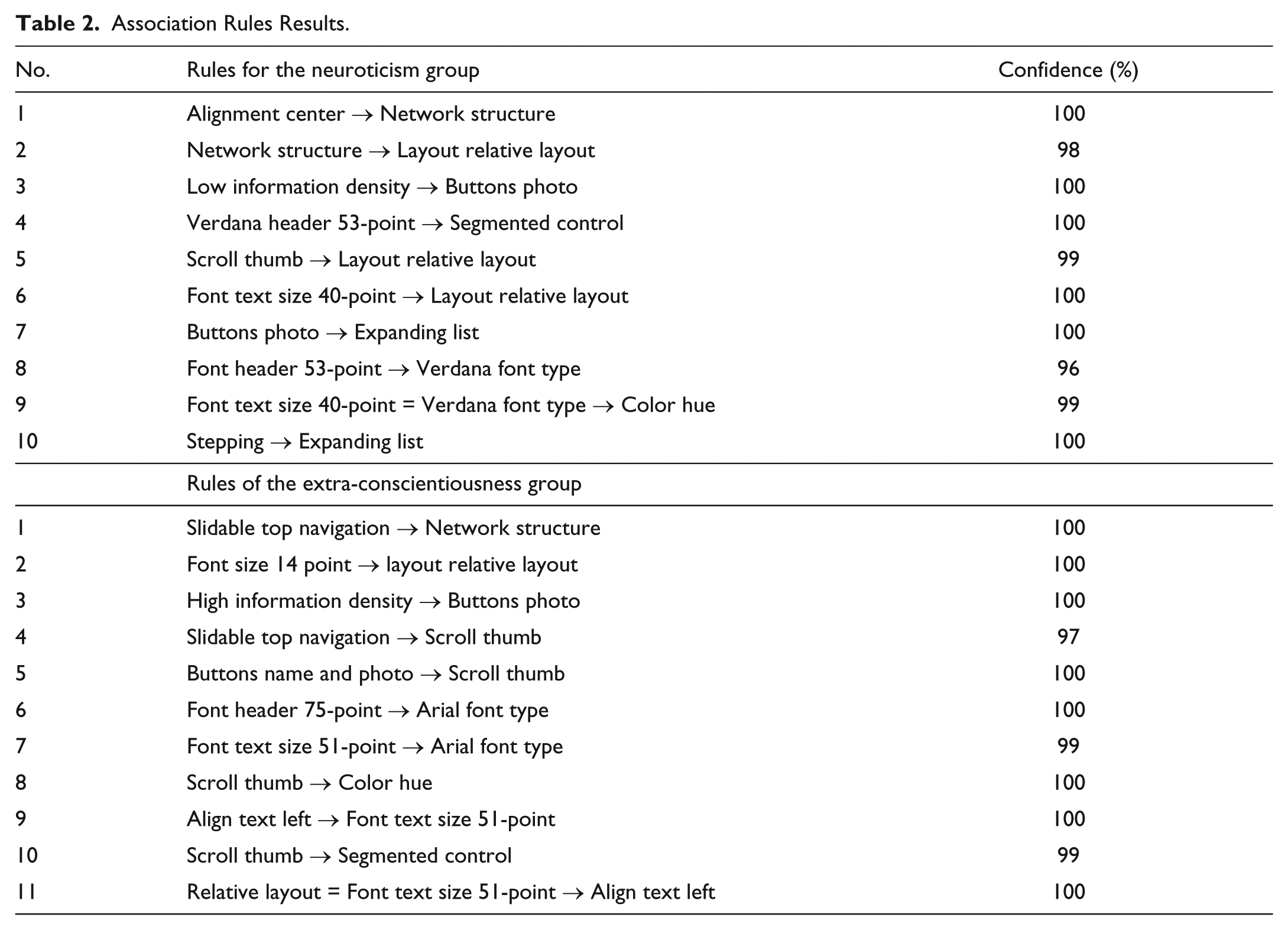
Association rules method was used to predict the associations between MUIDEs in each personality group. Association rules is a well-known method in data mining that is fundamentally used to figure out meaningful and valuable information from large data sets (Kamsu-Foguem, Rigal, & Mauget, 2013; Singh, Ram, & Sodhi, 2013). For this purpose, Waikato Environment for Knowledge Analysis (Weka; Chauhan & Chauhan, 2014; Lekha, Srikrishna, & Vinod, 2013) was used in this study. The Apriori algorithm is the most common algorithm to help researchers generate and define patterns within set of items or selections (Ian et al., 2011). It generates association rules that fulfill minimum support and confidence thresholds. We configured the Apriori parameters by setting the delta value to 0.05, and 0.1 as the value of lower bound for minimum support. Table 2 illustrates the constructed rules of MUIDEs in both clusters.
Association Rules Results.
Storyboards is the initial design of major design elements such as navigation, interface standards guide, and so on. In this study, there were two mobile UIs based on the identified personality groups. Figure 4 shows the storyboard design for the two personality types.

Storyboard design for the two personality types.
Then, all the design elements for each personality type were assembled using Java programming tool (see Figure 5).

Mobile UI for the two personality types.
Evaluation
Fifty undergraduate students (15 male, and 35 female) were recruited in this study. All the participants were enrolled in a design course. Their age ranged between 18 and 22 years (M = 21.66, SD = 0.47). They were familiar with using mobile device in learning.
Assessing Satisfaction
According to Briggs and Sindhav (2015), “satisfaction is a key indicator of the system’s success, and so it has been the subject of much Information System (IS) research” (p. 5). It is the aggregate of individual’s feelings or behavior to the issues that inspire a certain circumstance (Liaw & Huang, 2013). Liaw and Huang (2013) stated that enhancing individuals’ satisfaction of environmental conditions would significantly increase the positive learning behavior. Satisfaction can be considered as a measure of a learner’s reaction toward a particular learning context. From the literature, we can see that considering users’ satisfaction has become a crucial aspect of the design. This led later studies to consider the satisfaction when using an application as an important usability dimension (Long, Karpinsky, Döner, & Still, 2016). Thus, we considered examining learners’ level of satisfaction when using the proposed interface using the “User Interface Satisfaction” or “UIS” questionnaire developed by Chin, Diehl, and Norman (1988).
Results
Participants’ respond to the UIS questionnaire was analyzed using SPSS software. Every participant in both groups responded to all the questions after using the two designs. This was assumed to provide a better understanding of participants’ behavior when using the design that was shaped according to their personality characteristics and the one shaped according to other personality types. Table 4 shows the UIS results for the neuroticism and the extra-conscientiousness group. The results showed that the satisfaction of the participants in the neuroticism group was higher when using their preferred interface (M = 6.39, SD = 2.60) than when using the design of the extra-conscientiousness group (M = 5.92, SD = 2.57; see Table 3). In addition, the same was found for the extra-conscientiousness group who scored higher satisfaction with the design that was shaped based on their personality profile (M = 6.45, SD = 2.61) than when using the neuroticism design (M = 6.10, SD = 2.24; see Table 4). Thus, it can be stated that the participants’ level of satisfaction was associated with interface designed based on their personality characteristics in a mobile learning context.
UIS Questionnaire Result for the Neuroticism Group.

Note. UIS = User Interface Satisfaction.
UIS Questionnaire Result for the Extra-Conscientiousness Group.

Note. UIS = User Interface Satisfaction.
Discussion
Our results showed that participants had high satisfaction level when learning with mobile UI design that is associated with their preferences toward design elements. Participants’ level of satisfaction was reduced when they used a UI design that did not fit their personality profile. This means that UI design based on personality has the potential to offer the user of mobile device with the experience that meets their preferences. This finding adds to prior work of Huntsinger (2013), who stated that low motivational intensity (e.g., satisfaction) is related to the goal task completion, which as a result, leads to attract a broader attention span. We also noticed that other aspects related to the regions that the user visited would properly provide us with the necessary knowledge about user behavior in behavior aware contexts. This means that both the design structure and the elements’ location on the UI can in some fashion influence (either negatively or positively) learners’ satisfaction. This is considered reasonable because it is possible that learners obtain an essential clue about an element’s functionality (in a learning system) when learning from a UI design tailored to their personality. In addition, in our opinion, if learners are in general satisfied with the distribution of elements in the design of a UI, this increases their interaction, as the focus of their mental model remains on the task itself, whereas, if items are displayed such that their location distracts them when interacting, their satisfaction and performance is reduced, because they may face difficulties in processing visual context that are due to the incongruity of design elements to their mental model.
From the cognitive perspective, Segall, Doolen, and Porter (2005) stated that the greater the cognitive burden, the lower is the users’ satisfaction when learning. Later studies, such as that of Philippe, Koestner, Beaulieu-Pelletier, Lecours, and Lekes (2012), showed that episodic memories are linked with satisfaction, suggesting that satisfaction with a task is connected to basic cognitive operations (Greenhoot & McLean, 2013). Nevertheless, previous research findings that are relevant to forming the relation between individuals’ cognitive load and their satisfaction are in line with those of our study. Schmutz, Heinz, Métrailler, and Opwis (2009) stated that “Cognitive load, that is, working memory demands during problem solving, reasoning, or thinking, may affect users’ general satisfaction and performance when completing complex tasks” (p. 1). Thus, users may face additional cognitive demands and require additional processing effort when working with UIs that do not reflect their cognitive preferences. Hence, it is recommended that the elements of the design be relevant to the users to ensure the minimum level of complexity and therefore reducing their cognitive load (Klein, Wolkerstorfer, Hochleitner, Fuglerud, & Schulz, 2013).
Conclusion
The objective of the present study was to help improve learners’ satisfaction when learning using the UI of a mobile device. We focused on the association between the students’ design preferences and personality types in the design of the UI. On the basis of the results of the association rule algorithm, we were able to design and test two UIs, one designed for the neuroticism and one for the extra-conscientiousness personality groups. Our results showed that participates had a better satisfaction level when learning with the mobile UI designed in accordance to their design preferences. Participants’ level of satisfaction was reduced when they used a UI design that did not fit their personality profile. This means that UI design based on personality plays a key role in providing a positive UX. Our finding is in line with those of prior works. For example, Huntsinger (2013) stated that low motivational intensity (e.g., satisfaction) is related to the goal task completion, which as a result, leads to a broader attention span. Present study brings several important implications to the area of HCI. For instance, using the proposed approach, it is very easy to provide recommendation of the UI characteristics to suit users’ experience when using the interface in a learning context.
Supplemental Material
supplementary – Supplemental material for A First Look at the Effectiveness of Personality Dimensions in Promoting Users’ Satisfaction With the System
Supplemental material, supplementary for A First Look at the Effectiveness of Personality Dimensions in Promoting Users’ Satisfaction With the System by Samer Muthana Sarsam and Hosam Al-Samarraie in SAGE Open
Footnotes

Declaration of Conflicting Interests
The author(s) declared no potential conflicts of interest with respect to the research, authorship, and/or publication of this article.
Funding
The author(s) received no financial support for the research, authorship, and/or publication of this article.
Author Biographies
References
Supplementary Material
Please find the following supplemental material available below.
For Open Access articles published under a Creative Commons License, all supplemental material carries the same license as the article it is associated with.
For non-Open Access articles published, all supplemental material carries a non-exclusive license, and permission requests for re-use of supplemental material or any part of supplemental material shall be sent directly to the copyright owner as specified in the copyright notice associated with the article.
