




Abstract
Research evidence has established the importance of mothers’ education and their children’s educational achievement. However, little has been done to establish the association between mothers’ education with girls’ literacy and numeracy scores, while linking it with self-efficacy. Using baseline data collected in Kibera informal settlement in 2015 as part of the Adolescent Girls Initiative–Kenya (AGI-K), this article tests the mother–child education achievement hypothesis while taking into account girls’ self-efficacy. Results show a significant association between parental education and numeracy and cognitive scores at the bivariate level. In addition, interaction effects of mother’s and father’s education showed that girls whose mothers had at least some secondary education significantly performed better in numeracy, while the performance increased even more with increased father’s level of education. Findings also show that on average, girls’ numeracy and cognitive scores significantly increased by half of a standard deviation for a unit increment in self-efficacy. One policy implication is that investments into the secondary education of mothers in support of their daughter’s education need to strengthen individual attributes of girls in self-efficacy.
Introduction
Maternal education is a key driver of education attainment of children (Birdsall, Levine, & Ibrahim, 2005; Browne & Barrett, 1991). Studies conducted in Kenya, Egypt, India, Ghana, Mexico, and Malaysia have shown that mothers with primary education are more likely to have educated children after controlling for other factors (Alderman & King, 1998; Birdsall et al., 2005; Browne & Barrett, 1991; Kambhampati & Pal, 2001). The association between maternal education and children’s academic achievement informed the rallying call for literacy programs for women more than a decade ago, in support of children’s education (Birdsall et al., 2005; Browne & Barrett, 1991).
While the importance of parental education as a predictor of children’s education and behavior outcomes is well established (Abuya, Mutisya, & Ngware, 2015; Abuya, Oketch, Mutisya, Ngware, & Ciera, 2013; Dubow, Boxer, & Huesmann, 2009), the pathways through which parental education influences children’s academic achievement are not well understood. Some scholars have argued that highly educated parents will have children who aspire to achieve higher educational outcomes (Black, Devereux, & Salvanes, 2003; Dubow et al., 2009). Another school of thought asserts that higher parental education influences positive family interaction patterns, which lead to greater academic achievement and achievement-oriented attitudes over time (Dubow et al., 2009). In this case, parental education enhances family interaction during children’s early years to increase the likelihood of academic success and achievement-oriented attitudes among children. Thus, parental education and family interaction foster the positive experiences in children, which lead to an adoption of cognitive scripts, beliefs, and values in children that maintain behavior over time—in this case academic- and achievement-related behavior (Anderson & Huesmann, 2003; Dubow et al., 2009). In this article, we assess the association between mothers’ education and girls’ achievement in Kibera, while linking with self-efficacy. Below, we summarize existing evidence on the pathways through which maternal education influences children’s educational outcomes.
Mothers’ Education and Children’s Achievement
Research suggests that highly educated mothers’ expectations for their children’s academic achievement predict children’s achievement in math and reading (Davis-Kean, 2005; Halle, Kurtz-Costes, & Mahoney, 1997). These findings imply that children’s positive perceptions of achievement are linked to their mothers’ positive beliefs and expectations (Davis-Kean, 2005; Halle et al., 1997) and that higher academic achievement among these children is an outcome of their internalization of positive beliefs and expectations.
In contrast, Coneus and Sprietsma (2009) posit that highly educated mothers are more likely than less educated mothers to invest the time and materials needed to enhance children’s cognitive development. These studies suggest that higher education levels of mothers enable them to be more efficient with how they use their time with their children. Thus, a woman’s ability to negotiate the use of resources in the household is dependent on her level of education. One such resource is income, resulting in improved home investments in children (Coneus & Sprietsma, 2009). Other scholars have argued that the home learning environment, which refers to the parental literacy promoting behavior and quality of language spoken at home (Christian, Bachnan, & Morrison, 2001; Taylor, Clayton, & Rowley, 2004), is critical for children’s learning achievement (Taylor et al., 2004) and is often associated with maternal education. Proponents posit that educated women are more likely to have stable employment, earn higher incomes, have partners who are also highly educated, and reside in better neighborhoods (Cleland & Van Ginneken, 1988; Desai & Alva, 1998; Frost, Forste, & Haas, 2005). Higher incomes enable parents to afford reading materials in the households.
The Controversies in Research on the Association of Mothers’ Education and Children’s Achievement
Despite the fact that parental education as a predictor of children’s education and behavior outcomes has been well established, some studies still challenge the association between mothers’ education and its effect on children’s education (Behrman & Rosenzweig, 2005). These scholars argue that increasing women’s education does not necessarily improve their children’s education—rather mothers’ education reduces the home time for mothers with their children (Behrman & Rosenzweig, 2005), and inadvertently affects their educational achievement negatively. Research shows that children of young mothers with low levels of education perform better on tests focused on academic skills (Magnuson, 2007). This is because these mothers are often at home and therefore provide more quality home time for their children (Magnuson, 2007). According to Magnuson (2007), children of older mothers with high levels of education will not enjoy a similar quality home environment. Other studies in Kenya found a negative association between mothers’ education and children’s achievement, which persisted even after controlling for top- and bottom-performing schools (Abuya et al., 2013). In the same study, the interaction effects of mothers’ and fathers’ education yielded a positive association between the parental education and the mean math score. This finding supported results from other studies that found a significant interaction effect of both fathers’ and mothers’ education on the children’s numeracy and literacy scores (Abuya et al., 2015; Abuya et al., 2013). This study wants to expand the evidence base by establishing the effect of parental education not only on math scores but also on the cognitive scores—seldom used as an outcome variable in these contexts.
Self-Efficacy and Learning Outcomes
Much of the existing literature on the association between maternal education and children’s academic achievement has focused on direct effects of maternal education on the household environment with less attention to possible effects on children’s motivation and attitudes toward learning. In this study, we examine the extent to which self-efficacy—defined as people’s assessment of their ability to take actions that can influence the outcomes of events or situations that affect their lives (Bandura, 2010)—moderates and/or mediates the association between mothers’ education and girls’ performance on numeracy and literacy tests. The association between high self-efficacy and academic achievement has been demonstrated in a variety of settings including among ninth-grade students in Singapore (Liem, Lau, & Nie, 2008), college students in the United States (Komarraju & Nadler, 2013), and secondary school students (8th and 10th grade) in Norway (Diseth, Danielsen, & Samdal, 2012).
In a context marked by limited educational opportunities and given that modeling is one of the ways through which individual perceptions of self-efficacy develop (Bandura, 2010), we posit that girls whose mothers have a secondary or higher level of education may have higher self-efficacy than those whose mothers are less educated. We also posit that self-efficacy will influence academic achievement or performance through several pathways, including increased motivation to learn, persistence in pursuing academic tasks, goal setting, and self-regulation (Komarraju & Nadler, 2013; Lee & Jonson-Reid, 2016).
Data and Methods
Data
The study utilized data from the baseline survey of the Adolescent Girls Initiative–Kenya (AGI-K). Data were collected in Kibera, a densely populated informal settlement in Nairobi, Kenya, which is characterized by high levels of poverty, crime, and lack of basic services (African Population and Health Research Center, 2014). A detailed description of the study can be found in the AGI-K study protocol (Austrian et al., 2016). Prior to the baseline survey, a household listing was conducted using a household roster administered to heads of household that collected information about household members, including age, education, marital status, and parent’s survivorship. The comprehensive survey collected data at both individual (girl) and household levels. Data were collected from 2,393 adolescent girls between the ages of 11 and 14, and from their parents or guardian (household). The analyses are limited to 2,119 girls and exclude 29 girls who were not in school at the time of the survey, and 194 girls whose mothers were not alive.
At the girl level, the survey collected information on a variety of topics, including sociodemographic characteristics, schooling history, educational attainment, social assets and networks, self-efficacy, financial literacy and savings, marital and childbearing aspirations, birth history, and reproductive health knowledge. Girls also completed three tests to assess literacy in the local language, English, and mathematics, which were drawn from the 2012 Uwezo Kenya National Learning Assessment (Uwezo, 2012). The survey also assessed nonverbal cognition, using a subset of Raven’s Colored Progressive Matrices (Raven, Court, & Raven, 1994). At the household level, the survey included questions on ownership of household assets, the source of drinking water, type of toilet facility, the number of rooms for sleeping, and the main material of the floor and the roof of the structure.
The study received ethical approval from the Population Council Institutional Review Board and the African Medical and Research Foundation Ethical and Scientific Review Committee. In addition, the Kenyan National Commission for Science, Technology, and Innovation granted research clearance.
Measures
This study examined two core-dependent variables: scores in numeracy and cognitive assessments, which are standardized (z scores) based on the highest grade reported by the girl. The standardization based on the girls’ grade ensured that the scores were comparable despite grade differences as the same assessment tests were administered to all girls irrespective of their grade. The z scores are interpreted in terms of the number of standard deviations below and above the mean.
Explanatory variables
The key explanatory variable was mother’s education. This was constructed as a categorical variable indicating the highest grade achieved: no schooling or some primary education, complete primary level of education, and at least some secondary education. The highest level of education was unknown for about 4% of the mothers in the sample. The data from these mothers were retained and mother’s education coded as unknown. Father’s education was similarly coded. Father’s education was coded as unknown in several cases where the father was reported not to be alive (n = 320).
Girl’s self-efficacy, which measured the belief of girls to succeed despite being in the slums, was captured using a set of seven items. The self-efficacy items captured girl’s belief in their ability to solve problems without too much effort and thinking of solutions when in trouble and confidence in handling unexpected situations among others. A continuous self-efficacy index was derived from standardized values of the seven items (Cronbach’s α = .624). Higher scores indicate higher self-efficacy.
The wealth index was used as a proxy measure of household social economic status. The index was calculated using a mix of items that included household possession, such as television, watch, mosquito net; ownership of livestock and agricultural land as well as the number of sleeping rooms; and whether the family experienced days without food in the past month, and had enough savings in case they needed. The responses for each of the item were dichotomized and scores calculated using the principal components analysis as described by Filmer and Pritchett (1999). The scores were thereafter categorized into three equal groups.
The following explanatory variables were also included: school type, which was coded as either government or private school; age; whether the girls read or write while at home daily or sometimes; whether the girls calculate prices or fractions daily; and girls’ educational aspirations. Girls’ educational aspirations were captured using a single item that assessed the highest level of education they would wish to attain. Given the distribution of the responses, this variable was dichotomized to either attain at least college education (college and university) or not.
Analysis
We employed both descriptive and inferential data analysis techniques. The descriptive statistics included frequencies and percentages which were used to describe the distribution of the study sample by background characteristics. Two sample t tests were used to establish whether the means varied by key background characteristics. Analysis of variance (ANOVA) was used to test for the equal variance regression assumption. Moreover, scatter diagrams were used to assess correlations between a continuous variable and girl’s achievement. Multiple regression analysis was used to establish the association between mothers’ education and the core-dependent variables, while controlling for other characteristics. Given a large number of variables, backward stepwise selection of variables at the significance of 10% was used to determine which variables to include in the final model.
Results
Table 1 shows the distribution of the background characteristics and their respective z scores. The first category for the categorical variable was used as the reference category to test whether there is a significant difference in z scores through pairwise comparison using t tests. About 71% of mothers and 43% of fathers had a primary level of education or less. A higher proportion of fathers (42%) had at least some secondary education compared with mothers (25%). There is a significant association between the two variables when examined jointly, with 71% of mothers with at least some secondary education married to men with the same level of education; however, fewer men with at least secondary education (39%) were married to women with the same level of secondary education. Almost two thirds (63%) of men with no or some primary education were married to women with no or some primary education compared with 39% of women with no or some primary education married to men with a similar level of education.
Descriptive Statistics Showing Sample Distribution and Mean z Scores (n = 2,119).

Note. The ANOVA and t test applied to numeracy and cognitive scores.
ANOVA was used to test for differences in means and equal variance.
The t test used to test whether the difference in means was significantly different.
p < .05.
Slightly over one half of the girls were enrolled in low-cost private schools, which are common in the slums (Ngware et al., 2013). Few girls reported that they read and write every day (32%) or calculate prices and fractions (27%). We observed high education aspirations among the girls—with 90% of them reporting the desire to at least attain a college education or higher.
Table 1 also presents the average z scores for numeracy and cognitive scores. A negative z score indicates on average the number of standard deviations that girls with a given characteristic scored below the mean, while a positive z score shows on average the number of standard deviations above the mean. Bivariate significant effects of numeracy achievement are seen for mother’s education, aspiration, age, wealth, and reading and writing at home as well as self-efficacy and calculation of prices and fractions at home. For instance, on average, girls who reported that they calculate prices and fractions daily scored significantly higher (and above the mean) in both numeracy and cognitive assessments compared with girls who reported calculating prices and fractions sometimes. Self-efficacy was positively associated with numeracy and cognitive scores. A unit increment in the self-efficacy score was significantly associated with 0.49 and 0.41 increase, respectively, in numeracy and cognitive z scores.
Figures 1 and 2 show a graphical presentation of the z scores for both cognitive and numeracy achievement stratified by mother’s and father’s level of education, respectively. Overall, increased mothers’ education has positive and significant z scores, while lower levels of education have negative z scores. Using the no or some primary education as the reference category, girls whose mothers had completed primary or at least some secondary education scored significantly higher in numeracy; however, cognitive scores were only significant for mothers with at least some secondary education.

The effect of mother’s level of education on numeracy and cognitive z scores.

The effect of father’s level of education on numeracy and cognitive z scores.
A similar trend is observed with father’s education, though the association is only marginally significant (p = .06) for numeracy scores among girls whose fathers had at least some secondary education. Although not reaching the threshold for significance, it is worth highlighting that very low scores were observed for girls whose fathers had no or some primary education. There seems to be a high variation of scores with regard to father’s level of education as indicated by the wide confidence intervals that largely overlap.
Figure 3 shows regression results for the interaction effect between father’s and mother’s education on numeracy achievement. The reference category in this model is both parents having no or some primary education. Mother’s education is stratified by father’s level of education. Overall, the coefficients are positive, meaning that girls with at least one parent who had attained a primary education and above performed better than girls whose parents had no or some primary education. However, the interaction effect appears mixed: On one hand, girls whose mothers had no or some primary education performed better irrespective of the father’s level of education (though not significant). On the other hand, though girls whose mothers had at least some secondary education significantly performed better, their performance increased even more with increased father’s level of education. That is, the joint effect of both parents having some secondary education is larger than when just one parent has some secondary education. The interaction shows the complementary effect of mother and father education on girl’s education. For the cognitive development, the joint effect was only significant if both parents had at least some secondary education.
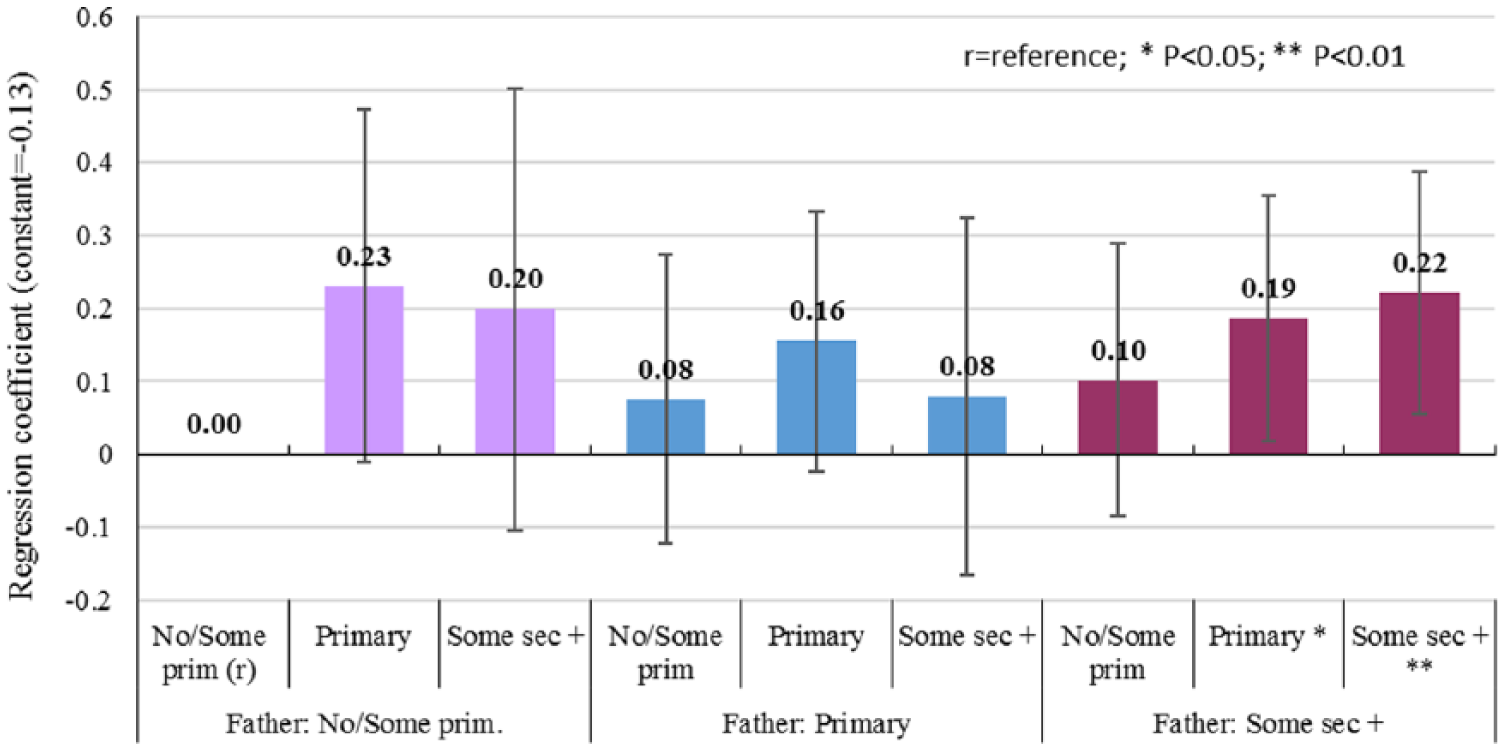
The effect of mother’s and father’s level of education on numeracy.
Table 2 shows the results from a multiple linear regression on the effects of mother’s education on cognitive and numeracy achievement among girls aged between 11 and 15 years. Mother’s and father’s education level were interacted to estimate their complementary effect. The interacting effect of mother’s and father’s education on numeracy did not meet the threshold for statistical significance. However, higher levels for both parents show positive and somewhat large coefficients. For instance, among fathers with at least some secondary education, girls whose mothers had primary and some secondary education on average scored 0.13 and 0.14 standard deviations above the mean in numeracy, compared with girls whose mothers had no or some primary education. There appears to be a linear trend on the effect of mother’s education on numeracy in each of the father education category. The same trend is evident in the cognitive model. However, in both models, girls whose father had a primary education and mother at least some secondary education have negative and small coefficients.
Regression Results on the Effect of Mother Education on Girl’s Numeracy and Cognitive Achievement (n = 2,119).

p < .05. **p < .01.
Comparing the effects of control variables on numeracy and cognitive ability, more variables are significantly associated with numeracy than are with cognitive ability. The age of the girl, self-efficacy, and daily calculation of prices and fractions were the only variables significant in both models, while in the numeracy model, mother’s marital status, father being alive, and education aspiration were significant.
The girl’s numeracy and cognitive achievement declined with age. Girls’ self-efficacy was positive and significant: On average, the girl’s numeracy and cognitive scores significantly increased by half of a standard deviation for a unit increment in self-efficacy. Moreover, girls who reported being able to calculate prices and fractions were on average scoring 0.19 and 0.12 standard deviations above the mean in numeracy and cognitive assessment compared with girls who reported calculating either one of the two items or none.
In the numeracy model, in addition to the variables that are significant in both models, mother’s marital status and girls’ education aspiration were significant. With regard to mother’s marital status, being widowed, divorced, or separated was negatively associated with numeracy achievement, when compared with mothers in union (married). Girls with high aspiration scored significantly higher in numeracy by 0.28 standard deviations compared with girls with low education aspiration.
The results of wealth index were not significant for either numeracy or cognitive ability. There was no significant difference in numeracy scores based on school type. However, girls enrolled in private schools scored on average 0.10 standard deviations below the mean on the cognitive assessment.
Discussion
This article provides a unique contribution to understanding the multidimensional effects of parental education on two key learning outcomes—cognitive scores and numeracy scores. It adds nuance by trying to understand the role of self-efficacy and schooling type. Overall, while mother’s and father’s education seem to be associated with better numeracy and cognitive scores at the bivariate level, at the multivariate level, parental education is no longer significant, even though there are large and positive coefficients for the association between parental education and girls’ numeracy and cognitive scores. At the bivariate level, we presuppose that two possible pathways could be linking higher parental educational outcomes to subsequent higher achievement levels of their children: (a) Education enables the parent to earn more money, and consequently, the parent is able to expose the children to educational experiences that will enable the children to earn more money as well; and (b) there are differences between a parent with an education and one without an education; therefore, a child of an educated parent will have the likelihood of attaining higher educational outcomes (Black et al., 2003). Moreover, the study found a positive association between mothers’ education and achievement, with the effects on achievement larger with increased levels of fathers’ education. For instance, girls whose mothers had at least some secondary education significantly performed better; their performance increased even more with increased father’s level of education. This shows that when both parents have secondary education, the effects on achievement are larger than when just either of the parents has some secondary education. The interaction shows the complementary effect of mother’s and father’s education on girl’s education as has been seen in previous studies (Abuya et al., 2015). This, however, is contrary to what other studies have found that mothers’ education on daughters is greater that the effect seen for fathers’ education (Birdsall et al., 2005; Browne & Barrett, 1991; Kambhampati & Pal, 2001).
In addition, a girl’s educational aspirations, self-efficacy, and use of numeracy skills (numeracy score only) are stronger predictors of positive numeracy and cognitive scores. Interestingly, as girls age, their numeracy and cognitive scores drop—perhaps pointing to girls’ lower engagement with school and social isolation as age increases (Hungi, Ngware, & Abuya, 2014). This points to the importance of ensuring that girls use their numeracy skills on a daily basis so that they do not face a loss in these skills—suggesting that financial education or other interventions that engage girls in these activities are important. Furthermore, studies conducted among college students (Komarraju & Nadler, 2013) and high school students (Zimmerman, Bandura, & Martinez-Pons, 1992) in the United States suggest that students with high self-efficacy may perform better because they are more self-motivated and persistent even when studying difficult material. Thus, interventions that increase girls’ general self-efficacy and educational aspirations may result in improvements in educational performance.
Taken together, the results suggest that it is a combination of household and individual factors that play a role in learning outcomes. On one hand, it is positive to note that the household a girl is born into may not determine her long-term numeracy and cognitive capabilities. However, on the other hand, household factors may play an important role and therefore must not be ignored and could potentially be used to identify girls in need of an intervention.
The main limitation of this article is that it uses cross-sectional data, and therefore, it is not possible to confirm whether stronger numeracy and cognitive skills cause stronger self-efficacy and educational aspirations or vice versa. Furthermore, as the sample is young, at this point, educational outcomes cannot be used as an outcome measure. Finally, there is very limited variability in the wealth index as it is computed using household amenities and assets, which tend to be very similar in the slum context. This may explain the insignificant results on this measure. The outcomes explored in this article are important in long-term health, education, and livelihood success for adolescent girls (Austrian et al., 2016). Therefore, understanding what influences these outcomes in early adolescence is useful to identify girls with particular vulnerabilities in this area, as well to guide the development of interventions that seek to improve girls’ short- and long-term education and learning outcomes.
Footnotes
Acknowledgements
The authors thank Dr. John Maluccio and Dr. Eunice Muthengi for feedback on the various iterations of the manuscript draft.
Declaration of Conflicting Interests
The author(s) declared no potential conflicts of interest with respect to the research, authorship, and/or publication of this article.
Funding
The author(s) disclosed receipt of the following financial support for the research, authorship, and/or publication of this article: The authors acknowledge the generous support by UKaid from the Department for International Development (DFID) for the Adolescent Girls Initiative–Kenya (AGI-K) (Prime Award: PO 6171; Sub Award: SP1404). The analysis and writing of this work was partly supported by core support grants to the African Population and Health Research Center from the Swedish International Development Cooperation Agency (SIDA) (Grant Number 2011-001578) and the William and Flora Hewlett Foundation (Grant Number 2015-2530).
