




Abstract
Neural tube defects (NTDs) can be reduced by 50% to 70% with sufficient periconceptional intake of folic acid. Hispanic women are up to 3 times more likely than non-Hispanics to have a child affected by NTDs. This disparity is complicated by health literacy, as women impacted by this disparity are also at-risk for low health literacy. The purpose of this project was to pilot advertisements to promote multivitamins, increasing folic acid consumption, among Hispanic adolescents. The advertisements for Hispanic adolescents and their mothers focused on broad benefits of a multivitamin, downplaying folic acid’s role in prenatal health. Participants were Hispanic mothers (n = 25) and adolescents (n = 25) at a clinic in the Southwestern United States. Likert-type survey items and an open-ended question were used to assess attitudes toward multivitamins and advertisements. The Newest Vital Sign (NVS) was used to assess participants’ health literacy. Participants’ impressions of the ads were positive. Both groups expressed the intent to start taking a daily multivitamin after viewing the ads—adolescents for themselves and mothers to start their daughters on a daily multivitamin. There was no relationship between participants’ health literacy and perceptions of the advertisements or intentions to begin a multivitamin habit. This research illustrates the potential of messages that rely on peripheral health benefits to overcome communication barriers posed by health literacy and address serious health problems such as NTDs.
Introduction
Neural tube defects (NTDs) are among the most severe types of birth defects and affect nearly 4,000 newborns annually in the United States (Helinski, Trauth, Jernigan, & Kerr, 2004; Kannan, Menotti, Scherer, Dickinson, & Larson, 2007). In a normal pregnancy, the development and closure of the neural tube takes place within 28 days after conception. If the neural tube does not close completely, an NTD occurs (Helinski et al., 2004). To reduce NTDs such as anencephaly, which is fatal to the newborn, and spina bifida, which often results in serious health complications, the U.S. Public Health Service recommends all women capable of becoming pregnant consume 0.4 mg of folic acid per day (Prue, Hamner, & Flores, 2010). Research indicates that periconceptional (at least 1 month before conception and in early pregnancy) consumption of folic acid can decrease the risk of NTDs by 50% to 72% (Helinski et al., 2004; Lindsey et al., 2009). Despite this recommendation, a disparity in NTD-affected pregnancies exists among different racial and ethnic groups within the United States; prevalence rates for anencephaly in Hispanics is 2.84 per 10,000 live births, 1.98 for non-Hispanic Whites, and 1.80 for non-Hispanic Blacks. The prevalence of spina bifida in Hispanics is 4.18 per 10,000 live births, 3.37 for non-Hispanic Whites, and 2.90 for non-Hispanic Blacks (Williams, Rasmussen, Flores, Kirby, & Edmonds, 2005).
The large-scale fortification of grains by the U.S. Food and Drug Administration (FDA) in 1998 has helped reduce the occurrence of NTD (Prue et al., 2010); however, fewer than 8% of all women reach the daily recommended level of folic acid with fortification alone (Lindsey et al., 2009). Multivitamin supplements are a convenient way to ensure adequate intake of folic acid. Health promotion efforts by the Centers for Disease Control and Prevention (CDC), the March of Dimes, and other organizations have had some success in increasing folic acid awareness among women of childbearing age—reporting a 17% increase in knowledge that folic acid prevents birth defects from 1995 to 2003 (Thomas, Hauser, Rodriguez, & Quinn, 2010). However, research measuring the effectiveness of multivitamin promotion campaigns often reports limited success in such efforts, often due to target audiences that are too narrowly or broadly defined or culturally irrelevant messages (Flores, Prue, & Daniel, 2007; Lawrence et al., 2003; O’Rourke & Roddy, 2007; Thomas et al., 2010). The need for effective campaigns in this sphere remains high.
While folic acid education is vital to all women, research has found that Hispanic women in particular are significantly less likely than non-Hispanics to be aware of the benefits of folic acid in reducing serious birth defects (Kannan et al., 2007). Products made from corn masa flour, which are dietary staples in many Hispanic communities, are also excluded from the FDA’s current mandatory grain fortification, possibly contributing to the lack of sufficient folic acid intake among Hispanic women (CDC, 2010). Spanish-speaking women are reported to have lower multivitamin usage than their English-speaking counterparts (Thomas et al., 2010). They also have the highest rate of NTD-affected pregnancies (Kannan et al., 2007; Prue et al., 2010). Research establishes that a substantial disparity exists between Hispanic and non-Hispanic women with regard to folic acid knowledge: that it can prevent NTDs, how to consume folic acid, the amount to consume, and when to consume it (Quinn, Thomas, Hauser, Rodríguez, & Rodriguez-Snapp, 2009).
This serious health issue becomes more urgent due to the fact that the Hispanic population is one of the fastest growing in the United States and by 2020 will constitute nearly 18% of the total population (U.S. Census Bureau, 2006). Hispanic women generally begin to have children at a younger age and continue to have children as they age. The short birth intervals that tend to occur among Hispanic women may also lead to further folate depletion (O’Rourke & Roddy, 2007). The rate of unintended pregnancies is also highest among poor Hispanic women (Prue et al., 2010). Due to their disproportionate rate of neural tube–related birth defects, their frequency of births and their unintended pregnancy rates, there remains a pressing need for effective health promotion efforts designed to reach this vulnerable audience.
Making the problem of promoting folic acid for prenatal care even more difficult to address is the fact that approximately 50% of pregnancies in the United States are unplanned and that the highest rate of these unintended pregnancies occur in women aged 18 to 24 (Lindsey et al., 2009; Thomas et al., 2010). Due to the higher rate of unintended pregnancies in younger women, research has focused on folic acid awareness and pregnancy health efforts targeting late high school and college-aged women (Flores & Kilker, 2007; Lindsey et al., 2009), meaning younger audiences have not been targeted by health promotion campaigns.
Given the health disparity among Hispanic women and the higher rate of unplanned pregnancies in young women, the purpose of this project was to develop and pilot test a public health campaign that could be used to promote a multivitamin habit (and thus increase folic acid intake) among female Hispanic adolescents regardless of their intentions to become pregnant. This overall strategy would involve advertisements to reach the mothers of the adolescents and the adolescents themselves, such that actual behavior change could be driven directly (reaching adolescents) and indirectly (through their mothers).
Background
In seeking to create new health promotion campaigns to address the issue of NTDs, it is useful to provide background on health literacy as context for developing new campaigns and the Health Belief Model (HBM) as a conceptual framework for thinking through what new campaigns might look like.
Health literacy is an individual’s ability to obtain, process, and act on health information (Ad Hoc Committee on Health Literacy, 1999). Low health literacy often leads to poorer health outcomes due to a variety of factors, including the individual’s lack of understanding health professional’s instructions (DeWalt, Berkman, Sheridan, Lohr, & Pignone, 2004; Kalichman et al., 2000; Lindau et al., 2002; Schillinger et al., 2002). Factors such as age, low socioeconomic status, and being part of a minority or immigrant population can impair health literacy (Ad Hoc Committee on Health Literacy, 1999). Hispanic women often have many of the risk factors associated with being low health literate, especially if English is not their native language (Ad Hoc Committee on Health Literacy, 1999; Nielsen-Bohlman, Panzer, & Kindig, 2004). When developing health promotion efforts to address a specific issue, such as increasing folic acid consumption among Hispanic women, it is pertinent to understand the needs of individuals with lower health literacy.
In addition to recognizing the information needs of low-health-literate audiences, it is crucial to consider how individuals process health messages and take action on them. The HBM is a theory that attempts to predict health-related behaviors based on perceptions about a condition and the recommended behaviors that prevent or reduce it (Janz & Becker, 1984). According to this model, an individual’s perceived susceptibility to a condition and the severity of its consequences contribute to the overall perceived threat. That threat can lead to a correct course of action if the individual perceives that the negative health outcome can be avoided. The HBM suggests individuals are more likely to act on a recommendation if they have knowledge of the negative condition and/or if they are reminded by cues from media campaigns, health professionals, family or friends (Janz, Champion, & Strecher, 2002). Targeted health promotions can influence and increase knowledge of a negative condition and also serve as cues to take preventive action, and with its focus on perceived benefits and barriers as major contributors to health behavior change, the HBM is a particularly useful theoretical framework for developing new health promotion campaigns. In the case of this study, the HBM was used to design campaign materials and the instruments used to assess their impact.
Research Questions
This investigation was guided by two primary research questions:
The study used a convenience sample to investigate the potential of the advertisements (individual messages/posters) developed for this project, consistent with the key role of message pre-testing in developing health communication campaigns (overarching communication program) that can then be deployed on a larger scale (National Cancer Institute, 2004).
Method
Design
Advertisements were designed to encourage multivitamin usage among Hispanic adolescent females (ages 13-18). The advertisements targeted the mothers of Hispanic adolescents and the adolescents themselves to encourage multivitamin usage. The overall strategy focused on broader benefits of multivitamin usage, deemphasizing the specific role of folic acid in prenatal health, to build a long-lasting multivitamin habit that would benefit the Hispanic adolescents and prepare them for a healthy pregnancy with sufficient folic acid if and when they become pregnant—whether that pregnancy is intended.
The advertisements were designed based on reviews of relevant literature and existing folic acid promotion campaigns, a series of classroom exercises which challenged graduate advertising students to promote folic acid among Hispanic females, and insights garnered through formative research with Hispanic women (Mackert, Kahlor, Silva, & Padilla, 2010). Specific insights from Mackert, Kahlor, Silva, & Padilla (2010) that were utilized in the development of these campaigns included: avoiding dense blocks of small text that were deemed to be overwhelming by low-health-literate participants, with resulting ads featuring limited text; a preference for headlines that got participants’ attention and made them want to read more, such as through asking a question; participants did not perceive major barriers to consuming a daily multivitamin, so ads did not address potential barriers; a desire for a fear appeal to raise awareness of the issue, which led to a “You Got Lucky” headline; and a knowledge of the benefits of folic acid among mothers that came from their first pregnancy, which led to the overall communication strategy of targeting mothers already aware of the general importance of folic acid.
Teams of advertising students then developed one advertisement for Hispanic moms of adolescents (see Figure 1) and two advertisements for Hispanic adolescents (see Figure 2 for one ad; the other featured similar text, but a single large photo). The ad designed for mothers was meant to describe a range of health benefits to taking a multivitamin, such as lowering the risk of heart disease; the ad highlighted, but did not focus exclusively on, the value of folic acid. The ads designed for adolescents were intended to highlight more short-term and concrete benefits of a multivitamin, such as boosting energy and muscle function, and it excluded any specific information about folic acid.
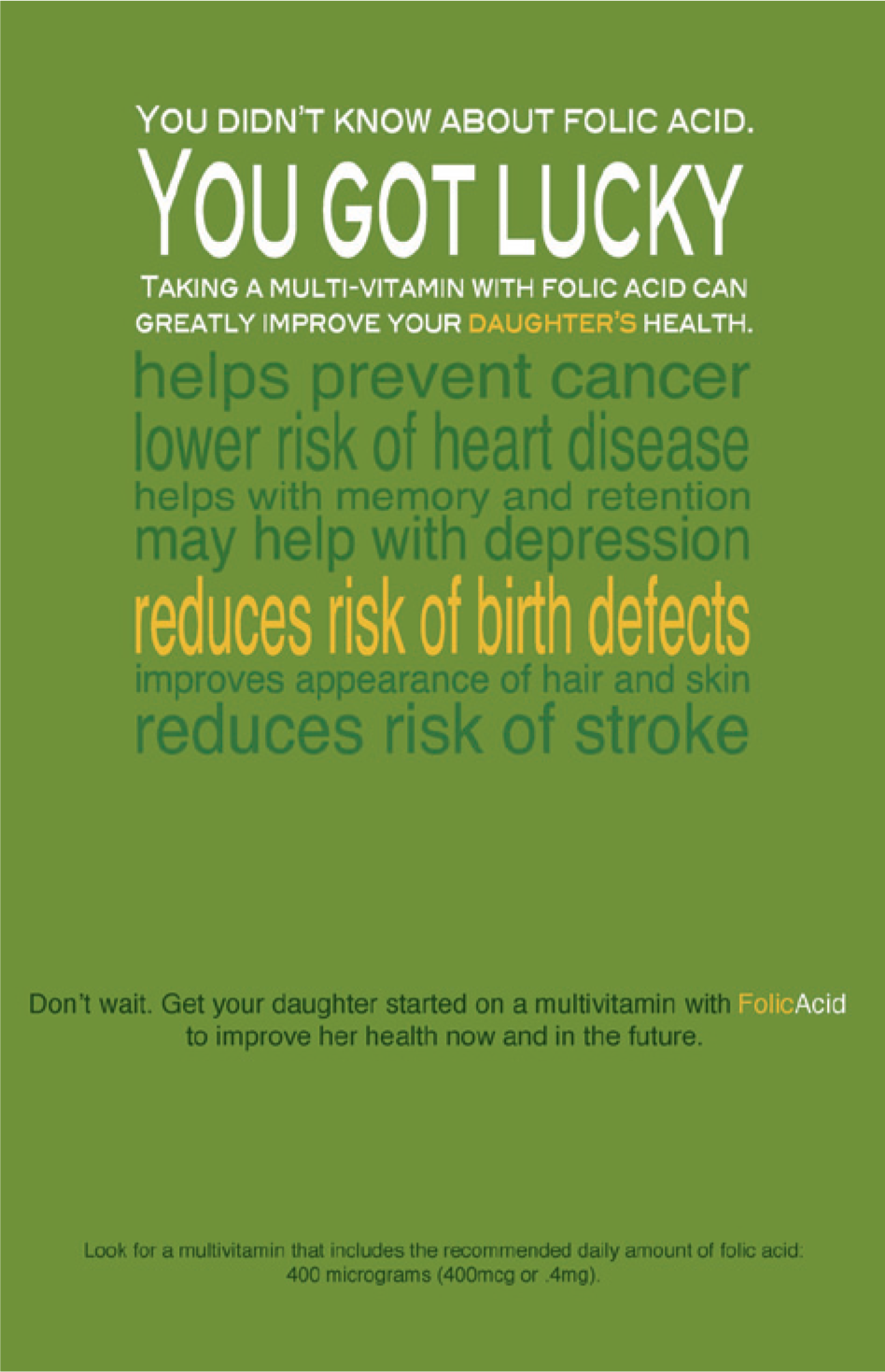
"You Got Lucky" Targeting Mothers.

“What’s Her Secret?” Targeting Adolescents.
As noted earlier, the HBM was used as a theoretical framework to guide message design. The HBM was used to frame campaign messages, highlighting perceived benefits that would be relevant to participants and downplaying or even omitting messages related to barriers (due to the simplicity of taking a multivitamin) and severity of failure to take a multivitamin with folic acid (because a birth affected by NTDs would likely not be a relevant health issue to the adolescents being targeted with this campaign). For adolescents and mothers, there was an emphasis on the use of plain language whenever possible and the use of visuals and headlines to catch the audience’s attention and encourage them to engage with processing campaign messages. Additional details on the process of campaign development are provided elsewhere (Mackert, 2012).
Measures
The study protocol was approved by the relevant Institutional Review Board. All participants provided appropriate consent prior to participating in the project, and they were given US$25 gift cards to a local retailer to compensate them for their time.
The purpose of this pilot project was to assess the potential of advertisements to promote multivitamin usage among Hispanic adolescents as a way to increase folic acid intake. As such, it was necessary to garner the opinions of mothers of these adolescents and the adolescents themselves. To that end, mothers of adolescents and adolescents were surveyed to determine their attitudes regarding the potential benefits of multivitamin usage, the advertisements developed for this project, and the impact of the advertisements on their attitudes and intentions to start a daily multivitamin habit. Guided by the HBM, single-item measures were designed to reflect specific messages about the perceived benefits of a multivitamin that were included in each advertisement; the advertisements for mothers and adolescents included different messages about benefits, resulting in different survey items for each group. Survey items are provided for mothers (Table 1) and adolescents (Table 2) with all using a 7-point Likert-type scale from 1 (strongly disagree) to 7 (strongly agree).
Mothers of Adolescents Responses to the Advertisement.

Note. n = 25, df = 24.
p < .05.
Adolescents Responses to the Advertisements.

Note. n = 25, df = 24.
p < .05.
A graduate student administered the surveys orally in one-on-one sessions with participants, to avoid potential issues with participants’ reading level confounding results; ads were shown without commentary from the graduate student collecting data. All participants also provided basic demographic information and completed the Newest Vital Sign (NVS) to assess health literacy (Weiss et al., 2005). The NVS is a 6-item assessment of health literacy that correlates well with other established health literacy measures (Weiss et al., 2005); a score of 0 to 1 on the NVS reflects a 50% or greater chance of limited health literacy, a 2 to 3 score suggests the possibility (25%) of limited health literacy, and a score of 4 or greater reflects adequate health literacy. Participants were also given an opportunity to share any other thoughts they might have after viewing the advertisements.
Analytic Strategy
Standard descriptive statistics were used to assess participants’ perceptions of the advertisements developed for this project, perceived benefits of taking multivitamins, and intentions to start a daily multivitamin habit. Paired-samples t tests were used to assess the impact of the study advertisements on participants before and after viewing them. Correlations were used to assess the relationship between participants’ health literacy and attitudes toward the ads, perceived benefits of multivitamins, and intentions to start a daily multivitamin habit.
Participants
Participants were recruited in the waiting room of a nonprofit health clinic that operates in a midsize Texas city; flyers were posted in the waiting room stating the inclusion criteria for the study, and interested participants were directed to a graduate student collecting data. The clinic serves approximately 10,000 patients per year, the majority of whom are Hispanic (75%), female (72%), and at or below the poverty line (74%). Participants were recruited and interviewed in English, because campaign materials were originally developed in English; in addition, the patient population at the recruitment site features a roughly equal split between English and Spanish as a preferred language, with the adolescent population showing a two-to-one preference for English.
A total of 50 (N = 50) Hispanic participants were recruited for this study, including 25 mothers (n = 25) with at least one adolescent daughter between the ages of 13 and 18 and 25 female adolescents (n = 25) between the ages of 13 and 18; these were individual mothers and adolescents, not dyads of mothers with their own daughters. The mean age of the mothers was 35.5 (SD = 8.8) with 1.8 children (SD = .9), and the mean age of the adolescents was 14.9 (SD = 1.7). Means scores on the NVS for the mothers (M = 3.6; SD = 1.3) and adolescents (M = 2.8; SD = 1.2) indicated risk of low health literacy.
Results
Mothers of Adolescents
Mothers responded to a series of statements about benefits of and barriers to taking a multivitamin before and after viewing the ad encouraging mothers to start their daughters on a multivitamin. As can be seen in Table 1, paired-samples t tests indicated the ad increased mothers’ beliefs that a multivitamin could improve appearance of hair and skin, help prevent cancer, may help with depression, lowers risk of heart disease, reduces risk of birth defects, can lower risk of stroke, and can improve memory.
While the ad was not designed to eliminate the belief that multivitamins can cause weight gain nor shift attitudes about the expense of multivitamins, there were small (though not statistically significant) decreases on those items. The ad also did not significantly increase mothers’ level of worry about the health of their daughters. Results also indicate the mothers believed the ad was useful and informative. The findings also show the mothers approved of the appearance of the ad and believed it would be effective on others like them.
The mothers expressed strong intentions to start their daughters on a daily multivitamin (M = 6.8; SD = 0.7). While the ad was not designed to encourage the mothers themselves to start a daily multivitamin habit, it appears many mothers internalized the health benefits and expressed intentions to start taking a daily multivitamin for themselves (M = 6.5; SD = 1.4).
A series of correlations were utilized to test the potential relationship between the mothers’ health literacy (as measured by the NVS) and their evaluation of the ad, intentions to start their daughters on a multivitamin and intentions to state taking a multivitamin themselves. There was no evidence that health literacy was related to mothers’ reactions to the ads, which was a positive finding given the ads were intended to be accessible and persuasive to low-health-literate audiences.
As noted earlier, participants were given a chance to share any other thoughts they might have after viewing the advertisements. Talking about what she might say to her daughter, one mother stated: “It helps keep you healthy, smart (memory), can make her future babies healthy, acne and hair (she’d buy into it helping her appearance).” Another participant said, “I think she’d be willing to. I’d take them with her, saying we could take them together because it would be good for both of us.” One mother expressed concern about the term folic acid, saying, “‘Acid’ scares me, and I think that this acid would be bad for me.” Finally, several participants commented on the colors of the advertisement, suggesting brighter colors might be better.
Adolescents
Adolescents were asked to respond to a series of statements about benefits of and barriers to taking a multivitamin before and after viewing the ads. As can be seen in Table 2, paired-samples t tests indicated the ad increased adolescents’ beliefs that a multivitamin could help improve appearance of hair, skin, and nails, as well as boost energy.
The ads did not achieve significant improvements in adolescents’ beliefs that a multivitamin could help build stronger bones, be helpful even if someone has a healthy diet, or is a good way to stay healthy. The ads were not designed to address the mistaken belief that a multivitamin can contribute to weight gain, nor that a multivitamin every day can be expensive, and the ads did not significantly shift beliefs about these items. They also were not designed to rely on a fear appeal to motivate behavior change, so the lack of a significant shift in adolescents’ perceptions of their health was as intended.
Adolescents’ views of the ads themselves—that they included useful information, were easy to understand, looked good, and would be liked by people like them—were not as positive as the ad designed for mothers. Given this, the ads did lead to relatively strong intentions for the adolescents to start taking a multivitamin every day (M = 5.7; SD = 1.4).
As with the mothers, these ads were designed to be accessible and persuasive to low-health-literate audiences. A series of correlations found no significant relationship between the adolescents’ health literacy (as measured by the NVS) and their perceptions of the ads or their intentions to start taking a multivitamin every day.
Adolescent participants were also asked to share any thoughts they had after viewing the advertisements. Discussing what she might say to her mom about a multivitamin, one participant said, “I want to take a multivitamin to keep myself healthy, strong, and energetic.” Another reported, “This has actually made me really want to buy and take them.” Concerns about taste of multivitamins emerged as a potential barrier, however: “I don’t like the taste of them.”
Discussion
Given the importance of promoting folic acid to reduce the incidence of NTDs in general, and the disparity impacting Hispanics in particular, it is crucial to continue to explore new health promotion strategies for increasing folic acid intake. The advertisements developed for this project were designed to increase multivitamin consumption—and thus folic acid intake—among Hispanic adolescents by promoting the benefits of multivitamins to the mothers of adolescents and the adolescents themselves. Such a strategy, focused on broader benefits of a daily multivitamin habit, could help prepare these adolescents for a healthy pregnancy—whenever that might happen—whether that pregnancy is planned or unplanned.
Overall, the response to the advertisements was positive, with mothers having a more favorable impression of the ads and the content than the adolescents. The advertisements were successful in shifting beliefs about the benefits of consuming multivitamins, leading to intentions to start taking a multivitamin; intentions were stronger for mothers (for starting their daughters and themselves on a daily multivitamin) than for the adolescents themselves. The stronger reaction of the mothers may be due to the inclusion of relatively novel information (e.g., the potential of a multivitamin to help prevent cancer) in the advertisement targeting mothers, leading to stronger intentions. Previous research demonstrates that new or surprising information increases the likelihood that audiences will attend to messages (O’Keefe, 2002).
It is important to note there was no relationship between participants’ health literacy and their perceptions of the advertisements or stated intentions regarding initiating a daily multivitamin habit. These advertisements were designed to be accessible and persuasive to low-health-literate audiences, so the lack of a relationship between health literacy and intentions is an encouraging finding. Thus, it demonstrates the potential of a health promotion model designed to utilize education and persuasion—finding benefits that will be most persuasive to engage the target audience and change health behavior regardless of an individual’s health literacy. In this case, the campaign was designed to reduce the focus on folic acid as a way to have a healthy pregnancy, which is likely an important step in addressing this problem for pregnancies which are not planned.
Before considering implications for future research and practice, it is important to recognize the limitations of this research. Most significantly, participants expressed their intentions to start their daughters (for mothers) or themselves (for adolescents) on a daily multivitamin; while intentions are a strong predictor of actual behavior (Ajzen, 1991), this pilot work did not track participants’ actual behavior over time. This study was conducted in English, so the potential of this approach to engage and promote behavior change Hispanics who do not speak English cannot be established; study results suggest translation to Spanish and further testing is warranted. Finally, this research was conducted with participants drawn from a single clinic in Texas, which may limit generalizability to other populations.
Even with these limitations, this work points to interesting directions for future research. A first important direction is to investigate the potential gap between stated intentions and actual behavior. Continued investigation of this campaign would require a longitudinal assessment of the short-term and long-term impacts of the campaign on participants’ actual behavior. Another likely outcome of this campaign is interpersonal conversation between a mother and daughter, as the mother explains to her daughter why she should take a multivitamin or the daughter explains to her mom why she would like to start taking a multivitamin. Future research could investigate those conversations and which are more or less likely to contribute to the daughter eventually starting to take a multivitamin and maintaining that habit. While this project relied on the HBM to guide the investigation, the Theory of Planned Behavior (Ajzen, 1985, 1991) could be a useful theoretical framework for considering the role of social norms around a health behavior such as a daily multivitamin. In addition, these advertisements did not address any barriers to starting a multivitamin habit, largely due to formative research and the fact that messages about barriers did not fit the layout and theme of these advertisements; future research, utilizing different messages or layouts, might incorporate details about perceived barriers (e.g., concerns about the term folic acid or taste of a multivitamin) and evaluate the impact of these messages on recipients’ intentions to start a daily multivitamin habit.
This campaign was designed to reach Hispanic adolescents and their mothers, but the targeting of these campaigns was generally subtle (e.g., the name of the girl in the ad shown in Figure 2). Future research should assess how individuals of different ethnicities respond to these advertisements. Particularly, given the budget constraints under which public health campaigns must operate, a targeted campaign that can remain persuasive to broader audiences while appealing to Hispanic populations would be valuable. Such a strategy could address not just a disparity (in this case, the disparity in NTDs impacting Hispanics) but a pressing, population-wide problem (the continued incidence of NTDs in the general population in the face of public health efforts to eliminate this health concern).
A practical challenge in promoting folic acid (alone or as one benefit of taking a multivitamin) is how to reach people with that message. Future research must focus on the most effective placements for posters and other media, preferably places where the target audience spends time more frequently than doctor’s offices—one example might be grocery stores (Mackert, Kahlor, Silva, & Padilla, 2010). While this pilot research established the potential of these advertisements, it is a necessity to demonstrate the “real-world” impact on multivitamin consumption as part of a large-scale social marketing campaign.
Addressing the problems of NTDs, in general and the disparity impacting Hispanics, remains a pressing public health issue. While existing health promotion efforts have begun to address the problem, there remains a need to develop new and alternative strategies to increase folic acid intake. This research demonstrates the potential efficacy of encouraging a multivitamin habit among Hispanic adolescents and their moms—a strategy that relies on the fact that other health benefits of a multivitamin might be more salient than messages focusing on prenatal health and that particular benefit of folic acid. Public health researchers and practitioners must continue to explore the potential of campaigns that rely on peripheral health benefits of a recommended health behavior to address health problems where education or engagement on the “main” health issue can be difficult to achieve.
More broadly, issues associated with health literacy permeate the health care system, resulting in poorer health outcomes for low-health-literate populations. Addressing those problems will involve building individuals’ health literacy, educating health care providers to better care for low-health-literate patients, and making changes to the health care system itself. This research serves as evidence of the utility of public health messages relying on persuasion and potentially peripheral health messages to improve health promotion to low-health-literate audiences. The specific context of this study was prenatal health promotion, but these findings can be extended to other pressing health issues.
Footnotes
Declaration of Conflicting Interests
The author(s) declared no potential conflicts of interest with respect to the research, authorship, and/or publication of this article.
Funding
The author(s) disclosed receipt of the following financial support for the research, authorship, and/or publication of this article: The authors received support from The University of Texas College of Communication for this research.