




Abstract
Given that enlistment in the U.S. military is completely voluntary, there has been a great deal of interest in identifying the various factors that might explain why some people join the military, whereas others do not. The current study expanded on this line of literature by estimating the extent to which genetic and environmental factors explained variance in the liability for lifetime participation in the military. Analysis of twin pairs drawn from the National Longitudinal Study of Adolescent to Adult Health (Add Health) revealed that 82% of the variance was the result of genetic factors, 18% of the variance was the result of nonshared environmental factors, and none of the variance was accounted for by shared environmental factors. In light of a number of limitations, replication studies are needed to determine the robustness of these findings and whether they are generalizable to other samples and populations.
Keywords
One of the most important and interesting questions related to service in the armed forces has to do with why certain individuals decide to enlist in the military and others do not. A great deal of empirical research has been aimed at answering this question by examining the role that family background factors and individual-level factors have on enlisting in the military (Bachman, Segal, Freedman-Doan, & O’Malley, 2000; Gibson, Griepentrog, & Marsh, 2007; Jackson, Thoemmes, Jonkmann, Ludtke, & Trautwein, 2012; Segal, Bachman, Freedman-Doan, & O’Malley, 1999). The results of these studies have revealed a range of factors, such as gender, high school grade point average (GPA), and attitudes about the military, which consistently predict service in the military (Bachman et al., 2000; Woodruff, Kelty, & Segal, 2006). Moreover, there is some evidence indicating that different types of recruitment strategies and screening practices are likely to affect participation in the various branches of the military (Gorman & Thomas, 1993).
Given that decisions to join the U.S. military are voluntary, it is critically important to understand the factors that are related to enlistment to address issues corresponding to the quality and quantity of potential members. After all, the quality of military personnel hinges, in part, on the attributes and characteristics of the enlistees. Likewise, the ability to maintain an effective military depends on recruiting individuals who are most likely to enlist, which simultaneously maximizes recruitment resources and results in a greater number of incoming recruits. Although research has identified certain factors that are related to military service, much remains unknown about what might cause someone to enlist in the military (Bachman et al., 2000; Woodruff et al., 2006). One potential factor that has been overlooked to this point is the role that genetic influences might play in military enlistment. The current study addresses this gap in the literature by estimating the influence that genetic factors have on lifetime military participation.
Gene–Environment Correlations and Selection Into the Military
Because of the voluntary nature of U.S. military involvement, there logically must be certain factors or traits that differentiate those who join the military from those who do not (Jackson et al., 2012). These factors can be termed selection factors as they are quintessential to predisposing people to select into military service. Selection factors are widely varied and may include gender, age, attitudes toward the military, educational achievement, personality traits, and even aggressive and antisocial behaviors (Bachman et al., 2000; Gibson et al., 2007; Jackson et al., 2012; Segal et al., 1999). A list of selection factors have been identified previously, which, if present, increases the likelihood that a person will join the military. Even so, collectively, these selection factors leave a significant proportion of variance in military enlistment unexplained (e.g., Gibson et al., 2007; Jackson et al., 2012), indicating that there are many other salient selection factors for military enlistment. One group of factors that has yet to be examined is genetic factors.
At first glance, there might be some confusion regarding how genetic factors could be related to military service. The concept of gene–environment correlation (rGE), however, helps to understand how genetic influences might relate to the decision to join the military by delineating the ways in which genetic factors might be correlated with the environment (Plomin, DeFries, & Loehlin, 1977). There are three types of rGE, each of which outlines a unique mechanism that links genetic influences to environmental variance. The first type of rGE is known as an active rGE. Active rGE refers to the role the genetic factors play in selecting environments that are compatible with genetic propensities and that maximize genetic expression (Rutter, 2006; Scarr & McCartney, 1983). Active rGE can be thought of as being synonymous with selection factors, but instead of focusing on individual-level traits and attributes that are driving the selection, active rGE brings the unit of analysis down to the genetic level. Even so, genes do not directly cause environmental variation, but rather genes influence individual-level traits which, in turn, influence the selection of one environment over another. In the current case, any individual-level traits that have been shown to affect the decision to join the military and that is under some level of genetic influence would be evidence consistent with an active rGE for enlisting in the military.
The second relevant form of rGE is a passive rGE (Scarr & McCartney, 1983). One can envision passive rGE as representing the correlation between a child’s genotype and the types of environments provided to him or her by his or her biological parents (Scarr & McCartney, 1983). What this might mean as far as questions of military service are concerned is that prior research demonstrating family-level influences on joining the armed forces, in actuality, may be capturing a passive rGE. If it were indeed the case that genetic factors influence selection into the military, then these same factors would inform propensities in the offspring of some parents toward military service. Moreover, the environment experienced by the child early in life might serve to reinforce the latent propensity toward a career in the military (Scarr & McCartney, 1983).
Evocative rGE is the third type of rGE. This type of rGE recognizes that genotype can elicit responses from the environment. Once again, single genes do not operate directly on the environment, but rather many genes acting in concert contribute to variation in individual phenotypes and these phenotypes are responsible for eliciting responses from the environment. A person with an explosive temper (a genetically influenced trait), for example, is likely to evoke negative responses from his or her environment much more frequently when compared with a person with a relatively passive temperament. Unlike active and passive rGEs, evocative rGEs are not likely involved in enlisting in the military (unless of course military enlistment is forced by an authority figure like a parent) and so the focus of this study will emphasize active and passive rGEs.
It is important to point out that an rGE explanation for military service does not necessitate that there are specific genes that are causing an individual to enlist in the military. Rather, any effects that genes would have on military service would operate via individual-level factors that have a more proximal influence on military service (Arvey & Bouchard, 1994; Jaffee & Price, 2007). As mentioned earlier, one might conceive of genetic influences on occupational choice, including military service, as representing a unit of analysis below that of individual-level traits (like personality characteristics, temperaments, etc.) that could influence decisions about whether to enlist. More important, this point further illustrates the importance of directly quantifying genetic influences on decisions to serve in the military. To the extent that individual-level traits influence enlistment decisions (Bachman et al., 2000), and to the extent that genes influence variation in individual-level traits (Turkheimer, 2000), the possibility that genes play a role in creating variation in decisions to join the military is increased (Arvey & Bouchard, 1994). As a result, directly estimating the degree of that influence becomes important. Of course, this logic hinges in large part on the selection factors being influenced by genetic factors.
The Estimation of Genetic Influences
To understand how genetic effects are estimated, some basic quantitative genetic analytical approaches must be discussed. Most research estimating genetic influences employs the twin-based research design (Barnes, Boutwell, Beaver, Gibson, & Wright, 2014; Plomin, DeFries, McClearn, & McGuffin, 2008). With this approach, twins from the same monozygotic (MZ) twin pair are compared with twins from the same dizygotic (DZ) twin pair to establish how similar the twins are on the measure of interest, such as military service. MZ twins share 100% of their DNA while DZ twins share approximately 50% of their distinguishing DNA. If the assumptions of twin-based research are met (Barnes, Wright, et al., 2014), then the only reason that MZ twins should be more similar to each other than DZ twins is because the former share twice as much genetic material as the latter. And, as the similarity of MZ twins increases relative to the similarity of DZ twins, the genetic effect on the measure of interest increases. In contrast, if genetic influences have no effect, then the similarity of MZ twins and DZ twins will be approximately equivalent.
Overall, twin-based methodologies (and variants of them) decompose the variance in any measure into three latent components: a heritability component, a shared environmental component, and a nonshared environmental component. Heritability captures the proportion of variance that is explained by genetic influences. Shared environmental influences capture environmental factors that are the same between siblings/twins and work to make them more similar to each other. Nonshared environmental influences capture environmental factors that are unique to each sibling/twin and make them different from each other. The nonshared environmental estimate also includes the effects of measurement error. When summed together, the heritability estimate, the shared environmental estimate, and the nonshared environmental estimate explain 100% of the variance in the measure of interest (Plomin et al., 2008).
Research Examining the Genetic Basis to Military Enlistment
The twin-based methodology has been used extensively to estimate genetic, shared environmental and nonshared environmental influences on virtually every human trait or behavior that can be studied. The results of these studies have been remarkably consistent in revealing that genetic factors account for about 50% of the variance in most of these traits (Turkheimer, 2000). Approximately 40% of the variance is accounted for by nonshared environmental factors while the shared environment typically only explains about 10% of the variance. These results, which have been generated from thousands of studies, have direct application to the genetic estimate of military enlistment. Recall that if military service is genetically influenced, the genetic effect would operate indirectly by affecting selection factors (i.e., it will operate as an rGE). Previous research has revealed that a broad range of selection factors, such as high school GPA and aggression are related to selection into the military (Bachman et al., 2000; Gibson et al., 2007; Jackson et al., 2012; Segal et al., 1999; Woodruff et al., 2006). Given that these factors have all been shown to be heritable, and given that selection factors that have not yet been discovered are likely around 50% heritable (Harris, 1998; Turkheimer, 2000), it stands to reason that at least part of the variation in military service would also be under genetic influence. In addition to selection factors, screening factors that eliminate potential enlistees, such as IQ scores, also likely contribute to genetic effects on military service because they are screening enlistees based on genetically influenced traits.
One additional line of evidence that supports the possibility that genes might be involved in military enlistment comes from studies that directly estimate the heritability of environmental factors, such as selection into certain peer groups or even the propensity to marry and divorce (Barnes & Beaver, 2012; Beaver et al., 2011). These types of studies provide direct tests of rGE because they provide an estimate of genetic influences on variance in measures of the environment. Typically, such studies use a twin-based methodology, but instead of estimating genetic effects on a trait or behavior a measure of the environment is used instead. The genetic estimate on environmental outcomes varies across different environmental measures and different samples, but a large review of the existing studies revealed that genetic factors explain roughly 30% of the variance in environmental measures (Kendler & Baker, 2007). In the words of Kendler and Baker (2007), “[g]enetic influences on measures of the environment are pervasive in extent and modest to moderate in impact” (p. 615).
Based on the existing literature showing that selection factors are about 50% heritable and that variance in environments is about 30% heritable, it seems probable that enlisting in the military is at least partially heritable. To this point, however, no study of which we are aware has estimated genetic influences on military enlistment. The current study analyzes data from a longitudinal sample of twin pairs to estimate the influence that genetic, shared environmental, and nonshared environmental influences have on lifetime participation in the military.
Method
Sample
Data for this study were drawn from the National Longitudinal Study of Adolescent to Adult Health (Add Health; Udry, 2003). The Add Health is a longitudinal study that tracks a nationally representative sample of American youths across four rounds of interviews from adolescence through adulthood. The initial wave of data was collected between 1994 and 1995 and the second wave of data was collected approximately 1 to 1.5 years later. At these two waves, most of the subjects were adolescents and a wide range of questions were asked to respondents about their social lives, their family relationships, and their behaviors. Overall, 20,745 adolescents were included in the Wave 1 data and 14,738 youths were successfully reinterviewed at Wave 2. The third wave of data was collected between 2001 and 2002, and a total of 15,197 participated in this wave of data collection. The fourth and final wave of data was collected between 2007 and 2008 from 15,701 respondents who ranged in age from 24 to 32 years (Harris et al., 2003). Additional information about the data, including the sampling design, can be found in previously published reports (Harris et al., 2003; Harris, Halpern, Smolen, & Haberstick, 2006; Resnick et al., 1997).
Embedded within the nationally representative sample is a subsample of twin pairs (Harris et al., 2006). During Wave 1 data collection, respondents were asked to indicate whether they were part of a twin pair. If they indicated that they had a cotwin, then their cotwin was added to the study with certainty. This sampling procedure netted more than 780 twin pairs. After missing cases were removed using listwise deletion techniques, and after cases were removed where zygosity was unknown, the final analytical sample size used in the current study was N = 551 twin pairs, including n = 217 MZ twin pairs and n = 334 DZ twin pairs (n = 185 same-sex DZ twin pairs, and n = 149 opposite sex DZ twin pairs). More important, the twin subsample of the Add Health data has been analyzed extensively to estimate genetic and environmental influences on a broad array of behavioral, psychological, and environmental outcomes (Barnes & Boutwell, 2013).
Measure
Military Service
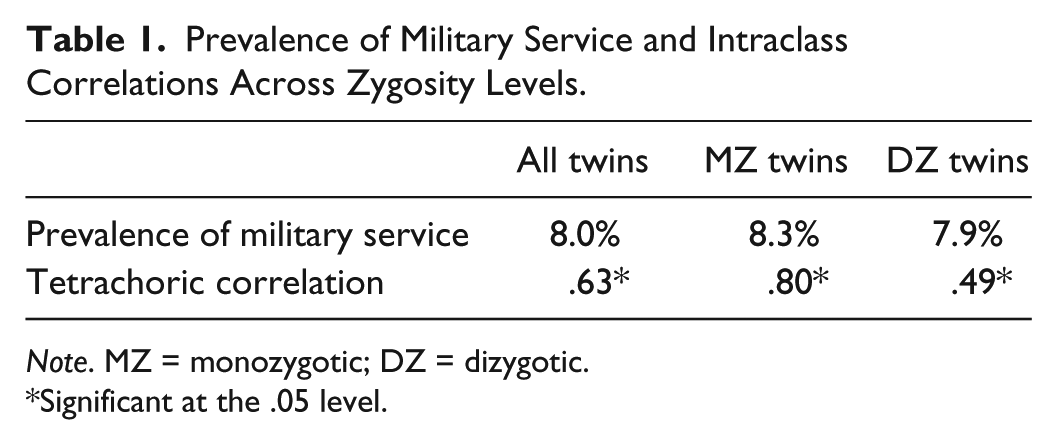
Military service was measured with a single dichotomous variable that represented whether the respondent had ever served in the military. During Wave 4 interviews, respondents were asked whether they had ever been in the military. If the respondent indicated he or she had served in the military, then he or she was assigned a value of “1,” otherwise he or she was assigned a value of “0.” As Table 1 shows, overall, 8.0% of all twins indicated that they had served in the military and there was no significant difference (χ2 = .07, p = .79) in the prevalence of military service between MZ twins (8.3%) and DZ twins (7.9%).
Prevalence of Military Service and Intraclass Correlations Across Zygosity Levels.
Note. MZ = monozygotic; DZ = dizygotic.
Significant at the .05 level.
Results
The analysis for this study began by estimating intraclass (twin) tetrachoric correlations. Table 1 contains the tetrachoric correlations for the full sample of twins, the sample of MZ twins, and the sample of DZ twins. As can be seen, the tetrachoric correlations are statistically significant for all twins, as well as for twins of different zygosity. More important, the effect size of the correlation for MZ twins is about 39% greater than the effect size for DZ twins, suggesting that military service is at least partially heritable.
The next step in the analysis was to estimate logistic regression models to explore the association between one twin being in the military and his or her cotwin also being in the military. The results of these equations are presented as a series of line graphs in Figure 1 and the parameter estimates are included in the legend. Across all three samples (i.e., the full sample of twins, the sample of MZ twins, and the sample of DZ twins), there was a statistically significant association between one twin being in the military and his or her cotwin being in the military. Specifically, for the full sample the odds ratio (OR) was 12.39. For the zygosity-specific models, the OR for MZ twins was 26.30 while the OR for DZ twins was 7.08. Given that the effect size was more than 3 times as large for MZ twins than for DZ twins again suggests that military service is partially heritable.

Predicted probability of being in the military as a function of cotwin’s military status.
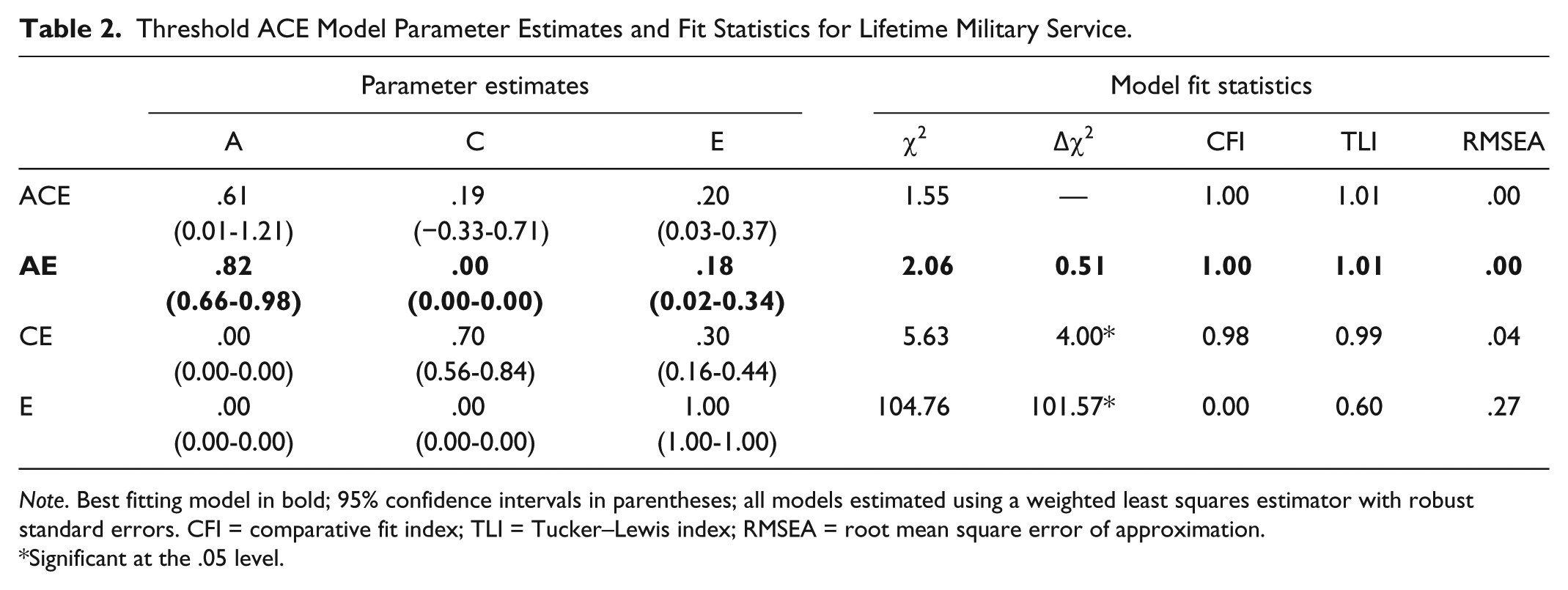
To provide direct estimates of genetic (A), shared environmental (C), and nonshared environmental (E) influences on military service, a threshold liability model was fitted to the data. The threshold model assumes that categorical and dichotomous variables possess an underlying normally distributed liability that allows for the decomposition of the overall variance in a measured phenotype into the A, C, and E factors (Neale & Cardon, 1992). The comparative fit index (CFI), the Tucker–Lewis index (TLI), the root mean square error of approximation (RMSEA), and the chi-square (χ2) were used to identify the best fitting model. In addition, Wald’s tests of parameter constraints were used to compare the full ACE model with each of the possible nested models (the AE, CE, and E models) in an effort to identify the best fitting, most parsimonious model. More specifically, if the Wald’s tests revealed that the constraint of any of estimated parameters (aside from E due to the presence of measurement error) resulted in a nonsignificant change in chi-square (Δχ2), the nested model would be favored over the full model. All models were estimated using the statistical software package Mplus (Version 7.1) and included a robust weighted least squares estimator (WLSMV). The results, which are provided in Table 2, revealed that the AE model provided the best fit to the data, indicating that genetic influences explain approximately 82% of the variance in military service, with nonshared environmental influences explaining the remaining 18% of the variance. 1 The shared environment had no effect on military service.
Threshold ACE Model Parameter Estimates and Fit Statistics for Lifetime Military Service.
Note. Best fitting model in bold; 95% confidence intervals in parentheses; all models estimated using a weighted least squares estimator with robust standard errors. CFI = comparative fit index; TLI = Tucker–Lewis index; RMSEA = root mean square error of approximation.
Significant at the .05 level.
Discussion
Understanding the factors that promote enlistment in the military is a critical issue that has implications for the quality and functioning of the U.S. military. As a result, there has been a line of empirical research attempting to uncover the various factors that contribute to someone enlisting in the military. The results of these studies have identified a swath of factors, including family background variables, individual-level characteristics, and even recruitment strategies, that are associated with an increased likelihood of a youth joining the military (Bachman et al., 2000; Jackson et al., 2012). Despite these findings, much remains unknown about why certain people enlist in the military, whereas others do not. The current study sought to address this gap in the literature by estimating the extent to which genetic and environmental factors account for variation in enlisting in the military. Analysis of data drawn from twin pairs participating in the Add Health study revealed three key findings.
First, the results of the twin-based models revealed that 82% of the variance in lifetime military service was the result of genetic factors. Although these results indicate that genetic influences represent the strongest effect on the decision to join the military, it is important to point out that these findings are consistent with the larger behavioral genetic literature (Turkheimer, 2000). Most previous research has revealed that approximately 50% of phenotypic variance is accounted for by genetic variance and joining the military does not appear to be an exception to this general rule though the genetic effect might be somewhat larger. Future research is needed to determine whether this heritability estimate would be similar in other samples.
Second, the remaining 18% of variance was explained by nonshared environmental factors. To date, research has not examined the nonshared environmental factors that might be integral to joining the military. To examine specific nonshared environmental influences, genetically sensitive research designs need to be employed, such as the MZ-difference-scores approach (e.g., see Barnes & Meldrum, 2015; Beaver, 2008). With this design, all analyses are confined to MZ twins and differences in their environments are examined to determine whether they explain differences in certain phenotypes, such as joining the military. Future research would benefit by using such an approach as it would help to identify specific nonshared environments that might be salient to joining the military. Precisely which nonshared environments might be involved remains unknown at this point given that there is no research that has fully examined the specific nonshared environmental influences that might contribute to enlisting in the military.
Third, the results of our analysis revealed that none of the variance was accounted for by shared environmental influences. Although this finding might seem unique, it also represents one of the most consistent findings to emerge from behavioral genetic studies (Turkheimer, 2000). Although previous research has identified that some environments that are commonly viewed as shared environments, such as socioeconomic status, are linked to military enlistment, these studies are not genetically informative. What that necessarily means is that these findings might be biased owing to genetic confounding (Barnes, Boutwell, et al., 2014). More genetically sensitive research is needed, however, before any firm conclusions can be drawn about the role of the shared environment in the decision to enlist in the military.
Although the results indicate that genetic factors account for more than three fourths of the variance in military service, these findings should not be viewed as though genes determine who will and who will not serve in the military. There is now a significant amount of empirical research revealing that genetic effects can be amplified or dampened based on exposure to certain environments (Caspi et al., 2002; Rutter, 2006). These findings leave open the possibility that the genetic effects that were estimated in this study could be modified based on different types of recruiting strategies or public campaigns. We were unable to explore this possibility in the current study, but future research would benefit by providing some direct tests of the various environments that might be able to moderate genetic influences on military service.
The findings reported in this study should be viewed cautiously in light of several limitations that also set the stage for future research on this particular issue. First, although the full Add Health sample is nationally representative, the sample of twin pairs that were analyzed in the current study is not necessarily nationally representative. Previous research, however, has examined the potential differences that might exist between the full sample and the sample of twin pairs and did not detect many meaningful differences between the two in terms of demographic characteristics, social factors, and behavioral/personality items (Barnes & Boutwell, 2013; Beaver, 2008; Jacobson & Rowe, 1998).
Second, military service was measured only through a dichotomous variable tapping lifetime involvement in the military. It would be interesting to determine whether the genetic effects on military service varied across different branches of the military. Unfortunately, the relatively small sample size precluded us from exploring this possibility. Third, it would be informative to examine whether military service covaries with other traits and personality styles, such as leadership acumen (Li, Arvey, Zhang, & Song, 2012), because of underlying genetic architecture that influences both traits. Moreover, there is some emergent evidence that variation in dopaminergic and serotonergic genes are associated with levels of job satisfaction (Song, Li, & Arvey, 2011). Future research should be able to shed light on whether similar effects operate to influence feelings regarding military service.
Last, information regarding performance in the military or the ultimate outcome of military service (e.g., honorable discharge, etc.) was not available in the Add Health data. Research conducted moving forward will help to explore the genetic and environmental influences that might explain performance in the military once an individual decides to join the armed services. Until these limitations are addressed with different samples, and the findings are replicated, the results reported in this study should be viewed as preliminary and should not be used to draw any firm conclusions about the nexus between genes and military participation.
Footnotes
Acknowledgements
This research uses data from Add Health, a program project designed by J. Richard Udry, Peter S. Bearman, and Kathleen Mullan Harris, and funded by a grant P01-HD31921 from the Eunice Kennedy Shriver National Institute of Child Health and Human Development, with cooperative funding from 17 other agencies. Special acknowledgment is due Ronald R. Rindfuss and Barbara Entwisle for assistance in the original design. Persons interested in obtaining data files from Add Health should contact Add Health, CarolinaPopulationCenter, 123 W. Franklin Street, Chapel Hill, NC27516-2524 (HYPERLINK “javascript:main.compose(‘new’,’t=addhealth@unc.edu’)”
Declaration of Conflicting Interests
The author(s) declared no potential conflicts of interest with respect to the research, authorship, and/or publication of this article.
Funding
The author(s) received no financial support for the research and/or authorship of this article.