




Abstract
Social platforms have become an important force in driving consumer decisions through content marketing, due to their wide reach and precise targeting. Based on Philip Kotler’s consumer decision making process, this study uses the LDA topic model to identify types of content marketing for agricultural products and key factors that influence consumer behavior at the advocate stage. It also applies grounded theory to explore the internal mechanisms of interaction across the aware, appeal, ask, act, and advocate stages in content marketing for agricultural products on social platforms. A theoretical model of key influencing factors and impact pathways is developed. The results show that common types of content marketing for agricultural products include the origin traceability type, daily situational type, product recommendation type, key opinion leader type, and selling pitiful type. Different content marketing types influence consumers’ source credibility awareness and flow content during the aware and appeal stages. This triggers either emotional identification or psychological reactance, which affect perceived risk at the ask stage and purchase behavior at the act stage. Consumer planned behavior moderates the relationship between perceived risk and purchase decisions, with some consumers bypassing risk perception and purchasing directly. At the advocate stage, emotional identification motivates consumers to share and recommend content according to their consumer demand hierarchy, shaping their ongoing behavior. Consumer feedback on product sensory characteristics, logistics, pricing, service attitude, and repeat purchase recommendations supports continuous improvement of content marketing strategies. The conclusions offer strategic guidance for content marketing of agricultural products on social platforms and support a sustainable content marketing ecosystem.
Plain language summary
Content marketing on social platforms plays a key role in promoting agricultural products, yet faces challenges such as repetitive content, declining authenticity, and consumer fatigue. This study explores how different types of content influence consumer decisions throughout five key stages: Aware, Appeal, Ask, Act, and Advocate. Using algorithms, we identify five common content types and link them to typical consumer feedback. We find that each type affects consumers through different paths—such as building trust, evoking emotions, or reducing perceived risks. Consumer responses are not linear but involve back-and-forth between perception, emotion, judgment, and action. These insights help marketers create more effective content: In the aware stage, businesses and anchors can build trust by combining professional identity with real-life scenarios. They can also use verifiable materials and leverage platform mechanisms for credibility. In the appeal stage, everyday scenes, multimodal content, and immersive emotional experiences enhance resonance. In the ask stage, explaining potential risks, making specific promises, and using FAQ mechanisms help keep interest. In the act stage, behavioral nudges, strategies for repeat purchases, and light incentives drive conversion. In the Advocate stage, positive reviews serve as new content inputs, encouraging consumer participation and creating a cycle of positive sharing.
Keywords
Introduction
The Content Marketing Institute defines content marketing as a strategic marketing approach focused on creating and distributing valuable, relevant, and consistent content to attract and retain a clearly defined audience, and ultimately to drive profitable customer actions. Social platforms, as digital social media tools, allow users to interact, share content, and exchange information online. They provide an ideal environment and channel for content marketing. Agricultural products, as the foundation of food and clothing for human beings (J. H. Zhang, 2022), are not only suited for sales promotion through content marketing, but also for breaking market limitations, expanding brand influence, and building emotional connections with consumers. For example, from September 2023 to September 2024, Douyin E-commerce recorded 7.1 billion sales of local agricultural products. This shows that content marketing on social platforms has become an important way for consumers to discover and purchase agricultural products. In addition, content marketing has brought changes to the consumer decision making process. Content marketing uses emotional resonance, interactive presentation, and instant feedback to reshape this model. It shortens the decision path, builds consumer trust (Ma et al., 2020), and makes brands more attractive and competitive (Hollebeek & Macky, 2019). However, challenges in content marketing for agricultural products should not be ignored. First, there is a gap between types of content marketing and authenticity. Some content is created only to attract attention, using fake pitiful life experience scripts, fabricated unsold product stories, or vulgar performances that misrepresent rural life. This short-sighted pursuit of traffic undermines consumer trust and may damage the reputation built by agricultural products over many years. Second, viral success is easy, but long-term influence is hard to maintain. Many streamers lack the ability to sustain operations. After a brief rise in popularity, they quickly fade away, making lasting marketing for agricultural products difficult to achieve. Third, there is increasing content fatigue (Schivinski & Dabrowski, 2016). Celebrities, internet personalities, officials, and farmers all engage in content marketing, leading to more diverse forms, but also causing content homogenization, which weakens consumer interest. Therefore, how to maintain both freshness and authenticity in content while achieving sustainable market growth has become a key challenge for the long-term development of content marketing.
Existing studies have explored the factors influencing the effectiveness of content marketing from multiple perspectives, including internal and external business environments (Qian & Wang, 2024), characteristics of streamers, and user responses. Most studies directly link content marketing with consumer purchase intention. However, many of these studies treat content marketing as a homogeneous whole (X. M. Huang & Yao, 2024). They overlook its diverse forms and contextual adaptation on social platforms, and lack a systematic analysis of typical types of content marketing and their differentiated expression strategies. As a result, they fail to explain how businesses achieve precise targeting through different content marketing types. In addition, current research mainly focuses on outcome variables such as consumer purchase intention, click-through rate, and interaction behavior. These studies emphasize the “purchase” stage as a central point (He et al., 2020), but offer limited explanation of how different types of content marketing influence and interact with consumers across the full consumer decision making process, including the aware, appeal, ask, act, and advocate stages. Although some studies have adopted the S-O-R model (R. Li et al., 2025) or the Technology Acceptance Model (TAM; Z. G. Qiu & Yuan, 2023) to explore the influence path of content marketing, they often fail to investigate how content driven factors stimulate consumers’ emotional responses and guide them toward active sharing and consumer participation in promotion. This limits our understanding of the positive cycle of the content marketing ecosystem.
Therefore, based on the above issues, this study aims to address the research question of the theoretical mechanism, staged interaction, and circular pathway through which content marketing of agricultural products on social platforms influences the consumer decision making process. Specifically, the study explores the following:
What are the typical types of content marketing for agricultural products on social platforms, how do businesses position themselves, and what are the key factors that drive consumer advocate behavior?
What roles do different types of content marketing play at each stage of the consumer decision making process, including aware, appeal, ask, act, and advocate?
Does the consumer decision making process show a staged interaction path after consumers are exposed to content marketing for agricultural products?
How do consumer feedback behaviors at the advocate stage affect the ongoing evolution and improvement of the content marketing ecosystem?
In this study, we first collected text data from merchant profiles and online comments on agricultural products across social platforms. Using the LDA topic model, Gephi, and modular clustering, we identified types of content marketing and key drivers of consumer advocate behavior. We then conducted consumer interviews and applied grounded theory to explore the internal interaction mechanism across the Aware, Appeal, Ask, Act, and Advocate stages. By integrating LDA and grounded theory results, we developed a theoretical model illustrating the key factors and influence pathways of content marketing for agricultural products on social platforms. Finally, we interpreted the model to inform more effective content marketing strategies for merchants.
The remainder of this paper is structured as follows. The Literature Review and Theoretical Foundation section reviews prior studies on content marketing, content marketing types, the consumer decision making process, 5A theory, source credibility awareness, and flow content theory. The Research Design section outlines the framework, methodology, data selection, and interview content. The Research Process and Model Construction section details the identification of content marketing types and consumer response factors using the LDA model, and the construction of 5A mechanisms through grounded theory. The Model Interpretation and Analysis section presents key findings, including influencing factors, mediating effects, and moderating mechanisms. The Conclusion summarizes the study, while the Research Significance discusses its theoretical and practical contributions. The Limitations and Future Research section highlights study limitations and future directions.
Literature Review and Theoretical Foundation
Impact of Content Marketing on Consumer Decision Making Process
Creating and delivering the right content has facilitated the consumer decision making process (C. Q. Li et al., 2022). Existing studies on content marketing and consumer behavior mainly focus on stages such as consumer aware, appeal, ask, and act. In the process of attracting consumer attention, simple and direct live broadcasts or videos sensorially stimulate consumers’ nerves, making it easier to capture their aware, which then enters the perceptual system and eventually prompts consumer behavior (H. Wang, 2021). Y. N. Wang et al. (2021) proposed that interaction and identification help form consumer attention. Content marketing, by highlighting the logic of consumer subjectivity, can transform attention. Emotional consumption reflects participation and trust in live broadcasts, thus ensuring the continuity of aware. In the process of attracting consumer appeal, research found that enjoyable live broadcast scenarios, user participation motivation, and positive emotional states can trigger users’ interest in participation (W. Huang et al., 2024; L. J. Jiang, 2023). In the ask process, studies found that consumer inquiries about content quality (N. Wang et al., 2020), review depth, review positivity, and review timeliness (Y. N. Wang et al., 2021) can influence user trust in the product and the anchor. In terms of act, studies have shown that factors such as the authentic presentation of products (Gong et al., 2019), the anchor’s professionalism, the anchor’s physical attractiveness (W. Y. Qiu & Zhang, 2024), the audience effect (Y. Zhang et al., 2024), emotional communication (Shi et al., 2024), social interaction level (T. Chen et al., 2025), trust perception (L. C. Liu & Zhang, 2024), and after-sales service guarantee (Han et al., 2023) can promote consumer purchase behavior. (For relevant studies on the impact of content marketing on the consumer decision making process, see Table 1).
Existing Research on the Influence of Content Marketing on the Consumer Decision Making Process.

Although previous studies have demonstrated that content marketing plays an important role in influencing the consumer decision making process, there are still several limitations in the current literature.
(1) Lack of theoretical construction and comparative analysis of content mechanisms. Most research emphasizes formats such as livestreams or short videos, with limited exploration of different Types of Content Marketing and their underlying psychological mechanisms. The impact of content on consumer cognition and emotion across the Aware–Appeal–Ask–Act–Advocate pathway remains underdeveloped.
(2) Limited attention to the characteristics of agricultural products. Agricultural products require higher trust and involvement, distinguishing them from fast-moving consumer goods. However, current models often neglect product-specific features and fail to integrate mechanisms such as trust formation, Perceived risk, and Flow content into theoretical frameworks.
(3) Lack of insight into the dynamic logic of behavior stages. Many studies treat Aware, Appeal, Ask, and Act as parallel rather than sequential stages and often omit Advocate. They also adopt static perspectives, overlooking the evolving, interactive nature of consumer responses to content marketing.
(4) Methodological limitations. Most studies rely on surveys and experiments, which are limited in identifying structural features of content and the formation of consumer psychological responses. Content classification often depends on subjective judgment, while consumer perceptions are pre-assumed rather than grounded in theory.
To bridge these gaps, this study develops a dynamic model of the consumer decision making process based on the 5A pathway. By integrating LDA topic modeling with grounded theory, it systematically identifies Types of Content Marketing and content driven factors, contributing to the theoretical construction and process-oriented understanding of content marketing in the agricultural sector.
Theoretical Foundation
Content Marketing and Types
Content marketing refers to the strategy of attracting, educating, and retaining target audiences by creating and distributing valuable content, thereby driving business growth and brand loyalty (Holliman & Rowley, 2014). High-quality content not only effectively showcases the unique attributes and production processes of agricultural products, but also stimulates consumers’ desire to purchase and advocate for these products. For example, content marketing can help consumers build trust and promote sales by introducing the product’s origin and production process. Content marketing(ng can also drive regional development by attracting more market attention and investment, thereby improving regional economic and cultural levels (Y. D. Huang & Yang, 2025).
Existing classifications of types of content marketing primarily focus on the categorization of content types, with five main classification methods. In terms of emotions, content can be divided into positive information and negative information (J. J. Kim et al., 2022). In terms of content creation, the focus is on aspects such as humor, interactivity, breadth, depth, readability, and accuracy (Borah et al., 2020). In terms of presentation formats, content can be categorized based on elements such as pronouns, text, images, links, and videos (Labrecque et al., 2020). In terms of content characteristics, it can be divided into emotional information, search-oriented information, product information, and so on (Kupfer et al., 2018). Regarding the purpose of content, content marketing is categorized into educational, inspirational, entertaining, and persuasive types.
The 5A Model of Content Marketing
The 5A model, proposed by Kotler et al. (2017), reflects changes in consumer behavior in the digital era, emphasizing autonomous information access, social media influence, and consumer participation. It outlines five stages: Aware refers to the initial exposure to brand or product information, where content marketing emphasizes strong visuals and frequent dissemination to attract attention (Batra & Keller, 2016). In the Appeal stage, consumers develop interest or emotional identification, influenced by product functionality and narrative, with content marketing fostering resonance and conveying brand values (J. Zhang & Mao, 2016). Ask involves consumers actively seeking further information, with interactivity and transparency enhanced through tools such as comments, livestreams, and user generated content, which help build source credibility awareness (Minimol, 2022). In the Act stage, consumers make purchase decisions based on accumulated trust and practical factors like price and convenience, and content marketing reduces perceived risk to facilitate conversion (Sharkasi & Agag, 2024). Advocate describes satisfied consumers engaging in repeat purchases and brand promotion, completing the content marketing loop (Wilk et al., 2021).
Compared to the AIDA model, the 5A model offers a more holistic view by emphasizing social influence and consumer participation, especially in the Ask and Advocate stages. This study adopts the 5A model to examine how different types of content marketing influence consumer behavior across all stages, providing a practical and theoretical foundation for understanding content marketing on social platforms.
Research Design
Method Positioning
This study adopts a mixed-methods approach combining Latent Dirichlet Allocation (LDA) topic modeling and grounded theory to identify types of content marketing and construct a model of the consumer decision making process. LDA extracts two core elements from social platform text data—types of content marketing and consumer advocacy focus—which provide the basis for theoretical development. Grounded theory, supported by in-depth interviews, verifies the alignment of LDA-identified types with consumer perceptions and explores how advocacy focus fosters trust and drives behavioral conversion. While LDA offers empirical support for content classification, grounded theory uncovers the path logic from recognition to decision. The integration of both methods establishes a complete research cycle, enhancing the study’s theoretical depth and practical relevance.
The research process consists of two main stages. First, content marketing for agricultural products on social platforms features diverse and evolving formats aimed at different consumer segments. Identifying these types and the focal points of consumer feedback requires large-scale text analysis. LDA, a machine learning–based method, is well suited to extracting and clustering content types and advocacy themes from platform data. In this study, LDA is implemented using the Gensim library in Python. The process includes text collection, stop-word removal, word segmentation (via Jieba for Chinese), TF-IDF vectorization, and topic modeling. The optimal number of topics is determined by evaluating perplexity and coherence scores across a range of topic numbers (1–15). The resulting topic distributions and keywords are further refined by analyzing semantic similarities and constructing a co-occurrence network using a modularity-based clustering algorithm in Gephi to enhance topic distinction.
Second, grounded theory is employed to inductively build a theoretical model based on consumer perceptions and behavioral logic. Semi-structured interviews are conducted to validate and enrich the characteristics of agricultural products content marketing types identified through LDA. This method offers insights into how consumers progress through the 5A stages in response to different content types. Following Glaser and Strauss’s coding procedures—open, axial, and selective coding—the study iteratively analyzes interview data until theoretical saturation is reached. Grounded theory excels in extracting substantive theory from empirical data, complementing LDA’s strength in large-scale pattern recognition. Together, these methods provide a robust framework for constructing the internal mechanism model of how content marketing on social platforms influences consumer behavior.
Data Collection
LDA Topic Model Data Collection
This study uses Pujiang Dekopon on the TikTok platform as a case to explore types of agricultural product content marketing and key drivers of consumer advocacy. Data were collected from TikTok accounts promoting Pujiang Dekopon with over 5,000 units sold between March 9 and April 7, 2024. A total of 43 accounts with complete profiles, video topics, and captions were included, yielding 371 content pieces and 38,556 consumer comments related to product cards.
TikTok was selected for its significant influence and leading role in China’s e-commerce content marketing. In 2023, users watched over 2 billion “seed planting” videos and 10.61 million related live broadcasts, reflecting its broad reach and diverse formats. Other platforms are less suitable: Xiaohongshu emphasizes lifestyle and fashion with limited fresh produce focus (Ou, 2024); WeChat’s private domain and Moments marketing limit viral potential and data access (D. Jiang & Zhu, 2023); Kuaishou targets lower-tier markets with low-price content styles, challenging agricultural brand building (Y. Z. Liu & Li, 2021). TikTok offers a stable base for follower growth and content-driven sales. From September 2023 to September 2024, TikTok E-commerce sold 7.1 billion agricultural specialty products, with live-streaming totaling 38.25 million hours and a 60% year-on-year sales increase driven by product shelf scenarios. Overall sales and order volumes rose by 170% and 61%, underscoring TikTok’s central role.
Pujiang Dekopon was chosen due to its brand recognition and market success. It earned China National Geographic Indication status in 2015 and was named “Most Influential Chinese Agricultural Regional Public Brand” in 2021. In 2023, it ranked among China’s top 100 regional brands. The 2025 “TikTok 38 Festival” report highlighted Dekopon as a favorite among female consumers. At the 2023 peak season, daily online deliveries reached 15,000 units. Five leading merchants recorded daily sales of 3 to 5 million yuan, with many small and medium merchants achieving 100,000 to 200,000 yuan. Its thick skin enables long-distance transport with low damage. The supply chain includes over 200 cold chain storage firms, 20 packaging enterprises, and more than 6,000 rural e-commerce businesses. Agricultural product online retail sales surpassed 3.3 billion yuan in 2023. Pujiang Dekopon thus represents a typical case for studying agricultural product content marketing on social platforms.
Grounded Theory Data Collection
The interviews were conducted both online via video and face-to-face during June 2024. After excluding respondents who had never purchased agricultural products on social platforms such as Douyin, a total of 60 respondents who had participated in agricultural product content marketing were interviewed in-depth. Among them, 41 women and 19 men, aged between 20 and 60, participated, including 29 students, 10 corporate employees, 6 government employees, 8 freelancers, and 7 retirees. The interview duration ranged from 20 to 40 min. Key interview questions included: Have you ever purchased agricultural products on social platforms? What types of agricultural product-related content do you frequently encounter? What types of content would make you stop and watch, and why? Do you have any concerns about this type of marketing? What factors would prompt you to make a purchase? If you were satisfied after purchasing an agricultural product, would you leave a positive comment? Would you feel inclined to recommend the product to your friends and family? Is this desire to share similar to that with other products such as daily necessities? The interviews were recorded with the consent of the participants and transcribed into textual data. After the interviews, three-quarters of the interview transcripts were used for coding analysis and model construction, while the remaining quarter was retained for theoretical saturation testing. It should be noted that almost all respondents had participated in agricultural product content marketing on multiple social platforms, mainly Douyin, Xiaohongshu, and Kuaishou. Analysis of the interview results revealed no significant differences in the types and processes of agricultural product content marketing across platforms, and many influencer accounts engage in cross-platform marketing. Therefore, platform differences do not affect the research findings.
Research Process and Model Construction
Identification of Types of Agricultural Product Content Marketing and Key Factors of Consumer Advocacy Based on the LDA Topic Model
Identification of Agricultural Product Content Marketing Types on Social Platforms
In the LDA topic model, perplexity is an indicator used to measure the model’s predictive power on unseen data (see Equation 1). Specifically, M denotes the number of documents (i.e., the total number of documents in the corpus).

The core idea of coherence is to evaluate the correlation among high-probability words within a topic, namely the co-occurrence of topic words in the corpus, which reflects the interpretability and rationality of the topic (see Equation 2). Specifically,

As shown in Figure 1, the perplexity curve demonstrates a downward trend as the number of topics increases. This is because a greater number of topics may lead the model to split already clear topics into more fine-grained ones, resulting in overfitting and thus lower perplexity. Therefore, it is necessary to determine the number of topics in conjunction with the coherence curve. The coherence curve shows that when the number of topics reaches 9, the coherence value peaks, and then gradually stabilizes with further increases in the number of topics. Consequently, the perplexity and coherence curves both support the formation of nine distinct and independent topics (see Appendix 1 for detailed values).

Perplexity and coherence of content marketing types under different numbers of topics.
Using LDA topic classification, the top 10 high-frequency characteristic words for the nine topics of agricultural product content marketing types were extracted, as illustrated in Table 2.
Distribution of High-Frequency Characteristic Words for Agricultural Product Content Marketing Types.

Based on the LDA model’s word clustering results, each topic was manually labeled following conventional practice. Topic 1, Personally tested product recommendation, centers on authentic experiences and personalized suggestions. Topic 2, Positive life attitude, promotes optimism and reliability to shape a trustworthy brand image. Topic 3, Resonant life scenario, builds relatable daily narratives. Topic 4, Instructional product demonstration, provides detailed functional explanations. Topic 5, Pitiful life experience, evokes empathy through emotional storytelling. Topic 6, Release entertainment attributes, delivers humor and relaxation. Topic 7, Celebrity endorsement, utilizes internet celebrities for exposure. Topic 8, Origin traceability direct supply, highlights geographical origin and natural advantages. Topic 9, Regional brand promotion, involves official Accounts supporting brand building and rural development.
To assess thematic distinctiveness, the relevance and importance of these nine Types of Content Marketing were further analyzed using Gephi’s modular clustering algorithm. Figure 2 presents a typology map where node size represents word frequency and edge thickness indicates co-occurrence strength. As shown, Origin traceability direct supply stands out as the dominant marketing type.

Clustering map of characteristic words for agricultural product content marketing types.
Based on the intrinsic connections among the nine Topics, five types of agricultural product content marketing on social media platforms were identified:
Origin traceability type (Topics 8 and 9) includes origin traceability direct supply and regional brand promotion. This type emphasizes natural attributes, cultural identity, and branding strategies (e.g., traceability codes, trademarks), enhancing source credibility awareness and brand recognition to build consumer trust.
Daily situational type (Topics 2 and 3) involves positive life attitude and resonant life scenario. Through vlog-style content and relatable identities (e.g., rural officials, young mothers, college students), it narrows psychological distance and embeds brand identity into everyday life, strengthening emotional connection.
Product recommendation type (Topics 1 and 4) includes personally tested product recommendation and instructional product demonstration. It draws from traditional advertising to deliver transparent feedback (e.g., personal trials, influencer picks) and showcase product usage (e.g., efficacy, methods), reinforcing perceived utility.
Key Opinion Leader type (Topics 6 and 7) is driven by influencers and celebrities who shape consumer opinions through high-traffic content. By creating humorous, relaxed, and professional content (e.g., comedy, stress relief), and leveraging celebrity credibility (e.g., Dong Yuhui, Oriental Selection), this type strengthens trust and drives the consumer decision making process.
Selling pitiful type (Topic 5) uses pitiful life experiences (e.g., disability, illness, unsold goods) and emotional storytelling to evoke empathy and social identification. Centered on philanthropic appeals, this type stimulates emotional engagement and encourages progression through the consumer decision making process.
Key Feedback on Consumer Advocacy Behavior in Content Marketing for Agricultural Products on Social Platforms
Similar to the determination of the number of Topics in agricultural product content marketing types based on perplexity and coherence, the feedback focus on consumer advocacy behavior is established through these metrics. As shown in Figure 3, the graphs of perplexity and coherence suggest a preference for forming five clear and mutually independent Topics. (See Appendix 2 for detailed values)

Perplexity and coherence of consumer feedback focus under different numbers of topics.
Through LDA topic classification, the top 10 high-frequency feature words for the five Topics of consumer advocacy behavior feedback were extracted, as shown in Table 3.
Distribution of High-Frequency Feature Words for Consumer Advocacy Behavior Feedback.

The characteristic words of Topic 1 reflect sensory perceptions such as taste, texture, flavor, appearance, and aroma of agricultural products, indicating consumers’ attention and feedback on product sensory characteristics. The characteristic words of Topic 2 highlight elements such as packaging, transportation equipment, delivery methods, and time information, which reflect consumer concern and feedback on logistics transportation. Topic 3 represents sales price measurement, capturing consumer attention to price transparency, cost performance, price fluctuations, and promotional pricing (e.g., offline discounts, great value, price increases, and special offers). Topic 4 is related to repeat purchase recommendation, indicating consumer satisfaction through repeat purchases (i.e., transaction frequency) and recommendation behaviors (e.g., repurchase and recommendation). Topic 5 reflects feedback on service attitude, capturing consumer concern with after-sales policies, customer service attitude, and service responsiveness (e.g., compensation, attitude, prompt resolution).
The above types of content marketing and key themes in consumer participation in promotion identified through LDA analysis correspond to the early-stage guidance of the consumer decision making process and the advocate phase, as illustrated in Figure 4.

The theoretical framework of key factors and influence paths in content marketing for agricultural products on social platforms.
Construction of the Internal Mechanism of the 5A Stage of Agricultural Product Content Marketing Based on Grounded Theory
Open Coding
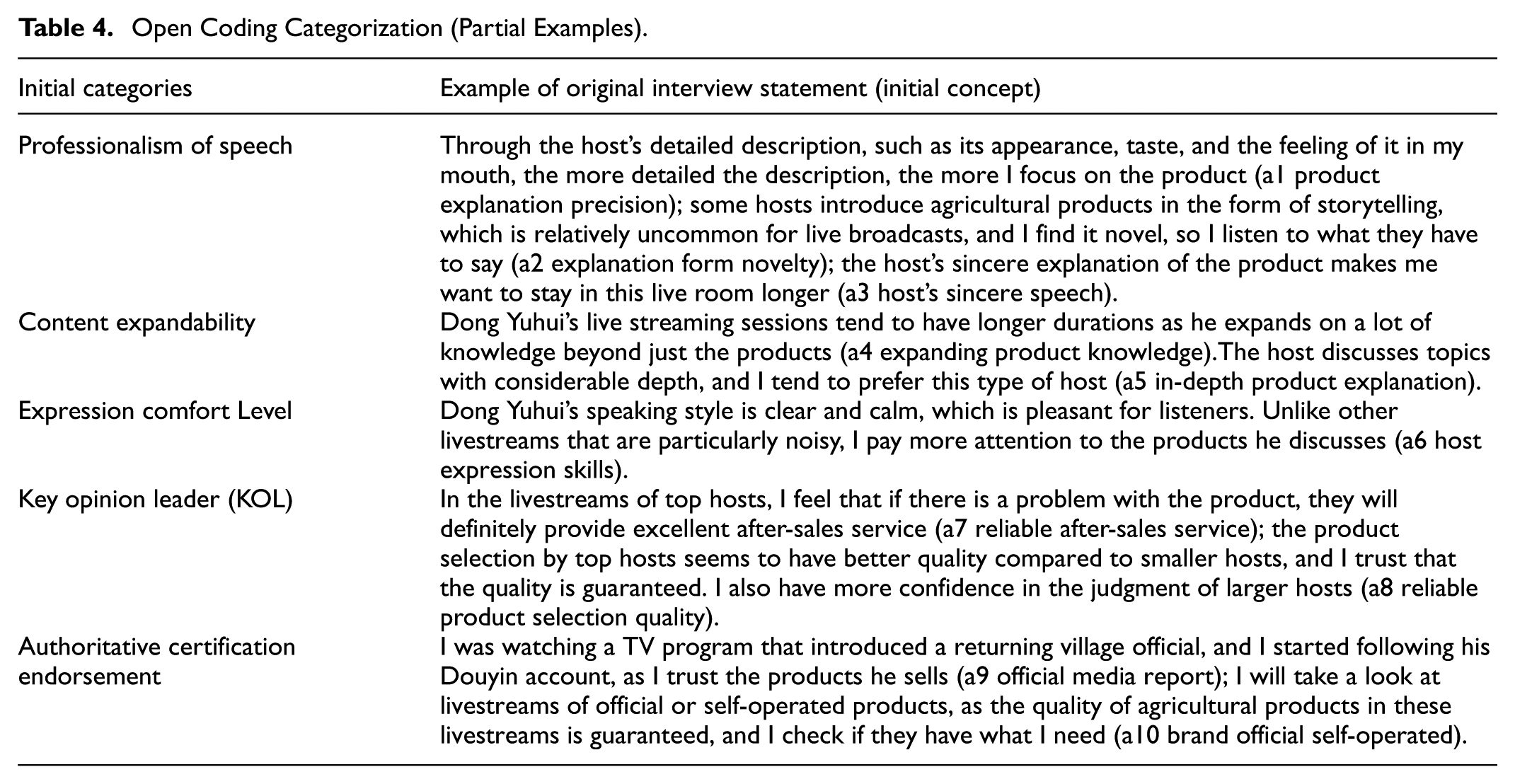
Open coding involves a word-by-word, sentence-by-sentence, and paragraph-by-paragraph analysis of raw data, assigning conceptual labels to the data to distil initial concepts and categorize them. To ensure the authenticity of the open coding process, this study utilizes the respondents’ original statements as the basis for extracting initial concepts. After extracting initial concepts from the raw interview data and eliminating concepts that appear fewer than three times, a total of 116 initial concepts and 48 initial categories were extracted from the interview data. Table 4 presents some of the resulting initial concepts and several initial categories.
Open Coding Categorization (Partial Examples).
Axial Coding
Axial coding aims to further differentiate between main categories and subcategories based on open coding, discovering and establishing connections between various categories. These connections can represent either logical relationships or process relationships. In this study, based on the conceptual and logical relationship analysis of each initial category, 22 subcategories and 9 main categories were identified. The main categories are source credibility, immersive content, consumer planned behavior, perceived risk, consumer purchasing behavior, consumer needs hierarchy, and consumer participation in promotion, as shown in Table 5.
Axial Coding Forming Main Categories.

Selective Coding
Selective coding is an in-depth refinement of the axial coding results. The analyzed “core categories” depict behavioral phenomena and contextual conditions in the form of a “storyline,” connecting them with both main categories and subcategories, ultimately forming a new theoretical framework. The typical relational structure of the main categories is shown in Table 6.
Typical Relational Structure of Main Categories.

Through iterative categorization and analysis of the main and subcategories derived from grounded theory, this study constructs an interaction framework of consumer decision making for agricultural product content marketing on social platforms (see Figure 4, Consumer Decision Making Process). Based on the continuous synthesis of themes and categories from both the LDA topic model and grounded theory, this study ultimately identifies the core category of “Key Factors and Pathways of Agricultural Product Content Marketing on Social Platforms.”
The narrative surrounding this core category can be summarized as follows:
During the content exposure phase (Aware and Appeal stages), different types of content marketing for agricultural products on social platforms influence consumers’ judgments of source credibility and flow content, triggering corresponding emotional and psychological responses. Exaggerated or manipulative content may induce psychological reactance and hinder decision making, whereas emotional identification can reduce psychological defenses, enhance content acceptance, and facilitate progression in the process. In the content persuasion phase (Ask and Act stages), source credibility, flow content, emotional identification, and psychological reactance jointly affect purchasing behavior. Consumers also evaluate perceived risk under the influence of content driven factors, while consumer planned behavior moderates the effects of these factors on perceived risk and purchase actions. In the content accumulation phase (Advocate stage), post-purchase emotional identification deepens based on the level of consumer demand hierarchy satisfied and emotional states, encouraging content sharing and product recommendation. Emotional identification thus acts as both a driver of sustained behavior and a feedback link between content dissemination and product content improvement, forming a virtuous cycle.
In summary, the alignment between content marketing types and consumer feedback identified by the LDA topic model, together with the grounded theory-based interaction framework across consumer decision making stages, constructs a closed-loop “narrative” of agricultural product content marketing. Based on this narrative, the study proposes a theoretical framework centered on the 5A model, mapping key factors and influence pathways of content marketing on social platforms (see Figure 4).
Theoretical Saturation Test
After continuing with open coding, axial coding, and selective coding on the remaining 1/4 of the original interview data, it was found that no new concepts, categories, or theoretical insights emerged. Additionally, some categories repeatedly appeared multiple times in the open coding, which essentially aligns with the model shown in Figure 4. Therefore, it can be concluded that the theoretical model constructed in this paper has reached theoretical saturation.
Model Interpretation and Analysis
Formation of the Aware and Appeal Stages: The Impact of Content Marketing Types on Content-Driven Factors
Content driven factors are key variables in content marketing shaped by content type characteristics that influence consumer cognition and emotion. They reflect how content presentation and style affect consumers’ psychological responses. According to the 5A consumer journey model, particularly the Aware and Appeal stages, content presentation plays a crucial role in forming first impressions and emotional engagement. This study selects four representative factors—source credibility, flow content, psychological reactance, and emotional identification—as core indicators to assess the influence of types of content marketing.
The Impact of Content Marketing Types on Source Credibility
Interview data show that the five types of agricultural product content marketing identified through LDA modeling shape perceptions of anchor or account professionalism, credibility, and attractiveness, aligning with the three dimensions of source credibility theory (Ohanian, 1990). Different content types affect each dimension:
Influence of different types of content marketing on consumers’ perception of anchor professionalism. Professionalism refers to the belief that the anchor has relevant expertise (H. Zhang et al., 2021). Key opinion leader type content often shows expertise through explanations and marketing skills. Daily situational type content conveys professionalism via high-quality, creative material (F. Wang & Jiang, 2021). Interviewees noted, “The orchard anchor explains clearly, so I stay longer,”“Daily life videos teach me useful things,” and “Dong Yuhui speaks calmly, unlike noisy livestreams.” These responses show professionalism is conveyed through language, breadth, and tone.
Influence of different types of content marketing on consumers’ perception of anchor or account credibility. In origin traceability type content, local farmers presenting on-site processes improve understanding and trust (L. Chen, 2024). Celebrity endorsement content builds trust through official or influencer endorsement (Erdem & Swait, 1998). Interviewees said, “Top anchors offer better after-sales service,”“I trust the village official I follow,” and “Flagship store livestreams seem more reliable.” These illustrate how credibility arises from authority and trust.
Influence of different types of content marketing on consumers’ perception of anchor or account credibility. Attractiveness refers to perceived charm or unique personality (H. Zhang et al., 2021). Visualization boosts appeal, and short videos and livestreams offer richer experiences than text (Bai et al., 2019). Participants shared, “A female anchor with a tidy home gains my trust.” These show content types shape positive images. Technical features of social platform e-commerce also support engaging services. As interviewees said, “High sales in origin traceability direct supply accounts attract me.” This reflects the role of visitor value in perceived attractiveness.
The Impact of Content Marketing Types on Flow Content
Analysis of interview data shows that different types of content marketing often lead consumers into a highly focused flow state, shaped by elements such as entertainment, visualization, usefulness, interactivity, and personalization. This aligns with flow theory, which refers to a deep psychological state of immersion when individuals are fully engaged in an activity (Csikszentmihalyi, 1975).
Entertainment embedded in content provides intrinsic stimulation, a key factor in entering flow(Martocchio & Webster, 1992). According to uses and gratifications theory, entertainment satisfies needs like escapism, relaxation, and emotional release (Yu & Xu, 2017). Interviewees noted, “He sang product introductions—I love that style,” and “Funny music and packaging made me stay.” These reflect how humorous performance and audiovisual design trigger immersion.
Visualization enhances information accessibility and fosters immersion (Skadberg & Kimmel, 2004). For example, origin traceability type content often shows natural settings and food preparation, making viewers feel present (Brakus et al., 2009). As one interviewee said, “The production area was beautiful, so I stayed,” while another shared, “They show fresh, juicy fruit—that attracted me.” Visual cues tied to the origin and sensory characteristics of products boost the immersive experience.
Usefulness refers to the relevance and informational value of content. Studies show that instructional product demonstration stimulates imagination and strengthens flow (Barsalou, 2008; Y. Wang & Zhang, 2024). Interviewees reported, “The vlog had fruit dessert recipes I liked,” and “If the product helps with sleep or digestion, I’m interested.” Such content not only educates but connects with personal needs, deepening engagement.
Interactivity is another important trigger of flow. Social interaction theory suggests people seek emotional expression and enjoyment online, contributing to immersion (Su & Hsaio, 2015). Interactive forms like lucky draws or real-time chats increase engagement (Hamari et al., 2014). As one viewer noted, “I like vloggers whose daily life feels similar to mine.” and another said, “When chats aren’t crowded, I join giveaways.” These experiences highlight how emotional expression and community settings facilitate flow.
Personalization also plays a role. Tailored content helps consumers feel noticed, increasing immersion (J. Wang & Li, 2015). Marketing of regionally distinctive agricultural products using localized stories or scenarios can arouse curiosity (H. Kim & Bonn, 2016). For example, “I’m curious about things not seen locally,” or “His rural lifestyle is rare—I want to know more.” Personalized storytelling deepens emotional connection and engagement.
The Mediating Role of Emotional Identification and Psychological Reactance in the Aware-to-Act Process
Interview data reveal that source credibility and flow content shaped by different types of content marketing can induce psychological fluctuations in consumers, influencing their purchase decisions. Some content prompts emotional identification, as consumers resonate with the anchor and develop positive emotions toward the product, while others trigger psychological reactance, marked by doubt or aversion that hinders purchase. This study conceptualizes these responses as key emotional variables and constructs a perception–emotion–behavior pathway to examine their mediating roles between content driven factors and consumer behavior. This mechanism reflects the Consumer Affection–Cognition (CAC) theory, which holds that external stimuli first undergo cognitive processing, followed by emotional responses, and finally lead to behavioral engagement or resistance. In this framework, source credibility, flow content, and perceived risk serve as perceptual triggers, while emotional identification and psychological reactance mediate purchase decisions.
Existing studies emphasize the mediating role of emotional responses in how content marketing influences consumer behavior. According to CAC theory, consumers first engage in cognitive evaluations, which elicit emotional reactions and subsequently shape behavioral decisions (Fishbein & Ajzen, 1975). In agricultural product content marketing, different content styles trigger distinct emotions. Daily situational anchors often evoke warmth and intimacy, enhancing emotional identification and promoting purchase (Y. Wang & Yang, 2023). In contrast, traffic-oriented or key opinion leader type anchors stimulate herd mentality or curiosity through high exposure, also encouraging purchase (Z. Li et al., 2023). These positive emotions reduce resistance and foster emotional bonds with the product. However, overly scripted or profit-driven content may trigger psychological reactance, a resistance to persuasion that results in avoidance or rejection (Rosenberg & Siegel, 2018). Thus, emotional identification and psychological reactance are key emotional mechanisms mediating the impact of content driven factors on consumer decisions, explaining why identical stimuli can yield different outcomes.
This mechanism is supported by interviewees’ statements. For example, one participant noted, “Daily situational anchors remind me of my childhood. I was really touched, so I placed an order,” reflecting emotional identification. In contrast, another stated, “Some pitiful live streams feel fake. I don’t believe them and won’t buy,” indicating psychological reactance. These quotes demonstrate how different content perceptions trigger emotional responses that influence consumer purchase behavior. Therefore, emotional identification and psychological reactance serve as key mediating mechanisms in the impact of content driven factors on consumer decision making.
Consumer Ask and Act Choices: The Outcomes of Content Driven Factors
The Direct Impact of Content Driven Factors on Consumer Purchasing Behavior
An analysis of the stages from Aware to Act reveals that source credibility awareness and flow content, shaped by different types of content marketing, directly influence consumer purchase behavior. Prior studies have shown that anchor credibility—including attractiveness, trustworthiness, and expertise—is positively associated with purchase decisions (Park & Lin, 2020), while content features such as entertainment, usefulness, and interactivity also enhance consumer engagement and conversions (Dong & Li, 2024; Y. Zhao et al., 2022). Interviewees offered supporting examples: “In origin traceability livestreams, the farmers look honest, and I can see the environment, so I placed an order,” and “Some anchors peel the fruit on camera, it’s so fun and fresh—I got curious and ordered.” These illustrate how source credibility and flow content drive purchases.
However, not all content types have a positive impact. For instance, one participant remarked, “Some origin traceability streams look fake, maybe green screen. I won’t buy,” and another said, “Selling pitiful stories seem touching, but I doubt their truth. I don’t trust them enough to buy.” These examples show that consumers often choose not to buy when they are skeptical about the content shaped by different Types of Content Marketing.
The Mediating Role of Perceived Risk in the Impact of Content Driven Factors on Consumer Purchasing Behavior
Interview data reveal that many consumers conduct risk assessments before purchasing. Based on Perceived risk theory, this study classifies risks into six dimensions: financial, functional, social, psychological, physical, and time-related. These collectively shape consumers’ internal evaluations, mediating the relationship between content driven factors and purchase behavior. This aligns with the Stimulus-Organism-Response (S-O-R) model, where content driven factors act as external stimuli, influencing internal states—Perceived risk—which in turn affect consumer actions.
Previous research has found that sellers’ behavior significantly impacts Perceived risk (Wang et al., 2020). Under the influence of Flow content and Source credibility awareness in different Types of Content Marketing, consumers assess risk from multiple perspectives: price transparency and discount reliability (financial risk), product sensory characteristic and reputation (functional risk), food safety (physical risk), platform reliability and service policy (social risk), delivery efficiency (time risk), and psychological dependence (psychological risk; C. Zhang & Fan, 2023).
When content reduces these perceived risks or builds trust, consumers are more likely to act. Otherwise, hesitation prevails. For example, one interviewee noted, “Popular anchors offer discounts. If the same branded Agricultural Product is cheaper than the flagship store, I’ll buy it.” Another said, “If reviews for Origin traceability content are mixed, I won’t buy.” Others mentioned evaluating ingredients despite strong recommendations, or only purchasing when comments praise service attitude. These responses highlight how consumers weigh multiple dimensions of risk before making decisions, confirming that Perceived risk mediates the effect of content driven factors on consumer purchasing behavior.
The Moderating Role of Consumer Planned Behavior
Based on interview data, consumers’ responses to Source credibility awareness and Flow content vary due to differences in attitude, subjective norm, and perceived behavioral control. Therefore, consumer planned behavior moderates the transition from Appeal to Ask and Act under the influence of content driven factors. This behavior includes rational demand and emotional impulse (attitude), social conformity and group norms (subjective norm), and perceived influence and urgency (perceived behavioral control).
According to the Theory of Planned Behavior (TPB), attitude reflects a consumer’s emotional and evaluative stance based on prior experience, shaping behavioral intention (Xiao & Zhang, 2021). Subjective norms reflect social pressure from influential others, affecting decision certainty (Aertsens et al., 2009). Perceived behavioral control captures self-efficacy in executing behavior and also influences intention formation (Kidwell & Jewell, 2003). Thus, consumer planned behavior shapes how content driven factors influence decisions. A highly interested or familiar consumer may act regardless of content type, while others assess Perceived risk before proceeding. High viewership and interactive livestreams may trigger urgency and social pressure, prompting impulsive action. Conversely, rational consumers may still engage in careful evaluation despite social cues.
Interviewees confirmed these patterns: “I regularly buy corn from the same seller, so content format doesn’t affect me,” and “If Agricultural Products are selling well and viewers are placing orders, I usually buy too without paying much attention.” Others said, “For less popular Origin traceability livestreams, I review feedback and listen carefully to decide.” These responses confirm that consumer planned behavior is a key moderator in the transition from content appeal to consumer inquiry and action.
Advocate Stage Drives Content Ecosystem Circulation: The Emergence and Feedback of Consumer Participation in Promotion
An analysis of the Advocate stage behavior reveals that agricultural product content marketing on social platforms often drives consumers to engage in promotional behavior after completing their purchase decisions. According to Expectation-Confirmation Theory (ECT), consumers’ post-purchase evaluation and advocacy behavior depend on the degree to which their expectations of the product are confirmed by actual experience (Oliver, 1980). Therefore, both content experience and actual product experience directly contribute to the generation of consumer feedback.
Influence of Different Types of Content Marketing Experiences on Consumer Participation in Promotion
From a content experience perspective, different Types of Content Marketing promote spontaneous recommendation and dissemination during the Advocate stage through distinct mechanisms such as emotional stimulation, social motivation, and identity recognition, thereby facilitating secondary diffusion.
Origin traceability type builds brand trust by highlighting product authenticity and source reliability, encouraging consumers to share their experiences based on credibility (F. L. Chen et al., 2021). Daily situational type evokes emotional resonance through relatable scenarios, prompting consumers to convert their usage into shareable, authentic word-of-mouth content (Xu & Li, 2024). Product recommendation type offers a mix of emotional appeal and rational information, including detailed functionality and personally tested recommendations, motivating consumers to advocate by helping others make informed choices (Filieri, 2015). Key opinion leader type leverages anchor professionalism and social influence to trigger follower imitation and herd behavior, promoting active sharing within social communities (Freberg et al., 2011). Selling pitiful type drives deep emotional resonance through narrative storytelling, motivating consumers to advocate not only for the product but also for its underlying emotional or social significance (Small & Verrochi, 2009).
In summary, these five content types support the transformation from attention to action and ultimately to advocacy, contributing to a closed-loop communication model in which user-driven word-of-mouth enhances content visibility and credibility. This reinforces the study’s theoretical proposition that consumer behavior in the Advocate stage is not solely driven by post-purchase satisfaction but also shaped by emotional attachment and psychological alignment with the content.
Influence of Consumer Purchasing Behavior on Consumer Participation in Promotion
As revealed through the LDA topic modeling analysis of comment content, consumer participation in promotion typically includes feedback on products, prices, services, and logistics, along with promotional comments mentioning repeat purchase behavior. Previous research has shown that when consumers are satisfied with a product or service, they are more likely to leave positive reviews and share their pleasant experiences. Conversely, when a product or service fails to meet expectations, consumers tend to generate negative reviews, complaints, or expressions of dissatisfaction (Lappas et al., 2016). Other studies have found that consumers are more inclined to comment on content posted by anchors or accounts that invest more effort in product presentation or have strong traffic effects, such as celebrities or internet influencers (Morales, 2005). According to some interviewees, “I only write a comment when the product is either very good or very bad,”“when a product is excellent in appearance, I post a short video to show off,”“if it’s my favorite celebrity or anchor, I support them in the comments,” and “half of the oranges I bought were dried out, and the customer service didn’t help properly, so I gave a negative review.” These findings indicate that the actual outcomes of consumers’ purchase behavior directly influence their promotional behavior.
The Moderating Role of Consumer Demand Hierarchy in the Transition From Purchase to Advocacy
Consumers’ progression from the Action stage to the Advocate stage varies according to their position within the Consumer Demand Hierarchy. Based on Maslow’s theory of human motivation, individuals derive utility from fulfilling five levels of needs-physiological, safety, belonging, esteem, and self-actualization-which in turn moderate their post-purchase behaviors.
This study finds that the total utility generated from these needs significantly influences consumers’ willingness to participate in promotion. For instance, physiological needs may be satisfied through cashback, discounts, or lotteries (Yang & Peterson, 2004), driving feedback behavior when material incentives are provided. Safety utility may emerge when consumers post negative feedback to voice dissatisfaction and protect future consumption. Belonging utility is reflected in behaviors such as joining fan groups or engaging in community-driven live streams, which foster a sense of inclusion. Consumers also pursue esteem utility by sharing reviews or unboxing videos to help others. Finally, self-actualization utility motivates feedback as a form of altruism or contribution to public welfare.
Interview data support these distinctions. Some participants stated they would only comment if given financial incentives, while others expressed dissatisfaction publicly after negative experiences. Some reported leaving feedback to connect with a fan community, while others shared product content as a habitual or socially driven practice. One interviewee explained, “I like recording unboxing videos because it helps others.” Another added, “I leave comments whether products are good or bad-I just want to be helpful.”
These findings demonstrate that consumers’ engagement in post-purchase promotion is not uniform but moderated by the utility derived from different levels of need. This deepens understanding of how motivation influences the behavioral transition from action to advocacy within the 5A framework.
Conclusions
First, this study is the first to apply bidirectional LDA modeling to identify five core Types of Content Marketing on the supply side—origin traceability, daily situational, product recommendation, key opinion leader, and selling pitiful types—and five consumer feedback themes on the response side—product sensory characteristic, logistics transportation, sales price measurement, feedback on service attitude, and repeat purchase recommendation. These represent multidimensional strategies targeting consumers’ emotions, rationality, trust, social identity, and public welfare awareness, as well as consumers’ concerns over product value and content reliability. This dual discovery provides empirical evidence for aligning upstream content strategies with downstream consumer feedback in the Advocate stage, forming a theoretical basis for the cycle of “content production–consumption–regeneration.”
Second, grounded theory analysis reveals how each Content Type influences distinct stages of the Consumer Decision Making Process via differentiated mechanisms. Origin traceability type enhances source credibility awareness and flow content, fostering rational trust in the Aware to Appeal stages. Daily situational and selling pitiful types evoke emotional identification or psychological reactance through identity resonance and emotional arousal, affecting the Appeal to Ask transition. Product recommendation type emphasizes functional value and consumption utility, shaping perceived risk and motivational factors. Key opinion leader type triggers social influence and conformity behavior through brand endorsement. These pathways involve diverse perceptual, emotional, and evaluative mechanisms—such as source credibility, immersive experience, emotional identification, and six dimensions of perceived risk—forming a dynamic “type–pathway–decision” system in which consumers cycle, loop, and weigh decisions non-linearly under multiple influences.
Third, the study establishes a “feedback–regeneration” mechanism, explaining how the Content Marketing ecosystem achieves a closed loop. In the Advocate stage, driven by self-actualization and social expression, consumers engage in commenting, recommending, and sharing repeat purchases. These behaviors enhance content credibility and visibility, offer social proof, and strengthen brand influence. Through the cognition–action–feedback loop, platforms can refine content strategies, and anchors can iterate content based on user input, fostering a multi-round positive cycle.
In sum, this study fills a key gap by linking Content Types with stages of consumer behavior and proposes a closed-loop model that integrates the 5A model, CAC theory, and related constructs, offering a structural and dynamic understanding of Content Marketing on Social Platforms.
Research Significance
Theoretical Contributions
The research yields key theoretical breakthroughs in the following areas:
First, it challenges the conventional assumption of Content Marketing as a homogeneous construct and highlights the heterogeneity of content expressions. Existing research often treats Content Marketing as a unified strategic variable, primarily focusing on its overall impact on consumer purchase intention or brand awareness (He et al., 2020), while paying limited attention to contextual adaptability and structural differences in actual applications. This study uses LDA modeling to identify five dominant Types of Content Marketing in short video comments on Agricultural Products, offering an empirical basis for content stratification.
Second, it develops an interaction model of “Content Types–Consumer Pathways,” enriching the application logic of the 5A model in social contexts. The 5A consumer decision making process proposed by Kotler et al. (2017) emphasizes a behavioral chain from Aware to Advocate, but lacks clarity on what kind of content affects which stage and how. This study finds significant variations in the impact mechanisms of different Content Types along the 5A pathway-for example, Origin Traceability Type enhances rational trust, Selling Pitiful Type triggers emotional resonance, and Key Opinion Leader Type stimulates social influence. These findings advance Content Marketing research from a static structure toward a dynamic evolution process, and provide theoretical support for stage-based content strategy alignment.
Third, the study systematically introduces the dual mechanisms of Emotional Identification and Psychological Reactance. Most models of Content Marketing emphasize positive stimuli and rational evaluations (Y. Wang & Yang, 2023), often neglecting how content may provoke negative consumer emotions. This study integrates Source Credibility Awareness and Flow Content at the perceptual level, introduces opposing variables of Emotional Identification and Psychological Reactance at the emotional level, and incorporates Perceived Risk and consumer planned behavior at the behavioral level, thereby constructing a nonlinear cognitive-behavioral model that more closely reflects real consumer journeys on Social Platforms.
Fourth, the proposed mechanism of content reproduction extends the ecological perspective of Content Marketing. Although user-generated content (UGC) has gained wide attention in brand marketing (Vo et al., 2024), there remains a lack of systematic understanding of how consumer behaviors in the Advocate stage—such as comments, recommendations, and repeat purchases—feed back into content design. This study utilizes LDA to mine themes of consumer feedback from comments and finds that feedback on product sensory characteristic, logistics transportation, and sales price measurement has become a vital resource for platform-based content reproduction.
Practical Implications
In the context of increasingly path-dependent consumer behavior and fragmented decision-making on Social Platforms, Content Marketing for Agricultural Products must move beyond single-point strategies and adopt refined content deployment along the consumer perception pathway.
In the aware stage, “whether it is trustworthy” precedes “whether it is worth buying.” Content professionalism is not about “sounding professional,” but about “being verifiable.” Building source credibility awareness is the first threshold for consumer retention. Merchants and anchors can establish trust by combining professional identity with authentic scenarios. Compared to traditional packaging, this “trust as entry” mechanism better fits the high perceived risk of agricultural product purchases, reducing authenticity skepticism and content aversion.
In the appeal stage, the goal is not to inform, but to create experience; not to promote values, but to resonate emotionally. Emotional arousal and flow content enhance emotional resonance. Merchants should pair resonant life scenarios with multimodal content to boost engagement and immersion. Anchors can use a companion-like tone and integrate natural sounds and authentic labor visuals to increase presence. This stage aims to spark the initial emotional connection of “I’m willing to trust you,” laying the foundation for Ask and Act.
In the ask stage, preventive risk explanation is key to user retention. Consumers often read comments or send messages, with the core concern being “Is this reliable?” Content should provide specific assurances visually or verbally, such as illustrated delivery timelines, screenshots of policies, or visible service contacts. Anchors can add FAQ sessions or pin answers in comments to reduce customer loss from information asymmetry. For price-sensitive products, explaining pricing structures like logistics or labor costs helps reduce perceived price opacity. Embedding verifiable, promise-based elements enhances rational evaluation and behavioral intention.
In the act stage, the driver is not the “reason to buy,” but the “excuse to order.” Conversion relies on micro-motivation and social conformity. Anchors should highlight behavioral cues to create a purchase atmosphere, guide repeat purchase logic, and offer light incentives like “cashback for referrals,” linking purchase with willingness to promote. Content becomes more than a “promotion carrier”—it triggers action by combining emotional value with social identity.
Limitations and Future Research
This study constructs a closed-loop model of Content Types, Perceived Pathways, and Consumer Feedback based on LDA topic modeling and grounded theory, aiming to reconstruct the dynamic evolution logic of Content Marketing on Social Platforms. However, several limitations remain, requiring further research and refinement:
Since this study is exploratory in design, it has not yet systematically validated the model pathways. Future research may adopt a multi-method approach to enhance theoretical rigor and model robustness. Specifically, Partial Least Squares Structural Equation Modeling can test the linear and sequential relationships among key variables, particularly suited to the chain-like paths across multiple consumer decision-making stages. Fuzzy Set Qualitative Comparative Analysis can further uncover multiple causal configurations and examine interactions among content-driving factors. In addition, System Dynamics can simulate dynamic changes and feedback loops in the purchasing process, capturing the closed-loop nature of agricultural products content marketing. These complementary methods enable a more comprehensive validation of the model from structural, configurational, and dynamic perspectives.
The sample is drawn from Chinese social platforms, reflecting cognitive psychology and interaction logic within a local context, which introduces contextual limitations. China’s digital agriculture policies, platform ecosystem, and user culture all shape content strategies and consumer responses. Future studies should conduct cross-cultural comparisons across different countries, platform mechanisms, and cultural contexts to assess the model’s applicability and stability, enhancing its international relevance and theoretical generalizability.
Footnotes
Appendix
Perplexity and Coherence Values for Different Topic Numbers of Consumer Feedback Focus.

| Num topics | Perplexity score | Coherence score |
|---|---|---|
| 1 | −3.9162909121472116 | 0.24877872512107727 |
| 2 | −4.202057013541406 | 0.26833842208444840 |
| 3 | −4.3916856212088256 | 0.26631976087415127 |
| 4 | −4.562382222274158 | 0.24644413104824428 |
| 5 | −4.706443991821328 | 0.29659878888898050 |
| 6 | −4.827106922784139 | 0.23863599142100952 |
| 7 | −4.921429231421847 | 0.22792416147826630 |
| 8 | −4.979061466380307 | 0.25026917096338275 |
| 9 | −5.041751545685117 | 0.27436253623566687 |
| 10 | −5.118796752547547 | 0.24589292128584903 |
| 11 | −5.17877620124802 | 0.23945079978701414 |
| 12 | −5.236472972659504 | 0.24734854683074145 |
| 13 | −5.287209541268235 | 0.24987656518154094 |
| 14 | −5.344813583787367 | 0.23630933549516103 |
| 15 | −5.397406425591112 | 0.2477778173021709 |
Acknowledgements
The authors are very thankful for the Editors’ and anonymous reviewers’ comments.

Ethical Consideration
The data used in the study was collected with full consent of the respondents and the data was anonymized to protect participant confidentiality.
Funding
The authors disclosed receipt of the following financial support for the research, authorship, and/or publication of this article: This study was funded by the National Social Science Fund of China (grant number 23GLB03699).
Declaration of Conflicting Interests
The authors declared no potential conflicts of interest with respect to the research, authorship, and/or publication of this article.
Data Availability Statement
Data are available for researchers upon request from the corresponding author.