




Abstract
Synthetic drug abuse has become an increasingly serious problem among adolescents in Macao, the world’s largest gambling market and the only legal gambling place in China. To counteract this trend, a good understanding of the culturally relevant risk factors for this behavior is required. Based on social learning theory and opportunity perspective of deviance, logistic regression analysis was performed on a probability sample of 8,076 Macao students collected in 2014 to investigate whether delinquent peer association, recreational use of time with friends, attitudes toward drug use, and the availability of synthetic drugs are significant predictors of synthetic drug use among adolescents. The analyses revealed that students who had more drug-using peers, perceived drug use to be less harmful, and had easier access to synthetic drugs were more likely to use drugs. The findings indicate that preventing synthetic drug use among adolescents should target individual risk factors and the availability of drugs.
The number of people who use synthetic drugs, such as amphetamine-type stimulants (ATS) and ecstasy, has increased in recent years across the globe (United Nations Office on Drugs and Crime, 2014). China is no exception. Official statistics show that the rate of synthetic drug use in China grew faster than the rate of natural drug use (China National Narcotics Control Commission Office, 2015), especially among the younger population. Nationally, approximately 75% of the 7 million synthetic drug users in mainland China are below the age of 35 years (China CCTV, 2015).
Although what fueled the rapid increase in synthetic drug abuse in China is not completely known, there seems to be little doubt that the popularity of synthetic drugs among youth and adolescents has played an important role shaping the trend. Unlike American youth who are more likely to use marijuana than any other illicit drug (Johnston, O’Malley, Miech, Bachman, & Schulenberg, 2017), adolescents in Asia, especially those in the Greater China Region, typically choose synthetic drugs as their drugs of choice. Official statistics released by the Food and Drug Administration of China (2014) show that people below the age of 18 years are far more likely to use synthetic drugs than traditional drugs. This pattern holds true in Macao, a Special Administrative Region of China and the only place in the country where gambling is legal. According to the surveys conducted by Macao’s Social Welfare Bureau in 2010 and 2014, methamphetamine and ketamine were the most frequently used drugs among young drug users in recent years (Macao Social Welfare Bureau, 2010, 2014). In consistency with the survey data, official statistics from the Central Registration System for Drug Abusers of Macao also show that young drug users registered in the system disproportionally used synthetic drugs such as methamphetamine and ketamine as opposed to traditional drugs (Macao Social Welfare Bureau, 2016).
To reverse the trend of increase in synthetic drug use among adolescents in the Greater China Region, we need countermeasures that are scientifically based and effective. A starting point in developing such countermeasures is to identify culturally relevant factors contributing to the problem. However, there has been little scientific evidence that can serve as a basis for building systematic understanding of the key driving forces leading to the spread of adolescent synthetic drug abuse in this region. Our study aims to contribute to the knowledge base through a population-based survey.
While large-scale representative studies are lacking, smaller studies using nonprobability samples have offered some suggestions of potential predictors of adolescent use of synthetical drugs in the Greater China Region. One of the key factors might be party culture, a form of socializing that has taken a strong hold in major cities in the region in the past several decades (Joe-Laidler & Hunt, 2008; Macau Daily, 2015; Zhou, 2016). Adolescents influenced by this culture tend to see synthetic drug use as a way to fit in with friends and to have fun in a party setting. They do not necessarily consider synthetic substances, such as ketamine, to be drugs at all. In their minds, traditional drugs, such as opium and heroin, are dangerous and should be avoided. To these young people, synthetic drugs do not pose the same risks and are acceptable to use, especially when doing it with friends (Lam, Boey, Wong, & Tse, 2004; Lee, 2007; Macau Daily, 2015; Zhou, 2016). Taking advantage of the demand created by party culture, drug dealers market synthetic drugs to adolescents as recreational consumer goods, promote the use of methamphetamine or ketamine as new types of fashion, and propagate the notion that the occasional use of synthetic drugs is harmless. They also offer discounts and incentives to attract young people to these drugs and encourage them to keep the habit (Meacher, 2013; Xiang, 2015). All of these circumstances surrounding party culture appeared to contribute to the increase in the recreational use of synthetic drugs in entertainment venues, such as KTVs (karaoke televisions) and dance clubs among adolescents and young adults. Second, a major change in the drug trafficking routes through Asia has boosted the supply of synthetic drugs in this region. The new trafficking route to Asia passes through Mexico, the Middle East, Southwest Asia, West Africa, and finally to drug-consuming countries in East and Southeast Asia, such as Japan and China. Methamphetamine, for example, is frequently trafficked from West Africa to South Africa or Europe and later to East and Southeast Asia (United Nations Office on Drugs and Crime, 2014; Wyler & Cook, 2011). This change has increased synthetic drug trafficking to Asia. At the street level, drug dealers increasingly rely on the sale of synthetic drugs for profit. These market conditions have increased the supply and use of synthetic drugs in this part of the world.
The primary purpose of the current research is to identify culturally relevant predictors of synthetic drug use among adolescents in Macao. Built on prior knowledge in this area, this study focuses on the modern party culture and drug availability while taking into account of other potential correlates of the delinquent behavior.
Literature Review
Lam et al. (2004) and Hunt, Joe-Laidler, Moloney, van der Poel, and van de Mheen (2011) attributed the spread of drug use among urban adolescents to the modern party culture, which places heavy emphasis on communicating with friends and regards the use of psychoactive drugs as a ritual, a form of recreation, and an activity enhancer (e.g., dancing and singing). Youth in the Greater China Region who are drawn to the party culture tend to share at least three characteristics. First, they have more unconventional friends and peer relationships. Second, they spend more time in recreational activities. Third, they have more favorable attitudes toward psychoactive drugs (Hua & Li, 2009; Perrone & Sanders, 2006; Xu, 2009; Zhang & Han, 2015). These three social and personal characteristics have each been shown to positively correlate with substance abuse (Arthur et al., 2007; Arthur, Hawkins, Pollard, & Catalano, 2002; Hawkins, Catalano, & Miller, 1992; Johnson, Marcos, & Bahr, 1987; Kandel & Andrews, 1987; Yanovitzky, 2005). Drug availability has also been found to be a significant predictor of illicit drug use. For many adolescents, drug use is a choice of pastime. They may start to use drugs when the activity is encouraged and approved by peers and when an illicit drug is readily available. First-time use does not usually require a lot of effort. Continuing use over a period of time, however, may depend more on one’s ability to obtain drugs. Either behavior is tied to the availability of drugs (Desmond, Bruce, & Stacer, 2012; Hogan, Tsui, & Ivanov, 2003; Nargiso, Friend, & Florin, 2013).
Peer Influence, Time in Recreation, Attitudes Toward Drugs, and Addictive Behavior
One of the strongest and most consistent correlates of delinquency in the criminology literature is the association with delinquent peers, especially during adolescence when the relationship with friends supersedes the relationship with parents (Thornberry, 2005). According to the social learning theory, individuals learn deviant behavior (e.g., drug use) through their associations with other people, such as family members, siblings, and peers (Akers & Sellers, 2009; Petraitis, Flay, & Miller, 1995). Individuals associated with deviant peers are more likely to hold attitudes favorable to deviance, learn the skills to commit crime, and engage in deviant or criminal behavior (Sutherland, Cressey, & Luckenbill, 1992). Many studies have indicated that association with substance-using peers is significantly and positively correlated with substance use among youth (Hawkins et al., 1992; Johnson & Hoffmann, 2000; Kaplan, Martin, & Robbins, 1984; Peralta & Steele, 2010). Perceived drug use in peer groups is also a strong predictor of adolescents’ attitudes and actual drug use (Iannotti & Bush, 1992; Simons-Morton & Farhat, 2010). A meta-analytic study comparing the influence of parents and peers found that peers and friends have stronger influences than parents on adolescent substance use (Allen, Donohue, Griffin, Ryan, & Turner, 2003). Research conducted in Hong Kong and Taiwan also found that peer influence contributed significantly to youth drug use (Laidler & Pianpiano, 2006; Shek, 2007). A similar pattern has been observed in Macao. Studies conducted by Li and colleagues (Li, Tang, Xia, & Zhang, 2016; Li, Zhang, Tang, Xia, & Lin, 2016) found that the association and time spent with delinquent peers were positively correlated to drug use among adolescents in Macao.
Furthermore, several studies examining the relationship between leisure activities and antisocial behavior have found that certain recreational activities (e.g., going out at night) increased the risk of problematic behavior (e.g., drug use) among youth (Berg, Aslanikashvili, & Djibuti, 2014; Mahoney & Stattin, 2000; Piko & Vazsonyi, 2004). Casual leisure activities, such as hanging out with friends for fun, were found to be associated with heavy drinking among high school seniors (Bachman et al., 2002) and first-year college students (Finlay, Ram, Maggs, & Caldwell, 2012). Piko and Vazsonyi (2004) found that peer-oriented or commercial-based leisure activities are positively correlated with problem behavior among Hungarian youth aged 14 to 19 years. Findings from Monitoring the Future consistently indicated that socializing with peers away from home and authority figures is closely related to deviant behavior (Johnston, O’Malley, Schulenberg, & Bachman, 2006).
A number of studies have found that juveniles who had favorable attitudes toward drugs and drug use were more likely to use drugs (Bretteville-Jensen & Jacobi, 2011; Hawkins et al., 1992; Kandel, Kessler, & Margulies, 1978). The perceived harms of drug use are especially important in predicting substance abuse. Studies have found that adolescents have a tendency to underestimate the harms of certain drugs, especially synthetic drugs that are designed to appeal to young people (National Institute on Drug Abuse, 2014). Furthermore, limited health literacy and the lack of personal awareness of the risks of substance use contribute to the misuse and/or abuse of psychotic drugs (Shek, 2012; Shone, King, Doane, Wilson, & Wolf, 2011). A study of 100 adolescent synthetic drug users in Shanghai, China, found that the respondents’ lack of understanding of the harmfulness of drugs and drug use was the main reason for their involvement in synthetic drug abuse (Fan & Li, 2012).
Drug Availability and Drug Use
The availability of drugs in community has also been identified as a significant predictor of the prevalence and frequency of adolescent drug use, especially for those who are prone to drug use because of delinquent peer associations, beliefs, or affectivity (Caviness, Tzilos, Anderson, & Stein, 2015; Coudun, Gégout, Piedallu, & Rameau, 2006; Dembo, Farrow, Schmeidler, & Burgos, 1979; Gillmore et al., 1990; Lettieri, 1980; Smart, 1980; Teichman, Barnea, & Rahav, 1989). This idea is highlighted in the availability-proneness theory of drug abuse proposed by Reginald Smart, which contends that drug abuse is more likely to occur when a drug-prone individual is exposed to a high level of availability (Smart, 1980). This notion is consistent with the opportunity perspective in the criminology literature. In their popular book A General Theory of Crime, Gottfredson and Hirschi (1990) argued that people with low self-control, characterized by impulsiveness and risk-taking, have a higher propensity for criminal behavior. The actual commission of crime, however, is conditioned by illegitimate opportunity. People with low self-control will likely commit a crime when the opportunity presents itself. Without the opportunity, criminal proneness may not actually result in a criminal act. In this regard, drug availability can be seen as an opportunity factor. Adolescents influenced by delinquent peers and delinquent beliefs are more likely to use drugs when they are readily available or accessible. However, their proneness to drug use may stay dormant if drugs are inaccessible to them. Several studies have confirmed that drug availability has a significant effect on adolescent drug use (Bretteville-Jensen & Jacobi, 2011; Coudun et al., 2006; Feldman, Boyer, Kumar, & Prout, 2011; Freisthler, Gruenewald, Johnson, Treno, & Lascala, 2005; Parker, Williams, & Aldridge, 2002; Lindström & Svensson, 1998).
Current Research
Although researchers have conducted a large number of studies on synthetic drug use among youth in the past several decades, there is still a lack of understanding of the factors contributing to synthetic drug abuse. Most of the research on drug use has been conducted in the West. Studies examining the causes of synthetic drug use among adolescents have been scarce in the Greater China Region, especially in Macao. A survey of students in schools conducted recently by Li and associates (2015) found that adolescents in Macao had a higher rate of synthetic drug use than their counterparts in nearby regions. However, the study did not explain why Macao adolescents were more likely to use synthetic drugs. Most of the studies on synthetic drug use conducted in the Greater China Region have been descriptive based on data collected from nonprobability samples. Studies examining the influence of peers, drug use attitude, party culture and availability of drugs usually focused on one of these factors without considering the contribution of the other factors. Multivariate statistical analysis using rigorous methodology and large random sample is rare. To date, reliable evidence is lacking with regard to how those factors influence adolescent use of synthetic drugs in the Greater China Region. This study attempts to fill this gap. Specifically, it tests the following hypotheses.
Method
Data
The data used in this study were collected in Students and Drugs in Macao 2014, a large-scale survey sponsored by the government of Macao and conducted by the research team. The main purpose of the study was to identify the level and pattern of substance abuse among students enrolled in Macao schools and colleges and the factors related to their addictive behavior. The target population was fifth- and sixth-grade primary school students, middle school students, and high school students in Macao. To increase representativeness, we applied a multistage stratified probability-proportional-to-size cluster sampling method to select 15 primary schools and 20 secondary schools. The sample consisted of nearly 8,300 students who were asked to participate in the survey from July to December of 2014. Strict procedures were used to ensure voluntary participation and to protect the students’ confidentiality. The response rate was approximately 97%.
Using a structured, self-administrated questionnaire, we collected the following information in the survey: demographic characteristics, family background, parenting practices, routine activities, school performance, attitudes toward drug use, antidrug education experience, and drug use. Many items on the questionnaire were based on standard instruments used in previous studies conducted in other cultural contexts, such as the National Longitudinal Study of Youth 1997 (NLSY97) and Monitoring the Future (Johnston, O’Malley, Bachman, Schulenberg, & Miech, 2014). When necessary, we modified the items to accommodate for Macao’s context. Trained investigators administered the survey in class. To prevent interference, we asked teachers to step out of the classroom when conducting the survey. Altogether, we received 8,076 completed questionnaires: 1,172 from elementary students, 3,185 from middle school students, and 3,719 from high school students.
Measurements
The key variables examined in this study were synthetic drug use, association with drug-using peers, time spent in recreational activities with friends, attitudes toward synthetic drugs, and the availability of synthetic drugs. We also included a set of control variables in the regression analysis. The appendix provides a summary of the variables and their measures.
Synthetic drug use
Previous studies show that the same predictor may have different effect on substance use depending on whether drug use is measured as 30-day, annual or lifetime prevalence of use (Gao et al., 2010; Johnston et al., 2017; O’Malley, Bachman, & Johnston, 1983). To test whether the predictive power of the key variables varies by type of prevalence of use, we included three measures of synthetic drug use: past-month use, past-year use, and lifetime use. In the survey, the respondents were asked how many times they had used ketamine, ecstasy/MDMA, ice/methamphetamine, tranquilizers (e.g., rohypnol and midazolam), and hybrid synthetic drugs in the past 30 days, in the past 12 months, and in their lifetime. Each item was measured on a 7-point scale, where 1 = 0 occasions and 7 = 40 or more occasions. Because our primary focus is prevalence of use among the youth population, we dichotomized the measures of synthetic drug use such that 0 = did not use any synthetic drug and 1 = used at least one type of synthetic drug. This measurement approach is common in population-based studies of drug use (Herman-Stahl, Krebs, Kroutil, & Heller, 2007; McCabe, Knight, Teter, & Wechsler, 2005; Stogner & Miller, 2014).
Association with synthetic drug-using peers
Association with synthetic drug-using peers is a composite variable, measured by five items asking how many of the respondent’s friends were thought to use ketamine, ecstasy/MDMA, ice/methamphetamine, tranquilizers (e.g., rohypnol and midazolam), or hybrid synthetic drugs. The responses were measured on a 5-point scale ranging from none to all, with higher values indicating more synthetic drug-using friends. Cronbach’s alpha for these five items was 0.92, indicating high-level interitem correlations. We computed a mean score of these items as a measure of the association with synthetic drug-using peers.
Recreational use of time with friends
The frequency of recreational use of time with friends was measured by asking the respondents how often they met with friends informally, such as going to a party or hanging out. The responses ranged from 1 = never to 5 = nearly daily.
Attitudes toward synthetic drugs
We focused on the perceived harms of synthetic drug use. The respondents were asked to respond to four statements designed to assess their perceived harms of synthetic drug use (e.g., “How much do you think people risk harming themselves if they occasionally/regularly use ketamine?”). The responses ranged from 1 = no risk to 5 = great risk. We reverse recoded the four items and computed their mean to measure attitudes toward synthetic drug use. Higher scores represented lower perceived harms or more favorable attitudes toward synthetic drug use (alpha = 0.93).
Availability of synthetic drugs
The respondents were asked to report how difficult they thought it would be for them to obtain synthetic drugs, such as ketamine, ecstasy/MDMA, ice/methamphetamine, tranquilizers (e.g., rohypnol and midazolam), and hybrid synthetic drugs. The responses ranged from 1 = nearly impossible to 5 = very easy. The alpha coefficient for the five questions was 0.90, indicating a high level of interitem correlation. We computed a single measure by taking the mean of all responses, with higher values representing greater levels of synthetic drug availability.
Control variables
We included several other risk factors, all of which have been shown to correlate with adolescent drug use in studies conducted outside Macao, as potential competing explanations to the explanatory variables listed above. Parental supervision was measured by asking the respondent’s perceived supervision and rule-setting from their mother and father. The scale is measured by taking an average of 10 items, five for mother and five for father. The overall alpha equals to 0.90. Low self-control is measured by Hirschi’s (2004) 9-item measurement, and the scale is ranged from 0 to 9. School attachment is measured by seven questions on how the respondents’ bond to school or school life (alpha = 0.68). Risk-taking is measured by two items on the respondent’s tendency for risk-taking behavior (alpha = 0.70). We also included a variable measuring whether the respondent participated in any antidrug educational programs. The variable was coded as 1 if the respondent participated in a program and 0 if he or she did not.
Last, we included demographic and family background variables that may operate as common confounders affecting adolescents’ synthetic drug-using behavior (Flynn, Falco, & Hocini, 2015; Hemovich & Crano, 2009; Substance Abuse and Mental Health Services Administration, 2014). Gender was coded as 1 for females and 0 for males. Grade was coded as 1 for elementary school, 2 for middle school, and 3 for high school. In the analysis, we computed two dummy variables representing middle and high school students and treated elementary school students as a reference group. Two-parent home was measured by asking respondents with whom they lived. It was coded as a dummy variable, with 1 for living with both parents and 0 for the rest. Parents’ working status was measured by asking the respondents whether their father/mother had a paid job. The answers were coded as 1 for yes and 0 for no. We computed two dummy variables by combining the answers for father and mother to indicate that one of the parents had a paid job or neither of them had a paid job. Respondents whose parents both had paid jobs were regarded as the reference group.
Analytical Method
We first use cross-tabulation to explore the prevalence rate of synthetic drug use in the past month, past year, and lifetime by gender and grade of the respondents. Three multivariate logistic regressions are then conducted to investigate the factors associated with synthetic drug use. Case-wise deleting method is used to handle item missing in the response. The statistic software applied in the current study is STATA 14.0.
Results
Descriptive Results
About 1.46% of the respondents had used at least one type of synthetic drug, such as ketamine, ecstasy/MDMA, ice/methamphetamine, tranquilizers (e.g., rohypnol and midazolam), and hybrid synthetic drugs, in their lifetime. Approximately 1.04% and 0.78% of them had used in the past year and past month, respectively (see Table 1).
Distribution of Synthetic Drug Use Among Macao Adolescents.
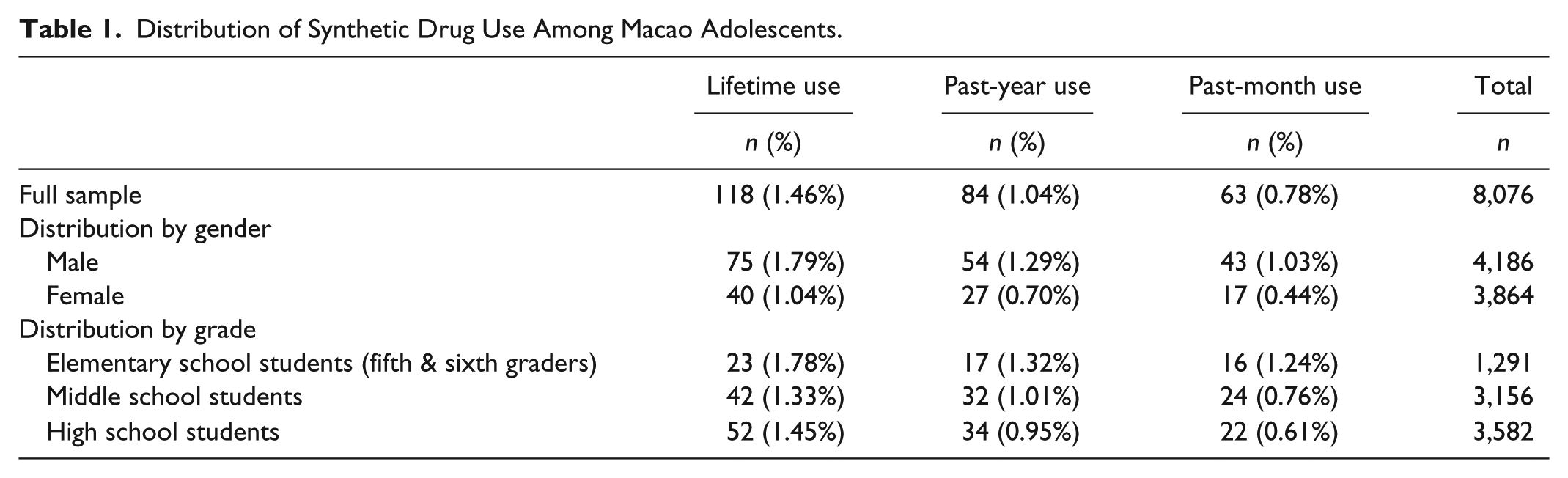
The rates of synthetic use among male adolescents were higher than those of female adolescents for lifetime use (1.79% vs. 1.04%), past-year use (1.29% vs. 0.70%), and past-month use (1.03% vs. 0.44%). Grade differences were also noticeable. Synthetic drug use was most prevalent among fifth and sixth graders at the elementary school level. The rate of use was higher among middle school students than high school students with regard to past-year use (1.01% vs. 0.95%) and past-month use (0.76% vs. 0.61%). High school students, however, had a higher lifetime use rate than middle school students (1.45% vs. 1.33%; see Table 1). Overall, the statistics shown in Table 1 indicate that synthetic drug use is more prevalent among younger students in the population of fifth to 12th graders in Macao. This finding is consistent with the results of several other studies showing that synthetic drug users in Macao are getting younger (Deng, 2011; Li, 2016; Li, Zhang, et al., 2016). However, the reason that students in lower grades were more likely to use synthetic drugs has not been explored in previous research. In the current study, students from elementary schools reported lower participation in antidrug educational programs, which might be responsible for their relatively higher rate of synthetic drug use.
Logistic Regression Analysis Results
We constructed three logistic regression models, each with one of the three measures of synthetic drug use as the dependent variable. As shown in Table 2, the association with synthetic drug-using peers was significantly and positively correlated to the students’ synthetic drug use throughout their lifetime, in the past year, and in the past month. More specifically, a one-unit increase in the measure of association with synthetic drug-using peers (e.g., from 1 = none to 2 = very few) increases the odds of an adolescent’s lifetime use of synthetic drugs by approximately 1.47 times (2.47 - 1.00 = 1.47), past-year use by 1.36 times (2.36 − 1.00 = 1.36) and past-month use by 1.29 times (2.29 − 1.00 = 1.29). All of these statistical tests were significant with p < .001.
Logistic Regression Analysis Results.

p < .1. *p < .05. **p < .01. ***p < .001.
Second, recreational use of time with friends was not a significant predictor of lifetime, past-year, and past-month use of synthetic drugs among Macao adolescents.
Attitudes toward synthetic drug use were also significantly related to synthetic drug use. Compared with those who perceived greater risk of synthetic drug use, adolescents who perceived lower risk were much more likely to use synthetic drugs. Specifically, a one-unit decrease on the 5-point scale used to measure perceived harms of synthetic drug use would increase the likelihood of lifetime use by 1.70 times, past-year use by 1.58 times, and past-month use by 1.60 times. The coefficients for lifetime, past-year, and past-month use were all significant with p < .001.
The availability of synthetic drugs was also found to be a significant predictor of synthetic drug use. A one-unit increase on the 5-point scale (e.g., from “nearly impossible” to “very difficult”) measuring availability of synthetic drugs was associated with an increase in lifetime use of synthetic drugs by 0.16 times, past-year use by 0.22 times, and past-month use by 0.19 times. All coefficients were significant with p < .05.
Discussion
The results of the regression analysis are mostly consistent with our expectations. Of the key independent variables assessed in the regression analysis, association with synthetic drug-using peers and favorable attitudes toward synthetic drugs stood out as the strongest predictors of synthetic drug use among Macao adolescents. Specifically, increased delinquent peer associations and decreased perceived harms of drug use are strongly correlated with elevated levels of synthetic drug use in the past month, past year, and lifetime. These findings lend strong support for the social learning theory, which identifies delinquent peer association and favorable attitudes toward delinquency as the primary influences facilitating delinquent behavior. In support of the opportunity perspective of criminological theory, this study finds that drug availability is significantly and positively correlated with the three measures of synthetic drug use. These relationships, however, are not as strong as those for delinquent peer associations and attitudes toward synthetic drugs, suggesting that individual-level factors, such as choice of friends and antidrug attitudes, may play more important roles in influencing adolescents’ synthetic drug use.
Despite this study’s extensive scope and representativeness, it has some limitations. This study is one of only a few surveys in Asia that have adopted many questions from U.S. surveys of adolescent drug use such as Monitoring the Future. The use of standard instruments has the advantage of producing measures with strong validity and reliability as shown in this study. On the flip side, however, this practice may have undermined our ability to capture culturally relevant variation. For example, the results show that time spent in recreational activities is not a significant predictor of adolescent synthetic drug use in Macao. This unexpected finding may be related to the measurement we used. In consistency with how time with friends is measured in Monitoring the Future, we asked the student respondents how often they had met with friends informally, such as going to a party or hanging out. These questions may not be specific enough to measure time-sharing activities with friends that amplify synthetic drug use in the specific cultural setting, such as going to KTVs or attending parties where synthetic drugs (e.g., ketamine) are used. There are also two design issues that may limit the validity of the study. First, the research design was cross-sectional. The relationships discovered in the analysis are correlational in nature and should be interpreted as such. More studies are needed to test the causal links between delinquent peer associations, recreational use of time with friends, proneness to drugs, and availability of synthetic drugs and synthetic drug use. Second, the respondents only consisted of students who attended school during the time of the survey. Adolescents who dropped out of school or did not attend their classes were not included in the survey. Studies have shown that adolescents who do not go to school tend to have higher rates of drug use than those who do (Henry, 2010; Henry & Thornberry, 2010; Li et al., 2011). Thus, our results can only be applied to at-school students in Macao. Consequently, the overall rate of drug use among adolescents in Macao may have been underestimated. Future studies should make a better effort to reach out to adolescents who do not attend schools.
With a population of approximately 600,000, Macao is at best a midsize city by Chinese standards. Despite the recent growth of the gaming industry, part of the society remains conventional with a high level of informal social control (Li, 2014), which may explain the overall lower rate of delinquency (e.g., drug use) in this society. However, significant risks exist for adolescent drug use, as shown in this study. First, like young people elsewhere, Macao adolescents are susceptible to the bad influences of unconventional peers. The opportunities for Macao adolescents to develop delinquent peer associations have become ever greater. Macao is a popular tourist destination. Thousands of tourists pour into the city every day (Macao Statistics and Census Service, 2016). Some of these visitors are young vagabonds from Hong Kong, Guangdong, and other places in China, trying to make money through illegal activities, such as synthetic drug trafficking. They prey on adolescents using various marketing techniques and even befriend them (Macao Social Welfare Bureau, 2016). Adolescents in Macao also travel to Hong Kong and bordering Chinese cities to meet people and to have parties. Sometimes, the main purpose of their trips is to buy and use drugs (Li, 2016). With more opportunities to meet unconventional peers, some adolescents, especially those with family and school problems, will be at high risk of developing delinquent peer associations. Indeed, a sizable portion of our sample reported that they had friends who smoke, drink, or use drugs. This kind of peer relationship may increase their likelihood to use drugs. Second, under the influence of the modern party culture, synthetic drug use has increasingly been seen as an acceptable way to have fun by many adolescents in the Peal Delta Region including Macao (Joe-Laidler & Hunt, 2008; Macau Daily, 2015; Zhou, 2016). Adolescents exposed to the subculture tend to underestimate the harms of synthetic drug use. For many of these young people, traditional drugs such as opium and heroin are addictive and dangerous. Synthetic drugs, on the contrary, do not carry the same level of risk and are therefore safer to use. If unchecked, the internationalization of these cultural norms may lead to a significantly higher rate of synthetic drug abuse among the youth population. Third, synthetic drugs have become increasingly accessible to adolescents who want to use them. In the past, most drugs trafficked to Macao were opioids from Southeast Asia, particularly, the Golden Triangle. Nowadays, synthetic drugs, such as ketamine and methamphetamine, have largely replaced opioids. The regions of China close to Macao, especially Guangdong Province, have become major producers of synthetic drugs (China National Narcotics Control Commission Office, 2015). Due to geographic proximity, Macao has become a key market for these illegal substances (Macao Social Welfare Bureau, 2016). Easy access to synthetic drugs provides more opportunities for sensation-seeking adolescents to use them.
The results of this study suggest that public policies aimed at preventing synthetic drug use among Macao adolescents should promote several key strategies. One way is to pay more attention to adolescents who are more peer-oriented and are more frequently associated with drug-using peers. Parents, teachers, and social workers should encourage adolescents to develop healthy relationships with conventional peers (Barnes, Reifman, Farrell, & Dintcheff, 2000; Cottrell, Li, Harris, D’Alessandri, & Stanton, 2003; Li, Stanton, & Feigelman, 2000). Another strategy is to educate adolescents about the harms of synthetic drug use and strengthen their antidrug attitudes. Adolescents who believe that drug use is unacceptable or harmful are much less likely to use drugs (Alhyas et al., 2015). Parents, teachers, and relevant government agencies can all play important roles in helping students develop the right attitudes toward drugs and drug use. Another strategy is to control the supply of drugs. Police and customs agencies should explore more effective approaches for reducing drug trafficking and drug selling activities. One thing the agencies can do is to intensify border patrol by using better technologies, such as mobile x-ray machines and drug-sniffing dogs, and to increase the punishment for drug trafficking (Floyd, Alexandre, Hedden, Lawson, & Latimer, 2010; Halverson, 2004). Currently, drug traffickers face a maximum of 15 years of imprisonment in Macao. Many people have argued that this punishment does not provide sufficient deterrence (China Court, 2012; China News, 2010; Macao Daily News, 2015). An increase in the severity of punishment may stop more people from smuggling and selling drugs in Macao.
Footnotes
Appendix
Variables and Measurements.

| Variable | Item | Response |
|---|---|---|
| Synthetic drug use | Have you or did you use any of the following substances in your lifetime/during the past month/during the past 12 months? | |
| Ketamine | 0 = No to 1 = Yes | |
| MDMA (Ecstasy) | 0 = No to 1 = Yes | |
| Crystal meth (Ice) | 0 = No to 1 = Yes | |
| Pills (Tranquilizer, Cross, etc.) | 0 = No to 1 = Yes | |
| Happy water | 0 = No to 1 = Yes | |
| Recreational use of time | How often do you get together with friends informally (like going to a party or hanging out) | 1 = Never to 5 = Nearly daily |
| Association with synthetic drug use peers | How many of your friends would you estimate . . . ? | |
| Use ketamine | 1 = None to 5 = All | |
| Use MDMA (Ecstasy) | 1 = None to 5 = All | |
| Use methamphetamine (ice, etc.) | 1 = None to 5 = All | |
| Availability of synthetic drugs | How difficult do you think it would be for you to get each of the following types of drugs, if you wanted some? | |
| Ketamine | 1 = Probably impossible to 5 = Very easy | |
| MDMA (Ecstasy) | 1 = Probably impossible to 5 = Very easy | |
| Methamphetamine (ice, speed, etc.) | 1 = Probably impossible to 5 = Very easy | |
| Pills (tranquilizer, cross, etc.) | 1 = Probably impossible to 5 = Very easy | |
| Happy water | 1 = Probably impossible to 5 = Very easy | |
| Attitudes toward synthetic drugs | How much do you think people risk harming themselves (physically or in other ways), if they . . . | |
| Take ketamine occasionally | 1 = No risk to 5 = Great risk | |
| Take ketamine regularly | 1 = No risk to 5 = Great risk | |
| Take methamphetamine (ice, speed, etc.) occasionally | 1 = No risk to 5 = Great risk | |
| Take methamphetamine (ice, speed, etc.) regularly | 1 = No risk to 5 = Great risk | |
| Antidrug education | Have you participated in any of the following drug education programs? | |
| Lectures or special group discussions in your school | 0 = No to 1 = Yes | |
| Lectures or discussions at other places | 0 = No to 1 = Yes | |
| Media (TV, radio, banner, etc.) | 0 = No to 1 = Yes | |
| Other antidrug activities | 0 = No to 1 = Yes | |
Authors’ Note
The authors alone are responsible for the content and writing of the article.
Declaration of Conflicting Interests
The author(s) declared the following potential conflicts of interest with respect to the research, authorship, and/or publication of this article: The research is based on data collected in Students and Drugs in Macao 2014, a project sponsored by the Social Welfare Bureau of Macao Government.
Funding
The author(s) received no financial support for the research and/or authorship of this article.