




Abstract
The current study tested the applicability of Jessor’s Problem Behavior Theory in explaining problem behavior among adolescents in Egypt. Data were collected from 887 adolescents (52% males) with a mean age of 13.4 years. Participants rated three measures of problem behaviors (delinquent behavior, cigarette smoking, and problem substance use), three types of psychosocial protection (models protection, controls protection, and support protection), and three types of psychosocial risk (models risk, opportunity risk, and vulnerability risk). Female adolescents reported lower levels of problem behavior involvement than male adolescents. Psychosocial protective and risk factors accounted for significant variation in adolescents’ problem behavior involvement. For males, models risk was the most important risk factor in problem behavior involvement variation, whereas for females, opportunity risk was the most important risk factor. Present findings are useful in understanding problem behavior involvement among Egyptian youth and informing the design of interventions to reduce problem behavior.
Adolescent problem behaviors such as substance use, antisocial behavior, and early sexual behavior, are both a social and health concern (Duncan, Duncan, & Strycker, 2000). Scientists have made systematic efforts to identify and help adolescents involved in problem behavior; however, most of these efforts have been concentrated in high-income settings in the global north (Achenbach & Rescorla, 2007) such as the United States, China, Turkey, Canada, Italy, the Netherlands, Slovenia, Spain, Switzerland, and Taiwan (Arslan, Verhulst, Van der, & Rol, 1997; Greenberg, Chen, Beam, Whang, & Dong, 2000; Jessor et al., 2003; Vazsonyi et al., 2010).
Jessor’s Problem Behavior Theory (PBT) is one of the most important theories for explaining variation in adolescents’ involvement in problem behaviors (Donovan, Jessor, & Costa, 1991). The theory has been supported by empirical research conducted in the United States and other countries (Jessor, 2008). Jessor (2008) has emphasized that the full PBT explanatory model should have general applicability to youth growing up anywhere. Although the magnitude of problem behaviors might vary across societies, the theoretical associations between risk and protective factors and problem behavior should be consistent across settings. Little is known about the applicability of Jessor’s PBT to Arabic cultures that may be different not only in terms of the prevalence of problem behaviors and levels of risk and protection but also in terms of cultural characteristics such as religion, educational structure, and/or political system.
The current study examines the applicability of the PBT in Egypt, an Arabic country. Egypt is markedly different from other countries in which the PBT has been tested in terms of religious, educational, political, economic, and social indicators. Despite the societal differences and more micro-level differences in the levels of risk factors, protective factors, and problem behavior involvement in Egypt in comparison with other contexts, we expect to find similar associations between risk and protective factors and problem behaviors in the present study as observed in previous work in other settings (e.g., Greenberg et al., 2000; Jessor et al., 2003; Vazsonyi et al., 2010; Vazsonyi et al., 2008).
PBT
The PBT is a social–psychological framework that explains the relationship between psychosocial protective and risk factors and involvement in a variety of problem behaviors such as delinquent behavior, substance use, problem drinking, and early sexual intercourse (Donovan et al., 1991). According to the theory, protective factors decrease the likelihood of adolescents’ involvement in problem behavior. Psychosocial protective factors include models for positive, prosocial behavior, personal and social controls to guard against norm-violating behavior and an environment of support. In contrast, risk factors increase the likelihood of adolescents’ involvement in problem behavior. Conceptually, psychosocial risk factors include models for risk behavior, opportunity for engaging in risk behavior, and personal and social vulnerability to engage in risk behavior (Costa, Jessor, & Turbin, 2007). Psychosocial risk and protective factors have been shown to account for substantial amounts of variance in adolescent problem behavior for both males and females and for younger and older adolescents across groups varying in socioeconomic status, race, and ethnicity subgroups (Jessor et al., 2003). In addition, the theory hypothesizes that protective factors play an additional indirect role in the occurrence of adolescent problem behavior by moderating the impact of risk factors (Jessor et al., 2003) and empirical evidence has supported that moderation (Jessor et al., 2003; Jessor, Van Den Bos, Vanderryn, Costa, & Turbin, 1995; Ndugwa et al., 2011).
Few studies have tested the applicability of PBT in developing societies. Jessor et al. (2003) examined PBT in two adolescent samples from China and the United States. Results indicated that the same protective and risk factors accounted for a substantial amount of variance of problem behaviors in both samples, even though problem behaviors were less prevalent among Chinese adolescents than U.S. adolescents. In another report based on the same data, Costa et al. (2005) showed that four contexts of adolescents’ life (family, peer, school, and neighborhood) provided a substantial account of problem behaviors among Chinese and American adolescents. Results also indicated that the family and peer contexts were the most influential in the U.S. sample, whereas the peer and school contexts were the most influential in the Chinese sample. The neighborhood context was least influential for both samples.
Vazsonyi et al. (2008) examined the applicability of PBT in Georgia and Switzerland. Results supported the applicability of PBT across these societies outside the United States. A more recent study conducted by Ndugwa et al. (2011) investigated the applicability of PBT among adolescents living in two informal settlements in Nairobi, Kenya, a low-income country. Results indicated that protective and risk factors provided a substantial account of adolescent’s problem behavior variation. Results also indicated that models protection can moderate the impact of risk factors on problem behavior vulnerability. Another recent comparative study by Vazsonyi et al. (2010) investigated the extent to which the PBT explained problem behavior in a sample of 10,310 adolescents from eight countries: Hungary, the Netherlands, Slovenia, Spain, Switzerland, Taiwan, Turkey, and the United States. Results provided evidence of great similarities in the associations between risk and protective factors and the problem behavior involvement across cultures.
Gender Differences in Problem Behavior
Existing studies on gender differences in problem behaviors have focused on individual problem behaviors such as substance use, academic failure, and violence (Chun & Mobley, 2010). In general, compared with females, male adolescents have higher rates of individual problem behaviors (e.g., Chun & Mobley, 2010; Soo Kim & Sil kim, 2005; Williams, Ayer, & Hawkins, 2007; Yin Drew & Watkins, 1996), are more likely to initiate delinquent acts over time (e.g., Williams et al., 2007), and are more delinquent at all ages (Miller, Malone, & Dodge, 2010). Mears, Ploeger, and Warr (1998), however, in their study of gender differences in delinquent behavior among adolescents in the United States showed that males were substantially more likely than females to have delinquent friends and appeared to be more strongly affected by delinquent peers than were females. However, other researchers have shown that the same risk factors (e.g., mental health problems, running away, gang involvement, and secure detention) predict serious, violent, and chronic offenses among males and females (e.g., Johansson & Kempf-Leonard, 2009), and gender-coded activities increased the risk of problem and delinquent behaviors for both boys and girls (e.g., Dennis, 2012).
Few studies have examined whether gender might be a predictive factor of multiple problem behavior involvement. Beam, Gill-Rivas, Greenberg, and Chen (2002) found that being male and having peers who engage in misconduct were associated with more adolescent involvement in problem behavior among high school students in Los Angeles. Chun and Mobley (2010) investigated the structure of problem behavior across gender and grade level. Results indicated that females had a lower tendency for unconventionality compared with males. Being female was less predictive of problem behavior involvement among U.S. adolescents. Overall, study findings provide a good rationale for testing gender differences in the effects of protective and risk factors in the present study. In addition, documenting the differences between male and female adolescents on problem behavior involvement in relation to protective and risk factors is essential to better understand this phenomenon and to inform more targeted prevention programs.
Study Context
Egypt is an Arab country located in northeast Africa with a population of 83 million. The country covers an area of about 1 million square kilometers. More than 90% of the population is Muslim. Official reports indicate that 18.4% of Egyptians live below the poverty threshold and only 51.5% of Egyptian families have enough income to support their monthly needs (Egyptian Cabinet, Information Center and Decision Making Support, 2010). Almost a third of the population comprises children and adolescents younger than 15 years of age (The Egyptian Central Agency for Public Statistics, 2011).
Islamic values and norms have a huge impact on Egyptian adolescents’ behaviors. For example, there are limited opportunities to establish relations with the opposite sex (Al-Omari, 2008) as the segregation of sexes is still a very common phenomenon throughout most Arab countries including Egypt. This segregation is based on Islamic values and also reinforced by Arab values pertaining to the honor of the family (Al-Omari, 2008). In addition, opportunities for residential separation from parents and the larger family are almost non-existent (Nydell, 2006).
Hofstede (2001) noted that Arab countries are characterized by collective cultures, which are thought to be less conducive to the overt expression of deviance and tend to encourage suppression of socially disapproved behavior (Greenberg et al., 2000). However, the Egyptian societal structure has changed during recent decades because of cultural, social, and economic changes (Saif & Choucair, 2010). Egyptian youth are exposed to liberal behavioral models through the Internet and media that are associated with poorer parental relationships, lower levels of religiosity, and lower levels of academic commitment (Shehata & El-Shenawy, 2010). Egyptian adolescents, therefore, face a conflict between conservative social norms (e.g., obedience, submissiveness, compliance, etc.) and liberal or unconventional practices (Nydell, 2006). In fact, one aspect of Egyptian culture urges youth to focus on Islamic knowledge and traditional identity, while the other aspect provides them with a new identity emphasizing use of information technologies, 21st-century science, and new global ideas (Asik, 2012).
Previous studies indicate that the problem behavior involvement rate is higher when the children were exposed to socioeconomic risk factors, such as poverty (Deater-Deckard, Dodge, Bates, & Pettited, 1998; Samrakkody, Fernando, McClure, Perera & De Silva, 2012). Official data show an increasing rate of crimes committed by adolescents in resource-limited settings (Egyptian Interior Ministry, 2007). Available data from a few studies carried out to explore problem behavior in Egypt report wide variation of prevalence among Egyptian students (Shehata & El-Shenawy, 2010; Souief, 1994). Exposure to violence in Egyptian society has also been linked to problem behavior involvement (Shehata, 2009).
Current Study
Few studies have examined the theoretical underpinnings of problem behaviors among Egyptian adolescents. Problem behavior prevalence among these adolescents can be better understood by applying existing theoretical frameworks. The present research examined the applicability of PBT and explores the contribution that psychosocial protection and risk factors can make to explain problem behavior among male and female adolescents in Alexandria and Shebeen El-Koom, Egypt. The study assessed (a) whether Egyptian adolescents’ scores on measures of problem behavior involvement and on measures of protective and risk factors differed by gender, (b) whether associations among protective and risk factors and problem behavior involvement were similar to those found in previous studies, and (c) whether the protective factors moderated the relationship between risk factors and problem behavior involvement. Based on previous studies, we expected that Egyptian female adolescents would be less likely than males to report problem behavior involvement and that the scores on measures of protective and risk factors would differ between Egyptian female and male adolescents. Based on Jessor’s PBT, we expected that protective factors would decrease the likelihood of involvement in problem behavior, whereas risk factors would increase the likelihood of problem behavior involvement. We also expected to find that protective factors would also moderate the relationship between risk factors and problem behavior involvement.
Method
Participants
Data were collected from a sample of 887 Egyptian adolescents (52% males) attending intermediate schools in Alexandria and Shebeen El-Koom. In all, 530 participants were from Alexandria city and 357 were from Shebeen El-Koom. Adolescents in Grade 7 were around 60%, 29% were in Grade 8 and 11% were in Grade 9. The mean age of the adolescents was 13.4 years. A majority of adolescents (85%) were enrolled in public schools.
Sampling
Four schools were randomly selected from a list of the 437 Alexandria intermediate schools and three schools were randomly selected from a list of the 410 Shebeen El-Koom intermediate schools. Within each school, all students from a non-randomly selected grade level were included in the sample after obtaining the approval of the students to participate in the study.
Procedures
Permission to conduct the study was granted by the Egyptian Ministry of Education. Data were collected in March 2009, using a structured interview capturing sociodemographic characteristics, behavior as well as measures of psychosocial protective and risk factors. The questionnaire was translated by the authors into Arabic language. Back translation into English was done by an Egyptian professor in the English department at Menoufia University, Egypt. The Arabic translation and the back-translation were externally reviewed and the Arabic translation was revised accordingly.
Measures
Age was measured using a single item. Participants indicated their sex. Responses were coded 1 for male and 2 for female. Participants were asked to indicate their educational stage. Responses were coded 1 for Grade 7, 2 for Grade 8, and 3 for Grade 9. The area of residence was coded as 1 for urban (Alexandria) and 2 for rural (Shebeen El-Koom).
Problem behavior involvement was assessed using the Multiple Problem Behavior Index (MPBI), which is an average of T-scored measures of adolescents’ involvement in three different types of problem behavior: (a) delinquent behavior, including theft, vandalism, and physical aggression (Cronbach’s α = .72 for the present study); (b) cigarette smoking based on participants’ reports of frequency and amount of smoking in the past month and the past year (Cronbach’s α = .80 for the present study); and (c) problem drinking (Jessor et al., 2003). The last subscale was replaced by problem substance use; this was done because the lowest consumption levels can be found in the countries of North Africa, sub-Saharan Africa, the Eastern Mediterranean region, and southern Asia and the Indian Ocean. These regions represent large populations of the Islamic faith, which have very high rates of abstention (World Health Organization, 2011, pp. 4, 274). The problem substance use subscale is based on the adolescents’ self-reports of substance use frequency, frequency of high volume substance use, and the negative consequences of substance use (Cronbach’s α = .75 for the present study). The term substance use in the present study explicitly covers cannabis (marijuana) and recreational use of prescription pills. Respondents rated frequency of substance use on an 8-point scale. Higher scores reflect high frequency of substance use. Negative consequences of substance use were assessed by answering five items (Table 1). The alpha reliability of the three components of the MPBI was .70. In general, alpha reliabilities of problem behavior measures in the present study were comparable with other studies (Jessor et al., 2003).
Scale Information and Example Items for Problem Behavior, Risk Factors, and Protective Factors.

Three types of psychosocial protection (models protection, control protection, and support protection), and three types of risk (models risk, opportunity risk, and vulnerability risk) were assessed using Jessor and colleagues’ (2003) composite measures of the three types of protection and the three types of risk. Each psychosocial composite measure was constructed by averaging all of the items in its component subscales, standardized and equally weighted, with a mean of zero. A description of the measures is presented in Table 1 (for more details about the measures, see Jessor et al., 2003). The alpha reliabilities of the three measures of protective factors in the present study were .61 for models protection, .71 for controls protection, and .75 for support protect. The alpha reliabilities of the three types of risk were .70 for models risk, .78 for opportunity risk (availability), .88 for opportunity risk (gangs), and .82 for vulnerability risk. Each measure was transformed to a T score, and means for the study constructs were then calculated for males and females.
Statistical Analysis
As a first step, initial descriptive statistics were computed for risk factor composite measures’ scores, protective factor composite measures’ scores, and the MPBI scores. Before examining whether the multivariate explanatory model of PBT applies to Egyptian adolescents, we estimated the partial correlations between risk and protective factors and the problem behavior involvement index to establish the relationships of the predictor measures with the problem behavior outcome variable, the MPBI. Hierarchical linear regression analysis (enter method) was then used to assess the applicability of PBT across Egyptian adolescent samples.
Results
Table 2 presents group means on protective factors, risk factors, and problem behavior measures for males and females separately. Male adolescents reported lower levels of control protection (49.50 vs. 51.52) and vulnerability risk (49.45 vs. 50.89) than females. However, males reported a higher level of models risk in comparison with females (49.62 vs. 45.86). Higher levels of vulnerability risk among female adolescents suggest that they had lower self-esteem, lower expectations of success, greater depression, and greater stress. With respect to problem behavior involvement, females reported less involvement in problem behavior types than males.
Group Means on Standardized Scores of Protective Factors, Risk Factors, and Problem Behavior Measures.
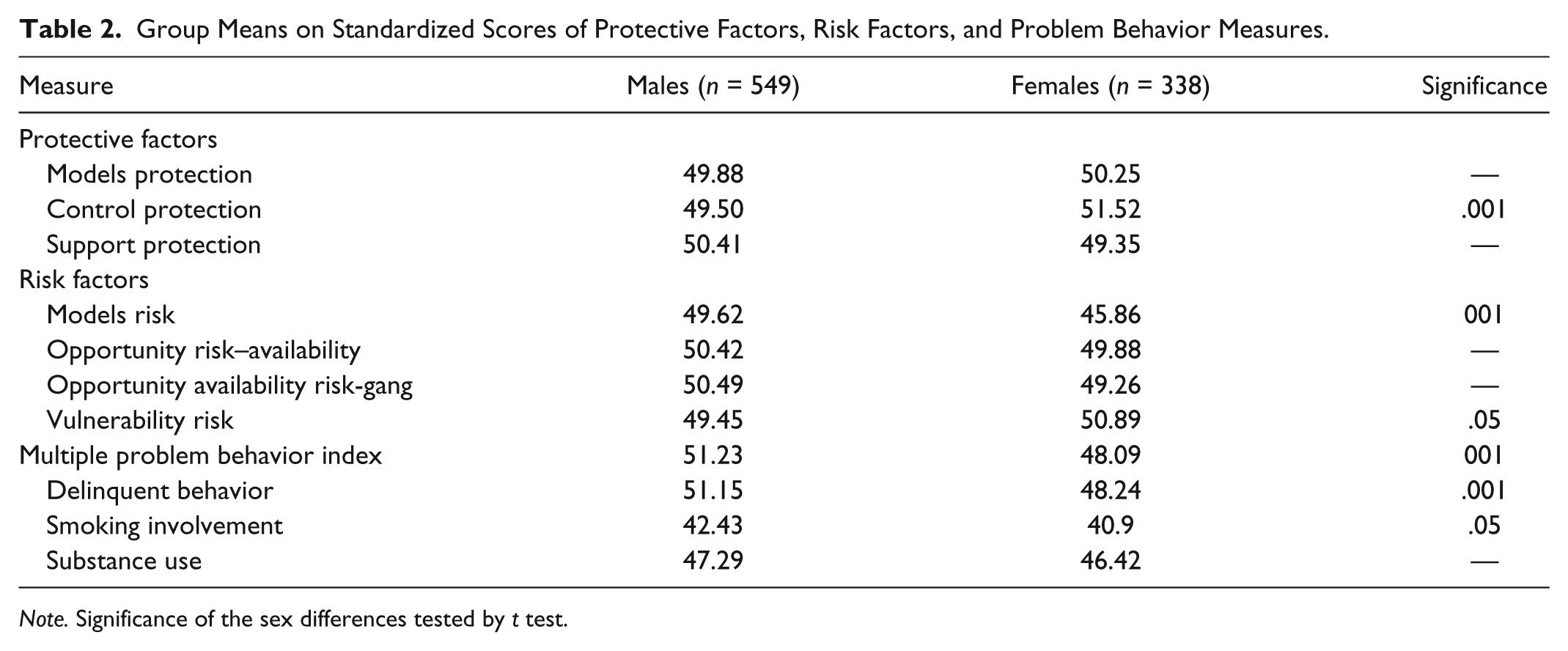
Note. Significance of the sex differences tested by t test.
Table 3 presents the bivariate correlations between problem behavior measures and protective and risk factors by gender. Correlations among the three types of psychosocial protection (models, controls, and support) ranged from .10 to .57 for the male sample, and from .13 to .53 for the female sample, which were all were positive. Correlations among the four measures of risk factors ranged from .19 to .30 for the male sample, from .14 to .24 for the female sample that was again positive. As expected, correlations between the psychosocial protective factors measures and the risk factors measures were negative and ranged from −.04 to −.43 for the male sample and from −0.05 to −0.46 for the female sample; all but two were positive but not significant in both samples. As shown in Table 3, correlations between the MPBI and the psychosocial protective factors measures (models, controls, and support) were −.02, −.37 (p < .01), and −.35, respectively, for the male sample, whereas for the female sample the correlations were −.22, −.37, −.36 (all ps < .01), respectively. The correlations between the MPBI and the psychosocial risk factors measures (model risk, opportunity risk (availability), opportunity risk (gangs), and vulnerability risk) were 0.36, 0.31, 0.23, and 0.34 (all ps < .01), respectively, for the male sample, while for the female sample the correlations were .35 (p < .01), .24 (p < .05), .11, and .36 (p < .01), respectively. These correlational findings provide initial support for PBT.
Correlations Between Problem Behavior Measures, Protective, and Risk Factors by Gender.

p < .05. **p < .01.
To examine the relative importance of the separate risk and protective factors in explaining variation in problem behavior involvement, hierarchical multiple regression (enter method) models were conducted after centering all the predictive variables (Table 4). Demographic variables (gender, educational stage, and socioeconomic level) were entered in Step 1 of the hierarchical regression accounting for 3% (p < .001) of the variance in problem behavior involvement. The protective factors were entered at Step 2. This model accounted for 19% of variance (p < .001) in problem behavior involvement. The four psychosocial risk factors were added in the third step. This model accounted uniquely for 29% of variance (p < .001). Given that some variance is shared between protective and risk factors, psychosocial protective factors were entered after the psychosocial risk factors in a supplementary analysis and they accounted uniquely for 3% of variance (p < .001) compared with 11% for the risk factors.
Hierarchical Multiple Regression Analysis of Adolescent Problem Behavior Involvement on Composite Risk Factors and Protective Factors.

p < .05. **p < .01. ***p < .001.
Control protection and support protection were significant predictors of problem behavior involvement (p < .001). In addition, three measures of psychosocial risk factors were significant predictors of problem behavior involvement (model risk, opportunity risk (availability), and vulnerability risk; p < .001).
The next set of analyses examined the possible moderating role of protective factors on the relation of risk factors to problem behavior. Here again, demographic variables (gender, educational stage, and socioeconomic level) were entered first, followed by protective factors in the second step, the psychosocial risk factors measures in the third step, and the 12 interactions of the three protective and four risk factors in the last step. Non-significant interactions at the 5% level were later dropped, and this model was refitted with only the significant interactions. The final model is shown in Table 4. When the only significant interactions were added at the last step, 31% of variance in problem behavior involvement was explained. There were only three significant interactions; however, one of those three interactions was in the opposite direction from theoretical prediction. Figure 1 illustrates the moderator effects for protection factors on the association between risk factors and the MPBI. Models protection significantly moderated the relationship of opportunity risk–gang to the problem behavior involvement. The relation of opportunity risk–gang to the problem behavior involvement is stronger when models protection is low compared with when models protection is high. This is illustrated by the smaller difference between the high- and low-risk groups under high models protection than under low models protection (Figure 1, Graph A). In addition, control protection significantly moderated the relation of model risk to the problem behavior involvement. High models risk was more likely to be related to problem behavior involvement under low control protection than high control protection (Figure 1, Graph B).

Moderator effects for protection factors on the relation of risk factors to problem behaviors. (A) Moderator effect for models protection on the relation of opportunity risk–gang to problem behavior involvement. (B) Moderator effect for models control on the relation of models risk to problem behavior involvement. (C) Moderator effect for model protection on the relation of models risk to problem behavior involvement among the female sample. (D) Moderator effect for control protection on the relation of opportunity risk–availability to problem behavior involvement in the male sample.
The next set of analyses examined whether the relative importance of separate risk and protective factors to variation in adolescents problem behavior differed by gender (Table 5). Hierarchical regression was conducted again for each sample. Here again, demographic variables (educational stage and socioeconomic level) were entered first, followed by protective factors in the second step, and risk factors in the last step. The entry of demographic variables explained 3.7% of the variance in problem behavior involvement for females and 1% for males. With the entry of the three measures of protective factors in the next step, 22.4% of the variance in problem behavior involvement for females and 16% for males was explained. When the four measures of risk factors were entered in the final step, 30.4% of variance in problem behavior involvement among females and 27.7% among males was explained. In this regression model, the three psychosocial protective factors model protection, control protection, and support protection were significant predictors of problem behavior involvement (p < .05) among females. Control protection and support protection were significant predictors of problem behavior involvement (p < .001) among males. In addition, three measures of psychological risk factors were significant predictors of problem behavior involvement for both females and males (model risk, opportunity risk (availability), and vulnerability risk; p < .001). When psychosocial protective factors were entered after the psychosocial risk factors in a supplementary analysis, 31.4% of variance (p < .001) among the male sample and 26.7% of variance (p < .001) among the female sample was explained.
Hierarchical Multiple Regression Analysis Predicting Adolescent Problem Behavior From Risk Factor and Protective Factor Measures in Females and Males Samples.

p < .05. **p < .01. ***p < .001.
Again, hierarchical regression was conducted for each sample to investigate the possible moderating role of protective factors on the relation of risk factors to problem behavior. Demographic variables (educational stage and socioeconomic level) were entered first, followed by protective factors in the second step, risk factors in the third step, and the 12 interactions of the protective and risk factors in the last step. Non-significant interactions at the 5% level were later dropped, and this model was refitted with only the significant interactions. The final model is shown in Table 5 (Step 4). Only one interaction was significant in the female sample—models protection significantly moderated the relation of model risk to problem behavior involvement. High models risk was more likely to be related to problem behavior involvement under low control protection than high control protection (Figure 1, Graph C). Two interactions were significant in the male sample; however, one of these two was in the opposite direction from theoretical prediction. Control protection significantly moderated the relation of opportunity risk–availability to the problem behavior involvement. High opportunity risk (availability) was more likely to be related to problem behavior involvement under low control protection than high control protection (Figure 1, Graph D).
Discussion
The present study examined the applicability of PBT for Egyptian adolescents. The results indicated that female adolescents have a lower tendency for unconventionality. These results are consistent with previous gender difference studies, which indicated that being male was associated with greater involvement in problem behavior (Beam et al., 2002) and being female was less predictive of problem behavior involvement (Chun & Mobley, 2010).
In general, the present results support the theoretical concepts of PBT and the idea of general applicability of the PBT explanatory model (Jessor, 2008) in an Arabic Muslim culture. Consistent with previous studies that have been conducted in different cultures such as China, United States (Jessor et al., 2003), Kenya (Ndugwa et al., 2011), Hungary, the Netherlands, Slovenia, Spain, Switzerland, Taiwan, and Turkey (Vazsonyi et al., 2010), control protection, models risk, opportunity risk (availability), and vulnerability risk were found to be associated with problem behavior involvement in the hypothesized directions for adolescent male and female samples. The relationship among models protection, support protection, and problem behavior involvement was not significant for the adolescent male sample. Similar results were found by Vazsonyi et al. (2010) for Hungarian, Spanish, and Turkish samples.
Psychosocial protective and risk factors accounted for significant variation in adolescents’ problem behavior involvement. These findings were consistent, for the most part, for both females and males. For the male sample, models risk was the most important risk factor in explaining problem behavior involvement variation. For females, control protection was the most important protective factor, and opportunity risk (availability) the most important risk factor in explaining problem behavior involvement variation. These results indicate that although female adolescents had a lower average level of problem behavior involvement than male adolescents, their risk factors differ from those of males. This may also be an indicator that the etiology of problem behavior involvement is different for boys and girls. The importance of separate risk and protective factors in explaining problem behavior involvement for males and females in the present study suggests that prevention programs need to be tailored differently for boys and girls.
In terms of the direct effects of risk and protective factors on problem behavior involvement, both factors had nearly equivalent associations with Egyptian female adolescents’ problem behavior involvement, but the association with risk factors was greater than that of protective factors on Egyptian male adolescents’ problem behavior involvement. A similar finding was observed among poor urban adolescents aged between 12 and 14 years in Kenya (Ndugwa et al., 2011). These results suggest the need for systematic efforts for both protective factors promotion and risk reduction among Egyptian adolescents.
The finding of a few significant interactions is worth highlighting. For example, among females, models protection was shown to moderate the relation of models risk to the problem behavior involvement, indicating that at high levels of model risk, adolescent females with strong levels of models protection such as parents or friends models for conventional and healthy behavior, show less involvement in problem behavior than their peers with low models protection. Among males, control protection significantly moderated the relation of opportunity risk (availability) to problem behavior involvement. This indicated that at high levels of opportunity risk (availability), males with high levels of control protection show less involvement in problem behavior than their peers with low levels of control protection. These findings highlight the importance of socialization, and have important impacts on preparing intervention programs to reduce problem behavior involvement among Egyptian youth in contexts of high risk.
The present study has several strengths. First, it provides an extension to previous studies that have explored the applicability of Jessor’s PBT across different settings in low and middle income countries and is unique in testing the PBT in a lower middle income Arabic country. Second, it has important implications for understanding gender differences in problem behavior involvement among Egyptian adolescents. Third, the use of the psychosocial protective factors, psychosocial risk factors, and behavior measures based on PBT and developed by Jessor et al. (2003) as well as the large sample size adds to the reliability of the results.
Despite these strengths, the findings of the present research are limited in several ways. First, although the sample was obtained from different schools in urban (Alexandria) and rural (Shebeen El-Koom) settings, the extent to which similar findings would be observed in other Egyptian samples is unknown. Second, a need exists for longitudinal studies to examine how protective and risk factors contribute to different problem behaviors involvement. Third, the extent of problem behavior may be underestimated by the reliance on self-reports. In contrast to official reports, self-reports can provide information about undetected problem behaviors; however, there are difficulties related to memory, honesty, and willingness to report (Feldman, Rosenthal, Mont-Reynaud, Leung, & Lau, 1991).
Although Egypt has a different culture and is a lower middle income country, the present findings are consistent with different cross-national studies in several ways: (a) female adolescents were less likely to engage in all three problem behaviors in comparison with male adolescents and (b) the present work indicated the usefulness of Jessor’s PBT beyond the United States, especially in low and middle income countries. This indicates that adolescents from different cultures are subject to similar individual and social factors that influence adolescents’ problem behavior involvement independent of where they are living.
Footnotes
Acknowledgements
The authors are grateful to Dr Richard Jessor, professor of psychology, Colorado University, for his help in every step in this study and for his reviewing the final report. Also we are grateful to Dr. Mark Turbin professor of psychology, Colorado University, for his help in the statistical analysis; Dr. Osama Madiny, the Egyptian professor in English department, Menoufia University, Egypt, for retranslating the measures into English; and James El-Turk, who was an instructor in Colorado University for reviewing the Arabic translation of the measures.
Declaration of Conflicting Interests
The author(s) declared no potential conflicts of interest with respect to the research, authorship, and/or publication of this article.
Funding
The author(s) received no financial support for the research and/or authorship of this article.